EAST AFRICA 2023 – EPISODE FOUR

JANUARY 20th to FEBRUARY 3rd.
Life is good!

I rode back to Kitale from Uganda and stayed in Kitale for several days. It’s a pleasant place to rest up and go with the flow and be part of the family but I always feel that restlessness that’s been so much part of my peripatetic life. Sorting out the credit card problem that brought me back took thirty minutes on the phone to a call centre in Bristol. Huh. Still, as I wrote before, thinking back to the trials and tribulations of money-handling on my many many earlier world journeys, this is small hardship worth accepting…

Back in Kitale, our friends Wanda and Jorg arrived for a visit. I introduced them very successfully to Adelight and Rico three years ago. From Cologne, like me they hate northern winters and keep their camping car in Tanzania. I met them at Kessup, looking cosy in their old and idiosyncratic Land Cruiser. We linked immediately and they came on that time to stay a couple of days in the compound at Kitale, congenial folks with the love of Africa in common. This time, I stayed three days with them – one day taken up with a bad attack of vertigo, a nauseous, dizzy effect of a tiny blockage of the inner ear – (‘age related’, I fear!). Ardent travellers, we have much to talk about, especially our many years touring about various bits of this continent, while Rico and Jorg delved beneath their car to mend a leak.

Leaving them in the compound, I rode the high road back to Kessup.
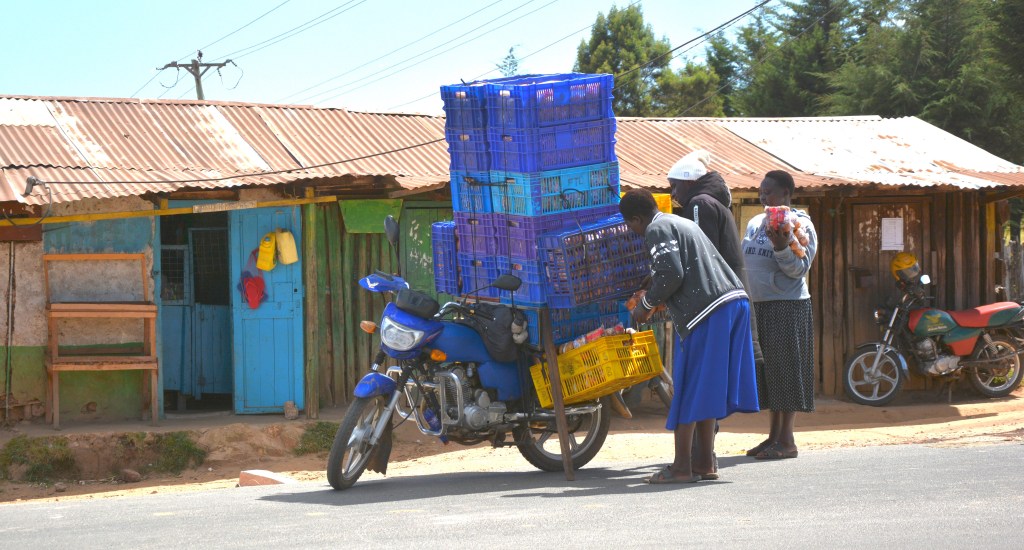
Bread delivery by boda-boda.

*

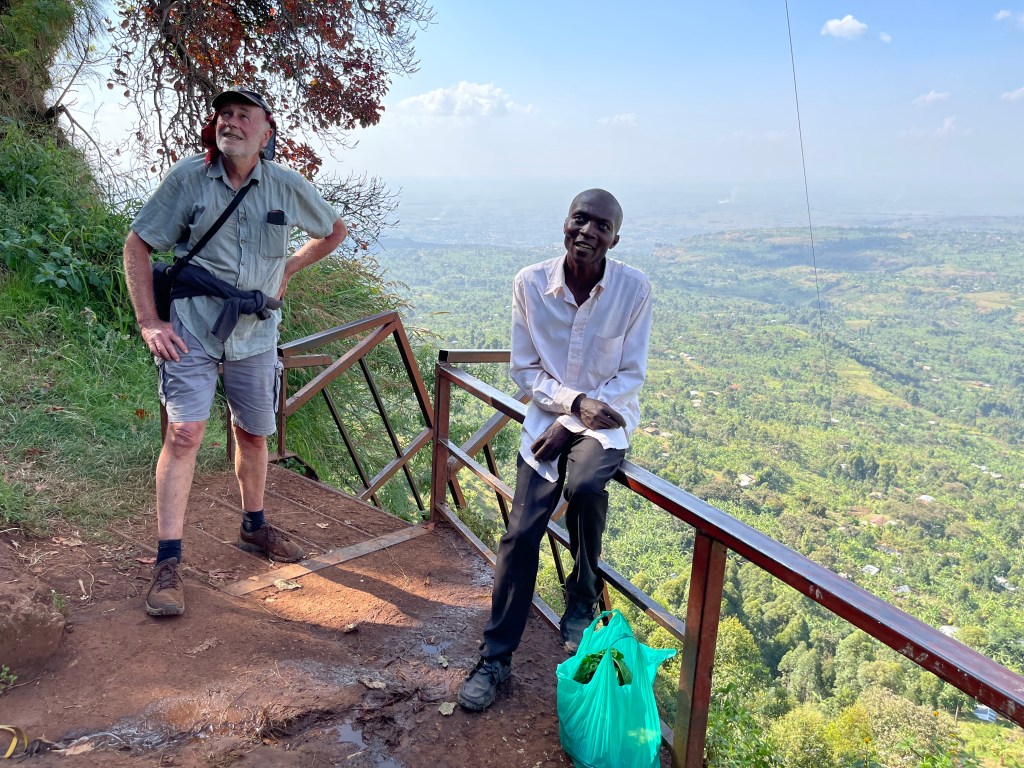
I’m back to Kessup to fulfil a plan that William and I made to hike again to the bottom of the Kerio Valley, this spur of the Great Rift. I ride in on Friday afternoon from the fine Cheringani Highway, with its connecting routes over the high hills now being tarred; losing some of their attraction for a keen trail-riding biker, but making the journey convenient and easy. I no longer arrive at Kessup red with dust and weary from dancing about on my little bike. Now I can make the 85 mile journey in less than two and a half hours if I’ve a mind to hurry through such scenery. Chattering with my fellow travellers, I’m late leaving, about three in the afternoon, so this time I move along, but I must still take time to wave at hundreds of schoolchildren on their way home: it’s astonishing how far so many small children must walk to and from school in so much of Africa. Only expensive private schools sometimes have a school van, and there’s no ‘school run’ clogging these roads, just hundreds of children in their dusty cotton uniforms walking the roadsides, playing and joking, and excitable when a very rare mzungu passes.

It’s beer time when I arrive in Kessup. William’s waiting, talking with ’Dutch’, his pride and joy: the healthy young Friesian cow I bought for him a year ago. He’s convinced the cow will pine when he leaves it for a day or two, looked after by his neighbour while we hike into the valley. It makes me chuckle, his sentimentality – unusual on this continent, where most have such a pragmatic approach to their animals. He cares scrupulously for Dutch and continually expresses his gratitude and responsibility to me for the gift. But William’s made me very free within his community and guides me about this hot, impressive region without question, and here in Africa, a small investment of £400 of capital – such a huge hurdle in rural Kenya – may well make him independent for years: with luck, Dutch will have calves and provide up to ten litres of saleable milk a day. That’s enough to keep William in his few necessities, this man who appears to live on air and a bit of maize meal ugali and his seasonal tomato garden.

*

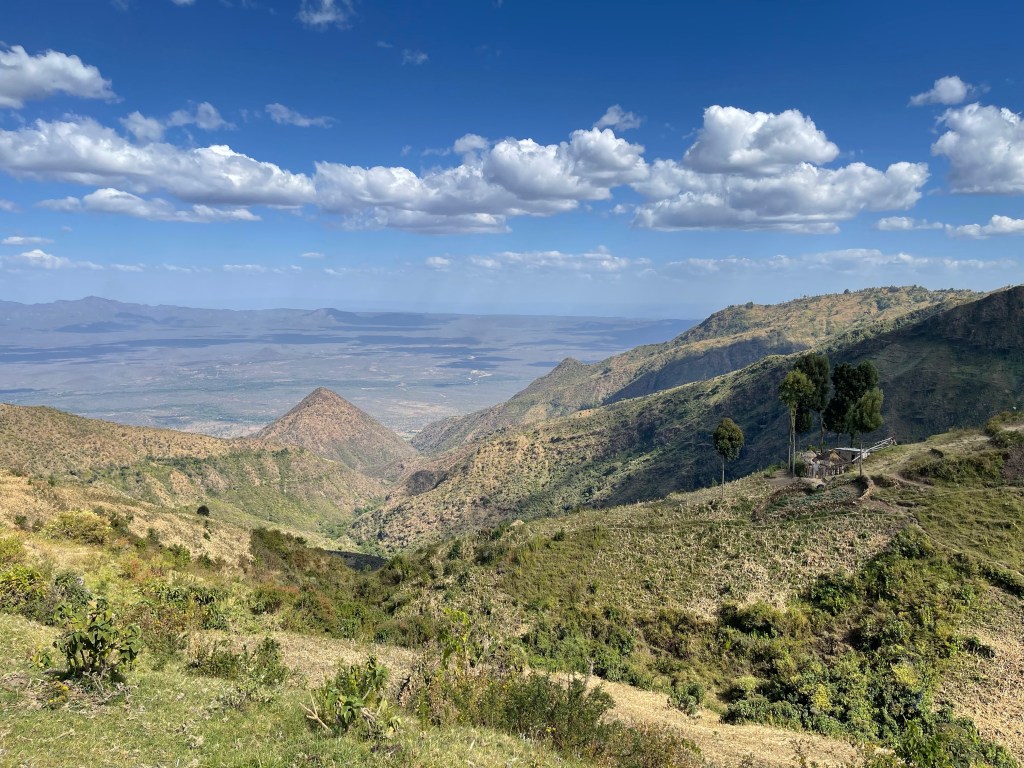
“The goodness is, we both like to walk, and we both like people,” says William frequently. So, on Saturday, we leave at ten, the sun already high and hot in a totally blue sky. From horizon to horizon – and that’s a BIG space here on this huge escarpment with the vast valley below – there’s not a cloud, not a handkerchief of shade beyond the one stuck under the back of my cap to keep the burn from the tops of my ears and my always reddening neck. It’s about 30 degrees up here on the plateau, but it will be over 35 by the time we are on the valley floor 2700 feet below…
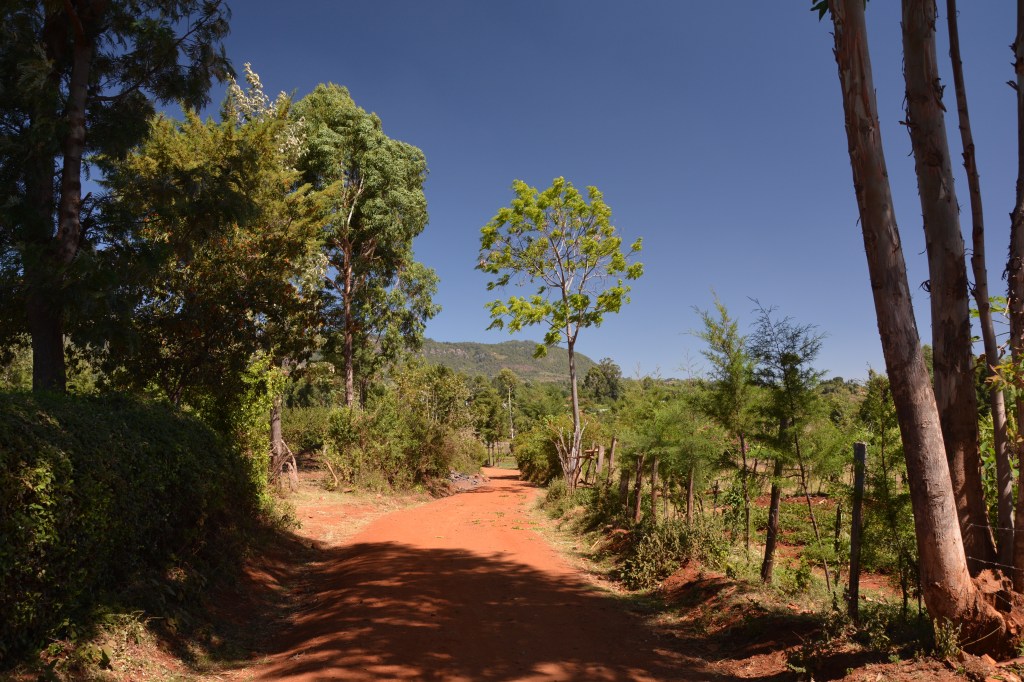
The never-to-be-completed road to the valley

The stoney descent begins about two miles along the red tracks of Kessup plateau. It’s a way we’ve taken before – both down and up. It’s a road to the valley that will never be completed: it looks to me as if the surveyors got things wrong on this friable, rocky escarpment. There’s a stretch of cliff-like precipice across which I doubt a road can be forced. It looks as if they’ve given up, as we take to a very steep rocky path plunging between aloes and prickly pear, stumbling down the steepest of slopes between the two ends of the putative gravel ledge that forms the ambitious road to the valley. It’s a gap of perhaps 400 feet in altitude, and the surroundings are insecure with long trails of rock falls held together by twisted trees. I fear this road will remain an unfulfilled dream of some local politician. It makes a great route for determined hikers though – and for the women and children we meet lugging great burdens of firewood on their backs up the precipitous slopes. Women’s work in Africa, like everything else.
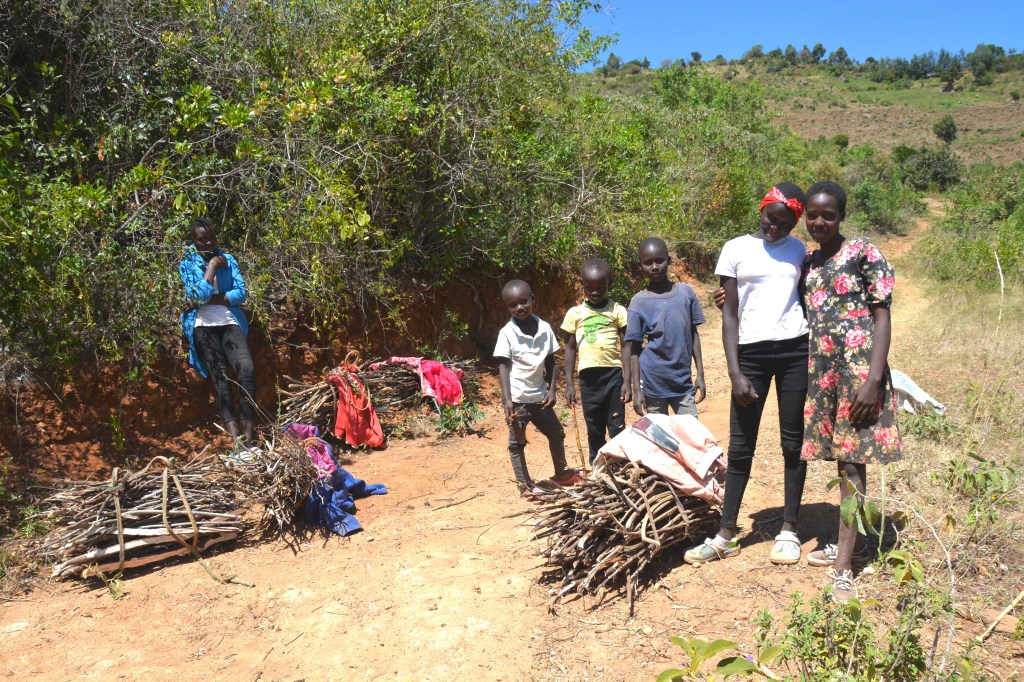
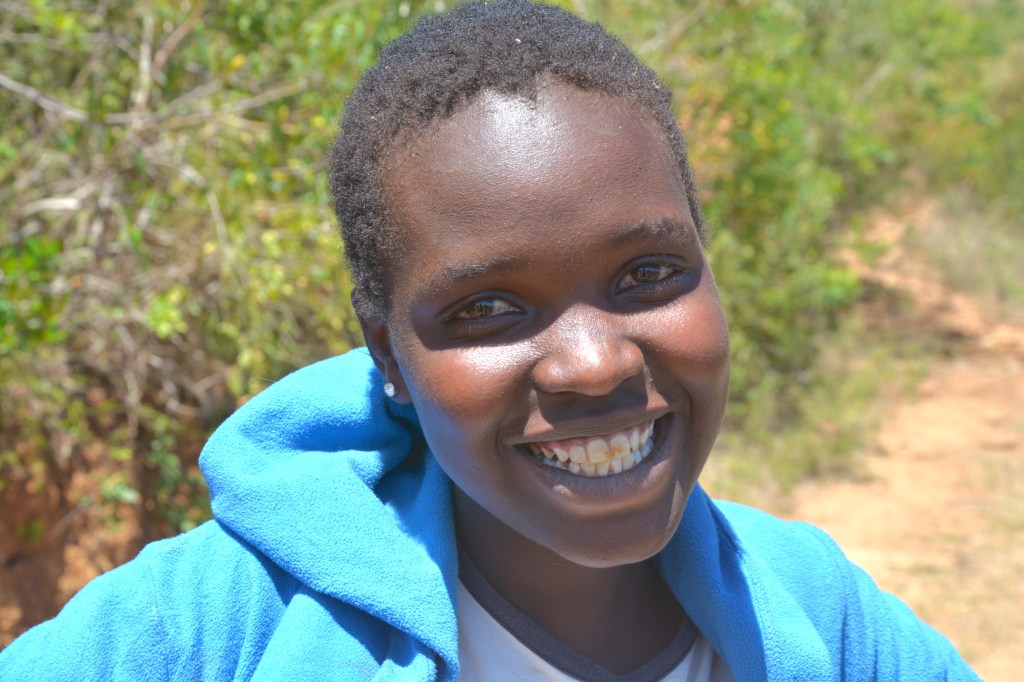
Women’s work – from a young age they must get used to the fact…
Sharon
Joy

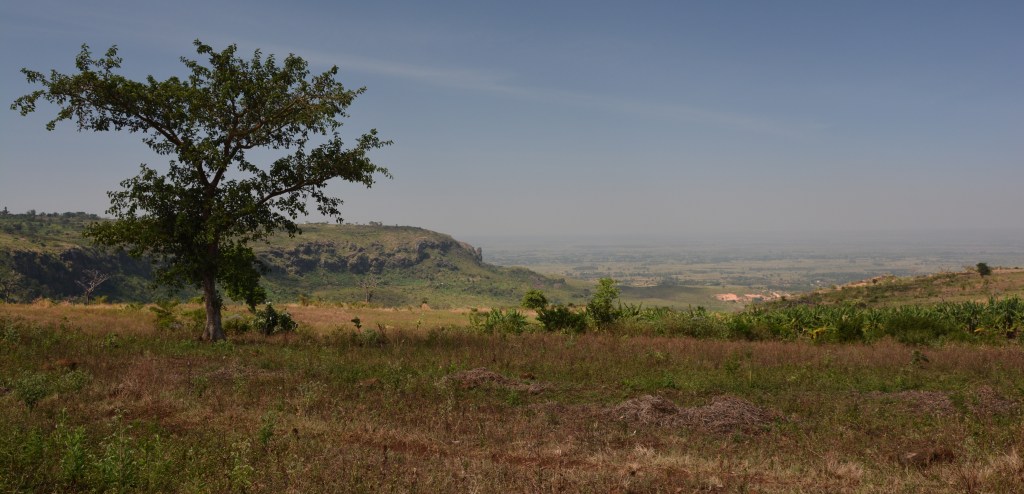
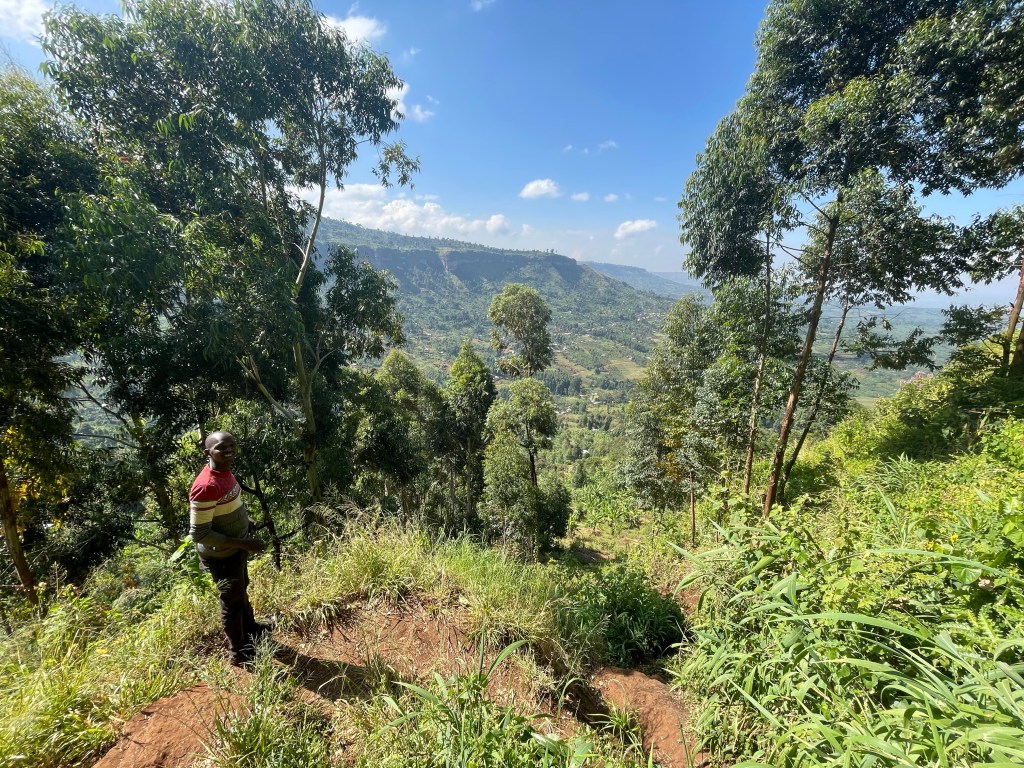
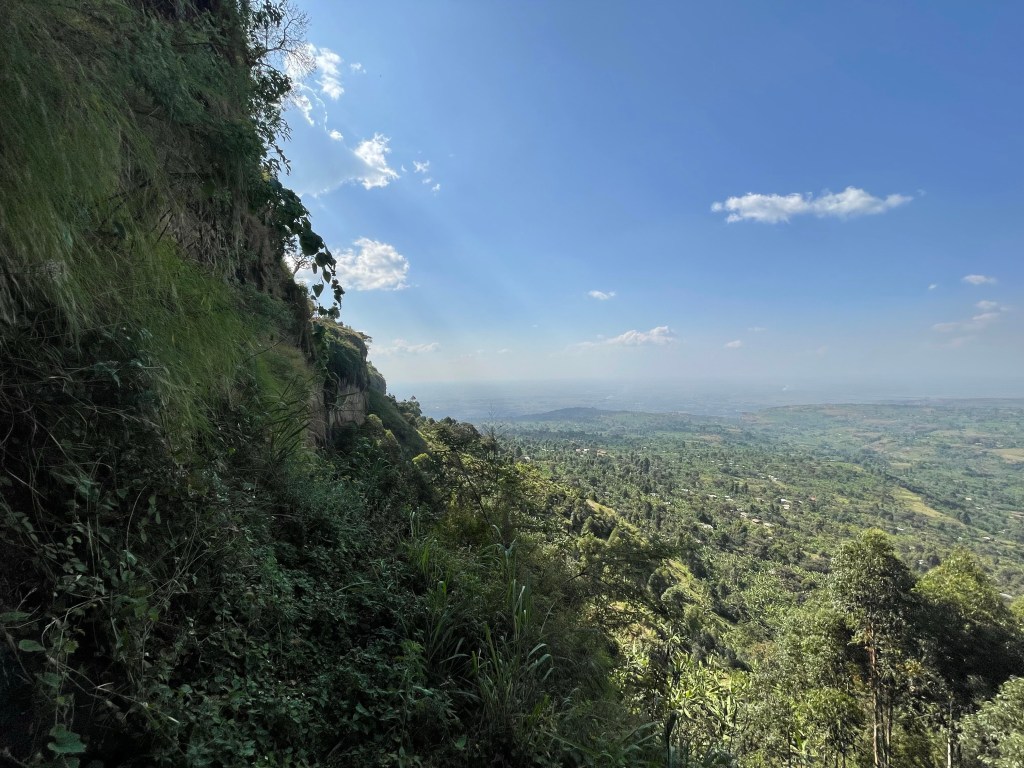
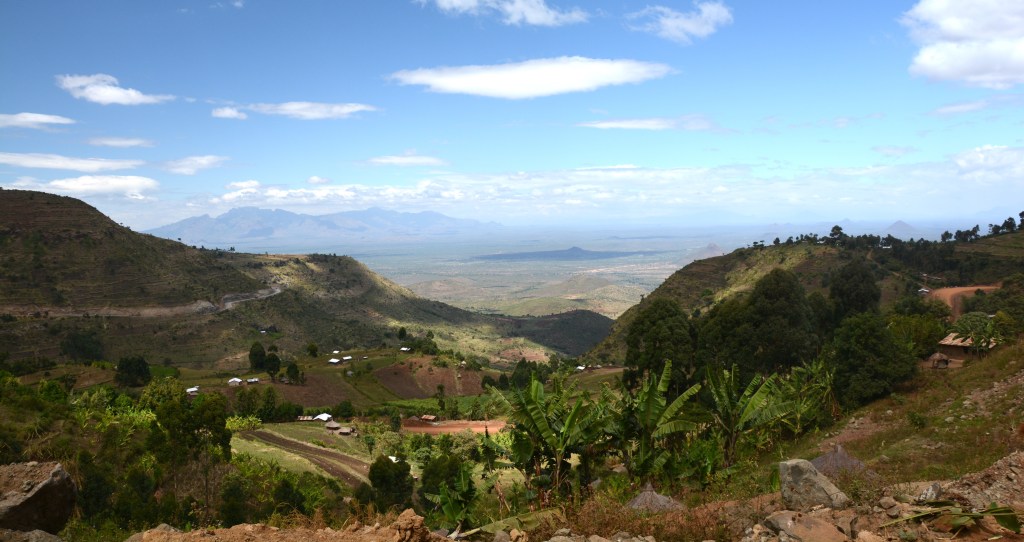
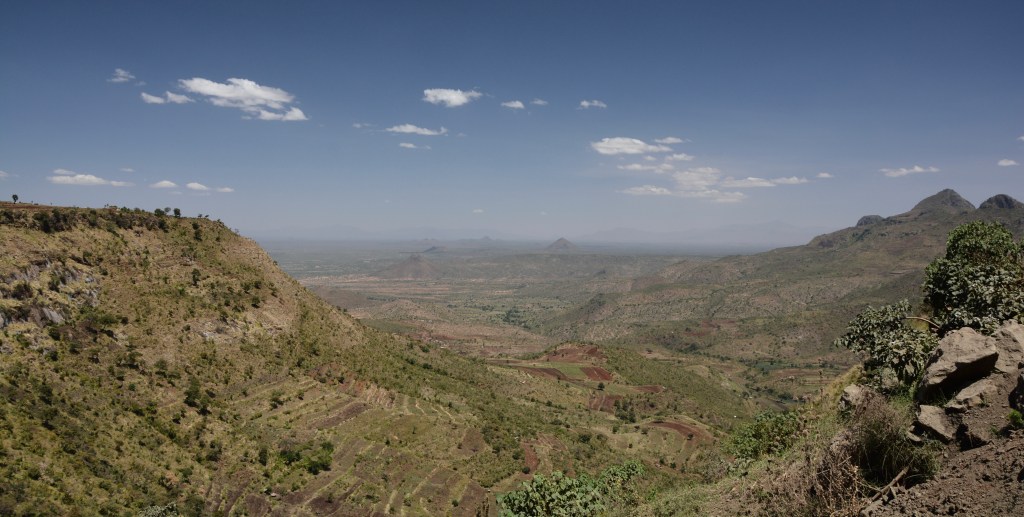
The views below us are thrillingly huge and shimmering in the heat. This is impressive landscape, this giant rift in the surface of the earth through so much of Africa. The Kerio Valley is merely a branch, a spur, of the Great African Rift, here about 4000 feet deep. We’ll descend about 2700 or 2800 feet from our perch at Kessup, itself 1000 feet below the valley’s upper rim. Behind the Tugen Hills, 15 or 20 miles across this great cleft, lies the Rift Valley proper, hot and huge, cracking much of Africa from top to almost bottom, surely amongst the most impressive topographic features of the Earth?
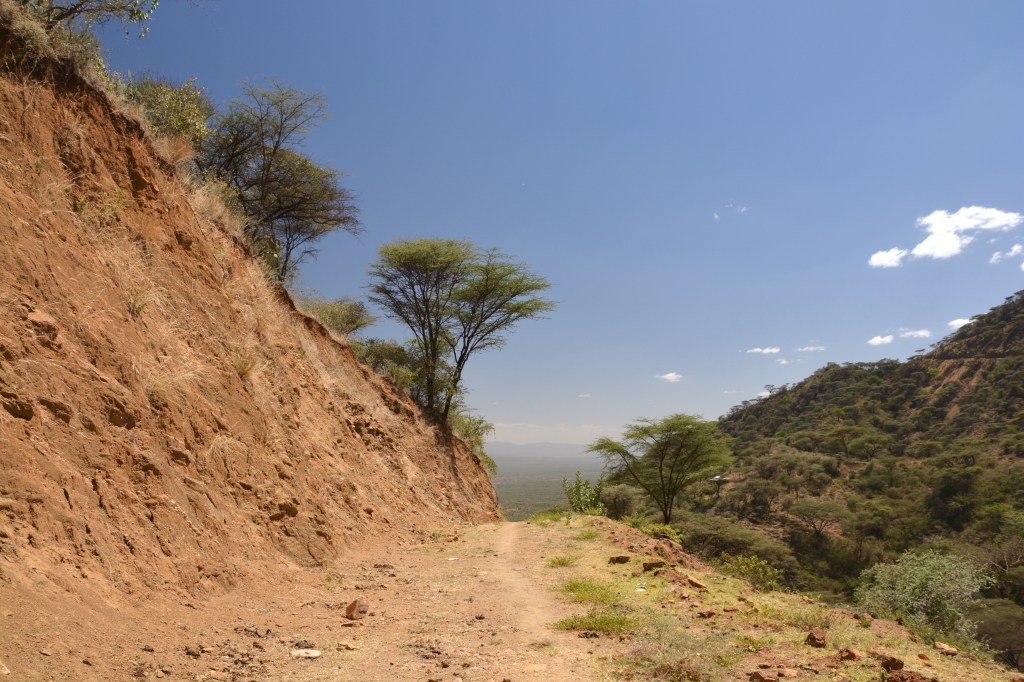
Hours downhill – but everything that goes down must come back up…

Far far below us, coming infinitesimally closer with every dusty footstep, is a straight white road, running south to north along the valley bottom – we’ll be down there in two or three hours, baking in the blinding sun amongst acacias, goats, small scattered villages on the edge of poverty, and sometimes elephants. More than 200 live in the valley below, but they’re cautious, shy animals and difficult to see. We clamber on downwards into the inferno, slipping on the unused road, searching for patches of shade to rest and drink our carefully rationed water. The only spring – we remember it from last year on our way up this track – is bone dry. “Eh, life is hard in Kerio Valley!” exclaims William, waving his stick over the parched landscape. William’s family has land down here but it supports little more than goats and the split-log beehives that hang in the trees. His comment is an understatement that makes me wonder how and why people adapt to such harsh places. Through lack of choice, I suppose. I’m glad I can come and witness this life for a day or two and retreat to my comforts.
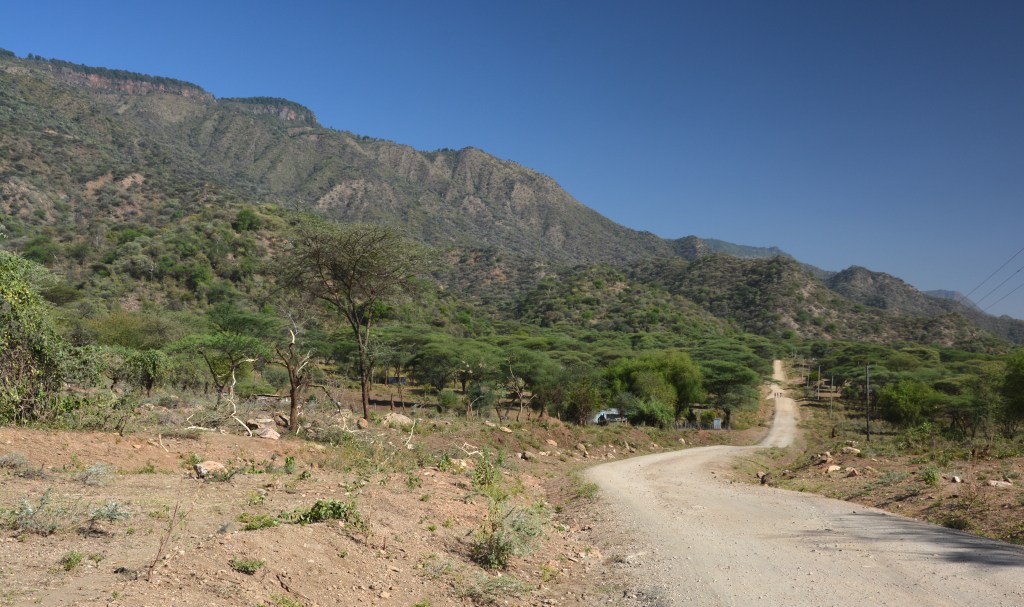
The dazzling valley road just goes on and on, then on…

When we eventually reach that white rock road, our legs straining from the continual downward slope, there are tracks of baby elephants on the dust at the sides of the road. People tell us that the elephants came today before dawn to drink from the public water supply at Kipkoiywo, the hamlet to which we are walking. Where, I wonder, as we plod on tea-plate sized footprints, are the prints of the mother elephants? Perhaps they are canny enough, these intelligent pachyderms, to observe basic road safety: adults using the middle of the road protecting the young elephants on the verges? It’s possible… and there’s no other ready explanation. By 4.00pm, as it is now, there’s been enough thin traffic – a few derelict lorries and overloaded boda-boda motorbike taxis (for no one walks any more, except mad Englishmen and their biddable friends) to scrub away the evidence from the dust of the main carriageway.
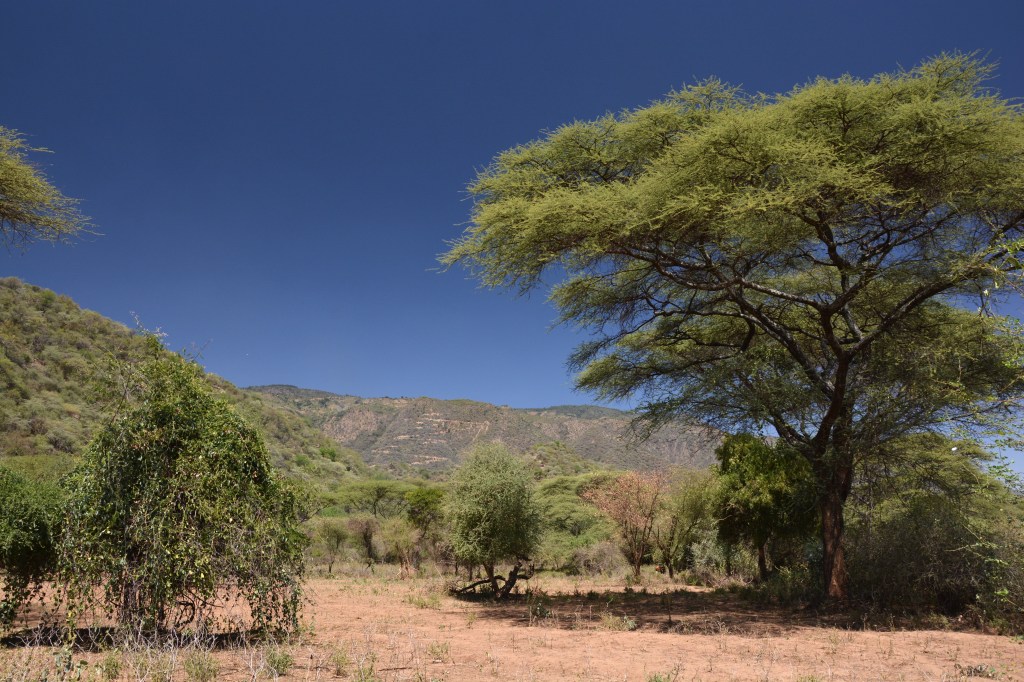
The blue is so deep. But look carefully at the track we must climb later!

The blue of the sky, here 40 or 50 miles north of the Equator, reaches an intensity of azure that Europe never equals except in adverts for expensive ski resorts. Its depth of blueness is a wonder at which I keep exclaiming. Grabbing an iota of shade, we sit on a rocky bank beneath a scant tree and I gaze at the shimmering landscape, just dazzling pale rock, thin acacia trees, scrub and an endless line of electric poles reducing into distant perspective. We’ve about three rather tedious miles to walk on this sun-blasted road to Kipkioywo. Now, by mid-afternoon, it seems an endless plod, the road reflecting brightness. It’s a very rugged life for people here: this year the rains have been poor and it’s dry as hell and about as hot. People live here though, as they do in so many inhospitable places, adapting to circumstances and scratching a sort of living with some goats and a few scrawny cows. There are almost no cash crops here; some ragged maize here and there, and the wonder of this valley: the best, most succulent mangoes in the world. It IS a wonder that they flourish here: it’s so intensely dry, yet mangoes are a fruit of the sweetest juice. But as we pass the small farm of one of William’s uncles, who last year cut a large fruit from a tree and sliced it open for me – the best mango I ever ate – William comments that there’s not a mango to be seen. It’s been a poor harvest, and over early: another sign of hardship and poverty down here in the burning valley, one of the main sources of income decimated by the increasingly uncertain climate.
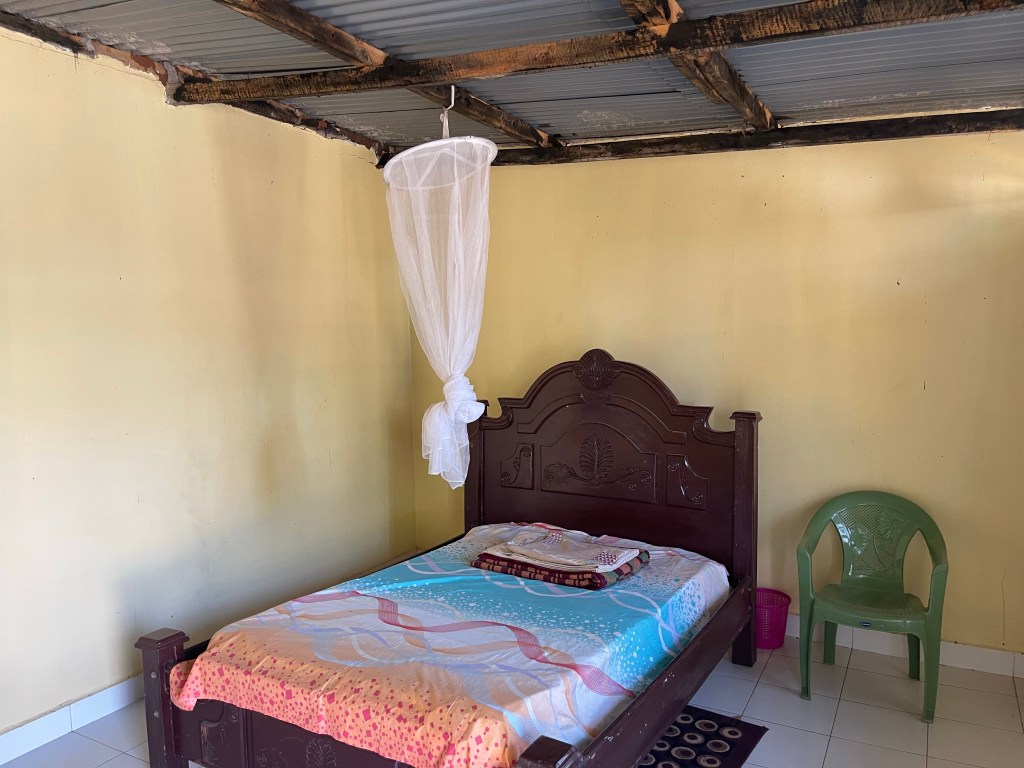
An elaborate bed but not much else.

At last we reach Kipkioywo. There’s a very simple guest house here, nothing more than a rather decorative bed in a tiled room beneath a zinc roof, with a plastic basin and jerrycan for washing. It’s clean and silent, the only qualities I require. It’s hot of course, and the water’s warm as weak tea, sun-bathed in a community tank by the water point where the elephants come for survival these dry weeks, but that we just have to accept. The only trouble is that William, usually easy-going unless he expects that we are being exploited (sometimes a temptation with his mzungu in tow), dislikes the woman who agrees to cook us a meal. She’s been rude to him, which he hates, and now he takes a big dislike to Marcelina. It’s awkward and uncomfortable as he argues about the pennies by which he thinks she is cheating us. William’s parsimony is sometimes amusing: he’ll calculate the cost of our trips down to the last tiny coins, to prove that I am not being cheated. It’s a good failing from this completely honest man, but I could do without the discomfort now when I am so hot and weary. In the end Marcelina slaughters a chicken and cooks chapatis for us, and we are saved by the elephants: she lives a few miles up the white dust road and must leave before dark in case the elephants come tonight. We are left to tend our own dinner. We sit and wait by the charcoal stove, drinking the warm beer William has had to go fifteen kilometres with a boda to collect. The meal’s actually quite good, if much too salty for me, but after our walk, maybe the salt’s not a bad thing, even if I dislike the flavour. I’ve pissed once since breakfast.

By 8.30 we are abed in our hot rooms. The elephants don’t come and I sleep like a log; dream-filled sleep, that I usually have in this heat. Pity I never remember what the dreams are about. Doubtless untroubled…

*
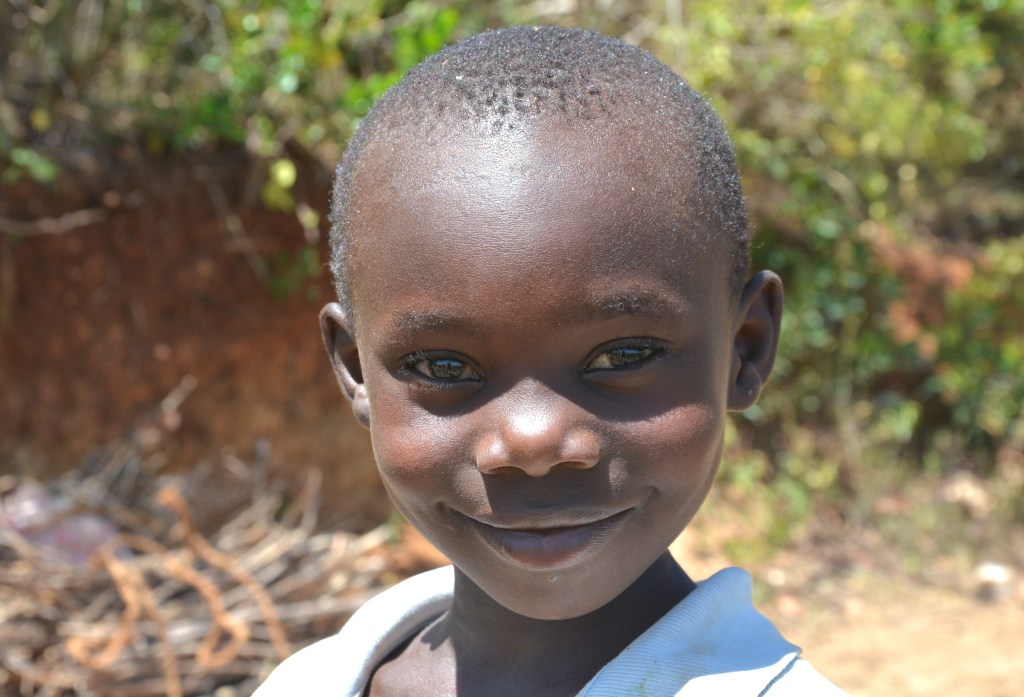
Patience

Next morning we breakfast on greasy chicken and cold chapatis and a rather small mango – William hates waste and he’s sacked the cook woman anyway. We’re on our way by 8.30, along the white road to the north. We’ve not really made a plan; William thinks we should head for Arror, a small township that I suspect is way beyond our reach. I rode this rocky road in 2017 when it was just a track. I recollect Arror: a back-of-beyond place of small kiosk shops, where I photographed an elderly tailor called Christopher, making bright school uniforms at the roadside while I drank a soda – I hadn’t yet discovered the delights of sweet milky chai on the road. I feel that Arror is a long way ahead. William’s never really explored the rest of the valley beyond the part he knows, where his family owns land below the Kessup plateau. When we reach Kabulwo, we compromise and ask a young man, Raymond, if there’s a place we can stay. We’d blithely assumed we might climb the escarpment again, but looking up at the indescribably hair-pinned road, we know it’s probably impossible after four hours on the blinding white ‘highway’. Raymond guides us to the Kabulwo Guest House, and William, fearing we’ll be exploited for a few bob if his mzungu is present, goes ahead to negotiate. He beckons from the gate; he’s done a deal: it’s cheap at £3.30 each for the night, same as it was at Kipkioywo. There’s cold beer – a fridge! – a real delight down here, and there’s food too. Raymond is happy and I must leave him my number: he calls later to wish me goodnight.

Basic and HOT!

The rooms are basic. Very basic. Too small for this heat. The corrugated roof and interior walls are like a hotplate this afternoon. We relax in the threadbare yard under a tree. It’s Sunday and a few people drink beer in a couple of over-heated zinc sun shelters. The young boy who is cook is friendly and respectful – a quality William admires, especially in the young. He’s called Hilary, and we send him to see if there’s moratina in town. Moratina is a local beer made from honey and water, boiled with some mysterious tree wood. It’s sunflower yellow in colour, a bit soupy and either sweet (the one I prefer) or sour, which William likes better. Hilary comes back to tell us it’s for sale in a house in the centre of this small scrappy village.
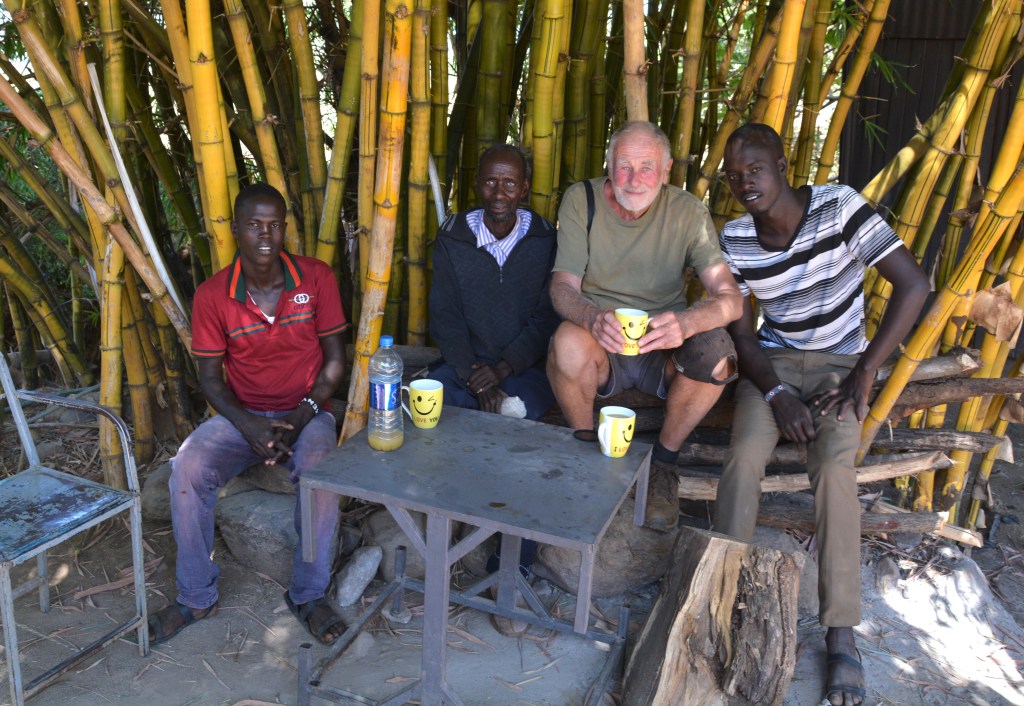
Drinking motatina with Hilary, 80 year old John, and another Hilary.

So we sit with some friendly locals, excited to have a mzungu drinking their odd brew. Hilary gets a glass for his trouble and people come to greet the strange white man who’s able to drink their yellow stuff. It’s fun, these meetings: people are so surprised at my adaptability: they’ve never seen white people so close in familiar surroundings, and all want to buy me more moratina. It’s mildly alcoholic and not unpleasant, but half a litre will do for me. William says he’ll carry the other bottle, just bought for me by David, on our walk up the mountain tomorrow. By then it’ll have soured – in fact, when he opens it a quarter way up the mighty cliff face next morning, it explodes and sprays two thirds of its contents about the parched hillside in a great arc of yellow fermenting stickiness. None of our companions believes I’ll be able to clamber up their mountain. Looking up at the zigzags on the precipitous faces, I wonder too…

I wonder too…

It’s still hot and the guest house yard is still scruffy; boda-bodas come and go with jerrycans of water, for there’s no piped supply here. A young teacher converses with me for a while. A pleasant, educated fellow, Rodgers has been abandoned here by the government, with no choice as to his location. He’s teaching in the village primary school, while his wife and children are hundreds of miles away. He’s delighted to find some reasonably intellectual conversation as he drinks his Guinness. He doesn’t complain about his posting: it’s just the way of Kenyan employment – at least he has a job.

Good-nighting him, we retire to our ovens early. It’s 8.30ish and there’s not a lot to keep us up. I rinse off in lukewarm water from a bucket and drop sweatily on the bed. The walls are like firebricks. I’m instantly wet again, despite the wash down. But I sleep again after a fashion, with more forgotten hot-night dreams.

*

By the time the ruthless dawn once again blasts through the pink frilly nylon curtain at the only small window, I feel slow-cooked to a sandwich filling, basted on an unsavoury sweat-filled mattress (NEVER lift the sheet to look!). Today I have to climb a 3000 foot paperclip red dust trail into the sky, spotlit like a fly on a light shade. Kabulwo isn’t the hottest place I’ve ever been – that’s reserved for southern Namibia, where the thermometer soared to 50 degrees Celsius in the shade – of which there was none on a motorbike – but it’s up there with the hottest nights in my little house in Navrongo, Ghana, when I’d take to a mattress on the flat roof. In the Kabulwo Guest House, it’s just the wet mattress and damp sheets and another wash down in warm water to start the day.

We’re on our way by 8.40. It’s already hot, but nothing to what is to come. We walk west towards the great escarpment from the hamlet’s ‘centre’, a place of a few booths and kiosks selling the same things that every booth and kiosk sells in Kenya: soap powder, sodas, ugali flour, a few fading tomatoes and countless Chinese plastic goods of low value. The track is dusty and a signpost tells us we have 12 kilometres to take us to Salaba, high, HIGH above, far beyond the visible edge of the vast cliff-like wall. I fear that there will be rise upon rise beyond that sharp edge… Soon, we are called into a neat compound to greet the inhabitants. Everyone is SO friendly and welcoming to a rare mzungu, they all want me to visit. “Eh, the pawpaw ladies were very happy! When a mzungu entered their compound!” exclaims William as we walk on, carrying three as yet unripe pawpaws they’ve knocked from their lanky trees with long sticks.
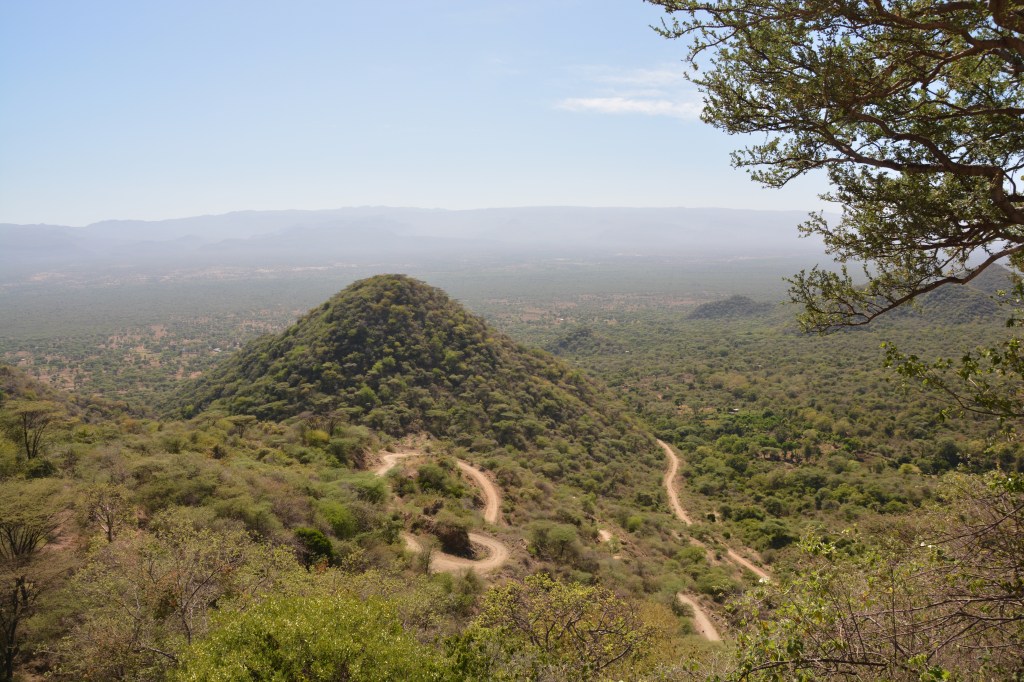
Going up…

We walk on… I’m never quite sure which is the greatest incentive: challenging my body as I get older with unlikely goals, or the exploration and discovery of what might be over the next hill. But I know that I’ll be going over that next hill just as long as I am able. This hill, though, is brutal…
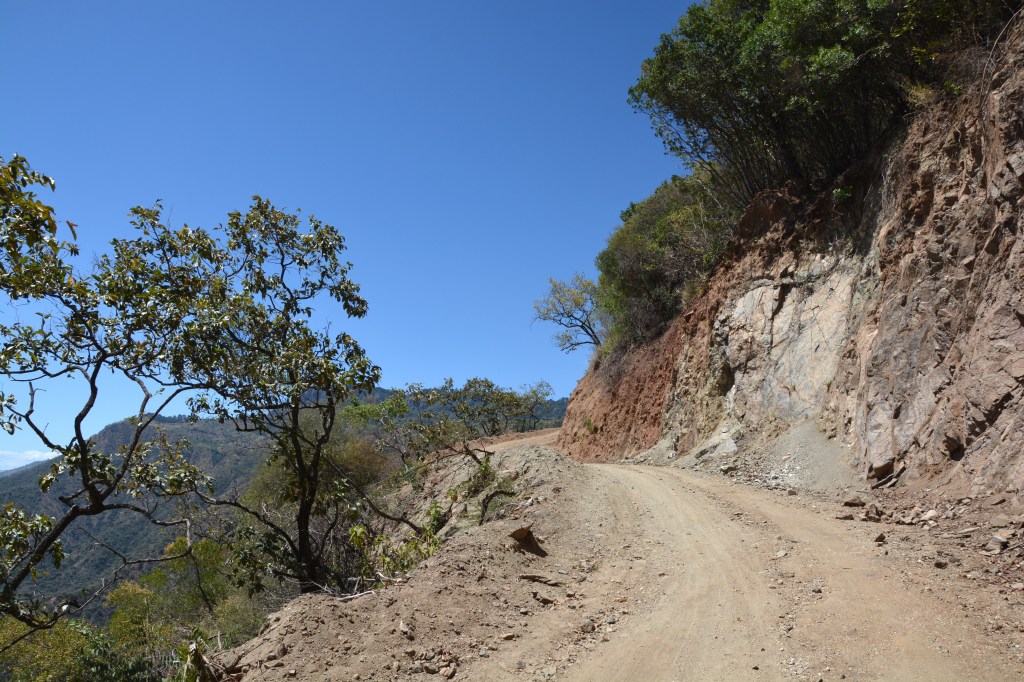
VERY brutal…

Pinioned to the shadeless mountainside by the pitiless searchlight equatorial sun, we staggered upwards on ever tighter twists and turns of rock and dust. It’s unbelievably a boda-boda road (one I might try on my Mosquito!), a new trail that attacks the heights of the escarpment. No one walks it any more (except that mad Englishman and his compliant friend) and the appallingly maintained 100cc motorbikes struggle and rattle, heavily overloaded and dangerously freewheeling down the 3000 feet, without control on bald tyres, most riders barely controlling their excitement and amazement to find an old white bloke plodding ever higher.

We walked for eight hours, about 15 miles and nearly 3500 feet uphill…

The giant valley expanded below us, our starting point dwindling on the valley floor. In scraps of shade we stopped to rest our beating hearts. We carried a litre of water each, and William had what was left of his moratina after his sticky explosive shower bath. Where we could, we topped up with water from pipes or houses we passed. Every day I thank goodness for my stainless steel guts that allow me to imbibe almost any local water and food.

The trail wound upwards relentlessly towards the crystal azure sky. It was stupendous, a word to use carefully. This is nature and scenery at its best, its most spectacular, its biggest. The extraordinary effort and the slowness of our progress made it rewarding in a way that I’d never experience so intimately on my Mosquito. The sun, with our 18 inch long shadows, blasted down, the dust scuffed at our feet, every hot rock and stone felt through shoe soles, with hardly ever a relief of a downhill slope – and when there was, we knew it would lead inevitably to another hill. This was supreme physical effort, repaid every moment by extraordinary vistas of gigantic proportions.

It took over five hours to reach the top – which wasn’t the top, as a cliff face another 300 feet or so rises west of the final narrow plateau, along which we walked towards distant Kessup. My map told me that Kessup and cold beer was probably a further 15 miles from where we joined the red dust of the plateau track. We reached a compromise and stumbled another five miles or so, gently rising and dropping along the fertile, peopled plateau, until we both reacted instinctively to a passing boda-boda rider’s happy smile and greeting, such that William signalled that he should drop his passenger and turn back to find us. Funny how that instinct found us a charmer, amongst dangerous, careless riders. Mathew drove us perhaps 10 bumpy miles on his battered machine with consideration and care. We parted friends and he was rewarded with a tip, while I submitted (as often) to a ‘selfie with the mzungu’.
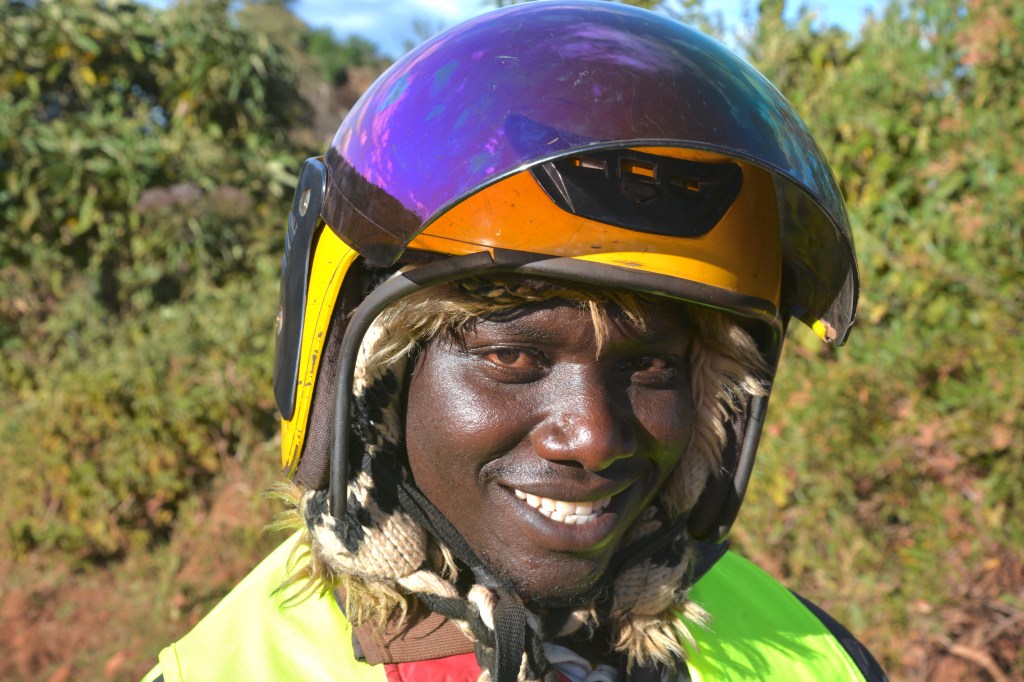
Mathew

Supper and cool beers over, I was exhausted and fit for no more than bed and heavy sleep. We had climbed the wall of the Rift Valley once again, the fifth time I think…

*

Next day, to complete the hat-trick, we clambered rather more slowly up to Kessup Forest, the preserved woodland above the Kessup plateau, almost 1000 more feet uphill, and nearly 4000 feet above the scratch of white road so far below, along which we sweated the day before. It looked insignificant indeed.
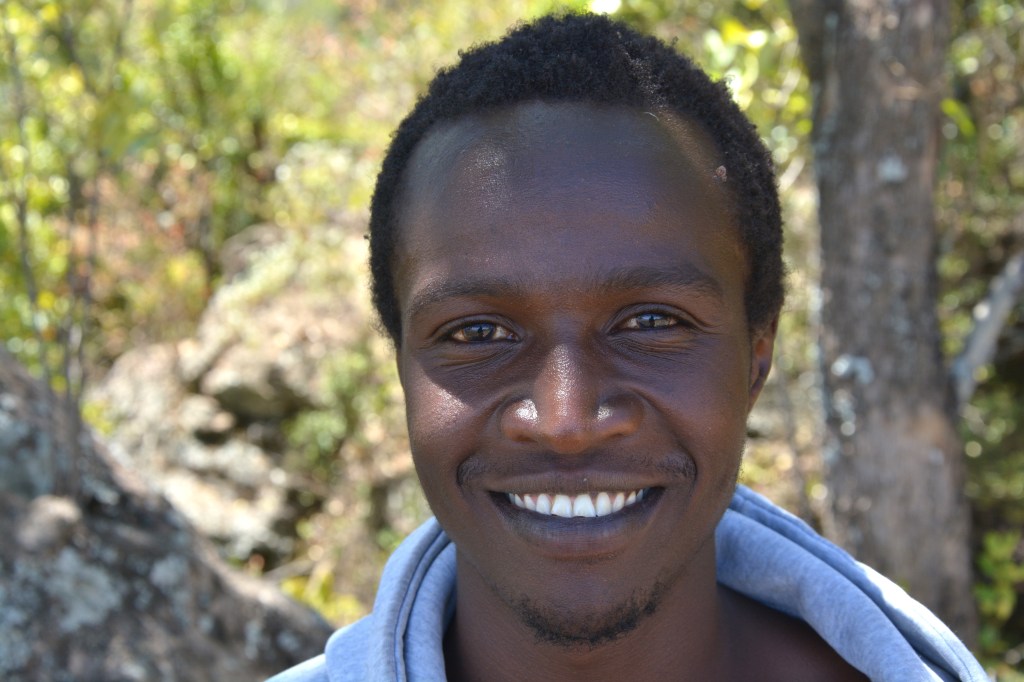
Zachia

On the way up this time, we met Zachia, a charming young 24 year old, educated and thinking, university trained as a teacher of history and KiSwahili. A local lad, he has been recalled by a proud father and forced – for now – to work on the family farm; a case of parental domination on their last-born, despite his education. Now he was on his way to clear one of the pipes in the system that funnels water down to the plateau. Starved of intellectual company, in a small gossipy, envious community, such young men will gravitate towards the free-thinking experience of mzungus with desperation. Frustrated Zachia is currently trapped in this small-minded, traditional community, with bigger thoughts of escape and freedom. It’s so difficult for such people to break the moulds of their traditional parents and upbringing and get out into the wider world. He’s seen a bigger horizon during teaching practice in another part of the country and dreams of more than a local smallholding in a rural community can satisfy. I hope he can escape and attain some of his dreams. He has rejected religion (something he cannot admit in this hidebound village); wants to travel; has no urge for children – witnessing with some cynicism the world into which he’d bring them; and dreams of freedom to make his own way without the ‘tradition’ and ‘culture’ that so stifles opportunities. Things he can’t talk about in a conservative uneducated region. Poor Zachia, a conflicted soul in search of only what we all want, but that is so difficult to forge in a narrow minded rural African village.

Acanthus generally only grows over 2000 metres

*

Some journeys are very special: I’ve a smile on my face for another whole day. On Wednesday, on hearing that it’s Adelight’s 40th birthday on Saturday and she wants her brother to be present, I change my plans. I was going home today, and on to Sipi on Friday, now I’ll take a longer route home and leave for Uganda on Sunday. I’ll explore the remote gravel tracks on the rim of the great valley on the way north. I’ve been this way twice now, but there are always new tracks to discover. And now, thanks to the manager of the campsite at Kessup, I have a map! I’ve been trying to get a map of the Kerio Valley for years: there are so many small tracks through these magnificent mountains alongside the deep valley. Last visit, I spotted a tourist map on the office wall of the guest house; I even photographed it, but now Timothy has sourced me a copy of my own. It’s not a very good map, more interested in the hotel adverts on the reverse, but now I have names of villages and all sorts of routes open to me.

A ‘road’ spotted for a future journey!

I visit the bank in Iten, the scruffy main town on the valley rim, and leave William, who’s come up with me to do some small shopping with the ten or twelve pounds I’ve given him. Now I’m on my own – and I realise that so much of this journey I have been in company with my African families. For an obsessively independent person, it’s quite a pleasure to be alone, independent for a day.

Now I’ll follow the road on which we walked two days ago, past the top of the contorted, twisting track up from the hot valley. Late that afternoon, before we engaged Mathew and his boda-boda to carry us the last ten miles home, we plodded along a red laterite road along the plateau beneath the valley lip. Now I have my Mosquito to take the pressure. The 20 mile vistas to my right, as I ride north, are superb, gigantic in scale, misted today by some humidity rising from the depths.
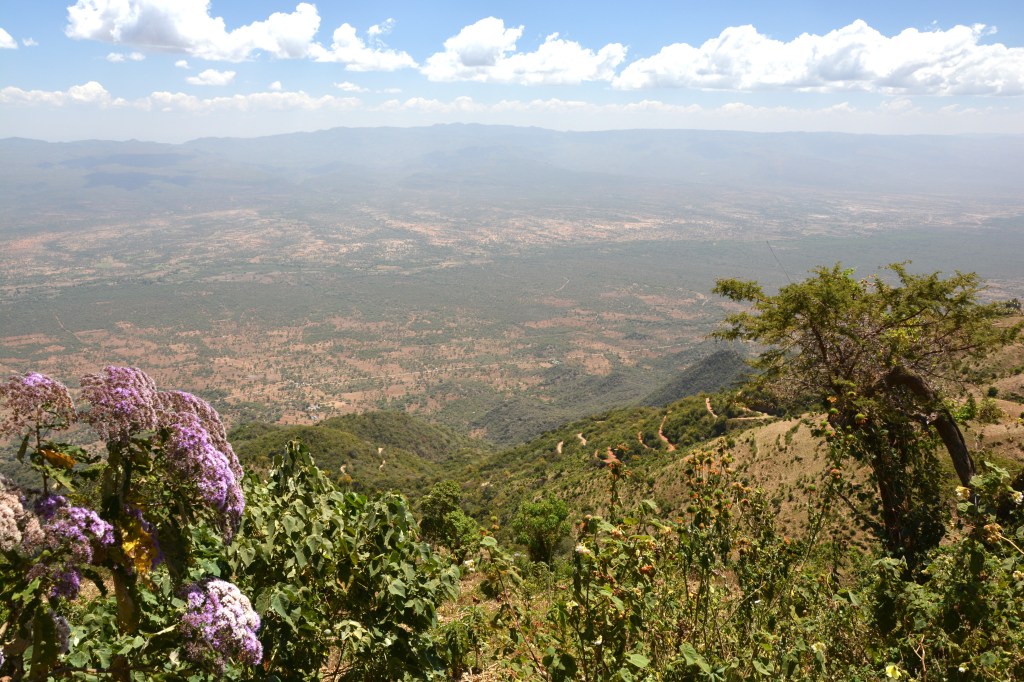
I ride back down the escarpment three kilometres from Iten and turn onto the red dust track that will follow the valley edge for fifty miles or more, here and there becoming little more than a cattle trail, teetering on the edge of huge drops into the burning Rift. Everyone waves and laughs as I pass: I am surrounded by goodwill. I love this. My smile spreads wider. I pass through many small hamlets, a celebrity on my blue motorbike. “Mzungu! Mzungu!” rises the chorus. At one point, below some inaccessible cliffs, the road is hacked from the rock in a narrow ridge. I doubt if four wheels can come this way. I twist and turn, wriggling along the mountainsides. I’m having such fun.
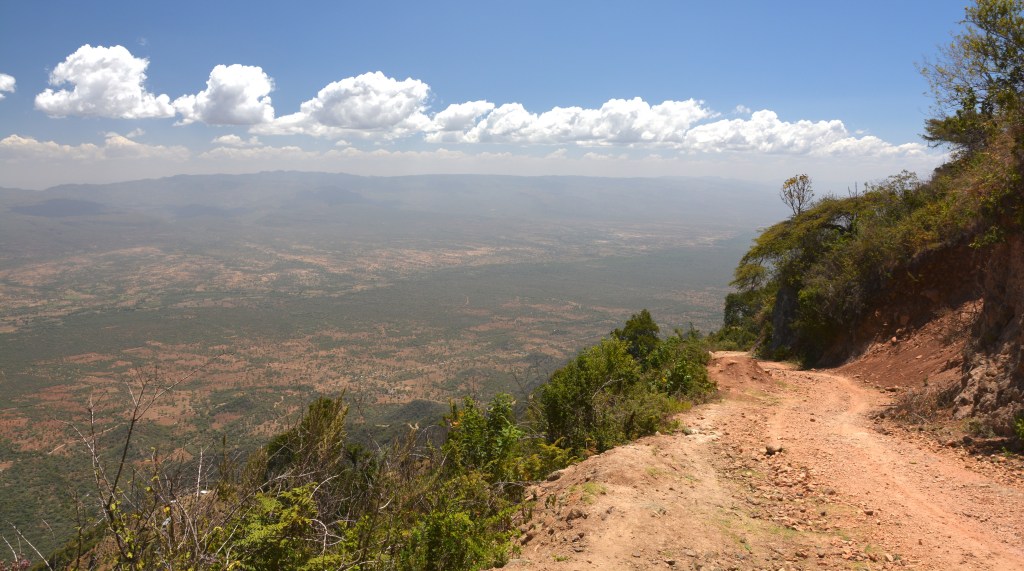
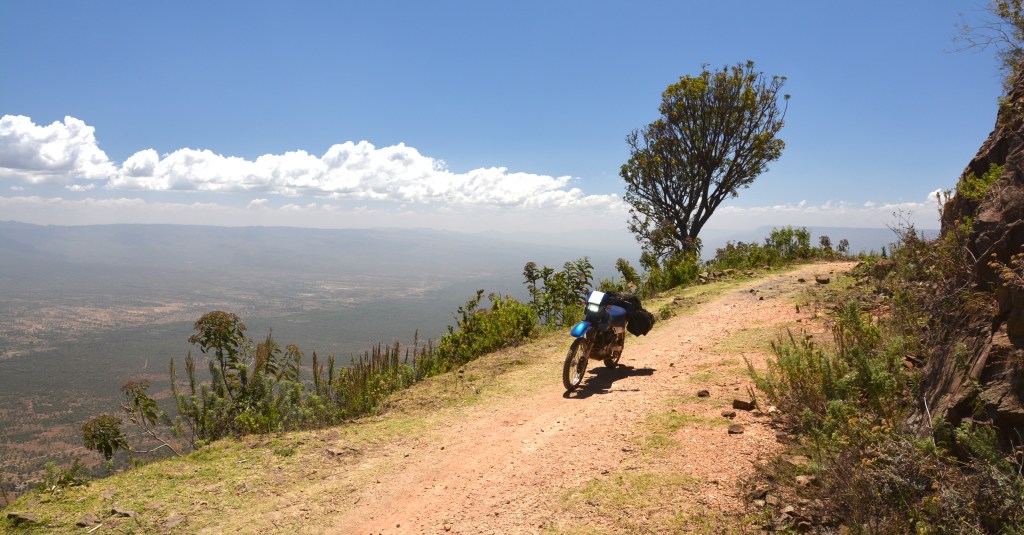
Here and there I have to ask my way when the track splits. No one can believe their eyes: this old white bloke bouncing through their villages. I reach Kapsowar, a junction of several insignificant roads. There’s a tar road going downhill here like a spaghetti trail, but I don’t want the tar road: I know the beauties of the terribly pot-holed broken track that stays up here on the heights and winds its beautiful way through some forest scenery that feels like parkland.
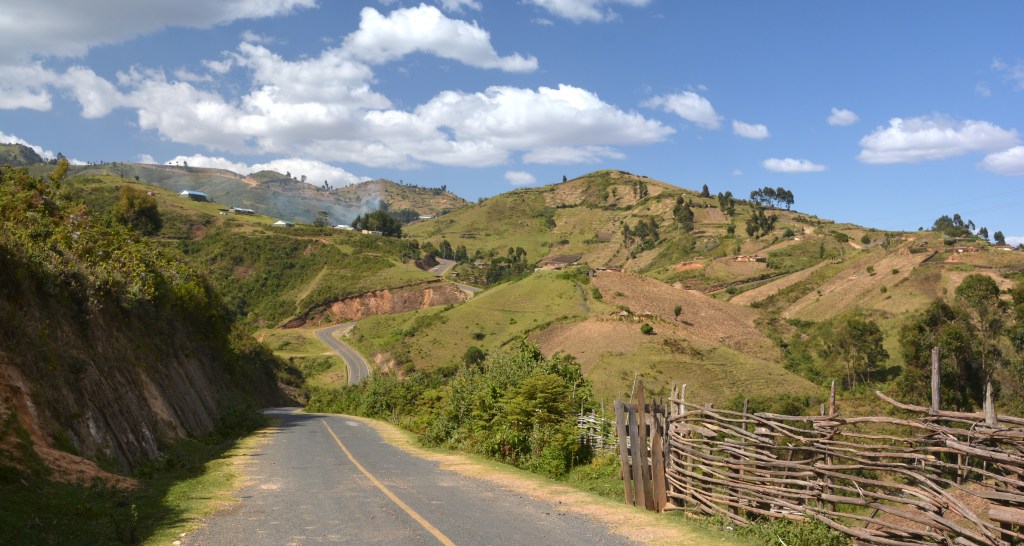
It’s punishing, but the rewards are great: deep green ancient trees against the brightest of blue skies, speckled with wisps of snow white clouds. Then the potholed section becomes serpentine tar winding through the heights of plunging hills. It’s just lovely here, and round a corner in some miles, I know there’ll be the spectacular view of one of Africa’s funicular roads that screws its way down to the shimmering depths and rejoins the white dust road along which William and I walked three days ago, far back down to the south.

The impressive twisting helter-skelter road is tarmacced but unmaintained. Here and there as I ride rather carefully down its three and half thousand feet, the upper levels have crashed down and partially covered the road. It’s so steep that even engine braking is insufficient; my brakes must be red hot. A great waterfall spins over a cliff and courses like a tide down a concrete conduit alongside several of the turns: I can feel it cool the air as it races and rushes valley-wards at speed. If I could stop, it’d be so refreshing to bath my face in the torrent, but I daren’t stop on this gradient: I have to keep going. I’m sure the gradient is considerably more than would be considered safe for vehicles in Europe, with no escape but over the edge…
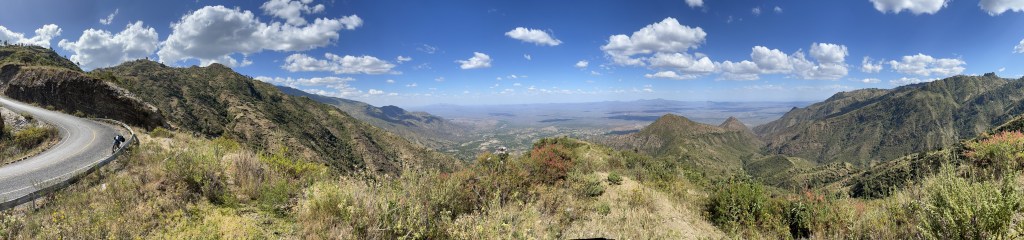
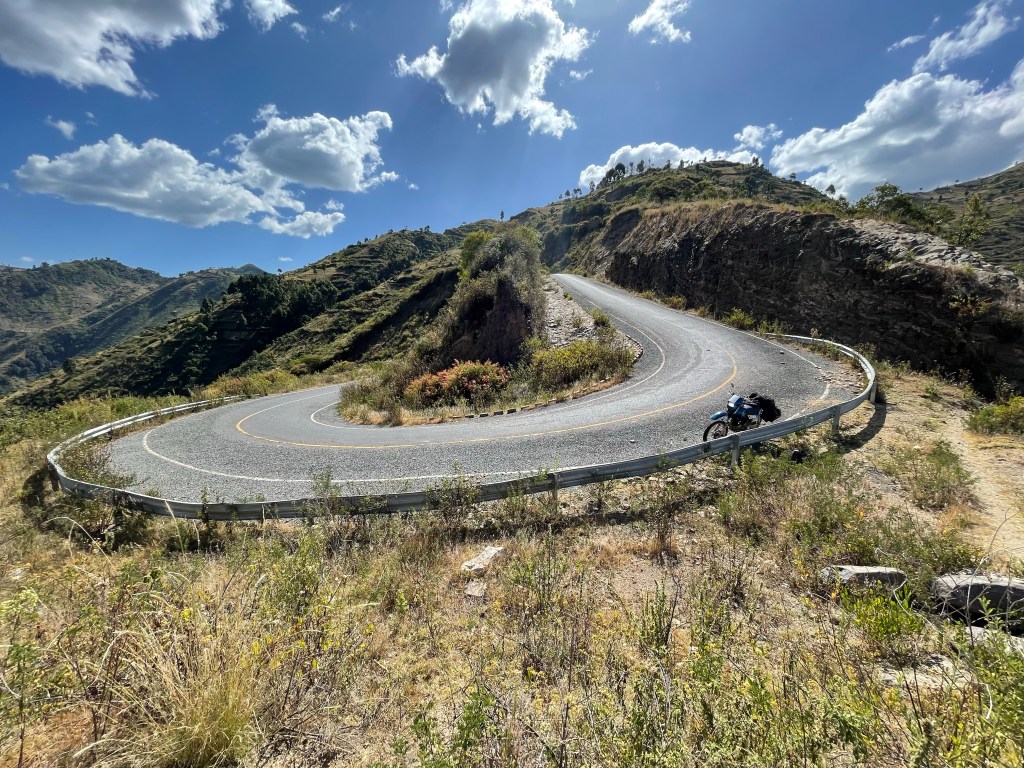
At last I’m at the bottom. The heat is like a blast furnace down here. The amazing big-dipper tar road ends at a bizarre junction, complete with traffic island. The roads to left and right, however, are mere dust and rock tracks. I keep left, the concrete traffic island causing me to feel I should stop to check left and right, but I haven’t even seen a derelict boda for the past twelve miles from the top. I turn left: I know the way, I’ve taken this route twice in the other direction. I know that I now have to bounce and battle across the terrible moraine of a devastating landslide that occurred about four years back. It killed over 200 people when the mountainside swept into the valley, the result of tree felling for pocket handkerchief shamba fields on the slopes. Shockingly, that night the mud and rock swept away the dormitory of a girl’s school as well as homesteads and small shops. Some of the shops are still visible in the debris, roofless, pocked by the flood, broken by huge rocks now scattered across the valley bottom. The trail pushes between them and through the shallow river. It’s unsettling to look up and imagine the power of the mud and rock that caused this horror.

Then I’m on the dust road that circles the base of the great escarpment for the next 30 miles or more. Unfortunately, for I am tired and hot now, the road is being rebuilt, with accompanying diversions and stretches of loose rubble and earth. I need more care now, not less, and tiredness is taking its toll. I’ve a long flat run on this broken surface; the deserts of northern Kenya begin here. The steep faces on my left are the end of the highlands; from here to South Sudan and Ethiopia it’s parched scrubby desert of unimaginable scale: just acacias and dry shrubs, goat-herders and rude dwellings of mud and thatch. This is a poverty-stricken region where water is scarce and people look lean and hungry. They’re troublesome people too, notorious for killing sprees of cattle rustling that have become a sort of tradition or sport between neighbouring warlike tribes. Many travellers avoid the area, frightened off by prophet-of-doom stories of gun battles and lawlessness – but still the populous wave and leap excitedly to see the mzee mzungu pass. It doesn’t seem remotely dangerous – if you ignore the doom-merchants. I suspect it’s a problem of idle, unemployed youth and tribal rivalry – one of Africa’s perennial problems – between the supposedly aggressive Pokot, Turkana and Marakwet tribes. So many Africans identify themselves first by their tribe and very secondarily by their nationality, a concept largely imposed on them by outsiders during the colonial carving up of the continent. The aggression and competition is unlikely to affect me and my eccentric tribe.

By five I am exhausted and happy to turn back onto the tarmac road to the far north of the country and the distant Turkana desert regions, tribal lands of toughness and hardship. About a mile up the road I know there’s a well established camping site with bandas (sleeping huts). It was created by an English professor and his Eritrean wife to supply experiences of Africa to English school groups, but ‘risk assessment’ and H&S have killed that trade and those experiences. The only other guest is a Anglican vicar’s widow from Sussex who befriended the family and visited with one of the original parties. She’s scathing about how officialdom and the Blame Culture has destroyed the opportunities for international understanding and adventure. In her seventies now, she comes back annually to interact with local schools and visit her friends. It’s good to have someone to talk with over my Tuskers and supper (although she rather talks AT me, as an old school teacher) but I’m so tired that all I really want is to stretch out flat on the bed and sleep until tomorrow. What I’ve done today is a young man’s game – but I’ve had a special day and enjoyed every mile of my rough safari. And maybe there’ll be another tomorrow…

If you don’t go out and look, you’ll never find the satisfaction of days like this.

*

At the guest house/ campsite I find that Wanda and Jorg left a few hours before I bowled in and headed back to Kessup, swapping places. I probably missed them on the road by a short time. Wanda texts me to say they enjoyed their ride back through Kerio Valley, but doesn’t say where they climbed the escarpment. Maybe they went right to the end and drove up the tar road. I think my description of the precipitous zigzags may have unnecessarily put them off my rather adventurous route.

*
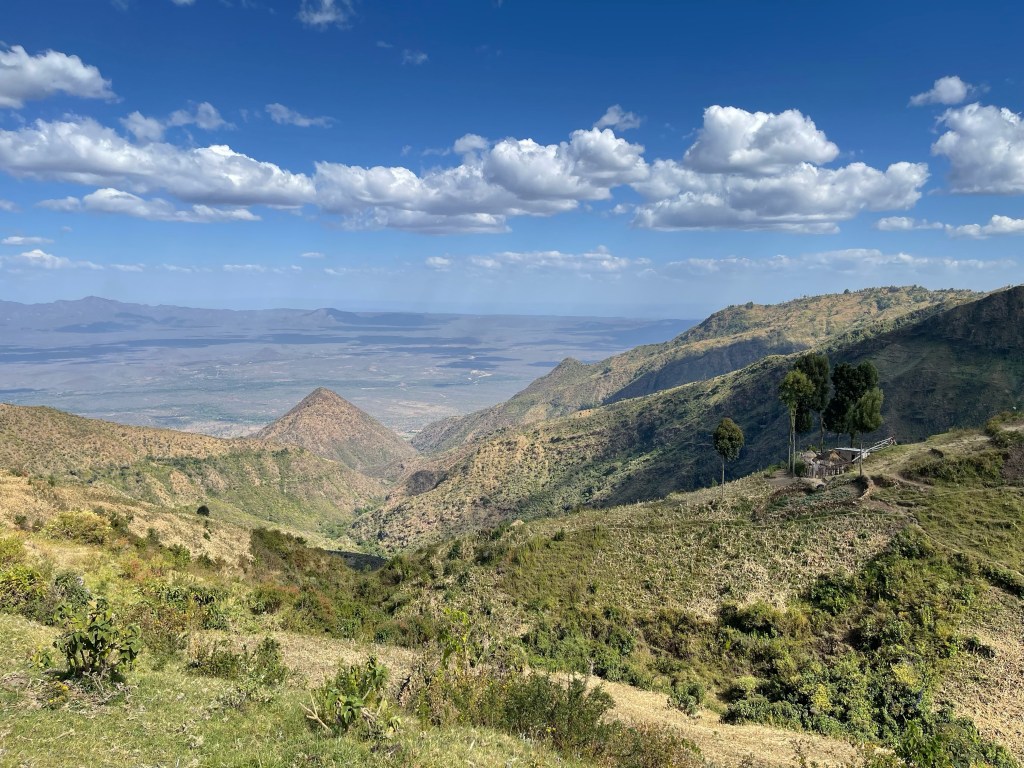
Finally sourcing a map, even if it’s a glossy tourist one, of this region that I love to explore so much, has added new horizons to my wandering. My return to Kitale was obscure but wonderful – tens of miles of severe trail riding over the top of the Cheringani Hills (the ones that’d be called mountains anywhere else) riding up to over ten thousand feet in the most dramatic scenery on tracks hacked and worried from the steep mountainsides, mere shelves of rock and dust close to the clouds. Trail riding was an early enthusiasm in my biking life – but somehow a couple of miles of Devon farm lanes hasn’t retained the appeal, when here in Africa I can trail ride all day, climbing SIX THOUSAND feet amongst landscapes from coffee table books.
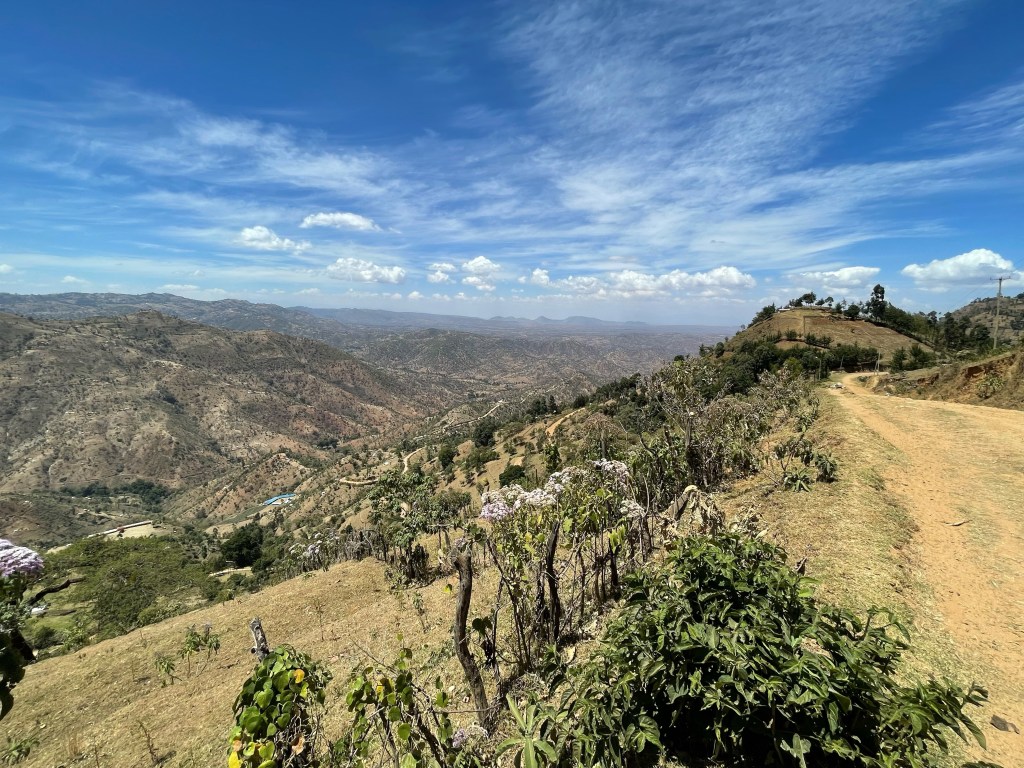
I’m away from Marich Pass rather late, conversing first with the CofE vicar’s widow from Sussex and then with Wahid, the son of the elderly owner, who’s currently in England, leaving Wahid in charge. He’s a businessman and entrepreneurial, with his family in America and his own origins in Sudan. Talking by my bike, he tells me he wants to develop some historical, cultural, projects in Khartoum and would I be willing to visit him there and help him get his ideas to fruition. “Are you expensive?” he asks candidly. To which I reply, “Yes, in America! But I did a job in South Africa three years ago, consulting on a dinosaur museum, and all they could pay was my expenses! But I still went because I love travelling. And I haven’t been to Sudan yet!” Well, who knows? I’m certainly up for it!

*

I rode away, smiling to myself at the chances and opportunities that occur in life, and headed south into the wide, dry, hot mountain pass that curls back to the highlands. I’d spotted a faint line on the new map, that headed high into the mountains on an obscure but intriguing route joining some of the dots I already know, and roads I love in this dramatic terrain. I’d no idea just how fine this ride would be, or how hard and remote…
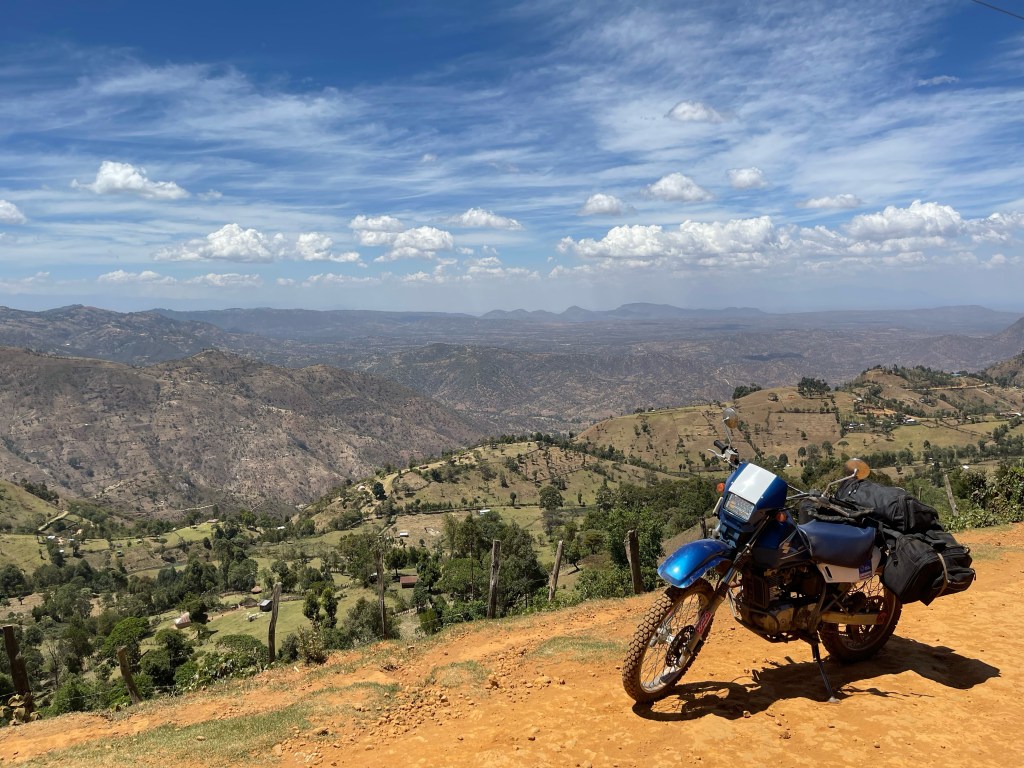
Thirty kilometres up the road, now beginning to climb back to the highlands, I found my junction. A rusty road sign, almost illegible, that claimed that I was turning onto the E353 made me laugh. This insignificant trail, that was soon to climb so high and so steeply as I bucketed about on rocks and dust, was considered a classified road! You could take a four wheel drive vehicle up it, I suppose, very slowly. After all, people need to transport goods everywhere, even in such inaccessible mountains.

My road twisted and turned, corkscrewing its way upwards, rocky and broken. To one side rose steep slopes, cultivated wherever smallholdings could cling to the earth. The views expanded down and around me. I was soon on precipice shelf roads, bounding and crashing over the rocky surfaces, exercising just about every muscle I have left. Often, on these winter journeys, I aim to lose at least an inch of my summer waistline: soon gone with this physical effort!
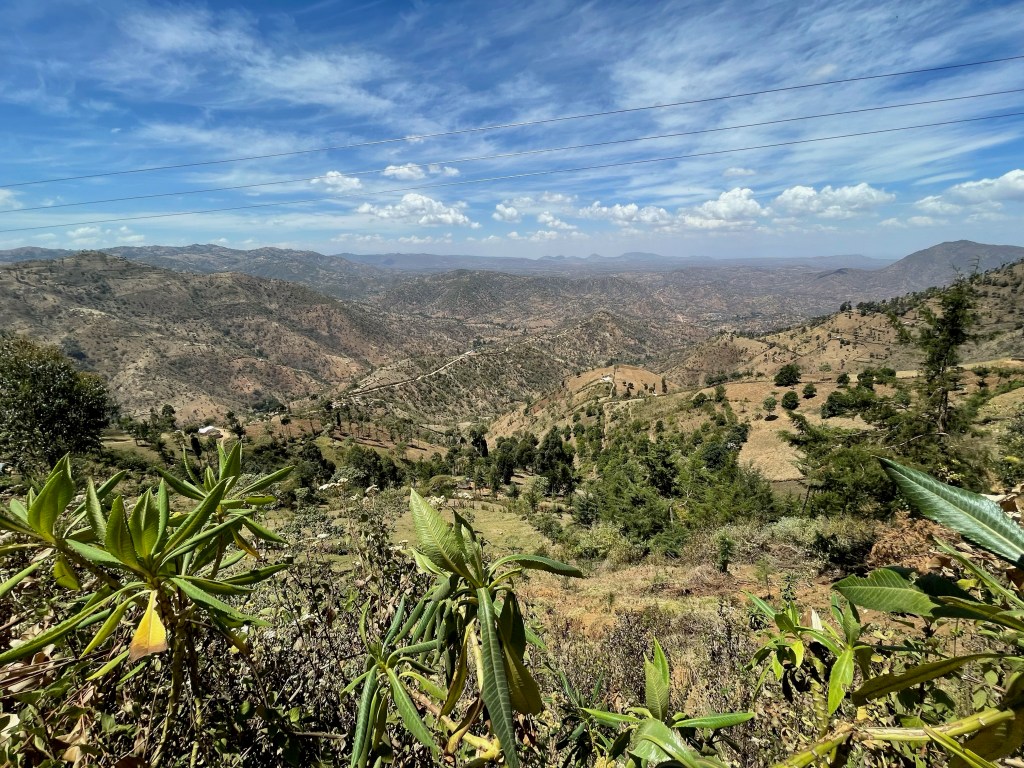
The valleys plunge steeply away, a foot or two from the narrow track. I look down onto shambas and rude houses of mud and thatch or zinc and timber. There are forests up here, with mature trees with screw-thread bark and dark coniferous leaves. The air is the freshest I’ll ever breathe; the sun sears down; the temperature reduces from the discomfort of the northern deserts as I climb. I have to stop often – to take photos of this extraordinary place. My mind is clear and I’m happy. It’s impossible not to react to this freedom, despite the hard effort and the always slightly present anxiety of mechanical problems – or falling off. But if you don’t take risks, life doesn’t amount to much: overcoming these anxieties is part of the fun and satisfaction. I’m here, almost ten thousand feet above sea level, in the brightest African sunshine, with spectacle after spectacle at every new corner of the track – or the ‘E353’.
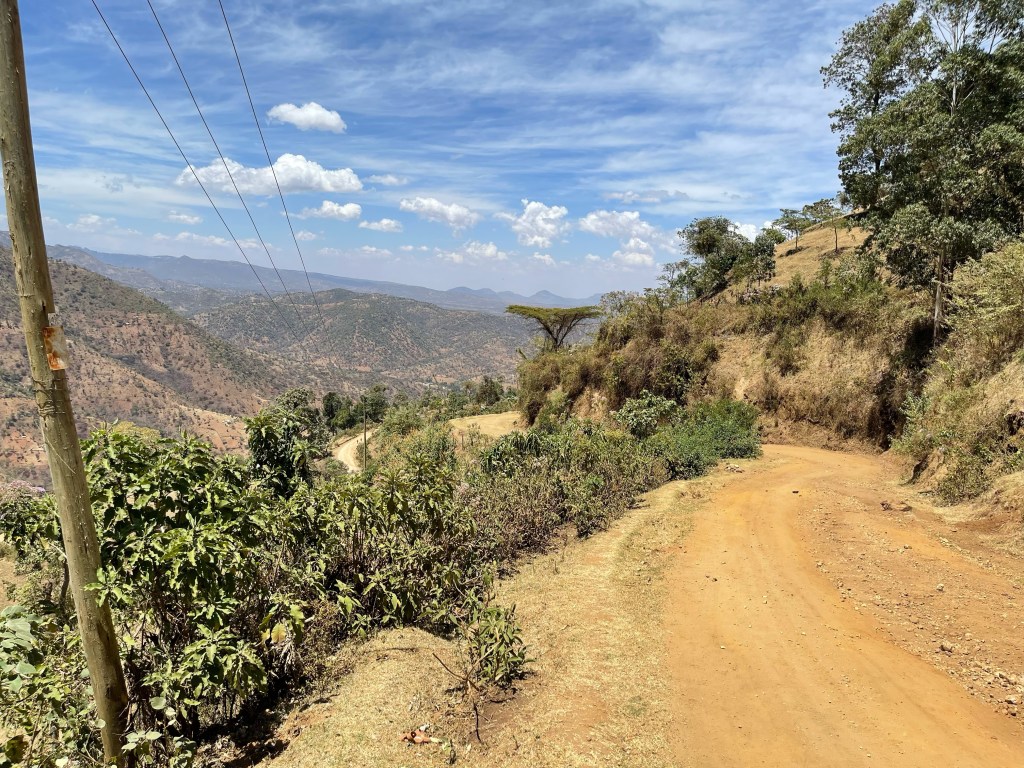
Finally, I am on top. There’s a small hamlet and a junction. Which way is to Murkokoi? A band of men at the side of the road are astonished to see me as I pull up to ask. A lanky fellow with a rasta cap points downwards to the right, a winding red rock trail. But I’ve still a long way to go. It’s even more remote up here, cultivation is more difficult on this steepness, but raggy sheep browse in my path and cows graze the short grasses. Occasionally, there’s someone watching their cattle, and here and there a small house clings to the slopes. One final rise of a mile or two and I start the descent for real. After a short while I am utterly confused to find myself issue from this cattle path (the E353!) onto a lovely smooth tar road. I didn’t expect it at all. I have to ask my way again, and while I’m at it, I ask the people loading a battered taxi car about the new tarmac. It seems it goes a long way into the mountains on another road I’ve seen on my new map. Another route for another time!

*

I’ve been in West Pokot region for the past fifty miles. The Pokot tribe is known through these parts as a troublesome, rather unfriendly, remote people. It’s true few people waved or smiled back, and children were mutely amazed rather than excited. On the other side of the mountains (‘Hills’!) I come back to the Marakwet people, friendly and cheerful. Joining the new tar road I descend in glorious sweeping curves to the Cheringani Highway. That used to be a dust track too, when I first used it seven years ago. Stopping for chai by the junction, I am soon surrounded by young men interrogating me with curiosity on my journey and my ‘big’ motorbike. These interactions are such fun, as I bask in my celebrity status. I often reflect on the commonest question I’m asked at home, “Aren’t you afraid, all these dodgy places you go?” If only people understood how open and generous most Africans can be in their welcome.
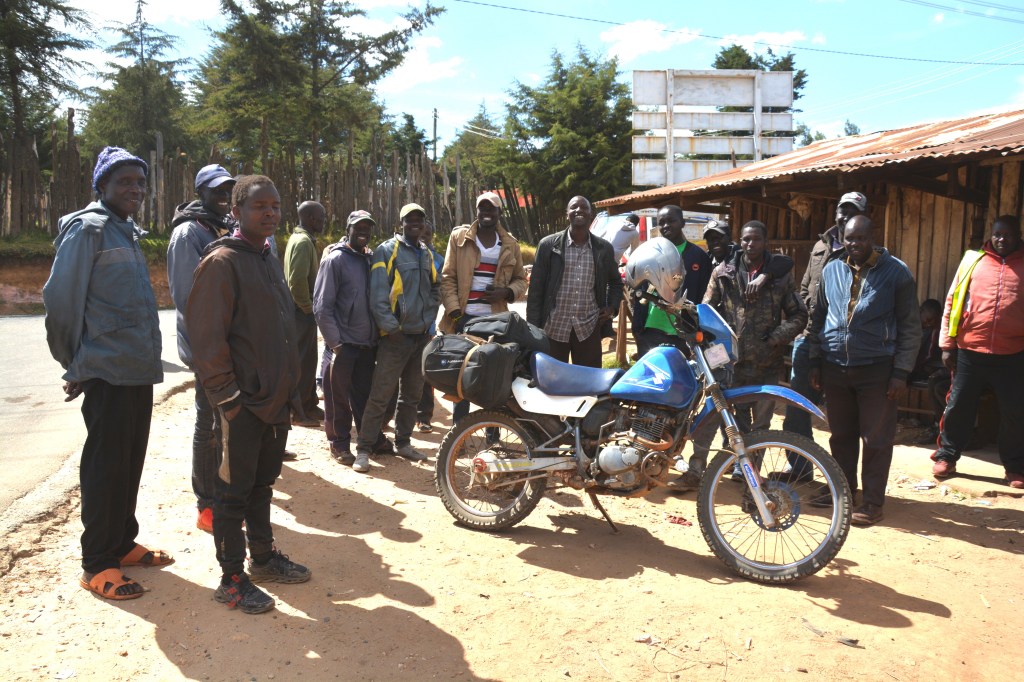
An admiring crowd meets the mzungu celebrity

The assembled crowd, poking and pointing at the finer points of my bike, assure me there’s a shortcut to Kapcherop, my next destination. “Before the radio mast!” says one of them, pointing across the hills a kilometre or so. I wave goodbye and set off again, restored by sickly tea I’d abhor in any other circumstances. The next track is also broken and stoney as it leads through handsome farmlands enclosed by split-tree fences and then enters a fine shady forest, to emerge ten miles later on the edges of a sparklingly green estate of tea. And here’s familiar untidy Kapcherop straddling a tar road, another one that used to be an adventurous track just a few years back. From here I have an easy ride home, spinning down the curls and whirls of the road, that suggest that I’m going to be in lowlands soon – but I’m coming back to Kitale, itself at almost 2000 metres altitude on the slopes of Mount Elgon.
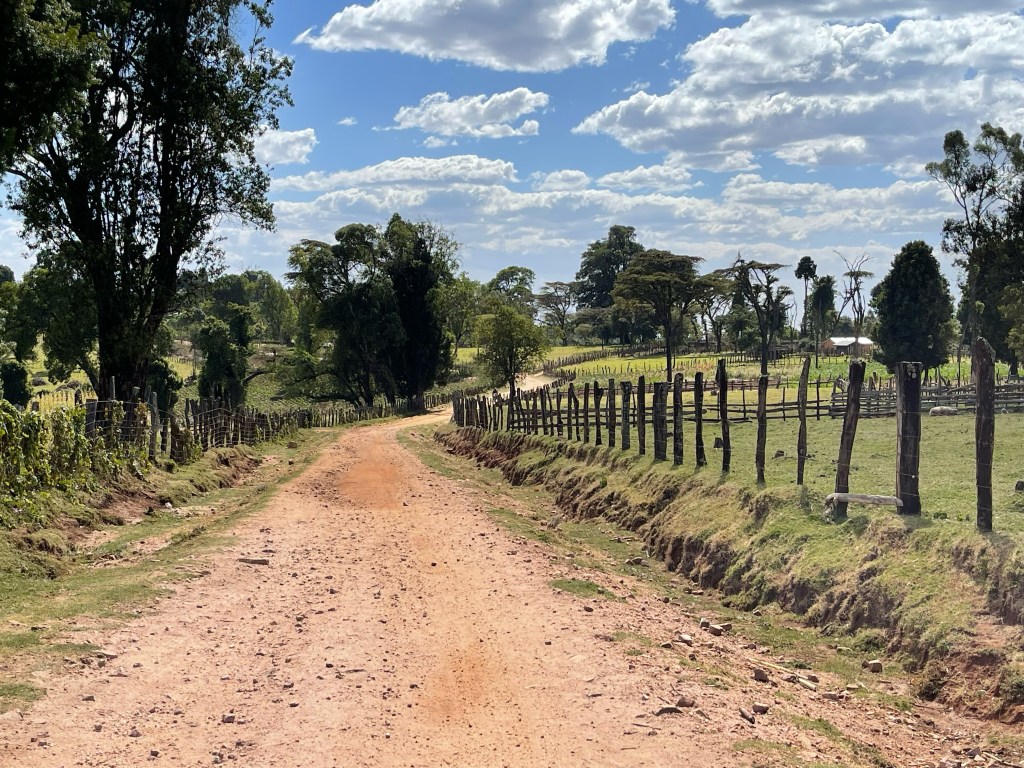
The past week has been one of those that makes travelling such an obsession for me. I hiked in and out of the Great Rift; I rode tracks and trails over imposing mountains; I talked with everyone from Kenyan schoolchildren and goat herders to a vicar’s widow from Sussex and a Sudanese businessman with a Californian phone number; I drank beer gazing over the wide Kerio Valley and local-brew moratina beneath a bamboo tree in a friendly village backyard; I wandered in high equatorial forest and rode the edges of a vast desert; I was welcomed by a thousand people, the focus of a thousand smiles and a flood of goodwill. I had a video call with Kari in Devon from a heat-blasted bar in the back-of-beyond in the Rift Valley, now with 4G internet (!) and learned of the frustrations of modern thought versus conservative village concepts. I’ve exercised mind and body and enjoyed the sunniest weather – in February, the most depressing northern month. And on Sunday, I set off back to Uganda, with probably a ride right across the country to far north western Tanzania in prospect, when I hear from my American associates.

Not bad… “Aren’t you afraid, these dodgy places you go..?”
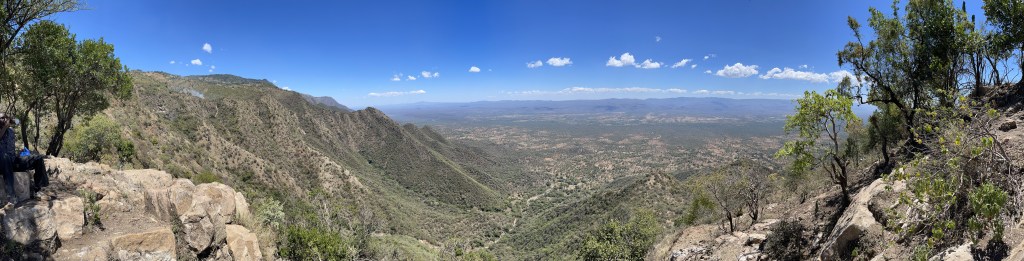
‘Dodgy places’…

EAST AFRICA 2023 – EPISODE THREE

BUILDING WORKS AND HIKES IN UGANDA AND BACK TO KENYA. January 2nd to 18th 2023

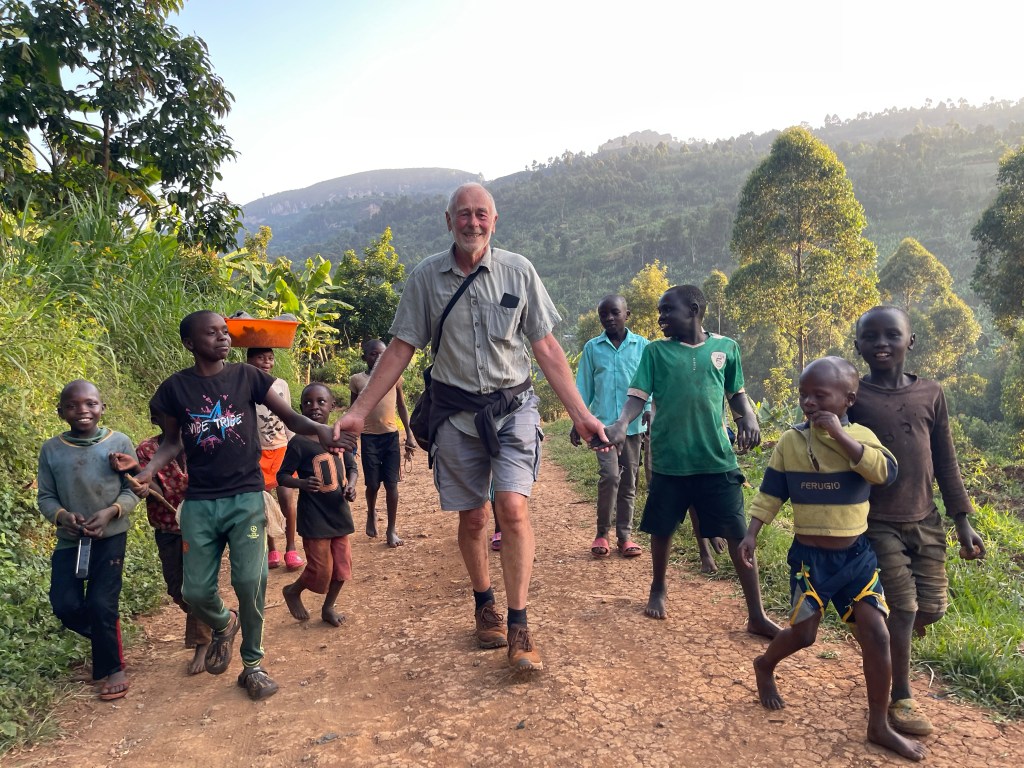
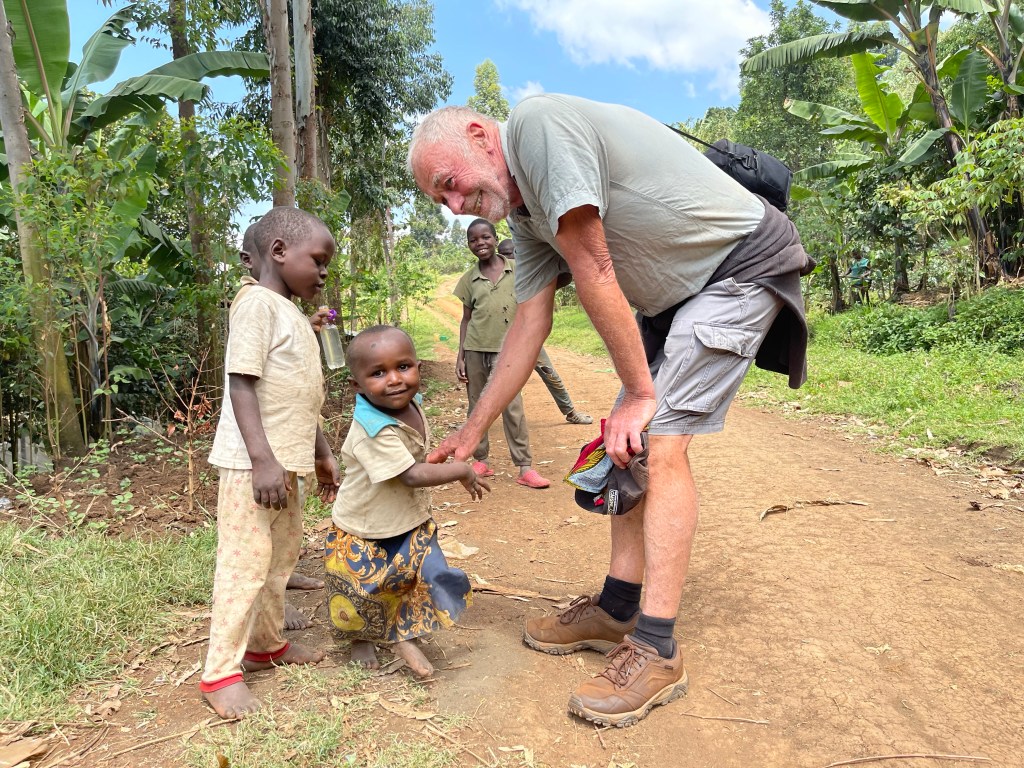
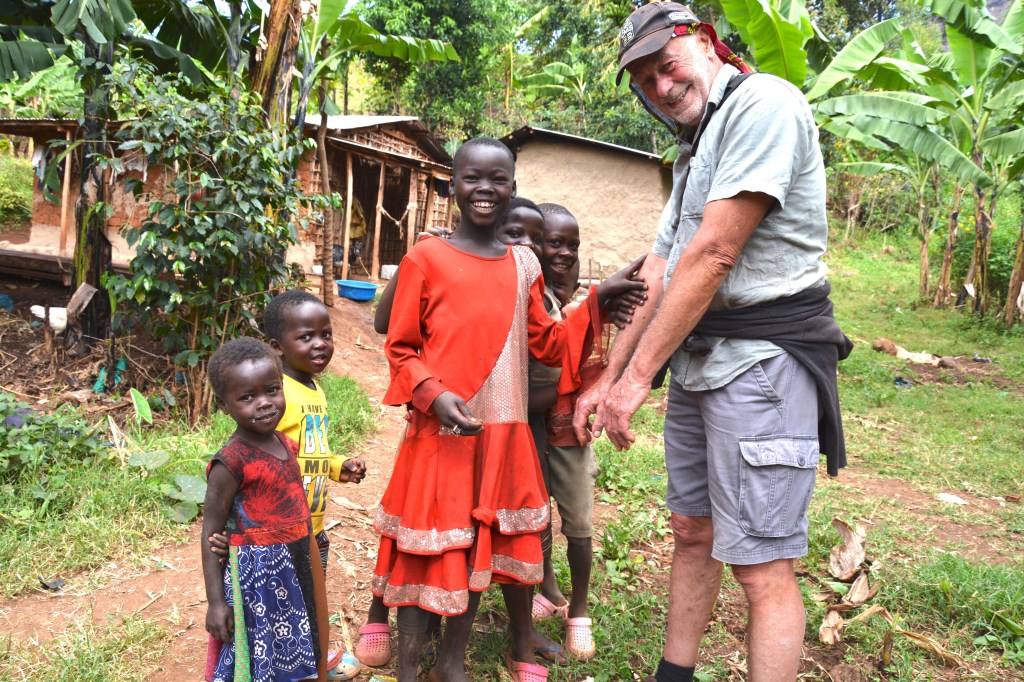
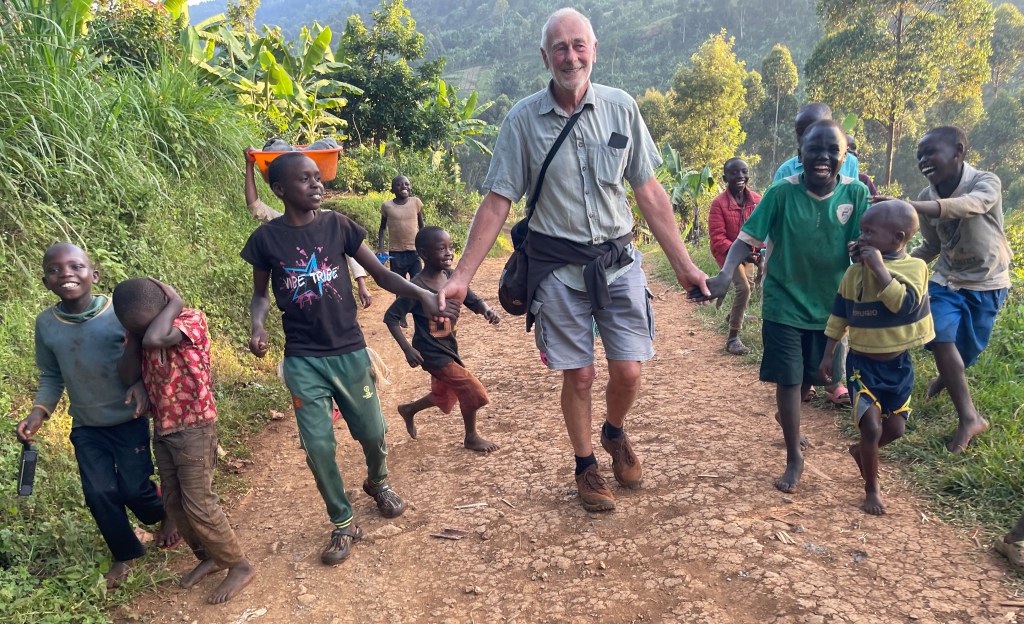
Sometimes I feel like the Pied piper in rural Uganda, where most children have never seen a mzungu before.

Alex and I like to walk, the best legacy of the pandemic, when I came to understand how much we miss in our vehicular haste. Walking, I can tune in with the landscape – and in Africa with the people too. It’s an influence I’ve brought to Alex, for no one here would consider walking for any reason but necessity. “Eh, these white men, nothing better to do but walk!” is a comment Alex has overheard and translated in passing. He now occasionally takes a long walk when he’s stressed – but he tells no one what he’s doing!

Wonderful country for hiking.

Once a week or so, when I stay in Sipi, we take a long hike. It’s great country for it: with the cliffs and expansive views, the huge plains way below to the west and north, and thick vegetation to wander amongst up on the mountain slopes – and then there’s the avenues of excited children we find everywhere in this child-filled land.

Two year old Rosemary is fascinated by the mzungu and greets formally with a curtesy.

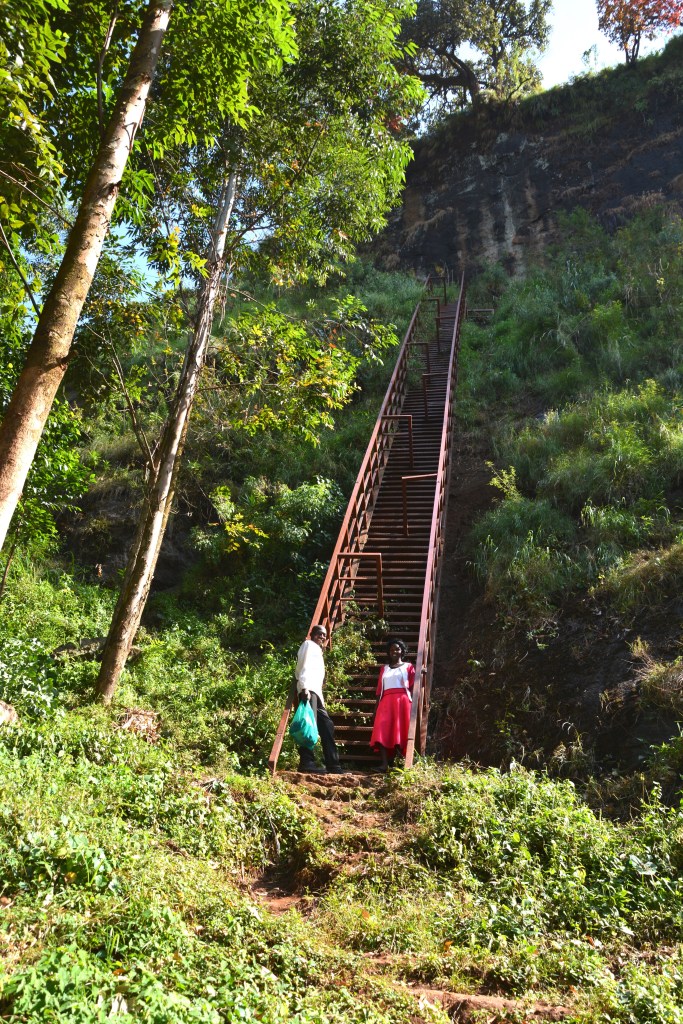
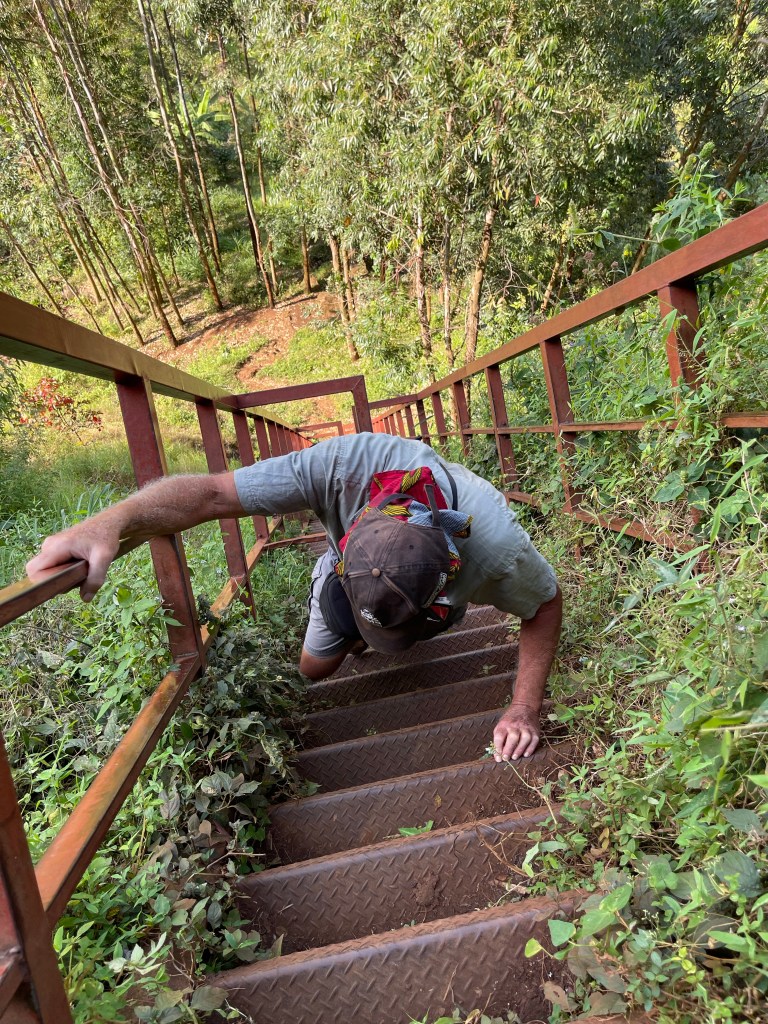
Having completed the kitchen floor, it needs to cure before the next phase: ideal time for a hike. Alex has worked out a route that will take us deep into the valley to the north, and then circle back into the steep slopes above which Sipi stands. That’s the only trouble here: we have to end the day with a 1000 foot clamber after several hours baking down below. By the final cliffs, where we sometimes have to teeter up ladders of twisted timbers, or steel stairways, I am stumbling along – but it’s all part of the challenge…

It’s hot and dry, hiking down to the great plains below Sipi, but the sense of space is energising.

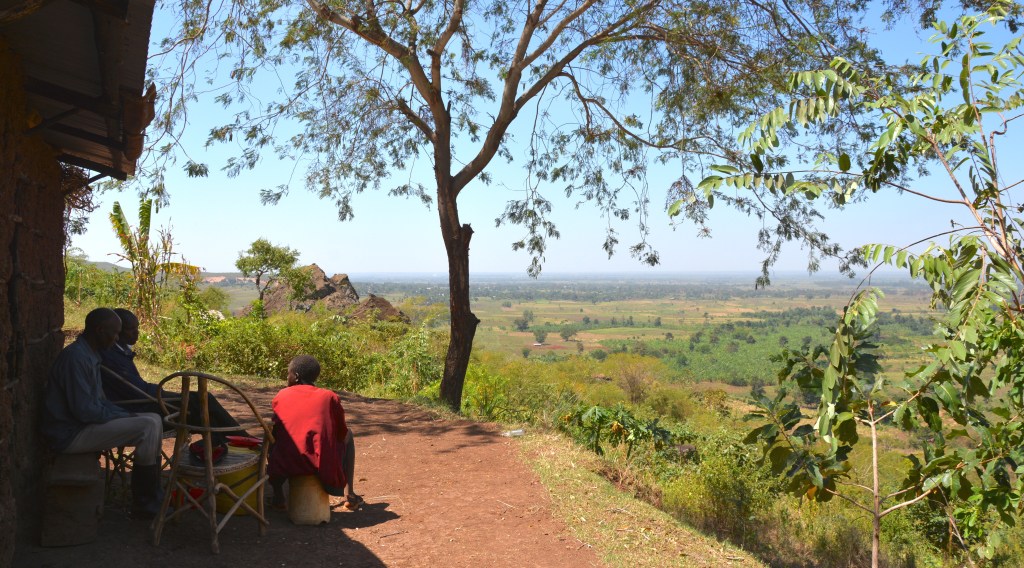
This walk must have been little shy of 20 miles, in a hot dry region, the temperature soaring as we drop into the valley. As we walk down the winding highway from Sipi village, we are joined by a middle aged man, who is going our way. Alex knows him, he’s called Kenyatta, having been born in 1963 at the time of independence. He walks the next two or three hours with us. At one point, we stop for water and peanuts at his farmland, a bumpy patch of hillside far from his Sipi home. Here, he has a mud-hut shelter perched on a terrace with fine views to the north.

Kenyatta’s farm hut and a welcome pause for water and groundnuts. Abraham, Alex and Kenyatta.
A fine view over the Karamajong plains.

We sit on local chairs and drink water he has carried a quarter of a mile uphill from an irrigation water pipe. We’ve also been joined today by Abraham, the small 16 year old who’s been helping with the kitchen work. He’s a nice lad, quiet but hard working, unlike so many. He doesn’t manage the whole distance, and we have to send him back on a boda-boda still eight miles from Sipi – his legs are short and he’s flagging. He carries back three huge sweet pineapples we buy from the back of a pick up for 50 pence each – the best ones I’ve eaten this year. The pineapples I’ve been buying in Kenya come from Uganda too, but they cost nearly three times as much as these.

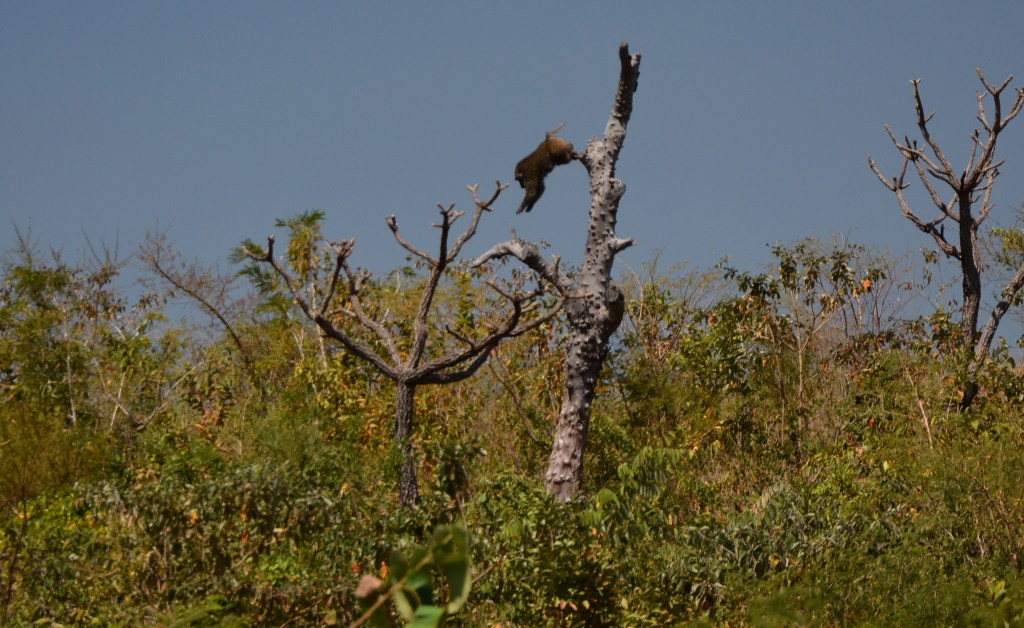
Dropping down the steep dusty paths through the rocks, we come across men yelling and shouting, chasing three big baboons from their crops. Nasty aggressive animals, they watch us from treetops and rocks and Alex is amusingly afraid they are humanly grudging enough to throw rocks back at us as we walk under the cliffs from which they are warily observing us. We can imagine the anger and challenge in their eyes. We put on an involuntary spurt as we pass beneath them!

Perhaps it’s a vindictive baboon!

Finally, we are down to the plain that stretches far, far north across the Karamajong region to the borders of Sudan. I tried to ride that way three years ago, but was beaten by mud after some hard riding. Now, where we finally emerge from the footpaths onto a wide dirt road, they are building a new road – more Chinese debt. We must walk along this road in clouds of dust raised by the big gravel trucks, tedious walking for three miles or so, and when we reach the junction of the tar road that climbs back up into the mountains, I urge Alex that we should take a boda-boda some of the way back up the tar road; there’s no pleasure in walking the tarmac verge beside smelly grinding trucks. The hill is a very long slope, climbing hundreds of feet; I’ve ridden it a number of times, one-up on 200ccs, and it’s a gear-shifting experience. Now we number: the rider, Abraham, Alex and me, with three big bags of groceries that Abraham will take home while we get off and walk the final rises. We’re on a 100cc motorbike with me on the rear carrier. It’s first gear stuff. Slow.

Alex and I alight part way up the hill and take to dust roads once more. I’m happy here, trudging through the matoke trees past earth and stick homes with corrugated roofs. There’s a huge wedding on in the district, so the houses are quiet, just children everywhere, running to greet the very rare mzungu or hiding in fear. So far, we’ve existed the whole day on various mugs of local water from houses as we passed, a plastic beaker of lumpy local drinking yoghurt called bongo (drunk in a scruffy dusty village coincidentally called Nabongo) and a handful of homegrown peanuts. Now we are flagging, even Alex, half my age. We have a thousand feet to climb before I can sit down with my Tusker and relax, at the end of maybe 18 or 19 miles of uneven walking…

Shamadi, met on the road. A joker and charmer!

By the time I get up from beside the fire pit three hours later, I can stagger just about as far as bed. But it’s a grand way to experience the countryside, the thousands of people I have greeted, the hundreds of hands I have shaken and the many – frequently untranslated – jokes of which I have been the butt on this hot, parched, dusty day in rural Uganda.

*

Next day, we clamber 700 feet back down the cliffs to visit Alex’s friend Tom, the wood-butcher who’s built much of the 1818 bar and restaurant and done much of the so-called carpentry at Rock Gardens. He’s asked us to go, as no mzungu has ever been down to the community around his home. Fortunately, I don’t mind being a display item to amuse the hundreds of children.

On display! Boys watch from outside as I relax.
Satya
Chemonges.

It’s difficult to describe the phenomenon of just how many children there are in Uganda. The vast majority of humans I see in any day are children and babies. It’s fun to be such a celebrity, but it’s shocking too, what it means for their future. Most are poorly educated, and by their mid to late teens will be already producing multiple children – probably seven and often more. They too will be sketchily educated, and producing another generation even before they reach school-leaving age. But what subsistence farmer, scratching maize from semi-vertical patches of rocky soil can afford school fees or even has time for stimulating the young brains of these giant families? The churches, of myriad scamming money-making cults, do nothing to stem the tide, male dominated Islam even less. If a woman doesn’t produce, she is likely to be abandoned and sent home (it’s never the man’s fault of course) and the man will ‘remarry’. Precious tells me the story of a mother crying on her knees in the school bursar’s office, whose husband was supposed to take the money to school but diverted and drank it all away with his male friends (£175!); shame set in too late and by then the man had found a sympathetic ‘other woman’ and disappeared. It’s a common story here. Men have so little responsibility and dump all their pride and aggression on poor uneducated women. I’m proud that Precious, born to a large poor family and lesser educated than Alex, is now withstanding extreme peer pressure to produce more than her two delightful (intelligent, stimulated, educated, very-good-English-speaking and bright) children. This couple have decided to give their children a future in which they have an opportunity to achieve the dreams that were so limited for them, Precious with twelve siblings and Alex with eight, plus three half siblings by other mothers. It’s a large part of the reason I support this couple: they actually think ahead, unlike most Ugandans, who bow to family and peer pressure – called, as with many of the other socially costly bad practices of life here, ‘culture’ and ‘tradition’.

Children are intrigued by the hair on my arms. Pity about the handkerchief/ cap! Sadly necessary on these walks by the Equator.

*

The sick old lady died down in her dingy earth and stick hut on the slopes below us. Now the family must have, by ‘tradition’, a huge funeral that will cost perhaps £1000 – in this subsistence community. “Do you think THIS is tradition?” I ask Alex as the noise begins: highly amplified techno-rapp music that will pound through the next three nights, disturbing the entire neighbourhood. Everyone is expected to donate, school fees and hunger not withstanding. Family farmland is sold, valuable cows slaughtered – in the name of ‘culture’. It’s not ‘culture’, it’s pure pride and arrogance. Every funeral must be bigger. Those who donate are praised by the master of ceremonies for their generosity – in front of all the so-called mourners, who are really there not to show grief and support but for the prospect of a free meal.
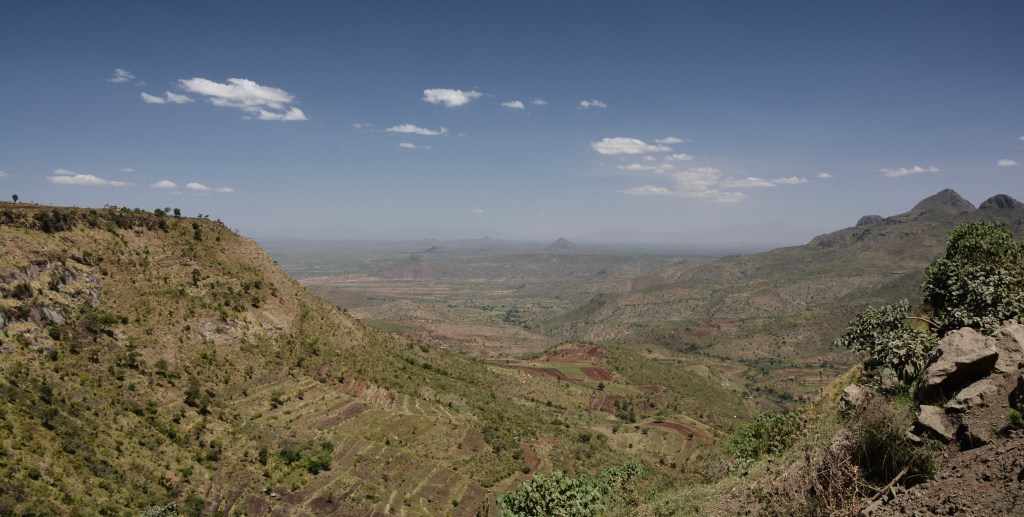
On burial day, Alex becomes MC, this educated younger member of the clan. He tells me of the unseemly fights that ensued over the free food and shares with me his record of the accounts so far. They include (and remember, this is explained as ‘tradition’):

  • Tents and chairs hiring £160
  • Music system £93
  • Petrol (for power) £50
  • Coffin £100
  • Cement, sand, blocks, tiles, iron sheets for tomb £93
  • Food £186

Total – so far… £685

This, in a poor, badly educated rural subsistence farming community where money is always the scarcest commodity.

“If you tell the people to give this money when the old lady is sick – you saw her yourself – nobody will give 50 shillings! That money would fund a child through most its future school life,” says Alex wisely. “Or given to a school, or orphans…” adds Precious. In this country, education is a low priority for most people. Every tiny hamlet has several ‘churches’, usually tin shacks closed all week and less leaky than the majority of crude houses, but no schools. There are far more ‘churches’ in these countries than schools – formed by self-elected ‘pastors’ as a business (that pay no taxes), frequently funded by right wing ‘religious’ Americans, exploiting the poor education and ignorance of the country-people. The chief pastor demanded £7 – considerably more than most earn in a day, for transport from just down the road (a boda-boda would be perhaps 1000 shillings – 20 pence) to come to lead the funeral prayers. The whole shebang is no more than a money-making opportunity; the funeral a chance of free food and drink or to demonstrate status and ‘generosity’ of the Big Men. With no election due, there were at least no politicians to make capital from it by distributing tenpenny bribes to potential voters but I could hear, from half a mile away as I worked on the kitchen, the amplified rants of fake pastors and self-serving speeches from local men of ‘status’.
This is what ‘tradition’ has become in this crumbling country. Life here can often be very depressing. Despite my pleasure at everyday times in the family, I am VERY thankful I don’t have to live here in this decrepit, backward land, ruled by avarice and corruption. Poor Alex. Integrity brings such slower rewards.

*

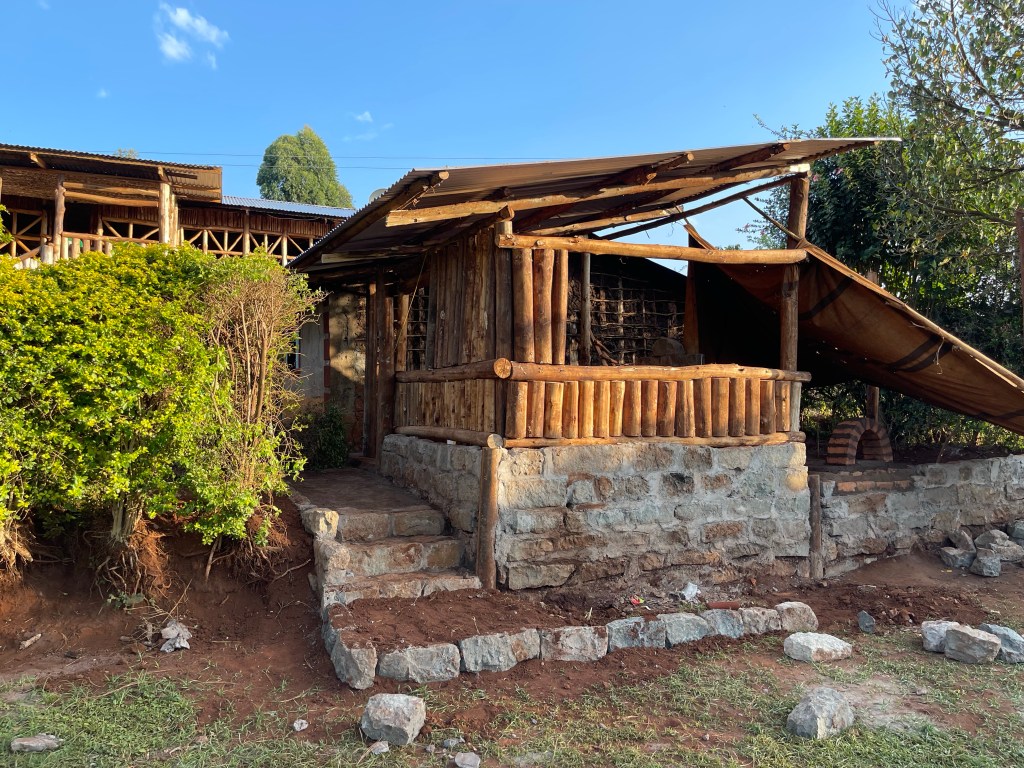
The rustic kitchen develops.

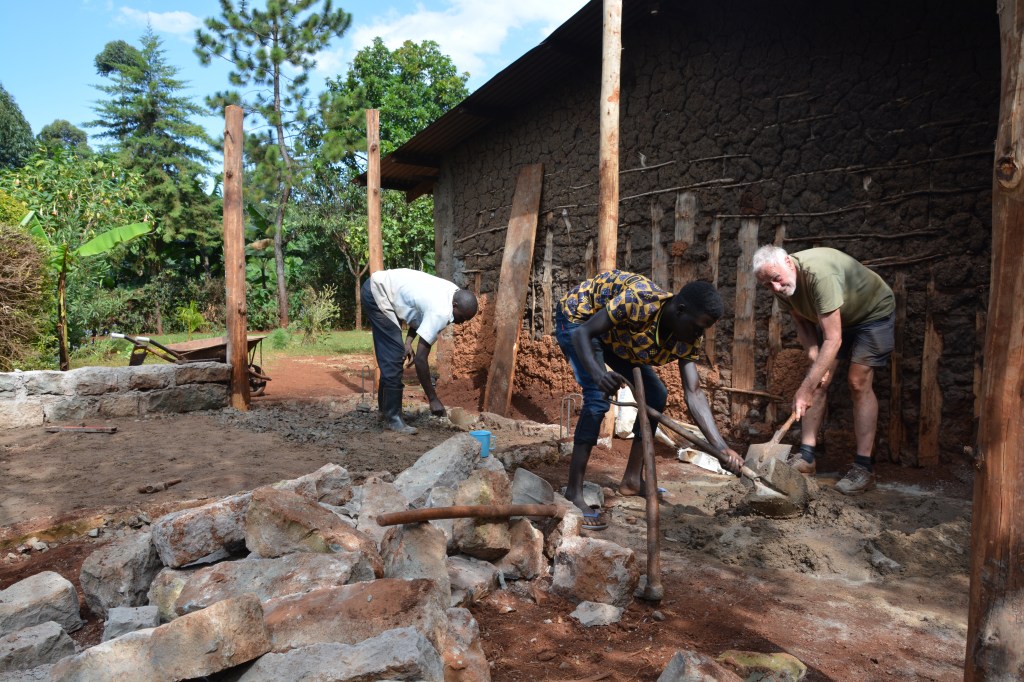
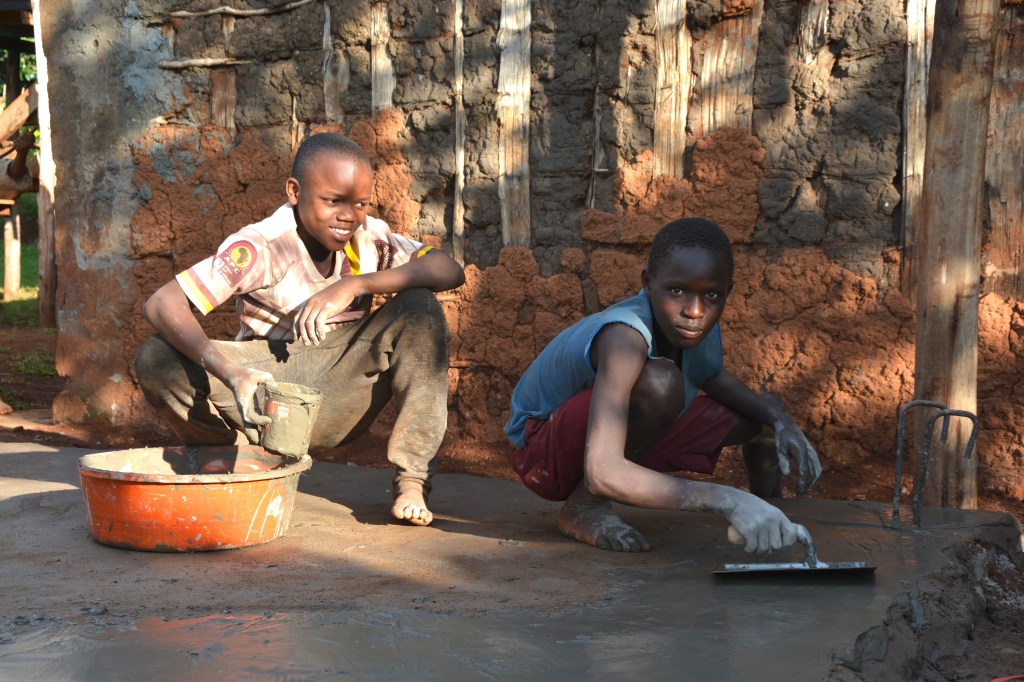
While Alex acted MC for the burial day at the huge noisy funeral, I worked with wood-butcher Tom on the kitchen. It’s one of the most frustrating events of recent life. If Tom can do things awkwardly and illogically, he does. He wants no new ideas and is resistant to experiment, just content to do things ‘the way we do it here’. And no one wants to actually WORK! They prevaricate and get distracted by phones, expectation of food, chatting with visitors – and they NEVER clean up. Alex laughs that most of the dreadful ‘workers’ who come because they think the mzungu has a lot of money, never come for a second day: I make them clean their tools and the worksite before they leave, and I lead and drive them into much harder work than they are prepared to do. As a consequence of my energy we use a changing succession of inept, unmotivated labourers! Alex, returning in the evening from the funeral was astonished that I had driven Tom to do so much in a day. We had raised the entire kitchen structure of posts and roofed it with zinc sheets.

“This would usually take him three days! Mama Keilah, how long would it take Tom to do this work himself?” exclaims Alex.

“Four days at LEAST!” replies Precious as Alex laughs that I even made Tom use local tree posts. “Eh, if I’d told him he must use local posts, he would have REFUSED! He’d want me to buy cut wood. Expensive!”

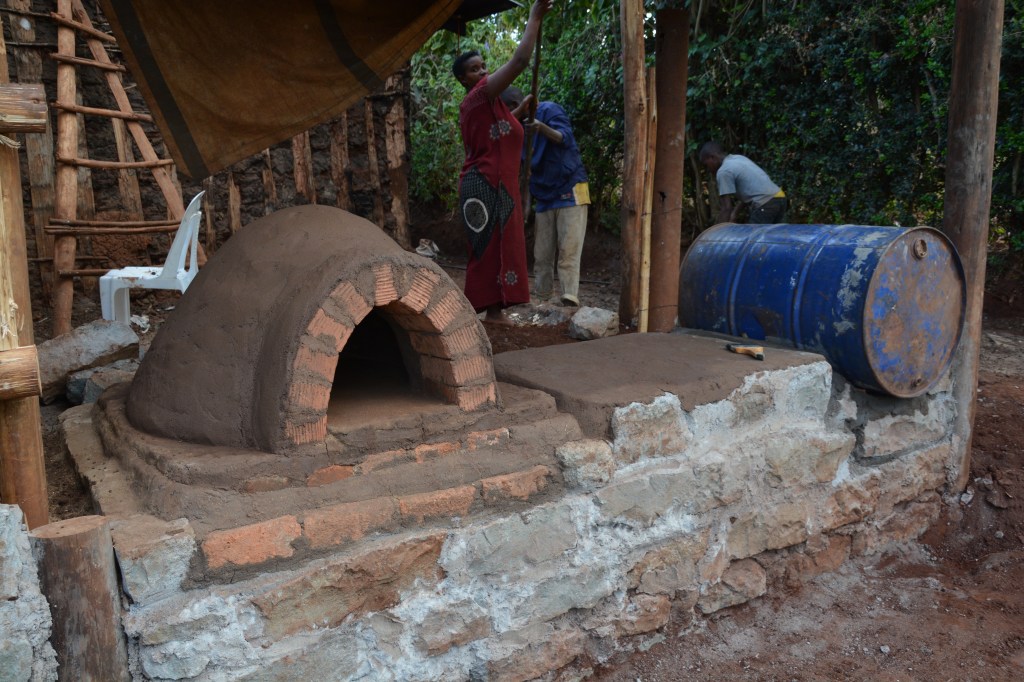
Bread oven, table and water heater. A bit medieval maybe, but novelties in Sipi.

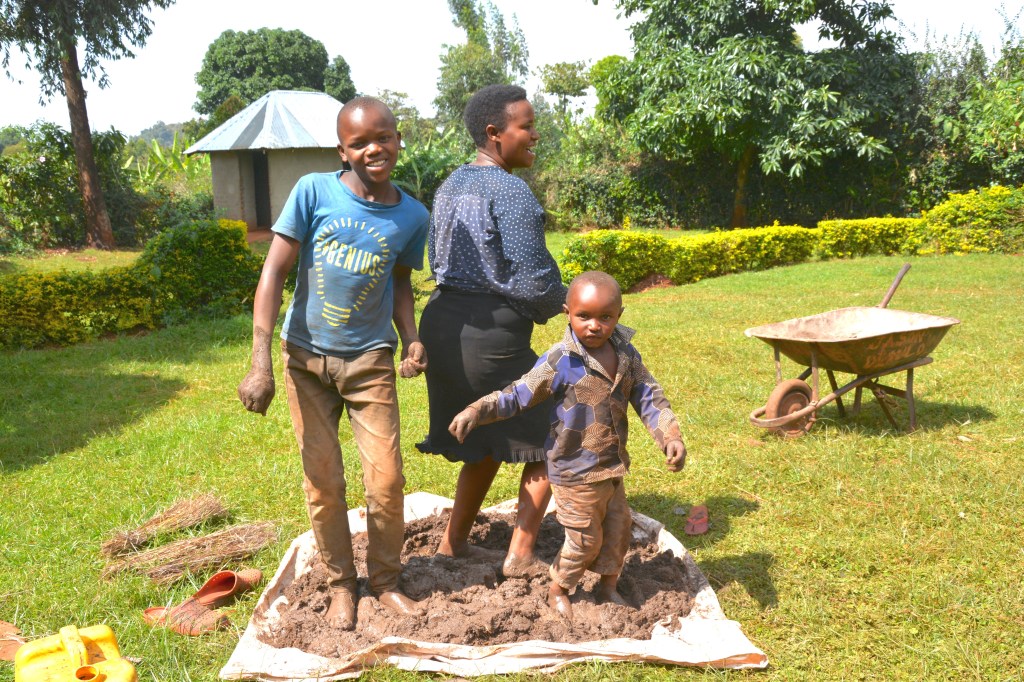
Meanwhile, I am also constructing a mud bread oven from a book I found in a Totnes charity shop. We’ve had fun with that, as the mud needs to be worked into a paste with the feet on a tarpaulin. One day, we worked just as a family, the children and Precious joining in with gusto and a lot of jollity, treading mud, dancing and singing. Family life at its best: all focussed on our project. Precious and Alex are desperate to be able to make real bread like that they ate on their visit to Kitale where they enjoyed Adelight’s bread, a tradition that’s travelled the world: Joy Bean’s bread recipe.

Dancing in mud. Rach, Precious and Jonathan Bean 2

*

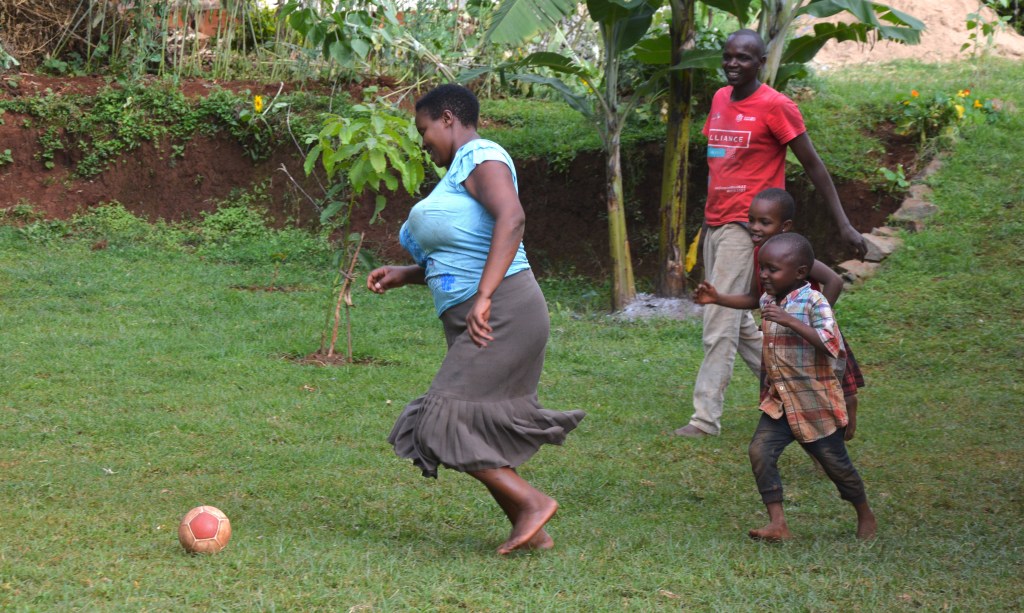
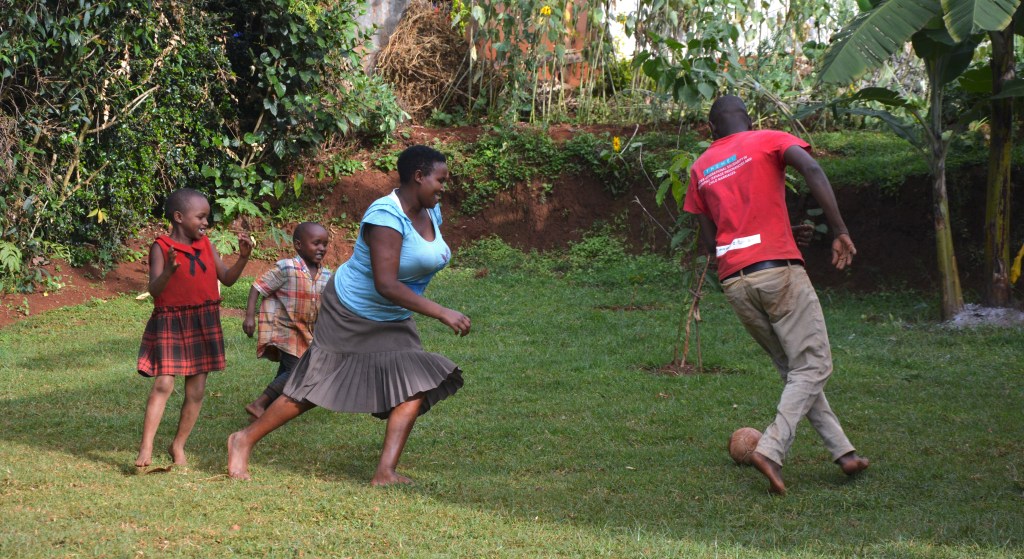
The two children have been a constant source of delight. Now there’s an admission! Keilah is five and a half, and Jonathan just over four. They are intelligent and stimulated and being close in age play happily together with shrieks of fun. In the evening, they come with long stories from their lively imaginations. Jonathan talks endlessly and noisily, while Keilah is quiet and very charming. She’s a pretty girl and warm-hearted. Each morning I get a run and a hug. JB copies most of what she does. Both speak English fluently already, as well as the local languages. They are bright. When we work together they have the greatest glee: with trowel and cement they help as they know and quickly learn. They are usually filthy beyond description by the end of the day in this mud and dust-filled homestead. They are unsophisticated, just small cheerful children. There’s not a ‘device’ in sight and apart from JB’s football, there’re no toys: Keilah’s Chinese plastic recorder and Jonathan’s Chinese plastic police car, so coveted at Christmas, are things of the past, already in local landfill – buried with all the other Chinese plastic rubbish in the pit from the old latrine. The football, however (leather and NOT made in China), was an inspired present, sometimes bringing together the whole family in a spirited game amongst the shrubs and flowers of our burgeoning gardens.

*

In a desperate need to focus on something more than cement, sand and stone, I suggested another hike. This was one of our hardest. It’s magnificent scenery for hiking, but very hard work, along the edges of this high escarpment. We walked for eight hours, probably about 18 miles again, but that doesn’t tell the half of the effort, for we must constantly rise and fall over these lower slopes of Mt Elgon, and sometime descend the cliff faces, only to clamber up again further along our walk.

Lovely country for hiking, but a LOT of up and down!

Our destination was one of Alex’s sister’s home, around three great outcrops of the escarpment. We’ve hiked this way before, but every route is different. With the expansive plains of northern Uganda down to our right, we scrambled part way into the valley between the first two outcrops and took to a dust road through endless small villages and scattered habitations. I said before, it’s difficult to describe the experience of being in a country with such a VAST population of children. Where we walk in these rural areas, most children have never seen a mzungu before. Cries surround us: “Come and see! There’s a mzungu coming! Come and see!” Sometimes, it’s not just the children either. Hundreds upon hundreds come from their fields and doors to observe the phenomenon, to greet, shake hands or just stare. Old ladies call out in their local languages (and those change every few miles. Just four or five miles from home, Alex – a true linguist – is struggling), “Thank you for the visitor to our village!”

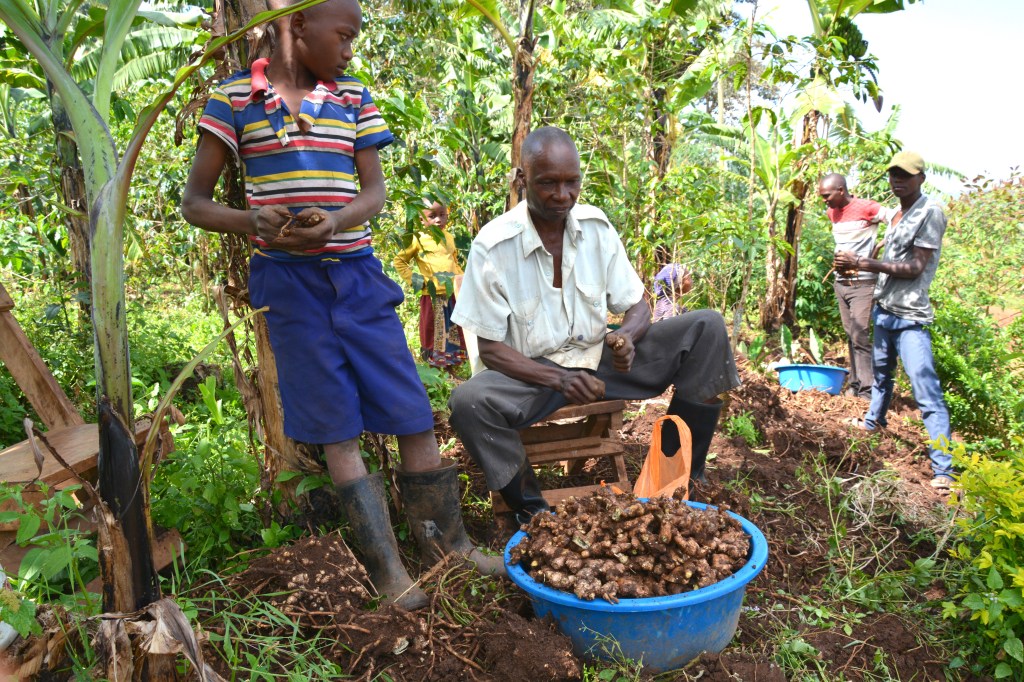
Ignatius harvesting ginger.

We come across Ignatius and his family harvesting ginger on an embankment beside the road. We poke and investigate, and walk on carrying a couple of kilos of ginger for our masala tea, that I enjoy so much. Two kilos from Ignatius direct costs us 40 pence. Alex is delighted; in town it’d be at least £2. And that £1.60 can feed the family for the day or two. Later, at Alex’s sister Doreen’s home we drink coffee grown right here on the slopes around the mud house, in her shamba.

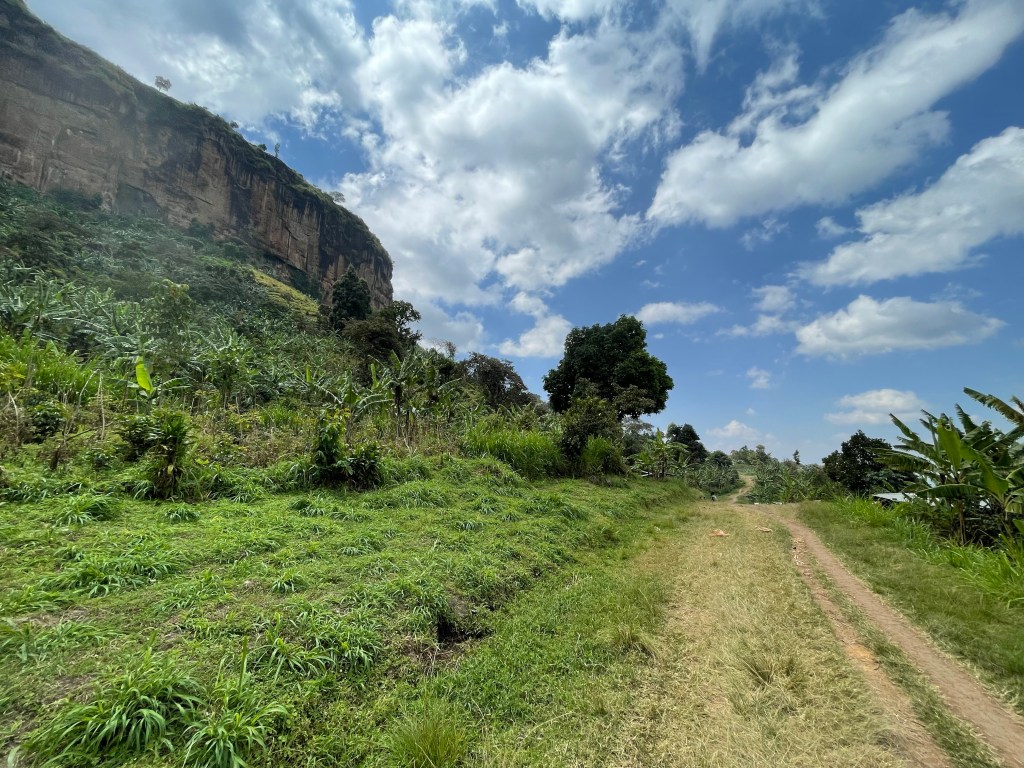
The views are spectacular. On our left, the great cliffs soar towards the bright blue, sun-filled sky. Trees teeter along the top edge of the sometimes overhanging precipices. It’s very dramatic, this enormous volcanic scenery. It’s green, green, green, heavily cultivated by the legions of subsistence farmers wherever there’s a chance to carve out a tiny field or terrace. And amongst the thick growth hundreds of basic mud and stick homes with rusty zinc roofs are hidden. Sadly, one gets used to wading through acres of plastic refuse: it’s everywhere underfoot and we crunch on single-use bottles, and black plastic bags wave everywhere. Broken Chinese products litter the slopes amongst the graceful matoke trees. I realise that I’ve become almost blind to the filth. I have to frame it out of my photos.

Playing marbles.

We are warmly welcomed when we stop for water here and there at houses we pass. Children come to stare from doorways, many of them reacting to my outstretched hand of greeting, but others running away with squeals and wails of fear. Some children approach bravely, intrigued by the odd being passing among them. Many rub the hairs on my arms in fascination, unlike the smooth skins of their own race. They like to feel the ‘pig’ hair on my head too when they get opportunity. Alex once wrote about his walks, when he takes along his phone camera, inspired by me to photograph people, “But I am not a slebrity like you!”

The great plain stretches FAR below.

At Doreen’s house, we stop for a couple of hours. She insists on a meal to follow her own coffee. We must submit to rice and some stringy meat in a stew – ALL meat here is stringy, a trial for my teeth; I haven’t an appetite in the heat of the day but I must make a show. When we leave, we are carrying a kilo or two of fresh coffee beans and a large bunch of just-plucked spinach.

Hard country…

Doreen and her husband, Leonard, will accompany us to the base of the huge ladders that cling to the cliff 500 feet above their home. High on the mountainside, at the bottom of the first steep steel ladder, we say goodbye to Doreen, but Leonard volunteers to guide us several more miles on our way. He’s a pleasant fellow, a subsistence farmer, intelligent and a good conversationalist with lots of local information. He and Doreen have four children I think, but as we walk, Leonard gives me the shock of the year so far. I am talking to him about the VAST population of children in this country, with 55% of the population under 18 years old, second in the world only to poverty-stricken Niger…

And then Leonard tells me that his father has 60 children!!! With ten ‘wives’ (aka baby-making machines) he has SIXTY children. Leonard is from the most recent wife… I doubt the father can even remember – maybe not recognise – that many children. And how can he hope to give them any life but that of subsistence? Even Precious is shocked when I tell her next morning. “SIXTY?!” she exclaims. “Look how hard it is to care for TWO!” as Keilah and Jonathan race about the garden making cheerful noise. What hope is there for this crippled country?

To Alex’s laughter, I suggest that perhaps circumcision ceremonies aren’t drastic enough…

*

Just don’t look down!
Or over the edge…

Leonard leaves us after about five miles at a junction by a bridge. We’ve just had to drop steeply down through small farms with children shouting, “Come and look, there’s a mzungu!” Leonard is amused. He’s never walked with a mzungu before. He’ll be taking stories back to the family as he hails a boda-boda to carry him home.

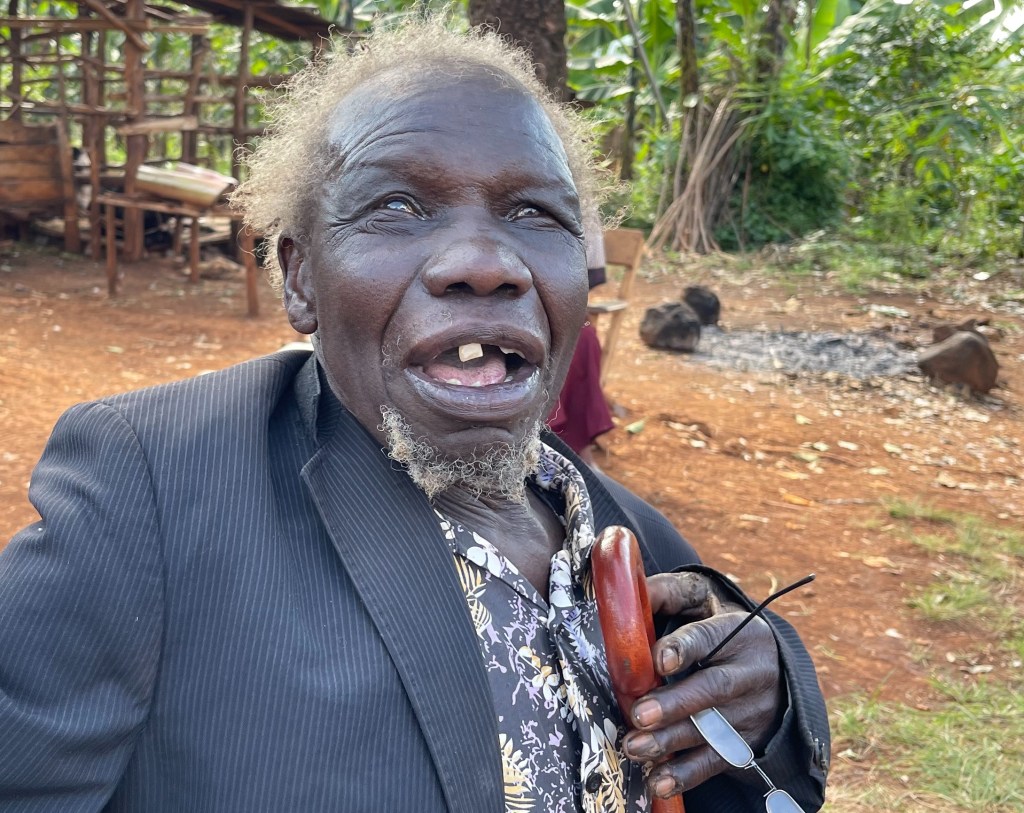
Ambrose, 83, stopped us with a history lesson on Uganda’s independence
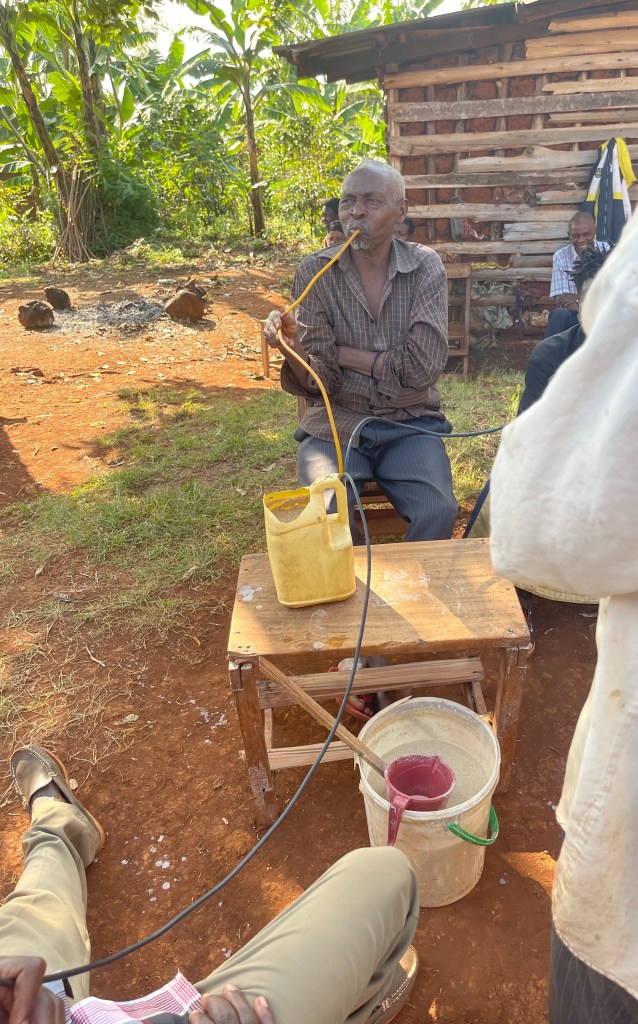
Ambrose and his friends were drinking local maize beer. It’s drunk through nasty plastic tubes and the container constantly topped up with warm water. It’s pretty disgusting (IMO)!

The sun’s getting very low and we now have to struggle up the other side of the steep valley. It’s an endless climb, accompanied by a Pied Piper groups of children dancing and joking: one of them has a small battery music speaker. It’s fun and makes us all laugh. There’s so much goodwill it’d be impossible not to enjoy such jollity, even though both Alex and I are now tired out.

We’ve another six miles or so to stagger and I realise we’ll be walking the last couple of miles in the dark. I hate that as I don’t have the night vision that most of my Africans seem to enjoy.

I’ve brought along my head torch just in case. We stumble the last miles in pretty much pitch blackness on the broken dust road. My sock’s worn through to a blister, but poor Alex admits next morning that his blisters were between his thighs! He’s an ideal, easy-going companion for these long days: intelligent and quick, friendly to those we pass, and informative about the life around us – and always willing for just one more hill.

*

Charcoal stove in the part-completed kitchen.

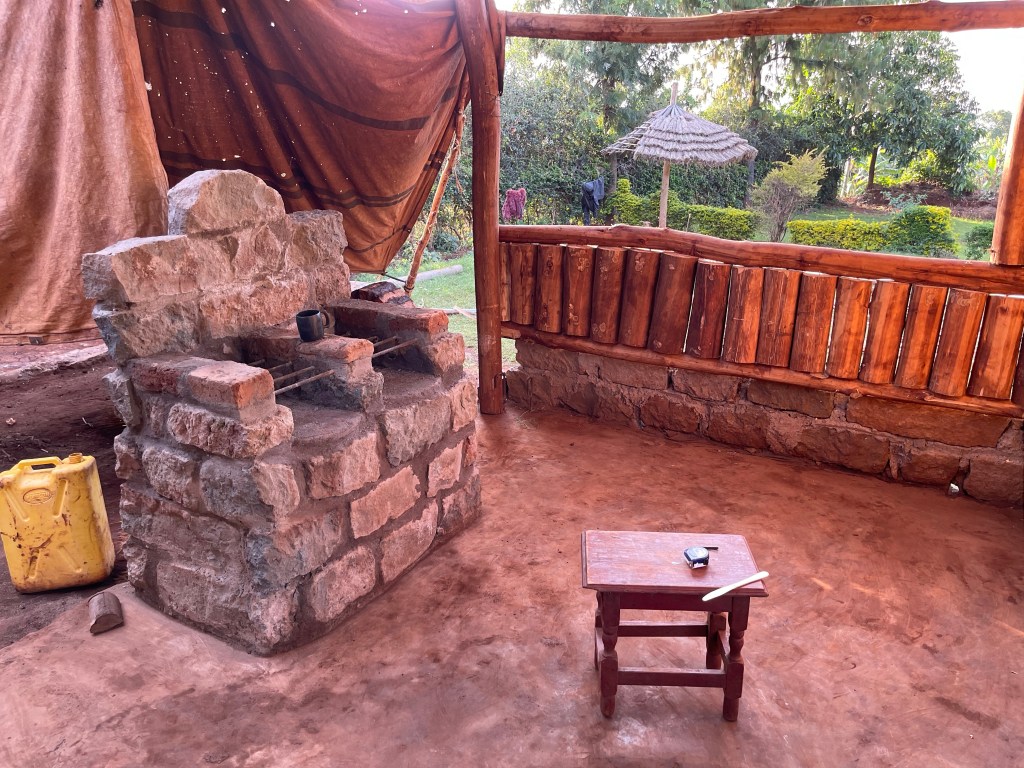
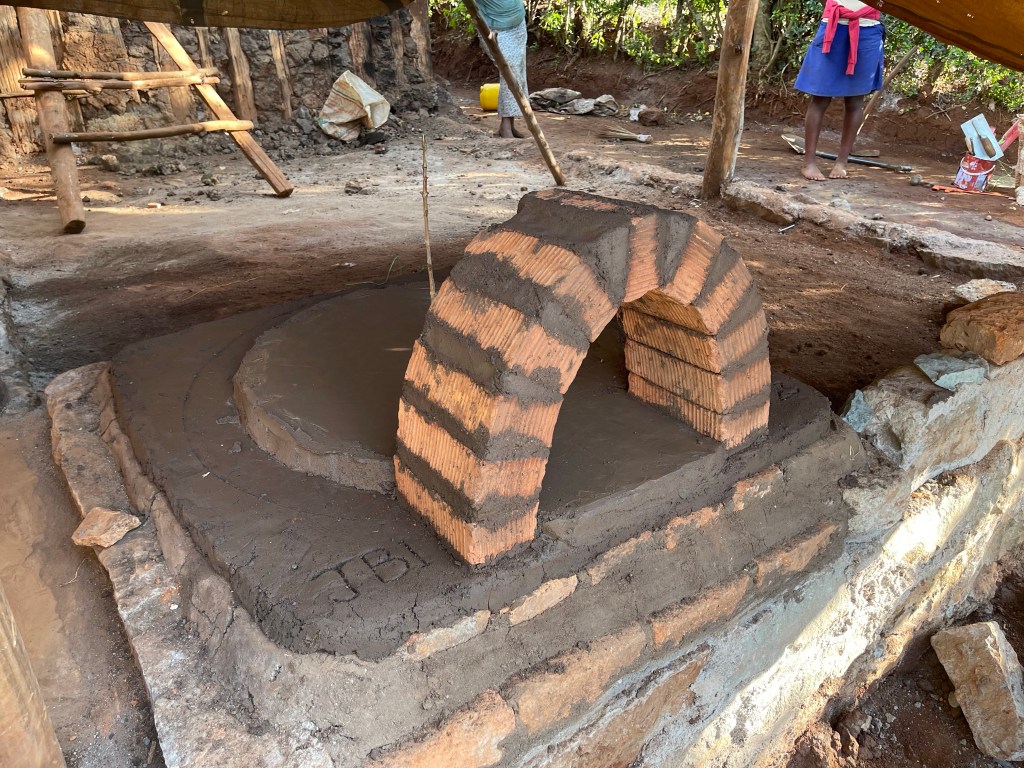
Our new kitchen is rather rustic in style, constructed from local freshly cut eucalyptus trees, with a zinc roof. I’ve built a substantial charcoal stove from stone, more heavy work. Behind it I am building the bread oven. That’s been a process adapting the instructions in the book to the – very few – tools and materials available here in rural Uganda… There is of course plenty of mud! It’s the bane of my time here: everything covered in a layer of thick red dust, until it rains and becomes slithery mud. We buried empty bottles for insulation (even those are scarce, when they must be paid for if not returned to the wholesaler) in a layer of mud-crete – earth and sand mixed and beaten smooth by various feet. Then I managed to form the brick arch. The book told me blithely to make a forma of plywood or 4×2 timbers. Yeah… Try finding anything as useful as those in Sipi. All I had was Alex to hold up the two sides as I inserted the keystone, holding it all with claggy mud.

The arch. I was proud of this in the circumstances…

Behind the arch, on the mud base I had a frustrating time forming a dome of damp sand, not easy in such a hot dry climate. We rigged up a shelter from an old piece of borrowed canvas to provide shade. We needed newspapers to cover the sand dome, and even those had to be searched for in this community. I can’t rely on a store of useful ‘stuff’ for inventing practical projects: there’s nothing here except earth – everything else must be bought (and is often unavailable anywhere closer than Kapchorwa, ten miles away), or traded for pennies from neighbours. No one shares much here: it’s very much a cash-based rural economy. Everything, even scraps of timber or stone, has a value amongst poverty. One of the most irritating aspects of working here is that the inept ‘workers’ whom we employ frequently leave their filthy work site and steal the few tools we have, most of them brought by me from the hardware supermarket in Kenya. Tom, the wood butcher, has taken our tape measure and hammer. Martin, the useless ‘mason’, has pinched our decent float and best trowel. They have to be retrieved with argument, and are always damaged and unclean. It takes patience and resolve to achieve anything here.

*

The two JBs get stuck in with trowels and cement.

But it’s the children who have given me so much pleasure these two and a half weeks, with their noise and energy, such that many days I haven’t left the compound. We’ve worked together, Alex and I, assisted by Rach, one of Alex’s half brothers, aged 14, Mark his bar keeper and Precious. The children have joined in with gusto, slapping cement and plaster about as they watch and learn. At this stage of life, they are lucky to have no ‘devices’, as they learn to interact and work with others or to make their own fun with their bright imaginations. In some ways, to me, this is a healthy environment that allows them to be just children for a time, although African children have many duties in the household. The persuasive influences of commercialism generally pass them by: they aren’t targeted by rampant consumer pressure and material aspiration; they have no ‘stuff’ and are dressed in grubby rags, but life is happy and carefree in a very old fashioned way, loved and fed by fond parents but free as they wish. In many ways an ideal young childhood I think.

Keilah
Jonathan

*

Work continued: a second thick layer of mud and saw chippings from the eucalyptus trees that are constantly and rapaciously felled for building and firewood; a wood fired water heater from an oil drum and stone and more wood butchery by others.

*

JB2

Then a ride back around the big mountain after 16 cheerful, hard-working days because of a problem with my credit card. Of such are the new rules of international travel: I needed better internet to sort out my finances! Mind you, when I think back to the frustrations of my earlier world wanderings and managing money far from home – with NO internet, just dog-eared ledgers; travellers’ cheques and crumbling banknotes hidden about my body – I suppose a three hour ride in wonderful scenery is better than that time spent fretting in aged banks beneath dirt-whirling ceiling fans…

*

Precious cried and I rode away up the rutted red dust track, sad to leave.

The ride back to Kitale is so beautiful. Now I can blow along at speed (well, 200ccs only allows ‘speed’ to be about 50mph) on a smooth curling road, remembering from wayside topography where I used to struggle down steps of rock, twist along ledges of slippery dust and slither up and down those hills through the pine forest in an all-enveloping cloud of fine red dust. By next year, all effort will be a thing of the past. I miss the delights of the old track, but maybe as an ‘old’ rider there are advantages to the new road!

*

You will have noticed that this safari is different from so many others. For half a century my travels have been footloose and exploratory and except those to Navrongo, the African journeys mainly overland wanderings. These past two or three years, initially thanks to pandemic restrictions, but now through instinct, I’m finding much pleasure in concentrating my energies on those I’ve come to respect and love as family and friends. I’m also able to share my good fortune at still being employed and well paid at my age to provide a measure of independence and good education for a few people’s future. There may be some more adventurous travels in February, when I look like having a (paid plus expenses!) contract to arrange and direct some filming in Tanzania for my American associates. That will be in a far remote corner of north western Tanzania that I’ve ridden through just once before, close to the borders of Uganda and Rwanda, around the bottom of Lake Victoria from here, but maybe only a three day ride, an area I’ll be happy to explore some more. My customary good fortune continues!

Precious’s sister Rhona, JBs 1&2, Precious, Keilah, Mark the barman, and Rach.

EAST AFRICA 2023 – EPISODE TWO

Christmas and New Year in Kenya and Uganda.

I’ve been away from internet access in Uganda since the 2nd of January, so it’s been a while since I updated. So there’ll be two episodes coming in quick succession.

With Keilah, Maria and Jonathan Bean Cheptai.

Christmas in Africa is a very different experience to the commercial, materialist bonanza of the season in the so-called developed world. ‘Developed’? I frequently question arrogance while I am in Africa. Yes, developed in the way that we have rejected many of the ‘cultural’ restrictions and belief systems of less educated Africa, but socially Africa has retained many of the more humane emotions that we have lost to the material ambitions and aspirations that seem so important to our way of life. Christmas here, where few have money anyway, is a family festival without the cost-counting I’ve come to associate with Christmas in the North.

Here, all travel home to commune with our families, few carrying those expensive gifts so much expected in other parts of the world. Of course, all here know that I represent that material world and are happy with my small gifts, but none are expected: it’s not an obligation, just a way to have fun together. The small children are excited by coloured pencils, a football, a toy car, a plastic flute. Maybe by giving these I am subverting their Christmas? But there is no expectation – that’s the difference. No one will count the petty cost of my small gifts: the fun is in having a rare parcel to open, wrapped in the only paper available, cheap and thin.

*

On the 27th, we drove to the border post, 30 miles away, to collect Alex, Precious, Keilah and little Jonathan for their ‘foreign’ holiday. For Precious and the children, this was a first time ‘overseas’, as we joked about the insignificant trickle of the Suam River that divides Uganda from Kenya just here on the lower slopes of Mt Elgon. The new road, so unlike the hard trail riding I used to enjoy so much between the two homes, makes for speedy transport now. I’ll miss the challenge of what used to be a long, hard ride but I must concede that the new blacktop will bring economic advantages, access and new wealth to this poor, inaccessible region.

Now the Sipi family arrive at the border without hassle; they can travel between the two countries quite informally. Many here share tribal roots anyway, on whichever side of the unthinking colonial borders they reside. Adelight herself is partly Ugandan, and everyone has relatives across these leaky borders. It’s more bureaucratic for me, but for them, they just walk across the decrepit bridge to the tumbledown corrugated iron and timber plank sheds that will soon be abandoned to history in the huge construction project to make a modern One Stop border. I liked the old border post, all mud, huts and dust-covered tents; it had a certain charm and overland adventure feel, and I became known from year to year as the old white man on the motorbike. Soon, it will be all show and impersonal formalities in big mirror-glass, concrete offices and the new soaring four lane bridge.

The Sipi family are a little overwhelmed to be away from home. But Keilah’s welcome of ‘her mzungu’ is delightful, knocking me backwards with a cannonball run, arms outstretched in excitement. For Precious, her generous welcome and cushion hug is perhaps thankfulness that at my advanced age I have survived the nine months since I last rode away from Sipi. My four year old namesake has lost all fear of his mzungu uncle and become a talkative, energetic child. And for Ugandans coming to Kenya it is a bit like getting back to Europe for me: relatively ordered, considerably less corrupt and richer. Poor, poor Uganda, struggling from decades of utterly corrupt government; vast world loans – that it was this week calculated will take 95 years to repay; crippling over-population and the vagaries of climate change adding to the toll of economic failures. A country in a complete mess. Kenya, by contrast, is a country of relative cultural freedom, reduction of old fashioned social pressures to conform and free(ish) from massive corruption that exists at every level in Uganda.

Jonathan, Keilah and Maria soon play.

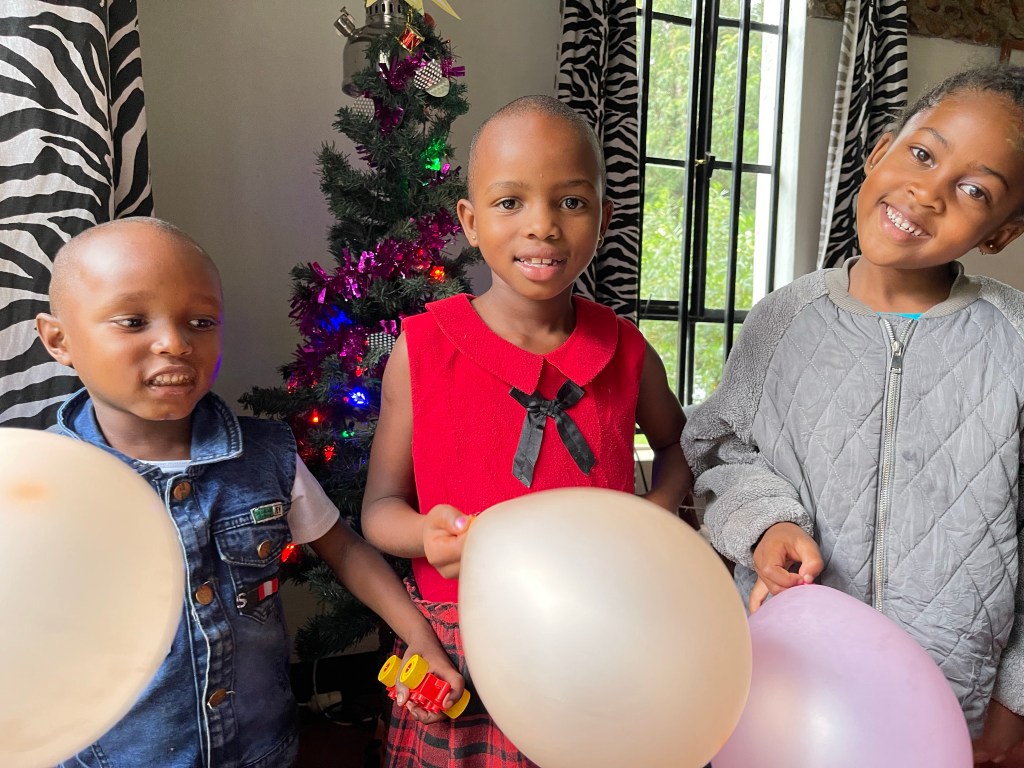
At home, the children soon bond again – Maria and Keilah have remained firm friends since we all went to Sipi in early 2020. Soon, Maria’s much-repaired bicycle and the playhouse that Rico converted from the old chicken shed, are causing noisy excited cries. We’ve put balloons in the trees to welcome the foreigners and there’s a festive Christmassy air about proceedings.

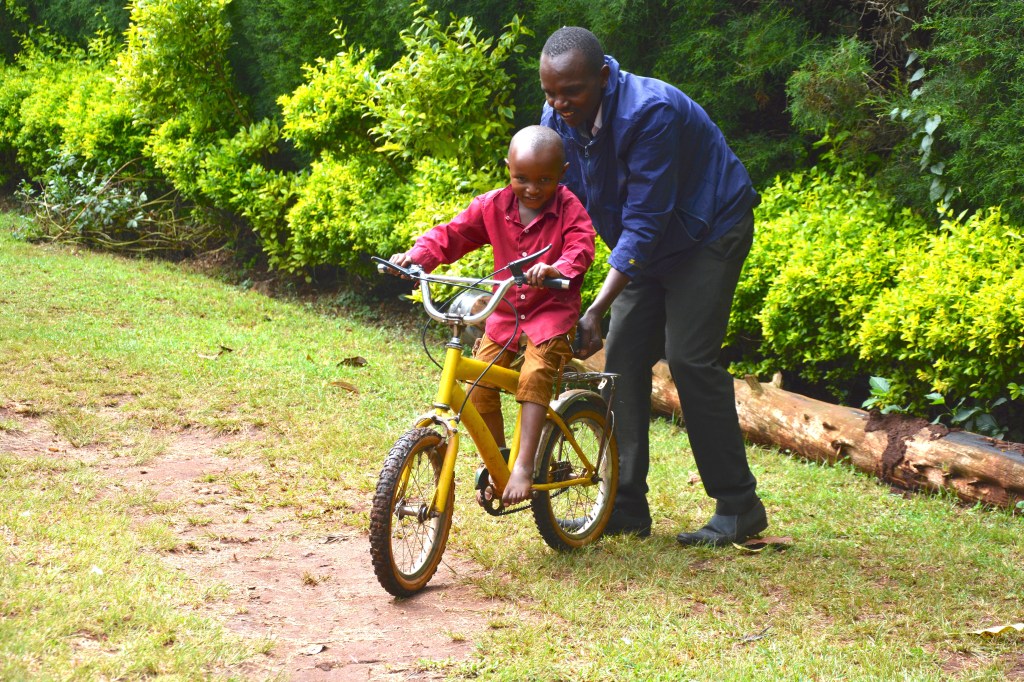
Alex gives JB2 a bicycle lesson.
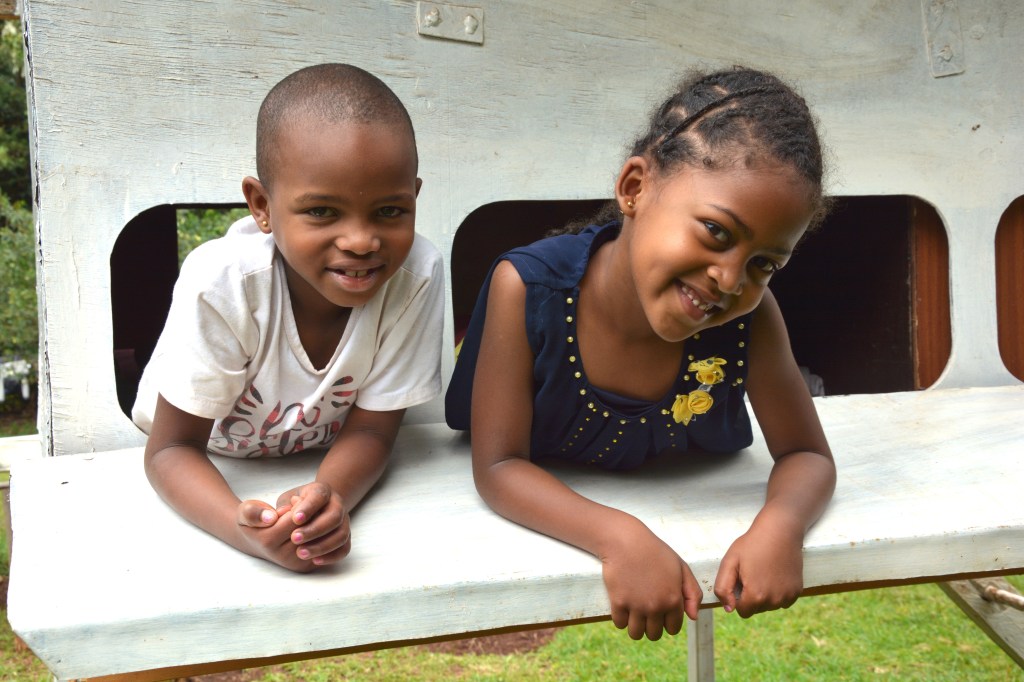
Keilah and Maria enjoy the playhouse.

Next evening, I have small gifts for the Sipians too, opened with spontaneous dancing and excitement. It’s rare for anyone to get a gift here. The children dance to music from a phone and little Jonathan, at first reluctant (“Dancing is for girls!”) makes us all laugh as the most enthusiastic dancer of all, and last man standing. It’s all simple, humorous fun. JB2 has a small leather football that will not leave his hands for days, and a Chinese plastic police car that will be clutched all the way home in their matatu, but be demolished soon after they reach Sipi. Keilah has a Chinese plastic flute that will bleat away for days, until it too disintegrates in Sipi. For Alex, flower seeds from Harberton, and for Precious a framed photo of her with her mzungu, and a pair of secondhand shoes Adelight has chosen. It’s all simple and heartfelt, causing wild dances of joy. For Precious, a glass or three of very rare wine helps the excitement. Alex drinks his tea as usual. That night, JB2 can’t sleep from over-excitement.

JB2

Alex tours Rico’s compound and garage picking up ideas, and Precious and Adelight spend a few hours in town, for Kitale is like a big city beside Kapchorwa, the only town available to Precious. I introduce Alex to the hardware supermarket, unlike anything we can find in Uganda. Then we walk the four miles home, carrying a heavy can of floor paint – unknown across the border – and a box of plants from the big nursery on the outskirts of town. He’s amazed how much choice there is and reckons he’ll be a more frequent visitor now he can reach Kitale by matatu in four hours.

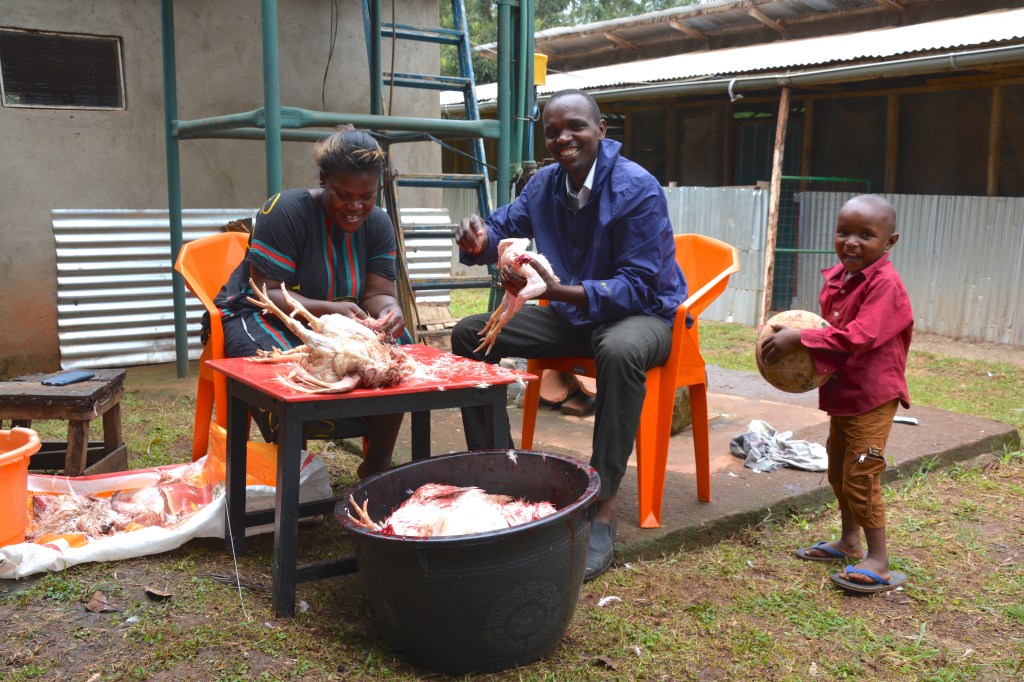
Adelight, Alex and Jonathan pluck an urgent order for Adelight’s chicken business.

The Sipi family set off on the 30th, Alex always anxious for his business; Jonathan clutching his plastic police car and Keilah and Maria hugging goodbye amidst the construction works of the new border post and walking away over the broken down bridge to find a matatu home.

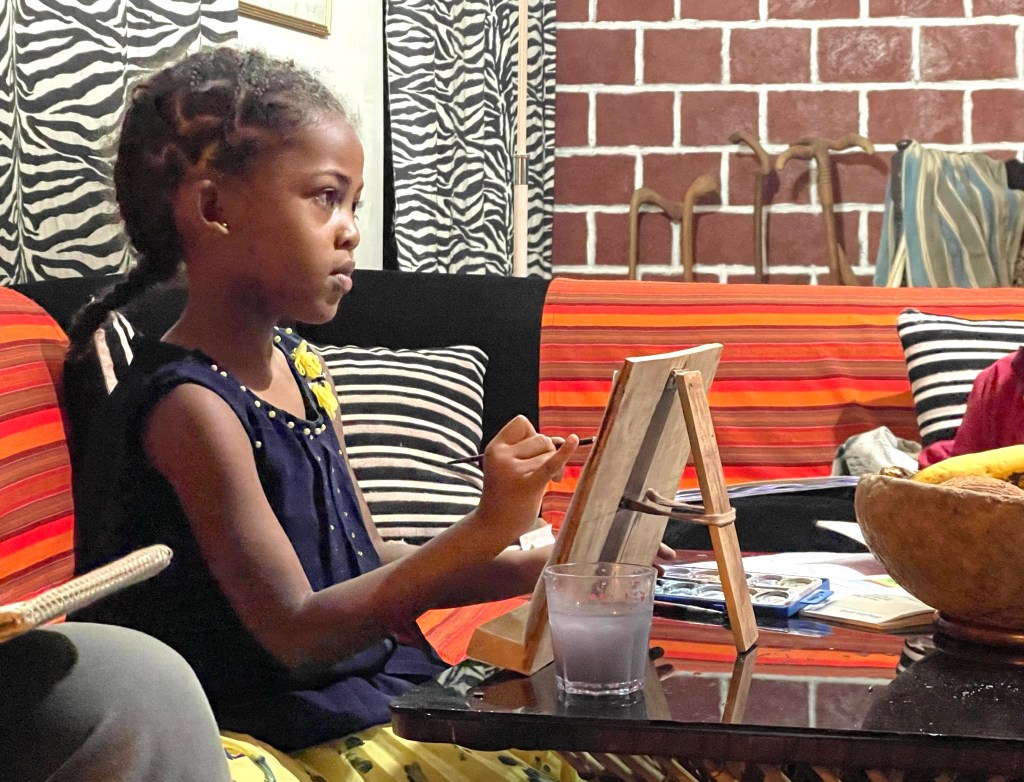
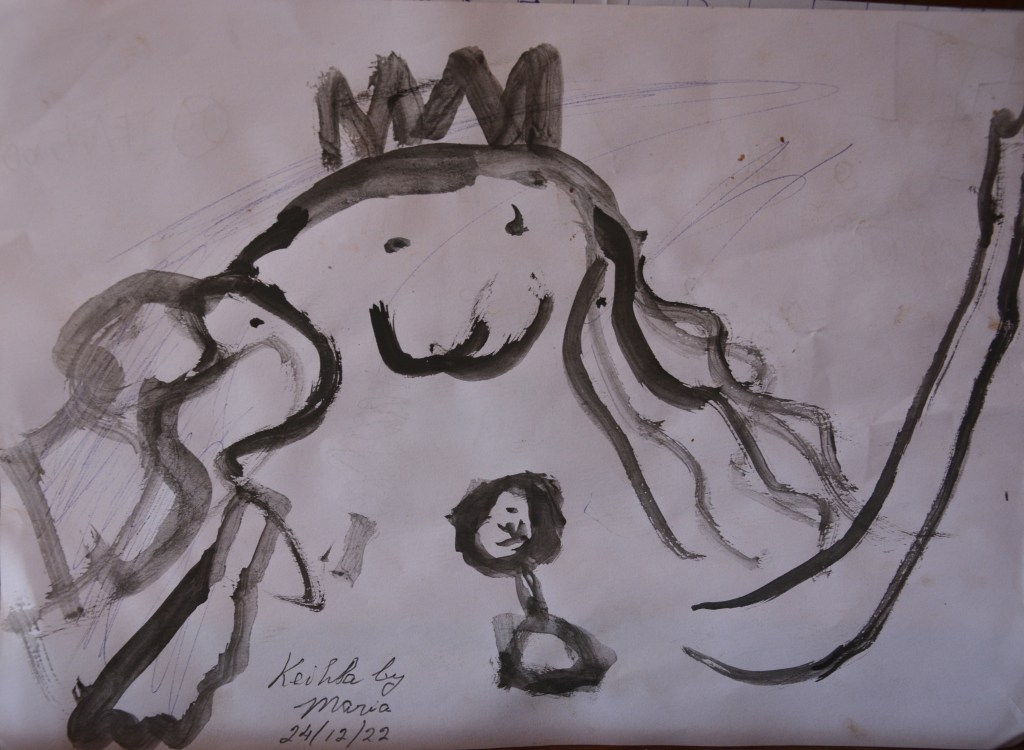
Maria paints a portrait of Keilah…
Keilah by Maria

*

New Year’s Eve somehow peters out about 10.45 after Adelight bakes bread and samosas. “Well, it’s already New Year somewhere!” Adelight says as we go to bed.

“What was the best thing in 2022?” I ask Maria.

“Keilah came for Christmas.”

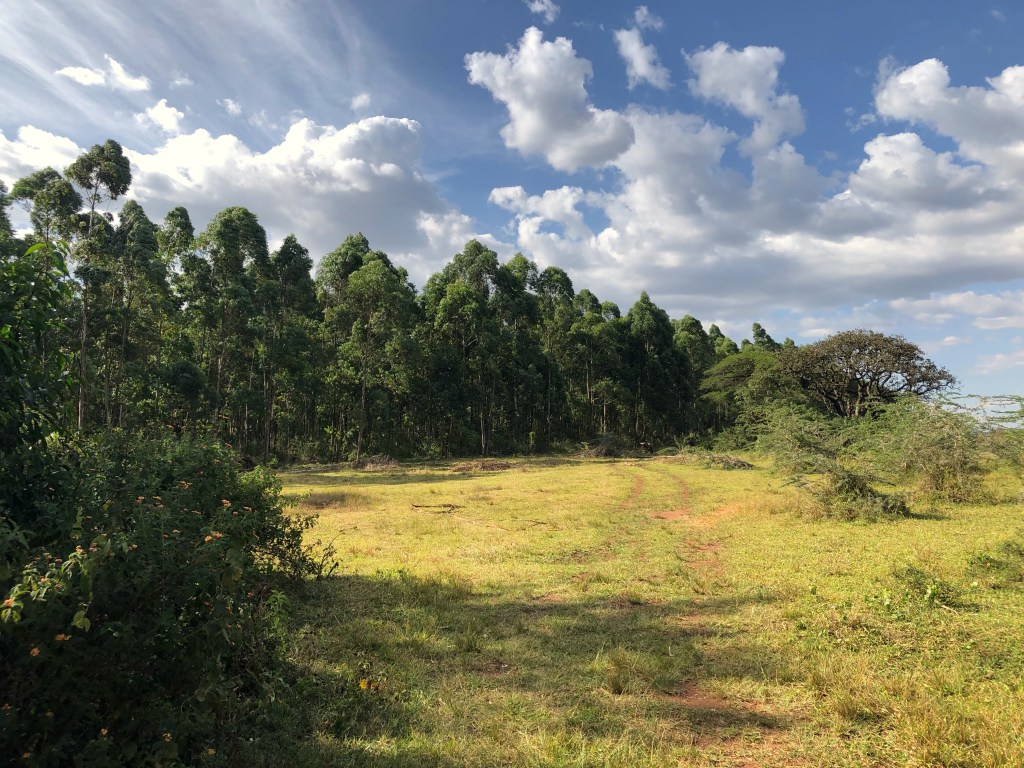
I often take a walk in the rural area below the house in Kitale.

*

On the second day of the year, I ride round the mountain to Sipi in Uganda. The border’s only 30 miles from Kitale and the road is now smooth and quick, unlike the dust and dirt of so many years. At the border, which is being rebuilt as a One Stop Border – where I will be able to complete both Kenyan and Ugandan formalities in one go, I interrupt the customs officer from a game of billiards on a table behind the ramshackle offices. It’s not a busy border; maybe the new roads will increase traffic, but for now it is so remote and unhurried that I ride over the broken old colonial bridge across the Suam River trickle – a bridge on its absolute last legs, parapet gone on one side, barely hanging on, literally, on the other (the other side had gone three weeks later). It might just last until the big new bridge beside it is complete. At the corrugated hut that presently serves for Ugandan Immigration, I am recognised: “Hey, Jonathan, you are back! Welcome!” It’s Harison, the medical officer, who’s been stationed here for a couple of years through the pandemic, dealing with Covid testing and registration. We had several dealings as I came and went over this border during the pandemic years. I was one of the only mzungus to pass for two years. Now, it’s a mere formality: I must be entered in the dog-eared ledger and have my temperature taken, but it’s all a bit lacklustre and no one seems much interested. I ask Harison about ebola, for Uganda had an outbreak recently that excited all the prophets of doom to expect me to cancel my journey. “If we reach the 10th, it will be declared clear. It was dealt with quickly.” I am told that it was not only quick but draconian in this dictatorship: anyone trying to break the cordon round the infected area would be summarily shot! But it seems the measures worked and the infection contained…

The chubby lady at the immigration window recognises me too: there aren’t many white-haired mzungus coming this way on motorbikes; not may mzungus at all. She looks away from the Bollywood drama on the office TV long enough to take my details and then I ride away, trying to recognise the filthy, dusty township of Suam that I recollect from only last February and previous journeys. It’s all changed, bulldozed to rubble for the new international road. The shanties and shacks of the roadside traders have gone and the place looks positively refreshed. The road for the next 30 kilometres is still dust and gravel, but now it’s graded smoothly over the hills, waiting for tarmac.

My smile, already broad, stretches to a split as I enter Uganda. These people have such a capacity for laughter and smiles, without reserve or self-consciousness, despite their collapsed country. Hands wave everywhere and everyone turns to watch the mzee mzungu ride and bounce past. I’m a celebrity riding an avenue of welcome.

The views into northern Uganda are still magnificent.

The road’s lost its attraction as one of the great trail rides of Africa. Where there was an eight foot wide pitted, stepped, rocky track is now a thirty metre wide swathe of graded red murram, and later of smooth blacktop. The earth moving that has gone on these past two or three years is astounding. More crippling debts to China, to add to the 95 year long repayments.

Soon, after the straggly town of Bukwo, where I used to bounce and crash down the ‘main street’ on steps of rock and dust, standing on the foot-pegs for balance, I begin the curling climb on these slopes of Mount Elgon. This used to be a tough ride requiring some rough trail riding experience. I loved it, but always feared being caught by rain on this slippery, cloying surface when it got wet. It’s difficult to recognise the roughest bits that I came to know: the steep hill of ankle-deep dust where I had to ski downhill to a broken concrete bridge; the deeply rutted section that leaned outwards towards the steep slopes and was hardly passable on four wheels; the hill where the clagging mud built up so much on my wheels that it stalled my engine; places I struggled and slithered in dense red dust; where I’ve gasped into meagre tea houses gagging for liquid to quell the dust; where I’ve tumbled off in ruts and had to lift the bike from craters and steps on a ‘road’ no better than a cattle path. Now, the Chinese have moved the mountains, displaced the forests and made a wide tar road on which I can sweep along, riding with one hand – the other for waving – as I gaze into the magnificence of limitless expanses of northern Uganda displayed far below, the blue landscape pimpled with old volcanic hills, waving matoke trees waving artlessly in the foreground.

Still one of the great rides!

To be riding along in this high mountain scenery (I’m over 2000 metres) on my responsive little bike, gulping in the freshest air, under a sparkling blue dome of sky sprinkled with snowy clouds on a summer’s day, with half Uganda waving excitedly at me – in the knowledge that at my destination there awaits an ebullient, heartfelt welcome – well, life doesn’t come much better!

Great riding!

*

The last half mile of my journey still holds the challenges of trail riding, more so this year after the interminable rainfall. I take the short cut from the main road towards Rock Gardens. The track is serrated by the recent rains. It’s now maybe the biggest obstacle to our Rock Gardens project: customers can’t get here in wet season weather. And in this country, the prospect of road improvement for a poor rural neighbourhood is remote.

I vibrate down the track, teeth rattling. They’ve heard me coming. Precious begins to dance, Keilah and JB are running helter-skelter as Alex holds open the wooden gate beneath its thatched roof. As soon as I dismount, the children launch themselves at their mzungu. It’s very charming; I’ve become very fond of these two: quiet, smiling, warm-hearted Keilah and obstreperous, talkative, grubby Jonathan.

Jonathan Bean 2 and Keilah

Precious has been busy decorating ‘Jonathan’s Room’, one of the two round thatched houses, with flower posies in bottles, in wraps of cloth buried amongst the pillows and intricately folded towels: skills she learned working in the big western Uganda hotel where she and Alex met. Keilah has been busy blowing up balloons to make the place festive. Later, as I look around the gardens, I think perhaps Precious picked every flower on the property for my arrival! In the nine months since I was here, the gardens have flourished. Given enough water, Africa provides sun for growth. Trees that we planted as seedlings in February are now higher than my head; flowerbeds in which we sowed seeds from England, are bright with abundant plants – (currently shorn of flower heads!); the local shrubs have grown luxuriant already. The place looks well established. Ramps that I left as brown dust and packed earth are now sloping lawns. We are well on the way to creating the botanical garden of our dreams.

1818’, the bar and restaurant, is 1818 metres above sea level.
I’m delighted that a Harberton hollyhock seed has germinated here. Maybe next year it’ll bloom?

But where will we find the customers? Alex, and I upbraid him for this once again, has extended the ‘1818’ restaurant with two balconies, back and front. They are cleverly decorated with timber palisades and woven banana leaf ceilings, wide cut boards for floors; there’s new furniture: chairs and tables and fine local wood settees. But there’s STILL no kitchen! Alex has such a vision of how he wants his business to look, but skates over the practicalities. When he built his raised restaurant, ten feet above the gardens, he constructed a framework of heavy posts and joists – in a country notorious for termite infestation. I accused him of building the roof before the foundations, and we had to spend several hundred pounds putting heavy stone walls beneath the flimsy structure. He loves the decoration, but has little practical skill, and his local builders are appalling: talentless, poor workers and with no tools beyond a hammer and machete.

Alex may smile, but I’ve never seen such bad work by a so-called ‘mason’.

He’s started the new kitchen and I can see the worst stonework of my experience, laid by so-called stone masons. It’s double the size we need and Alex has been bamboozled by the inept local builders. They’ve taken the (my) money and gone, leaving a complete mess. My advice to Alex is that we knock it down and start again, and forget the hundredweights of cement and sand that have been wasted on three inch wide joints in a ridiculous 3:1 mortar mix that is the custom here. No one ever uses initiative, they just do things ‘the way it is done’, even if it’s wrong. Every joint in the pipework in my room leaks: carried out by a so-called local plumber; the expensive double latrine a ‘proper’ contractor built (£2000) has one stall for the ladies beside another stall with a pipe in a corner, just like the one next door for the men’s urinal. “Sorry, Alex,” I say, “women don’t piss that way! Where’s the hole in the floor?” He hasn’t an answer, except that the contractor took the money but it wasn’t enough. I will have to use my ingenuity to find an answer…

But where will we get customers? “Oh, they will come!” says Alex confidently. But he needs to concentrate on marketing now; he needs a decent kitchen; a reliable electric connection; to complete the toilet block; to lobby for road repairs; get his website finished, pamphlets distributed. But he’s more interested for me to build him a bread oven and to chose crockery!

*

Before we start to knock down the kitchen, such as it is, or reshape the ladies loo, we spend a day visiting relatives. Alex was born here and most of his extended family live round and about amongst the matoke trees and shambas. I find it difficult to find my way about: we seem to approach places I know by different routes every time, but then the growth is fast and furious and the landscape always changing at ground level.

Alex walks in the matoke, where I am soon lost.

We sit with Aunt Khalifa, Alex’s oldest aunt and his supporter amongst the family. She’s a cheerful old lady and formal in her greetings, going down on her knees to greet us in the customary fashion in Uganda, a mark of respect – sadly, always from women to men… We drink sweet black tea in her somewhat tumbledown compound. The houses are looking rather frail, a sign that she too is getting frailer, for she always patched the mud and dung plaster walls scrupulously. Khalifa is in her mid 80s.

JB2 and his great aunt Khalifa.

We visit another old lady, wife of Alex’s clan’s senior member. She is in a very sorry state, virtually comatose and unmoving. I’d guess she’s had a bad stroke, added to a broken leg and crumbling back. She was in the hospital for three months, but no one has the money for that, so the harsh fact is that it was better for the family to bring her home where she can die slowly without further expense. Life is cruel in rural communities in Africa. She’ll lie in that dingy earth hut on a locally made log bed and aged blankets until she wastes away enough that she mercifully dies, however long it takes, with no relief or comfort.

Elsewhere, we are happily welcomed into crude homes of mud and sticks with few possessions or comforts. But the greetings are warm and generous, and tea or food is always offered. I shake hands a hundred times; children come running; greetings are called. Sometimes Alex translates. One group, sitting conversing until we arrive unexpectedly, a major event in their day, comments to Alex, “You were lucky. You got a white man like him – who also likes people!” They’re only used to proud white men representing charities, big business or the church; one who mixes with them in these rural villages is a bit of a phenomenon. My support can create jealousies too, though, in a rural community without education to understand that it is Alex’s intellect and hard work ethic that has brought my aid to the family.

Later, we spend a couple of hours sitting under a stained canvas awning – everything here’s stained with the brown of the earth after this very long rainy season – with Alex’s parents and his younger brother, Nick. Nick and his age-mates recently went through the – to me – barbaric circumcision ceremonies: a public ordeal that’s always explained away (even when it goes wrong and infections set in…) as ‘tradition’ or ‘culture’ It’s a huge party time in Uganda and various communities in Kenya – as in much of Africa. Bizarrely, Nick’s walking about wearing a skirt (boys in skirts is a sight I’ll see quite often in the next days) – the reason may be obvious! – to which there’s no stigma attached – it’s ‘tradition’. He’s now officially ‘a man’ after all, with all that means in Africa: he can father and abandon children in or out of marriage, be waited on by his womenfolk, and drink away the family money… But I’m being cynical: Nick’s a decent young man whom I like, and he’s shortly off to university, an educated, thinking man. But there’s the rub: education… So few in this country enjoy its benefits, which is why crossing that border back to Kenya is like returning to a ‘developed’ country. It’s so sad: this beautiful country with its friendly population, largely uneducated and with a belief that giant families prove virility and strength.

Joanne with Praise

Passing another broken down earth, stick and zinc sheet dwelling, I photograph tiny pretty Joanne, cradling an even tinier baby, Praise, her most recent sibling – the eighth child of her worn-looking young mother. There’ll probably be more, in this failing country where three quarters of the population is now below 30 years old; a country that has grown from 5 million in 1950 and is estimated to exceed 90 million by 2050… And a mere 2% over 65… One is left with little hope, except in odd pockets such as this small family, and Alex’s determination to have only two children whom he can educate well towards a better future.

*

First, we demolish the recent work and start again…

We knocked down and undid most of the local workers’ inept efforts on the new kitchen and started again to a design by the intercontinental mzee designer. It’s frustrating working here: there are no useful tools and few available materials – and absolutely nil skilled labour of any sort. The manual labour that is available is slow, unmotivated and has little understanding of what is required. Often, it’s quicker just to do it myself… It does sometime feel that Sipi is out in the sticks. Even ‘masons’ have no concept of bonding stones, just piling them one on another blathered in inches of over-strength cement. Corners have no joints, wall sections usually built between softwood timber posts which will quickly be weakened by termites. No structure is built with any expectation of lasting more than a few years. I tell the ‘builders’ that I live in a stone house that is at least 200 years old, in a village with a church built over a thousand years ago, to their open-mouthed amazement. All here is short-termism. I doubt there’s a building within 50 miles that dates back more than 40 years, except an occasional unmaintainted colonial era ruin or civic memorial.

Rach (a half-brother to Alex) and Abraham work on the new-improved Jonathan Bean (1) type floor.

It’s hard, grubby work for a fastidious Westerner. The sun beats down, the muck and dust disturbs my tidy mind. I’m soon coated in dirt, and there’s only cold water in which to wash – and this red dust doesn’t really come off, most of it ends on the towel. By mid-evening, I am fading and most nights abed by nine. But the pay-off is long sound sleep in the fine old bedsheets I have persuaded Precious to keep for me: thick ancient continental sheets that must have arrived in some mtumba bale.

*

I watched a shocking documentary about the mtumba wear we send to Africa: the secondhand clothes that our charity shops offload here. The film was made in Ghana, where the clothes are called Broni Wawo – ‘dead white men’s clothes’. It seems that a mere 40% of the clothes and goods that are baled up and shipped to Africa – many tons at a time, from Europe and North America, are actually resale-able. The rest is causing yet another problem for Ghana: many container-loads are towed to landfill every day, and much more of it to informal mountains of rubbish along the ocean, where it washes into the sea and becomes vast knotted clumps of fabric, much of it plastic-based that will take decades to break down and meanwhile poisons the oceans of the world, mankind’s major dumping ground. All in the name of fashion and disposability built into capitalist economies. Another example of our arrogance towards this continent, sending rubbish clothes and dumping our problems on another part of the world less able to deal with it. Out of sight, out of mind…

*

Well, a good start to 2023, amongst my families in Africa. Families I value more with every visit to this unique continent…

If you don’t have a cradle, you make do… Little Haggai (a girl) seems happy enough with the arrangement!
Family fun with JB2’s Christmas football. (It was white before it came to Sipi…)