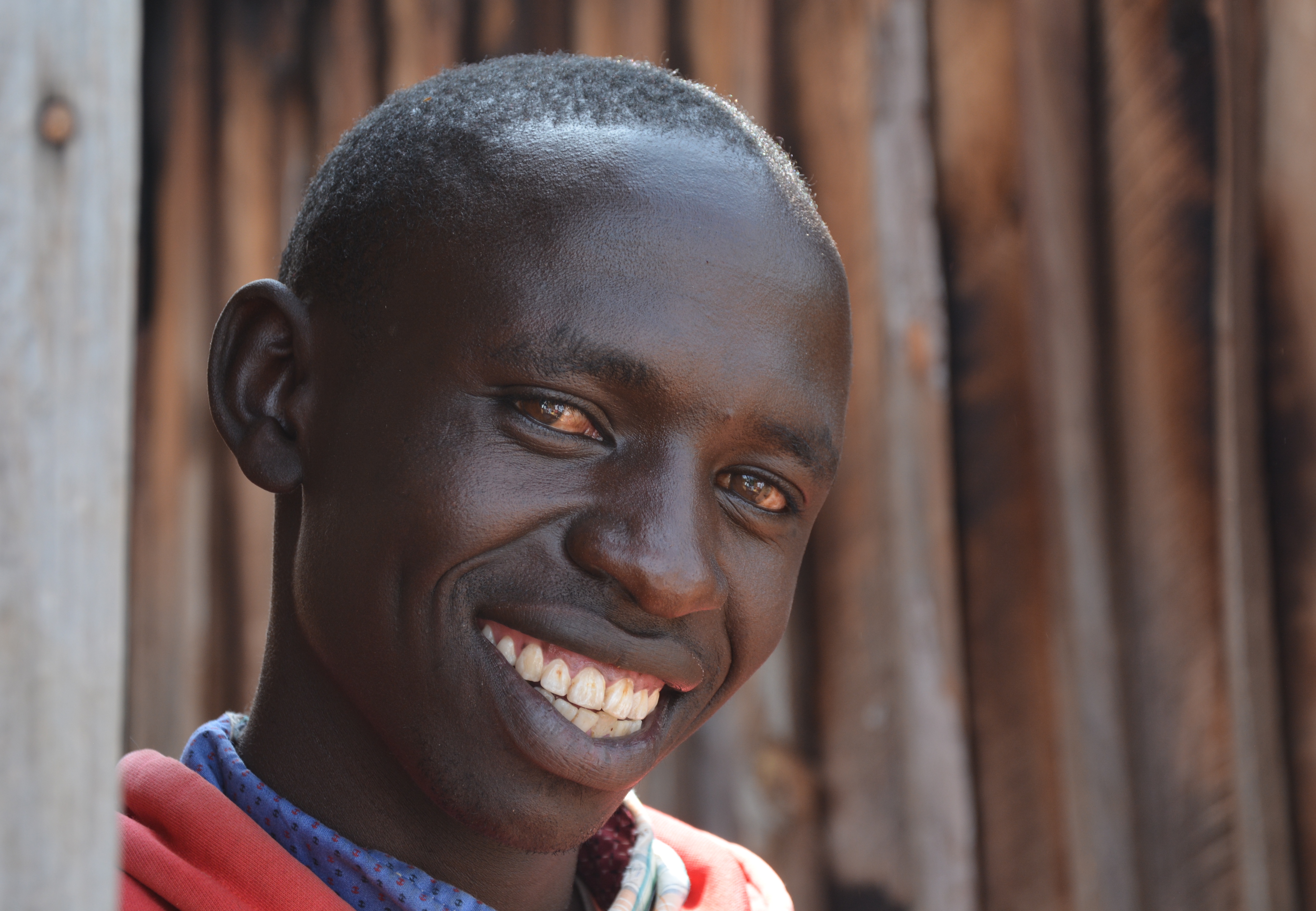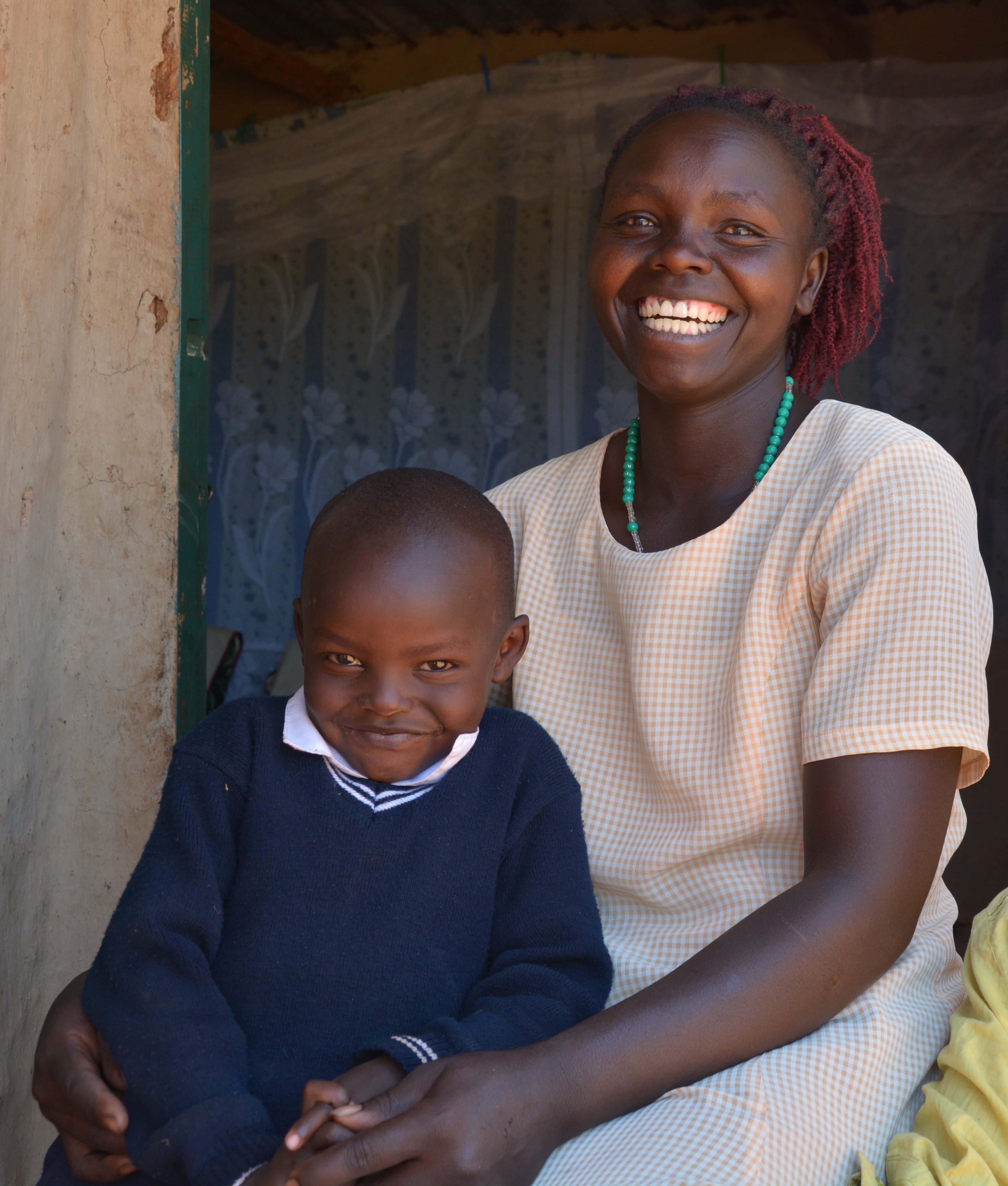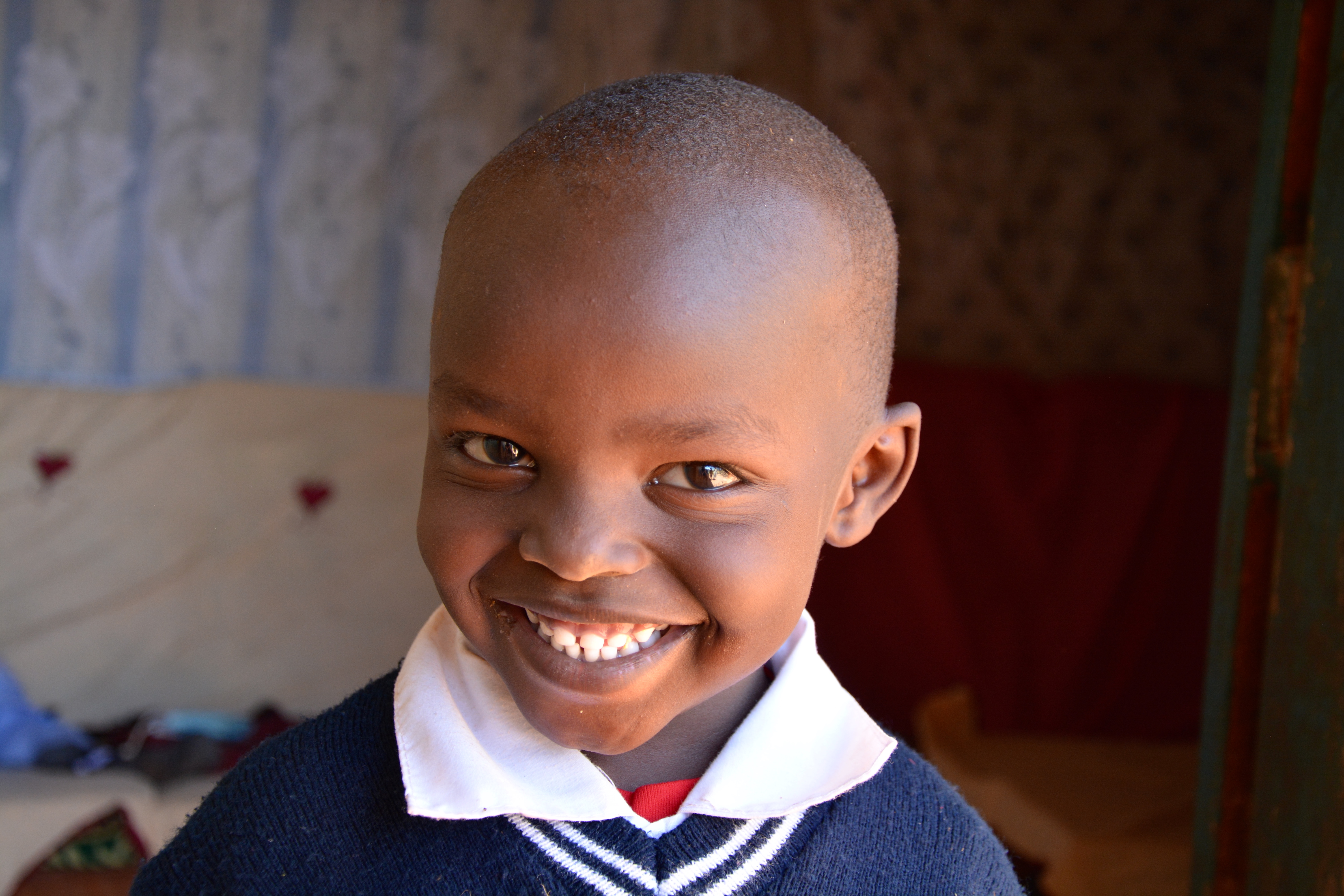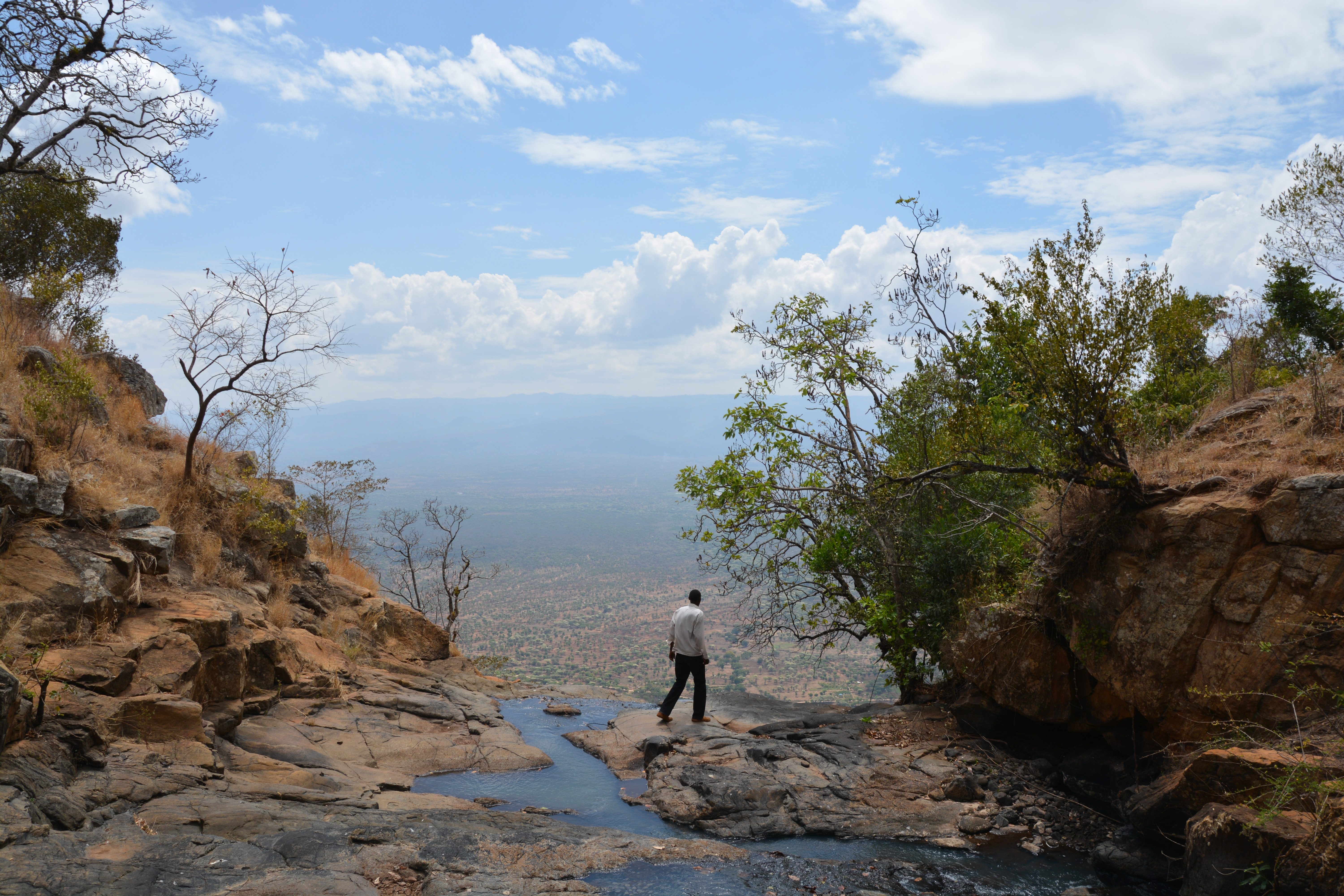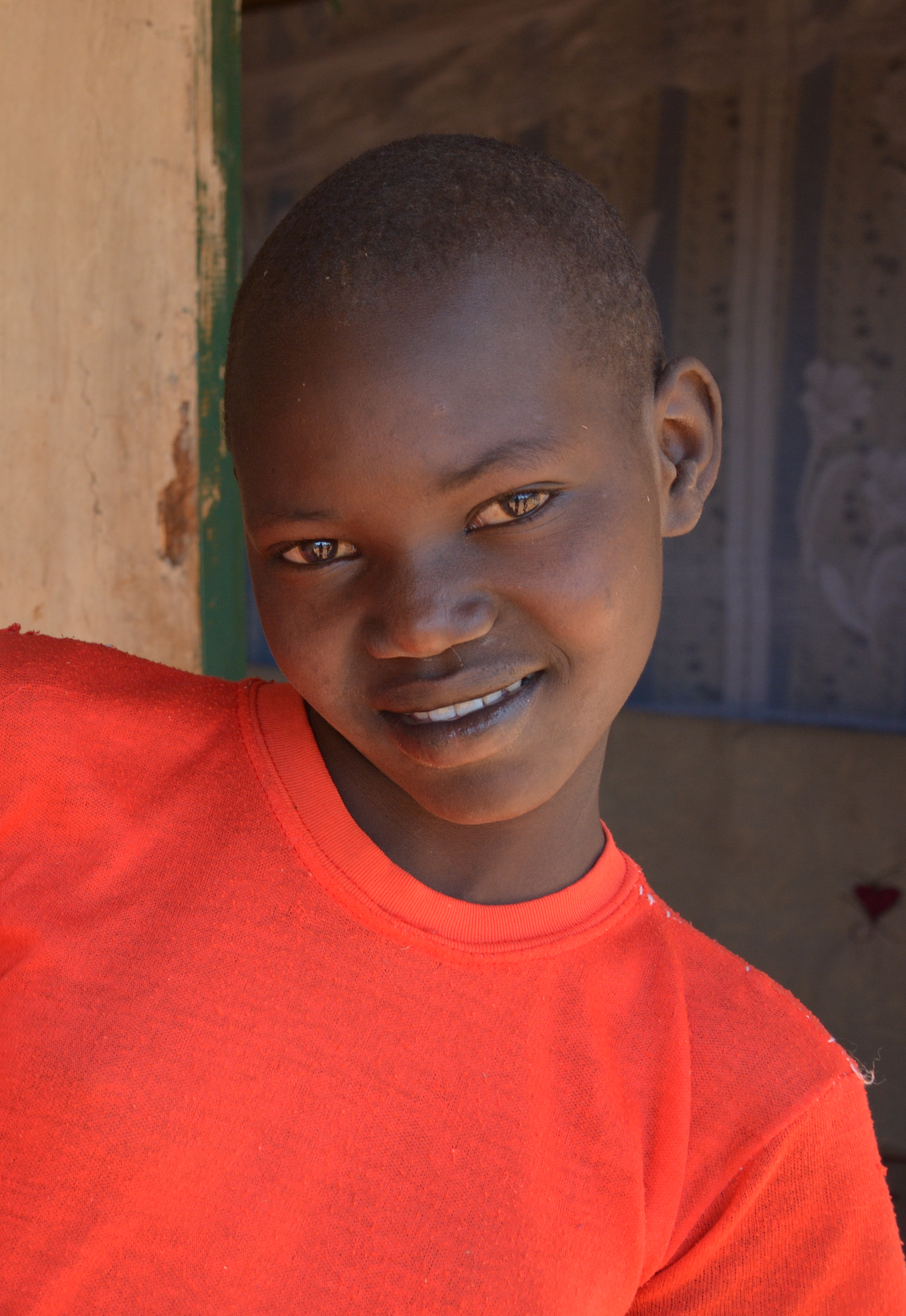
EPISODE TEN. March 20th to 28th. INTO THE FAR NORTHERN DESERTS, ONE OF THE BEST RIDES IN AFRICA AND THE JOURNEY HITS THE BUFFERS, BUT DOESN’T QUITE COME OFF THE RAILS… YET, AT LEAST.


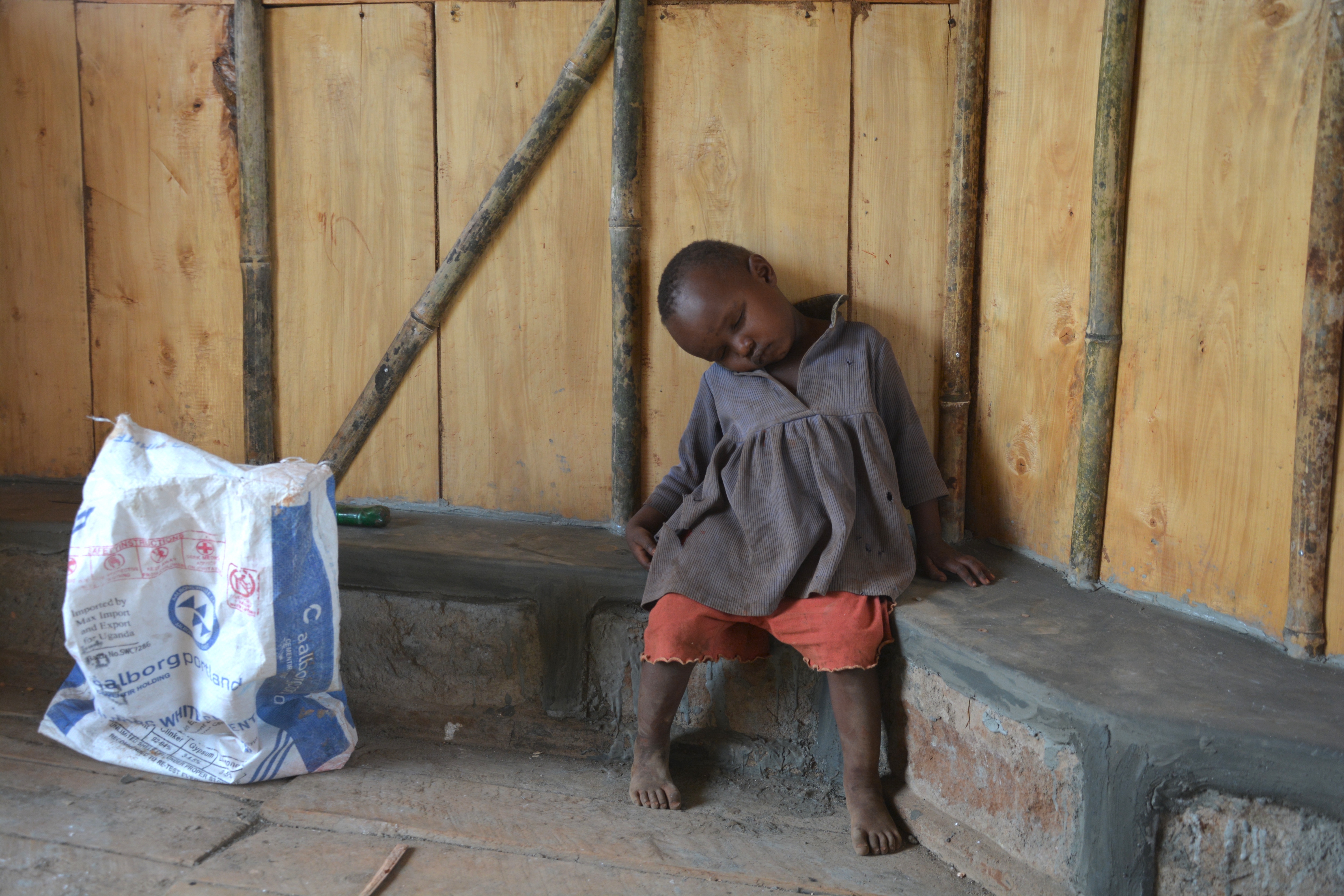
Lydia

Twenty years ago I made my first visit to East Africa. By then I knew Ghanian life quite intimately and was known as a ‘son of Navrongo’ in the north of that West African country, complete with name: Navrossay, ‘Navrongo accepts you’. It felt like time to broaden my African horizons, to visit my old friend Rico, who by then had pretty much accepted that Africa was his life and moved to Kenya. He’d married Anna, his late first wife, a Turkana woman, and was living, with a brood of adopted children, in Lodwar in the far northern deserts of Kenya, near the eponymous lake, deep in the Rift Valley – not far from where mankind is thought to have first stood up and walked away from his Neanderthal ancestors. 

That year, Rico arranged for me to borrow a motorbike for three weeks from a Dutch woman, an NGO worker. The following year, impressed as I was by my first experience of East Africa, I shipped my African Elephant – the 800cc BMW – to South Africa, by now clear of apartheid, during which time I refused to visit despite several invitations, and rode from Cape Town to Lokichoggio, another 150 miles north of Lodwar. 

In those days, Lodwar gave an impression of a dusty desert town forgotten even by the Foreign Legion: a last outpost; a town filled with colourful tribesmen in feathers and beads, women with giant piles of bright necklaces that extended their necks, or more accurately, depressed their shoulders. Shaven headed, ochre mud head-sculptures, wrapped in bright cloths and living a nomadic life in spherical shelters of sticks and leaves, amongst huge herds of cattle and camels, this was a region that felt exotic and worthy of expeditions. It felt remote and the ‘road’ north from Kitale was the worst I travelled all the way from Cape Town – and all points between.

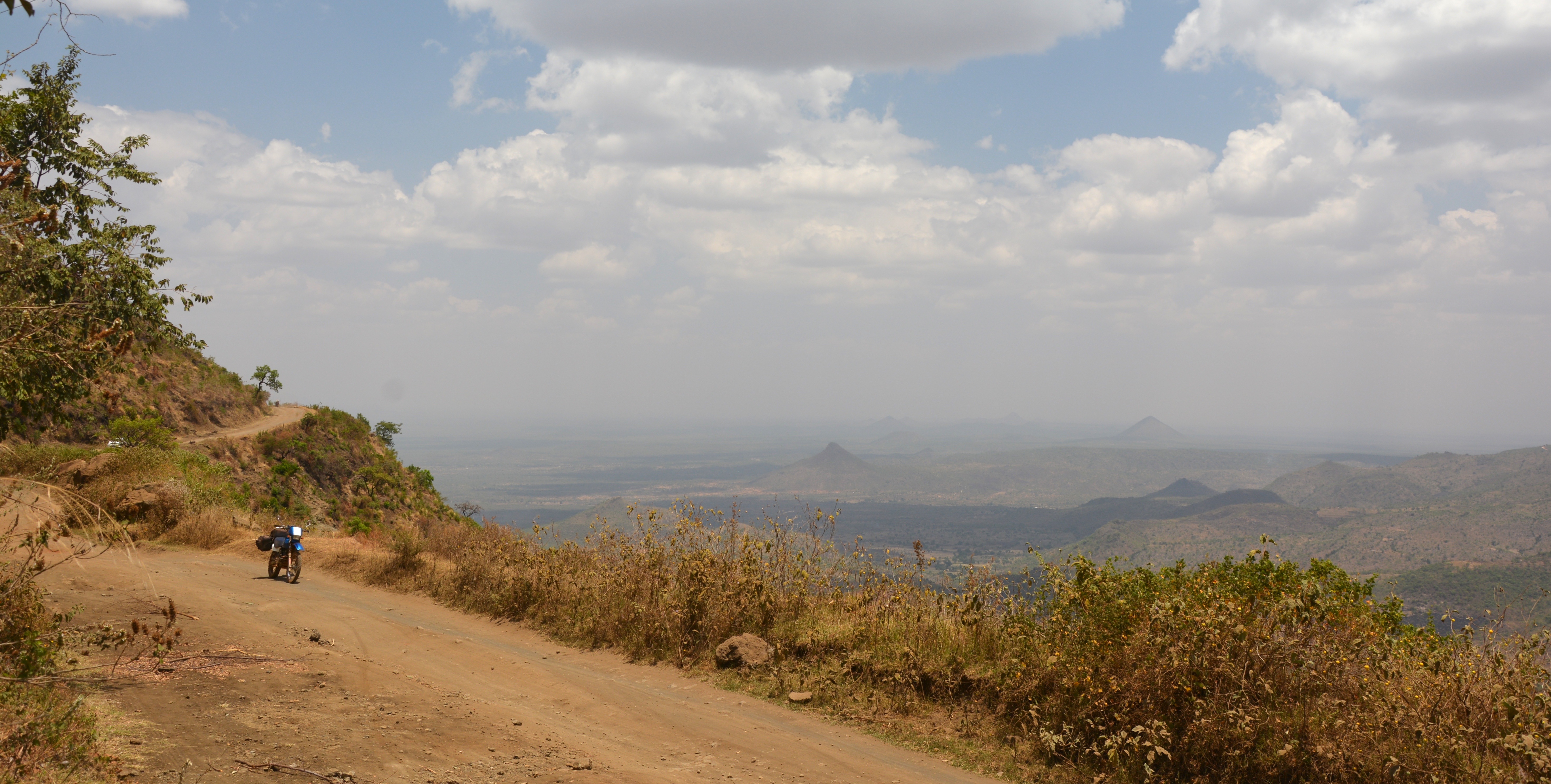
So, with my extra Kenyan days, why not ride north and see how two decades have treated this dusty outpost? The first part of the 190 mile ride is rather fine, dropping down from the forested highlands and snaking through the Marich Pass – ‘marich’ meaning narrow in Kalenjin. Then I emerge onto the flat Turkana Desert, that fills much of the northwestern corner of Kenya, to the mountains that line Uganda on the west, Sudan and Ethiopia in the north and Lake Turkana on the northeast, from where endless deserts stretch to Ethiopia and Eritrea into the Horn of Africa. It’s wild country, supporting ancient tribes of itinerant cattle herders amongst thorny acacia trees and limitless vistas of scrubby desert. It’s a long ride. And HOT. Here the landscape burns today at 35/36 degrees – in the shade, of which there’s NONE on a whirring piki-piki for the six-hour ride.

*

The descent after the regional town of Kapenguria is another of those impressive Rift Valley plunges. The road twists down through steep forested slopes, views north tantalisingly disguised by the trees below. Heat builds as I sweep downwards through the rich greens. I know I will miss this abundance in an hour or two. Through the winding pass the mountains close in sharply on either side, claustrophobically lidded by clouds of many densities, here where the topography makes for its own weather systems. A rock-scattered river worries below the road.

Then, apparently shot out of the mountain fastness onto the flat expanses that stretch for a thousand miles or more, a cheerfully friendly, portly elderly policeman waves me down – curiosity rather than hassle. Behind him, the desert spreads endlessly now I am suddenly out of the confines of the pass. He asks where I’m headed. “Lodwar!” I say. “On this BIG machine you’ll be there in two hours!” says he, vastly over-estimating the powers of my mere 200cc Mosquito, always in East Africa considered enviably large and fast – despite the reality of 45 or 50 miles an hour. I laugh, fist bump and ride on. 

Now the road is flat. There’ll be hardly a hill between me and Lodwar, 113 miles north. When I rode here in 2001 and 2002 this was a notorious road. It was a broken trail of deep ruts and trail riding, over which – somehow – trucks and matatus battled, breaking the awful surface even more. On my borrowed Honda and later my trusty Elephant, I was lucky to make 20 miles an hour. When the occasional rains came to the desert, they pounded the surface for an hour or two, washed away the road in the storm dips, filling them with sand behind the rapidly evaporating water. The rocky dust turned to mud, churned further by traffic. Then the powerful sun dried it all again, jagged and broken. The track became increasingly challenging. Not surprising these outposts got little attention or investment. The road north here was also notorious for tribal unrest, ambush and robbery. Sometimes we had to travel in so-called convoys, that soon separated after the police posts as there was no attempt made to match vehicles. On my motorbikes I seemed to be left alone to fend for myself. Then, added to all these potential dangers, the road was often prone to large herds of elephants that, just occasionally, got irritated by the passing traffic. 
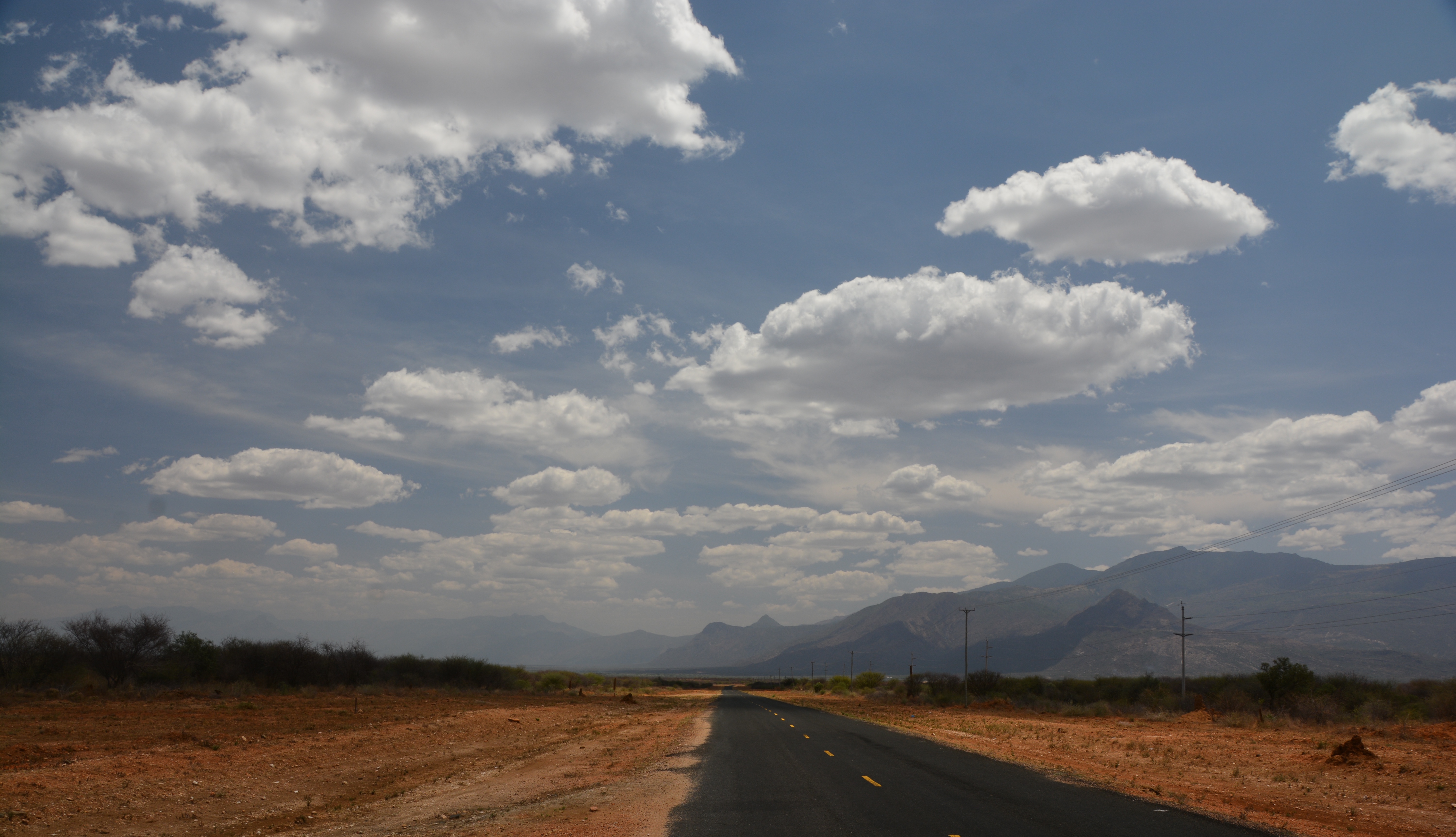
Now. NOW! There’s a wide sweeping blacktop highway most of the way (although no one warned me of the 36kms of appalling corrugated dust after Lokichar, towards the end of my long day!). The trees and spiky vegetation is pushed back behind a blasted apron of dry grass and dust, 100 yards wide. I doubt an elephant comes within a mile of the rushing 4X4s and beetling boda-bodas. It’s not a busy road by any means; I’d ride for minutes at a time with no passing vehicles, but any elephant that wants to pass now won’t linger here on the hot tarmac and the strip of devastation caused by the Kenya Highways Authority. That and the fact that every road brings ribbons of population to settle in the harsh desert, plus vast herds of cattle and goats and thousands of roaming camels. The old road, that seemed such an adventure and kept me terrified for raging pachyderms just twenty years ago, is now a tarred tedium filled with boda-bodas carrying cattle herders and shaven-headed, many-necklaced wives between god-forsaken outposts of mobile phone shops and Chinese supermarkets and a pox of tin churches of every irrelevant dotty faith, these poorly educated people a ‘god-sent’ challenge for the rampant evangelists…

*

I stop for much-needed tea at Lokichar. It’s the only place of any size en route across the desert, but it only extends sandily a few hundred yards alongside the road, the scrubby desert stretching to the horizons behind. Everywhere out here is eternal desert. On the TV we watch the sentimental gushing of coverage of the funeral of the President of Tanzania, who was a corona-denier – but got his comeuppance and died of ‘unspecified heart failure’, which everyone knows was corona. But no one will go against their late president for fear of offence, despite the fact that his denial has cost tens of thousands of lives and delayed any preventative measures such that the country has a crisis – not that it is mentioned. African politics… How do these inept, authoritarian leaders get power? Well, of course, we know the answer – they manipulate and buy it from uneducated voters. 

I fell into the usual conversation with the young men running the cafe: “I want to go to your country and get a job and make lots of money!”

“Do you not realise that many, many young people like you are unemployed in Europe? There are today ONE MILLION unemployed young people just in Britain! We have an economic crisis in which tens of thousands of families are relying on food-banks – charities – for sufficient food! Most of our shops have been shut for a year. A YEAR! Millions don’t have work! And not having work in Europe is MUCH worse than not having work here. Here you can almost always eat..?” The young men, mouths agape, nod. “If you have to, you can sleep out here on your porch..?” I wave my hand to the sun-beaten cement outside. They agree. “You have land, you can grow something at least to eat. You can build a shelter from local earth and sticks. You can survive!” They nod slowly, the penny dropping. “Most of US have NO land! We have to heat our houses. Even now, I am spending 16,000 Kenya bob a month to heat my house! It’s empty! But I can’t leave it to deteriorate. Our climate’s not like yours.”

“Yes, but we see you people come here. You are rich!”

“The few Europeans who come here are often the richest of our society, or like me, they’ve saved money by being careful and not buying Stuff. And yes, we seem rich because here our money is so big. This cup of chai is, what? 10 or 20 bob?”

“Twenty…”

“Yes, and in England I would pay about 350 bob for a mug of chai!”

The men gasp. No one’s ever explained this before. It’s why, in places like Turkana, one of the most heavily aid dependent areas in all Africa, I am greeted so often by an outstretched palm. White people are rich. White people distribute charity (even if much of it is ill-directed…) “But at home I live a bit like you. I’m rich here, but not at home!”

I guess I explain this ten or fifteen times a week. But look at these three young mens’ exposure to white people: they watch glitzy, materialist shite on American soaps and action films; they see adverts for everything they can’t afford – on the international channels that exploit their small spending power; they see white tourists, generally aloof behind the glass of expensive vehicles, travelling from one sanitised African experience to another. They don’t see the back to backs of Bradford, the slums of Birmingham or the North East, the desperate poverty of Pittsburg and the American South – no one makes soaps and dramas about those people: we all want the American Dream: the world for the taking. Of course, you and I know it doesn’t exist and never did. It’s a fiction, and a fiction used to create desire for more and more Stuff, in our skewed and sick economic model. Voices like mine are few and far between on the backroads and in the tea shops of Kenya and Uganda. No one understands that unless you have a rich daddy like the trumps of this world (no capital T: this way I can equate the man with the slang for farting), the only way to get Stuff and power is money, for which you need to work hard. Unemployment doesn’t fulfil those dreams… 

“Hey! We never knew this! We thought all you whites are RICH!” the young men exclaim, slightly more enlightened about the Money Trees of the West. At least I’ve made them think; maybe equalised their view of one mzungu at least. “When I work, I am well paid,” I say. “But I spend most of it just living quite simply!” I now have the Kenya equivalents of my electricity bill, a mug of tea, my phone bill, council tax, a litre of fuel and a bag of rice on the tip of my tongue and can trot them out all these times every week. When I tell them the cost of my boots, they just stare and stare in horror. “Yes, that’s why I’ve made them last for almost TEN years!” 

My mug of tea and a chapati cost me 26 pence… 

*

With many cheery goodbyes, I mount up and ride away again on the burning journey north. Now comes, to my surprise and chagrin, the 36 kilometres of corrugated dust. Just when I was mentally winding down and looking forward to arrival in Lodwar. Thankfully, the final 40km are tarred again and I can relax the overheated muscles. I don’t like to arrive this late at destinations. I have a rule of thumb that when my shadow on the bike stretches across half the road, it’s time to be looking for shelter for the night. Now my shadow is bumping and flapping over the stones at the roadside. High time to be seeking a bed. It’s the worst part of every day – still, when I’ve been doing this for 50 years.

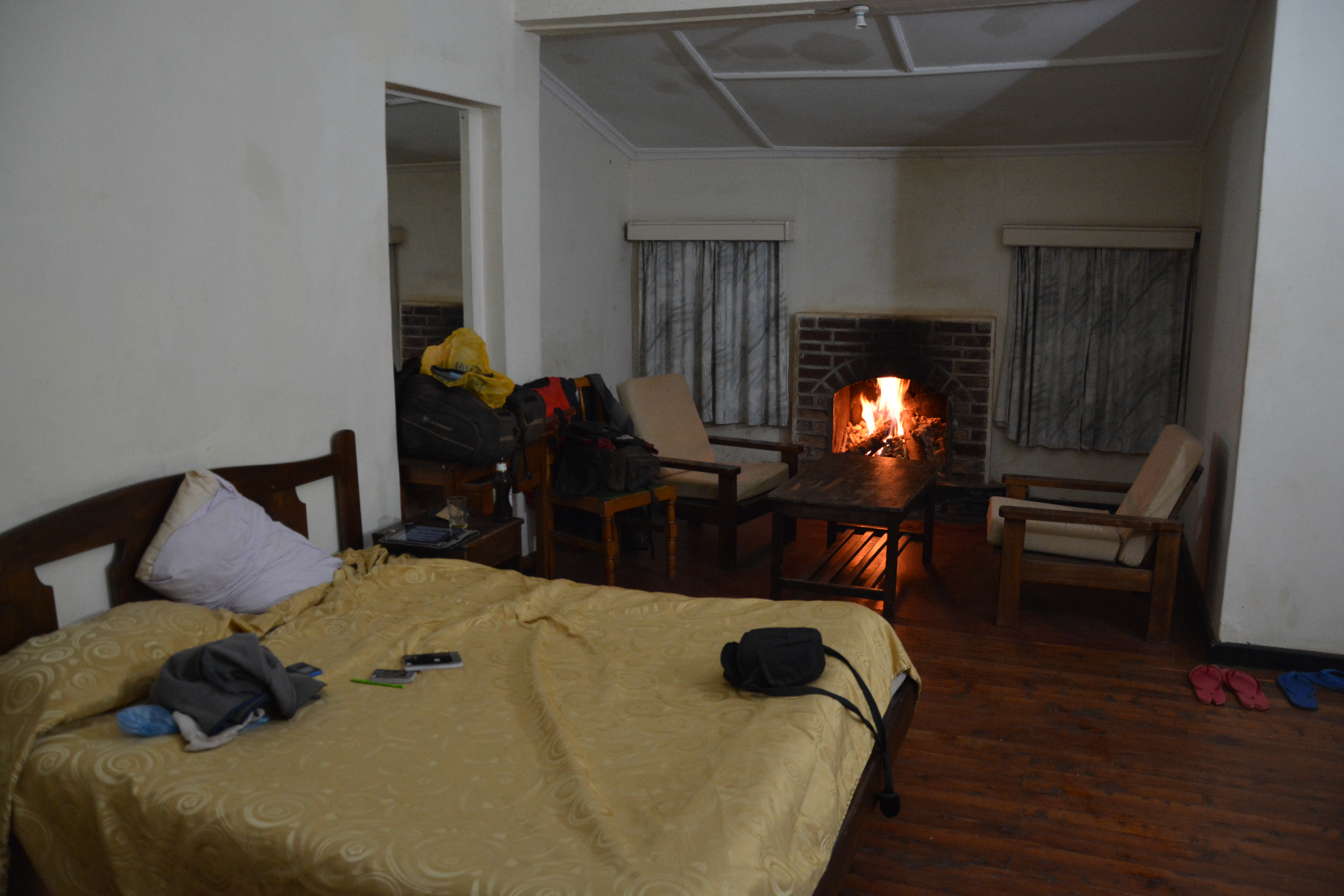
Now the sun is low and in my eyes and the entire centre of Lodwar is being dustily redesigned: the road is being renewed right through town. There are diversions and piles of earth, dust and dirt. There’s a thick fog and my eyes are gritty – but I have to find a suitable bed for the night. Quiet, clean (-ish, at least), security for my Mosquito, preferably an airy place or with trees – this being a tall order in desert Lodwar. I like to find a room upstairs if possible, for light and air and maybe a view. I’ll need a couple of beers (and how, tonight!) and somewhere nearby to eat. OK, so my instinct is extremely well honed by now, and generally I can tell from little more than a glance if I will fulfil at least some of my criteria. I try the Lodwar Lodge, but it’s dingy and dark, and probably impossibly hot. I politely ride away. It’s great, having the Mosquito for this search. I can turn on a sixpence and can divert down every road in town if needs must. But the sun is quickly sinking and I’ve only minutes to search and inspect. On the west side of town, just where the tarmac ends on the road towards Uganda, across the desert and over the mountains, I spot the Lodwar Cozy Inn. Looks passable enough to investigate. It has a gated yard and I can see bright rooms on an upper balcony looking west filled with orange light by the sunset. It’s 2500 bob, about on my top budget for breakfast as well, a bit under £17. Fiona shows me to a dull room on the first floor, looking east, away from the now searchlight sunshine, over concrete rooftops. “But I want light!” I wail.

“But the rooms on that side are 3000 bob!” she says, opening a room filled with sun to show me. “They are AC!”

“But I NEVER use air-con! I hate it, it’s unhealthy and I can’t breathe and I can’t sleep for the noise! I’ll just use the fan…” and I negotiate the light-filled room for the price of the dingy one. I overlook the bilious, vomit green paint but look longingly at the cold shower. Fiona goes off to buy me a couple of bottles of Tusker from a kiosk across the street. My needs are satisfied for now! 

As I thankfully stand beneath the cool shower, I realise that my usual rigorous parameters have been slack: there’s a bloody mosque 100 yards away! Bah! But then I hear that the impossible is possible here in Lodwar: the muezzin is actually in tune. It’s not unpleasant when the prayers are 

sung this way! Unlike the customary dreary drone that would send any god fleeing, this is atmospheric and rather exotic: a tuneful prayer to Allah, up there in the sunset for the muezzin. I’ll just have to remember the ear plugs for dawn… In tune or no, there are limits to the romance of travel in far flung corners of the East African desert.

*

I sleep well enough, considering the extreme heat of the night. The sheet’s a bit of a wet twisted rope by morning. I always cover my organs when I sleep beneath a ceiling fan. I’ve had stomach chills from this before now. My supper rolls about a bit in my guts. I walked down the road and ate a £1.35 supper with a bottle of ginger beer in a very inelegant restaurant. A few scraps of battered goat, some rice and kale, a dish of tomato salad: fuel. Walking the dark streets I was utterly at a loss to recollect anything of Lodwar twenty years ago. Was the smartly caparisoned Kenya Commercial Bank with its bright ‘ATM’ sign, really the one where I had parked my Elephant in the dust and queued for an hour to change two banknotes, in a bank that had no computer? Where had I lived in Rico’s compound: a brown tent set up for me by the children in the dusty yard? Where was the dusty road that passed through town to the deep flood dip between the brown hills that were little more than high piles of desiccated rocks? Where was the oddly attractive, end-of-the-world town? It’s a bustling small metropolis filled with thousands of boda-bodas and traffic. I’m sure it is no exaggeration to say there are probably 5000 boda-bodas in this small town now. It is estimated that there are about two million in Kenya and it’s now a powerful economic driver for the government. Riders are said to make 700 to 1000 bob per day (£4.75 to 6.75), but how this can be, with so very many of these smelly machines, it’s hard to understand. Over 20% of road deaths are attributable too… When I was here, mine was almost the only motorbike in town; in a day or two people knew who I was. 

Lodwar sprawls in every direction and the flood dip – that I once witnessed flowing with strong brown water, enough to overturn lorries that inadvisedly tried to cross to save an overnight wait – is now bridged with a sweeping concrete span. The old lane that ran right through town is now the scale of a motorway. The dusty expanses I seem to remember, are filled with countless kiosks, shops and construction. And through it all come the half-finished new roads, dust and ruts, piles of earth and rubble, and smoking Chinese road machines. 

I don’t recognise Lodwar any more.

*

On Tuesday after breakfast, I phone Peter, one of Rico’s mechanics twenty years ago when he ran his garage here. Peter kindly professes that he remembers me – but I expect it’s the Elephant he recollects really: the old bike was a celebrity in his own right. Still is, for me. We’d ridden twice across the Sahara – Rico would testify to that and tell his mechanics and family the stories; and then – in 2002 – I’d spent months riding through nine countries from far away Cape Aghullas, southernmost point of the continent to Rico’s garage. 

Peter tells me where to find his house. These days, he just tells me to phone when I get close. He lives over the new bridge that sweeps above where the wide flood dip used to fill with sand. There’ll be no more delays here when the torrents flow off the desert in such dramatic ways. It used to be that lines of trucks and vehicles would queue for the water to recede, which it often did as rapidly as it rose, but sometimes necessitated an overnight wait. That was when the trucks took risks and were washed downstream with the big trees in racing water. I wouldn’t really believe it if I hadn’t seen it that day that I had to abandon my old canvas tent in six inches of water in the middle of the night in 2002 and escape into Rico’s family living room.

I ride over the ruts and bumps and loose soil of the major earthworks. They seem to be everywhere this year: more sale of Kenya’s resources to China. New roads shout ‘development’ to the world and get governments reelected. Next year’s an election year… For now there are signposts: they’ll be knocked over and rusted to illegibility a year or two past the election. I take the road to Karakol, 60 kilometres away on the shores of Lake Turkana. I’m going there after I visit Peter somewhere on this stretch of new development, where Lodwar is expanding over the dry hills. Peter’s not a Lodwari: he comes from somewhere near Kitale, where he went to school. I phone and tell him I am close, see him waving from a hundred yards up the hill. We meet and shoulder bump: it’s a greeting I’d forgotten, it’s very Ethiopian to knock right shoulder to right shoulder as you shake hands. I like the greeting, and it reminds me of maybe the most fascinating journey I’ve made in Africa: Ethiopia. 

We chat for an hour in his house. It’s a simple structure of small rocks confined by wire mesh and sprayed with cement when he has money. “We don’t have building soil here, no clay, so we make do with what’s available!” Peter, like so many, is out of work, “…just some odd jobs here and there.” The pandemic has knocked everyone for six; the economy’s in a mess. Rico has taken Peter on one or two of his foreign contracts: he trusts Peter as a decent mechanic, and it’s not easy to earn Rico’s faith, so Peter must be knowledgeable, but now no work… His wife does, “Some small business in town…” That’ll be minor trading, buying and selling. Inside the door of his three-roomed house, Peter has a lock up cabinet that contains small food items for sale at a few bob each: spaghetti, cooking spices, sweet lollies, a tired cabbage. From a big container he dollops tiny quantities of cooking oil into plastic bags (single use, to later decorate the thorn trees and be ingested by goats). Ragged children come with coins as we drink tea, on errands from their mothers. One child actually rejects the cabbage. Not surprising, even though Peter peels off a few outer leaves to make it look fresher. So this is what Peter is reduced to, a trusted mechanic, quite well educated and intelligent: keeping shop for, I believe it’s actually his daughter’s small business, and watching Top Gear on a TV powered by a pile of car batteries and a solar panel on the tin roof. “I’d like to leave now and go somewhere else, but you know, the cost of moving…” When he came north into this furnace, there was more opportunity for a good mechanic. Not now. And few in Africa are ever taught to think as entrepreneurs, to create their own opportunities; and of course, for that they need capital. Most money goes on school fees for three children. Peter wants to send his son to technical school (the girls don’t appear to be going to be given that choice…). “He’s clever with computers. Graphics and so on. He wants a career in the media.” He and most of the rest of the young world… The shining beacon on that far, high hill: ‘A Career in the Media’. 

He’s a nice chap, Peter. Urbane and conversational. I enjoy sitting in his big armchair. I could do without the distraction of Top Gear with the sound turned off, but this is Africa, where the TV is all important. Later in the evening, I am in a small eating house down the dark dusty street from my Cozy Inn when it fills up, right up, so that the populous can watch the news. Even though it’s manipulated by the government ‘media’ machine. 

After an hour or more, I bump back over the desiccated rocky footpath to the road and turn north. I’m going to visit Karakol, down on Lake Turkana’s western shore. It’s a tedious road: small acacia trees dotting the dry land to the horizon every way; rolling hills with little growth. A few tribespeople are to be seen, some of the women in their many necklaces, with shaved heads leaving a small braided topknot, and wrapped in a bright cloths. I see very few of the peacock young men. Twenty years ago, they paraded the dusty roads of the town and particularly wandered the desert roads, proud and colourful, with ochre mud in their hair and beads, pangas and feathers to decorate their arrogant strutting, a herd stick across their shoulders, a small carved stool for a headrest that protected their elaborate head sculptures. The sticks and stools seem to have survived, but now it’s Premiere League strip and the normal curly hair. They still wear the wrapped cloth, and Turkana is one place where men still tend to wear shorts, but now mtumba and cheap rip-off football strip is the norm. Turkana is joining the polyglot, grey world like everywhere else. 

Twenty years ago, collecting wooden spoons, I ventured out to some of the cattle herders’ nomadic villages of leaf and stick manyattas, here in this part of the desert, north of Lodwar. A young girl in full tribal dress wanted a ride on the mzungu’s piki-piki. I was astonished and delighted. It’s a strong, powerful memory that still makes me smile fondly: in her red cloth, beads and shaven head, a redolence of wood smoke and goat fat, we rode across a few hundred yards of sand, her friends shrieking in excitement, her arms around my waist in a vice-like grip. It was a one off, a rare occasion. Those people didn’t even ride in buses of lorries then: they walked miles and miles, and then miles. Now, like the rest of Africa, they are of the ‘Pick-me-there’ generation: they sit, squeezed four up, on derelict boda-bodas to come and go from their crude manyatta homes, listening to pop music from loudspeakers the size of drawing pins on their phones. I am happy I saw those things then. Few will ever see them again. In time, reading this account of my African travels will seem as remote as those romantic tales of an Africa known to Victorians. Of course, there’s NO romance in poverty, and I want their ‘development’ and a certain amount of modernity, but I DO regret the loss of more colourful traditions and individuality on the way. When they all want ‘A Career in the Media’, the world will be a dull, compromised place indeed… Now they need ‘airtime’ for their phones, clutched in hand, rather than tales of tribal derring-do round a campfire. Hey ho, the Way of the World.

*

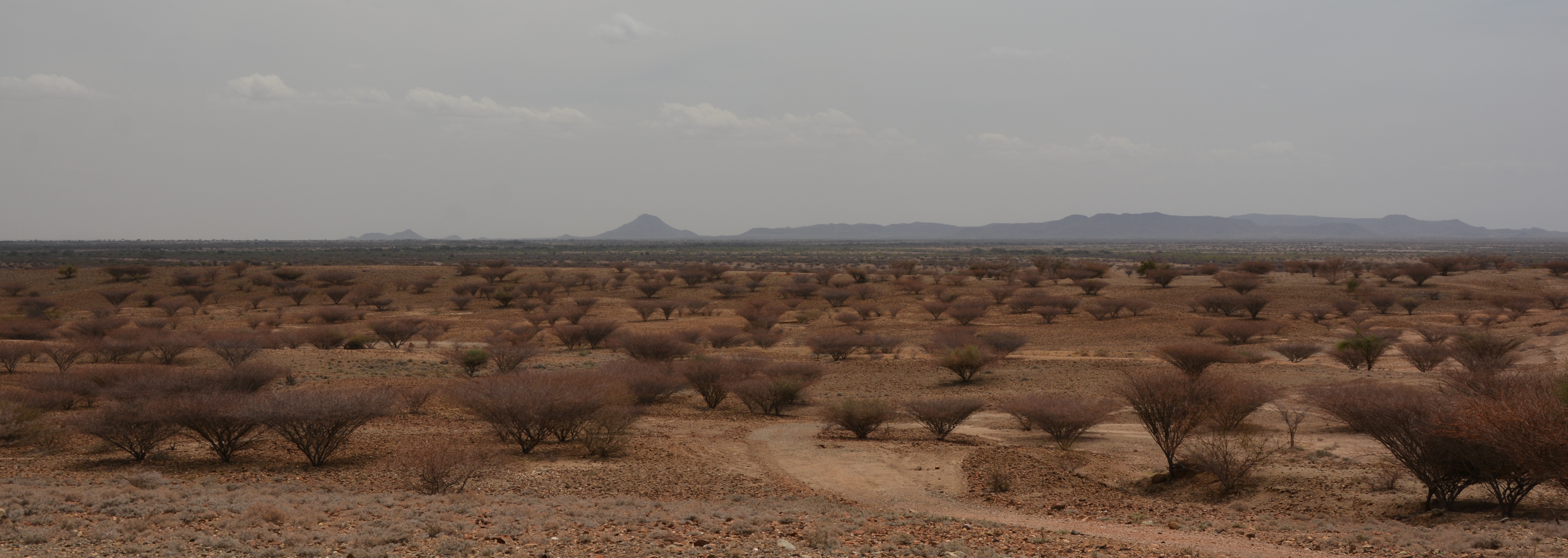
The road to Karakol turns out to be so boring and hot that I doubt my decision. I carry on a bit. After not much more than twenty kilometres I come across the Chinese road machines I see everywhere in Kenya and Uganda. The road turns to dirt and dust, then severe corrugations. It’s still twenty miles to Karakol. I am going to view Lake Turkana, perhaps take a picture. That I’ll probably never look at: I know pictures of lakes, unless they have the Alps or something similar behind them, are not very interesting. I stop, climb a low, totally desiccated hill of dry black stones, take a couple of pictures of the landscape – that will also probably become rejects too. It’s just a huge lunar scape of minor hills to a flat horizon. Grey, with light clouds turning the sky a bit boring too. Back on the track, I turn my wheels south again and retrace my ride back to Lodwar. I’ve seen Lake Turkana several times. No need to sit here and fry for another forty miles just to get a mug of chai and look at grey flat water…
*

Back in Lodwar, I look for Rico’s old garage, and pass it twice before I recognise it. Somehow, it seems to have flipped to the opposite side of the road in my memory. It’s now a depot for the big Indian hardware company, Suam. His old house, with the round living room he built twenty years ago, seems to be a private hospital. Next door is a vast evangelical baptist church that made him see RED when they built it and disturbed his days with their ranting and noise. The airstrip is still in use, but more formally enclosed now. Nothing’s really how I remember it. Often, it’s better to keep memories as they are and not come back. I’ve a fondness for the memories of discovery and the essence of adventure that Lodwar seemed to hold two decades ago. Now it’s just another Kenyan town. The Turkana spirit has been driven away by the boda-bodas and mobile phone companies. It’s a shadow for me. A shadow of long-gone expeditions. 

*

After a second broiling night under the fan in the Cozy Inn, I turn my wheel south again. There’s really not much for me in Lodwar, even though I’d planned to stay three nights. It’s cripplingly hot, three cold showers a day hot. I can find most of what Lodwar stands for in every other town in Kenya – in more bodily comfort. This could be Maralal, where I was two months ago. Honestly, it could be anywhere in the country. The ethnic uniqueness of this desert town has gone. 

Rolling hotly southwards, I take my time. I’m only planning a couple of hundred kilometres today, back to Marich, at the foot of the mountains. I plan to stay there tonight, so I can take a minor murram road back round into the Kerio Valley. It’s a road I’ve never taken but I know it’s dirt, so I’d rather be fresh than attack it at the end of the burning ride across the desert. And I’ve those awful 36 kilometres of corrugated sand to suffer soon this morning, back to Lokichar.

By the time I reach Lokichar I am coated in fine white dust, thirsty and stewing in my jacket, helmet, gloves and big boots. But I won’t compromise on this safety, even if I am cooking slowly under the now overhead sun. It must be heading towards 40 degrees in places, with no respite whatsoever, just that white searchlight sun. 

Tea! I stop in a one horse straggle of shacks and ugly concrete shops for a mug of disgustingly sweet tea. Anywhere else it’d make me gag with all the sugar, but I need some quick energy, so I check my revulsion. I take a chair to the concrete porch, watched by all and sundry. Not friendly but not unfriendly, just a sort of neutral curiosity. No one seems to be doing anything productive at all as far as I can see, just lounging about – existing. Some watch the opiate of television, an endless 24 hour sleeping draught. It’s STILL showing bloody Magafuli’s funeral from Tanzania. How long can they milk the mawkish sentiment of this foolish man who cost tens of thousands of lives in his country by exhorting the people to pray and inhale steam, rather than accept that some basic health measures may save the pandemic getting hold, as Kenya managed rather successfully? Now they are holding a five-day state funeral with thousands of (mainly unmasked) dignitaries from all over the continent – in the middle of an out of control pandemic in the country. 

In my dingy cafe, people come and go, slopping on ubiquitous flip-flops from the brilliant sun reflecting up from the pale sand outside. A few children gather to stare at the sweating mzungu. It’s all aimless, and many idle folk giggle as they pass, somehow embarrassed not to be greeting me more openly. Maybe mzungus never stop here. English education will be low; motivation levels even lower, if the serving girl is an example, as she sits, head on arms dozing at a table. Four young people approach and try to sell me a new, boxed basic model phone. A consignment must have arrived in the village, and I suppose they’re on commission. Clutch at any straw, but I can’t believe everyone here doesn’t already own a phone; they’re as essential as sugar to these folk – more, perhaps, to some. Most of the idle young people are tall and skinny, the boys especially, with long calves and thin knees. They’re almost emaciated, they’re so slim. I haven’t seen a really fat person for weeks, many weeks. 

But what do people DO here? It’s always a question I ask myself, for I need so much stimulation; it’s programmed in to me to be bored if I haven’t a goal ahead or present activity. No one has any tradition of reading: I’ve been looking for books to read for weeks on end, and had to resort to buying a couple on my iPad. I don’t like reading on a screen; I like to physically turn the paper pages, but here I’ve no choice: I found a total of about twenty five books in a Kitale supermarket, none of which I wanted to read. The only book I can find everywhere – I’m sure there are a couple of dozen for sale even in this god-forsaken disaster of a sun-bleached dead end – are bibles. They’re EVERYWHERE. Not that these people probably see their scruffy home as god-forsaken; not if you judge by the number of tin ‘churches’ competing for their money…

On again. Some bright spark has invented a clever device up here, where most families have to fetch water from distant bore holes or water sources – women that is, of course. Someone’s invented a rolling water drum. It’s the usual yellow 20 litre plastic container, but the clever part is a hole right through the centre, that means it can be dragged behind using a rope or length of wire. So simple: so damned obvious that no one ever thought of it until now. Even the children enjoy rolling their drums like yellow garden rollers over the sand and down the roads. Clever.

*

I pass the turn off to Turkwell Dam and a national reserve. As I ride, I pull my cheap phone from my pocket and check the time. It’s hardly even late lunchtime, and I’m only 25 kilometres from my destination. I turn in the road and go back. ‘Turkwell Dam 23km’, says the sign. I’ll go and see what’s there. I know it used to be a gorge, now dammed. 

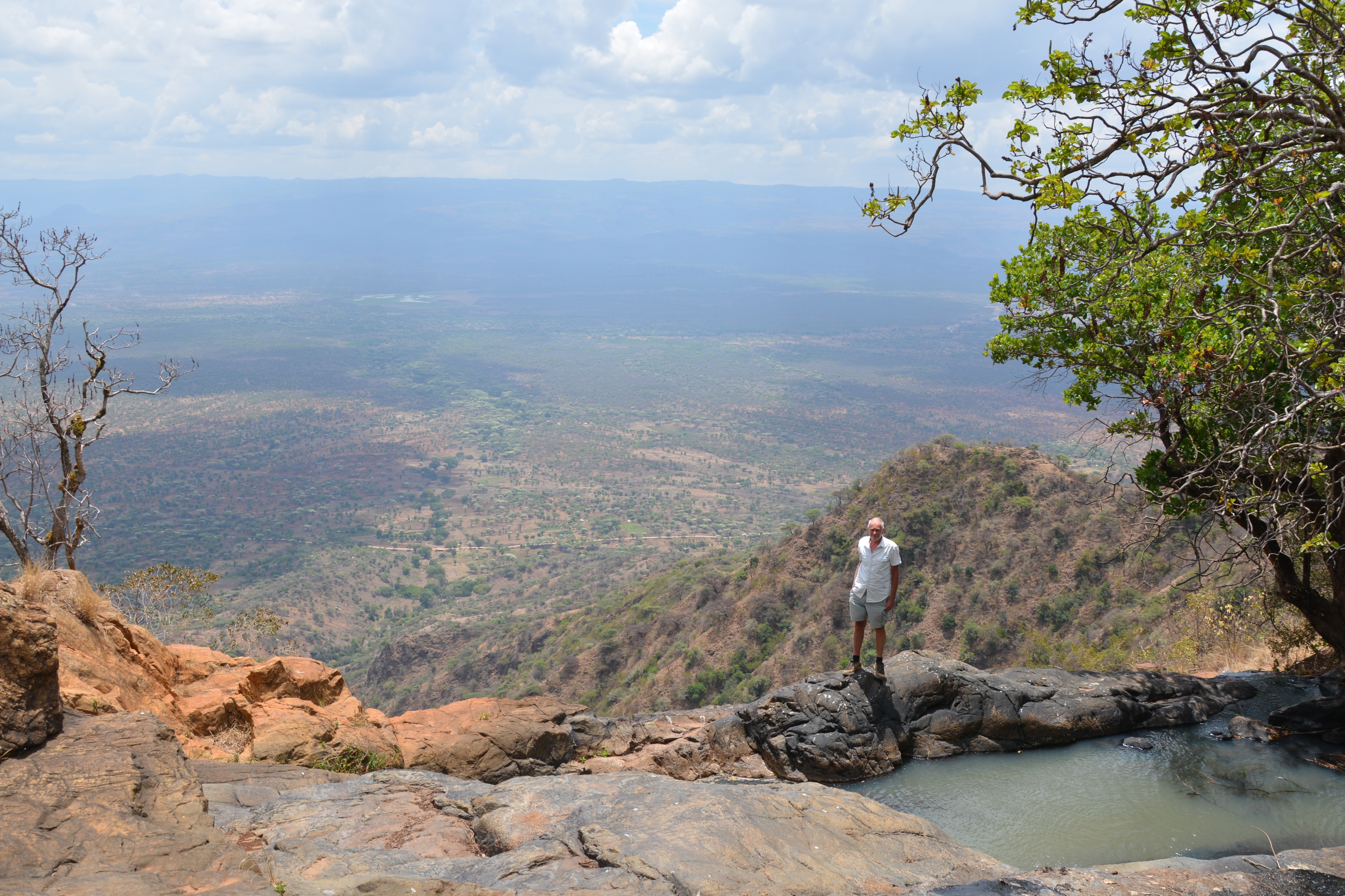
The road is good, tarred no doubt by the dam builders and well maintained. High steep mountains rise on my left, directly from the flatness of the desert. There’s a national reserve here, which means some control of the population, but I see only inevitable goats, big flocks of them tended by small boys as young as six or seven. It’s their family duty – while the women and small girls endlessly roll those water barrels. After 12 miles or so, a gate, a security guard. We negotiate. He has to call his boss – but he’s no airtime on his phone. I wonder what he’d do in a security emergency? Send a smoke signal? Oh well, his colleague, sauntering down the road with all the time in the world, has enough airtime to call the ‘manager’, and ‘Manager’ says it’s OK for the mzee mzungu (why do they always add the ‘old’?) on a piki-piki to ride up to the dam. I’m pleased, because I can see the road snaking back and forth across the step incline, hairpinning upwards dramatically. I want to get to a vantage point above this vast desert and look down. As I ride upwards, back and forth on the tight serpentines, I am quickly aware of the limitless desert stretching as far as the eye can see, a sort of dull green from the numerous thorny flat-topped acacia trees, dotted with shadows of the high white clouds. It’s so far to the horizon that it’s bent with the Earth’s curve, always a sign of extremes. At last the road turns in towards the mountain face and levels towards a high pass. As I breast the last rise I exclaim. In front is a big blue lake, ringed by low blue mountains, reaching across the range towards Uganda. It’s wonderful, especially here, after all the aridity I’ve seen for the past hours: a spectacular expanse of calm water, inlets and hills, all beneath the cloud-dotted blue of an African sky. 
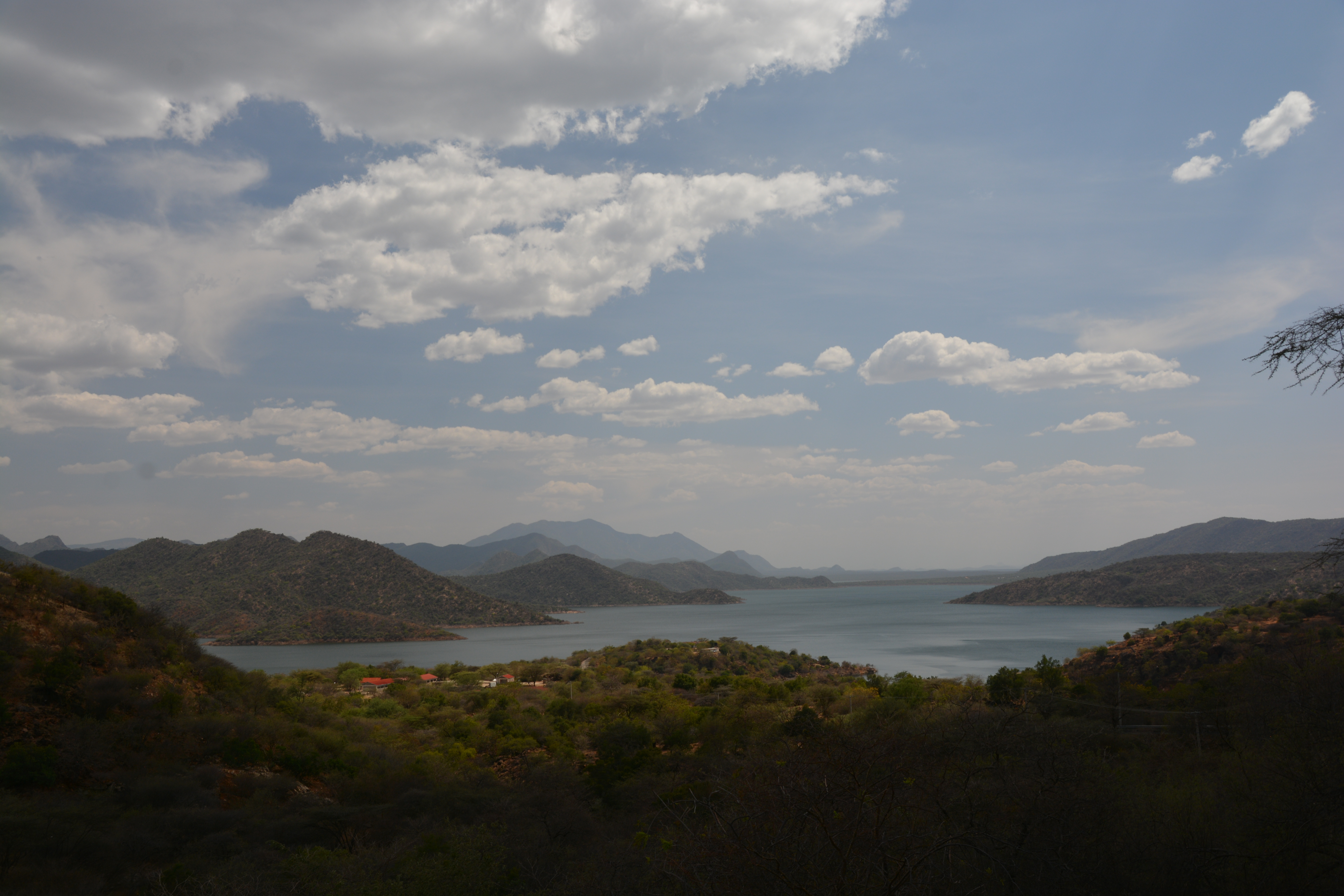
The lake is formed by the damming of a fine gorge, not more than 100 yards wide and maybe 150 feet deep. One side of the cleft is of smooth vertical red rock, the other a precipitous rocky drop to the bottom, which is perhaps no more than 60 yards wide. It must have been a wonderful entry to the mountain world beyond, but now it’s stopped by a big plug of curved concrete. I can walk across the narrow dam. A group of men are excited like small children, exclaiming that they’ve seen, “A BIG snake! BEEEG! EH!” at the viewing point on the other side. But it’s gone when I get there, probably frightened back to privacy by these men shrieking like schoolboys. Now they’ve gathered compatriots and are all heading back for another look. “It’s gone!” I say, a little deflated myself. I seldom, if ever, see snakes in Africa. I know they’re there but they always make a quick exit when they hear human life approaching, like almost all animals. The only danger is to come on one by surprise – and that’s difficult with snakes.

*

I ride back down the mountain twists and turns, enjoying the views over the desert that I crossed boringly this morning. Now it’s late afternoon and I need to find my bed for the night. There’s a long-established place at the foot of the mountains; I stayed there 20 years ago, sharing the last night of a school party from Gloucester! The place was set up by an Englishman, David, and his Eritrean wife. David died a few years ago, but his wife still runs the place. It’s billed as a ‘Field Studies Centre’ and hosts many school excursions – when there are visitors. Today no one has approached the centre, down its 900 metres of sand track, except goats. I begin to think it’s closed down due to lack of business this year. I ease open the gate with my front wheel. Everything is quiet; no people to be seen. I’m about to turn round when I spot an elderly woman in an easy chair under the many spreading trees. It’s David’s widow, still running the big centre. Later she says, “I can’t leave my husband…” waving a hand towards his grave. I’m the first guest for a couple of weeks. She says a Dutch couple camped then, and Indian families like to come from Kitale and Eldoret, but otherwise business is dead for the year. She’d like to visit her daughter in South Kensington, but can’t get there. She’s a son in Germany and a children in USA, all out of bounds for the foreseeable future. So she sits in her wooden chair and drinks tea calmly under the shady trees and stays with her husband of many years. 

The guest house is still open, and she’s a really good cook, making Eritrean food – much like Ethiopian. We spend a congenial evening chattering about the changes we’ve seen in Africa, many of which we regret. She’s lived in many places around the continent. She’s watched the demise of tribal life, dress and crafts; the importation of alien cultures; goods from China, ubiquitous old clothes from the West, the fading of ethnic colour, the beating back of now controlled wild life. “The elephants, they still come when it rains, but you don’t see them by the roads any more. Not now it’s such a big strip of nothing…” In my mind I conjure an image of the bland road, wide as a motorway through the receding bush land I just crossed. 

*

After my breakfast – a very substantial one of local millet porridge, three fried eggs (sunny side up, as my American friends would say, unlike the tedious omelette fries I eat everywhere), with vegetables and toast – Mama Roden, my entertaining, calm hostess, makes me buna. I’m thrilled; for me, coffee has never been the same since I drank Ethiopian buna, the original coffee: for the drink originated in Ethiopia in the 13th century. It’s thick and rich, boiled three times in a clay jug and served over sugar in a tiny bowl. It’s the BEST way to drink coffee in the world!

With fond farewells, I leave at about 11. I think I’ve quite a short journey today, just along the foot of the nearby mountains and round the corner, where I’ll turn south on a remote road and enter the neck of the Kerio Valley, and climb a dusty track up the escarpment and find my way back to familiar Kessup for a last visit this year. 

For years people have been saying I mustn’t travel these remote trails at the foot of the mountains in Pokot country. The Pokot tribe have a bad reputation: they’re aggressive and quick to fight and there are frequent skirmishes up here. But I’ve a feeling it’s a case of Chinese Whispers, for no one who warns me so dramatically has never actually been this way. The fighting is all about cattle rustling from the neighbouring Turkana tribe. Recently, a battle between rustlers killed 17 men. It’s almost a traditional violence, a sort of tribal hooliganism, which notches up respect for those who clock up kills against the ‘enemy’. My hostess this morning, who knows the locals well, and is much respected by them, says, “If you get lost, ask the way. They are VERY friendly people here!” I’ll believe her, not the doomsayers. A kilometre from the guest house sand track, I turn off the main highway onto the forbidden tracks. People wave and return my smiles…

*

A few moments later the track, white dust and red rocks, crosses a narrow bridge and passes a big bend in a sandy river bed. It’s largely dry, just white sand extending across 100 yards or so. The river frets down through some rocks to one side. This is the river bed that passes the back of Mama Roden’s ‘Field Centre’, where schoolchildren from Gloucester explore the terrain. At breakfast she told me about the Chinese… 

No one much trusts the Chinese people who come to Kenya. Everyone knows they have ulterior motives; they’re unpopular – plus they are unsmiling and not sociable. Those are sins in Africa. The Chinese keep themselves to themselves, send most of their money home and use their increased financial status to start businesses that locals could open if they had a little capital, and access to the cartels that the Chinese run amongst themselves over the supply of goods. No, they’re not well regarded: with suspicion, is about the best you can say. 

Anyway, Mama told me the story of the Chinese businessmen who came – while she was away in Nairobi, for she is a bit of a local force of nature, with her intelligence and marriage to a mzungu intellectual for 40 years. The Chinese paid local people on the other side of the river – the side now denuded of trees – 200,000 Kenya shillings (about £1300) for the right to mine for gold on the property. Mama heard of it on the probably very active grapevine and hurried back to Marich, arriving next day by air and taxi. She came to remonstrate. A big argument ensued, between her and her community as well as the Chinese. To the local people the short term profit was manna. “But the chemicals they use to clean the gold are poisons! They will destroy your water sources!” she remonstrated with them, finally winning the day by showing the people the already discoloured soils. Then she investigated the ‘company’ and found it utterly bogus. She brought the law to bear; she knows the right people. “I will go to the President himself if necessary!” she told the fake businessmen. For now, she won the day. But there are few Mama Rodens around Africa, with the influence and nous to control the rampant Chinese, who know that pennies will buy their way in to all the resources of the continent. Sitting beneath her mature trees, drinking tea – “I never drink coffee myself. I have an ulcer…”, as I sipped my delicious buna, she unconsciously echoed my oft-spoken words: “What good did you ever see the Chinese do in Africa? They want power and resources. When did you EVER see a Chinese charity..?” China: the biggest threat to Africa, and now, in their newfound economic and political strength and self-confidence – to the very planet. 

She’s small and slight, Mama Roden, an Orthodox Christian cross (with crossbars on the usual Christian cross) tattooed on her forehead, only really visible on her mid-brown Eritrean skin when the direct sun hits it. She wears the white woven shawl customary to the Orthodox Ethiopians, her pale grey hair scraped back into two tails tinted with orangey henna. I bet she’s influential around here, and very supportive of the local tribespeople. She brought her power to bear, she tells me, against unscrupulous ‘businessmen’ removing quantities of earth and rock for ‘road building’ from the property of one of the local schools she supports. I wouldn’t want to be the receiver of her wrath when she means business!

*

Despite its grand designation as the B4, the trail I am using after the river bridge, is an insignificant track through the bush. I squint in the sun reflecting uncomfortably from the pale red dust beneath my wheel. I have to concentrate: it’s rocky and full of surprises. Here and there I must splash through small rock-filled washouts, that probably rage when the rains come. On my right the mountains steadily rise towards the escarpment of the Rift Valley that they will become when I turn the corner into the neck of the Kerio Valley, that I love so much. These are foothills that presage much higher mountains that form the highlands behind; the ones through which I wound downwards three days ago from Kitale. I’m entering the Kerio Valley rather secretly here, just skirting the bottom of the hills, the endless valley stretching northwards from here as far as Jordan. 
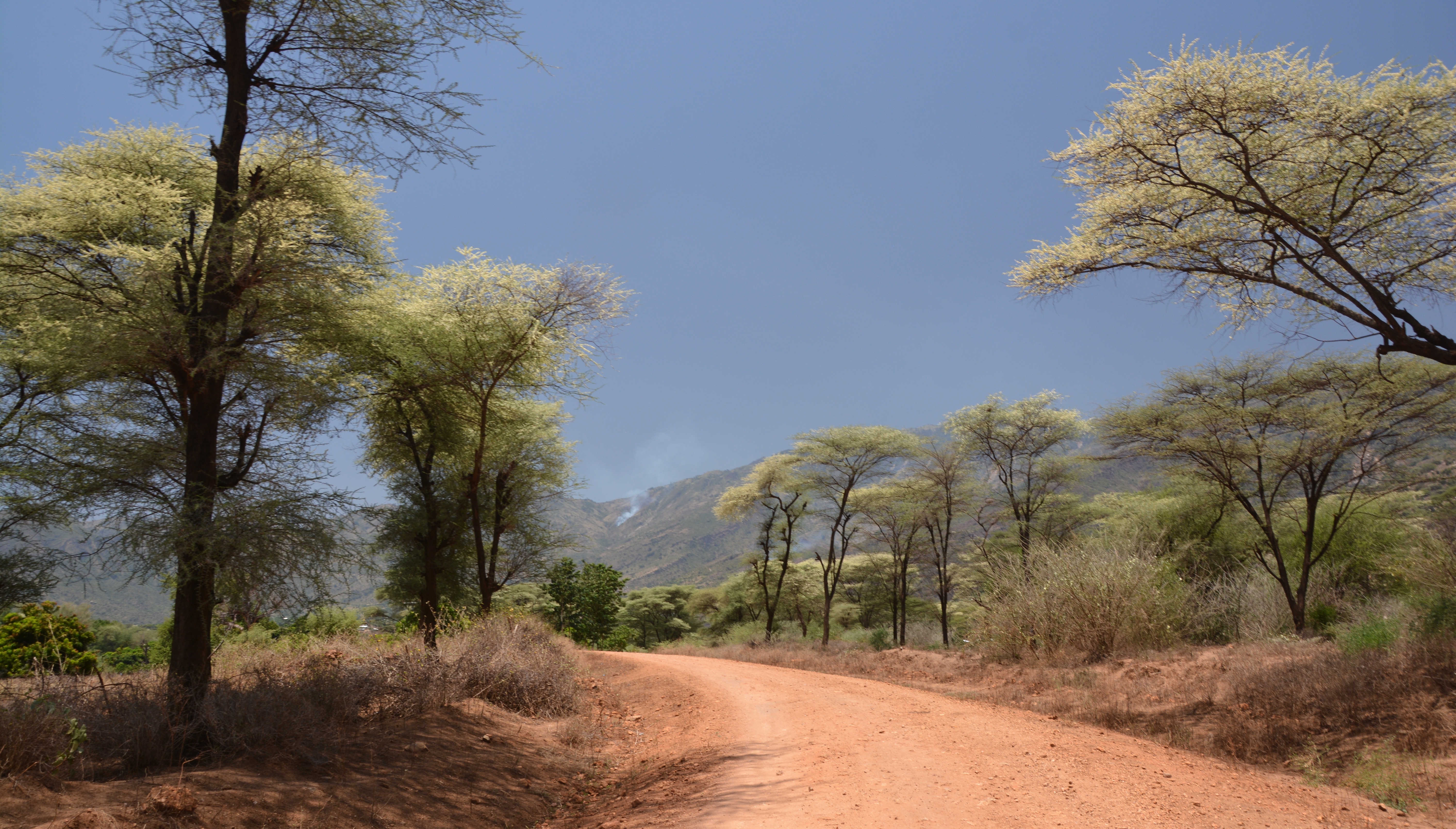
It’s a pretty obscure road, this B4. It meanders through thick bush, stunted acacias and scrubby growth. Now and again it wriggles through a remote village. It’s hot on the valley floor but the new growth on some of the trees, anticipating the rains that should have come by now, is bright and fresh. In places, the track threads through thin green woodland. The high mountains on my right become steeper. Even up there people are burning the scrub to make tiny semi-vertical fields to support the growing population. Something over 35 kilometres in, the road, such as it’s been, suddenly disappears. There are trees down and huge pits ripped in the ground by raging waters at some time. It’s an ugly scene, but impressive of the power nature has when unleashed. Trees are broken at the stumps, rocks everywhere. The trail twists and turns through rocky beds of small trickles and there’s scree everywhere to be negotiated. Vehicles, not that I’ve seen more than a handful in over an hour, have forged a sort of informal track through it all. I bounce and weave across half a mile of this devastation.

Slowly it dawns that this must be the site of the enormous landslide that brought disaster a year ago in West Pokot, the county in which I must be now. I recollect my moral outrage that I was forced to watch, on ubiquitous 24 Hour ‘News’ the inundation of a few streets of insured people in England, crying about their Stuff being ruined: endless sentiment about life never being the same; the inadequacy of ‘the Authorities’ in preventing the flooding in suburban England. Meanwhile, in West Pokot, where nobody cared because they were African peasants and no one had the cameras, whole communities were washed away in a gigantic landslide: even a dormitory of schoolgirls. No one was racing to their rescue: they’d have to rebuild for themselves here. 

My trail rose out of the valley bottom, climbing slowly up a red dust hill between ruined earth and stick structures. One had been a tea ‘hotel’, others homes. The tin roofs have been salvaged, no doubt for replacement homes elsewhere in this ruined landscape. What do you do if your land is in the path of such a natural disaster? You rebuild in the same place and hope it doesn’t happen again. But the reoccurrence is increasingly likely. “Oh, that landslide was caused by deforestation on the hills. The people cut the trees for charcoal and then the roots cannot hold the soil…” explains Josphat when I stop for chai in the next village.

The trail rises slowly. I can see Josphat’s village ahead. It’s called Karena. I turn a corner to the left and suddenly, like a mirage, there’s a T junction with roadsigns, white lines and direction arrows – on a tar road! It branches off at right angles to my rocky, pitted, dusty, slithery track: smooth black tarmac disappearing up a long hill in classic perspective. It’s not on MY map! But then, there are so many roads, new and old, in this region and my map is small scale. I WISH I could source a decent map of this wonderful area: it’s my favourite part of Kenya, here around the Kerio Valley. 

So I stop for tea at the ‘Midway Hotel’. Not sure where it’s midway from and to, but it’s a basic tea shop, painted hideous green with a plastic chair outside just made for me. Josphat is the owner, a wide welcoming smile, a cheery demeanour. Others gather. No mzungus come this way. Apart from any other reason, probably because the Chinese Whispers portray the region as so dangerous. So far I’ve met unremittingly friendly folk all the way. 

“So where does this road go?” I ask, waving at the black tarmac. 

“Chesoi! It’s tar all the way. But MANY bends!”

“But Chesoi is near to Kapsowar?” I was intending to head another 40 kilometres along the floor of the burning valley and turn right up to Kapsowar, a white dust road I took downwards on my first East African journey on the Mosquito. “Why should I punish myself? There’s a smooth road and it’s going where I need to get to!”

“Yes. MANY bends…  How OLD are you?” The question always comes eventually. Maybe I should have a tee shirt printed with, ‘I am 71 years old’?

“But this piki-piki is a Special Gym!” laughs Rogers, one of the idle young fellows who’s come to chat to the mzungu – probably hoping for a conversation about the current state of the Premiere League… “Yes,” I agree, “good exercise, specially on these dirt roads! Keeps me young.”
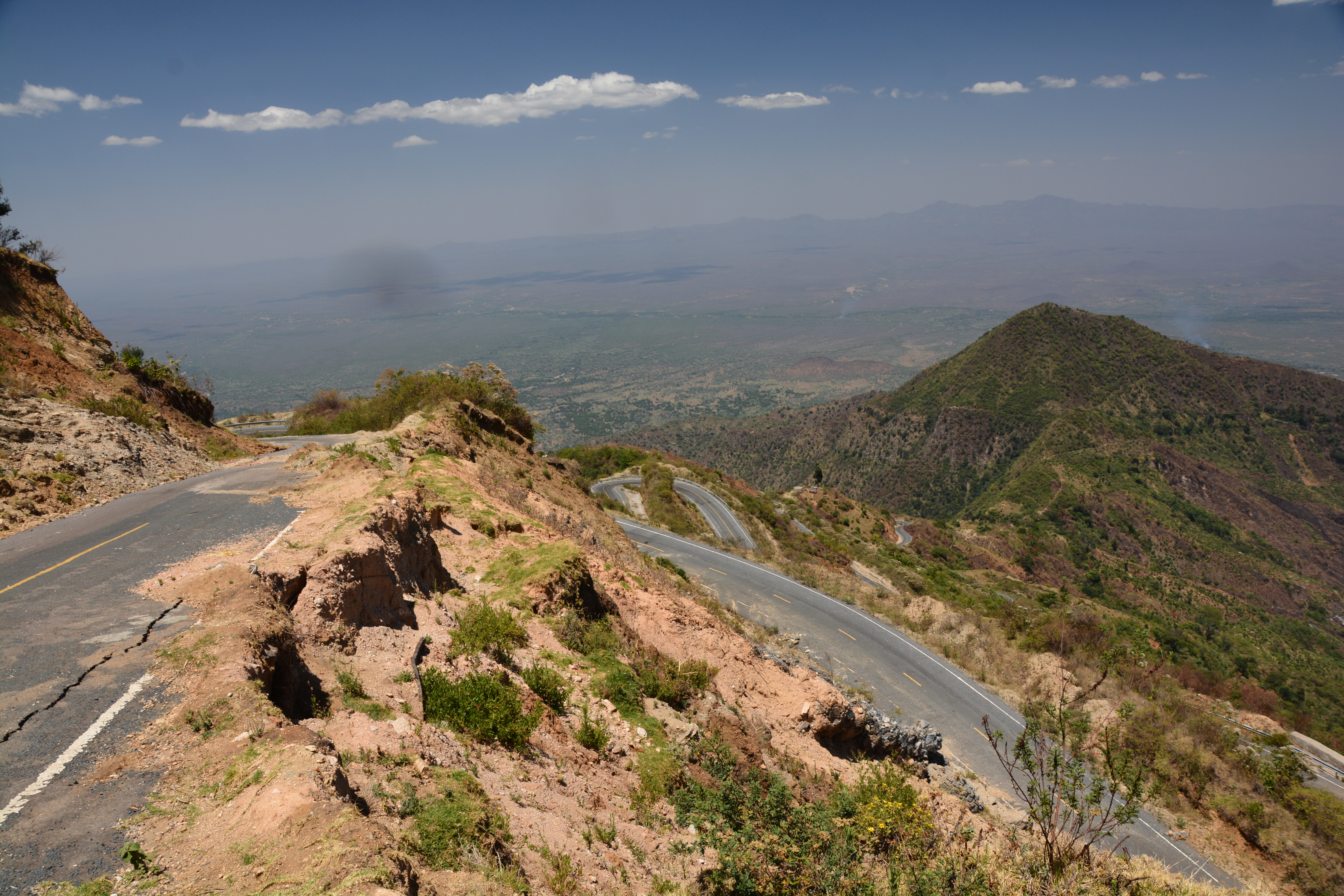
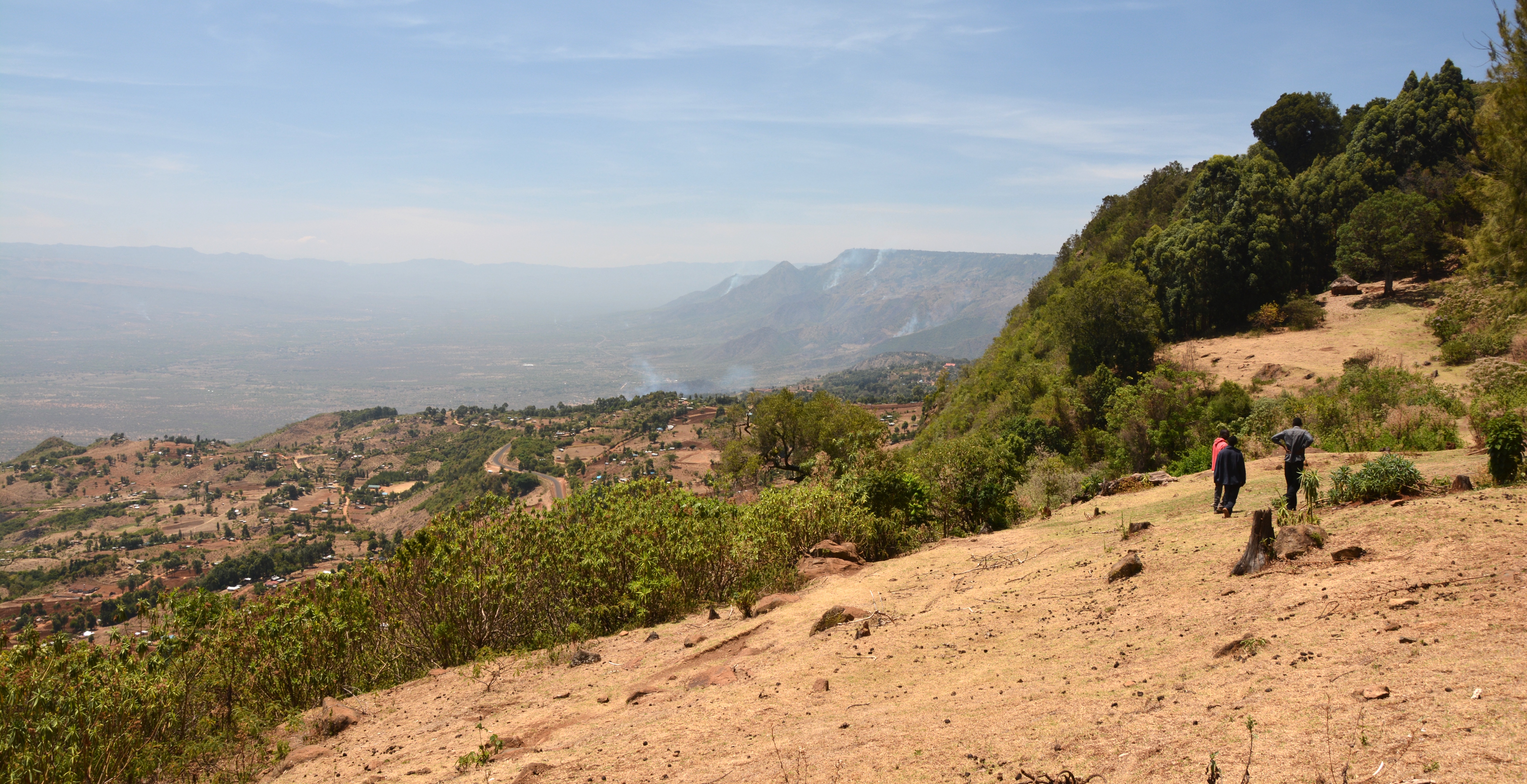
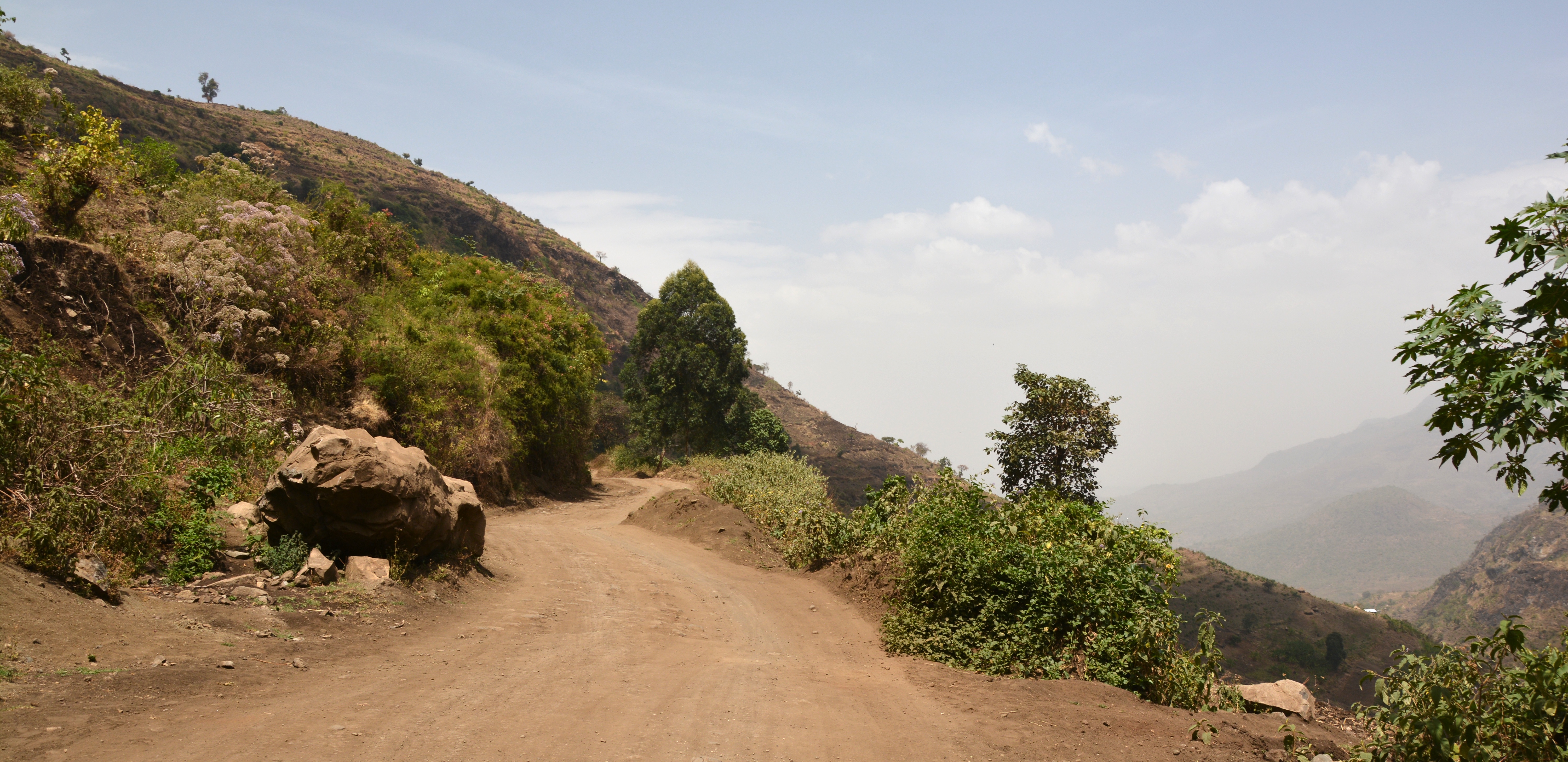
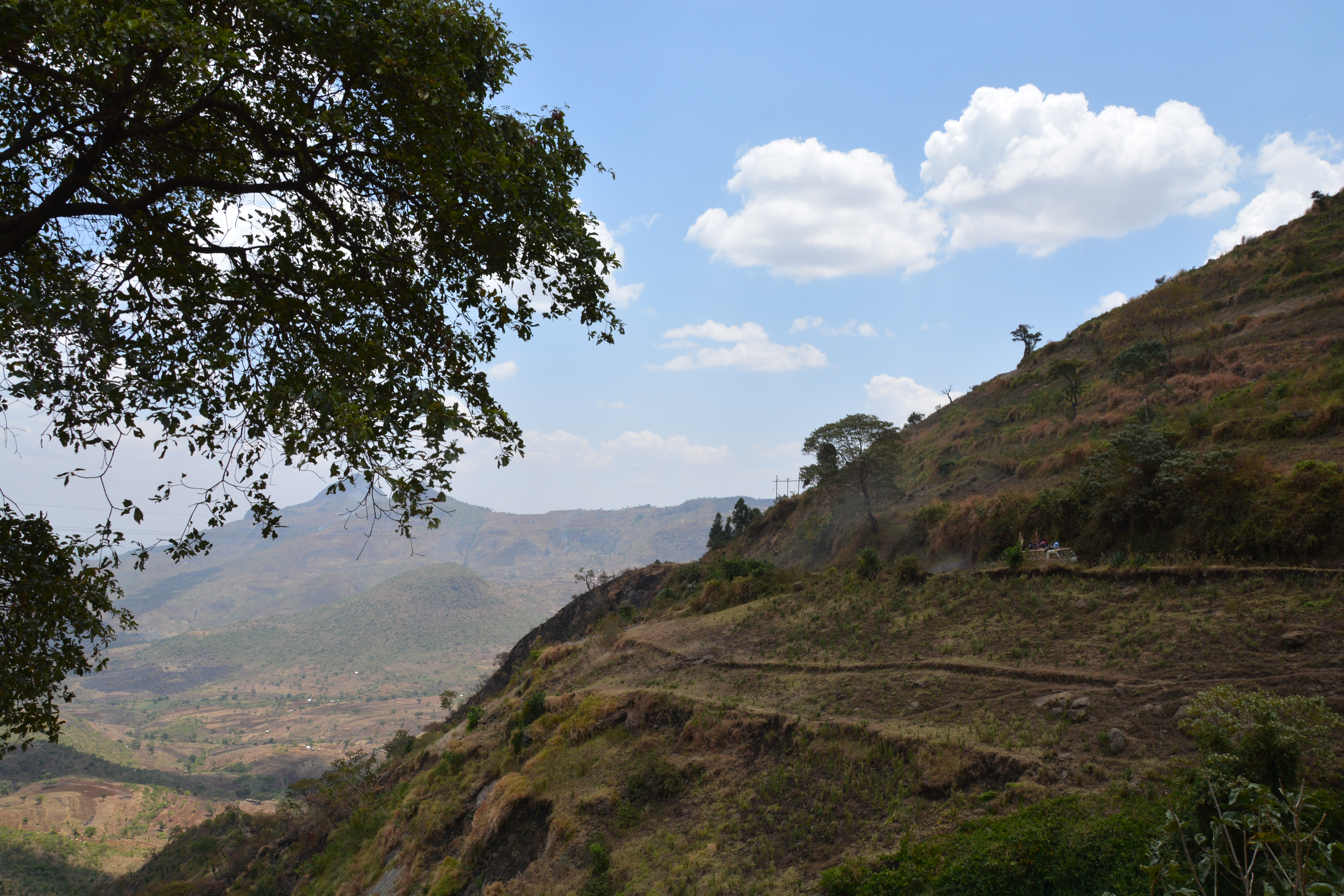
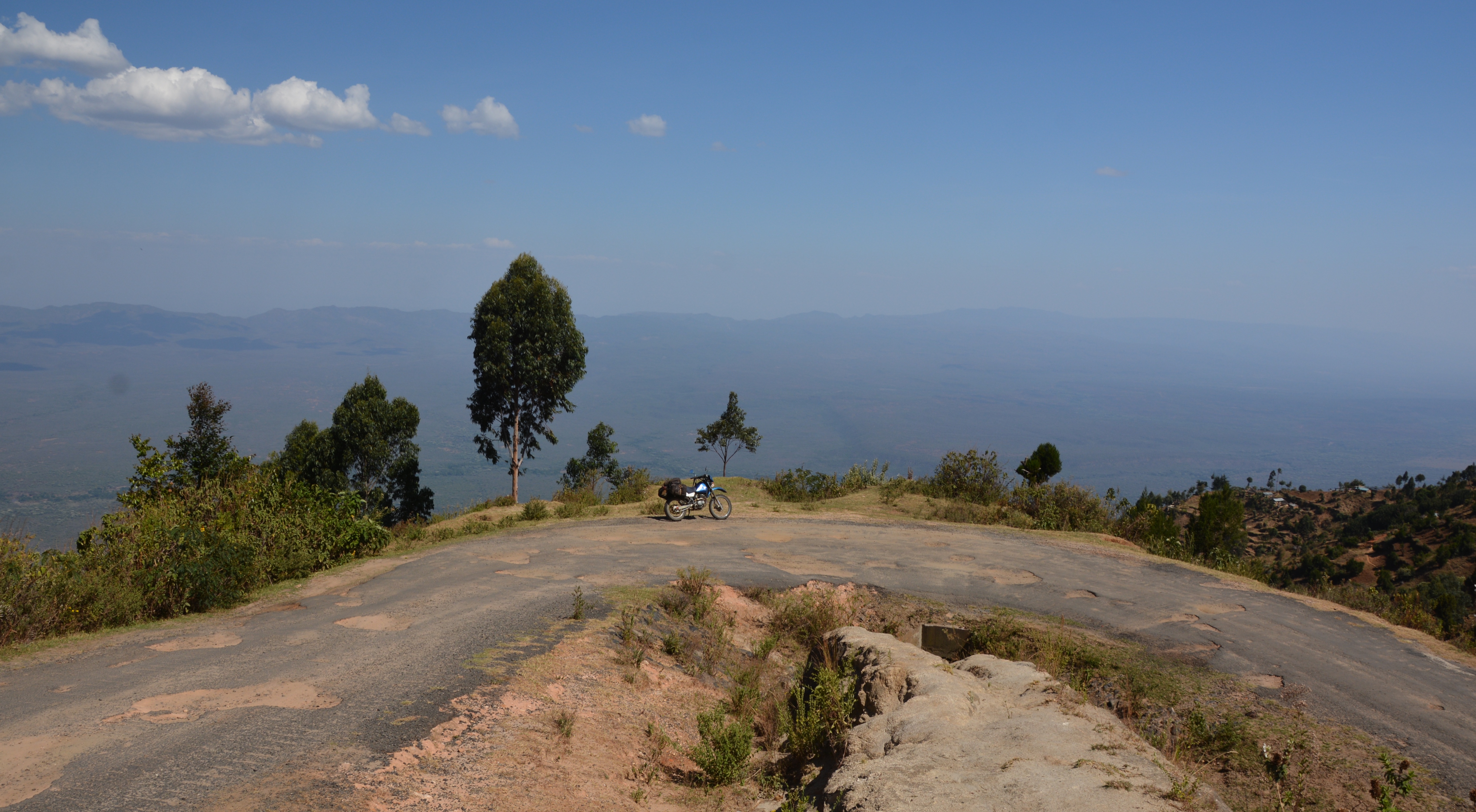
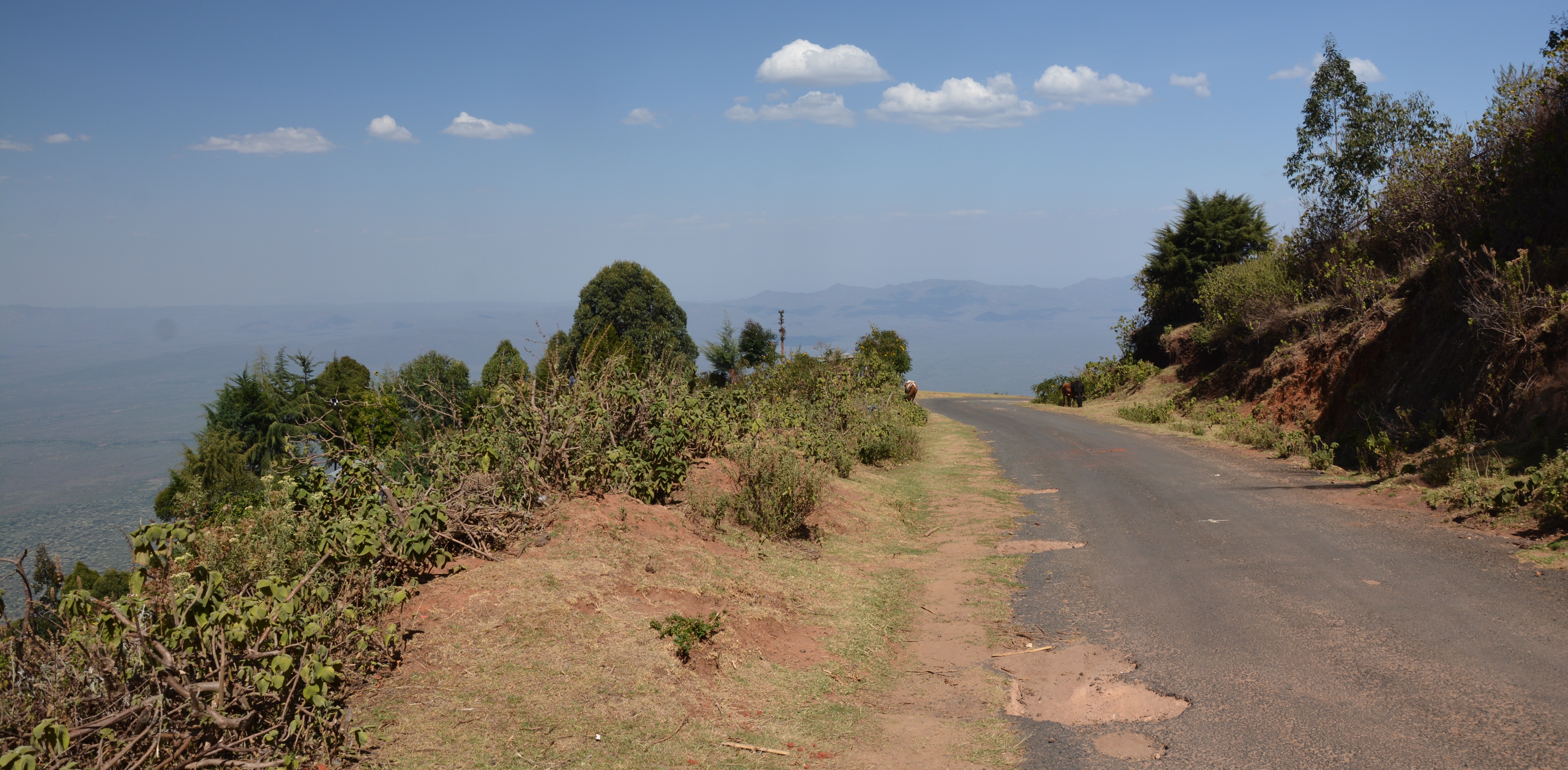
Amidst a shower of waves and smiles – these people around the Kerio Valley are my favourites in Kenya, endlessly welcoming and friendly – I ride away. Uphill. On smooth blacktop. Wow. Soon the bends begin. This will be the most convoluted road of my experience in East Africa. It’s wound about the escarpment like a puzzle. The bends are 180 degree; the rises steep. The views, of course, are stupendous. Vast. Expansive. Endless. The valley recedes downwards. The road struggles up, dizzyingly twisting. The sun’s overhead, so there’s no sense of direction, but I know it’s going to be UP for a long time yet. The height of the mountains above assures me of that. The road’s not maintained very well and I see three cars and a smattering of boda-bodas in 25 miles. The mountainsides have collapsed onto the tarmac in confusions of rocks and earth in at least twenty places, leaving a narrow rocky track just about enough for a car to squeeze by. Some of the falls are so old they’ve been colonised by grass and bushes. I guess there’s just no local government money to spend on maintenance. Pity, after the incredible effort to plan and construct this very impressive road. In places long lateral cracks are appearing, threatening the surface to fall away to the next level. I stop often; it’s SO extraordinary – and I go LOOKING for roads like this! In one place I look down and can see no less than nine levels of road scratched through the steep scrub below me. 
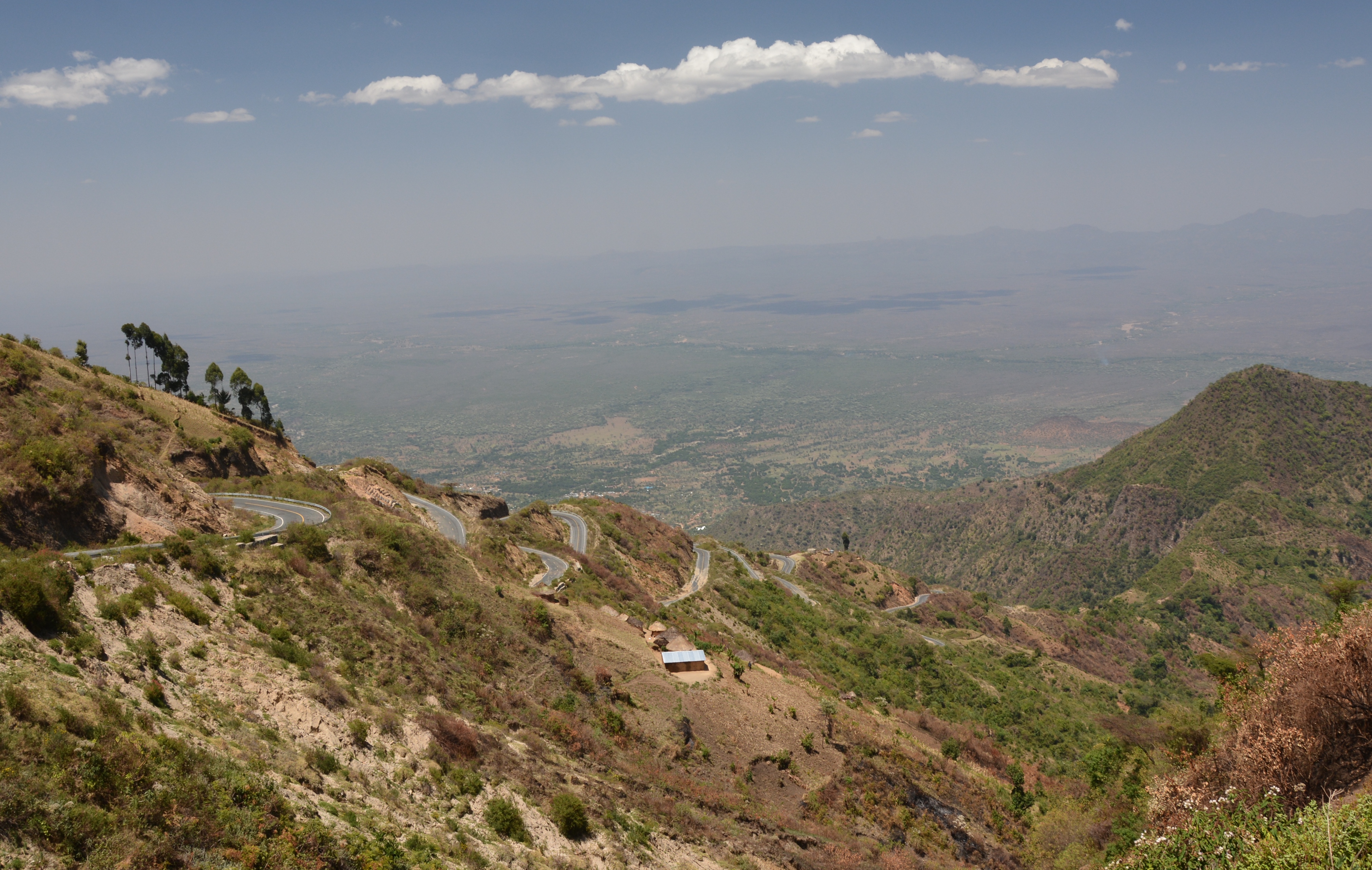
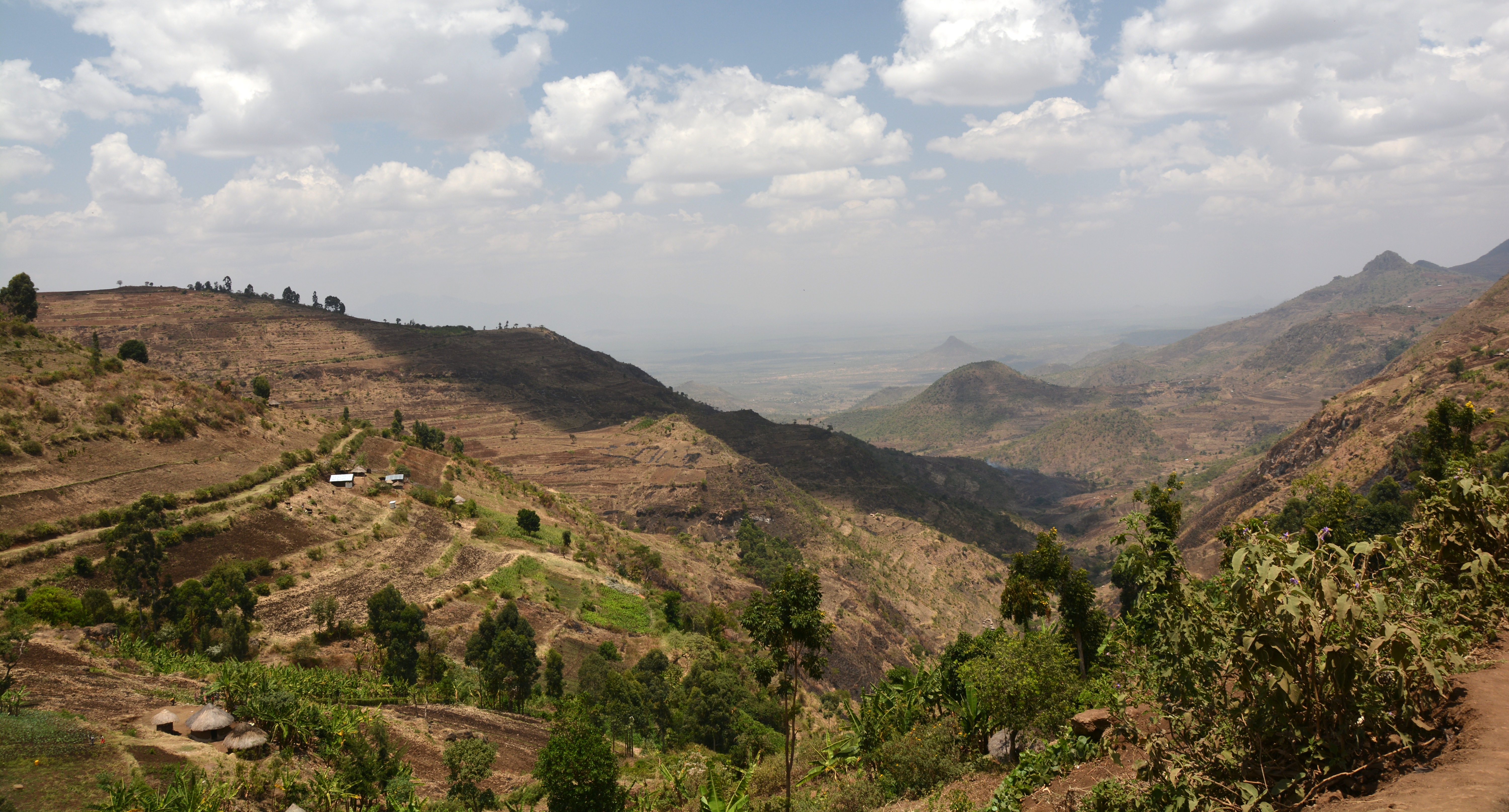
At last the hills level out and I am in high country. The valley’s misting now with distance. Up here I enter a wonderful landscape: on the valley side it’s cultivated and inhabited, with tidy shambas and a lot of round grass-thatched houses on small plateaux of pink earth; on the other side roll green mountains with mature trees and meadows that brighten the eye of one who’s just risen from the parched deserts far below. It’s a verdant, pastoral landscape of artlessly spellbinding views. Africa is SO surprising. I’d never have thought such beauty was here. It’s like a landscape from another century, as if I am winding through private Georgian parkland from a painting by Gainsborough – except of course for the excitement of the VAST Kerio Valley occasionally glimpsed below. Cropped grass licks at the very edge of the narrow road, pitted with potholes now – trimmed not by legions of ancient retainers but by ravenous cows and knotty-wooled sheep desperate for sustenance at the end of this extended dry season. 

I twist and wind through this charming landscape, first one way then another, the bends sharp and close, shrubs pressing in, greens of every hue, sometimes blue or yellow flowers. Birds flit about and I find I am riding at 20 miles an hour for mile upon mile, stopping every few hundred yards to wonder at the delights of this very special place I have discovered, and seem to have to myself. It’s a place worthy of the overworked superlatives I avoid: awesome, stupendous, stunning. My spirit soars with the circling raptors out over the heights of the valley, filled with unseen up-currents. I LOVE the Kerio Valley, but I’ve never seen it displayed thus before – for now my road is teetering on the very brink of the valley. Turn left and I’d plunge 4000 feet down into that furnace of rising heat. I stop for the

umpteenth time. I just can’t believe what I am seeing. Some young men, inquisitive and uniquely friendly around here – this tribe of Kalenjins are delightful – come close and stand by my Mosquito. I turn and say to them, “I think this must be one of the finest rides in ALL AFRICA! It’s WONDERFUL!” My smile must tell them even more about my sense of thrill.
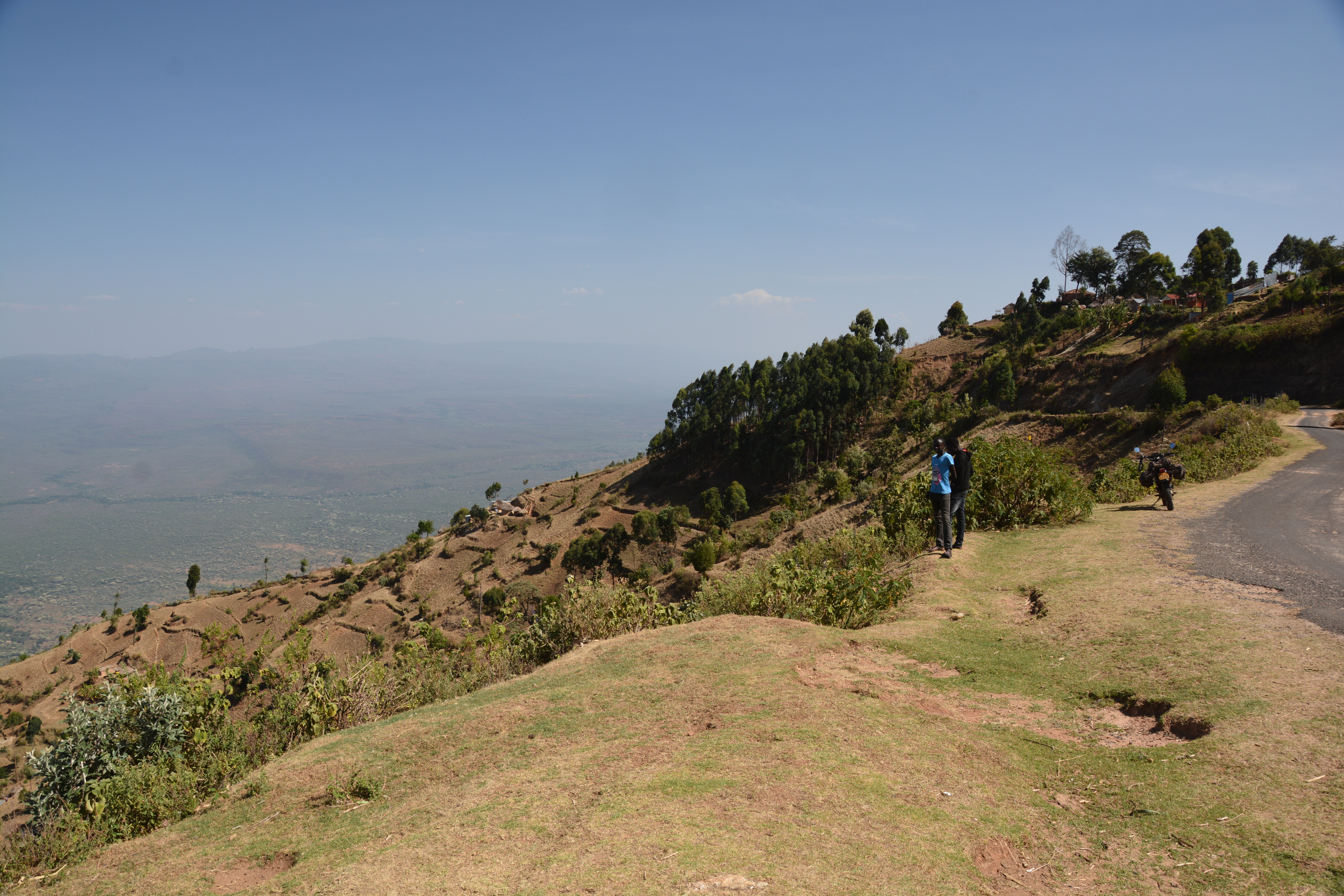
The boys just smile a bit. They look at this sight every day – and probably dream of life in a big city where they can be near their football heroes. They don’t see what I do: unbridled nature in all its power and majesty laid below just for me. This giant split in the Earth. This incredible sense of space and scale. This wonder of BRING HERE, in this sun-blasted landscape. I’m so excited by this ride. It’s up there amongst the very best I ever took, potholes notwithstanding. I feel so privileged to see this. I hope I always remember this day. My finest ride in East Africa long the lip of the Great African Rift – all there just for me.
*

Hours later, I arrive in Kessup excited, exhilarated, flushed with delight. “I think I’ve just discovered one of the best rides in ALL AFRICA!” I gush to William. “Incredible! Up there with the top of Lesotho, the Rwenzori mountains of Uganda, the forests of Rwanda! What a day! What a ride!” I can’t stop talking: I have to tell someone – so I tell everyone at the Kessup campsite, glowing with fulfilment and the intensity of my ride. 

I’m tired but buoyant with the wonder of what I’ve seen. It’s days like this that make travelling so utterly addictive. They don’t happen often, it’s true – there’s actually a lot of boredom and disappointment on the road, but just sometimes come those moments, if I’m lucky even whole days, like today… I can’t express the thrills of my day. If only you could relive these experiences in the vivid details they occur, ‘lockdowns’ and confinement could be made acceptable. But you can’t: you have to BE there to witness the wonder of, well, just BEING THERE!
*

Just when I thought I was running out of novelties in this part of East Africa, after five extended trips and 20,000 miles of wandering, I discover a new wonder. There’s enough in this region to explore for another trip. I just need to find a base from which to explore these mountains and the tumbling, rugged escarpment, riddled with so many small roads and villages and vistas. Kessup’s about 30 or 40 miles too far south for convenient exploration. Populated by the friendliest people, I’ve confirmed that this is my favourite part of Kenya, and up there with the best of this always-fascinating continent. 

*

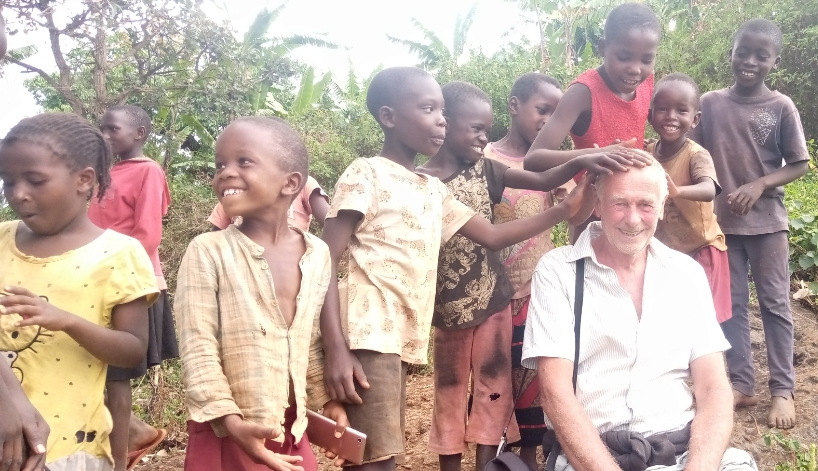
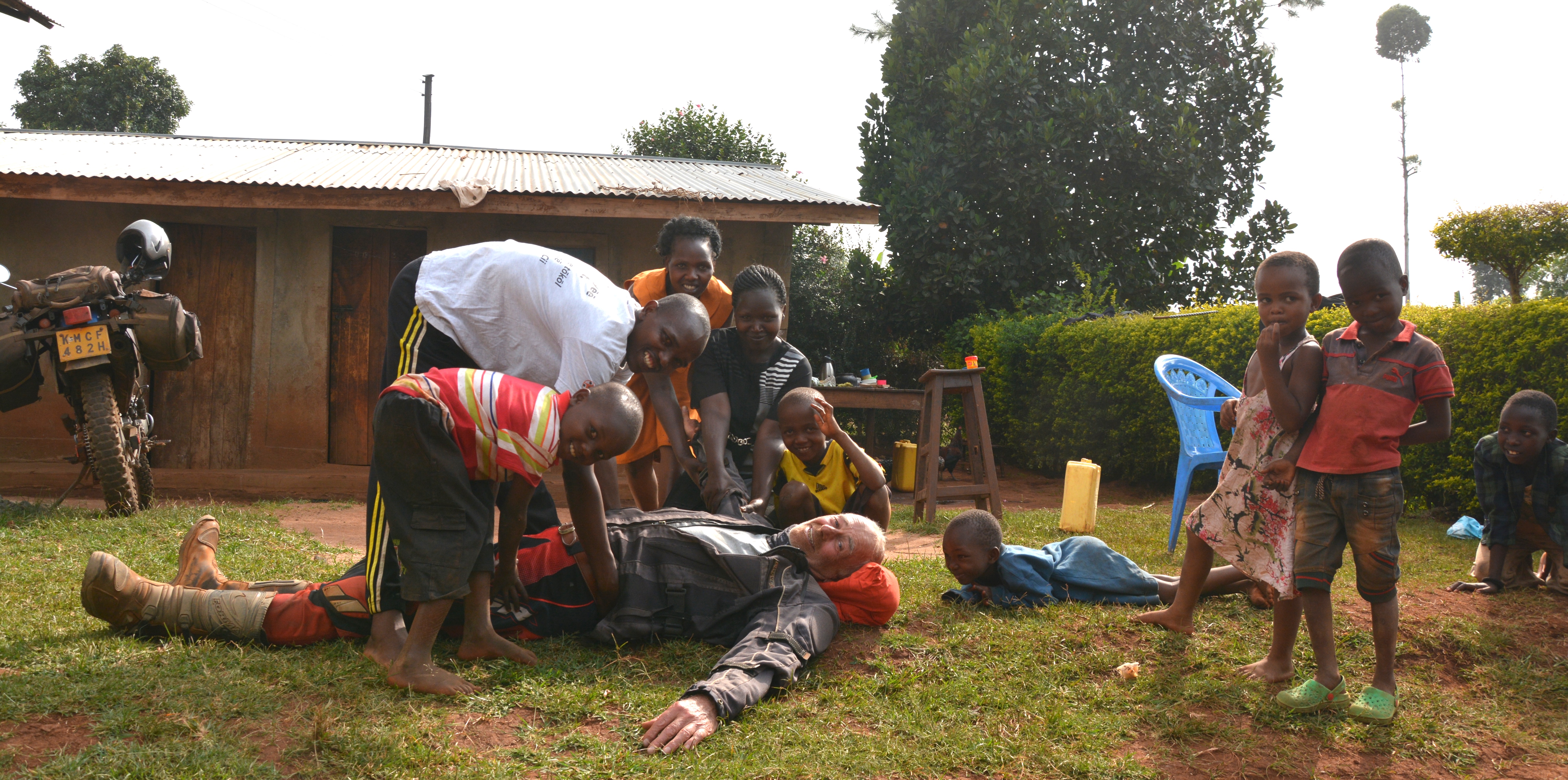
I’ve come back to Kessup with a mission: I made prints of quiet Naomi and her late daughter, Prudence, while I was back in Kitale. I even bought a frame, and now I’ve carried the pictures to Lodwar and back for her. Mine is the only image of her baby who died some months after my visit. She’s no other tangible memory. So William and I walk the red laterite roads to her compound, a mile or so along the plateau. She’s home, with her good looking firstborn, Brian, almost five. Some of his friends are playing here too, rolling motorbike tyres as hoops, the most common toys. Naomi is calmly delighted with the gift. “Oh, I appreciate it!” she exclaims, gazing at the image of her and her dead daughter. She brings tea, as Brian, Innocent and Dylan clamber over the rare mzungu. They’re all about four or five, and no one here has a chance to touch a mzungu’s white skin and feel the unusual hairy skin. Little boys should always be about four or five. It’s always endearing, and more photos must be taken; they’re all clamouring for their shots – so are some neighbours. I’m Kessup’s White Man and their photographer too. Each year, the bundle of prints I have to bring back grows thicker. 
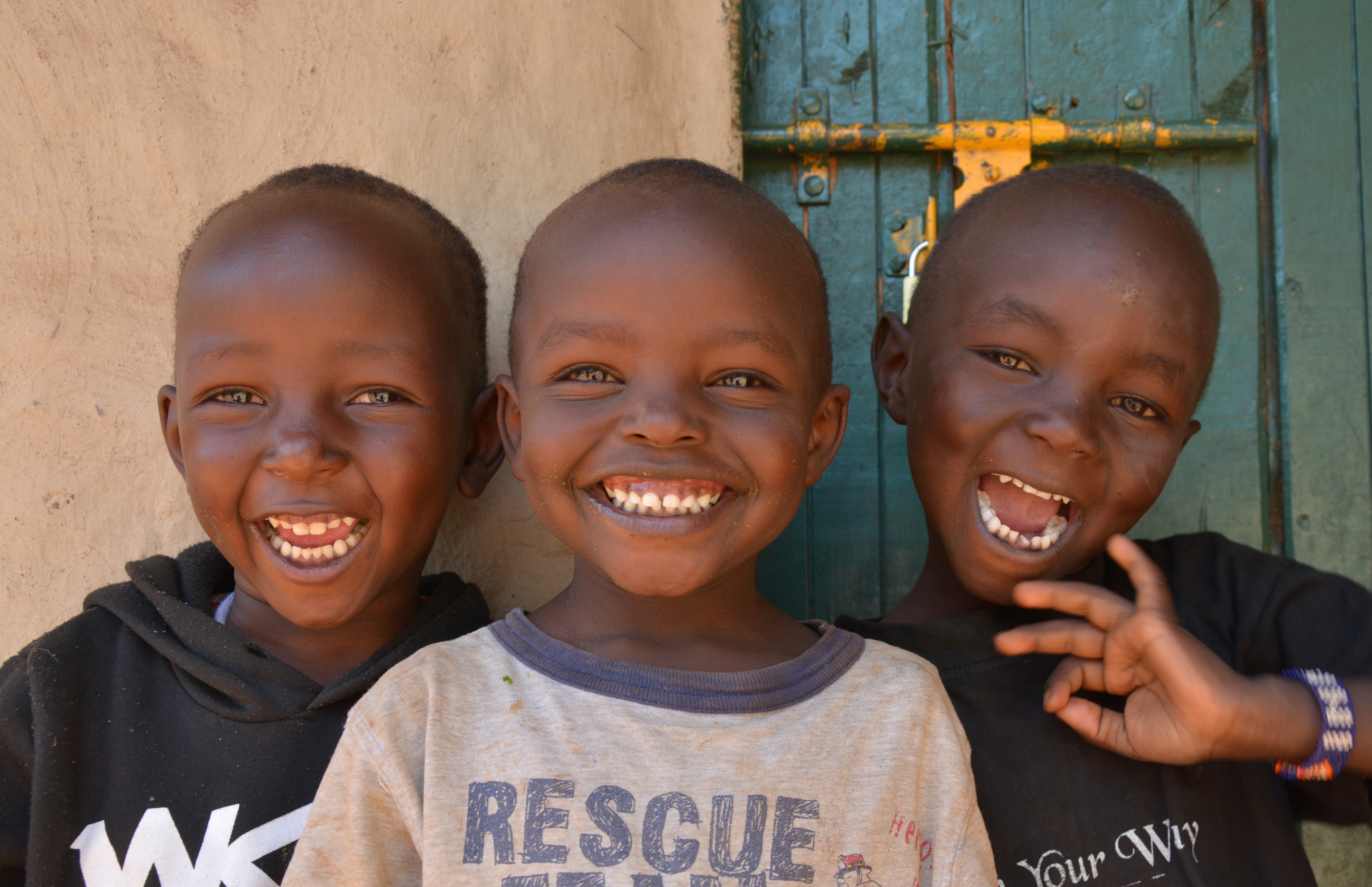
Dylan, Brian and Innocent. Four and three quarters is a grand age!

We can’t linger long today: William is on duty to help feed his ailing father at 1.00. He’s still bedridden and unable to walk, but seems consigned to his fate at wife-number-one’s house, where the family takes turns to help look after him. By good fortune, one of his second batch of sons trained to be a nurse, so now the duty falls on him. “My father paid to train him, so now he has to pay back!” says William with a laugh. 

William wants to show me his tomato seedlings. “They are about 3000! I counted three rows and averaged them. I transplant on the 10th. I will make good money! I must do well, because you trusted me.” I invested about £100 in the seeds and fertiliser he needs, and the original ploughing of his shamba. “But I decided not to employ anyone to break up the soil. I did it myself! Now I have nothing better doing, and I don’t take warigi and bulsa any more, I thought it is good exercise and so I was left with about 1000 bob. I took four beers instead!” He rather hopes that the £100 – literally seed money – may earn him as much as £800 to £1000 over the three months’ season, for these are expensive tomatoes, better than the usual run of fruits. “Oh, I can make GOOD money, if I am disciplined… And then invest in next year’s crop as well. Next time you come I can buy beer for you!”

*

Later, William turns up with a bit of a poser, that rather disturbs my evening. The president has announced a lockdown in Nairobi from tomorrow. What does that mean for my flight out? Am I in Africa for months, or do I have to leave in days? Who knows? I will try not to speculate but run back to Kitale tomorrow, where I have the internet and information. Oh well, it was always the risk of this trip…

*

I didn’t hang about, getting home to Kitale. I take the new winding road through Kapcherop instead of exploring further. I’m amused that this road brings me through the small scruffy habitation of ‘Garage’, in the midst of which is the ‘Garage Filling Station’. It makes me smile and remember another village, on the road to Soroti in Uganda, called ‘Television’. 

Back at home in Kitale, Scovia tells me that I have until Monday at noon to get myself inside the Nairobi county. It’s now early Saturday afternoon. The next two or three hours are spent in frustrating logistics and listening to bad music from KLM’s service centre. I manage to buy a ticket by air from Eldoret to Nairobi on Monday morning, and change my KLM flight to London to Tuesday 30th at midnight. The only anxiety I now have is that I must arrange a corona test before I can fly. KLM’s website says this can be done at the airport in Nairobi, so I must hope for the best and try to get the test on arrival from Eldoret… It’s all a very tense business – and expensive too, of course. The flights add about £500 to my trip. But then, I knew the risk I took, and if all goes well, I know I will consider my three and a half months’ of freedom well worthwhile. 

On both the last two afternoons heavy rain has fallen, in Kitale and then in Eldoret where I must stay overnight to get the early plane down to Nairobi. I’m quite glad the rains have finally broken; it makes leaving sun-filled Africa easier…

IF all goes according to plan, tomorrow, the 29th March, day 102 of this trip, I fly to Nairobi, get the corona test, stay in the old Nairobi Club overnight and take a taxi to the airport on Tuesday evening. I will be home rather suddenly on Wednesday 31st March. Then I must stay indoors for ten days in Harberton and will be out of purdah just in time for pubs opening – outside – on the 12th! 

So I’ll either add a brief update about the journey home, or I’ll be stuck in Nairobi for some bureaucratic reason. I DO find this a bit stressful..! Ho hum, we live in melodramatic times. 

EPISODE NINE. March 6th to 19th. A NEW VISA, BACK TO KESSUP AND THE JOURNEY ENTERS EXTRA TIME.


Naomi

I began the last episode by expressing the philosophy that I hope to get one thing done every day in Africa. Anything more is over-optimistic, and even one thing is hoping for a lot.

So far, my visa application has occupied many tedious hours. It’s all done online now, in the name of efficiency. Yeah… On Monday the 8th, ten days after I applied for a visa to enter Kenya on March 3rd from Uganda, I travelled back to Eldoret, 50 miles down the dangerous international highway. This time I rode in a matatu – minibus – for less stress than riding on that death-road. For £2 each way, it’s an easy journey, about an hour and a half of bad traffic and speed bumps, but they’re not my responsibility where I sit behind the driver, and matatus are comfortable these days as the virus regulations insist they sell only half the seats. You pay more, but so far as I am concerned, not being packed in with half Kenya, their goats and babies and cooking pots, is well worth the extra £1.50. That shows a certain lack of sympathy of course: for many in Kenya that £1.50 is as much as they hope to earn in a day.

So, a matatu ride and a boda-boda to the Immigration offices in the city centre. There to be shuffled from office to office, most officials apparently seeing the application process for the first time in their working lives, until I came upon a corpulent officer who took my application print-out and asked, “Where is your result?”

“What result? I applied ten days ago and NOTHING has changed on your website! Nothing… It’s just as well the old visa was still valid, or I’d have been waiting in Uganda for the new visa. One of your colleagues told me I should apply while I was out of Kenya, so I did. They all told me I must come here for endorsement!”

“Yes, but I can’t endorse without the printed acceptance form. Go and check online.”

“Where?”

“Across the road, a cyber cafe. Bring back the print.” Meanwhile, he phoned his colleague, who told him I have been granted a two month visa. It’s on the computer system. So why can’t he just GIVE me the bloody thing? Because he needs the printed acceptance. So efficient, this online stuff.

Frustrated, but keeping the smile resolutely on my face, since I know nothing happens if I lose my cool, I cross the road to a cramped lock-up internet cafe. 

“Oh, their website is SLOW!” says the nice young woman, who then spends an hour and two minutes trying to log into the site for me before we give up and I go back across the road to the Immigration office.

“Yes, it’s been down all day!” the officers declare, smiling. Then why, I wonder, didn’t they tell me when I was here over an hour ago? Perhaps because a miracle might happen, and people don’t like to give disappointing news in Africa. “Come tomorrow! No problem! Come tomorrow, or any another day!”

The fact that I reside 50 miles up the road, and the bureaucracy will take another day means nothing to anyone. So much time is wasted in Africa on this sort of nonsense. From outside the offices I phone Rico, “How the **** have you endured this for 12 YEARS?” I exclaim in frustration, having just coped with a mere couple of hours of the immigration department. Rico’s been trying to regularise his ‘status’ for 12 years; he’s STILL in Kenya on a visitor’s visa… He has a wife, a family, a house, what little wealth he has is all in Kenyan accounts: his life is committed to Kenya. But he’s still a tourist.

I repair to the smart hotel nearby – a white man can do this with impunity, I’m a little ashamed of the fact, but I may as well abuse it – and indulge in a decent mug of latte by the swimming pool and calm down before I trail back, empty handed, in a matatu to Kitale. Just on principle – the same principle that a miracle may happen – I keep trying to log on to the website, just in case anyone’s bothered to repair it. But of course not. A day gone. Just as well it’s only a holiday for me and time is elastic. At 3.30 I give up. May as well try to get home for some of beer-time at least.

*

Now, when I go for my afternoon rambles in Kitale the swallows are settling on the electric wires alongside the red dust tracks, perhaps preparing for their imminent flight back to places north – and to Devon to shit on my motorbike seat. The rainy season is approaching. There’s a subtle change in the weather; the skies roll with intermittent thunder drums and the nights are cooler up here at nearly 2000 metres. There’s almost an autumnal feel to the faint morning mists. In the afternoons humidity builds to proportions that remind me of the wonder of that traditional Turkish hammam in Istanbul, an experience which I haven’t forgotten for almost 50 years. But it tends to rain chiefly in the afternoons, so I can generally regulate my riding to avoid the worst soakings. Anyway, one look at the Totnes weather forecast soon brings a sense of perspective. Rain and 5 degrees with a yellow warning of wind.

*

On the third day I get on the Immigration website, I must have slipped through an unguarded cyber wormhole. Hastily – well actually it takes 12 minutes, but on Kenya’s Immigration Service website, that’s haste – I download the confirmation page. A button in the corner suggests ‘print’. Yes, if you have a colour printer nearer than six kilometres away and have the drivers for said printer loaded in your device. For safety I snap a picture of the screen with my camera before I race to town. The cyber cafe owner spends twenty minutes trying to print the single sheet, finally resorting to loading my edited photo to his own computer and printing that. What is so utterly illogical is that it is the Immigration Department’s own system that generates the confirmation – that I have to print and deliver to THEM! It’s available to them, as to me, on their own system! Huh! It’s crazy. 

Now all I have to do is take that sheet of A4 paper 50 miles to Eldoret. Where it’s already on their computer system… 

Let’s hope that solves the problem…

Later, I change the flight booking over the phone with KLM in Nairobi. KLM staff use their own computers. It’s easy. Takes moments. Done! I fly out on April 8th.

*

I can only comfort myself and keep my patience because I am aware that this near-insurmountable nonsense was created by the British colonials as a barrier against the black-skinned man, whom we did not believe to be in any way as capable or honest as us… And any poor African trying to get a visa to my xenophobic country is treated a great deal worse and more arrogantly than anyone will ever treat a mzungu in Africa. 

These shameful realities cause me to remain as patient as I am able.

*

My health seldom lets me down on these journeys; I have developed a pretty secure immunity to most ills. There was a hasty dismissal of some kitere and beans (tough maize kernels and beans) in Kessup, and a dire emergency – probably from beans again – on election day in Uganda in January, most inconveniently sudden, while watching the returning officer announce the result of the ‘auction’. A mighty urge overcame me, such that I had to run from the field the quarter mile back home, hoping I’d make it. I raced across the compound, much to Precious’s consternation, to the pit latrine, making it about 20 seconds too late.

Precious is convinced someone cursed me with the evil eye. “There are bad people! They can just look at you…” Alex and I laugh, but she really seems to believe in the magic. Old beliefs still have a strong hold. A couple of Imodium solve the problem in a few hours. “I must write to the manufacturers that their medicine is potent against African witches as well as diarrhoea!” I tell Precious. “They’ll be pleased.” Alex chuckles. 

Last time I was in Kessup a month ago, on the way back from my abortive trip to the coast, I suffered a resurgence of an occasional problem – an inability to piss. An old man’s (never-let-it-be-uttered) problem, perhaps. In Kessup I decided to consult the local herbalist, an elderly fellow William and I sometimes bump into on our rambles, usually clutching grubby bags of leaves, twisted sticks or dusty roots – funnily enough, in these strange days, with a blue clinical face mask as a chin strap. He’s nicknamed Dawa, which means medicine in KiSwahili.

Dawa turned up at breakfast time one morning with a small bundle of rather dirty roots tied by a strip from a nylon sack. My instructions were: wash them and boil them for ten minutes in about a litre of water, let it cool and drink half a tumbler first thing in the morning for four days. I put the package in my bags and took it home to Kitale. 

The boiled liquid was utterly DISGUSTING, so bad it must be beneficial. It looked like something dredged from the bottom of an equatorial swamp, thickly green, unpleasantly pungent and very bitter. However, by day two there was a resumption of service… Perhaps I had a urine infection – I’ve had them a couple of times before on these long rides. Maybe the green filth contained a natural antibiotic? It prevented the necessity of a visit to a doctor, cost 100 bob up front (70 pence) and makes a better story. Back in Kessup, it’s the custom to take the herbalist ‘a present’ – for which William is my advisor.

*

Eldoret is a short diversion from my ride to Kessup. Usually, I try to avoid the congested, scruffy city, but this time I have a mission. Clutching the single sheet of paper that I, instead of the officials who generated it, have printed off their cranky website, I knock on the door of Room 104, smile resolutely glued across my face and cheery greeting foremost. “I’ve got it!” I declare happily, waving the stupid, irrelevant paper. “It took three days to get on your website! Three days!”

“Oh,” says one of the women, eating a chapati, at a computer on which she can probably view a virtual copy of the paper I clutch, “it sometimes takes people more than two weeks!” In that case, I wonder to myself, why don’t you press your bosses to get the crappy website rebuilt? But these are lowly civil servants, intent on no more than their month-end salary, and one thing Africa DOES lack is initiative. I guess we colonials beat it out of them.

It takes two minutes – ignoring the hour and a half’s journey from Kitale and the one last week – to put the stamp in my passport that confers on me the right to stay in Kenya until May the 8th. 

I repair again to the smart Sirikwa Hotel nearby, flashiest place in Eldoret, to celebrate with a decent mug of latte and a plate of kachamburi – my favourite tomato, onion and coriander salad – by the blue swimming pool in green gardens. If you haven’t seen it, you can’t imagine the novelty of green grass in a city like Eldoret, where all is dust and dirt and crowds and noise. Refreshed by a bit of not very African luxury, I return to the chaos outside and ride north to Kessup, 25 miles away.

*

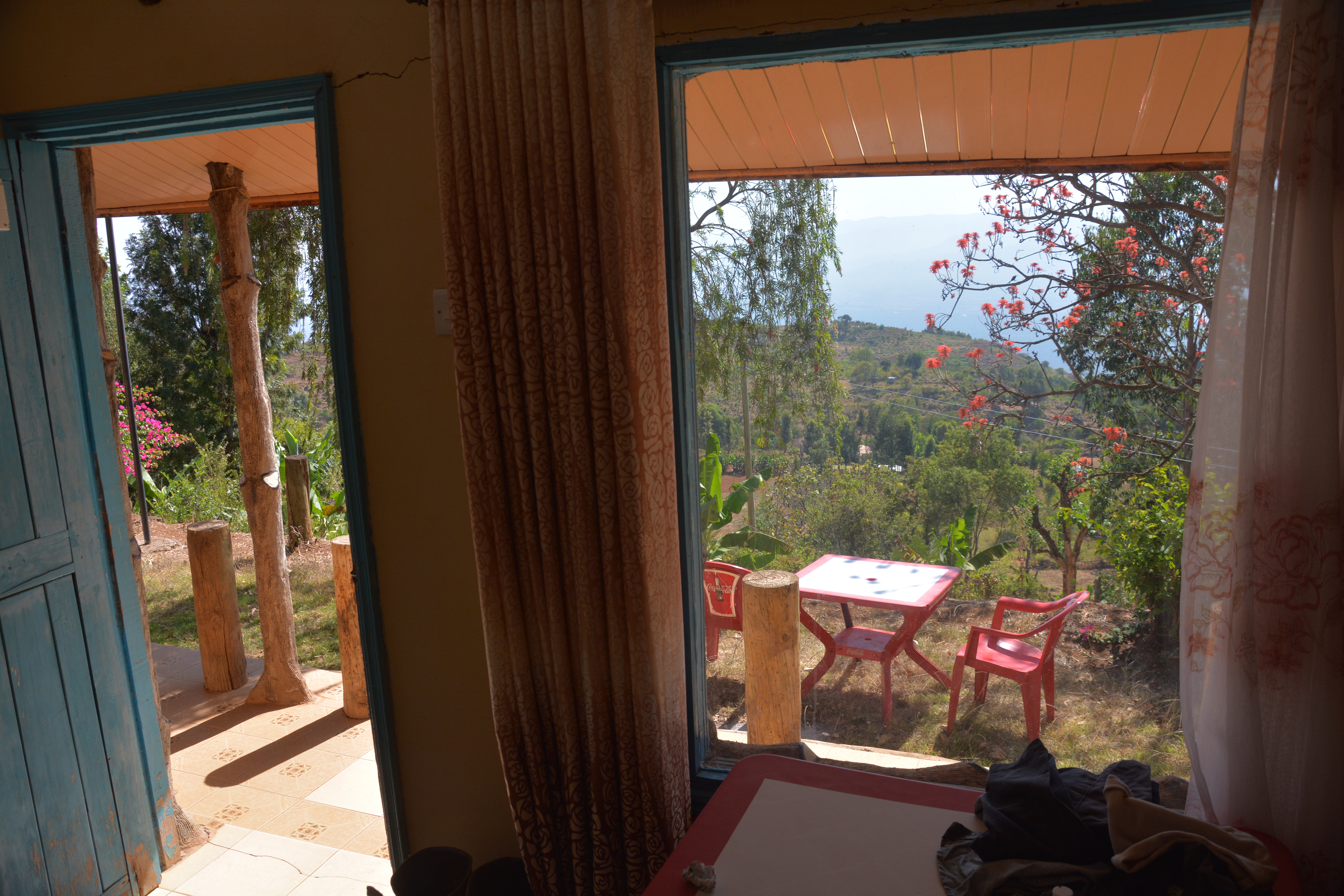
A room with a view. Not very luxurious, but who cares with this view?

Back in Kessup, I clock up my twelfth week in East Africa. What a relief it has been to spend my winter with PEOPLE. The sun, the freedom to roam, the relaxation are all incidental to that necessity of life itself. We are – I AM – social animals. Shutting us up for months on end will have lasting damage. Calling it ‘social’ rather than ‘physical’ distancing was a semantic mistake that will leak into our collective subconscious. Becoming a Covid Refugee is the best thing I have done in years. It was a gamble of course: maybe things would change for the worse in Africa; maybe I wouldn’t be let back; maybe… But I don’t live life by maybes and if onlys. Just by instinct. And instinct was correct. 

As my travelling years have passed – quite a lot of them by now – I’ve come to understand that it’s people who count. It’s been the reason I roam about like this, after the initial excitement of just seeing new places faded. And Africa has been a vital part of it, for on this continent I am – largely – received without judgement; of course I am a mzungu and a somewhat exotic for that, a ‘slebrity’, as Alex put it. Assumptions are made about my wealth and privilege, but – again largely – I am accepted at face value and welcomed openly. Africans (and of course I am making generalisations) are generous and trusting; everyone – and this ISN’T a generalisation – reacts to a smile. It’s the wonder of the continent: a smile for a smile. It’s no accident that my photos are all of smiling people, and the only credit I take for that is that they are reacting to ME, not my camera. 

Africa has enriched my life fundamentally and happily. Yet most are afraid of travelling here; old prejudices inculcated in colonial times by dramatic, demeaning tales and perpetuated by wilful ignorance and the shameless self interest of the rich world. Even those who DO come to Africa seldom engage with its people, keeping them as an exotic background to their animal safaris. Who needs animals in parks when they can enjoy an African village?

Which of course explains why I am back in Kessup again, with my friend and guide to his community, William. “Eh, your best friend is back!” calls the owner of the campsite, driving a truck full of big fenceposts down the rutted and rocky approach track and seeing William and I inspecting William’s newly ploughed tomato field. “And our best customer!” ONLY customer might really be more accurate. Gladys, Vicky and Millicent come to hug their mzungu as I pull in on my Mosquito. 

A view to drink beer by! Kerio Valley spread below

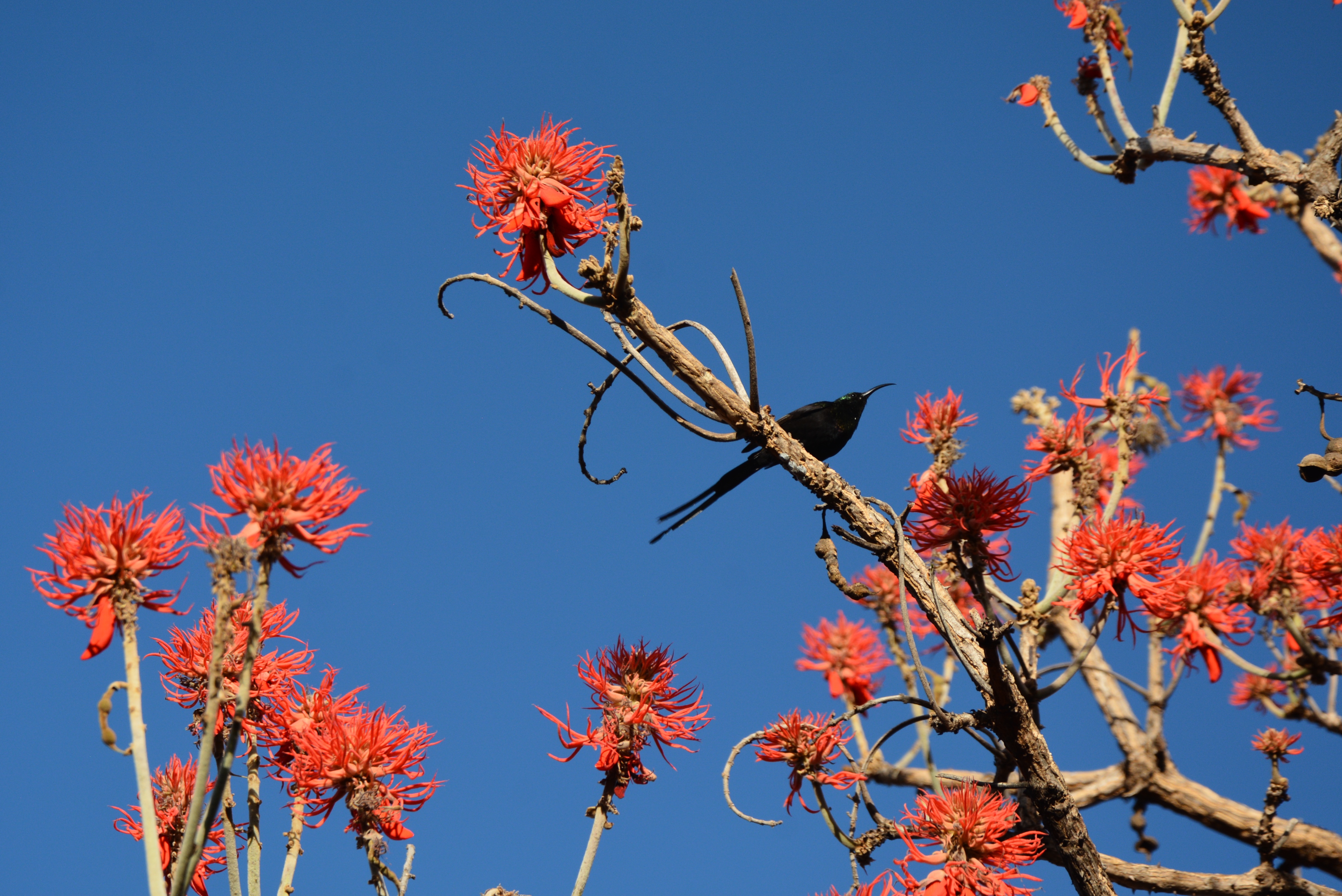
Soon it’s time for beer. We sit beneath a flashy flame tree, its red flowers on leafless grey branches. It’s a dramatic tree, the flame tree, I’ve never seen another like it with its showy inverted scarlet tassels. Long-beaked nectar-sucking birds jump about enthusiastically overhead and the wonderful view of the Kerio Valley – part of the Great Rift – drops away at our feet. It’s a pretty special place to sit with a beer and catch up on the past month. William wants to hear of my families in Kitale and Sipi: he feels he knows them by now, again with that very African sense of concern and brotherhood. I bring him greetings from Adelight and Rico and Alex. None of them have yet met but they all express a trusting warmth – ‘any friend of yours…’

Many birds enjoy the spectacular flame tree

*

William and I wander down the red dust roads of the village on the plateau. We’re going to visit Dawa, the herbalist, and take him the ‘gift’ for my local medicine. William says 500 bob (about £3.25) will be about right, inclusive of two more bundles of the same medicinal roots and sticks to take home. Dawa lives in a couple of red-painted zinc houses behind a large primary school, down towards the edge of the plateau. Below us the valley shimmers in the heat rising from its depths. Everything’s much drier than when I was here a month ago. “There’s not much mil-ikk,” says William. “There’s nothing for the cows to eat. I think the rains will come late this year, maybe not until the beginning of the next month…” He gazes upwards. It’s certainly hot today, with a huge deep blue sky arching over us. Landscapes seem so BIG in Africa. And this is such a magnificent landscape; one of the best. “Well, we can’t all have Rift Valleys!” said Rico when we contrasted the lack of scenic beauty in West Africa. No, just ONE is terrific though, worth coming back time and again.

Dawa is expecting us, sitting on a log wearing his jacket – for me it is oven-hot already at 10 o’clock. William greets him in Kalenjin. “He’s impatient!” he tells me as Dawa pulls forward a plastic chair for me. “He knows he’s getting money and he wants his warigi!” That’s how Dawa will spend my medical fees: on the local home-distilled spirit that will ironically probably kill him from sclerosis, as it does so many. ‘Physician heal thyself’… But it’s almost certainly an addiction by now, William says later as we walk. And it’s a long walk to a house that has warigi this morning. 

Before we leave, Dawa stands up to present me ceremonially with two more bundles of sticks and roots tied with a plastic strip from a woven sack. I stand to receive them, both of us exchanging the bundles with both hands. Dawa mimes spitting on his hands as the roots pass. I take the 500 bob note in both hands and present it to Dawa. He pretends to spit on the note. Maybe in pre-corona times, he’d actually spit. I enjoy these thoughtful little formalities of old local life – now largely replaced with a casual wave from the back of a boda-boda; no one’s got time any more, too busy with their phones and ‘social’ media. 

I want to know a bit about his local herbal knowledge. Through William I ask Dawa if he is sharing this valuable skill with anyone younger. “Oh, he’s only allowed by tradition to tell one other!” Maddeningly, this hard-learned knowledge is dying out all over the continent, yet ‘tradition’ demands that he divulge his secrets to only one family member. So even tradition serves to force people into the hands of the multinational drugs companies, peddling chemical drugs of probably no more potency and many more side effects – making eye-wateringly HUGE profits that make Western shareholders rich.

Dawa’s itching with impatience to be off in search of his fix of hard spirit, the alcohol that I have witnessed to have killed so many I knew in my African years. Of course, it’s illegal, but commonly available and far cheaper even than beer. Who knows its alcohol content? Made from a distillation of maize and wheat, it’s more potent than gin or whisky and costs pennies. When we reach the house with warigi, half an hour’s walk along the plateau, Dawa downs more than half a litre of the spirit. Suddenly it appears he can speak English and, he says, now he can see clearly. But not for long, I bet; he’ll wander home and sleep it off, forget to take a proper meal, and be back as soon as he’s made another 70p to buy another cooking oil container of this poison. Poison I would use to strip paint and clean brushes perhaps. Poison that kills so many here. 

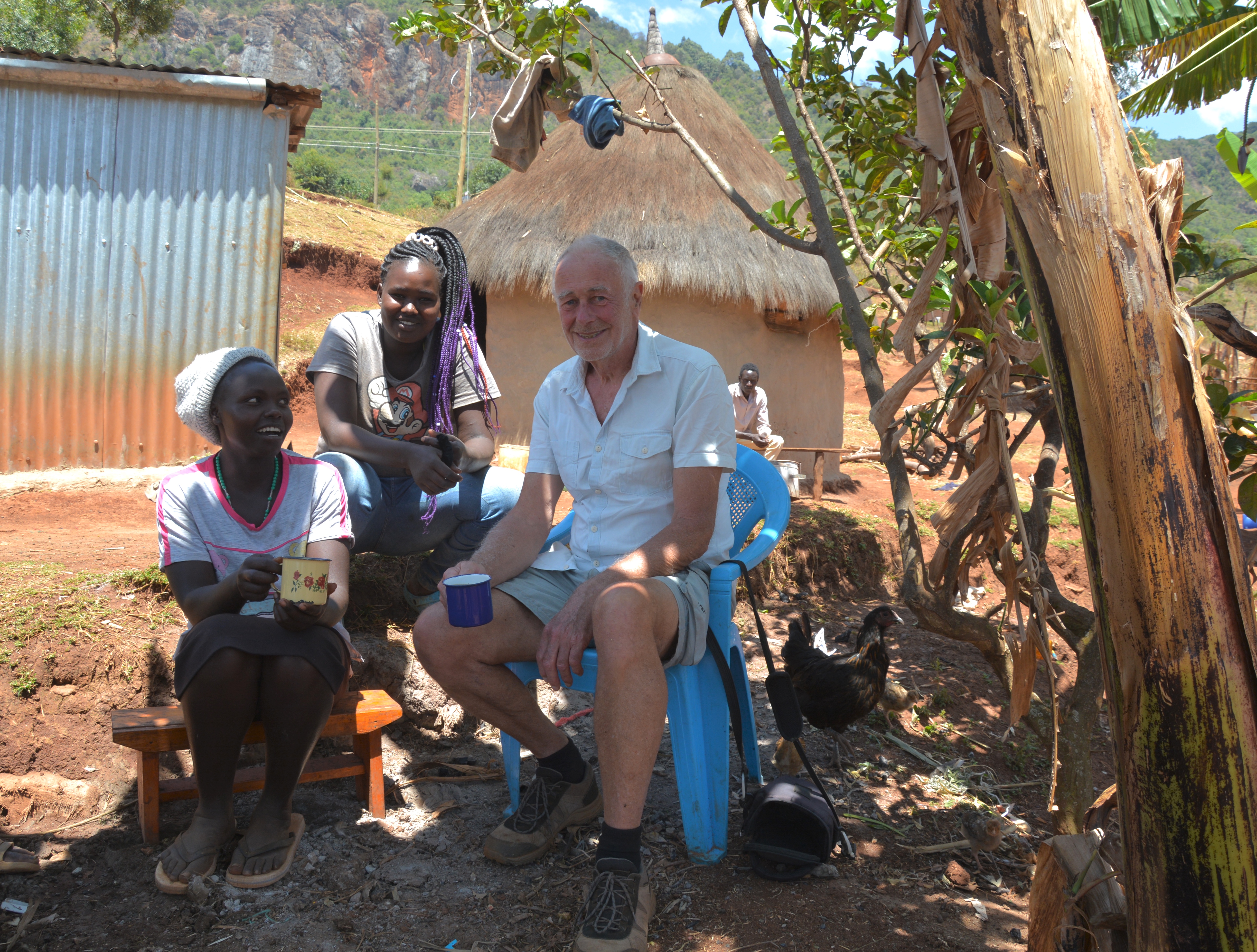
Naomi, Vivian and I take tea

William, who’s stopped taking warigi, stopped smoking, no longer drinks the local beer, bulsa, and cut his sugar intake, all he says, on my advice, drinks tea as Dawa gulps down the two enamel mugs of neat spirit. I recognise a young woman whom I photographed along here last year. Naomi is very attractive: widely spaced bright eyes and a happy smile of lovely teeth. She’s a happy disposition and a quickly smiling face. I snapped her last year with her small baby, Prudence. Now she’s holding a small child and I ask if it’s the same baby. She tells me quietly that Prudence is no more; she died in October last year. “But now I am calm again. Have you the photo? I have no photo of my little girl to remember…” I tell her that I have photos still on my iPad from that journey and I will do my very best to get prints for her. She’s smiling again, that pretty smile. I take her photo again, moving her to the shaded doorway of a grass-thatched round hut nearby. With the dark background and the light reflecting from the pale dust outside, they’re lovely pictures. “I think one of those will end up on my wall at home,” I tell her. She smiles quietly at the idea. 

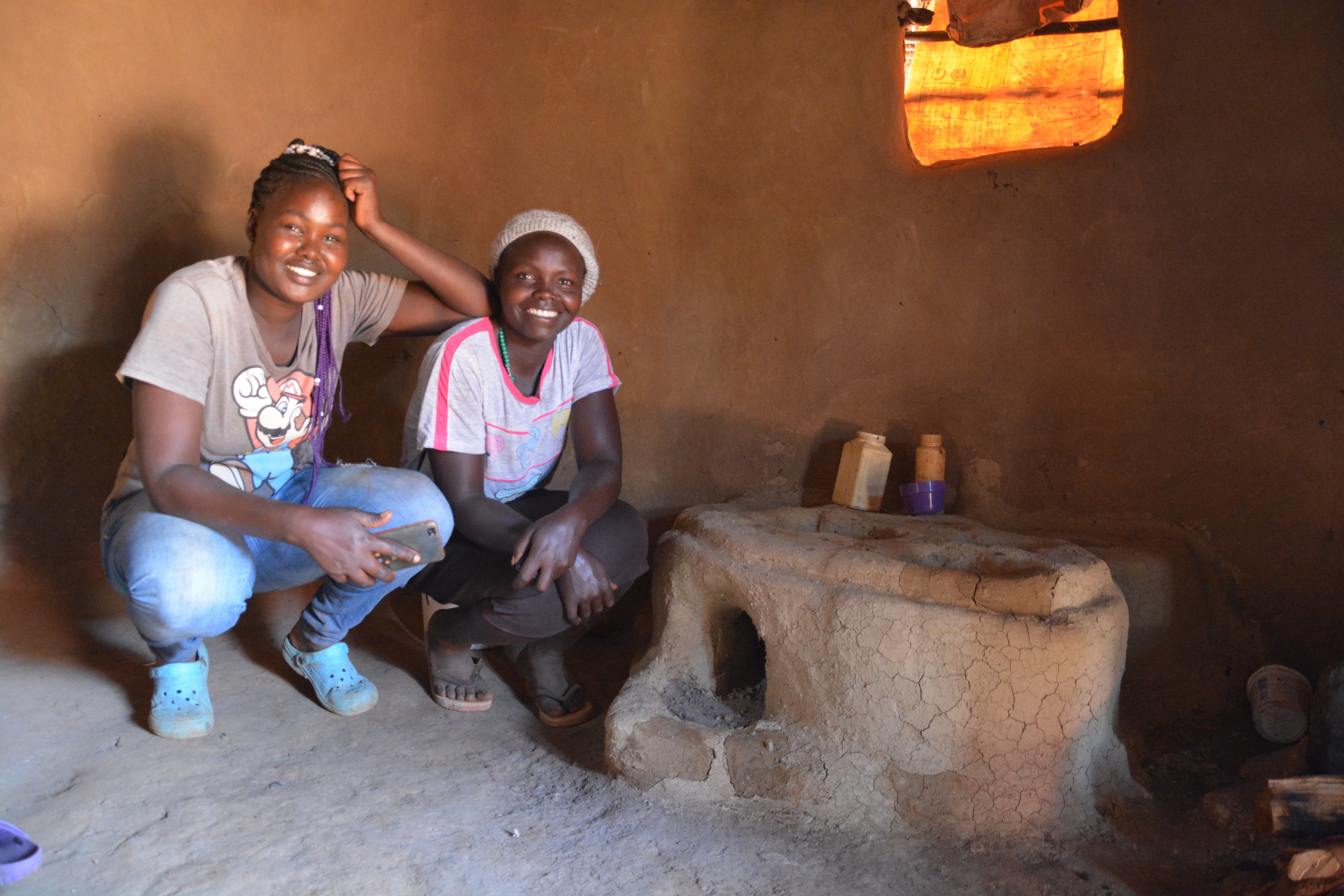
Vivian and Naomi show me the traditional cooking stove in the round thatched house – of course, no chimney…

*

On Saturday, William and I hike in the other direction, northwards along the plateau. We’re heading back towards Siroch, the village we visited last month where I so delighted all the schoolchildren. It’s terribly hot today, the sun blasting from a sky so deep blue it’s almost ultramarine. The enormous valley is just a shade of pale blue below us, hazed by the intensity of the light and distance. Three thousand feet down it must be an inferno today. Happily, here on the edge of the high plateau there’s a strong breeze rushing out of the valley. Oddly, it’s a cool wind. It tempers the extremes for a pleasant but pretty warm walk. We greet dozens as we go and children run from shambas to see a real white man pass their villages. It’s exciting for them and the cry of, “Mzuuungu! Mzuuungu!” rises everywhere. 

We don’t make it quite as far as Siroch this time. William must be back by three for a family meeting. His father is dying – well, that seems the likely outcome from his stay in the hospital in Eldoret. He’s in the final stages of prostate cancer and the doctors don’t hold out much prospect of recovery. The hospital is expensive: it’s private, as the family reckon the government hospitals are of low standard. The old man wants to come home, to his much younger second wife. “How the heck can you do that?” I ask William, for I’ve visited Changwony at home. He lives on the very outer edge of the escarpment down bumpy footpaths and rocky fields. Short of a helicopter, I can’t imagine how you’d get a terminally ill 86 year old, who can’t walk, is catheterised and bed-ridden, down to the collection of mud and thatch houses that are his home, a short mile from the tar road. 

“By boda-boda!” says William, amused at the idea of a helicopter. I am silenced by shock. Four men and a stretcher, maybe. But a boda-boda..? A clapped out Chinese motorbike..?

So the family is meeting to discuss what they will do. If the old man is dying, why keep him in an expensive hospital where he’s discontented? “The meeting will be to discuss if we shall sell some of his cows. Which ones… And what we are to do if he insists on coming home.” William’s family is long-established here and relatively wealthy – in land and cattle at least. “Maybe he can live another year. Maybe two!” But with a diagnosis of late stage prostate cancer it seems unlikely. 

Later in the day, when we meet for supper and beer beneath our flame tree, William says his father will be discharged tomorrow. He’ll come back to wife number one’s house, William’s mother. “How does he get on with her?” I ask, polygamy a mystery. 

“Oh, it will be very OK. And my mother and the young wife, they are alright too.” 

But for some days the family has to resist Changwony’s insistence that he wants to go down to his own house and his younger wife. I wonder how it will play out, if indeed he does survive for weeks or months, bedridden, requiring nursing and discontent to be at his number-one-wife’s house? 

*

“The goodness is..” as William says, that we both like to walk. We’ve roamed this plateau extensively, but Sunday was our first time to climb UP out of the Rift Valley. It’s over 1000 feet of stiff rocky scrambling to the top edge, the giant valley laid out now over 4000 feet below, baking in the equatorial sun. Another hot day, maybe 30 or 32 degrees. Even more in the sun. But the top of the cliff’s cooler than when we walked down into the inferno. 

It’s hard work though… I struggle up the steep incline, my feet slipping on the dust and rocks, vicious thorns grabbing at my skin. It’s almost straight up at right angles to the incline. Feels that way anyway. The path is overgrown and not very well used, yet William points out some sticks that have dropped from bundles on backs. “Even here, women from Kessup come for firewood!” he says over his shoulder, phone in that grip that must soon become a new human physical attribute. (‘Women’, you note). Kessup is now about eight hundred feet below us, laid out like a map on its giant step in the drop to the Rift. We come to a narrow passage between a huge rock on our left, the upward side, and a line of rocks that have split away aeons ago. As we emerge, we are greeted by our two guides. They’ve been sent down to guide us the rest of the way to Leonard’s compound. Leonard is the beekeeper that we visited last year at the bottom of the Kerio Valley. He showed me his  bee hives and his business down there with great patience. Now we have made an appointment to visit him at home, up here on the top of the escarpment. We’re over 7000 feet; I tend to forget that. Any effort is multiplied, although I’ve been at high altitude most of the time for the past three months. 

Near the top of the escarpment, the path slips through a crack
Near the top, with the Kessup plateau spread below, and the Rift below that
Walking near the top of the Rift Valley, across a dry meadow at the edge of the old forest

Elias and Timothy are our guides. Elias turns out to be a complete tonic. I’m delighted by his endless cheerfulness and engaging smile. For the next three hours, I have only to look at him for a smile to spread over my face too. What a gift he has! Now the two young men lead us through a lovely forest. There are mature hardwoods towering above us, and thick spiky equatorial growth around us. It’s an insignificant path through the thick growth. I’m glad these two fellows are here to guide us, at least until we reach a red dust footpath. The sun is shaded here, light dappling through the dense greenery above. Old trees. It’s a magical place, uncommon even in rural Kenya, where the population invades every natural space. This is an old government forest, so I suppose there’s some protection. I didn’t expect it, and after the rigorous exercise I just went through, I’m a bit shocked I still have more than a couple of miles to battle through the forest. But it’s terrific: cool, calm and very beautiful. 

Kessup forest, a visual and climatic rest from the heat and searing sun

Then we reach the edge of the forest, a red dust road and a rickety bridge of tree trunks over a grey river. Two boys are fishing off the bridge with plastic bottles on blue plastic string lines. One of them reels in hisJ informal fishing rod and shows me a fish, about the size of a goldfish, rather confined in the plastic water bottle. Did they bait the bottle, I wonder? Did he put the fish in the bottle? Did the fish swim in of its own volition? Who knows? He’s very proud to show his ‘catch’ – if that’s what it is – to the mzungu.

We climb again, on a red earth road, to a village of compounds and green shambas and newly ploughed small fields. We reach Leonard’s home, neighbours excited to see a mzungu climbing the rural paths. They all call out and greet. We enter a compound fenced with split logs: there’s plenty of wood up here on the highlands. 

We’ve come by appointment, to try Leonard’s muratina. It’s a sort of wine made from fermented honey, some dried tree seedpods, water and a local leaf. It’s not really mead, although that’s what William and I have called it, because I didn’t know quite what he was describing. In a few moments I will. Men sit about the sloping, grassy compound on wooden plank benches, each with a Fanta bottle filled with bright sunflower yellow liquid. It’s attractive, with the bright high sun glinting through the mixture. We greet the assembled group and Leonard, a smartly dressed, quietly spoken man, insists on bringing me an armchair from the house. Everyone else is sitting on planks or rustic stools, but a mzungu guest is not just special but probably unique in this village. After the very hard walk – which has taken us well over two and a half gruelling hours – I don’t object to celebrity status.

Leonard brings my Fanta bottle. I sniff the neck a little suspiciously. It doesn’t smell too good: a bit of a fermenting aroma, slightly fruity but sour. He brings a tin mug; I pour the liquid, and discover it’s really rather good, it’s got a sort of mango and orange flavour but is like a very sweet wine. William has been telling me for days that he will only allow me to drink, “ONE glass!” I think he’s afraid I’ll fall off the mountain if I imbibe any more. But it’s not as strong as he’s been warning me. I guess it’s a bit like wine, about 12% alcohol. I suppose it’s not wise to drink two Fanta bottles of sweet wine, especially with a thousand foot cliff to descend, if I think about it. But I don’t think about it: I like the stuff! 

Elias, one of the most cheerful dispositions in all Kessup

I sit, very contentedly, amongst a small group of respectful men, surrounded by ten or more delightful children, so excited that a real mzungu – for some of them the first they ever saw – has arrived. After the exertions, it’s lovely to sit here: the temperature is perfect, I have a comfy seat, plenty to look at and I’m enjoying the booze. And Elias makes me grin every time I look at his big smile. It strikes me that it’s a bit like sitting outside the Church House Inn on a wonderful, balmy Sunday afternoon – rare though those may be. But the big difference is that I can entertain four friends to three litres of this local wine – and get change from £3.50, less than the cost of my own pint of beer at home. 

Then Phyllis, Leonard’s wife, insists we must eat rice and lentils in the house. A mzungu visitor makes this a very special occasion. It’s very charming. Children gather to watch; Leonard and Elias and William and I eat and chat. I feel completely at home, welcome and content. 600 centilitres of local wine may be helping that mood. It’s occasions like this that make travelling so addictive for me. Surrounded by friendly people who give me celebrity status and entertain me, and share with me what they have: it’s humbling in a way, but also expresses the most natural emotions possible.

All the children have to have a picture. It’s exciting to have a mzungu in the compound. Leonard lines them up

William’s watching the clock all the time. He likes his programmes, but even he seems to relax in this generously friendly atmosphere and we overstay by 45 minutes. I photograph all the children: they are excited and calling to William not to take their new mzungu away. But we still have to descend that huge mountainside. I think William is relieved that I’m not falling about with the DTs. He’s been warning me for days that I mustn’t over-drink Leonard’s honey concoction. I’m merely smilingly content and in rather a good mood. It was worth the hard work to climb up here – in fact, the effort enhances my satisfaction: I feel I earned my inner glow. 

I’m happy Elias volunteers to show us the way to the other path down the mountainside. I’ve rather vetoed the idea of going back down that slippery dust and rock chute. There’s another path that’ll bring us back a bit farther north; a better established trail down beside the waterfalls. It was those waterfalls that introduced me to William. The campsite manager that year – 2017 – suggested I take William as a guide for the morning. I was persuaded, although I seldom hire guides. “Do you want to go to the waterfalls?” William asked, these apparently being the local sight. “No, not much…” I replied. “Waterfalls are just water falling over a rock, unless they’re the Victoria Falls, of course! No, I’d rather walk in your village and meet your neighbours.” We compromised, and walked up to the waterfalls – which I don’t remember at all – and then met a lot of neighbours on the way back to a beer bar, many of whom I remember.

William crosses a rather informal bridge in the forest above the Rift Valley

“I’ve not see you so tired on our walks!” says William as I pant and snuffle back through the lovely forest to the top of the cliffs. My exhaustion is compounded by the heaviest of head colds that suddenly appeared two days ago. I’m proud though that I can now claim to have walked from the bottom of the Rift Valley to the top – and back. Not all in one journey, it’s true, but still…

We’re later back than William meant, “But only 16 minutes!” He goes to water his cows and I take a shower. I feel sticky and dirty from our hike. Soon it’s time to sit with our beers under the flame tree, gazing into the great valley. The tree is popular with many birds. The gardens here, and the agricultural landscape around us, attracts a lot of birds. They suck at the flowers and peck at the dry, leafless branches. They are colourful and a bit exotic: small shapely birds with long curved beaks for the nectar; woodpeckers, smaller than European but still some with the red head and others the spotted bodies, all with that oddly spherical head like cartoon birds. Sometimes a whole flock of yellow weaver birds descends on the bright, flashy tree. Doves and pigeons and small birds with russet underbellies, birds with electric blue flashes, magenta gleams, white-ringed eyes and stiff-shirted fronts. And above them all, out over the vast valley, giant raptors hover almost stationary on the up-currents like 747s of the avian world. 

*

“Hey, the rain is still very far. Very far. It will not rain very soon…” says William as we walk on Monday. And today, the 15th of March, is coincidentally the day I should be flying home on the original booking. It’s stinking hot, somewhere north of 30 degrees. I’m flagging a bit; I slept badly with this intense head cold, spluttering and sniffing through a congested night. Now, as we walk, everyone’s concerned, ‘Kessup’s mzungu’ is suffering. Vicky presents me with half a bulb of garlic and some ginger, and Naomi boils three tiny green lemons, skin and all, in water. It’s acidic, but not as much as if it was only the juice. Local remedies. Vitamin C. Later, I drink a whole flask of it.

We’re walking south along the plateau to visit Naomi this morning. We’re bringing my iPad to show her the only existing picture of her dead daughter. Last year we walked along here and asked at her house for water. The family gathered and I took photos: one of them of Naomi and her four month old daughter, Prudence. In September, Prudence took ill. A visit to the local hospital referred the baby to Eldoret hospital, but even a costly CT scan failed to show the problem, and Prudence died in October. Mine’s the only photo Naomi, a quietly spoken, very charming young woman, has of her daughter. My African portraits have been used at the funerals of many people, and now this one represents the only visual memory Naomi will ever have. It’s moving. Happily, Prudence is awake and looking alertly at the camera in my photo. I’ve promised I’ll find a way to get a print from my iPad and get it to her. 

We sit in the decreasing shade as the sun soars to virtually overhead: there’s little escape. We move in her compound on the hillside from under a tree to a small overhanging roof to a larger one. The sun chases me relentlessly, almost vertical above. Shadows reduce to black patches. It’s furnace hot. The rains should have started a week or so ago. Now William reckons they’ll not come until next month. “The cows will suffer. There’s nothing left for them to eat.” 

Naomi is very charming, and very attractive too. She’s quiet, tidy and cheerful. She has William’s most admired virtue: ‘discipline!’ It’s a word he often utters, his time as a policeman, “Trained by British!” important in his personal history. How this honest man ever survived in the Nairobi flying squad, a policeman of integrity in Kenya, is a constant mystery, but he admires ‘discipline’ in behaviour and demeanour. Naomi makes us a big flask of tea and boils us four miniature eggs, delicious from local chickens. She’s thoughtful and undemanding, chatting happily to William, and occasionally very softly spoken to me too. She’s so happy that I am the guardian of her only visual record of her second child. Her husband is cook in a school on top of the escarpment. We must wait until her firstborn, Brian, comes from his primary school. She’s had to promise him she’ll keep the mzungu in her compound. Brian is five and quiet like his mother; a good looking little boy with his mother’s wide-spaced eyes and shapely mouth. He’s very excited to have a real white man at home. More pictures. 

Naomi with her son Brian

We make only the one visit today, although of course we greet many on our way. Children call; schoolchildren follow us along the red dust roads, giggling, and William knows most we pass. “Oh, you have given me a good name in Kessup!” he constantly insists. “It’s not easy for a white man to trust an African.” To me that says more about white men than Africans – to our detriment. We’ve just had a charming morning; we’ve brought comfort to a bereaved young mother and been respected and kindly regarded for our concern. People have welcomed me open-heartedly into their homes here on the edge of the Kerio Valley. They aren’t smart homes: there’s almost no material wealth – but the generosity is extreme. There are different measures here when you come to understand some of the realities of life in an African community.

Brian

*

The 15th should have been my last day in Kenya. About now I should be whiling away a boring day on the streets of Nairobi waiting to head for the airport in the evening for the midnight flight north. Thank goodness, I have another three weeks of this freedom. A few days ago I did a bit of research into the statistics of Coronavirus. The figures are interesting – and probably fairly accurate in Kenya, which has good infrastructure for such things. 

On March 6th, Kenya had had, since the beginning, some 109,164 confirmed cases of virus, of whom, so far, 87,623 have recovered, leaving 21,541 cases still active. 1879 confirmed deaths have been recorded.

The United Kingdom, meanwhile, (who reacted very slowly at the beginning, unlike Kenya) has confirmed 4,218,520 positive cases of virus, of which 3,199,565 had recovered by March 6th, leaving 1,018,958 cases active – more than ONE MILLION. UK has recorded 124,501 deaths. Sixty six TIMES as many as Kenya.

The discrepancy is marked. The countries are not markedly dissimilar in population: Kenya 54 million to UK’s 67 million. Of course, the main difference is in life expectancy. We in UK expect to live for 81 and a half years; sub-Saharan Africans hope for a mere 61 and a half… The average age of death with Coronavirus in UK was, certainly until quite recently, a year OLDER than life expectancy – at 82.5. And a vast percentage died with ‘underlying health issues’ – obesity, heart disease, lung disease and diabetes. Few Africans live long enough or extravagantly enough to develop any of these ills. They work hard for their relatively short lifespan, are seldom overweight and have immunity to most ill health. Few have the luxury of sitting about as couch potatoes – most don’t even have a couch… They live outdoors in a generally healthy climate: it’s only the likes of me that are ill-adjusted to the extremes. Few suffer stress, hypertension and diabetes. Most exercise well – they have no alternative. Most eat a natural diet low in sugar and fat and no one eats ‘convenience food’ created by industrial processes. 
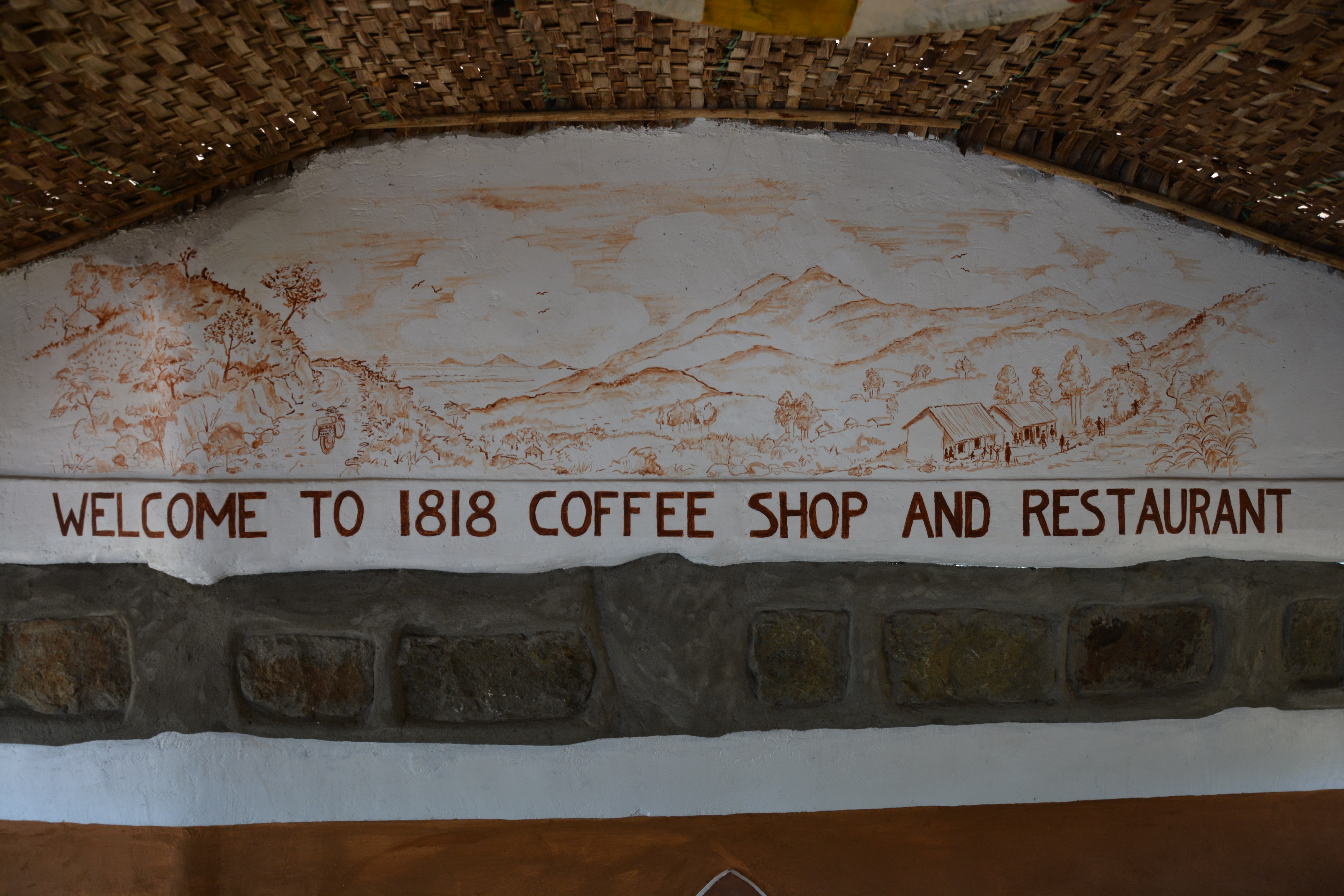
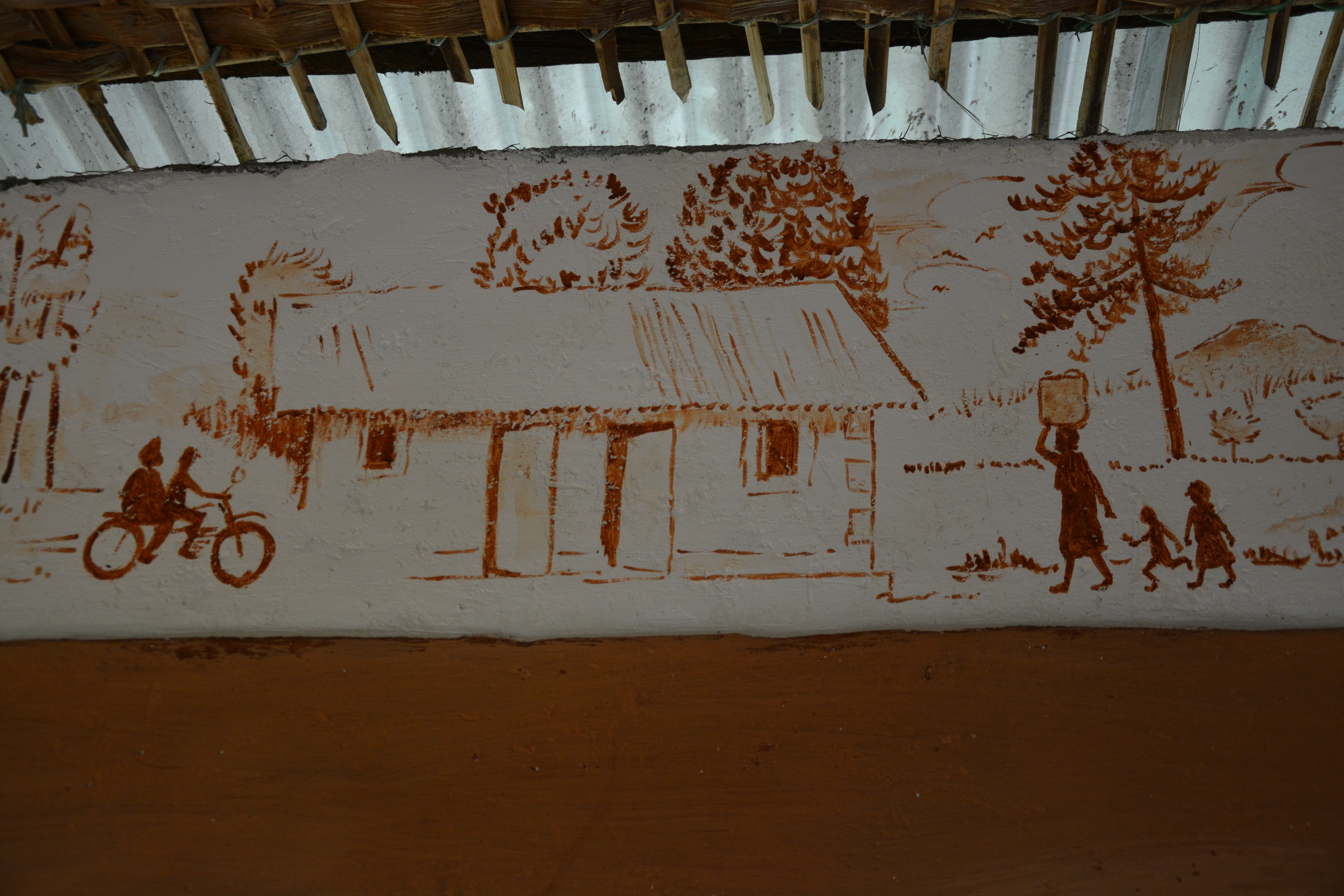
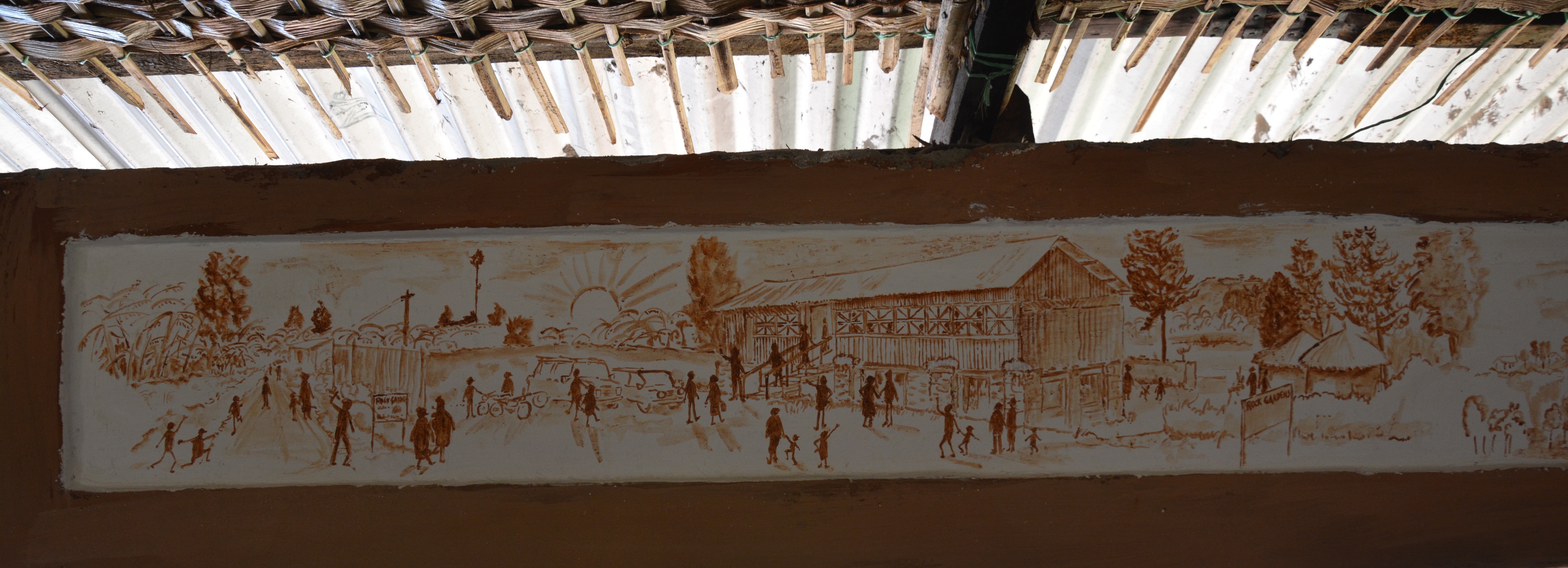
Makes you think – about the life WE lead… Maybe we had it coming.
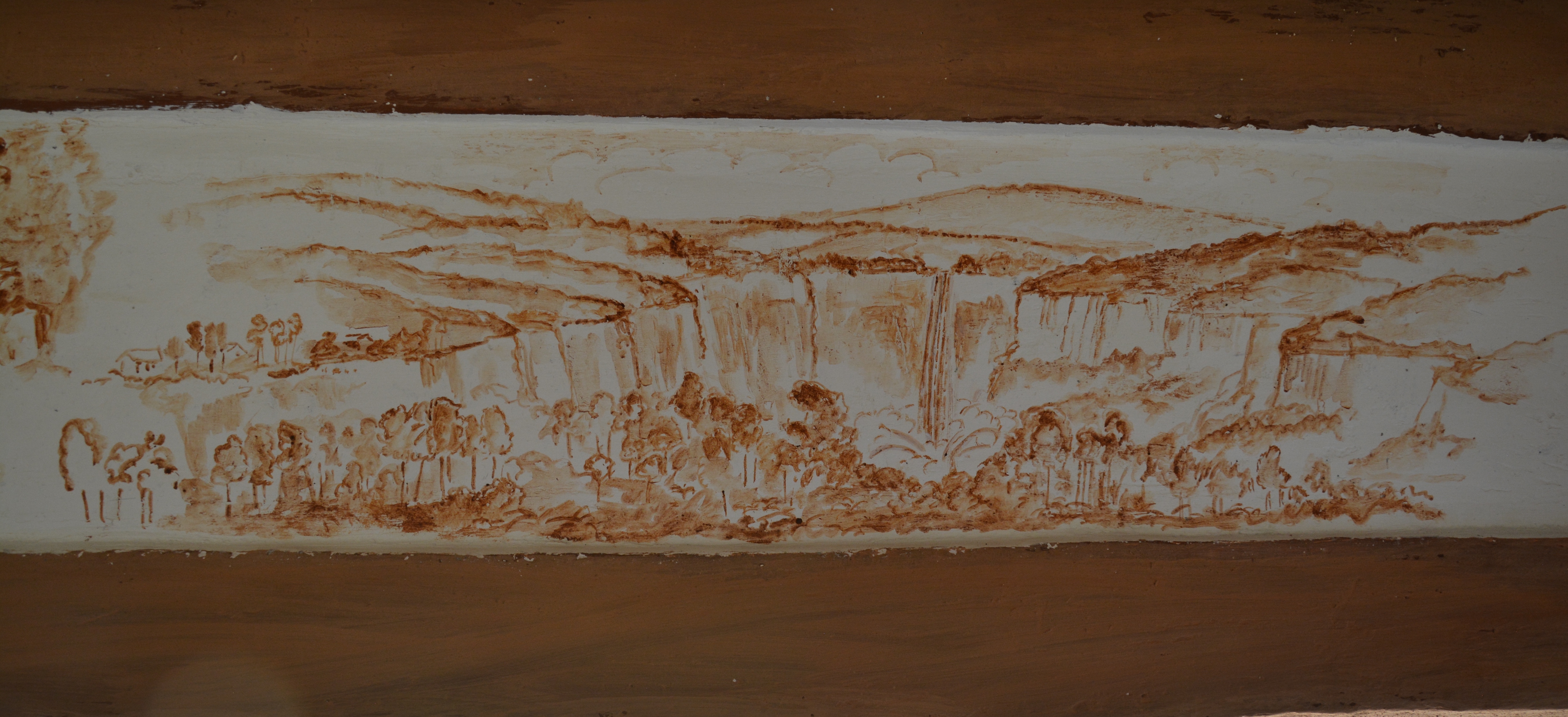
Ironic that I will have to isolate for ten days on my return to UK… I feel I should isolate FROM the UK, rather than the other way around. (Like I have been for the past three easy-going months). On these statistics I am THIRTY NINE TIMES more at risk of catching Coronavirus in England than I have been in Africa. And I have to isolate for Britain’s safety! Haha. 

Then, I find that the regional variations for Britain in the past week show that the places of least infection are Orkney Islands, zero cases; Shetland Isles, one case; South Hams, 5 cases; Ceredigion (far west Wales) 7 cases and the Isle of Wight, 10 cases. Per 100,000 the figures are: Orkney 0; Shetland 4.4; South Hams 5.7; IOW 7.1 and Ceredigion 9.6. Every other constituency in Britain exceeds 10 cases per 100,000. If my mathematics is correct, I reckon that (on average) Kenya has had something like 3.77 infections per 100,000 per week. A bit less than South Hams, least infectious place in mainland UK last week. 

I live in South Hams. 

*

William walks by the river where Kessup ‘threw out corona’

“This is where we threw out Corona!” William is pointing at the rocky river, where sluggish pools gurgle a bit greyly, rotting leaves spinning slowly in eddies, now there’s been no rain for weeks. “The line was LONG! Only men. The water was higher then. When was it? Oh, I think at the beginning, when Corona was first announced, before the lockdown…”

“So back last March? A year ago, this ceremony?” 

“Yes, about then. Early after it all began. We all came, from the village above.” We are perhaps 400 feet below the main village area, three quarters of a mile away on the very edge of the plateau. From here the mountain plunges downwards, brush-covered into the hot valley far below. “It’s our custom… Whenever an illness is announced: ebola, typhoid, corona, anything like that, we come here, the men, to cast it away. The leader, he takes off all his clothes and enters the water and we have a special bush we throw onto the water. Yes, always here. We think this is a special place for such things… So we THREW OUT Corona!” William chuckles. 

“Well, it seems to have worked!” I joke.

“Yes, we have had NO cases!”

Old superstitions die hard, even in modern Africa. 

*

High above the Kerio Valley, part of the great Rift of Africa

Despite William’s confident assertions, showers came on Tuesday, about the time I should have been on a train to Harberton – where it’d probably be raining anyway. Somehow, showers over the Rift Valley are more attractive than showers over the rain-sodden lanes of Devon. Funny that. 

For now the rains may be light, but I must accustom myself to their onset. We are entering the rainy season in equatorial East Africa. I may actually need to put on a jersey sometimes…

*

Kaptagat is one of the places I need that jersey. It’s chilly up here at 8000 feet amongst the tall trees. I’m back to the old Kaptagat Hotel, but I’m disappointed the candlewick is gone from the bed. “There’s been a revolution!” I joke with Ellen, the manager who has no guests to look after. But it’s alright, she’s taken them to wash. Somehow, the showy gold satiny bedcover looks is like an inappropriate face-lift on the old, faded charm of the hotel. But at 6.30 Ellen brings logs and dry corn cobs to build my fire and I am soon sitting by the fire, content – in a power cut as a heavy shower passes noisily across this high altitude place. It makes me laugh, does the Kaptagat Hotel. It’s £10 a night, another £1.70 for a simple supper served by my log fire, £1.35 for a bottle of Tusker and £1.50 for breakfast. The cook sends a message that I forgot to pay for my breakfast last time. It’s a month ago, but I’m Kaptagat’s only mzungu – since I stayed a year ago.

From Kessup, I rode up to Iten, perched on the edge of the escarpment, to find medicine for my heavy cold. Chemists in Africa seldom have trained pharmacists, just salespeople to peddle the drugs – invariably selling oh-so-valuable antibiotics for uses for which they have no efficacy, except to increase resistance. It’s a time bomb in medical health, the way that antibiotics are abused as a wonder drug, sold for completely the wrong purposes by ignorant salespeople. Without regulation – SOON – complex surgeries and the legitimate uses will become impossible. I carefully read the labels and warnings on various boxes that were thrust across the counter, most of them little more than Paracetamol that would make me dozy on my bike. In the end I settled for an antihistamine that worked quickly and allowed me to breathe again after four uncomfortable days. By the time I was riding along the valley bottom towards my favourite trail – the 18 rocky hairpins that clamber the cliffs the 5184 feet in 12 miles up to Nyharu again, I was breathing once more, but my energy has been sapped by bad sleep and nasal discomfort. I bump and lurch upwards, stopping to help a young man right his vastly overloaded boda-boda that’s gone down – slick tyred – on a rocky bend. The views are fine, the road a feat of engineering. It’s magnificent! The cliffs above, several hundred feet high, are unstable and friable. It must take considerable maintenance to keep this trail open. Here and there rock falls have been bulldozed, often twice, where the fall has plunged down and covered two stretches of the hairpin road at the same time. Vast rocks, the size of houses, teeter above amongst the dark trees. It’s impossible not to look up at them and wonder… 

At the top, the scruffy habitations of Nyharu can only be there as a junction on this road and the main road to Eldoret, and another that is being surfaced, along the edge of the Rift back to Iten. There’s really no apparent reason for this ugly extrusion of tin and timber shacks surrounded by a hundred waiting boda-bodas and matatus – unless there’s a metropolis I have missed, hidden in the trees. It’s not much more than a bus stop.

I pull up: it’s time for tea. As I manoeuvre the Mosquito to find level parking in the mud dips and holes by the road, a young man approaches. “Welcome back! How is Britain?” It’s over a year since Kipchoro and I met and chatted in the same small tea shack I’m looking for now. He remembers. I suppose there really aren’t many white haired mzungus riding motorbikes in Kenya. The owner and some of his customers remember my visit too. I drink two mugs of sweet tea that he pours from a vast polished aluminium kettle and fall into conversation again. It’s a congenial tea house, with some samosas and mandazi (sweet fried bread) in the greasy glass cupboard beneath the counter. The calendars and pictures are unchanged and years out of date. Everyone’s dressed in ancient mtumba jackets and anoraks, ski jackets with the stuffing escaping, woolly hats and ragged woollen gloves. Young boda-boda riders love to find knitted and felt hats adorned with ears, faces and tassels. For them, it’s cold. In a few miles, I’ll have to stop and add my waterproof jacket to my protection too. Down below, an hour ago, I was sweltering. 

It occurs to me that these men and women have been doing the same things for the year since I was here – and probably long before that, just sitting conversing in this clean but dingy shack day in, day out, week in, week out. Places like this make me aware of my restless nature. Sometimes I think it must be comforting to be content with where you are – but maybe they’re only here because they have no choices, like most people of the world. They don’t have the opportunities I have. Not many have. 

Having learned a new way to Kaptagat last visit – on that new road that follows the clifftop – I turn off the big tar road that sweeps between high shambas, with distant views to the west. On this road, still being built, with diversions through soft earth and over rolled murram, I ride slowly and enjoy the glimpses of the huge Kerio Valley out of which I just climbed. Anywhere else, there’d be viewpoints planned in the road, but here no one thinks of that. The Rift Valley is just there, seen every day, rather an inconvenience with its vast disruption in the earth’s surface and the weather systems it creates. No one else stands and stares in awe like me.

There’s also a lovely red rock road through Kaptagat forest that I discovered last time I was here. It’s a spreading forest of eucalyptus and conifers, dark and mysterious and soothing on the eyes in this part of East Africa, where the population manages to convert most rural areas to shambas and ugly dwellings of zinc and earth or crudely finished  concrete, often painted in those awful brash colours of the mobile companies, emblazoned in exhortations to spend more on calls and make the international companies richer. It’s worth sponsoring painting rural lock-ups and businesses. It keeps their glittery material products in the public eye – ‘upgrades’, new devices, ‘3G, 4G, 5G’… In twenty years I have watched as Africans everywhere developed the ‘phone clutch’. The talk is all of networks and download speeds now, even out in the sticks. It’s an essential possession, even if you go hungry to pay for ‘airtime’. How this continent has changed since I first came, 34 years ago. 

So to the old hotel. They all know me here. Even some of the customers. I’m ‘their’ mzungu. Almost no tourists are arriving in Africa this year, probably because the risk of getting home is too unknown. They certainly won’t get Corona here! Might get a bad cold, developing into a bit of a cough. I’m rather grateful I’m not on that flight home with this – as I’d have been on my original schedule. Sniffing and spluttering and sneezing (even ‘into you elbow’) is probably not an auspicious condition in which to fly just now! It’s taken a toll on my energy though and about all I’m good for this evening is to doze by the fire and make for an early bed, the embers glowing across the room. It’s not elegant living: limply clean bedsheets, thick old army-issue type wool blankets and no running water, but it’s fun and costs me £14.55 in all – dinner, B&B and a beer. The spreading old trees outside are dripping on the tin roof. I can breathe again. Now I just need sleep.

Old fashioned, dowdy and faded colonial charm – but where else do I get a roaring fire in my bedroom? Kaptagat Hotel

*

It’s now three months since I made my escape. On the 18th March I arrived back ‘home’ in Kitale. I’ve just three more weeks of this freedom to roam, most of the next couple up here in the northwest of Kenya, then I’ll spend the last week or ten days down in Nairobi with a trip – by train – to the coast.

When I get home to Kitale and an internet connection and emails, I find there seems to be a general impression that I am immured in a quarantine hotel near Heathrow! Let me lay that rumour to rest. Had that been the threat: a second rate hotel overlooking the A4, with pink and grey wallpaper and boxed meals, I’d have fought tooth and nail with the East African nations’ bureaucratic webs to stay here in Africa! I’d have gone through all the struggles of new visas for Uganda and Kenya, and corona tests as required to escape that fate. No, I am happy here in Africa and the journey home will, I am sure, be frustratingly officious, but no more than that. 

And well worth every small inconvenience my inept government may invent to punish an escapee who had the audacity not to stay and face the music like an Englishman!

This picture, sent by Alex in Uganda, shows local children fascinated to be so near a mzungu. They declared that my hair was like that of a pig!
A familiar pose, but sadly only a flask of masala tea. Alex took this picture in our new 1818 bar in Sipi, Uganda

EPISODE EIGHT. February 14th to March 5th. AFRICAN BUREAUCRACY, RETURN TO UGANDA, MAKING PAINT AND WILL-IT-OR-WON’T IT BE A LONGER STAY IN AFRICA..?


It’s another bumper episode, I’m afraid. I am reliant on internet connections, and there’s none – as you’ll read – in Sipi. So, sit back and relax for some armchair travel, the good and the sometimes challenging. But that’s the travelling life..! Here’s my story of the past three weeks:

JB gets a head shave – and, terrified of his mzungu uncle, allows me near enough to take the photo. We are making progress.

Generally, I reckon to get one thing done in a day in Africa. Better to hope for that than the frustration that sets in when trying to achieve anything that entertains any bureaucratic necessity… So it was with surprise that Thursday and Friday (Feb 18 and 19) went so efficiently. Wishing to return to Sipi, Uganda, to keep my promise to Alex and Precious, I needed another Coronavirus test to get across the border. Adelight phoned acquaintances in Kitale to enquire where I should go to get the test. “Oh, our machine is broken!” exclaimed a nurse friend. (‘Machine’? What machine is used for the PCR test?). None of the doctors’ surgeries – mainly private – carried out the test. In the end, I said, “I may as well ride to the border and ask the horse’s mouth, the medical officer of health…” On Thursday, I rode the 30 appallingly dusty miles, to be welcomed back by all the officials at the remote border post. “Their ‘machine’s’ not broken, the doctors are on strike!” proclaimed the medical officer. 

“It’s so nice you all recognise me!” I commented to Juma, from Immigration. “But I suppose there aren’t many mzungus on motorbikes these days…”

“No, it’s only you. There was another mzungu about two months ago coming from Uganda by matatu, but now it’s just you!”

The medical officer said I must go to a hospital in Eldoret, the busy, scruffy city 50 miles down-country from Kitale.

*

On Friday I rode to Eldoret, a risky process on the main trans-East Africa highway that brings all the goods to Uganda and Rwanda from the coastal docks. It’s the top end of the road on which I chickened out of the ride to the coast ten days ago. Not quite so lethal, but not much fun. After two attempts on my life, I preferred to return by the longer route that curves across country away from the busy highway. Twenty kilometres longer and 102 speed humps in 85 kilometres, but not murderous.

“No, the man who does the tests is not here,” said a nurse whom I buttonholed. 

“But I just rode the dangerous road from Kitale specifically to get tested!” I wailed in disappointment. A very helpful young male nurse took up my case. There was a man – on his phone contacts simply called ‘Philip Covid’ – at the general hospital who might help me. He phoned Philip Covid on my behalf, sent a photo of my passport to him and directed me to find the hospital in the very centre of the traffic-clogged mess of Eldoret.

Sometimes I quite enjoy the anarchy of African traffic. I am on a very manoeuvrable machine, better aware than all the boda-boda boys and can treat a ride in such conditions like a rather exhilarating computer game! Weaving and ducking, accelerating into gaps, ignoring every traffic rule of Kenya and all the European regulations inculcated in 43 years of riding mainly lawfully, I made my way to the centre of the city and the general hospital. I phoned ‘Philip Covid’ from the rocky car park. “You can’t miss me, I’m the only mzungu here.”

Philip and his two colleagues, Matthew and Daniel, were charming and efficient. In minutes the swab was taken in the car park: “We do it in an open space!” and we chatted in their office as Matthew filled in my details on his computer. “We’ll email the result tomorrow.” I paid the 5000 bob (£34) fee – which seemed to be a sum that Philip thought up, rather than a regular charge. “Will that be alright? The private clinics can charge up to 8000…” I didn’t tell him I paid £120 for a much lesser service in England. I gave the three men a further 600 shillings (about £4) and asked them to have a beer on me after duty. “Next time you come to Eldoret you must come and find us, and we will buy YOU a beer! We are so happy too see you enjoying yourself. Old men of your age just look after cattle here in Kenya! They can’t do what you are doing!” Always the wonder at my years. 

I roared through a few side streets to the Immigration Office to get information about how to extend my visa, and was on my way back out of town by 1.15. I’d taken a book to read, even my toothbrush in case I was kept waiting all day in offices and maybe even overnight to achieve my business. Kenya can sometimes pull out the stops and has perhaps one of the best infrastructures in this part of Africa. I was on the road, away from the horrors of Eldoret, a city I try to avoid, and home by three o’clock. Philip Covid promised that I would receive the result on Saturday. 

*

A chameleon adapts its colour even to a pine tree. This one is a journey upwards.

In Kitale I try to take a walk every afternoon, an hour or sometimes two. There are rural areas close by, down behind the house. People greet the mzungu as I walk. I excite the children. A couple of women are often milking their cows down there. A muscled young fellow, covered in lather, bathed naked in a stream one afternoon, just a big white smile over his shoulder in a completely lathered head, washing away the sweat from a hard day hacking at a large field with a mattock. Schoolchildren come from school. The greeting down here is, “I am fine!”, usually the reply to the well known salutation, “How are you..?” Education levels down in these hamlets are very low, and English little known. Men cut old trees, chain saws wielded without the slightest protection, not even goggles, chips flying, flip-flops and wellies, office trousers and fast rotating killer blades. The planks they are making from the freshly cut wood can almost be watched warping and twisting as they dry in the hot afternoon sunlight. A couple of crested cranes stilt-walk about a newly ploughed field, dipping like car window toys. Bright birds flit and flute, a flash of electric blue, a scrap of brilliant yellow, a dash of red breast. Two rodents scavenge at the side of the red dust track, unaware of my proximity for a moment. It’s peaceful – and I feel the sunlight and warmth in my bones, the relaxation, the strength from constant exercise, my posture. What will I do, I wonder as I walk, when I get too old to do this? It’s on its way; however I fool myself that I am invincible, I can’t delay old age. It’s inevitable. But here, in Africa, I don’t feel aware of it as I do at home. One of the secrets is being surrounded by young people. Of course I am: I’m already 10 years beyond average life expectancy here. Less than 4% of people make it beyond 65. I’m almost 72! This is as near eternal youth as I’ll find. “Most men of your age in Kenya can’t do more than care for their cattle.” Daniel said – as I took my Covid test so I can ride my motorcycle on the appalling 90 mile, rutted, rock-strewn trail around the mountain slopes to Uganda at the weekend. 

It’s amusing how intrusive strangers can be in Africa: down in the fields a car stops – it actually carries the tree cutters, I later find. A face peers out of the driver’s window. “How OLD are you?” he asks in a manner that in Europe would be impolite, but here is just natural curiosity. I satisfy his enquiry. “You look younger… Thank you.” And they drive away without further comment, leaving me chuckling. I love curiosity in people. Why not ask what intrigues you? Why be polite and courteous if you’re interested in the answer?

*

It’s about 90 miles from Kitale to Sipi, of which perhaps 25 are tarred to date. The weather forecast for days – I’ve been watching it carefully – has been for rain on Sunday 21st, but then, on Saturday the rain symbols disappear and the prediction is just for cloud and 24 degrees, a fine temperature for my hard effort on this road. But on the day, it’s sunny most of the way, and if this is 24 degrees, then I’m a Dutchman. It’s HOT riding. I’m shading red with dust as I leap and dance on the little bike, sweating in my riding clothes, enjoying the journey as I enjoy few others in Africa. I ride in a chorus of excited children: “Mzunguuuu! Mzunguuuu!” waving and jumping up and down, running from their doors in glee. Not many of us pass this way: “There was a mzungu about two months ago,” says Juma, the immigration officer at the border. I look over his shoulder as he enters my details in a ledger. We are looking for my last exit to Uganda. I spot my signature near the bottom of the page. Since I passed through Suam’s remote border on January 8th, only eight vehicles have been registered in the ledger! Eight in over six weeks! Not surprising they all remember me at the border posts. I’m something of a celebrity. 

Suam international border post from the Kenyan side.

It’s simple this time, my Covid test clutched in my hand. There’s a potentially edgy moment when the medical officer says, “Yes, but this is a photocopy. Where’s the original?” I have to explain that I had to ride 100 miles to get the test and actually, this is not just a photocopy but a photograph of the document taken with ‘Philip Covid’s’ camera in Eldoret, sent by Whatsapp to Adelight’s phone, shared to Rico’s phone and then emailed to me to take to a printer in Kitale town to make me these copies! The explanation is so intricate that he gives up and accepts the slightly out of focus print with grace. The important details: my passport number, the date and the word ‘negative’ are all legible. 

They all know me at this border and I know all the intricacies. We’re soon done, with a few chats on the way. “You are done! You can go!” I’m in Uganda again. The woman police officer tells me she’s looking for a mzungu husband and asks if I’m interested? The same old half-joke that so many try. She pulls the log speared with six inch nails away from the track and I am free to ride the ruts and potholes away from the border post. Outside the gate – never closed since the hinges failed years back – I am instantly in the meagre outpost of Suam town. It exists only because of the border and is a collection of mean tin shacks and ugly concrete lock-ups painted in the lurid colours of mobile phone companies. The road, such as it is, is awful: all corrugations of dry mud, potholes and filth on the hill through the rough town. I accelerate away gratefully and head into Uganda. There’s some sort of habitation most of the way now alongside the track – rough shacks and mud and stick homes, small shambas of matoke bananas amongst waving eucalyptus. People everywhere, especially children, here where so many have ten and fifteen children, living on the very edge of visible poverty. Friendly though; constant waving and a thousand greetings will accompany me on the miles around the slopes of Mount Elgon. 

Soon I wend my way through the biggest town en route, Bukwo. It has one of the worst ‘roads’ in Africa, far worse than anything you can imagine reading this. It’s a trials section: rocks, dust, steep slopes, debris and holes. It’s the somewhat informally planned town’s main street. They must vote for the wrong politicians here: this feels like a perceptible punishment of the townspeople, leaving their main thoroughfare in this condition. I stand up on the foot-pegs to make my way through the scruffy town, a layer of dust on everything, debris lining the track, rocky steps and hummocks; my wheels slewing left and right, the rear of my bike leaping up to bump my backside as my knees do their best to grip the sides of the seat. It’s exhilarating too, in its way. People stare, wave, laugh, call out. I’ve done this so much now that I can even sometimes take one hand off the bars to wave back! I reckon I’d make a trials rider after all my African experience.

The road from Suam around Mount Elgon, my favourite.

The track climbs out of Bukwo, onto the best part of the ride. A mile or two on I’m battered but smiling as the road zigzags up a steep white rock hill, climbing quickly. A truck is stuck in a huge rut at a compromising angle. Its driver and assistant and a few hangers-on are looking bemused, wondering how to release it. It was trying to get up a big rock step and failed, obviously slipping back into the deep gulley that drainage has formed at the side of the trail. They’ll be here some hours. There’s just enough space for me to squeeze past, bouncing up the rocky step, wheel spinning; the men grinning and shouting encouragement that I can hear through my ear plugs. No one gets very phased or angry about these incidents on this appalling track. What’s the point? It’s obvious that now the authorities are building the new road – from the other end: we’ve still at least 35 miles to go to get to anything resembling a real road, and then it’ll just be graded loose earth – it’s obvious they’ve stopped maintaining this track. Problem is, it’ll be three or four years before the roadworks get as far as this… 

On a small plateau, where the trail makes a big rocky loop, I stop to rest, enjoy the view, phone Rico and the family in Kitale to tell them I made it into Uganda, and to text Alex that I am now on my way. I drink some of my water, greet a woman in Sunday clothes who appears from nowhere, apparently on the way to nowhere, probably coming from some tin church of some self-proclaimed pastor on the slopes, hopefully feeling uplifted by the ranting and raucous hymn singing. Then Hudson stops; I’m never alone for long in Uganda. He’s on a 125 piki-piki, on his way to a photocopier in Bukwo, below us in the heat haze. He works for the forestry department and we discuss the fact that the fine forest through which this track wove its cool, shady way a few miles on, has been decimated and the wood sold to Kenya. It’s just stumps now and ugly. It was the best part of the journey three years ago. “We looked at taking them to court. It’s completely unsustainable, what they’ve done, but you know, with Ugandan laws and corruption…” His voice tails off at the impossibility of holding anyone to account in this desperately corrupt country. “They say they will replant, but we see no sign of it…” Hudson hopes, as do so many in this country reduced to poverty by bad governance and dishonourable politicians, that I can find him a sponsor to help him set up some project. I have to deflect these appeals constantly. We swap email addresses, for he’s an educated, decent sort of chap, but even as I write my address I know I will be parrying requests in day to come. 

What a ride! An uplifting sense of freedom.

We part and I ride on, ricochetting and gambolling about the rocks and stones of the steep hills. There’s about five hours of this exercise. It’s not a lot better when I meet the road builders coming the other way, for then I need extreme concentration – in the light of many other calls on my attention: people waving, cattle wandering the earthy road, children shouting. The loose surface over the hard packed earth is even worse. It rolls about beneath my wheels, threatening to unseat me any time. The first few miles of it are on soft earth, and that’s horrible, my arms locked to control the weaving wheel. Finally, the last 25 kilometres to Kapchorwa are on the new tar – except where  the unsmiling Chinese engineers are still constructing the bridges, where diversions have been ploughed through the surrounding fields. Even in Kapchorwa, the regional capital, another sprawling place of earthen embankments, concrete lock-ups, mobile company advertising and a few banks and offices lining broken red earth roads, the pain doesn’t end. They are now resurfacing the ten miles to Sipi through the impressive, sweeping hills. More loose surfaces and hold ups.

I arrive in Sipi exhausted. I’ve just undertaken about 60 or more miles of serious trail riding, in some places trials riding, the difference being, if you’re not a biker: trials riding is short sections of awkward terrain filled with technically challenging riding, where the competition is to get through the section without putting your feet to the floor, while trail riding is just plummeting along on unmade tracks – roughly what I’ve been doing most of the time since I left Kitale almost seven hours ago.

*

Wails of delight and Precious’s helicoptering arms announce my arrival. Alex is a little more restrained, but I can see his warm pleasure too. His sisters, Doreen and Helen are visiting with various children this afternoon. It’s a big reception. “Bring Jonathan a chair!” Alex calls to one of the children.

Stretching out the old mzungu after the exhausting ride!

“Huh! I need more than THAT!” I exclaim, collapsing on the scant grass on my back. Everyone’s amused and starts to grip my arms and legs, pulling them to stretch me out to ease my pent up muscles. There’s great hilarity and I love the overflowing welcome that they all give so generously. I wonder if eastern Uganda really IS the friendliest place on Earth? It often feels that way. Desperately poor, not much ‘developed’, scratching an existence amongst some of Africa’s worst corruption, the second ‘youngest’ demography of the world, over-populated, poor infrastructure, with appalling pollution and even worse politics, its people are exceptional. High amongst my favourites. 

*

Keilah, little JB and Precious. For all the privations, presentation is still considered…

Another proof of that emotional generosity and honesty comes in naming your child after a guest and taking that visitor as a family member. Having another Jonathan, ‘JB’ around is a bit confusing, but in a touching way. Now he’s often nicknamed ‘Beans’ by his parents. “Oh, people ask!” says Alex. “I have to explain that on the day he was born, Precious was cooking beans! Hahaha!”

It’s a pity the child is so terrified of the mzungu and breaks into wails, hiding behind his parents or sister whenever I approach… Not easy to bond with a two year old who screams when he sees me. 

*

“OK, we are going to run a European worksite here!” I declared to Alex looking over his 1818 bar and coffee shop that is slowly developing, mainly with my sponsorship. I can see that the Ugandan workers he’s employed have little pride in their work and leave the workplace without cleaning up. It’s a shambles of shavings, dust and off-cuts. “They just want their money and go!” says Alex. So we started with an hour’s sweeping and tidying. 

Our task – my task – is to decorate the quirky, twisted timbers of the upper level of his bar on stilts. Since I left, he’s had stone walls built to support the heavy structure. If you recollect, he started his project with much enthusiasm but the wrong way round. In effect he built the roof without considering the foundations! You don’t build a stilt structure in Africa and rely on the tree trunks for strength: the termites will soon eat the supports… As, indeed, they have in places already in the two years he has been building. The stone walls are an improvement, although I can see they have been constructed by ‘masons’ without knowledge of the basic mechanics of building, of bonding courses and creating strong corners – but it’s a lot stronger than the structure that relied chiefly on hope and prayer. 

Carpentry is crude. There are few tools, and what there are are coarse and the timber available is little more than firewood. There’s not a power tool within miles, just old bendy saws much sharpened and a panga (cutlass) for shaping and ‘planing’ wood to shape. Wood is straight from the tree – well ‘straight’ in one sense only. Twisted, bark-covered posts resembling a corkscrew, chewed with a panga to make a door frame. A four inch nail is used as a chisel or drill to make a hole for the door lock. The lock is nailed into the door with three inch nails, the protruding ends bent and hammered into the varnished front of the door. It’s pitiful. 

Alex prepares pigment from soil. A new skill!

We are going to create our own paints from local earth. The only paints available here, and in much of Africa, are crude colours, many made in China or by an off-shoot of some multinational company here in Uganda. They are quite expensive – which is why most buildings remain unpainted stained mud and concrete, except in the lurid colours sponsored by mobile phone companies and the ubiquitous villains of the Coca Cola Corporation. I have introduced the old scenery making technique of using PVA for just about everything. We create, very dirtily, a blend of PVA, water and earth, enthusiastically sifted through old mosquito netting by me and a group of cheerful small children. Owing to the corrupt politics and the recent election no child is in school. No one can explain why, but all schools are closed – this in a country struggling with low levels of education. One useless, ancient president, ‘advised’ by a mafia-style coterie of corrupt fat men, has this country in its grips. They care not a jot for their people, only for personal wealth and advancement. It’s amongst the most shameful regimes on a continent infamous for failed and failing politics. Many – probably most – support the ‘mzee’ (Old Man) Museveni, now seated back in power in Kampala, wearing his ridiculous trademark big-brimmed hat, but do not rationalise that one crook making all life’s decisions for now 35 years institutionalises the system. Where there has been no opportunity for dissent for so long, power is grabbed by the ruthless and no new systems are able to flourish. This poor country is in such a mess. I feel so sorry for earnest, honest young people like Alex, with his dreams trapped in this downward spiral, his country hijacked by the ruthless dishonesty and self-interest of a few. It’s in the interests of those men to keep their people uneducated. They’re easily manipulated.

We sourced three different shades of soil: the dark red earth from the foot of the 1818 bar, red earth from the bottom of the deep pit now dug for a new latrine at the bottom of the property, and an orangey soil that Alex spotted nearby. A bucket of each was broken up and sifted by me and my team of small – out-of-school – helpers. Then we mixed big cooking pots of our colours. I’d bought paintbrushes in Kitale – Kenya has much better products and more availability than the dirt cheap items available in rural Uganda. Sometimes Kenya and Uganda seem far apart in infrastructure and development for such near neighbours. 

*

Mud fish for supper…

Exposing myself to this sort of life, that led by billions around the world beyond the privileged confines of our riches, is self-illuminating. It’s not comfortable and there’s much I dislike about it, and then despise myself for my complaints. My hosts, Alex and Precious, treat me as a very special guest, making life as easy and agreeable as they know how. But they can’t alter the physical deprivation of their lives. They buy me pineapples, cook extravagant foods, make quantities of fresh passion juice, look after me as a ‘slebrity’, pander to my whims and are deeply respectful of all the help I provide them. 

But they can’t take away the MUD, the dust, the lack of gutters, the basic wood and corrugated iron pit-latrine, the smoke from their cooking fire around which we sit of an evening, our feet in brown puddles. I wash in cold water in a bowl on the cement floor, then must paddle about cold dirty water on the concrete floor and carry the wet dust to bed. Frequently I must eat with my fingers, and I abhor grease on my skin (my mother told me how I frequently washed my hands as a child – odd behaviour!). The rat in the roof thatch of my round room scratches and scampers overhead in the night. The roof leaks in heavy rain: it needs a new layer of grass. Working with Chinese paintbrushes that fall to pieces. Watching the carpenter use a panga (machete) as a planer, everything crooked, not a wood screw in sight, using firewood to build a bar, nails to fix hinges and door locks. Smoke in my eyes. The smell of smoke on all my clothes. Ants and mosquitoes. Seeing nothing in the dark, for there is only basic electric light: a dim bulb in my room but none where we eat by the fire in the kitchen yard. The massacre of ancient trees, the visual pollution, the unawareness of natural beauty. Screaming children, barking dogs, crowing cockerels. The plastic and garbage in every hedge and field; total lack of awareness of what’s happening to our planet by their forced exploitation – and the ballooning population, just about the youngest average age of any country in the world: 15.7 years… 

 And they can’t take away all these petty discomforts for they lack the one commodity required… Their own lives are short and compromised by lack of money, so much compounded by poor education and corrupt politicians who contrive to make this once well developed country into a basket case in Africa. 

But of course, I am here for the human warmth that flourishes despite all the deprivations. We in the West may have the material wealth, but we no longer can claim to have the emotional generosity that eastern Uganda – and so much more of Africa that I know – can give me. The wealth of the world is so poorly distributed, Africa always suffering at the bottom of the heap, exploited for its resources, improperly rewarded for its efforts; fragile politics meddled with by the big players: China, USA, Russia; an unsophisticated, easily manipulated market for uncaring multinationals. 

But where else am I greeted with such excitement by a million children? Where do I enjoy the curiosity of so many amongst whom I travel? Where do people force me to eat food I know would be their own supper? Where do people with next to nothing give me what they have?

Precious makes me passion fruit juice for breakfast.

As I write, Precious breaks into peals of laughter as I catch her trying to secrete a second chapati in my breakfast ‘rolex’ – a fried chapati with a fried egg rolled inside. She is incorrigible. With a vast appetite herself, she tries to impose one on me! Generous to a fault, she may be, but in African terms I eat the quantity of little Jonathan, ‘Beans’, ‘JB’ – who is two and a quarter years old.

It’s salutary to remember that this isn’t how the other half lives: it’s how the other nine tenths live…

*

The frustrations of life in Africa – Uganda especially – are sometimes almost overwhelming, compounded by my subsequent guilt at feeling angry and irritable when Ugandans suffer this daily. I’m here expecting things to be done as they are in Europe and exasperated that people don’t question why they do things the way they do, when they’ve never known anything different as I have. 

For arcane bureaucratic reasons I can’t extend my East Africa visa that gives me access to Kenya, Uganda and Rwanda. And all visa business for Kenya must now be done online. Try that in rural Uganda. There’s no internet connection in Sipi except at an expensive hotel. By good fortune, Alex’s cousin Barbara works there. Alex’s junior brother Nic walks with me the fifteen minutes to the hotel. “It’s not working,” says Barbara. Because no one’s paid the bill. Kindly, Barbara says she’ll go and buy ‘data bundles’ for her phone; Nic is of an age to believe that we can connect my iPad that way. Barbara walks off to the village centre; Nic and I gaze at the view of northern Uganda spread dramatically below us. Twenty minutes pass. Barbara brings her phone and Nic fiddles and clicks at the screen. At last we get a connection, but it’s not strong enough to load the enormous Kenya Immigration website. Nic battles the technology: I fume – for forty more minutes, before I suggest we give up and I must ride to Kapchorwa, ten miles up the part-finished road, to find connections. We walk home, I change and ride away. Alex joins me and we ride to the hotel where he used to work in Kapchorwa. It has internet. But that doesn’t work well enough either; I spend another half hour waiting for connections. We decide to go to the main post office: it has an internet cafe. 

Still my iPad won’t connect. About four hours have gone now. Another one and a half to go… I have to use one of the old computers at a station in the back of the post office. I haven’t used an old Microsoft machine, keyboard and mouse in years. I keep hitting the wrong keys, doing things wrong, getting angry. Well, it’s a long story of irritation and complex bureaucratic demands that make no sense. I fill in the ten page form. I tick the box: ‘staying with friends’, give the address and details. Six pages later the website demands a copy of my hotel booking… Just one instance of how going ‘online’ makes it all so easy! I even have to give the names of my father and mother – dead 25 and 10 years. I need a passport photo, a picture of the outside and inside of my passport, details of my incoming and outgoing tickets – I’ve already filled in the portion about entering by road, by Suam border… I goes on and on. Thank goodness Mark is here at the post office. He’s in charge of the internet section and very charming. Without him I couldn’t have coped. Finally, after hours of purgatorial illogicality he prints out a copy of the form I have filled in and a receipt for the £35 I have paid. The copy is in B&W; the website demands that I bring a colour print to the border. There’s no colour printer in Kapchorwa, I’d have to go to Mbale, another 30 miles away in the wrong direction. 

And still, until I get to the Kenyan border on Wednesday or Thursday, I have NO IDEA if it’s worked. I am determined to go back through Suam now: they know me, and Juma, the immigration officer, has been friendly and helpful. If anyone will help extend my visa, Juma will.

By now all pleasure has left the day. I am seething with impatience and frustration. Yet maybe I have achieved something? Or Mark at the post office has. I give him probably a day and a half’s salary (£4) in gratitude. But I am ashamed of the petty tantrums I have displayed. I come here with my European sensibilities and complain that poverty-stricken Uganda frustrates my needs and makes me angry. It’s just the way it is in this unequal world. 

*

Child safety takes on different attitudes here. A twelve foot deep hole for the new latrine is totally unfenced; Keilah, aged three and a half, wanders about with the carving knife; children play on the muddy track and grassy verges of the lane that passes Rock Gardens – despite the dangerously ridden boda-bodas who have little regard for anyone. The small children dance by the open fire at night, play with burning sticks, are constantly smothered in mud, bare footed and eat with muddy fingers. They sit, four and five up, on boda-bodas ridden by untrained idiots; are blathered in filth; play on unsafe heaps of rock; are barefooted all day on mud, the occasional nail, razor blade and vicious thorns. They do, though, grow up understanding risk…

No child has toys. They make their own playthings from debris and rubbish. Lorries from oil containers, the wheels from their tops or cut from discarded sandal soles. They play with sticks and mud, sand and stones, old plastic bags and tins, bald motorbike tyres as hoops. While we worked, they took brushes and old election posters for their own paintings, mainly of material wealth: cars, TVs and helicopters. 

In this enormously over-populated nation, with an average of seven children to every woman – and god knows how many to the men – they never have any lack of playmates. 

*

How do I convince Precious that my appetite is about one tenth what she demands? Presenting me with a serving dish quantity of fish stew, sufficient for three people, four potatoes, a large bowl of rice, a lump of matoke enough for three, and greens for three meals, if anything makes my appetite reduce. I eat more than I wish and she’s then upset with me for ‘eating nothing’… In her culture, from western Uganda, it’s an insult. “Hah! A woman can dive-vorce her husband for not eating her food! I am aaangry!”

*

Alex paints the bar door. I always wonder why bar staff in Africa are expected to duck? Alex can’t explain… “It’s the way we always do it…”

We worked eight long days decorating the 1818 coffee shop and restaurant, as it’s now called. I’m proud of the colours we made: several different bright brown colours from local earth and PVA and black from charcoal and PVA. We bought one litre of commercial white emulsion paint for £1.65 (!). We have painted the whole interior for less than £9.50! Alex reckons that had we bought the lurid commercial paints, we’d have paid £50 at least – for Alex a vast amount. His salary for 30 days on-call as manager at the hotel was £60… Now he knows how to mix these cheap pigments, I foresee an outbreak of coloured buildings in his compound, and maybe an increase in sales of what everyone thinks is mere wood glue at the rather basic Sipi building supplies shop. “We just lack knowledge…” complains Alex.

Alex paints on the outside of 1818
International sign writer at work inside.
‘Traditional’ painting rendered by an international designer!
At the end of 1818, I painted the view I love so much of Kabelyo.

Many visitors come. Word goes round the village that the ‘mzee mzungu’ is painting in traditional local style. It’s a wonder. Well, of course the tradition has been reinvented by this scenery designer’s imagination. I am thanked fulsomely for my efforts by all the visitors.

Here I drew Precious bringing water to the house. JB and Keilah love this picture where they follow their mother!
1818 on an unlikely busy day! “Oh, it’s Christmas!” exclaims Alex, delighted. Let’s hope…
Sipi Falls reinvented in mud and PVA

Above the windows I have painted a frieze of local activities: boda-bodas, bicycles, women carrying babies, local houses, matoke trees and eucalyptus, men drinking komek, the local brew, cows, and children playing. On the end wall I have sign-written (not too badly) ‘Welcome to 1818 coffee shop and restaurant’, and above that painted the view from the road to Suam, with northern Uganda and its volcanic pimples spreading into the far distance: a day spent standing on a plastic table and stools, using paint from dirt and glue. 

*

Nic gazes at the first descent.

The last day of the month was a day off, Sunday. Alex and Nic took me on another lengthy hike – I guess about 15 miles or more. The trouble with living on mountains, as in Sipi and Kessup, is that every metre you go down, you must eventually struggle up again. So fifteen miles seems like many more, especially when the altitude differences are 1500 feet or more. We descended direct from Sipi’s single street, with its shacks and lock up shops. Here the village perches on a ridge, falling away 100 yards on either side. Our path wriggled through big rocks down the steep mountainside into one of the large valleys beneath the escarpment. Away to the north and west, yet lower, stretches a huge vista of northern Uganda, an endless plain reaching to hazy distance. I’ve ridden over big areas of it in previous years, sweating in its inferno. Up here the heat is tempered by our near 2000 metre altitude, but the sun is fierce and walking shaded only by matoke trees and a few remaining deciduous survivors of the depredations of a poor community and their short term economy. It’s distressing to see how most large trees, that took a hundred years to grow, have been relentlessly harvested for charcoal. The few that remain are shapeless from the culling of so many branches, now stunted and distorted. Few new trees are planted, and those too are cut for their weak timber. Only the African weed, eucalyptus, that drains the soil of water and nutrients in its speedy growth, provide shade and soil retention here. People need money – to provide for their huge families of multitudinous children. They need money NOW. There’s no education of environmental damage. No explanation of how they mortgage the futures of their numerous offspring by this short-term need. But who’s to explain? The government itself relies on short-termism. It’s endlessly taking staggering debts from China, selling its future resources and land to a nation that cares nothing for African livelihood or the planet. It wants ever more resources, to plunder the planet for financial gain, with no regard for anything else. THIS is probably the largest challenge and problem facing this continent: its selling of its independence to Chinese overlords. In a couple of decades those canny players will begin to call in their debts. Africa will have nothing with which to pay, except its land and natural resources. It’s a long game, cleverly manipulated and of frightening consequences. Abandon all hope of environmental change now China is the main secretive force in much of the world. 

A small instance is plastic torches. Petty but illustrative. When I was here in January, on our very long hike we ended up staggering up the escarpment in the dark. I have poor night vision and wouldn’t have made it but for the fact that Nic wore pale trousers and somewhere at the bottom of the climb, Alex sent a relative to purchase me a torch. It cost 20 pence from a local rural kiosk. It came complete with three of those small silver button batteries and worked brilliantly – literally. It had an LED bulb and lasted for weeks. Being European, I eventually bought three new button batteries for it: they cost £1… A new torch would have been 20 pence. These people need light. Chinese factories have identified the profit from cheap production and huge sales. As I walked today, everywhere I saw the glow of discarded florescent plastic torches, the plastic and the poisons from their batteries ploughed into the soils on which Ugandans depend for life. All the rest of the short lived plastic products from China ends in the same waste system: the soil and water courses. Sorry, but the future is grim, however assiduously you, reader, recycle your bottles…

In my years of travel on this continent I have constantly seen signboards: ‘Furnished by the people of USA’, ‘Supported by funds of the European Union’, ‘Charity of the United Kingdom’, ‘Aided by the Republic of France’ etc. I see Oxfam, World Vision (USA), Save the Children, Water Aid; charities big and small; often schools named for individual sponsors.

I have yet to see evidence of a single a Chinese charitable body…

*

The sun burns fiercely down. It’s about 30 degrees today. Hot for walking. We are one degree north of the Equator. We walk on our own shadows. Countless people we pass make personal allusions – in their own tongue, but Alex laughs and responds with equal quips. They are commenting on why a mzungu should be walking so far, in the sun, where no mzungu has been seen before. They make personal observations about my age, my hair, my white beard – whatever takes their interest. They don’t see it as rude; it’s merely factual (as they see it) and open curiosity. Alex laughs at many more jokes than he translates! 

We pass a couple of remote villages. Education is low here. There are far more ‘churches’ than schools. It’s Sunday. We hear ranting self-emboldened ‘pastors’ in a dozen mud and zinc ‘churches’. Precious attends one; Alex is cynical. Maybe it’s one of the reasons I get along so well with this intelligent young man: he questions accepted norms in his society. Not many do in emasculated Uganda. He knows about the corruption, desperate pollution, the way ‘Big Men’ manipulate the ignorant – how the ‘pastors’ are in it for the money. Precious is much less worldly aware. She’s simply educated and listens to the nonsense these ‘pastors’ spout. She’s told us some of it, accepting it as truths – that Alex and I refute. Much of it’s not even morally justifiable, yet these self-proclaimed sermonisers have wide influence in these poorly educated, rural communities. Precious and her children sometimes spend the whole of Sunday at a mud and zinc ‘church’ on a nearby hill. There are constant calls for donations – and no accountability whatsoever. As we walk, we hear drumming and singing and ranting. The singing is that high pitched, strident wonder that is so African in nature. A drum keeps the beat. 

There’s a sense of space in Africa that is seldom found in England. Later, we’ll have to reascend that escarpment…

Branching downhill through newly ploughed fields and stumps of mature trees, we visit one of Alex and Nic’s aunts. In families of this scope there are always relations everywhere. She makes us tea as we sit gratefully in the shade of her matoke bananas. A young calf comes to have its chin rubbed by the sentimental mzungu. Mama Tarito (Precious is frequently called Mama Keilah, after her firstborn) obviously likes animals: the calf, a young cat, a couple of dogs, many chickens and a couple of ducks all coexist comfortably on her earthy ledge and in and out of her mud houses. It’s peaceful and bucolic, the breeze rustling the matoke leaves as Alex exchanges news with his aunt. The tea restores me. I needed it. We’ve walked many miles and still have that enormous escarpment looming above. Mama Tarito is thrilled to have a mzungu guest and after an hour she leads us back up the fields and gives Alex directions to a steep path that will climb back out of the lowlands. 

Nic is walking in his socks by now. His shoes give him discomfort and his feet are as hard as most Africans’. We puff and struggle upwards. We’ll be climbing for the next hour and a half, always another hill above us; comments called from every homestead, children running excitedly to view the rare mzungu. I really do travel as a ‘slebrity’ here. Young boys race down one hill on homemade go carts of matoke wood, shouting with glee. The hills rise relentlessly, but there’s a breeze as the afternoon progresses, and the views – when we get out of the endless waving matoke – are pretty spectacular, back over half Uganda below. 

Alex with local children, of whom there’s never a shortage.

On the last – apparently endless – hill, we are followed by a growing band of small children. It’s good to have Alex, now a keen photographer, along with his phone camera. If I pull mine out of the bag, it causes chaos, but they accept Alex and his phone easily and he gets some funny pictures of the numerous children excitedly touching my hair and white skin. “They say your hair is hard and spiky. Like a pig’s!” laughs Alex as he translates. 

It’s after five when we get home, seven hours after we set out. I am light-headed from fatigue and lack of food and liquid. We found a couple of village spring-water supplies en route and I drank some sort of ‘herbal tonic’ (said on the bottle – plastic – to clean the fallopian tubes, amongst other claims) but we haven’t eaten. I’m quite wobbly. 

*

We sit companionably by the fire later in the evening. It’s full moon about now and the nights are bright. Mild tonight, we sit and chat. It’s difficult to describe how fully accepted I am, as a family member. Only little JB is wary, although in the dark he accepts me better. He gets excited looking at photos on my screen, even forgetting his fear enough to lean on my knee. Daylight is different: he still remains apart, although it’s improved in the week I’ve been here. The wails of fear are reduced. 

“How will I send Keilah to look after you?” asks Precious. “To cook for you and keep your house clean.” Women’s work of course,  but Precious means it kindly. She’s concerned about me going back to England. “Stay here!” she demands, not understanding the bureaucracy of Africa. “Stay with us! We will look after you! Don’ go to England and be alone. No one to come in your house! Haah!” Alex chuckles at her naiveté. He has a concept of just what’s involved: the visas, virus tests, flights. But they’re generous thoughts from this warm-hearted young woman. I hesitate to explain the lack of generosity with which the bureaucrats of my own country would receive Keilah. Yet I have complained so long about the officialdom of these countries, who didn’t even invent this appalling bureaucracy. We did, because we didn’t trust black men…

It’s late – all of nine o’clock. The weariness of the long walk is getting to Alex now. Nic says goodnight and goodbye: he’s off to Kampala in the morning, back to his high school. It’s actually opening. As for me, I am reduced to extreme exhaustion, keeping polite with effort. It’s time to retire to my round house, ‘Jonathan’s House’. We’ll sleep well tonight. 

Nic was home two days later, his school still closed.

*

One morning the milkman brings a story from a distant village. He comes with fresh milk in a twenty litre container and dispenses it for sale. It’s fresh from cows in his area. He explains his lateness this morning: his community has been searching the forests for a man who stole a four month old baby last night. Old beliefs persist in uneducated rural areas (sometimes just as powerful in the big cities too) that making sacrifice, even in modern Africa, will bring good fortune to your project. Or it may be for cult worship or black magic. Witch doctors still exist, although little is said of such things. Precious exclaims over and over at the tabloid horror of this abduction, seen by the mother as she cooked, the man chased into the forest. “Can such things happen in your country?” Alex asks. 

“Very occasionally, yes, but it’s a HUGE media circus when it happens. It’s in the news for years! Years!” I think of Soham and the McCanns (the names still in my head, what? 15, 20 years later?)

“Here, the witch doctors, they are still there… A witch doctor who asks for the head for his evil will be RICH! And Big Men, when they build a big building, sometimes they still believe that sacrifice will bring riches. The mother won’t see her baby again.” 

Beneath the surface, some of the evils of old Africa still exist. Even in 2021, with all those fake pastors…

*

The first supper in 1818.

On the fourteenth day I must return to Kenya. My Covid certificate runs out today. It’s the 4th of March, Thursday. A gloriously warm, sunny day. It’s hot riding the roughest of roads, but it’s still my favourite in East Africa.

I leave Sipi amidst the waves and hugs of my family here. Precious waves until I reach the corner of the red track and turn away at last from the home where I am so welcome. I’m really regarded as a family member, a father figure. Precious’s big mattress-like hug says it all and Alex’s sincerity conveys much of what they feel. I know I am their only sponsor – they would have been in great difficulties this last year without my generosity. We all accept that, but I know instinctively that were our positions reversed, they’d be looking after me – just as Precious imagines sending Keilah to look after me in my old age! I’m investing a lot of my money in their future to try to make them independent. I know Alex will honour my commitment. If he can, he will make a success of his small venture, his coffee shop and restaurant. 1818.

*

Uganda has become such a basket case of a country, with its politics and lack of empowerment of its peoples. It’s run by a cartel of crooks with no care for its charming people. This could be such a wonderful country: it has fine scenery and friendly people; it’s full of smiles and welcomes strangers. It’s one of the most cheery places I have visited on this continent that fascinates me so much with its warmth and spirit. But it’s a mess, and the mess is getting worse as people watch the poor examples from above and cohesion and discipline reduce. What a terrible shame. One of my favourite places in the world, reduced to a shambles by its rulers. Returning to Kenya is like a return to order – yet Kenya is hardly a paragon of logicality and rationality itself, but the infrastructure is infinitely more efficient than its wayward neighbour.

*

The Chinese road builders are advancing quite fast, at least as an earth road, from Kapchorwa to Suam border. There are huge amounts of earth to move and diggers work at the big red embankments, villagers in large, idle bands watching the redistribution of their old vistas. For some reason, roads here are built on the scale of motorways. Why, when there’s so little traffic? Now they are facing the biggest challenge, the parts of the topography where the road will have to be carved along the steep mountainside.

A semi-derelict lorry struggles the road between Suam and Kapchorwa.

Well, I buck and ride the rough road towards the east. It’s sunny and hot. I’m more tired by the ride than usual today. I’m not riding very well, maybe because my attention is so much distracted by the expansive views on such a glorious day. I always sense when my riding ability is compromised like this; then it takes a bit of self control to slow down and concentrate better. But it’s difficult to ignore the spectacular views on a day like this when I reach the part of the track that is carved from the hillsides. I stop to take yet another photo. A boda-boda stops nearby, obstructing my picture, inquisitive what the mzungu is doing in the middle of nowhere. Actually, this part is just about the only ‘middle of nowhere’ en route from Kapchorwa to Suam. The inclines are too steep for much agriculture so there’re only a few scattered grass-roofed round huts and some matoke trees. Their shambas are tedious climbs up or down the slopes, but people colonise wherever they can: they have to in this vastly populated country. The grass roofs make the scenery even more fine for a touring mzungu. I ask the boda-boda rider what the area is called. I told Alex I’d find out as this is the view I painted for him on the end wall of 1818 this week. The boda rider doesn’t speak English, but he comprehends my question. It’s Kabelyo, he says. I must remember to tell Alex. I text him the name. He replies, ‘Yes, meaning place of elephants. Nice name with meaning.’ It’s a long time since elephants coexisted with all these numerous Ugandans. The track seems busy today, for no apparent reason. There are scattered boda-bodas weighed down by multiple passengers and huge sacks of produce, wide bundles of sticks or planks of wood, a settee – out here in the sticks… Perhaps the end of the dry season, which will come soon, although it appears to be late this year, is causing the extra traffic? Harvest to be carried on the small Chinese motorbikes and a few lumbering small trucks, loaded high with people and sacks, bouncing and creeping the roughness if the trail. 

*

Maybe I should have stopped for tea? But I am anxious about my visa still. For some illogical reason it keeps me riding towards Suam, where I’ll find out if all the frustrations of the ghastly online application have borne any fruit at all. I ride on again. 

Rural Uganda round Mount Elgon, paradise or poverty?

Then comes the steep winding white hill down to Bukwo with its appalling town road, the worst section of this hard track. I stop and drink some of Precious’s passion fruit juice from my water bottle and gaze at the view towards Kenya and Mount Elgon, beneath a slate grey cloud – impressive. I won’t be coming back to Uganda this year, whatever the visa result. I’d need another Uganda visa, another Kenya visa and a Covid test. I don’t have the patience or resolve to go through all that! I hope I can come back in a year or so. I feel such closeness to my small family here, struggling to be independent. Funny how these contacts are made by chance and maintained by instinct. Gazing over scruffy Bukwo, I reflect that if I hadn’t come this way in 2017 and sought a place to sleep off my exhaustion from the wonderful/ diabolical track round the mountain, I’d have missed out on the friendship and love of my Ugandan family. I looked at various guest houses in Sipi and dismissed them all for one reason or another; then I spotted a sign to a more remote one, a kilometre and a half from the road on grass-lined paths, and there I pulled in to a rough place and was welcomed by Precious, terrified by my appearance, red with dust and deeply weary. The view was fine, the room basic but prepared with unusual sensitivity: the fabrics were cheap but creative, the decoration the best that could be managed on a pathetically small budget. Instinct attracted me to Precious. Local bush telegraph quickly told Alex a stranger was at his house and he came. Instantly, I accepted his integrity and charm. I stayed. I returned later in that trip. We kept in contact. I gained family in Uganda. 

Perhaps if I’d been able to stay another week, little JB would have accepted me? He’d stopped wailing and running away by the time I left, waving me away with a smile from a discrete distance. Keilah had started smiling, expressions that lit up her small face and make her pretty and appealing. Little JB had started to come closer and even let me wash his head after Precious shaved it with my beard trimmer. He loved to look at photos, particularly of himself, on my iPad, screeching in childish delight. It was looking at photos that made Keilah bond with me a couple of years ago: the magic of having a camera that displays the picture just taken. A big step forward in my travels, for I can turn the apparatus about and show them their smiles; children love that. It makes me many small friends. 

*

I make no excuse for multiple photos of this view! The feeling of Being There is immense at this moment.

I bounce down through the last outpost of Suam, people staring as I pass. It’s not a road, just a wide rutted area lined with shacks and lurid shops painted in the livery of the mobile phone companies. What will happen when the road – one day – reaches this back of beyond? Then the fine one-stop border post that’s planned, an artist’s impression of which Juma showed me on his phone? Now it’s still just the dust and dirty shack buildings of the smallest border I know in Africa; me the eighth non-local vehicle registered as passing in over six weeks. 

Harison, the Medical officer on the Uganda station, greets me like and old friend, writes down my Covid certificate details and stamps it with yesterday’s date. He hasn’t changed the stamp as no one’s passed since yesterday at this international border. He stamps it again. A local drunk tells me he’s in charge of the post and ‘guides’ me to customs. Another useless form that no one will ever read is stamped; then my passport. So far so good. I am out of Uganda.

Down over the crippled bridge, most of the railings gone into the trickle of river below where twenty small naked children frolic and shout at the rare mzungu, mere ruts for the track, and up to the twisted gate that defines Kenya’s border. Now what? 

*

All the effort and frustration of my new visa application comes to nought. Helpful, sympathetic Juma isn’t on duty… The only step forward is that Rogers, the officer taking my details, staples the receipt to the printed form I spent 45 minutes getting printed in colour in Kapchorwa this morning. I’m no further forward. His boss dismisses me: “We cannot process this here. We are in the bush! You must go to Eldoret, or go to a cyber cafe in Kitale and print out the new visa.” 

There’s no evidence of a new visa to print out… When I get home and check, the complex website tells me my ‘status’ is still ‘not read’. I still have no visa. “Well,”says Rico, “now you know why I have been trying for 12 years to regularise my ‘status’!”  Just as well my previous visa – the one that’s non-extendable – is still valid. Without that, I guess I’d be waiting at Suam for days. Rogers stamps my old visa. “Go to Eldoret. There it will be simple!” Yeah… I bet.

*

The road home is still thick with dust. In a year or two it’ll be a tar road to the one-stop border. Now the Chinese machines plough and dig, dust everywhere. It’s horrible, but a shower and beers await at journey’s end in Kitale. A real shower, not the bowl of cold water on the floor that I’ve used for the past 11 days.

Kitale town centre is in chaos too. Another new road, and some day perhaps the Chinese railway, is being constructed right through town. An area 150 yards wide, mainly shacks and informal commercial sprawl, has been demolished and cleared. Now a tractor with a trailer of sugar cane – like the one that brought down the power line across the road to Rico and Adelight’s house and caused another two day outage – has broken down in the narrowest part of the earth diversion. The ill-disciplined tailback is long, so I take off onto the red earth at the side and dodge down a bumpy dust alternative, for I know the town well now. Soon I am at home, filthy, exhausted and frustrated by the visa business. But my welcome’s warm as always. I just hope we can sort out a short extension here, until after Easter at least. Everyone at home in gloomy, incarcerated England is emailing me: ‘Stay where you are if you can! There’s nothing to return to here!’

*

On Friday, Rico engages his friend, John, at Immigration in Eldoret. He seems to be the one efficient, honest employee of the organisation. Maybe he can help. “They gave you wrong information at Suam,” he says. “You will need to go back.” He sounds organised and I trust him. He’s been helping Rico with his ‘status’ for a year or more, since Rico met him when he was stationed at Suam. We SMS him my application number. He’s on the case. We wait… We do a lot of that in Africa.

*

Stop press news, as I go to upload this story later on Friday afternoon, the 5th of March. John says I must go to Eldoret on Monday, to the regional immigration office, where they will endorse my visa. “What visa?” I might have asked, but he sounds believable. I’ll give him my trust. If they DO allow my request, I shall return after Easter, adding around a further three weeks to my freedom of movement and happy activity in Africa… Monday will tell. Inshallah… 

Little JB, ‘Beans’ couldn’t take the pressure this afternoon.