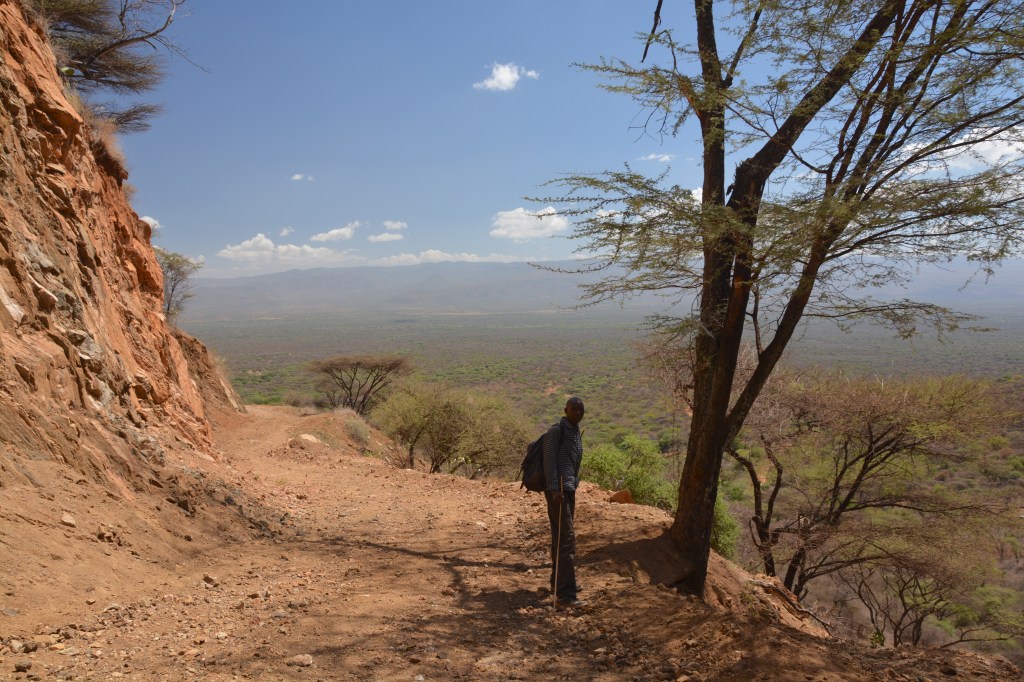
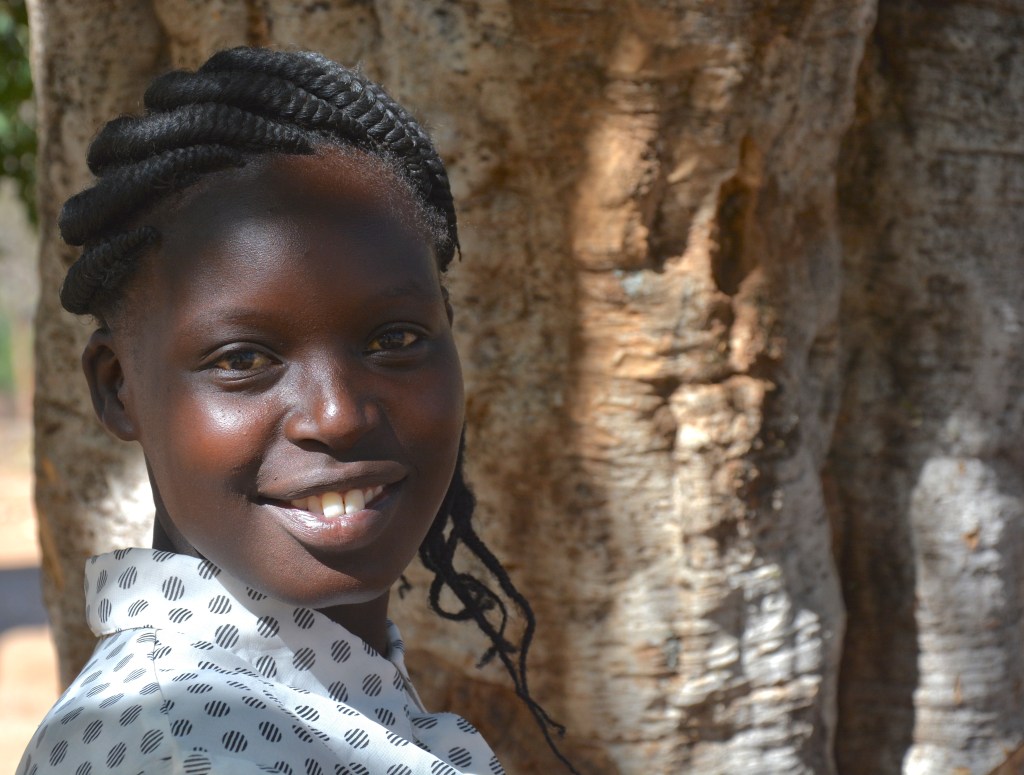
EAST AFRICA 2021-2022. EPISODE FIVE

A NEW UNDERSTANDING OF THE KERIO VALLEY BY ‘FOOTING’ AND AN ELEPHANT ENCOUNTER
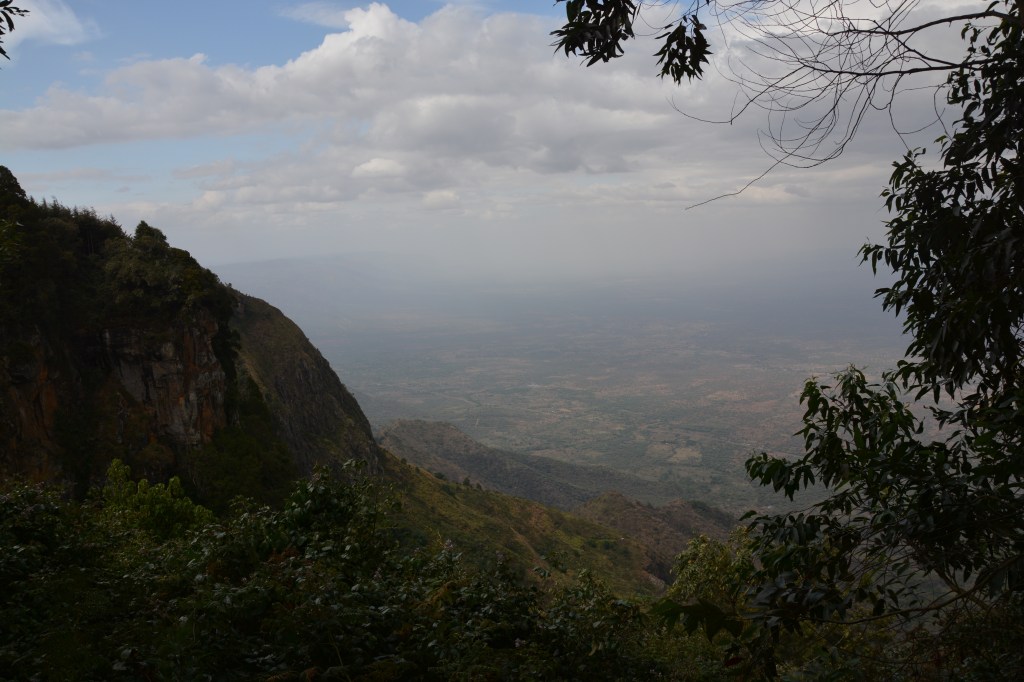
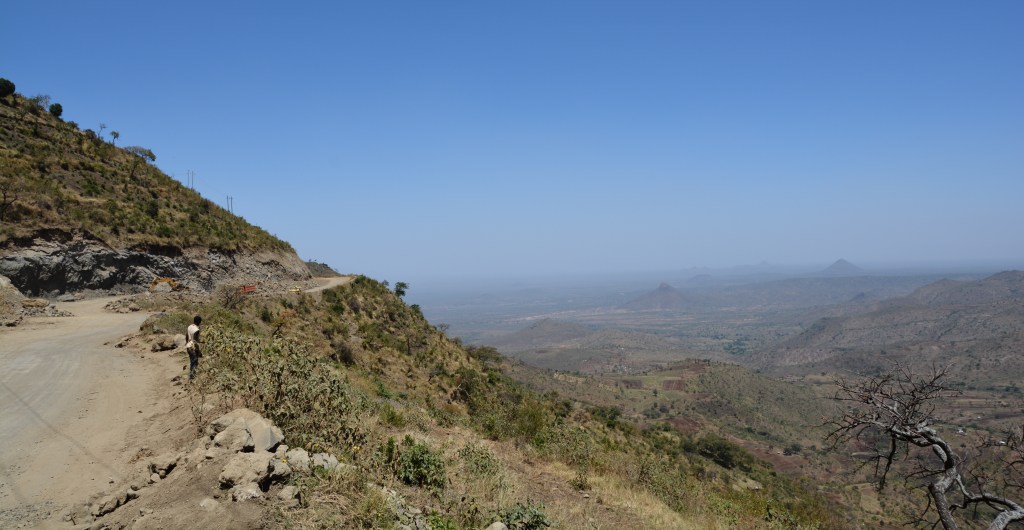
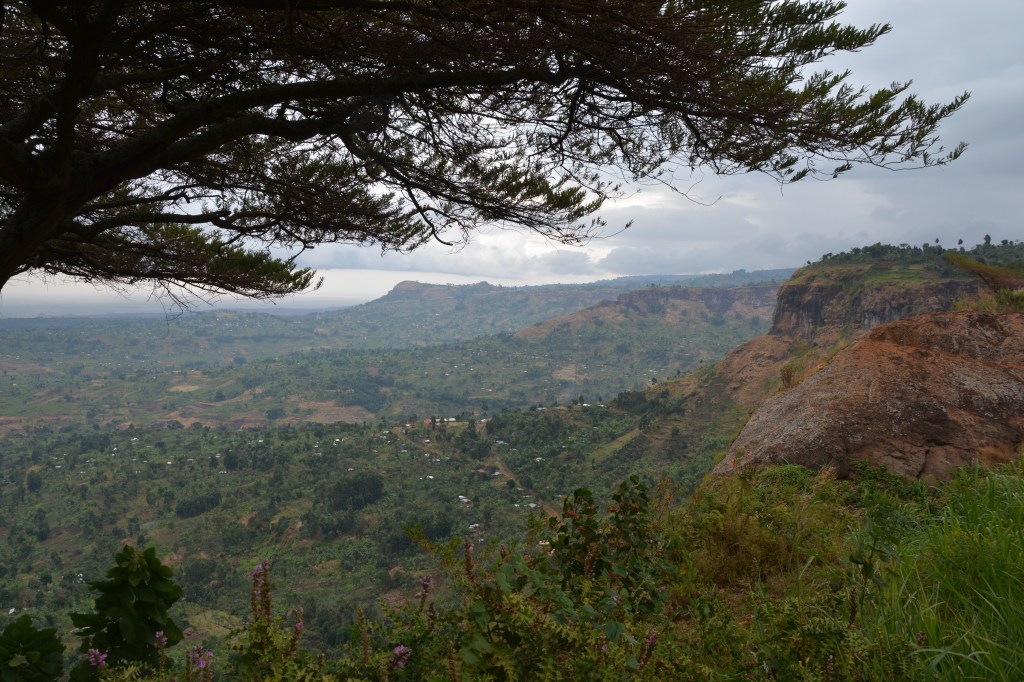
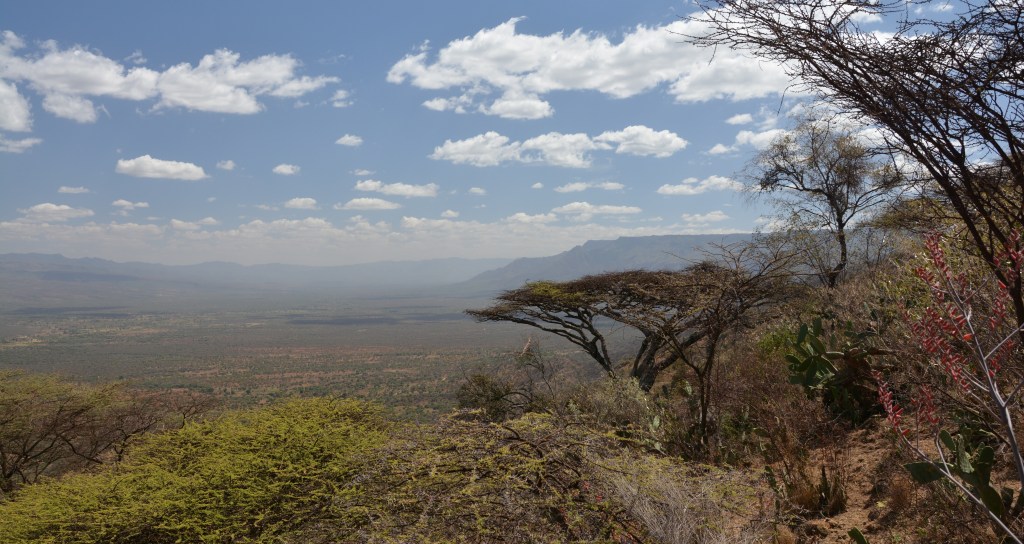
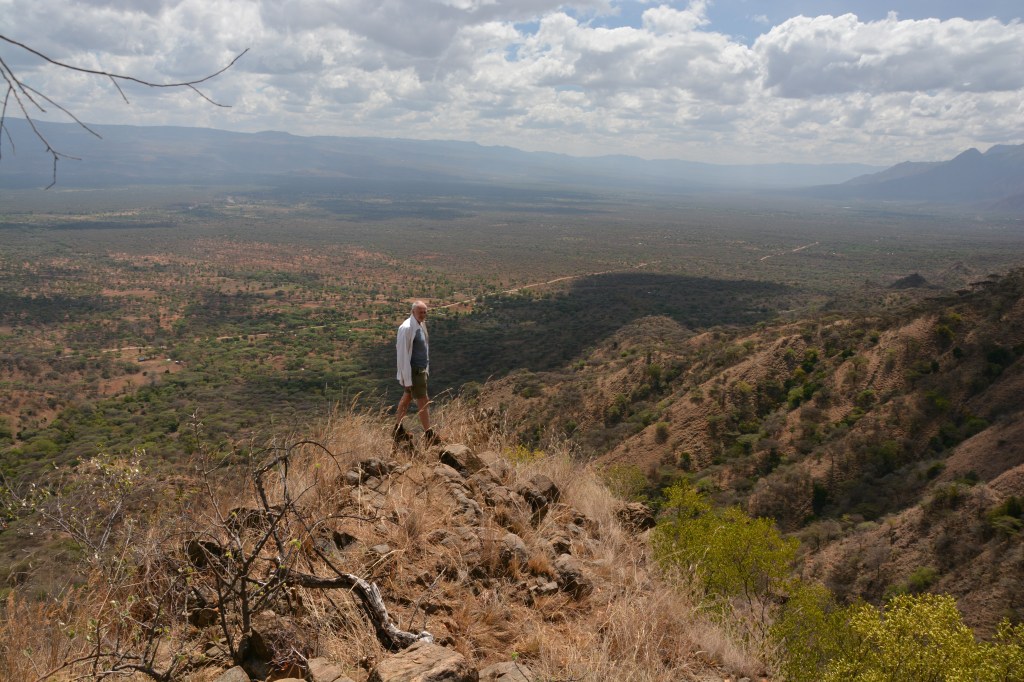
The wonderful Kerio Valley from 7500 feet. Here the floor is about 4000 feet below

Riding a motorbike is a different experience to driving, enclosed in a car, whatever wonders may unfold. It’s what’s kept me riding in Africa for all these years. I am exposed to the elements, part of the landscape, open to the people I pass. If it’s hot, I am hot; if it rains, I get wet; if it’s windy, I buffet about. It’s a tactile experience. I smell the aromas of the country through which I pass – bad ones too, if there’s a dead camel by the road. If the road is rough, I need to dance about, often standing on my foot pegs to lower the centre of gravity of man and machine. Of course, I am more at risk too, but that adds a certain edge to the riding. Nothing encloses me; it is an immediate sensation, a mixture of discomfort and exhilaration. And I am seen as a celebrity by those I pass and interact with, however briefly: an ‘old’ man riding like a youth. Sometimes feeling like one too.

One of the many added attractions to riding a motorbike about this area is the dramatic quality of the roads. I am descending back to the head of my favourite Kerio Valley, where this offshoot diverges from its mother valley, the Great African Rift that stretches from Mozambique to Jordan. I ride towards Kapenguria, a road I dislike, it’s narrow with broken edges that drop onto loose gravel and roadside craters, onto which crazed matatu and truck drivers attempt to push all the weaving, slow boda-bodas – and me. It’s a frightening road, but only for the first 35 kilometres. There’s no alternative that makes geographical sense, so I must run its gauntlet for now. I know that ahead, past the untidy town of Kapenguria, already at high altitude, the road rises further into cool, coniferous woodland and then plunges away into the depths of the Rift Valley with its endless deserts, curling and twisting downwards for twenty miles, from 2260 metres dramatically down to a mere 930 metres (still a higher altitude than most of Britain) – a contorted, twisting descent of 4350 feet.

Having caught up with my American colleagues by the magic lantern of the internet, and been assured that for now I can stand down, I take this safari northwards from Kitale in relaxed mood. Last March, right in the last three days of my journey, I discovered wonders I hadn’t found before. Then I had to run to beat a lockdown in Nairobi that threatened my departure from Africa. Even then, I promised myself that I’d take the ride again and explore more of the area along the fine escarpment of the Kerio Valley. These gravel and dust roads hardly exist on maps; it takes a questing spirit to go and find them. That, and a suitable off-road machine. Happily, I have both! I’m on my way back…

Down through the shady dark conifers: cedars and fir trees that stretch above local flowering shrubs – it’s a handsome descent – the road eventually levels off into a slow decline towards the valley floor, still beyond the tight confines of the Marich Pass, the final gateway to the northern deserts that reach away to far South Sudan and Ethiopia. It’s fine riding; a good road and little traffic, just those pesky Kenyan speed humps to watch for. They’re a national obsession in the Highways department, but they cause accidents too as most are unmarked, just sharp lumps in the grey surfaces of the roads. On my little bike I can stand up and coast over most, but it’s a dangerous assumption that I can do that for all: some are lethally steep and make my bike bounce up to hit my bum if I am unwary. Failing to spot one is serious. I must pay attention, despite the fine scenery that unfolds down these roads.

In time, the slopes of the dry scrubby pass fall back and I roll out onto the sunburned desert floor, where aloes and strange water-hoarding plants swim in the sweaty heat.

*
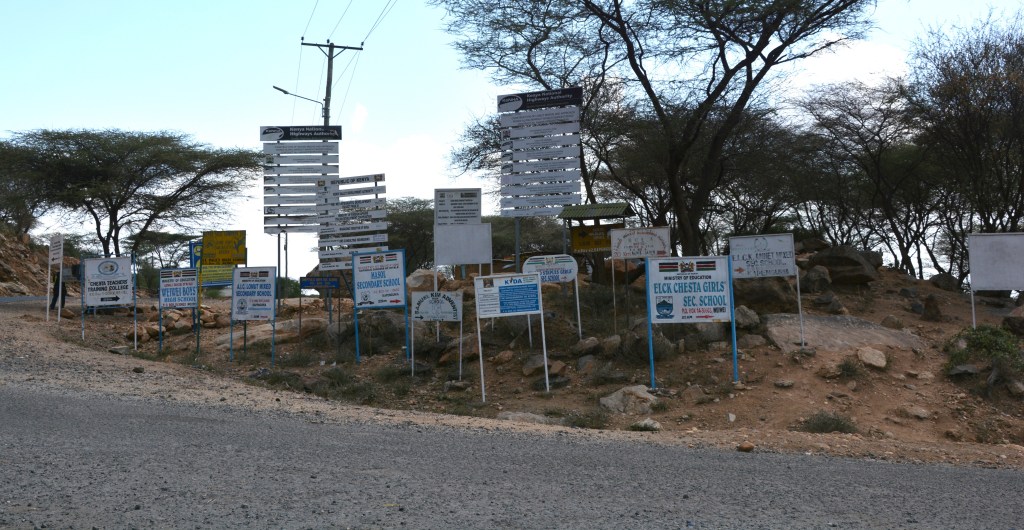
A junction to a side road. Every school and project must have a board!

I’m not heading far this afternoon, just 70 miles or so to a guest house at the edge of the limitless valley floor, amongst the sand and rocks and aloes. It’s a long-established place started by an Englishman and his Eritrean wife years ago. It’s a shady place filled with the mature trees and the landscaping that we Brits seem compelled to bring to Africa. I stayed here back in 2001, sharing the encampment with the last evening of a school group from Gloucester, watching overweight pale teenagers clumpily dancing the local Pokot tribal dances round a big fire. Last year I stayed a night with the late David’s Eritrean wife, Mama Roden, drinking her buna (the elixir of the gods: Ethiopian coffee), eating a tasty Ethiopian supper and conversing about the changes we have both witnessed in African life, in my case for 35 years. Now she is abroad but I find companionship with Kate, an Englishwoman in her 50s, who’s been working with Oxfam at home. Her husband works with the Foreign Office in the aid sector, both disillusioned by the way British foreign politics have slid into meanness, selfishness and drawbridge-pulling-up and trying to work out the last decade of her working life in something that will bring more satisfaction. I’m glad to find a few tourists filtering back to help the beleaguered foreign earnings of Africa. I’ve spotted a handful this year, to last year’s total of three young Englishmen working from their computers, who’d escaped without question during ‘strict lockdown’. “No one even asked! And Heathrow was heaving!” I remember them telling me when I expressed surprise to find them here, having escaped myself a few days before that lockdown. “Huh, they can’t afford to stop travel, it’s just the spin they put on it…” They were dismissive of British politicians too…

*

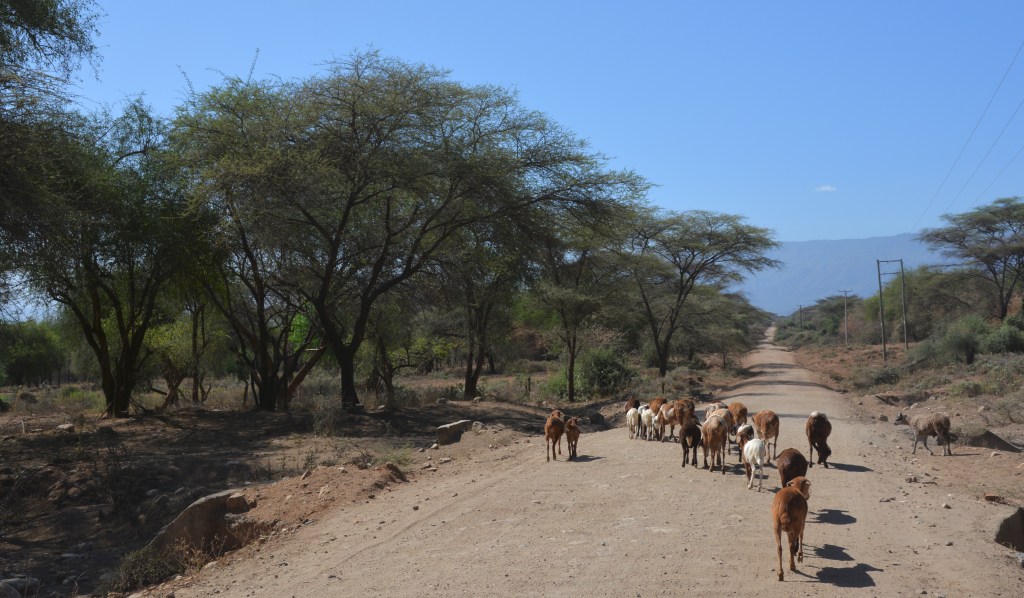
Next morning, I set off on my promised safari, on rocky, dusty trails round the base of the great escarpment, here perhaps 4000 feet above me. I have a great sense of freedom here; of delight to be experiencing this again; an anticipation of the trails in front of me today: the desert shimmering endlessly to my left, the scrub-covered steepness to my right, rising into a bright, hot sky. In Sigor, the first village on my ride, it’s market day, mainly local vegetables and shoddy, brightly coloured Chinese goods and men driving flocks of knotty sheep and wayward goats along my road. I cause a stir as I pass, everyone turning to look at the old white bloke bouncing through town between the untidy shacks alongside the dust trail.

Here and there I bump through washouts, dry now and for some weeks to come. The rock road is rough and dusty, wriggling its way through this parched landscape. There aren’t many people about; scant villages, just a few people sitting here and there beneath shady trees, turning in surprise to see a mzungu biker passing, returning my waves. I am a mystery to them, as, largely, they are to me. What’s it like to spend your life in such harshness, relying on a few goats, an odd cow or two, with basic education, little awareness of anything much more than a few miles away – except the inevitable Football League matches? I’ve no idea, as I pass through in moments, leaving them to their sixty-one-point-four average years of this privation, as I ride away with all my privileges. Already ten years beyond that average. A wave, and I am gone, discussed for a moment and forgotten forever. It’s philosophical stuff that I ponder as I ride! I’ll never know the answers. Thank god.

I come at last, after 42 kilometres and about an hour of this rough trail, to an area I remember from last March. I’m relieved to recognise it, as I have felt a bit lost for a while, although the mountains rising on my right give me confidence. As long as I keep round the base of these steep slopes I am heading into the Kerio Valley. What I recollect is a disaster area of huge boulders and broken trees, disturbed terrain and devastation. I weave my way over the rocky mess, thinking about the natural disaster that overtook this valley bottom three years ago: a terrible landslide that took over 200 lives in a few minutes, as a huge section of mountain, loosened by tree felling, swept horror downwards from the steep escarpment. It swept all before it, even a dormitory of schoolgirls. I remember my shame that this occurred at the same time that there were floods in UK, in which no one lost life, but many lost (mostly insured) Stuff. Of course, the media in England had the cameras and reporters and it made the world news night after night, even to be seen here in Africa. Meanwhile, nearby, families disappeared; orphans were created in moments; livelihoods were lost; a whole generation of schoolchildren perished. But that was in remote rural Africa so it didn’t count.

Here I can still see – three years on – the devastation. When I stop for tea, the people who suffered this trauma still remember it as if it were yesterday. No one came to help them clear up; no services were mobilised; no emergency was declared: they just had to pick up any pieces left and cope as best they could. A community largely wiped off the face of the earth. I can see the scars today.

*
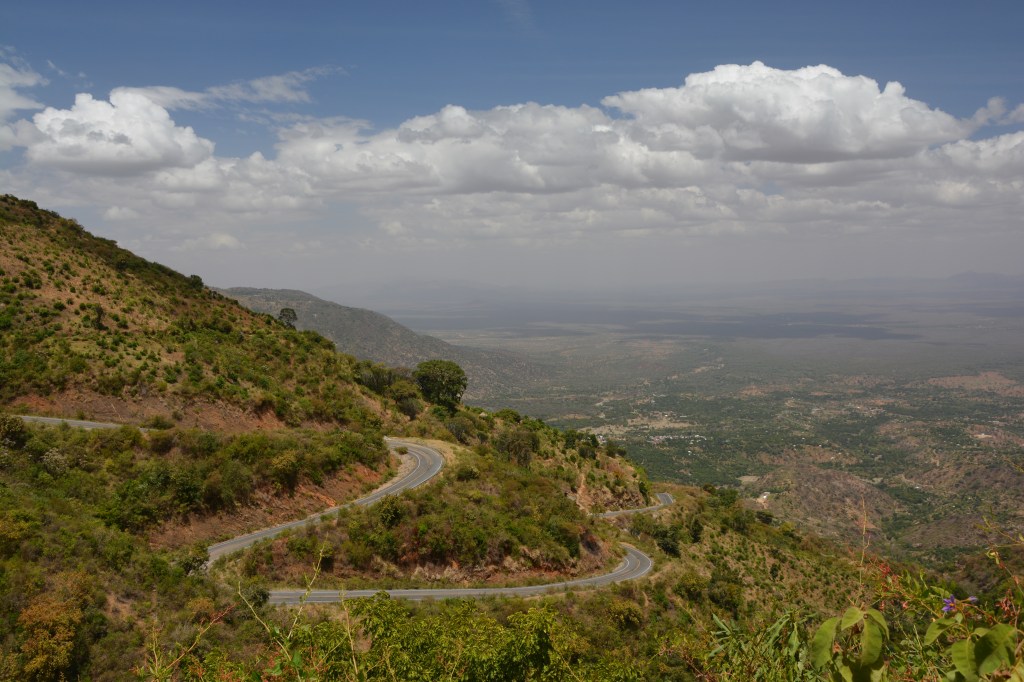
A road from nowhere much to nowhere much.

“Are you back from Uganda?” asks a young man when I stop for sweet chai and a chapati from a makeshift grubby tent in Karena village, just above the disaster area. Ten months on, a mzungu on a motorbike is still remembered. “Do you still have that map?” I sit for half an hour, chatting to the gathered young men who have nothing better to do. I tell them that this was my best ride last year, so I determined to repeat it. “I’m going back up the tar road to Chesoi. It’s one of the best roads I’ve found in all Africa!” It is too: this spaghetti-twisting road that rises three thousand or more feet in the next 15 miles. I search the world for roads like this. And then, when I least expected to find it, I found this magnificent zig-zagging contorted road. It makes no sense: it just goes up the mountainside, partially blocked by landslides that have been colonised by vegetation as big as bushes and small trees, unmaintained, between a rough valley-bottom rock and dust road, to a broken once-tar meandering strip thousands of feet high above. A road to nowhere that should be a feat of road design but makes little sense. Multiple hairpins with corners steep enough that they tax even my versatile, light little bike, labour upwards for no apparent reason. I suppose some vainglorious politician thought it’d be a vote catcher once upon an election…
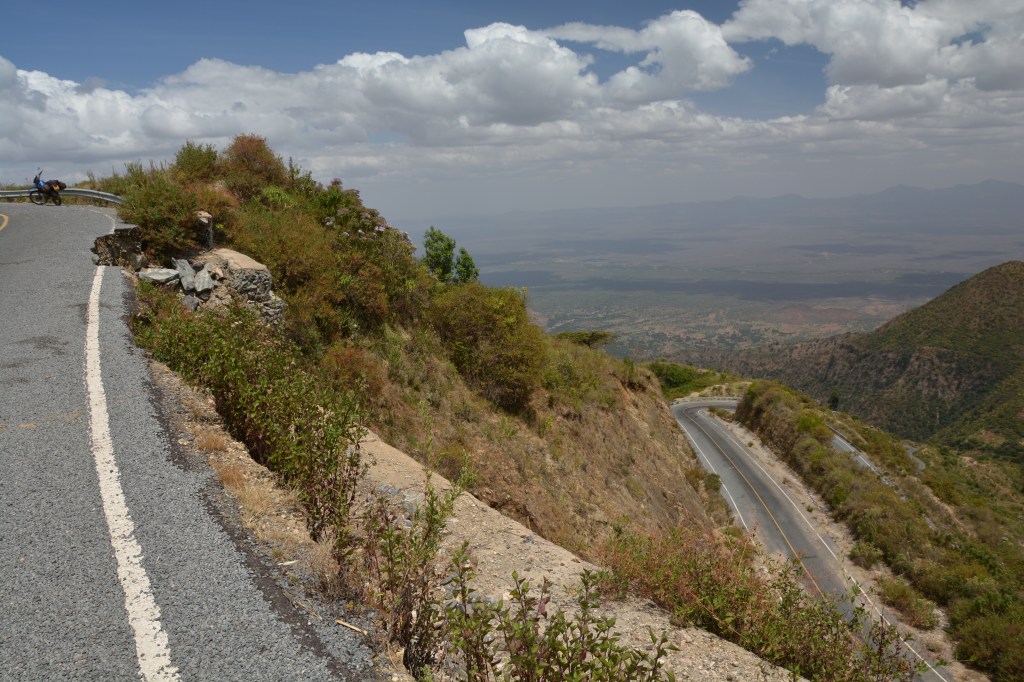
A politician’s vanity project?

Still, I love it! It’s amazing as I first-gear upwards on the steepness. The valley expands, plunging ever downwards on my left, then my right, the escarpment soars skyward on my right, then my left. Here and there, the road has collapsed, one level dropping tarmac directly down to the broken tar below. Roads like this should be in record books, but here on the remote edges of the Great Rift Valley, they don’t get noticed. Doubtless, the politician who inspired it is long out of office, or elevated to the untold wealth of national government and doesn’t care any more about his remote constituency. A vanity project mouldering on the precipices of the Rift Valley. Wonderful beyond compare for a wandering, adventure-seeking mzungu motorbiker.
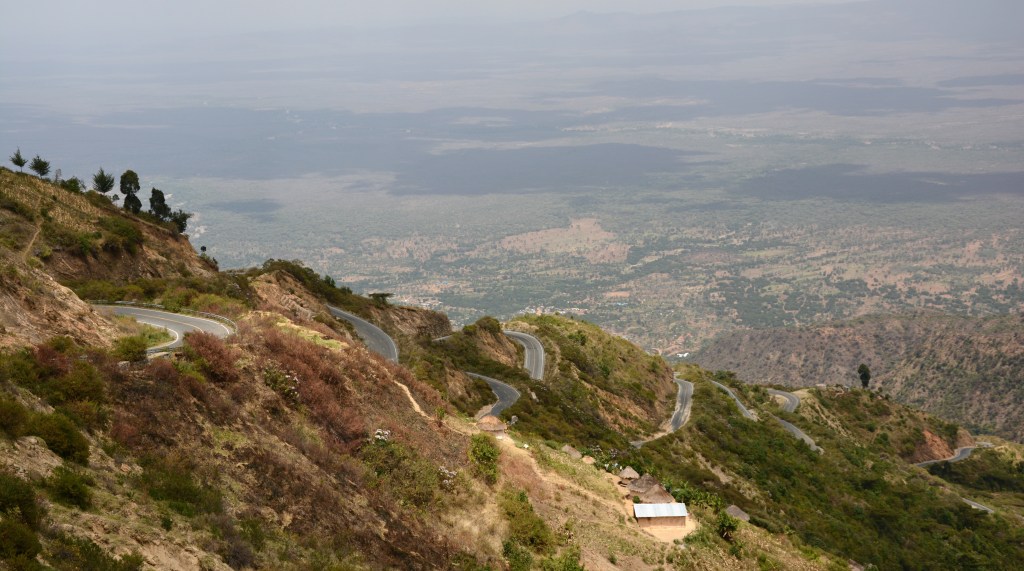
I search the world for roads like this

Then comes 20 kilometres of horribly pot-holed, broken old tar through magnificent scenery. Last year I described this as a delightful parkland, reminiscent of the background of 18th century paintings: a sort of Gainsborough fantasy landscape. It’s charming and beautiful, mature trees and sweeping meadows, flowering shrubs, light and shade, greens beneath a sky of speckled clouds. My road weaves and meanders through the splendour, up here on top of the world. I just love it. It’s worth coming back.
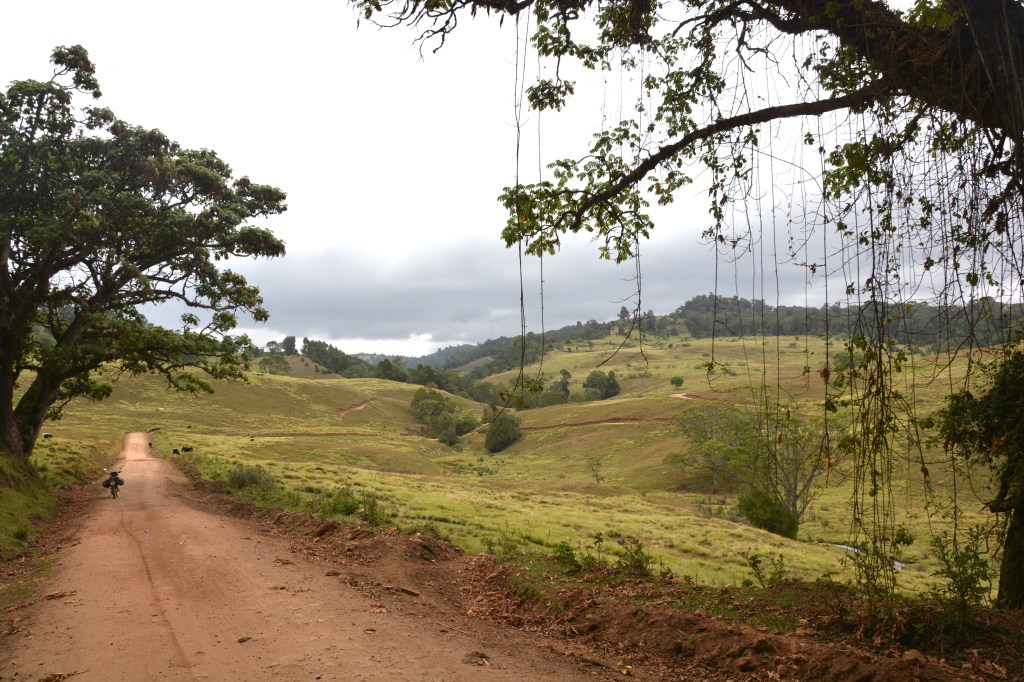
I saw this as a sort of 18th century idealised landscape

I reach the remote town of Chesoi, balanced on the edge of the escarpment. Young men laugh at me. I call: “Kapsowar…?”, my next destination, and they indicate upwards to the right with big smiles and waves. I turn right… Funny, I’m sure that last March I turned left… It was counter-intuitive at the time, as the road dropped away, and I knew Kapsowar was miles away up on the heights. Still… they all waved to the right, uphill…

I turn right, uphill.

It’s perhaps an hour later – and I am getting very tired, despite the fine scenery – that I feel intuitively that I am wandering deeper and deeper into countryside that doesn’t bring me to Kapsowar. I stop two elderly gentlemen for information. “Oh! You have gone the WRONG way!” they exclaim, as a cheerful drunk festoons my handlebars with convolvulus. (William tells me later that this is considered a blessing in this region). “Oh, the WRONG way! But if you go on, you will come to the tar road in 13 kilometres. Keep left at the next junction. Where are you from? How old are you?” The questions come happily as an election vehicle flies past in a dust cloud, wardrobe-sized speakers deafening us with pounding ‘music’ and filling the rural landscape with a hideous cacophony. I shake friendly proffered hands and ride on. The drunk stumbles off chuckling at some inner joke – maybe me. I keep left at the next junction, but it’s the first of dozens. I am LOST, entirely lost on these narrow red dust tracks in the back of rural beyond. It’s cool now too: the sun’s gone, the clouds have rolled over the heights. I keep asking my way. It’s always “Not far!” – but it’s always actually VERY far.

Time’s moving on. Children are returning from school, many of them so astonished to see a mzungu – they probably never saw one before – that they don’t even wave. I am riding through deep rural extremities here. Well, last year I did promise myself that I would explore more of this region; I just didn’t plan to be doing it now. I’ve had a bad neck ache for days and now have a stonking headache, and am not really in full adventure state. I’m tired from a great deal of trail riding on which I hadn’t planned and the fun’s going out of it…
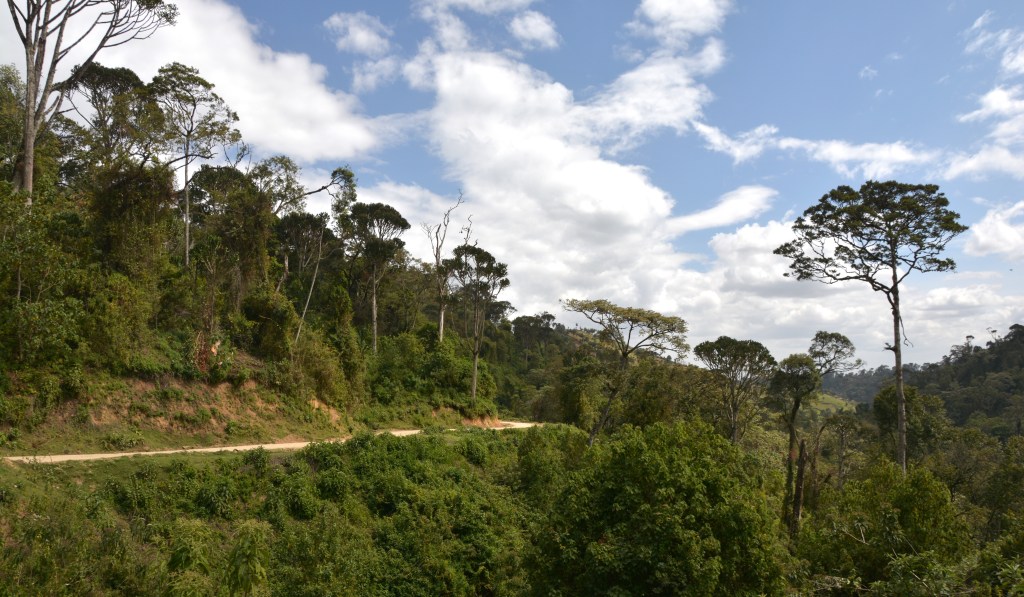
A fine forest ride at the top

Then I am in a deep forest. It’s magnificent, even though I’m not fully in the mood. Great sweeping meadows flow beneath old old trees; the trail, bumpy and hard riding, is contorted and complex. I slip and slide, bump and bucket. But it IS magnificent, even if I am lost and far off route. I just wish the sun was shining (the clouds are thick and threatening now) and I didn’t have this pounding headache. Every time there’s a junction, there’s no one to ask. I have to double back a few times. To all I repeat my mantra: “I am going to Iten! But I seem to be lost!” Most exclaim and tell me I will meet the tar road. “Not far!”

Huh. ‘Not far’! Eventually, late in the afternoon, after many mis-turns and riding through the smallest of hamlets, weaving my way past endless tiny shambas, watched by amazed countryfolk, I DO find the tar road. I even recognise it. I am WAY further from Iten and Kessup than I expected. I still have another 35 miles – at least – to ride. At least now I know I have tar roads – and those bloody speed humps, most of the way. I stop on a steep hill and text William that I am still on my way and will be with him in about an hour.

“Eh, you were TIRED! I’ve not seen you like that!” My head’s pounding. My neck’s aching fit to sever as I pop Paracetamol and drink my beer. “Sorry, William, I don’t think I can walk down to the valley tomorrow as we planned. I need an easy day!”

I’ve ridden 115 miles, of which over 60 were hard trail riding. I am utterly exhausted. I am in bed by 8.00pm and sleep for eleven hours.

*
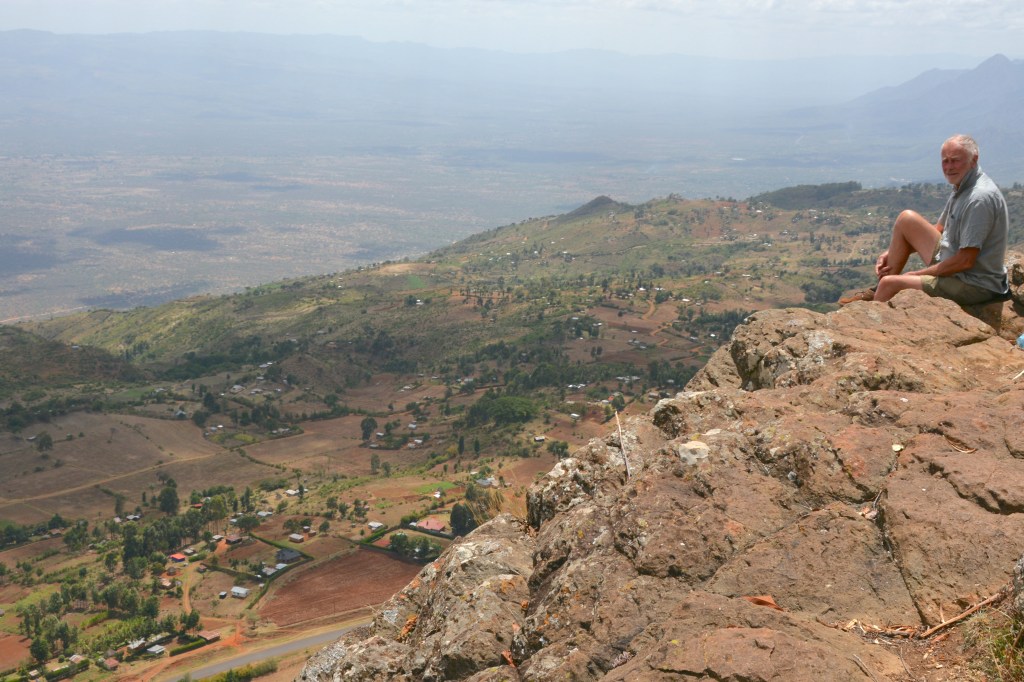
High above Kessup and the Rift Valley

Next day we saunter in Kessup Forest, if ‘saunter’ can really describe an eight mile walk that starts with a scramble of 1000 feet up to the top of the escarpment. “The goodness is, (here comes one of William’s favourite shibboleths) that we both like to walk!” The forest is nationally protected, so it’s full of old trees and thick underbrush. It’s cool in the shade. Shrubs are bright and the paths faint. Not many come here; there’s nothing much to exploit, just some firewood from fallen trees, fair game. Not much fodder, and habitation is a way off, so it’s silent. In four hours we meet no one. We see no wildlife either, not so much as a lizard. We are surprised, but perhaps the animals are suffering too from the lack of rain. People’s onions are wilting in the shambas below and William hasn’t planted his tomato seeds yet. “I don’t want to waste them; they won’t germinate. Maybe the rains will come early. We are praying they come by middle of next month.”

Kessup forest, a peaceful wander, even if we were lost

We mislay our way soon after we leave the clifftops, but here we’ll never really be utterly lost as there’s always that yawning valley to the east. Finding the trickle of the Kessup River, we pick up our trail again and slowly wander back to the steep path down to Kessup after six hours on the mountain top. William’s an easy companion and this is a ‘gentle’ day in preparation for our planned descent back into the valley tomorrow. I’m spending more time this year ‘footing’ the landscape, and coming to appreciate it more through this slow intimacy.

*

So now we are going to ‘foot’ back into the depths of the valley we gaze down into like a map below, as we eat our supper on the Kessup plateau. At least ten miles away, across the blue haze of the valley, I can see the Tugen Hills as I sip my Tusker mixed with Guinness. We’ll head for a village called Barwessa, William says. He doesn’t know that side of the valley either, past the elephants and crocodiles. It’s an adventure for him too. “The goodness is, we like the same things!” We’ll find someone local to guide us to the river bank. I can see the Kerio River glinting far away from my perch here on the escarpment edge. “We can wade across.” Pity I once saw those ugly crocodiles upstream! But I am assured it’ll be puddles or slow moving shallows. I guess I’ll see the crocs coming in time, chomping their prehistoric jaws.

*

The downward hike begins into the wide Kerio Valley

We set out about ten thirty. It’s cloudy today – a relief for me, for we’ll be without much shade, exposed like flies beneath the searchlight bulb of the equatorial sun for hours. It’s uncompromising, this landscape, and we’re challenging the climate. We’re going to walk back down the unfinished road that we walked UP last month. We can’t see how the engineers can ever hope to connect the two lengths of bulldozed gravel: the missing bit – about 300 feet in height – is on the steepest slopes and of friable rock and dust. For that part we have to take to a shortcut trickle of a trail through the prickly pears, aloes and scrub, slipping downwards on the grey dust. There just doesn’t seem enough room for the connecting part of the ‘road’, and if it’s not constantly maintained it’ll fracture and collapse on these rocky angles. We’re in no hurry today; we know where we will stay tonight. But it’s still about 15 miles to hike today.
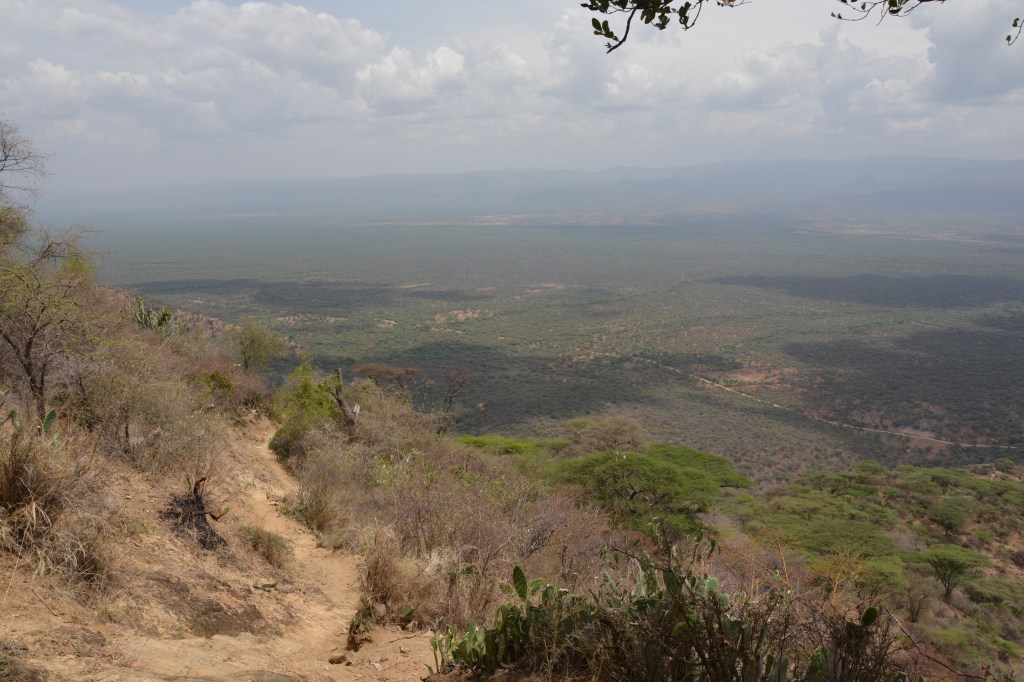
We will hike to the other side through the inferno below

Anne is the pretty cook at the Kipoiywo guest house, which we discovered last month. She’s a good cook too. Her husband, Colin, is here this time. He comes from the top of the escarpment, not from this community. They’ve already three children under three, only youths themselves, probably in their early 20s. The two small boys are ecstatic to have a mzungu visitor, screeching in delight and invading my basic oven-hot room with a bed its only furniture under a burning zinc ceiling. It’s probably 100F degrees in here at the end of the afternoon; and it won’t cool much until the early hours of tomorrow. They throw themselves at the bed, touch my skin, investigate my few belongings (I’ve just carried them for 15 miles downhill by 3000 feet, so I was careful what I brought), and interrogate me in screeches in a language I don’t comprehend. But they’re charming and I can’t be angry with their inquisitiveness and thrill, despite my weary condition. I’m the first mzungu they’ve seen.

*

There’s little food down here in this parched dry season world. William’s carried a woven bag of my favourite green vegetable since we bought it for 50 bob from a farmer this morning. It’s called nightshade, and looks as if it could be a relative of our nightshade, or even the potato. But this one is tasty and Anne cooks it well, with some oil and tomatoes. It’s a bit like spinach but with many small leaves off a central stem, not a vegetable I’ve seen anywhere outside East Africa. William goes off with a boda to fetch beer from a bigger village along the white dust road. He finds six small eggs and some tomatoes. We sup off scrambled eggs, Anne’s delicious chapatis – she really makes the best I’ve eaten – and the green vegetables. We must adapt to local resources, notwithstanding our long hikes.

William talks about the chicken he wanted to buy up top. “We could have saved 100 bob! (70p). They are EXPENSIVE here!”

“Yes,” I say dryly, “and we’d have carried it for six hours, stressed and flapping and shitting down my back!” For William had suggested we could hang it from the straps of my little backpack. He laughs loudly at the image I conjure and assures me he was only joking. But I know if I’d conceded, we’d have walked 15 miles with an unhappy, fretting chicken shitting down my shorts. You don’t buy dead chickens here, and certainly not ones vacuum packed in plastic, you just dangle them by the legs… It’s just the way things are. Feathers and all.

*

We stay the next day. A lithe young Masai stops to chat as we take our leisurely next-morning milky tea beneath a shady tree. Only chapatis this morning. There’s nothing else available. The sun’s already hot in this low-lying inferno. The Masai wears car tyre sandals, and a colourful chequered cloth. He’s got no ounce of excess fat, just smooth, almost girlish skin and polished chin and cheeks. Even his head looks polished. His narrow face is not handsome but he carries his body with the relaxed ease of one used to endless walking. And I don’t mean the kind of walking I am doing: this boy spends his life walking, the modern traditional peddler, selling beaded bracelets, leather belts and a herbal mixture: a sort of tonic, William says, from a grubby five-litre plastic container. He seems to carry nothing but his few wares – and a mobile phone. He walks without stopping to the most remote hamlets and habitations looking for sales of a few bob a day. Then he finds a place to sleep and carries on tomorrow. An odyssey that may last for years, I suppose. A bunch of handmade cattle bells hangs from his hand. William pumps him for information about our walk across the great valley tomorrow. He can do it in three hours. “So maybe we will take five…” William tells me with a chuckle. The Masai walks off, soon swallowed by the spiny trees and crackling undergrowth, something slightly mythical in his rootless existence. All hail, the wandering Masai.

*

The customary African demon raises its head here in Kerio Valley: ALCOHOL. The Achille’s heel of Africa. I’ve seen many die and very many more lose all sense of self respect and decency. It’s a major problem of Africa. There’s so much of it down here in Kerio Valley. It’s probably the main reluctance I have about going back to Navrongo in Ghana too, which provided such a framework to my life for thirty years, and where still lives one of my closest friends, my dear brother Wechiga. Some years back, it came to the point where I would not go to town after lunchtime, for I knew I would see only misbehaviour and suffer from educated people begging for more hard alcohol: the white man an irresistible ‘touch’, for we are all so rich from our money trees. People sensible and respectful in the morning are talking nonsense, begging further alcohol and harassing me after a small amount of very intoxicating hard alcohol, home produced and unregulated. It’s costing lives, families and development. Yet no government dares to expose it or attempt to control it. They’d lose votes of course. This way they just lose voters… A day fending off alcoholics – for that’s what many have become – becomes irritating. My usual adaptability and acceptance reduces: I hate this.

Largely, it’s a problem of the useless African men who hold back this continent so much, doing little useful but fathering children with their scattergun approach: sex with any woman, like the proud cockerels. With no more responsibility for the consequences too. The women do all the work, unless they too join the legions of drunkards, in which case children go hungry and miss school. People on the very edge of poverty spend what tiny resources they have on this poisonous hard alcohol, wirigi, then try to beg for more as they become addicted. In this hard, hungry drought-scoured valley it’s a problem of depressing proportions. “Oh, you have assISTed me a LOT!” exclaims William many times as we walk between groups of drunkards. “You made me leave this wirigi! And the cigarettes.” He knows he is much healthier and stronger than he was five years ago when we met. Would that I could influence these desperate communities burning up in the sun and avoid the frustrations from drunkards that I now associate with the villages of the Kerio Valley.

*

On Sunday there’s no food but two cold chapatis and half an unripe mango for breakfast. William’s walked for half an hour before I get up, looking for eggs. We must make do. It’s not a lot on which to walk for the next six hours in the scorching sun. For today we intend to walk right across the valley floor to the foot of the hills to the east. I’ve looked down into this valley for six winters, not really knowing the landscape.

Edward, William’s sort of uncle’s cousin or something, the man we walked with last month, is going to come with us and show us the way, for there’s no defined path through the thick scrub and bush. And there may be elephants in there… Real live pachyderms…

I fill my three water bottles early. By afternoon, the water from the borehole tank is hot as bathwater. Here, even the nights are hot as the fires of hell. By morning, the water is still tepid. What a place to live. I lecture Colin, Anne the cook’s husband, angrily. Last evening he cheated me of 200 bob (£1.40 – a considerable sum here: it’s the pay for a day’s labour) implying that he needed to get supper supplies. He arrived home four hours later rolling drunk, having left Anne to cook alone, care for her three very young children and look after the two guests. There was discord in the house; we ate late, and he stole our remaining ripe breakfast mango. Later, Edward tells us he is a ne’er-do-well; he’s stolen money from the hotel owner, but he comes back to force his ‘rights’ with his gentle wife. Of course, no African would countenance the concept of marital rape. They just laugh at the idea. Who knows why Anne made such a poor choice, one that will perhaps ruin her life and leave her lovely children in poverty? Who can tell? It’s the cause of our lack of breakfast too. She hasn’t even money for chapati flour.

The status of African men… the majority raised and indulged by mothers, their fathers frequently having cleared off like those cockerels to find other women to despoil: that’s the root of this evil. Boys are always favoured. They grow up knowing they are better than their sisters: the inferior sex that is provided to work for men. Few men take responsibility for their offspring and many descend to deceit, drink and womanising.

We deduct the 200 bob from our small bill (the rooms were just £3.40 each), but I secretly give it back to Anne as a tip before we leave. Why should she and her toddlers suffer for her useless husband’s misdemeanours? The sooner she sacks him back up the mountain, the better.

*

We walk away along the white dust road. It’s 10.30 and the sun’s already high and hot. It’s so hot that despite my litre water bottle, various quantities of water that we beg from mud and stick homes the other side of the river, a bottle of juice we scavenge from a small shop, two mugs of tea and two pints of beer, I don’t urinate for 23 hours! THAT hot! Oh boy, it’s HOT!

For an hour we follow a dusty track made by lorries bringing river sand from the valley floor. As we walk, I ask Edward what crops he grows on his shamba, which is quite deep in the valley. “I had fruit trees, like the ones where we got the mangoes yesterday, but more than a year ago, elephants destroyed my trees. I have filled in all the forms for compensation, because the National Reserve is supposed to maintain the electric fences to keep the elephants from our tribal lands, but they don’t care; they say they have no money. Even until now, they say the papers are still in Nairobi…”

“They will be there for ten years!” exclaims William in disgust at the power of authorities to procrastinate.

“…unless they settle our claims and mend the fence before the rainy season (now within weeks) we won’t be able to plant again.” It’s a hard life, stuck between the harsh climate, marauding elephants and African bureaucracy.

The sandy track turns sharply; we branch off directly into the low bush and push our way for several kilometres through dry thorn bushes, whipping branches, crackling drought-suffering bushes and beneath small, weakened acacia trees eastwards. It’s hard going and painful. I draw blood frequently, embattled by vicious thorns. Sometimes I must crouch under trees like bags of needles. The scrub fights back. Branches like whips attack me from every direction. I’m tired and SOOOO hot. The bush isn’t thick enough to prevent the searing overhead sun at under half a degree from the Equator in this burned up ghastliness.

We duck under the broken electric fence that is supposed to keep the wildlife in the national reserve.“We are in the reserve now,” says Edward. I should be paying over $50 for this! It’s even harder going and excruciatingly uncomfortable. It seems to just go on and on; no real route, just pushing through the knife-edged growth. ‘Mr Currter’, the ugly old white shirt I bought for these expeditions, is constantly catching on thorns and I have to extricate myself and my small backpack. I’ve a grubby tee shirt over my head, held in place by a sweat-stained baseball cap: both are frequently entangled. Often, I suspect we are going round in circles: the two mountain ranges to east and west are invisible from amongst the underbrush. We’ve passed a lot of monkey prints as we walk, big ones, although we’ve seen no wildlife, but now we’re stumbling over large quantities of elephant dung; some is fresh, from last night. Elephants are close by. The reserve’s last head-count tallied 210 elephants.

Edward’s walking quietly, looking ahead where he can, spotting lots of fresh elephant footprints. When he picks up their direction, each time he diverts. We avoid any shady trees we see ahead over the underbrush, where elephants might spend the day. Twigs whip; thorns catch. I stumble on, punctured. We spot the bones of an elephant in a small clearing. “Probably poached…” says Edward as we inspect giant bones like something in a museum display. We hear a branch break not far away. “Elephants,” whispers Edward. It’s quite exhilarating; we have no idea quite where they are. Or, I suspect, quite where WE are…
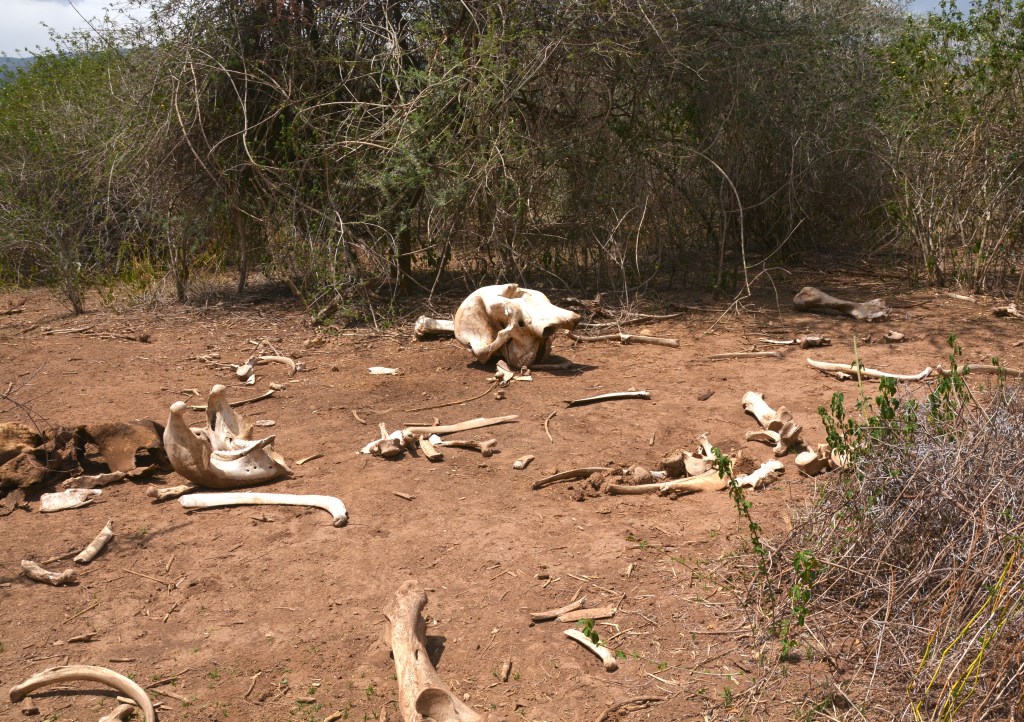
Where an elephant went to die – or perhaps was killed…

The ground briefly opens out and ahead is an area of thick mud: an elephant-made dam about thirty yards around. It’s churned and scarred by giants’ footprints. We rather tiptoe across where it’s thick and dry. Then to the left, about 80 yards away, a huge elephant pauses in tearing leaves from a tree and turns to watch us. He’s a big tusker. A giant. Off to our left, there’s another, about 50 yards distant. Huge. “Keep moving!” William and Edward both insist, as I scrabble with my camera bag, preventing me from getting a picture, which I regret all day. It wouldn’t have hurt to delay for twenty seconds, but Edward and William communicate their nervousness to me. William’s never actually seen a real live elephant up close before. “NO! Only from FARRR away! Eh, they were BIG!” William exclaims over and over for the rest of the day, excited by his close view. “HUGE!” Perhaps Edward is more afraid of the rangers than of elephants, but they too are probably far away, for we are in a remote corner of the small reserve, unlikely to be spotted as trespassers.

There are no more alarums on our walk to the river that weaves through the valley. It’s a trickle now, no crocodiles down here! Not in this very dry season. It drifts languidly over mud. We rest under a thorn tree and I splash warm water over my sweaty body. Then we paddle across to the other side. “No elephants here,” says Edward. “These people are hunters. The elephants don’t cross the river from the reserve. They know.” We leave Edward here to make his way back between the elephants to his home amongst the elephant-ruined trees of his shamba.

*
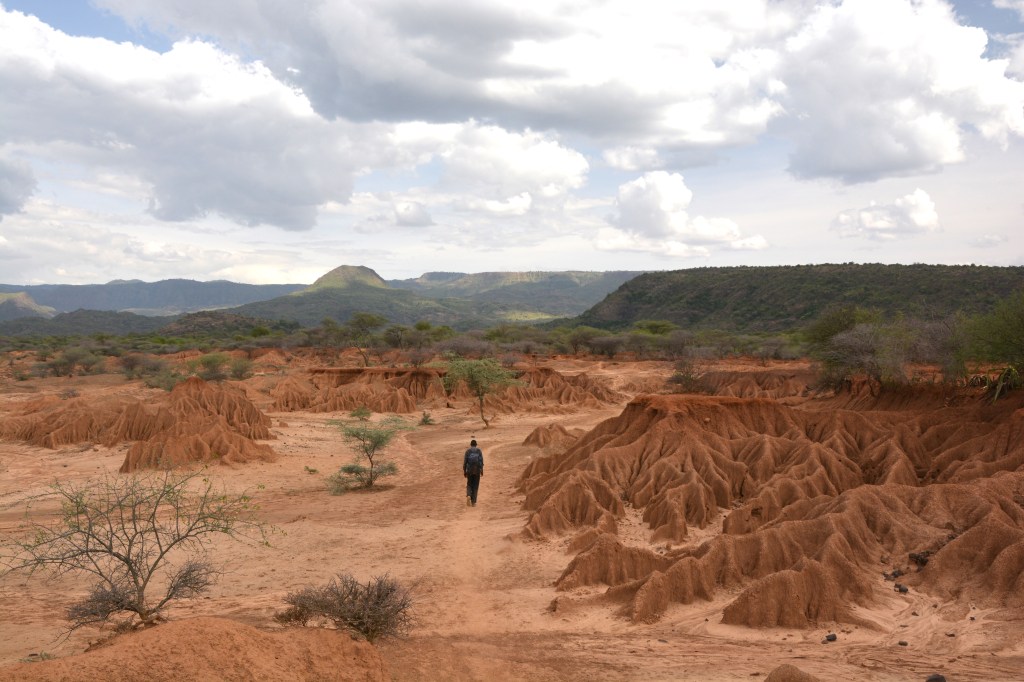
A bizarre mud-scape burning in the valley

The other side of the river is flat and desiccated. It grows little more than thorn trees and water-storing aloes on its packed red dust surface. And it seems endless to me. The water bottles are empty until we find two women living in this back-of-beyond-inferno in mud and thatched houses. The younger one wears an incongruously glittery stylish necklace, white against dark skin. What do they EAT, William and I wonder? Only goats survive here. We plod on and on. I need more water! Much more… We trudge on; just red dust and scarce patches of thin shade from flat-topped thorn trees. We slog across a heavily-eroded mud-scape like something from science fiction film, towards Barwessa, an ugly mess of shacks and lock-ups that passes for the local town. As we enter the scruffy village, I am followed by a Pied Piper band of fascinated youngsters. They’ve never seen the like. I can’t say I’m surprised… A sweaty old mzungu, scratched and gasping for air, in a disgusting over-sized ‘Mr Currter’, now brown with filth and pitted with thorn holes. No, I’m not surprised at all that I attract a crowd of onlookers. And quickly we can see that Barwessa doesn’t provide much other excitement to its inhabitants. The first two we meet are pissed as rats… The rest look depressed, slightly glazed.

The only places to stay are airless, dingy and grubby. ‘Not good enough for William’s Mzungu!’ I’m much more adaptable than he imagines, but I agree that Barwessa holds no attraction. So we hire a boda-boda to take us 20 kilometres to the main cross-valley road, where I suggest that rather than struggling to look for accommodation when we are so tired, we take a matatu ‘home’ to Kessup, only 30km away. We phone ahead: “Put beer in the fridge! We are on our way coming.” And we ride the curling hill up to Kessup, supper, an oh-so-grateful wash and beer.

“We accomplished our mission!” declares William proudly, at least as satisfied as I am. I am fortunate in a companion who enjoys the exploration as much as me. “The goodness is, we both like to walk!” I don’t think anyone quite believes we ‘footed’ from Kessup to Barwessa, a distance of about 25 miles across the burning valley. But we did. Even William is tired. “We meet tomorrow. I go and sleep.” And he wanders away to his dilapidated wooden house carrying a plate of roasted potatoes left from our supper for his breakfast. “Eh, those elephants! They were BIG!” he says over his shoulder, still excited. “HUGE!”

I walk to my small room that hovers on the edge of this stupendous view, now hidden by night. Only a few weak solar lights and fires prick the felt-black below, reminding me that people actually make their homes on the near edges of this inhospitable void. All beyond is like pitch as far as the opposite hills, outlined faintly against the lighter sky. North eastwards, any lights of Barwessa are hidden by a shoulder of the near escarpment, drunks still probably stumbling about its single gloomy main street. To the south east, points of light glint fifteen miles off in Kabarnet, the only town of size on those opposing hills. In the big shadow between, elephants browse in the darkness. I have a new understanding of the landscape below my room; of the Kerio Valley, junior scion of the Great African Rift Valley.

William goodnights Vicky in the smoky kitchen shack as he passes. “Eh, they were HUGE!” I hear him exclaim. The awe of his first elephant encounter will stay with him for a very long time…
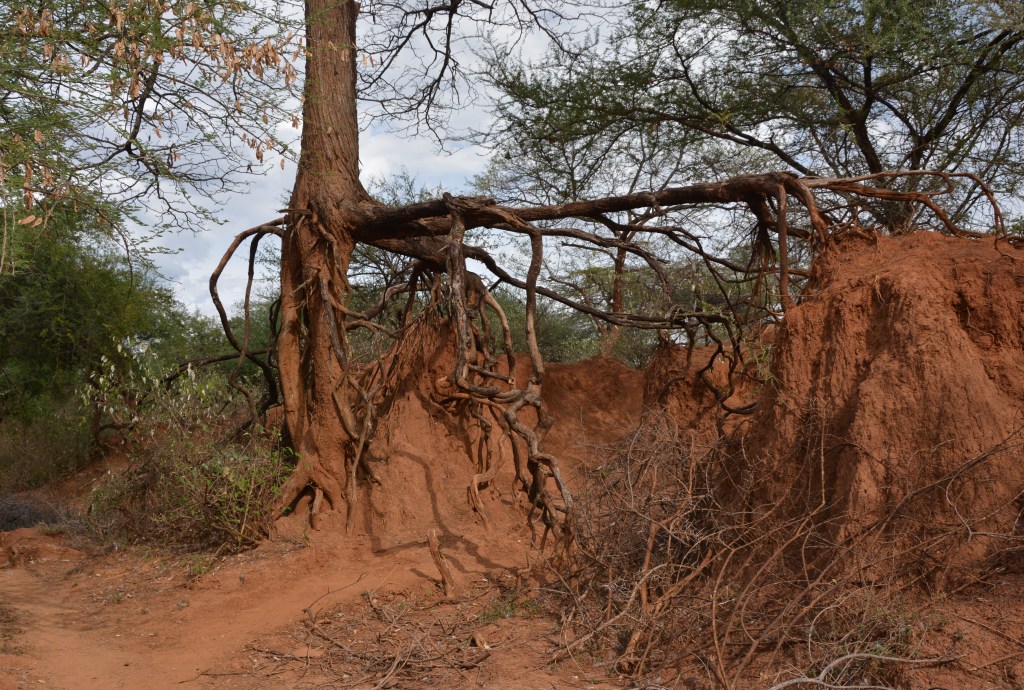
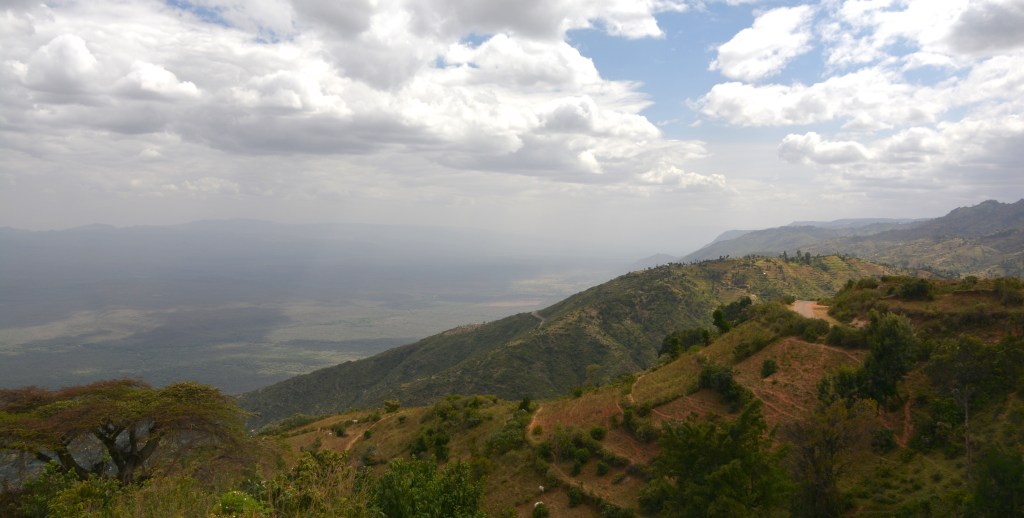
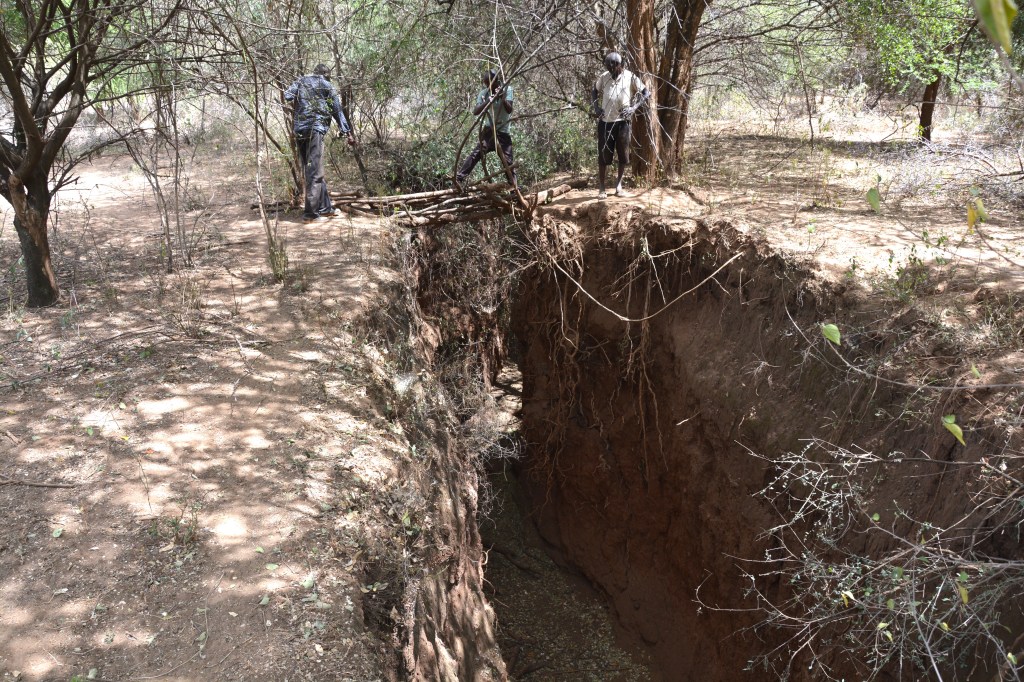
A tree adapts to erosion, and still lives on – just
Kerio Valley. A wonder of nature in Kenya

EAST AFRICA 2021-2022 – EPISODE FOUR

MY UGANDAN FAMILY

The Aunties’ visit

The loosely called ‘road’ that connects my two East African families was one of my favourites in all Africa, with its dramatic trail riding and views into half northern Uganda from its mountain shoulders, the hot, hazy northern lowlands reaching to infinity, punctuated by the pimples of ancient volcanoes. It was friendly too: an avenue of excited children calling, “Mzungu! Mzungu!” and ripples of waving hands. Not many mzungus go this way – for many years, not many vehicles at all. It was only passable with tenacity and suitable off-road machines, or local vehicles battered beyond caring.

Soon it’ll be boring tarmac. Difficult terrain…

But for two years now, the Chinese have been busy building a debt-sodden highway across the fabulous scenery. Most of the excitement’s not there any more, and the old rocky trail is a mess of red dust, broken rocks, huge bulldozers and a livid red scars across the mountainsides. Now I must slither and drift through red dust, inches thick, for 40 kilometres and then cruise on wide flat featureless tarmac for the other 100. Villages have been ripped apart to push through the new expanses of tar. The rough, rugged trail riding pitches and features are gone – with the sense of satisfaction and thrill. Soon there’ll be a six metre high bridge and new international one-stop border offices at little, remote Suam border, where the ragged colonial bridge for now still rattles over the trickle below, the date 1956 stamped on its remaining concrete post. In a month or two even that will be gone. Only one small satisfaction remains: I am still the only mzungu through the post this year.

One thought occurs, however: maybe this is a good thing for this old African biker? ‘At my age’ I’m not really supposed to be doing this sort of adventure riding – not that I care a jot how I am ‘supposed’ to behave – but the road should be complete and smooth easy tarmac by the time the 75 year old Mosquito rider requires it… That could be an advantage, I suppose – although the 75 year old would probably find MUCH more satisfaction in the 90 mile rugged trail ride it used to be!

*

So now I arrive in Sipi reasonably fresh, ready for the onslaught of welcome at Rock Gardens, the idiosyncratic guest house/ beer garden and restaurant I am helping Alex and Precious to develop, its name inspired by Rock Cottage in far off Harberton. I ride the last kilometre down red earth tracks, knowing that they are waiting. The gardens are now fenced by bamboo and a new thatched gate has been erected. It’s beginning to look professional: I’ve seen a lot of these gates in South Africa, where tourism is big business and usually white-owned. Here it’s a bit more homespun: the quality of timber and tradesmen limits what’s possible.

Alex, grinning widely, swings the crooked gate open: Precious comes running, ululating with delight (she thinks I am so old, that every time she says goodbye, she’s convinced I’ll never make it back!) and throws her not inconsiderable bulk at me, such that I almost fall. Little Keilah, who has now grown to a delightful, pretty five year old, launches herself like a torpedo at me. Jonathan, nicknamed JB, who calls himself Jonathanbean Cheptai, hangs back, reluctant; the mzungu still a bit frightening – but that changes over the next three or four days. I am welcome home.

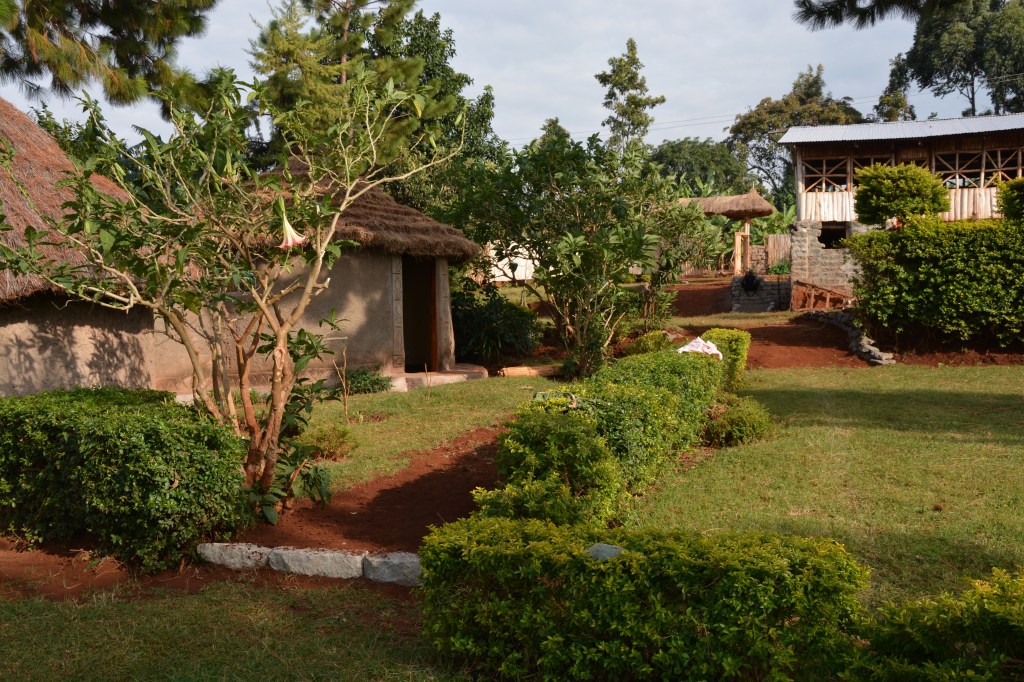
‘Jonathan’s House’, round and thatched, is decorated with blooms from the slowly developing gardens, towel folded into fans by Precious, decorated with nasturtiums and marigolds, from seeds I brought from Devon, as if in a big Kampala hotel, where this young couple trained and met. It’s basic but charming: the bathroom just a rough cement extension with a plastic bowl, jerrycan of water and an old curtain. The bed is locally made from tree trunks; the sheets once very expensive – wonderful linen sheets long ago loved and laundered in Europe.

In the evening Alex makes a fire and we chat and catch up. I’m so fond of these two, and now their cheerful children too. Keilah has gained confidence since last year, and is now chattering like any five year old. She’s bright, despite the long school closures. Little JB repeats everything she says; they are close companions. JB slowly warms to his mzungu grandfather, after we kick a bottle about together and run races across the garden.

The weather is poor: there’s rain around. It shouldn’t be here at this time of year, but the whole planet is in disorder now. On the second night we have torrential rain. Recently, Alex had Jonathan’s House rethatched. It looks fine.

At 3.00am I’m awoken by splashes on my face… I quickly see that my room is like a shower bath. Drips cascade everywhere. The thatch just doesn’t work! With my head torch, I scurry about, showered by cold drips, packing my belongings into my pannier bags and shoving them beneath the plastic table. Water’s running down the walls and puddling the floor. Only in the very centre of the room does the shower leave a dry patch into which I can pull the big bed and continue the night sleeping wrong way round on a dry quarter of it. Poor Alex, such disappointment that the new thatch is useless. So many set backs. So much hope and ambition. His only support a mzungu who respects his integrity, tenacity and determination.

*

In January I come to Sipi expecting sunshine and brightness. I travel light and wash as I go. In this climatologically crazy year, I am confounded. In four days all my clothes are either grubby or still wet, festooned about the garden awaiting some drying sun. My fastidious nature hates all the mud. No one else appears to notice: they’ve always lived with this red mire. The children are filthy, our feet are red; it gets on the bedsheets. It spreads across the bedroom floor, however hard I try to avoid it. Cooking and washing up are done on the floor, on the mud. It gets wetter and wetter, and then comes the unseasonal rain again. I slip and slide with distaste.

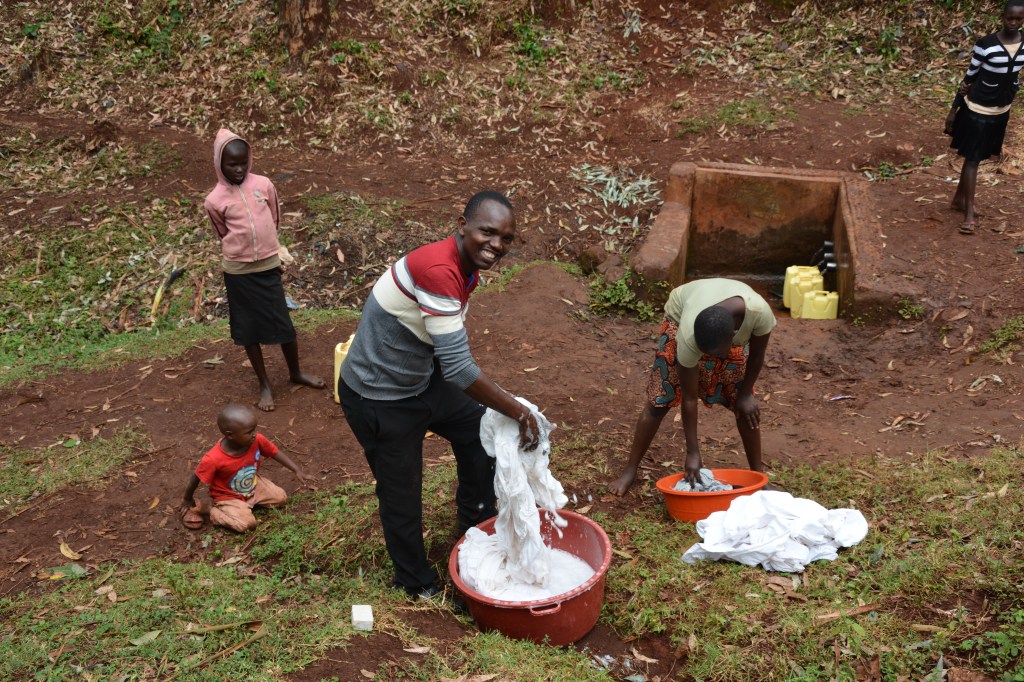
After the rain, Alex takes the washing to the water

I move to the other round room: only the middle of the bed has suffered from a leak in the thatch. We dry the mattress and bedding in some brief sunshine, move the bed and I hope for the best. We’ll have to get the thatcher back to sort Jonathan’s House. Pity to waste (my) money thus when there’s so much more needing investment at Rock Gardens.

*

Poor Uganda, it’s such an appalling mess. One of the most corrupt countries on the African continent, an absolute basket case politically, that begins to show cracks in the social attitudes of its very friendly people, now troubled by so much. The cause of this social disquiet works down from the top. With no example of leadership, except the disastrous selfishness of leaders determined, above all else, to stay in power for their own egotistical vanity – and wealth, the people begin to follow the current. They are lost and rudderless; they see greedy men looking out for themselves and the social fabric begins to unravel. Museveni, the notorious president of Uganda, leads a deeply corrupt government, and has done for over thirty five years – so far, having ousted the previous president in a coup ‘because he had been in power too long for the good of the country’. The problem with these people is their overwhelming narcissism that leads them to think they become saviours. Elections here are an unhappy farce; I watched the last one myself, a year ago and saw with my own eyes (even with my camera) agents handing money to voters as lie upon lie was told.

Now I see this unhappiness surfacing amongst some of the friendliest people on the continent. There is jealousy for those who try to get on, even be it by their own hard graft: the assumption is that they are progressing by dirty means, as so many at the top are seen to do. Envy erupts and mutual support ebbs away. Neighbours begin to report neighbours, to hassle one another, to steal, argue, spread gossip, to undermine.

It’s a warning of where narcissistic leaders, mendacity, misinformation and one-rule-for-us can take a nation…

So I feel so sorry for Alex, a young man of integrity and principle, struggling to make a go of his life and provide for his – small – family; and sorry for so many other Ugandans with similar modest desires and ambitions, ‘hampered’ by, and in the current climate often despised for their honesty… “I lie awake sometimes and think, without you, what would we be?” For I have supported this family through the past two even more than usually troubled years.

*

Some days back, Alex’s maternal grandmother was hit by one of the millions of dangerously ridden boda-boda motorbikes, a blow by the mirror that toppled her. She was taken to hospital but didn’t speak again, and died a day or two later, aged 85. No police get involved and the family pays the hospital fees. There’s discussion, Alex tells me, about the retribution the rider should pay, but as he’s of a similar clan, he may get away with his recklessness.

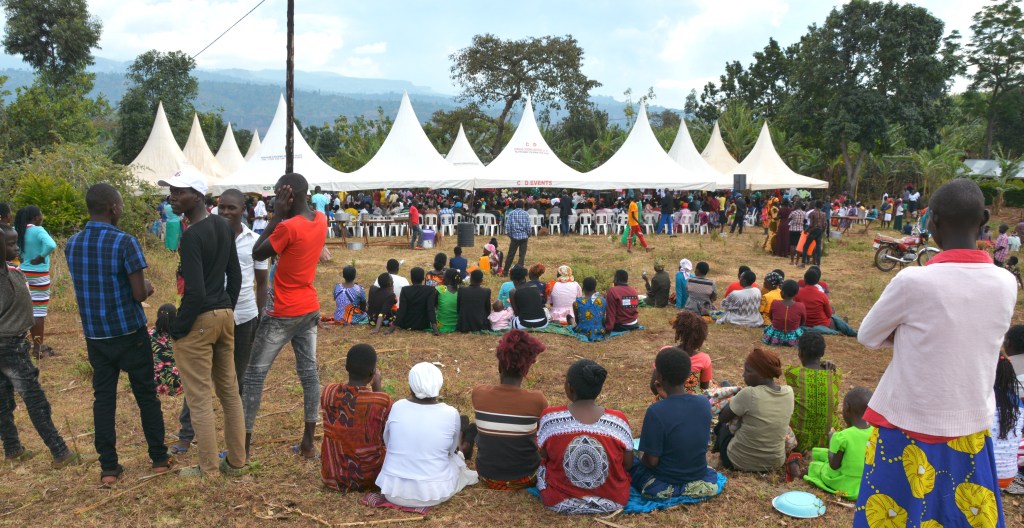
Alex’s grandmother’s funeral

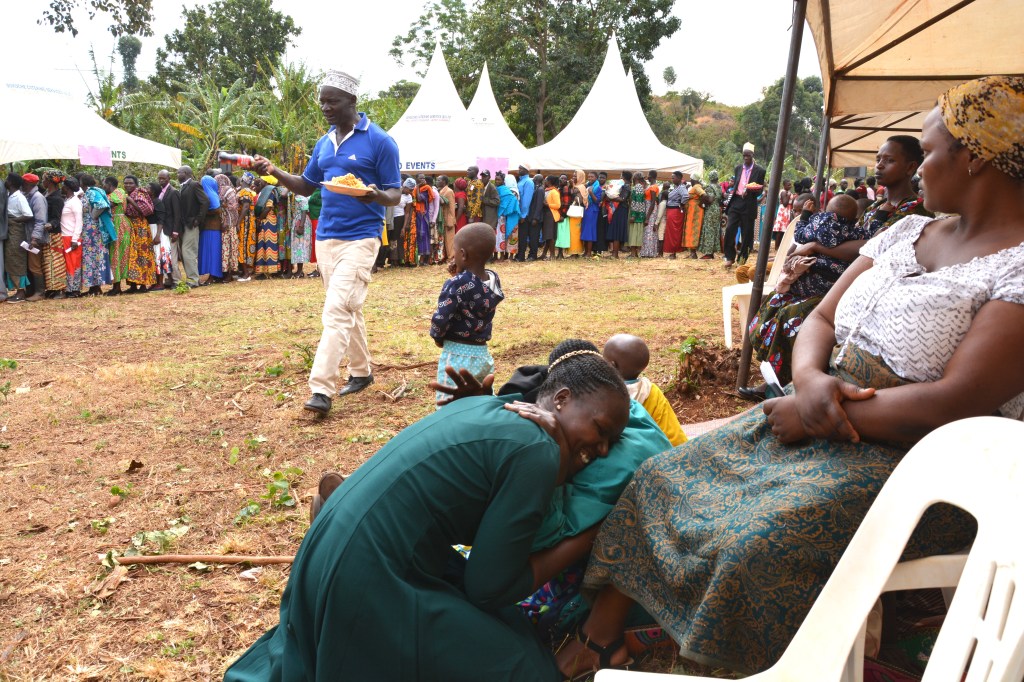
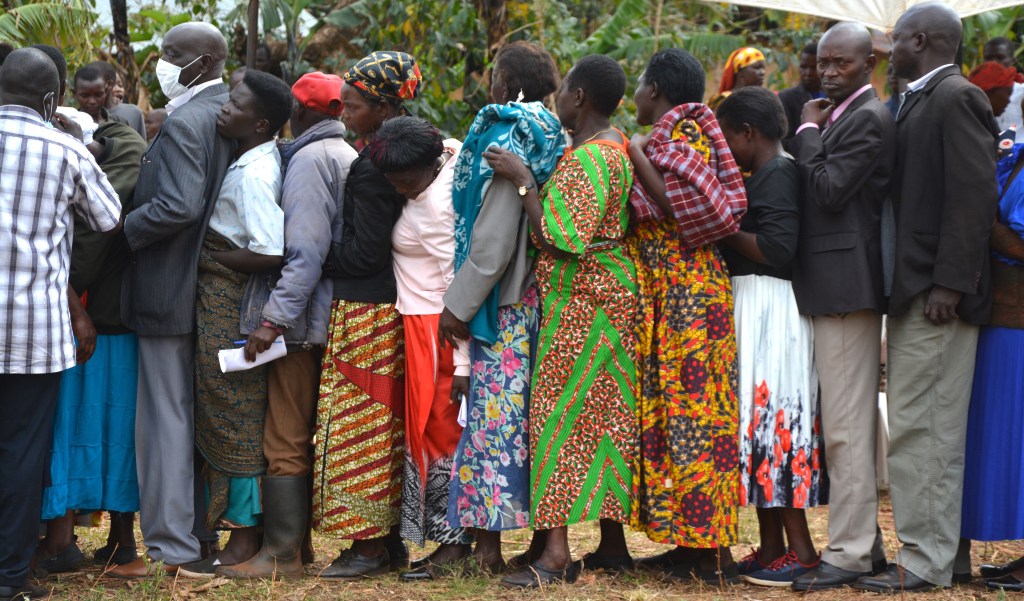
So on Sunday, there’s a vast funeral. I attend as a sort of surrogate grandchild – even encouraged by all around me to stand when the grandchildren are mentioned, and at one point welcomed by a daughter of the deceased in her speech, and thanked for ‘loving us’. I join a crowd of perhaps five or six hundred. It’s interminable, and all in languages I don’t comprehend, but it’s interesting culturally too of course. We sit beneath pointed gazebos ranged around a lumpy field on hundreds of hired white plastic Chinese chairs. A raucous PA system with a DJ relays awful pop music so loudly that the huge speakers distort. Preparations for feeding this enormous crowd with rice, potatoes, beans and scraggy beef continue behind the coffin. Boys relay the food in plastic dustbins, stainless buckets, washing up bowls and a few fancy serving dishes. We eat from plastic plates and some of the lucky ones get a bottle of plastic water or a bottle of pop. The food is surprisingly good. There’s an MC to introduce all the speeches, and Africans given a microphone love the sound of their own voices. I must sit through 24 various speeches, all unintelligible, plus addresses by various priests and politicians – THEY never miss out on these gatherings. “This will cost MILLIONS!” says Alex. “Millions.” Later, he estimates about £2000 – a king’s ransom in Uganda. “A waste! All pride, when the family needs the money, but you must put on a show like this!” There are so many noughts in Ugandan currency that I get utterly confused, but it’s also an economy where pennies matter to all but politicians.

Alex’s sister, Helen, greets Aunt Khalifa at the funeral

Meanwhile, the corpse lies in a mauve coffin festooned with golden plastic furbelows under a tent amongst the family mourners. We must all come and open the jack-in-a-box lid to look at the poor deceased beneath her glazed window, like a specimen. The lid pops up and down – I think she’s been made to look too young – the chatter continues around, the music blares. People are dressed in mismatched clothes: a few in finery, but most in their ill-fitting secondhand clothes, unpressed and a bit ragged. Very few can afford new items; they rely on our waste. I count five face masks, and ‘social’ distancing is impossible in this throng, and against all Ugandan social norms.

‘Social distancing’, Uganda style. Or just the prospect of a free meal at the funeral!

*

Uganda, to compound all its problems, is hugely overpopulated. That’s not what most Ugandans believe: they exist to make babies, it seems. The country has the second lowest median age in the world at 15.7 (beaten only by Mali at 15.4). In my lifetime the population has ballooned from 5 million to 50 million – and growing fast, estimated to be 100 million by 2050. Shocking statistics. The average Ugandan woman gives birth seven times, and even educated women have multiple births. There are babies and children everywhere. Few people reach my age – less than 2%. Only a few educated young people understand how this affects their economy. Alex and some of his friends, many of whom I have met over my visits, work tirelessly, and voluntarily, to expound the messages of smaller families, healthier families and better educated families, but it’s a seriously uphill task in a land of downtrodden women and largely amoral men.

The late Yamangwa Jane, Alex’s grandmother, whom I met a couple of times, had 11 children. She had 81 grandchildren (81!), 136 great grandchildren and 23 great great grandchildren! She was only 85 years old. For me to go back to my great grandfather, I must reverse just short of 200 years…

The great view to the west from Sipi hill

“Come, let’s go to the back, on the hill,” suggests Alex after almost two hours of speeches. “The church service will begin now.” Alex is no fan of organised religion and the money collecting antics of the church officials. I remind him of what happened when Precious and I attended another funeral in a distant village. A self-proclaimed pastor ranted endlessly and neither of us understood the language (Precious hales from the other side of Uganda, a country with many languages). “Let’s go, we are bored!” she whispered. As the only mzungu amongst several hundred people it was impossible to make a discreet exit. We slid off our benches and sidled away… and caused an exodus of other attendees! At least 40 more people followed our lead, just waiting for the excuse. The pastor was livid, furiously condemning ‘infidels and non-believers’ for their behaviour. I didn’t understand that either until Precious told me later, laughing.

This time, no such disgust, and I was able to retreat to the big hill with its fine view of northern Uganda stretching below the escarpment into the lowering sun. At last, another hour later, we could slip away behind the trees, hopefully forgotten but having given respect by my attendance. Enough was enough: cultural interest has its limits.

*

On day four, we set off on a long hike, along the steep curling edges of the red rock escarpment that drops away towards the vast plains and lakes of central Uganda. There’s mist wreathing up from the valley. There’s a cool dampness still around on the breeze, but it’s humid too, difficult to get my body temperature regulated by outer clothes: I am backwards and forwards between a chill short-sleeved shirt and damp sweaty thin jumper. Shortly after we set off, we are joined by Del, a young fellow who decides he wants to accompany us. He walks the fifteen or more miles in tee shirt and flip-flops. Alex thinks perhaps he wants to improve his English, but if so he’s pretty tongue-tied most of the eight or nine hours we are walking. A nice enough lad, he doesn’t say much but appears to enjoy his day.

We wind our way through matoke (savoury banana trees) and coffee bushes. Tall eucalyptus shimmer in the cool damp breeze that’s rising from the valleys below. I pant up some steep red earth hills; we’re over 2000 metres high, the air is thin. Villages are scattered and remote. In the largest we take to mud footpaths, still mired by yesterday’s heavy rains. It’s slippery going. We divert to visit an elderly couple, some clan relation to Alex. They live in a comfortless earth and stick home with some plank sheds around. The old man, says Alex, is a veteran of WW2, in the Middle East. He’s 87, he says, born in 1935, so he’d have been 12 at the end of that war. I work it out that he must have served in the Suez conflict. “Yes, Suez Canal” he agrees proudly. He’s astonished to have a mzungu visit and his wife, bent almost double with age, immediately starts to prepare tea for her visitors, but Alex demurs: we have a long walk and will come back another day. The old man points our way through the matoke. We walk on.

Alex and Del walk ahead, but I feel we are going wrong: we shouldn’t be walking downhill…

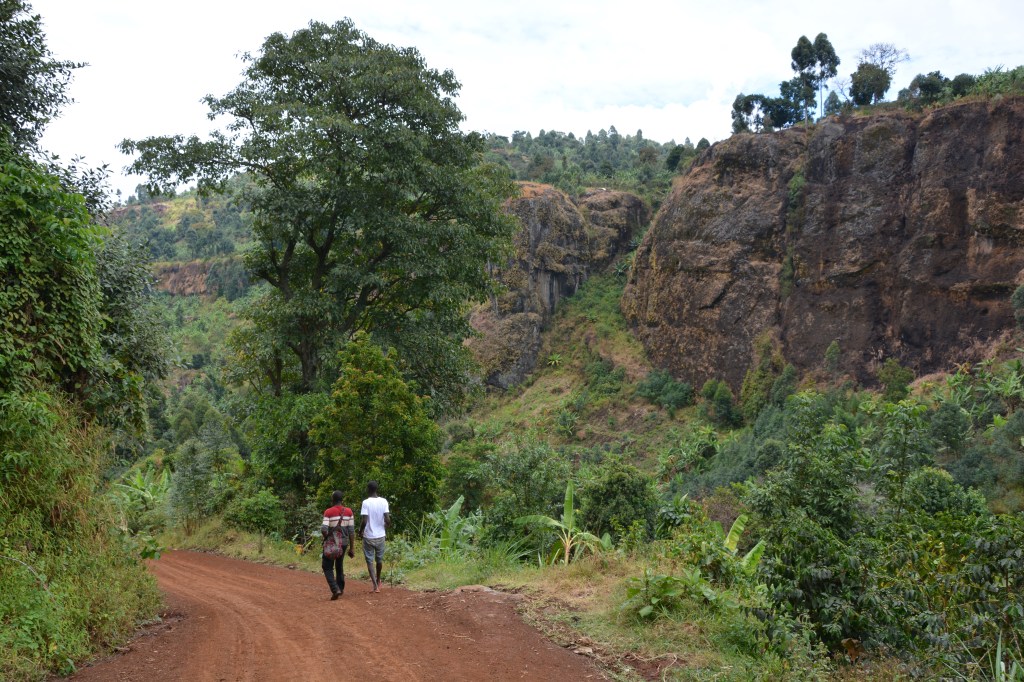
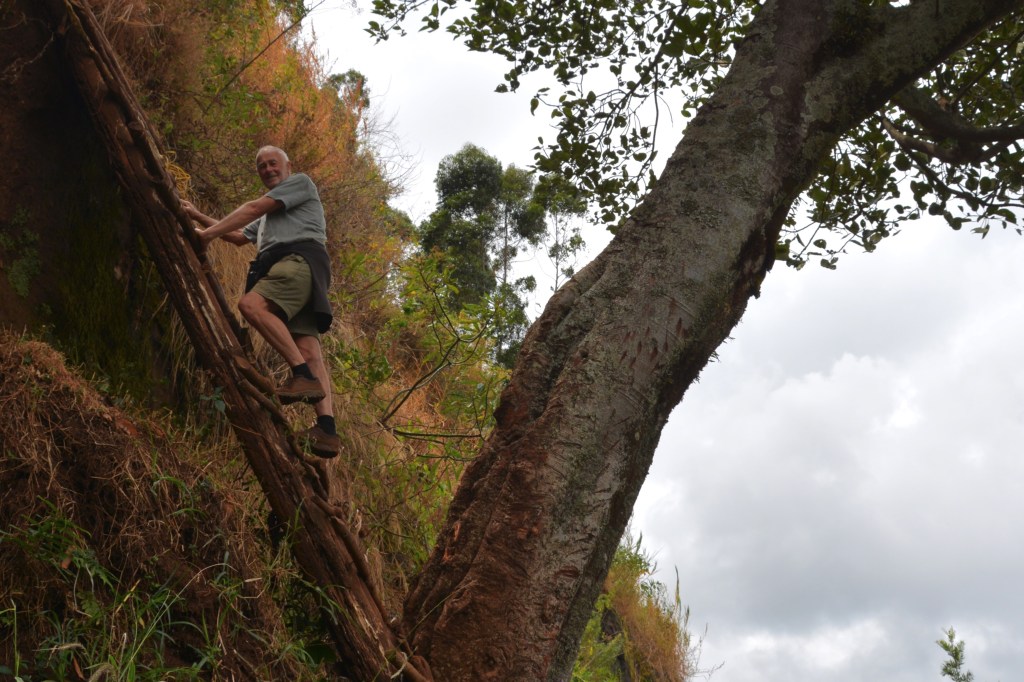
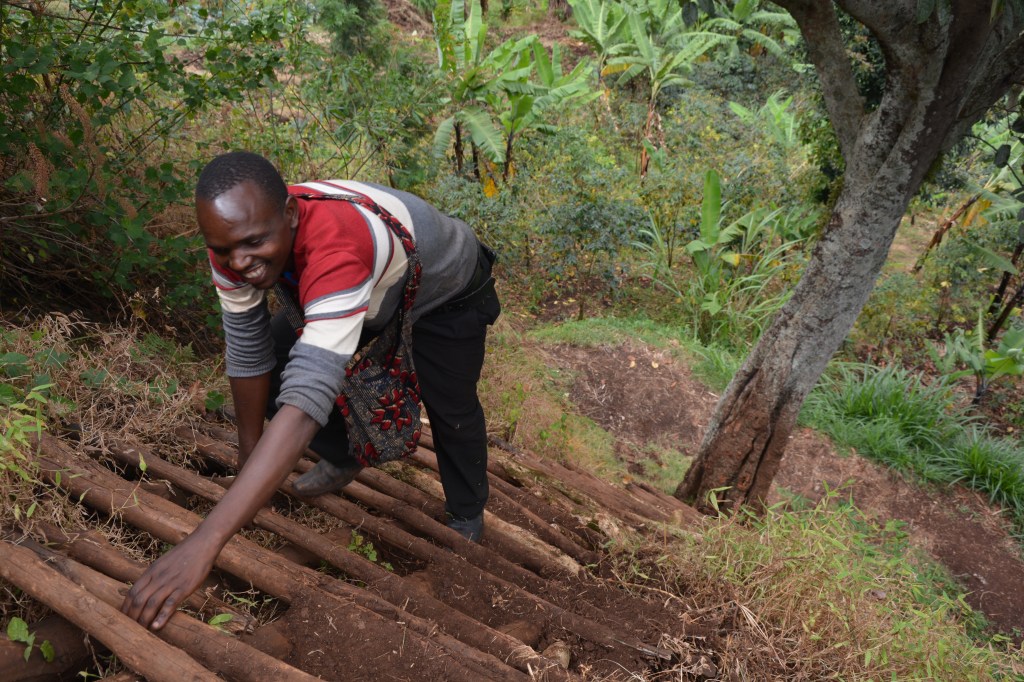
Soon we find we are walking into the valley. We’ve gone wrong. Alex asks some boys with cows, and they point directly up to the red cliffs 300 feet above us. We clamber and slip up a trail through small shambas, farmed at acute angles. It’s a hard life, scraping a living from land like this. Near the top there’s a roughly made ladder, fifty or sixty feet straight up the cliffside. It’s a metre wide and made of sticks held with four inch nails. We climb up and weave through tiny fields over the final curve of the steepness to the rim of the cliffs. For some miles now, we follow the rim of the impressive cliffs and look back to where we started at Sipi, a distinctive hill several miles away across the contortions of the cliff faces. We must have walked about eight or nine miles by now, it’s the best walk I’ve taken here. Alex dreams of bringing guests here for exploration. I warn him to check they are athletic and not afraid of heights. We’re close to the edge, and it’s a long drop; water sprays up on the stiff wind from a delicate fall that we cross. It’s magnificent. I don’t get to these places by motorbike: I have to work for these thrills.

You don’t get this on a motorbike!
Alex follows up the ladder

We ask our way from a farmer. “Hah! I don’t speak this language,” says Alex, who speaks many Ugandan tongues. We are no more than ten miles from Sipi and the farmer is almost unintelligible to him. At last we can look down on our destination, 500 feet below. We’re visiting Doreen again, one of Alex’s sisters. He has eight siblings. “…By my mother,” he expands. “There are three more by other women.” Alex has determined that Keilah and Jonathan will be all his family. “I want to educate them well, not at government schools. I don’t want them to have the life I have led. Two children is enough! Enough!”

We’ve walked from Sipi hill, the peak on the far horizon, and we aren’t half way

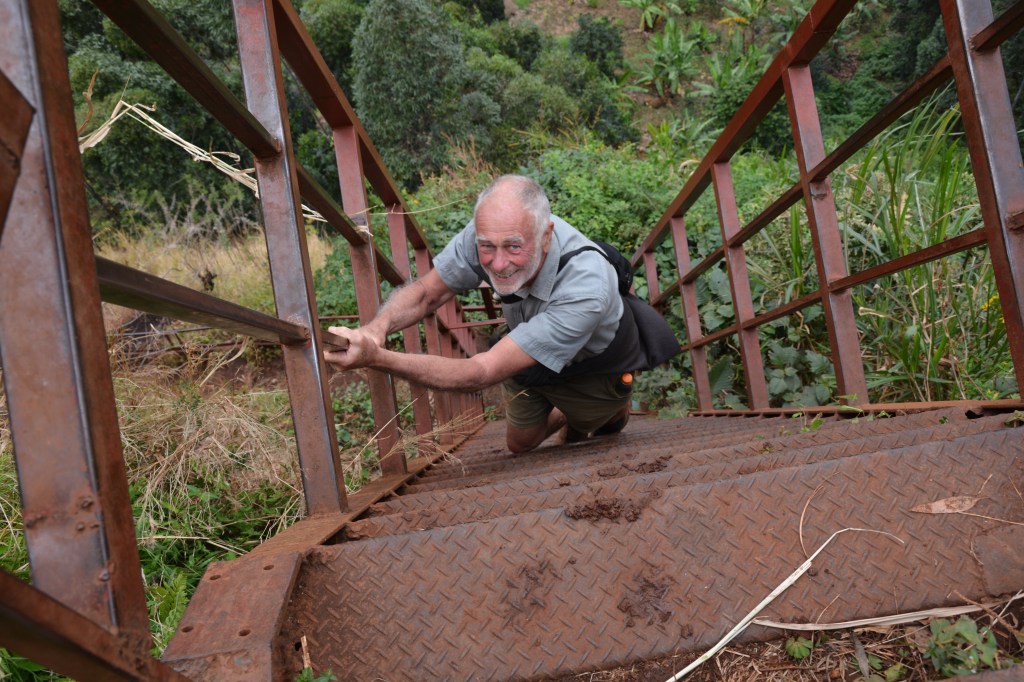
We’ve walked to Doreen’s shamba once before in the valley and motorbiked here too, along the curling earth roads at the escarpment base. But this is the best way we’ve approached. Our winding clifftop trail brings us to the top of two steeply angled ladders, down the cliffs, about 110 feet high, I estimate as I count the steps. They’re well maintained, professional jobs, obviously by the local council, but I can’t imagine lugging 30 or 40 kilos of vegetables or firewood up these ladders, as local people do – mainly women…

The ‘down’ ladder
Locals carry huge loads up and down these ladders!

We scramble down the final earthy slopes to a welcome from Doreen. A neighbour calls out, “Eh, Jonathan! You are back!” No mzungus come to these remote villages – except mad ones who enjoy a challenge. Neighbours come quickly to greet and offer us food.

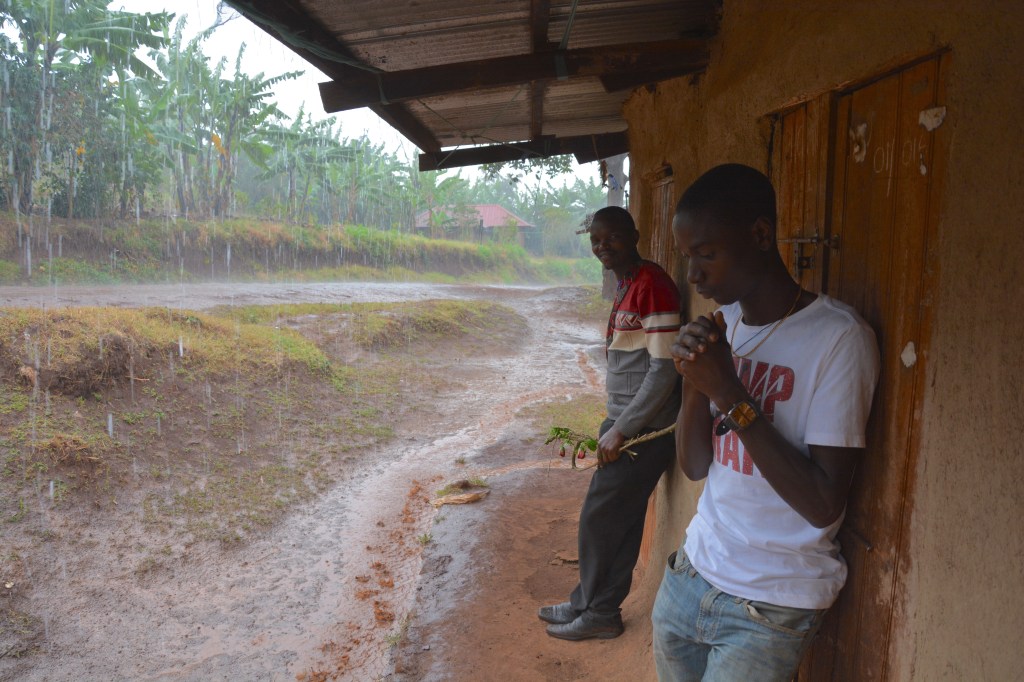
We are just in time. It’s been cloudy all morning and we’ve watched the mist wreathes and rainfall in the valley, curtains of wetness emptying the clouds below us; but now they are drifting upwards on a stiff – cold – wind. It drizzles on Doreen’s zinc roof as we sit in the earth-built room and drink sweet coffee grown on her own shamba by Leonard, her pleasant husband. We don’t stay, promising to return sometime. It’s already “going to four” and we’ve still a very long walk back, at least seven or eight miles, including that awful clamber straight up the mountain right at the end. The rain catches us along the road and we run for shelter under the corrugated awning of a house. Rain thunders on the roof and drops in mini explosions in the soon-flooded muddy puddles. It’s cold: Alex and I have thin jumpers, but Del’s forearms are goose-pimpling in just a tee shirt. “We’d better find him some mtumba clothing,” I suggest to Alex, but the trading centre is a mile or two ahead. “I’ll go and buy umbrellas!” Alex says, and slips and slides off into the rain. “You’ll get soaked!” I call after him. “Oh, I am an African! I’m used to it.” Fifteen minutes later the torrents abate and Del and I can follow him down the now very slippery road. I’m happy I’m not on my Mosquito, yet still boda-bodas go past at speeds I wouldn’t consider – and I wouldn’t be freewheeling down hills as is their universal habit (to save a few pennies of fuel at the cost of no engine braking or lubrication), relying on weak, badly maintained brakes and bald tyres on this ice-rink of muck. They are awful riders and many accidents happen.

Sheltering from the downpour

Alex comes the other way, swinging Chinese floral umbrellas. He’s bought three for £6. “I made the seller reduce because I was buying three!” We twirl our way down the muddy slopes through the local village, idlers calling cheek about the old white mzungu, only some of which Alex translates, but most that make him laugh. Who cares? I’m such a celebrity ‘footing’ my way through these rural areas. For many, I am the first mzungu they’ve been close to. We are often told that I am the first mzungu visitor when we go to people’s homes.

One cheerful insult Alex translates: “Eh, these mzungus! So much money they have nothing better to do than go walking!” Of course, no mzungu has to work for his money, he just picks it from the mythical money trees up there in the global north. Not one African really understands that there’s an appalling distribution of wealth in my country too: four million unemployed, homelessness, lack of rights and gig economies. We’re all wealthy and living in luxury. It’s what they see on ridiculous TV soaps and ‘reality’ TV. And we make the stuff we sell them – few make the difference between Chinese mzungus and European, and now there’s even an influx of dreadful Chinese soap TV to add to the Brazilian, Mexican and other low quality dramas. The better stuff – even the dire American productions – are more expensive for the broadcasters, who want to fill the minutes between the adverts and propaganda as cheaply as possible.

“Oh, take me to your country. I want to make money,” is the most common demand made of me in Africa. How can anyone wonder about the desperation of immigrants taking to leaky boats and risking their lives, when all we show them is this profligate wealth and wonder? We peddle lies to sell Stuff but don’t have the honesty to respond with any sympathy to the resultant ambitions to reach our gold-fringed borders.

Sorry for my tirade, but you see, I am here, and I somehow understand the visions Africans have of life in our privileged lands. I am such a rich mzungu: no one understands that my apparent wealth involves choices.

The walk home is more or less dry, but those last heights make me flag at the end of a fifteen or sixteen mile hike. With the ragged footpaths greasy after heavy rain, there’s always another hill above. “We are almost there!” exclaims Alex, as another steep rocky clamber comes into view. At this time of year, we should have been walking in hot equatorial sun: it shouldn’t be wet at all, even here on the high slopes of Mount Elgon. What’s happening to our fragile planet?

*

Uganda’s schools have been closed for 83 weeks. Almost two years. The longest school closures in the world. By a government who just don’t care. Education levels were low in this country before the pandemic, they are now set back again. Many schools will never reopen as they have been sold by their landlords for trucking depots, accommodation blocks, warehouses, housing development. All non-teaching staff resigned when their pay stopped, and found other ways to scrape a living. Many parents will not send their children back to school because when schools opened last year, and they paid fees, the government summarily closed them again within less than a week. Parents had no compensation – and their children no education. Alex lost Keilah’s school fees. And no one has money in Uganda, except a few. Multi-billionaire Museveni doesn’t care. It’s a fiefdom run for his and his cronies’ benefit. Many suspect that he inflated the coronavirus statistics to get more support from Western governments, but none of that support trickled down to vaccinating the people…

“Some of us have been vaccinated,” said Milton, an erudite friend of Alex’s brother Cedric at the big funeral. “We’ve had two shots, and when they offer a booster, we’ll be there. But many people resist. They’ve been influenced by the myths and stories and they think the vaccination will bring the antichrist to their bodies!” He laughs ironically. “The antichrist, in a vaccination!” It’s so easy to manipulate the uneducated. Most of those vaccinated are the educated.

We laugh at the idea of the antichrist in a vaccination. “And look around,” I say, surveying the 500 or 600 funeral crowds. “Almost every person is clutching a phone! If the antichrist is coming, it’s already in those devices!”

“Yes, data-mining, algorithms, your fingerprints, ID, facial recognition, propaganda, marketing – all stored in some ‘Cloud’ available for any use or abuse…” Milton and Cedric are both employed for their IT skills. “And I think in total our vaccination rate is about 3%…” No one cares. There’re no role models. And everyone is more influenced and manipulated by the phones in their hands than sensible argument.

*

JB in his first school uniform. Room to grow

Now schools are open again at last, and we all take little Jonathan to register for his first day at school. The teacher asks his name. “Jonathan Bean Cheptai,” says Alex. “Is that B-E-N?” asks the teacher in some confusion. It’s a private school; Alex has no faith in the government schools, and the Shalom Nursery and Primary School is more than ten miles off, in Kapchorwa, the local rather scruffy town. There are two school minivans, packed with toddlers and small children. One travels as far as Sipi, and Keilah is collected shortly after five in the morning! School actually begins at eight and ends at three thirty. Keilah is five years old. Little JB, at three years, will have the same day, returning in the late afternoon. They eat basic food during the school day and Jonathan will join the ‘Baby Class’, along with about 60 or 70 (very appealing) toddlers. Having a mzungu visit is exciting and I must shake 100 small hands. A considerable part of the smaller children’s school day will be spent in play and activities, watched over by three very patient teachers, cheerful women: they’d need to be. The school buildings are somewhat shanty-like; poorly constructed timber walls under zinc sheets. The playgrounds are the same red mud as everything else around here. Everything has the same patina of dust and mud, even the hundreds of children packed in the few classrooms. Yet this is one of the best schools in the district. Little government money or development reaches these places. They don’t care about their people, just themselves, entrenched by propaganda and lies…

Once evil men gain power they buy loyalty around them and it’s very difficult to unseat them…

Sadly, after two days at school, Jonathan was back home with a hacking cough.

*

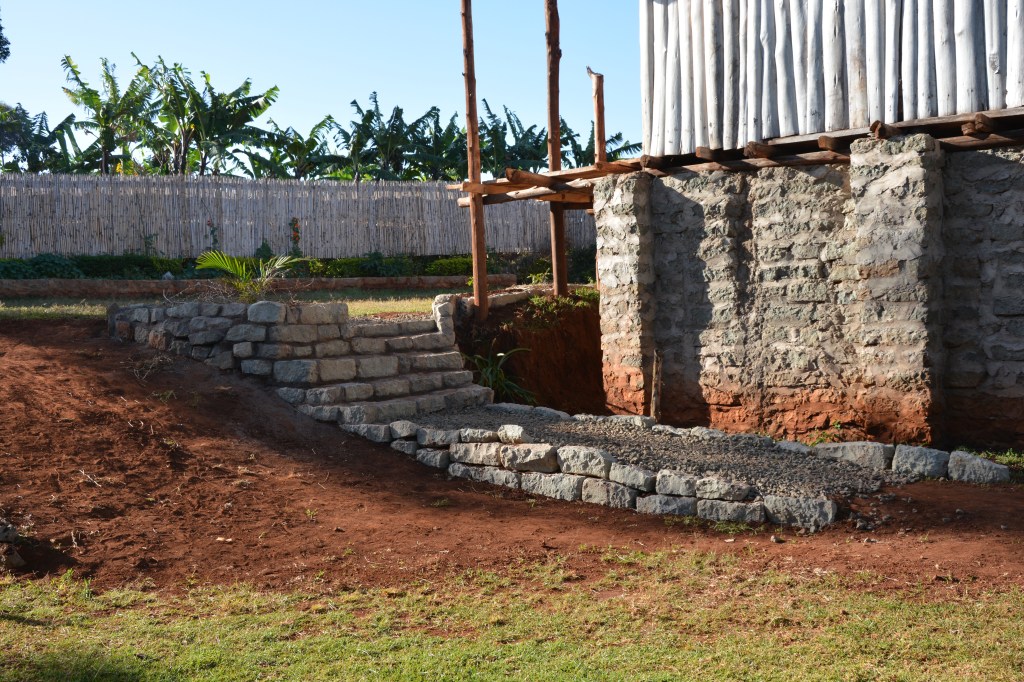
For five hard hot days I pitched into the development of Rock Gardens. After all, it’s my investment too. I’d like Rock Gardens to have the finest gardens in Sipi – which won’t be difficult, as no one here bothers with gardens. Alex was stuck on the fact that he had to have exotic plants (expensive) until I pointed out that local plants and trees are exotic to me. So why not fill the garden with avocado trees, mango trees, matoke trees, bananas, coffee bushes (which have a delicious aroma when in flower), camellias, acanthus, orange trees, lemon trees? They all grow locally, and if we plant them as a garden, not a plantation, they can give shade and colour, and fruit – and many of them cost nothing, or not very much. Add a few more exotic palms and he will have a veritable botanical garden! So we’ve been planting like fury, while I have undertaken huge earthworks to make vehicle ramps, raised stone flower beds, pathways, a fire pit and a flight of stone steps. Alex is full of dreams but gets diverted easily by his enthusiasms. I have been focussing him: on things that make him money or make a good first impression. I am a scenery designer after all. A beer garden, washing lines dismissed to the back of the roughly half acre plot, shade for mzungus, flowers, tidiness. Litter burned.

Rock Gardens, soon to be Sipi’s botanical gardens!

Most Sipi workmen are terrible. Quality of workmanship is abysmal. Commitment to work is poor. Turn your back and workers sit down and drink. No one cleans up after themselves. There is no pride, just take the money – for a bad job – and go. The norm appears to be two working to four watching. Tools are old, basic and blunt, if there are tools at all. Screws don’t exist: you hammer in a nail, without drilling first. Timber is curling and twisted, almost fresh off the tree. Everything is done with a panga (machete), hammers and hoes with loose heads. A nail suffices as a chisel. I can see that what Alex – not a particularly practical man – needs is an old mzungu workman! I can do in a day, even with the heat, what Ugandan ‘workers’ do in three. And do it a lot better.

I’ve been fortunate to have a quiet young man as helper, Fred. He works hard and even thinks for himself. We have literally moved part of the mountain and Rock Gardens WILL be the best beer garden in Sipi, with a homespun, ethnic feel. Things grow fast in Africa if we keep away the goats – and one of the projects Alex completed successfully last year was to fence and enclose his complete compound from wandering animals and short-cutting locals, to improve security and protect his garden.

The Bean ziggurat at Sipi. A day’s work for an old mzungu, three or four for local ‘masons’…

Two young men passed telling comments: “Huh! This place started as a joke!” But their implication was that now it’s a serious venture and they could see something of the vision Alex has nursed for so long. Sadly, anyone who works for a dream is seen as somehow deluded and vainglorious here in Sipi. There’s a deep cynicism and pessimism amongst the neighbours that work is not worthwhile. After all, the ‘Big Men’ don’t work much. Poor Alex.

*

Unfortunately, three days before I leave Sipi a villager about 300 yards further down the red earth road, is inconsiderate enough to die. He’s been a thorn in Alex’s flesh for years, spreading jealous suspicions of cheating and petty corruption impossible to Alex’s open honesty. Yet still he must attend the funeral house. And no one will work in the area on the burial day, so work will stop at Rock Gardens.

So, the man died. Bad news for me! Death equals disco in Africa nowadays. As in Navrongo, Ghana, where 30 years ago I remember drumming and whistling through the nights after a death, that has now regressed to a rented pounding PA system relaying thumping pop ‘music’ for four endless nights as the corpse lies, presumably quietly decomposing, in a painted coffin with pop-up lid until burial. It’s a ghastly travesty of cultural tradition that probably began as a belief in warding off evil spirits or something similar.

Nights in the Discos of Death. Such a cheapening of culture.

*

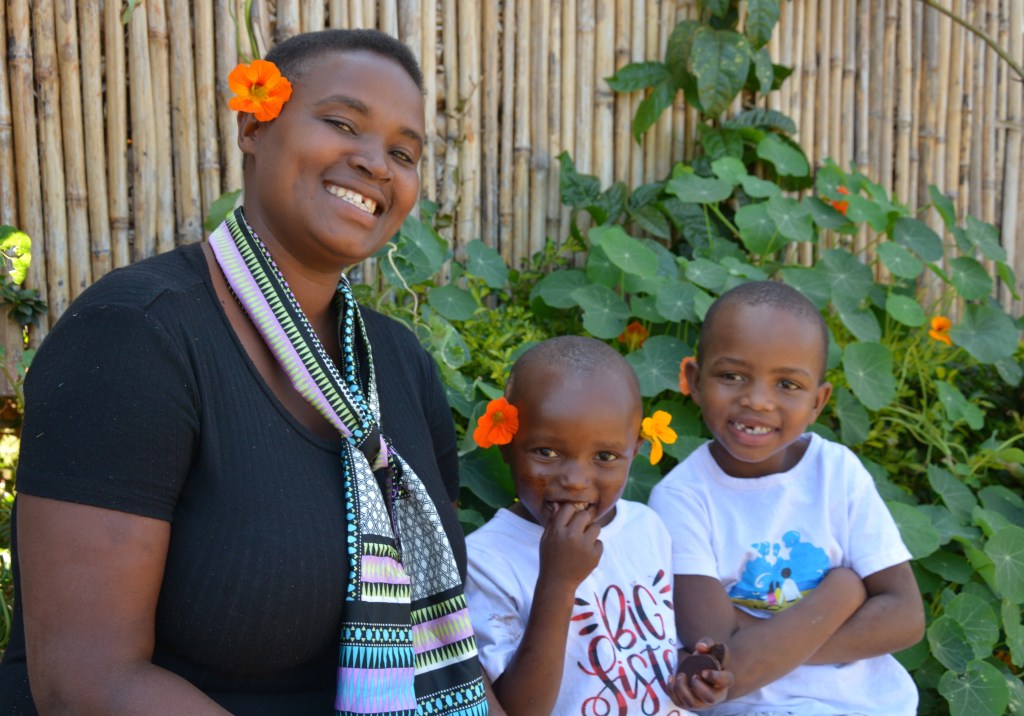
Precious, Jonathan and Keilah and nasturtiums from Devon

Precious and Alex and the children wave until I turn the corner of their red earth track and start down the hill on my way home to Kitale. I’ve been 12 days at Rock Gardens and we have transformed its landscape. The burial that has disturbed my sleep so efficiently for three nights will take place today. Many people will pass Rock Gardens.

Alex emails later: ‘am very happy of the great work you shortly did during your stay. Oh yes, much pictures taken by rich men and just wondering. The place looks beautiful. Yes, a joke is turning into reality and we will keep focussed’. We’ve discussed often that his customers should be the ‘rich men’: professionals and business people who want a quiet, peaceful place to drink in a nice beer garden, eat a few snacks, have meetings or office parties, weddings and events, with the added option of a few paying guests in what he plans will one day be five rooms.

The ride back round the mountain to Sipi is exhilarating and fun, trail riding at its best for the 40km of still rough road. Leaping and dancing about with a smile on my face, I am once again thrilled to be here, gazing down into the expanses of northern Uganda. Maybe in two years, I will be able to fly along on smooth tar, but for now the dusty enjoyment is exciting. I am at one with my little trail bike, behaving as if I were 30 again, people waving and exclaiming as I pass their shambas, earth houses and trees blathered in dust from the roadworks.

I wish Alex so much success. If he becomes independent, can educate his charming children to a positive future, and keep his small family content, I shall have achieved and left something very good in Uganda.

Jonathanbean Cheptai and Keilah
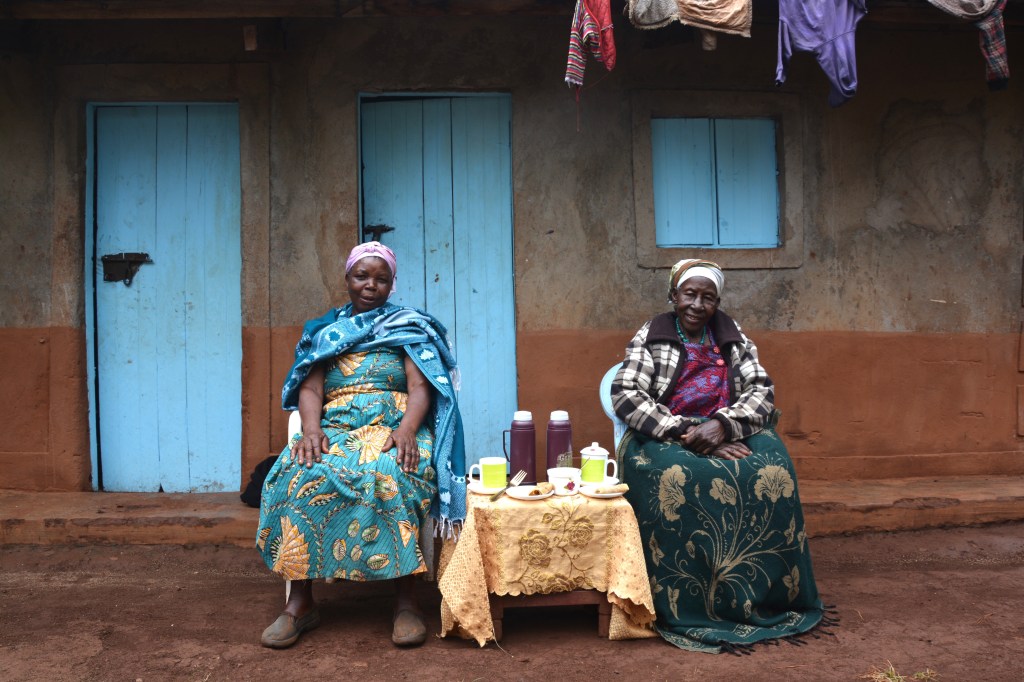
The shoulder puffs are a traditional dress for older women
Mama Shifra with Surea, complete with charcoal eyebrows
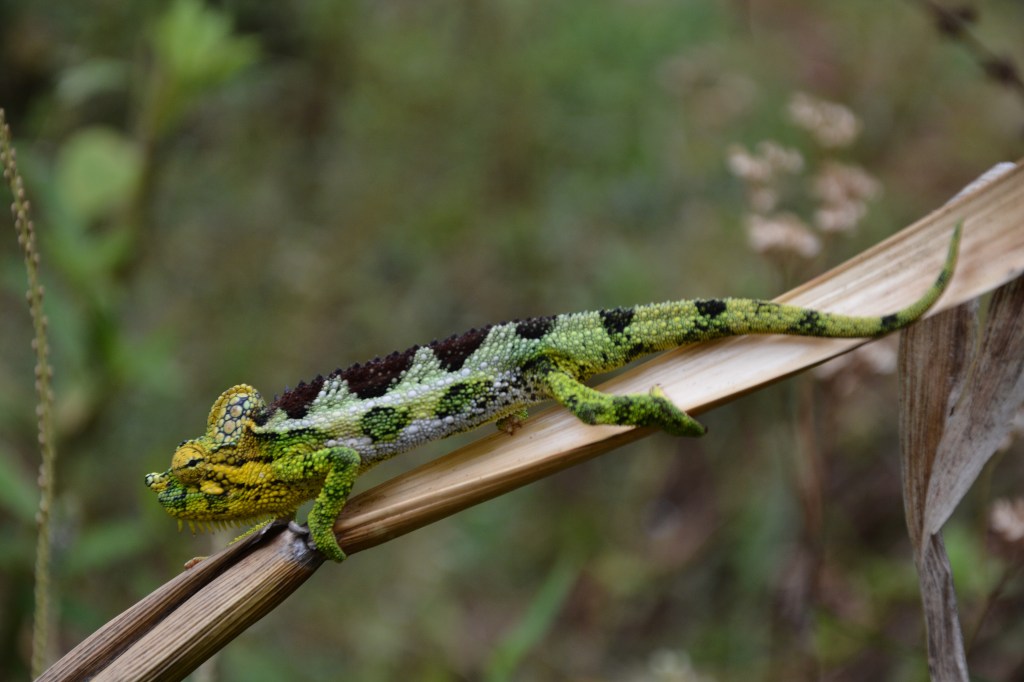
The finest chameleon I’ve seen in Africa
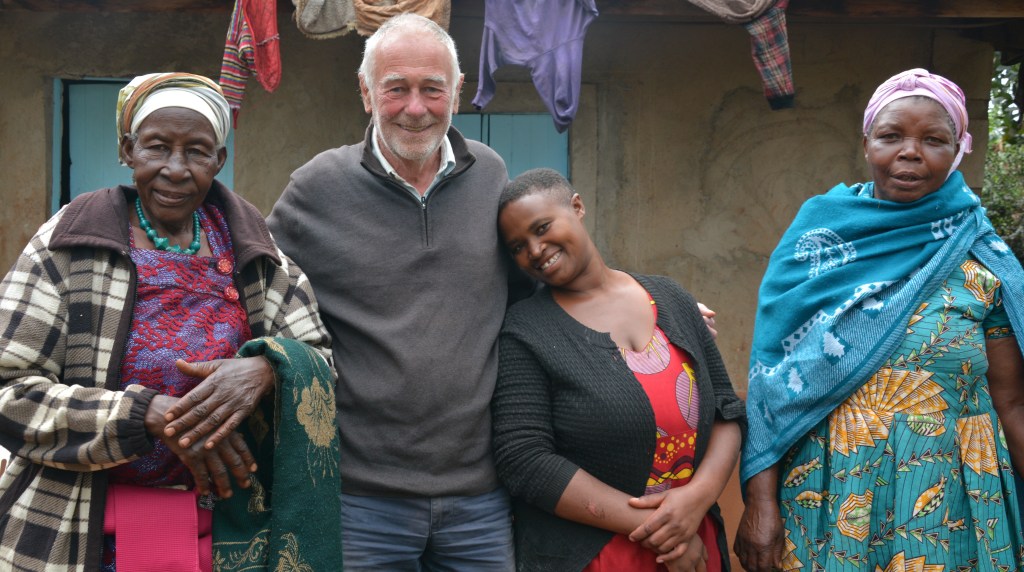
Precious joins the Aunties for a photo

EAST AFRICA 2021-2022. EPISODE THREE

‘FOOTING’ IT… A SAFARI INTO THE KERIO VALLEY

The magnificent Kerio Valley, 4000 feet deep – and HOT

“Eh, poverty level in this area is very high,” says William as we pass a crude earth shack on the sloping dusty scrubland below Kessup. “You get a lot of children. They don’t go to school. What can you eat here? Poverty!” A bit further down the broken slopes to the fiery furnace that shimmers far below, William says, “Now this is my land. Useless! Look at it; it can produce NOTHING without water. Investing in pipes is exPENSive! Then if you have crops here, you must pay dearly to transport them to market. USELESS!” We stumble and slip down through his inherited land, dry grasses crunching, thorny twigs whipping at us as we head for the yawning drop just ahead through the trees, where Kerio Valley is laid to infinity like a brown bush map. “Useless…” Yet, oddly enough, the parched valley below is known for the best mangoes in East Africa. They’re only just coming in season, these sweetest, juiciest, least fibrous mangoes I ate. Elixir indeed. “Eh, life in Kerio Valley..!”

“Poverty!”

We are heading for the valley floor; the expedition we planned a couple of weeks ago. As we slither down the scree-like rocky slopes amongst desiccated trees and scrub, the heat rises from the huge chasm below. A hot wind gusts up, scant shade helps me to survive the ordeal. Why am I doing this, I wonder? Well, because it’s there, it’s a challenge and because I know that to understand this burning landscape and the people who scratch a living here, I have to walk its hot paths, one foot in front of the other. There’s so much to see when you walk: things I miss on my motorbike; things I can’t share unless I live the life – thankfully, only for a day or two.

William surveys the valley

A few days ago, When Marion was going to town to search for mtumba wear, I gave her money to find me a large white cotton shirt as a sun barrier for this journey. I’m wearing it now, 70 penn’orth of Mr Currter’s shirt. His name is written four times on the corner of the tail. I suspect it’s the late Mr Currter, and he died in an old people’s home or hospital in America, or perhaps Germany. This is the real ‘dead white men’s’ clothes, as our rejects are called in Ghana. After all, why wouldMr Currter, or anyone, throw away serviceable clothes – in which everyone here is dressed – if they were not dead? The concept of Western waste just isn’t conceived here. Mr Currter was a large man, and his shirt has become a bit of a joke for William and I. “Eh, put on Mr Currter! It’s HOT!”

Mr Currter gets an outing. What a landscape to discover on foot!

William showed me his ‘ceremonial safari’ shoes yesterday: today he’s wearing an aged pair of secondhand canvas deck shoes, and his socks, I notice, have no heels whatsoever. When he showed me his ‘ceremonial shoes’ at our beer time above the sweeping valley, he was laughing. “Eh, when I bought them from Iten, the mtumba seller did not notice that they are different sizes! But they look exactly the same!” Someone, somewhere in Africa, has a similar mismatched pair of shoes. But people here don’t really worry about such things: they are shoes…

As we stumble downwards, slithering on the gravelly scratch of track, William phones his friend whom he has taxed with finding us a place to sleep in the valley. With his love of ‘British discipline’ and order (I try not to disillusion him by telling him how things have changed since he was trained as a police officer), he likes to organise things for ‘his mzungu’. And how things have changed here too these past few years. Here, slipping down the broken sides of the Great Rift Valley, we have not just phone signals but 4G internet.

I fall to thinking how different were my world travels when I started roaming, forty eight years (!) ago. William enjoys my stories of places he’s never been: most here have intense interest in how people live elsewhere. One quality most Africans enjoy is curiosity – which, if you’ve read these journals, you’ll know is my most admired human quality, along with compassion. The two are prevalent here, one of the reasons Africa weaves such power over my life.

“It was so exciting to go travelling back then…” I tell William as he lifts a vicious thorn branch with a stick he’s broken from a young tree. The stick will accompany him for the next two days; it’s a tradition to carry one, arising originally I suspect from a fear of reptiles and bush animals. We are unlikely to see either these days: that’s changed too…

Forty eight years ago, I could fly to distant places in long cigar-tube aeroplanes and it WAS exciting, not the tedious transition it’s become. You felt you were leaving home far behind. I had no contact with home on most of my journeys, except slow mail, or in emergency – if there was a general post office available, I suppose by telegram – almost no international phones, such that it wasn’t an option. Letters took two or three weeks from that first South American journey and the Asian ones, and the replies about the same. Any news was old news. Mostly, my letters came (grudgingly) by the British Embassies or unreliable poste restante, where they might be filed under any letter of the alphabet, especially in places that didn’t use our alphabet. I could very occasionally buy an old English newspaper or visit the British Council in big cities. Money transfer was almost impossible and very expensive, facilitated reluctantly by banks. I was on my own. And that was much of the attraction: adventure and dealing with things myself, living on my wits. I couldn’t ‘share’ my every trivial thought and post ‘selfies’ of where I was. I couldn’t read my Guardian Online; check my bank balance from remote places; be in constant – immediate – touch with people; carry on an intercontinental design business from far away places; talk to my friends on video – in colour and real time. It’s easy to forget that as late as my second Sahara crossing in 1989, we still used letters for communication. When did I last write a letter – or a postcard? Who sells postcards these days?

Despite its trials and complications, I enjoyed using my own wits. I learned so much about myself then. When I had that accident (first, of four, I think), rolling 360 degrees in a big bus, (THAT’S happened twice!) and broke minor bones and suffered from confidence-shaking shock, the process of coping with it was important for the rest of my life. Most of the misadventures turned into the stories I’ve continued to tell all my life. So did the fantastic opportunities, the times that really felt like discovery – without Wikipedia and the internet in every last corner. There’s no doubt that those times made me extraordinarily self-sufficient and gave me a wealth of experience – and self confidence – to deal with everything else. And I SAW all those places for myself! I’ve a vast compendium of memories, stories, influences, and been witness to so many different opinions, events and lifestyles. And I made many friends, with an address book (an old fashioned indexed one) with friends made on the road, with whom I shared a few hours, a day or two, a week or two, from the world over. I sometimes wonder what happened to them, but I know they will remember the times strongly, as I do.

“Eh, you have travelled!” says William, without envy. He knows that my wealth has created opportunities his life could never produce. Wechiga’s the same: no jealousy but a huge curiosity about other ways of life. It’s something very African, that there is scant envy and great generosity, and an acceptance that life is the way it is – usually attributed to how God creates things, with no question of why that god would allow such devastating inequality… Usually my FIRST question.

A view of Kerio Valley. We’re on our way down…

The steady chop of panga on wood across the precipitous escarpment makes me wonder how there are any trees left in Africa at all. We can’t see the wood cutter, but the sound of women’s voices floats on the incredible silence of this immense emptiness. Of course, if you travel the desert regions here, there are very few trees in sight. Just big sacks of charcoal for sale at the roadsides, brought from far, far away across the barren landscapes of sand and rock.

“It’s not for their own use,” says William, always quick to explain life here for me. “They will sell it at the top.” The ‘top’ is now about 2500 scree-rolling, semi-vertical feet above. The women will lug the heavy bales of wood on their backs, held on woven straps across their foreheads.

“How much do they get?”

“Just 150 bob! It’s food for their families.”

150 Kenya shillings is one sterling pound…

“Eh, but this season is very BAad! DRY! I don’t think even bush animals will survive now. How do people exist here?”

We are nearing the bottom of the escarpment now. We’ve been scrambling down for about three hours. The app on my phone – the only thing I like about said iPhone – indicates that we have descended 2650 feet. We stop in the shade of a scraggy tree, perhaps another 50 feet to go to till the earth levels out again and we can walk with straight legs. A woman lives here; William says that she looks after his mother’s goats. His family has a good deal of inherited land on these final slopes into the valley. “What do you eat here?” William calls down to the woman. She’s burned almost black by the harsh sun and pared to the bone: a thin black shadow of a woman. “Especially veggytable?” She points upwards, such that I need no translation, and replies that all fresh produce, if she can afford it, comes from climbing to the top of the escarpment, back to the Kessup plateau from which we’ve just slithered. All that way for 50 bob of green local vegetables and a bag of maize flour for the inevitable starchy ughali.

The long dusty road arrows along the valley

We reach the dusty white road that we have seen so often from our beer perch outside my rented room high above on the edge of the escarpment. It runs seemingly straight as a line along the foot of the mountains, disappearing each way into the heat haze of distance. It’s extremely hot now. ‘Mr Currter’ is becoming unbearable, but I keep it on to stop the beetroot sunburn that erupts so quickly here. Invisible radar-equipped children shrill, “Mzungu! Mzungu!” from amongst the brush. We take over-sweet tea in enamel mugs in an informal tea house by the road. This is where it’s so good to have my cheerful companion with me. He knows the culture so well. He knows quite a lot of the people too. We bump into several of his old classmates over these three days; men he’s long lost touch with. Now we sit on split planks on logs and chew a chapati with our tea. Most of the homes here are built from sticks and mud – local resources – with rusty zinc roofs. It’s a few moments before the women of the house and other customers become comfortable with the sudden, shocking, arrival of a mzungu. I don’t think many come, unless in vehicles to the national reserve in the valley centre. A white man ‘footing’ it through their valley is a rarity indeed, and everyone’s tongue-tied at first. But these curious folk can’t keep the reservation for long and soon the questions begin, as always.

With friendly goodbyes and good wishes for our stay, we continue on the white dust road, joined now by a ‘nephew’ of William’s. His family relationships are complex: his recently deceased father had two wives. It makes for difficult explanations (I’m the only one who seems to need to know) of how this young man, a local baker making oily fried bread cakes, is William’s uncle’s wife’s son by a half sister – or something! He sells his slimy dough balls at kiosks and local hotels along the valley. He’ll come with us to the place William thinks we will stay tonight.

But when we reach the Valley Joy Hotel, it’s pretty grim, badly maintained and scruffy. Not good enough for William’s mzungu – at least by William’s reckoning. I can see by his face that he disapproves of the people and their lax manners. No discipline. I leave him to negotiate. “Come, we go,” he says eventually. “We take a boda-boda. My nephew knows a better place.” He’s dismissive of the hotel. “Plenty of Valley; no Joy!” I quip, as we ride away to the Kipioywo Guest House five miles up the dust road.

*

It’s difficult to express the satisfaction that comes from experiences like our stay at Kipioywo – to which we are determined to return in the blast furnace of the Kerio Valley.

The guest house is little more than a series of empty concrete rooms, with clean tiled floors, tidily painted and equipped with no more than a bed and two sheets and a plastic washing bowl. It’s hot and silent. William and I sat with our beers under thin trees in the dust of the valley floor as the dusk quickly drew darkness over the harsh surroundings. And then… And then, the stars began to shimmer: a glittering vault above the dry valley air.

All around us moved friendly, respectful people, scratching a living despite the horror conditions, apparently adapted to their hardy lot, full of warmth and responsive to my smiles, even when culture separates us. I am a celebrity amongst the children, sitting in the gathering dark watching in wonder their first ever mzungu. In the starlight I smile at the inexpressible delight of a small boy when I tear off half my chapati and surreptitiously slip it to him in the dark, manna indeed: a gift from a mzungu. Their warmth is all these people have to give. They give it generously.

There’s no power here except a few solar panels and the torches that spray about the dry dusty scrub as neighbours gather their goats and herd them home for the night, quietly greeting as they pass. We wait in – unrewarded – anticipation for the possibility of elephants, that several passers-by have assured us may come to the nearby borehole. William, now with his four bottles of Tusker inside him, is ecstatic about the experience of our calm evening in the heat of Kerio Valley. The elephants might not perform for us, either on Saturday or Sunday, but the chance is there, always the tantalising aspect of wild animals following their own instincts.

*

Next day, we find a couple more of William’s relatives, his direct maternal uncle and another cousin’s nephew, related by another uncle’s father, and we walk the hot lands to find moratina, difficult to find, but Edward, the ‘cousin’, knows a village some kilometres off where it’s brewed on Sunday. Moratina, I discover, is made by boiling honey and water and introducing split oak acorns that cause fermentation over four days. It’s sweet and alcoholic, and very tasty. “Oh, you’ll be drunk!” exclaims William as we walk on our shadows northwards.

It seems we join a gathering of most of the remote village, idling about on logs, bricks and old sacks behind a pointy hill covered in scrub and dry vegetation, this balmy Sunday lunchtime. Many are on the way to inebriety already. The scourge of Africa: drunkenness. “But you people, you make these spirits: whisky, vodka, gin!” says Elizabeth, seated on a sack nearby. She’s intelligent and becomes the spokeswoman for the villagers. “Yes,” I agree, “we do. But when I buy a bottle of spirits, it lasts me for many weeks, and I take a tot at a time, mixed with juice or water or soda. When you buy a quarter bottle of KK (Kenya Kane spirit) or wirigi (local distillation from maize) you drink it all at once. Neat!” On empty stomachs… Many die in these countries from sclerosis.

About 25 village people have gathered. They are all intrigued. I am the first mzungu ever to join their Sunday communal throng. They are full of welcome; laughter abounds, and then the questions start. I love this interaction: it’s why I’m here. Elizabeth says that all their problems in this burned-up place stem from lack of water. There’s plenty of water up on the valley top, 4000 feet above us, but no management, no money to buy pipes and construct a tank. The government doesn’t care about these rural people and they have meagre resources of their own. They’ve little influence, forgotten down here eking a living on the dust.

Kemboi

An old man hobbles into the village circle: lined face and cheeky, boyish grin with wispy white whiskers. There’s amusement that this man is my ‘age-mate’ so I leap up to shake his hand. Everyone laughs. It’s difficult not to behave with some exaggeration in this situation. I am their celebrity this morning. The old man lowers himself gingerly onto a log. He looks about 100. Life expectancy is low here; we’re probably a decade beyond it already. No one bears any fat; lean bodies pared by poor nutrition, heat and gruelling hard work, dressed in faded rags. But I never hear complaints, they just adapt their expectations and ambitions to what’s affordable: not much.

There was an article in the Guardian the other day: ‘Can we think ourselves young?’, a catchy headline that disguised an intriguing article. It seems that a great deal of scientific research has gone into how our attitudes of positivity or negativity affect old age, and the overwhelming evidence is that those with positive attitudes to their ageing process live considerably longer, are less likely to suffer Alzheimers, heart disease and other ailments. I’ve said for a long time that it’s far more fun travelling as an older person than a youth!

*

Later, we walk on with William’s uncle, also William, and Edward. They want to show me the landscape of the valley interior. Edward lives deep into the valley, “Amongst the elephants!” he says with a chuckle. “But they don’t trouble me. I light a fire and they know humans are there and they walk by. They came last night; maybe you’ll see them tonight!” But again we don’t: the elephants have their own agenda.

A ravine cut by the power of rainstorms on the escarpment above, and a rickety bridge

It’s desiccated and thorny, the goats have eaten anything that provides nourishment. We come to a ravine; it’s 15 feet deep and eight foot across, sliced by powerful water when it rains up on the mountains above. We teeter across a sort of bridge of sticks. William’s not keen: he’s no head for heights. It’s quite dramatic. Nearby, a household deep in the bush introduces me to their illicit wirigi still, a nasty looking contraption of old pipes and an earthen pot boiling the maize, a half-tub of water to cool the alcohol as it drips into a grubby container. 100 bob buys a small, oft-used plastic bottle of the poison. It’s Sunday: everyone’s steadily losing focus. Within half an hour the elder William is talking nonsense and wobbly on his feet. Today he’s probably taken tea and a few kernels of dry maize and a handful of black beans – and 330cls of hard spirit, perhaps 40% alcohol. We leave him to weave his way to his home that is little more than a hut of mud and zinc with a small fire smoking in the corner and a bed of branches with some rather unsavoury looking blankets. He raises goats, burns charcoal and in the rainy season I suppose he grows some crops on this arid ground. And imbibes his neighbour’s wirigi… He’s seven years younger than me and looks seven years older: I’d hazard that wirigi causes a good deal of the difference.

“Eh, I am glad I left behind the wirigi! And the bulsa… And the cigarettes. Now, just a few beers with my mzungu brother!” William looks so much healthier for his abstinence than when we first met five years ago.

Kerio Valley children get to study their first mzungu

By the time we get back to our simple guest house, it’s almost our own beer time. We sit again in the dusk and await the stars. It’s wonderfully warm at this time: balmy. William has become a comfortable companion. Ann, the pretty cook, fries up a slightly scraggy chicken William has managed to procure from somewhere. Will the elephants come tonight to the bore hole nearby? (No). It’s a magical night. And deeply quiet.

Anne, a good cook

*

What goes down the mountain must go back up. We’ve decided to take the new road – little more than a track hacked from the escarpment, and as yet unfinished. Somewhere we must take to a steep dusty path and scramble through thorn trees and prickly pear cactus where the improbable road ends, three or four hundred feet to where it begins again above. I reckon that by the time we get back to the guest house at the top, where I’ve left the Mosquito and my bags, we’ll have clambered perhaps 15 miles, mostly uphill today. It’s a long winding dusty road. We stop now and again where we can get shade. Mr Currter is getting pretty grubby round the edges. We’ve got a couple of litres of water, until we find a rare spring bubbling over rocks half way up, by a shallow pool where dragonflies flit, electric blue.

The long and winding road back up the mountianside

I guess the temperature is in the high 30s and the sun’s relentless. But the feeling of satisfaction, as the valley expands below, and we look back over the dusty pink scribble of our road, is great. Over the final ridge, and we stop for tea with Caroline, who entertained us generously two weeks ago. She’s thrilled to see us, clambering up the mountain to her compound. Tea’s quickly brewed and energy flows back – but we still have at least four kilometres to walk before I can wash down and enjoy my Tusker, looking back into the huge abyss of the Great Rift Valley. We did it! And now we sit and plan an even longer trek next time I come to Kessup. “I like to be active!” says William. “Without this, what will I be doing? Nothing!”

*

I ride back to Kitale on the high roads, a route I love. I’ve another ‘meeting’ with my American colleagues from my computer in the garden. The family’s smaller now: just Adelight, Rico and Maria and Marion, but she goes back to college, far the other side of Nairobi, on the 13th. Soon too, Rico will leave for a month or more work in Congo, and I want to plan my safari to Sipi in Uganda. Alex and Precious are very anxious to see me: I’m getting messages or calls every day. For this I need another PCR corona test. I’ve asked Adelight to find how I do this in Kitale, and she says it can be done at the district hospital. Last year I had to go to Eldoret, 40 miles downcountry, or to the border and back, waiting three days while the sample was sent across Uganda to Entebbe on Lake Victoria. Adelight says she’s been troubling her nurse friend at the hospital with a lot of calls to organise Rico’s various vaccinations for Congo, so it’s better I ring Euni, her friend myself.

I call and explain to Euni what I want. But we are talking different Englishes. In the end Adelight has to take over and bursts into laughter when Euni complains that, “Your friend’s English is TOOOO strong” for her to understand. Her African intonations made my comprehension impossible too! So Adelight gets my information. When the call’s over, she says, “You must go on Thasaday!”

“No,” I say, “Saturday’s the day I want to leave for Uganda.”

“Yes! So you go on Thasaday! Tomorrow!” Oh, sometimes we all use our English to complete cross purposes.

On Thasaday, the hospital says, “Come on Monday.” But I hold my ground, smile and wait. Ten minutes and a young lab assistant, Seth, comes, talking softly through a mask, that adds layers of confusion to the accent problems. Seems he’s the only one who can operate the lab machine and he has a backlog of work. We discuss options for another fifteen minutes: Eldoret… “Yes, I did that last year, but the only man who could do the test had ‘travelled’ and that road is so dangerous on my motorbike. I suppose I’ll just have to ride to Suam border and pay the Uganda medical officer and come back and wait while the sample goes to Entebbe and back.”

Seth is shocked that I might consider riding so far (it’s about 30 miles away). “How much did they charge you there?”

“I forget… About 5500 bob, I think.” (£40). Seth is open mouthed (behind his blue mask) in horror. I know from long African experience that patience and talk gets most things done my way. Now he is so aghast at the expense, and the ‘long’ ride I must undertake, that he’ll, “talk to his colleague.”

He leaves me in a dingy office full of piles of forms for another fifteen minutes. He comes back and proposes that he will do the test so I don’t have to ride to Suam. The government price is 1100 shillings – just £7.60. I don’t mention that the private health company (Nuffield Money Printing Partners) at Bristol Airport changed me £120! Seth says he’ll have to work late and take private transport home tonight, but he’ll do it for the £7.60. The way Africa works… It’s not a bribe this time, just that it would be appreciated if I help a bit. So I give him 2000 bob and suggest he keeps the balance. We are both happy! It’s just the way it works. And who knows, next time I leave for Uganda, I’ll have Seth’s goodwill to facilitate the test, maybe even when I leave Africa in March.

*

The test result arrived from Seth on Thursday evening as he’d promised. So now, after already a month in Africa, I am ready to leave for Uganda, where Alex, Precious and the children anxiously await my arrival. I should arrive on Saturday afternoon. There will be much happiness in Sipi.

Cynthia, half Ugandan, half Kenyan, wants to work for the Uganda Prison Service