At last, a legible version of Jonathan's travel dairies after all those years with fountain pen and ink bottle in my rucksack and motorbike panniers. Welcome to Africa…
AS I WRITE MY FINAL SUMMARY OF THIS JOURNEY, EVENTS TAKE OVER…
Constructing a chicken coop for Scovia
I’m sitting at my own breakfast table in Harberton. I returned last evening from my 2024 trip. I must update the last few days for those of you reading this remotely. The last day was rather overtaken by events…
Let me start with what I was writing before that, sitting in the Nairobi sunshine…
***
My 2024 safari is coming to a close. I dislike this last day, killing time as I wait to leave to the airport for my one minute to midnight flight. I check out at eleven from my old fashioned room at the gentlemen’s club, the United Kenya Club that provides me with a central, peaceful stay in Nairobi, for an economic £24. Then there’s nothing to do but sit about the gardens reading, take a pointless walk in the streets of central Nairobi – which irritates for its lack of ANY provision for pedestrians. Then the long evening wait, until that car ride to the airport once again.
So, I sit and ruminate on another African journey… There have been almost 40 of them now, the most recent seven in East Africa. Increasingly, the motivations for these latter trips has been Family.
There’s something special about African life, that manages to persist despite the increasing influence of Western family values: it’s that wonder of which I’ve so often written, the extended family, with its admirable flexibility: that allows even a distant foreign visitor to become an integral part of African families. It’s more than friendship, for mutual responsibility is accepted, a two-way trade of affection and care. It’s genuine, deep-felt – and about so much more than the money I inevitably bring to the deal – my resource that’s so much more available to me than to anyone burdened with the unbalanced economies of Africa. Latterly, my ability to reset this balance and assist at least a few good people to a better life has become important to my sense of justice.
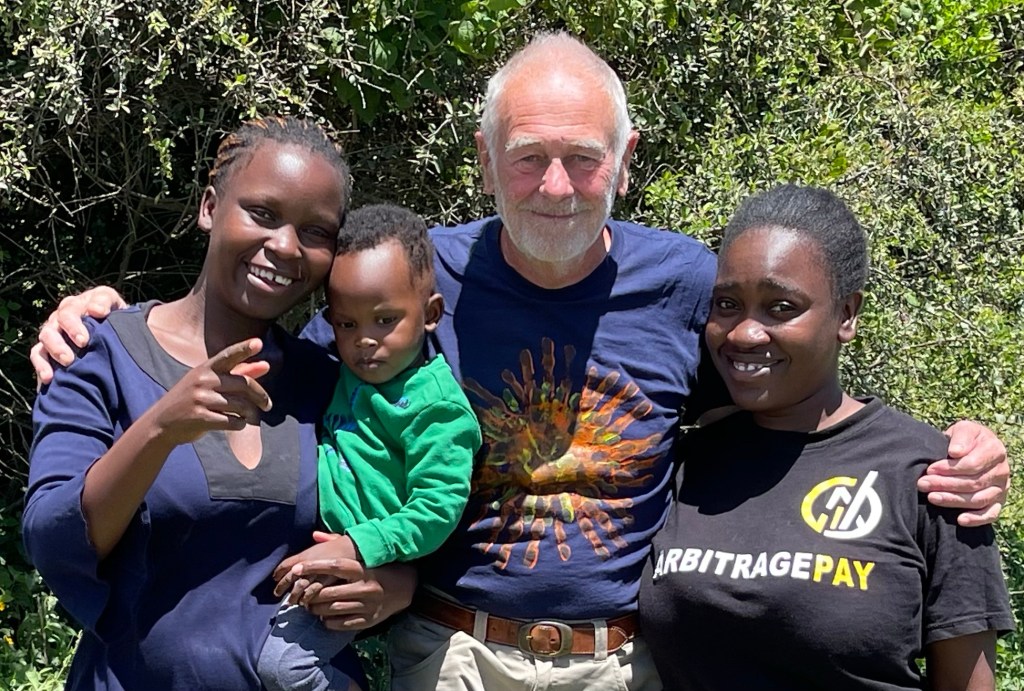
Scovia, Deon and Marion – family
***
I’ve spent about 30 days in Kitale, with Adelight, Maria and Rico, and the same in Sipi with Alex, Precious, Keilah and Jonathan. Kessup I have visited four times for my hikes with William. I’ve travelled independently for only about three days! I just returned to Nairobi from three nights with my Kitale ‘niece’, Scovia, her husband Webb, and their two year old son, Deon, a delightful charmer, and Marion, staying with her sister while she patiently awaits employment – something that comes infinitesimally slowly – even for a graduate with a distinction in her Tourism and Hospitality degree… All call me Uncle and Brother. I feel interest in them all and in their successes and challenges.
Deon
***
My closest brother, Wechiga, of whom I haven’t written much since his return to Ghana following our safari to introduce him to my East African families, has been going through hard times since he flew home. On arrival, he learned that his firstborn, Romanus, about 40, was sick in Cape Coast, the southern Ghanaian town in which he was posted as a police sergeant. He went directly to Ro and found him gravely ill with Hepatitis B, that went undiagnosed in several hospitals, until diagnosis came too late for poor Ro. I knew Ro from the age of six. Sadly, for Wechiga, the excitement of our time in Kenya and Uganda is likely to be overshadowed by his grief at losing his firstborn son. “But what can we do..?” he asks, now busy arranging the funeral at home in Navrongo. A tragedy to end Wechiga’s adventure in East Africa.
***
Long and involved negotiations have taken place in Sipi, since Alex’s neighbour sounded him out on purchasing the adjoining plot. It seemed, even to me, ‘The Money’, an opportunity too good to miss. Alex assures me, with a photo of an agreement written on the page of a worn school exercise book, that the deal is done, witnessed by the clan elders despite some awkward members of the neighbour’s family – some of whom had to be persuaded (in the usual African manner) to comply with the agreement. So, Alex tells me, I am now (technically) a landowner in Uganda! ‘We will plant coffee, Irish and more matooke,’ he says. ‘A demonstration garden for our ‘Jonathan Bean Speciality Coffee’. We are sooo proud of you!’
Precious wails at my final departure from Sipi
***
I talk to my sister Adelight in her chicken house, the squeaking of day-old chicks deafening. She’s bought the new brood that I sponsored to get her back in business after the bird flu epidemic that’s gripped Africa this winter.
Later, Keilah rings me to hear Uncle Jonathan‘s voice. I feel that I am doing my bit for the future of my families, against all the odds that life in Africa throws at them.
Our completed coop. Brilliant bodging, though I say it. Wet timber, assorted bent nails, a cheap saw and a hammer…
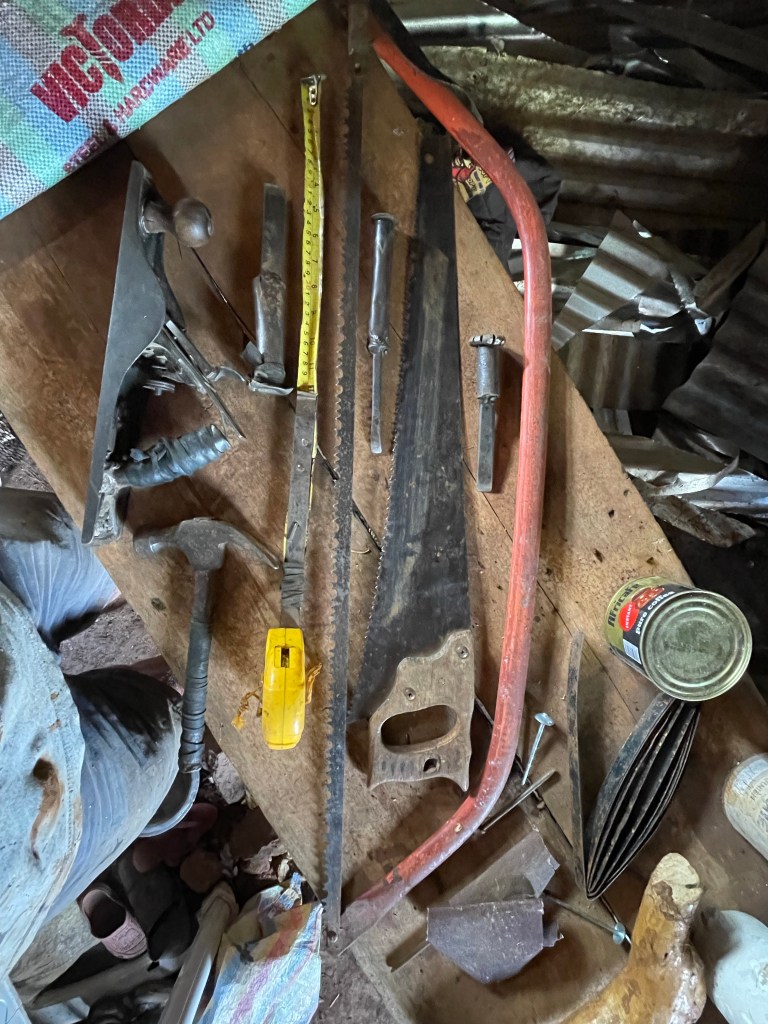
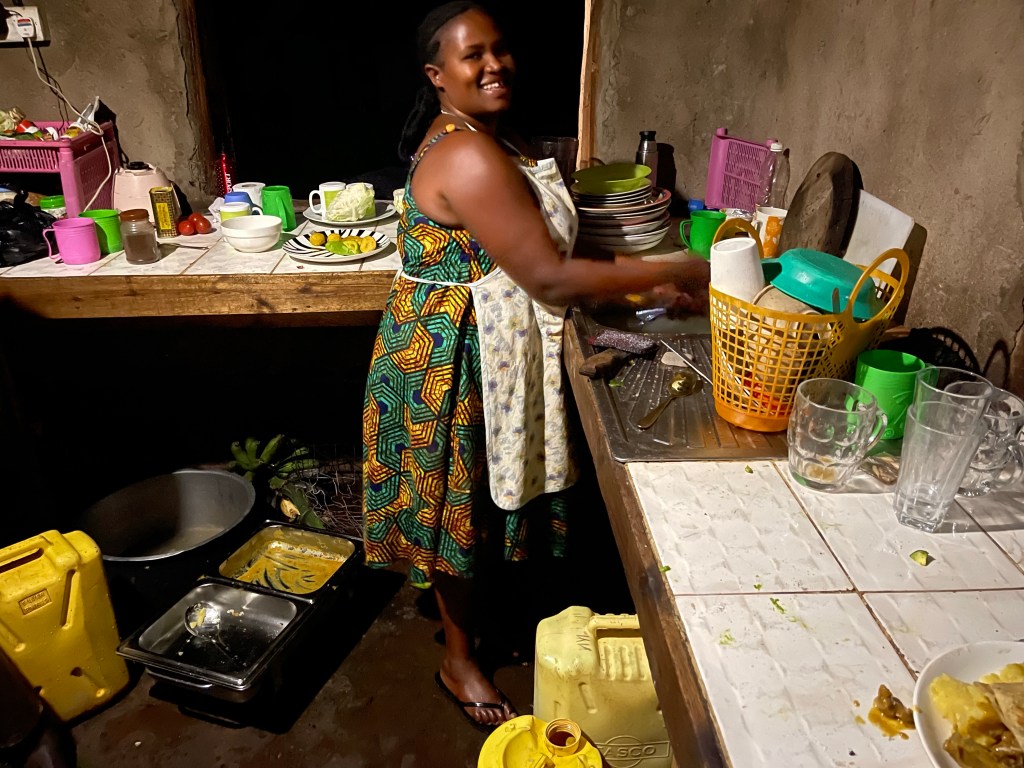
Scovia uses my advanced bodging skills to build her a chicken coop in her minute back yard, for 20 birds to provide eggs and perhaps some small extra income. Webb’s a chef in a very upmarket resort in nearby Masai Mara, the famous game reserve. He makes a spectacular curry! I work hard with them for two busy days, the only available tools a hammer, a cheap Chinese handsaw and tape measure I must go and buy
***
And there, as I sat writing on my last afternoon in East Africa, events overtook me.
Approximately half an hour before I was due to order a car to take me on the familiar ride to the airport in Nairobi, Rico died in hospital in Kitale.
I didn’t find it altogether a surprise. On Monday when we said goodbye at Kitale airstrip, I wondered if I’d see him again. His health has been failing badly. Some years ago, an insect bite became infected and his right leg has been swollen for years with serious oedema. It’s been getting worse, to the point that he could not stand for long and frequently had to rest. These past few days, his leg became very swollen and uncomfortable. A couple of years ago, he was hospitalised and severely ill, but lived to fight another day. This time, however, I believe a fatal embolism formed and even as we were arranging funds to get him transferred to a hospital with more ICU facilities, he expired. It was too late.
I knew Rico since 1987, our original meeting being on the very northern edge of the Sahara Desert, me on my motorbike and he in an old Land Rover with his young companions Marti and Liesbeth. We drove south together for the most memorable journey of my life and ALL my travels. The three weeks of my life I would so happily repeat: crossing those empty sandy spaces with my good friends, sharing the best scenery and achievement of life. Rico never really returned to Holland, living the rest of his life in Africa, and I never really travelled the rest of the world again. It’s that time that we shared and a love for Africa that bonded us in these later years. Well, life is a delicate thing, and he’s gone now.
What this means for the family, or my trips to East Africa remains to be seen. Time will tell, but it’s a sombre end to my 2024 safari. I left the family in confusion as I rode off to the airport to head for home.
Now I am here, tired from the journey home, and I have to pick up the story and deal with some of the fallout. As I wrote above, the extended family is so much ‘more than friendship, for mutual responsibility is accepted, a two-way trade of affection and care.’
I accept that…
A picture taken by our German friends, Jörg and Wanda to Kitale in late January. Wechiga in his smock, Jörg at the front, me, then Adelight, her friend Judith, Wanda – and Rico
***
It’s an odd irony that Thursday, the 14th and Saturday 16th of March 2024 will be the day of two funerals in my African families. Romanus Tungwandia Adamba in the family compound in Navrongo, Ghana, on Saturday – and on Thursday, Henricus Simon Johannes Maria van den Hurck in the family compound in Kitale, Kenya…
BACK ROUND THE MOUNTAIN TO MORE HARD WORK; I ACCEPT I’M NOT REALLY CUT OUT FOR AFRICAN LIFE; STORY BOOKS BY THE FIRE AND AN IGNOMINIOUS FINAL JOURNEY FOR THE MOSQUITO THIS YEAR…
A rare selfie, but I couldn’t resist. One of my favourite pictures this year! Keilah and her new books
I ride quickly on the fine smooth Ugandan road – that probably actually belongs to the People’s Republic of China. The sun’s shining down from a clear blue sky. The views are great today.
I sweep and lean round the bends; there’s almost no other traffic, except the inevitable boda-boda motorbike taxis, the most dangerous traffic on the roads. They wander and weave, overloaded and unaware of traffic regulations. I yell international obscenities at a rider who, chatting on his phone as he rides, swings across my path without so much as a glance rearwards. ‘Traffic regulations..?’ This is Uganda! There may be some rules – in principle – but in practice? Haha. Get caught and you pay off the police. Doesn’t cost much. Just a few bob hidden in the palm will sort most problems here. Gets more expensive, the higher up the ladder you climb of course.
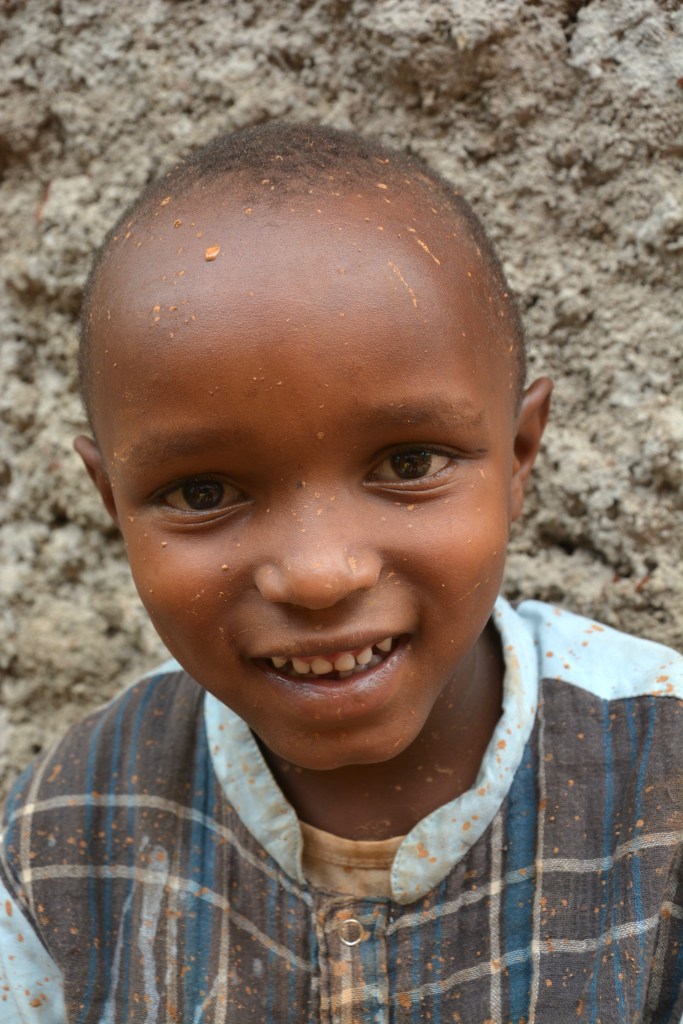
Jonathan Bean Cheptai – splattered with earth paint
I hear a truly shocking story. I know Alex has decided to send the children to board at school from Monday to Friday largely because of the danger of the road and driving standards drivers, with 12-seater minibuses packed with 30 to 50 small children. I hear a rumour that’s going round. A driver recently killed three people late at night, a scandalous tragedy involving an expectant mother and husband on their way to the hospital on a boda-boda. The school paid off the police, the press and the family of the deceased to quell all adverse scandal. “My god!” I tell my informant, “In Europe it’d be a huge scandal. He’d be in prison for dangerous driving! Surely, he’s not still employed driving small children?”
Of course he is…
Yesterday, two tyres burst on the van that was taking my ‘grandchildren’ to school until Alex decided they should board through the week. Children spent half the day by the roadside. TWO tyres! One might be chance. Two is incompetence and dangerous driving.
It’s then I realise I’m just not cut out for African life. My innate morality rebels when I hear these stories of rampant cruelty and corruption. I hear of a mother who clubbed her baby boy to death out of jealousy against her elderly husband, and of another who left her baby amongst the banana trees to be killed and devoured by dogs. This is not the Romance of Life or ‘Ethnic Colour’ in an undeveloped country, it’s disgusting, shocking – infanticide, surely one of the most heinous of crimes. Caused by ignorance. No action is taken.
Alex tells me later that he knew the girl in the latter case. He formerly made her an introduction to an educated professional woman, who employed her as a house girl and offered her education. Very soon, the mother came shouting at Alex for interfering and abusing her daughter by getting her sent to school. The job didn’t last, nor did schooling. The girl became pregnant – and remained ignorant enough to not understand the basic morality of life… Doubtless, she’s had various other babies, probably by a miscellany of uncaring men. What future have those children? What future have the majority of children in this failing country without ethical and social parameters?
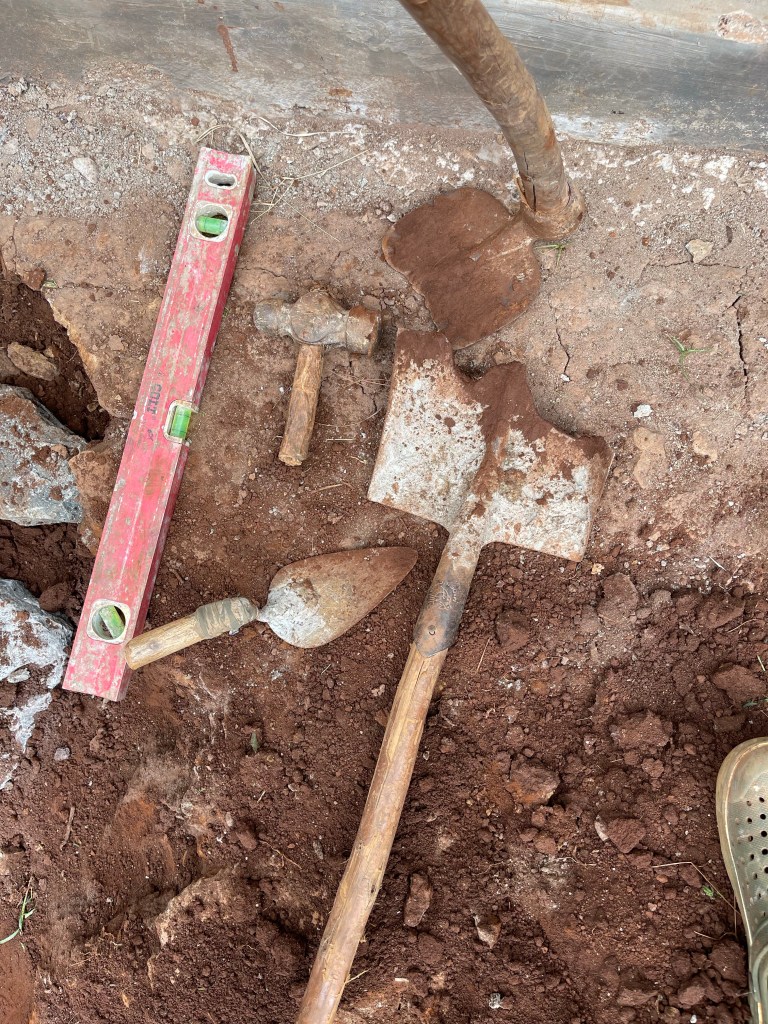
Tools available to Sipi ‘workers’…
A few days later, I am in despair over the lack of community represented in Sipi. We have torrential rain and Rock Gardens floods with surface water. It’s at the lowest point in the mud-filled road. “What needs to be done is… The drain needs clearing!” neighbours pontificate complacently, but without any suggestion of action. There’s a drain under the road. It’s blocked by plastic bags, plastic bottles, fertiliser sacks, debris and thick cloying Sipi mud. No one thinks to maintain it. That’s ‘someone else’s’ work. No one will help. They all say, ‘The only person benefiting from clearing the drains is Alex’…
There’s SO much jealousy here. No one understands that it’s hard work that makes for success. Look at Alex and Precious: up long before dawn; to bed late at night, struggling for success. But then, look at the way people progress in this country: corruption and petty crime. Where’s the incentive to community? Why help a neighbour? If you’ve never witnessed how mutual support is reciprocated, why would you believe in it? Wechiga was shocked that, “No one in these countries does anything without money!” Navrongo, back in Ghana, has always had an ethic of mutual support (reducing now, I suspect, with the increase in nuclear family beliefs).
The carpenter’s tools… Check the tape measure! And the bent hammer!
So, one day, with more rain threatening, I go out and start digging out the drains and culverts. People stare – but don’t offer to help. It won’t benefit them, they think. “What if you need to get to hospital?” I ask them angrily. “Having a passable road benefits you all!” But who’s going to pay them to work? They’re happier to take the chance that’s it’s not them who’ll need the hospital trip. So they stand and watch. It’s what they see all the way up the pecking order of their rotten society…
***
A few days later, I’m in Kessup, back in Kenya, and meet a bright, thinking young man whom I enjoyed talking with last year. He’s trained as a teacher. He tells me over a beer about the difficulties of getting work in Kenya. “There are two ways of getting a post,” he tells me. “Either you wait your turn by rota – and now that’s about seven to ten years… My sister’s just managed to get an internship – because she had a friend in the employment office and she moved her papers ‘upward’. Or you pay!”
“Pay?” I query. “Pay whom?”
“Well, the recruiting officers and human resource officials, of course! The rate now is 500,000 Kenya Shillings for a teaching post, and about the same for military entrance, but they say that’ll go up soon to a million…” 500,000 Shillings is about £2700 at present. This is money you pay – if you have it, and who here has that sort of money – to working officials who receive a salary for the work they do as recruitment officers. “If you pay, you’ll get a post in a week or so. If you don’t, it can be many years…” The head of department takes the biggest cut, filtering downward in a well trodden ratio. It’s the same with the legions of traffic police: a tax collected at the roadside by the many checks. The bosses set a daily challenge – which rises around Christmas and school fee time. Corruption is the ONLY way forward in these countries. Money talks louder than compassion or logic. And the problem goes from bottom to top of the ‘system’. I’m told, as I walk through Kapchorwa, in eastern Uganda, that the new petrol station that’s shot up in record time – literally a week or two – plumb in the centre of town, is owned by the president of Kenya. “Oh, he’s thick with our president!” exclaims a shopkeeper with an ironic shrug.
Most tourists skim the surface of these cultures, seeing the game animals and ‘cultural theatre’ put on for their benefit. It’s far from reality. The reality is hard, poisonous and often depressing. I’m privileged to have insight, because of my closeness to so many people, wrought over time. But I’m happy, despite an increasing nepotism in my own country, that I don’t have to live with this deceit, fraud, and lawlessness.
***
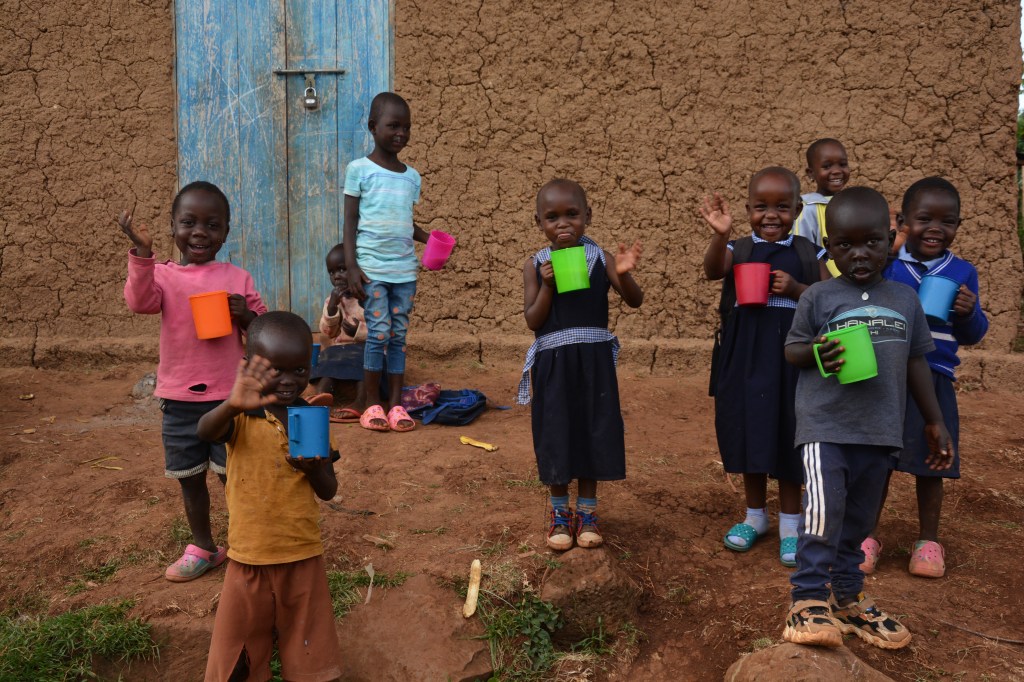
At a rural primary school, children excitedly greet the passing mzungu as they drink maize porridge
Well, that was a depressing start to this update of my travel stories! Where was I? Riding back to Sipi on the Chinese road. The Chinese already own Uganda’s only international airport at Entebbe, because Uganda reneged on a debt repayment – so the PRC took the airport instead. With the eye-watering debts Uganda has to China, there won’t be much left!
So, back to riding the mountain shoulders, with broad Mount Elgon shimmering in the sun on my left as I swing and sweep. The last time it was to do so, it later turned out. I was lucky to be riding that day: the rainy season, which seems to have been going on through most of the ‘dry season’ this year, was about to descend good and proper. But I had a smile on my face. And two big tins of red floor paint in my pannier bags; seven metres of zebra-striped fabric; new shower curtains and other gifts for the new guest house. None of them available in rural Uganda.
It was Thursday. I’d chosen that day because the children would be home from school tomorrow. And they’ve become an increasing impetus for my visits to Sipi.
Joshua, the best work colleague in Sipi
Joshua, the first thoughtful, reliable builder that Rock Gardens has witnessed, is working when I arrive. I sense he’s been a bit lonely. He obviously enjoys being part of a team with the mzungu. I’ve enjoyed his quiet, competent company too. He’s been beavering away at my list of jobs. I tell Alex we must keep him on. The list is still long!
There are no booked guests today, so I get JB1, the original round room. I’m back for only five nights this time, my trip is winding down. Bookings continue, however. Someone’s booked for August! And a school wants to bring their children for an Easter visit. Rock Gardens is a success! We’re getting great reviews. Everyone responds to Alex and Precious’s welcome and customer care, forgiving the cold water showers, mud and rough edges to the place. They love the food, the conversation, the cow Elio, the fire pit – and of course those two delightful children.
That night, by the fire pit, Elio comes and nudges my shoulder for a neck rub! Who ever heard of a soppy cow that seeks human company?
Precious, painting the latrine, couldn’t reach the paint pot…
Next day, Joshua and I work hard – rationalising the access to and painting the latrine at the bottom of the plot. Why have I never learned to pace myself? And I’ve got a filthy cold, had it for a week already, the usual curse: congestion that I get every year in Africa. I’m exhausted by evening. But by early evening, Keilah and Jonathan are back, picked up by Marshell, a young relative of Alex’s, who’s a reliable hard worker.
They come running. “Uncle Jonathaaan!” The questions start. Even exhausted, it’s impossible not to be happy to see them again. We all miss them on our long work days. JB is full of chatter. He never stops talking till he sleeps. He’s an imaginative player, creating patterns from left-over building stones and earth, constructing simple ‘houses’ from scraps. There are no toys in this household, except the football I brought, and now JB has two Matchbox cars that Leslie sent from Florida, and Keilah a plastic doll too. Proud possessions for a while at least. But nothing lasts long in this rough life. The football’s doing well: I insisted that Alex send it for mending after JB punctured it on a vicious thorn. The one I brought last year, made it through about 11 months – before it was stolen.
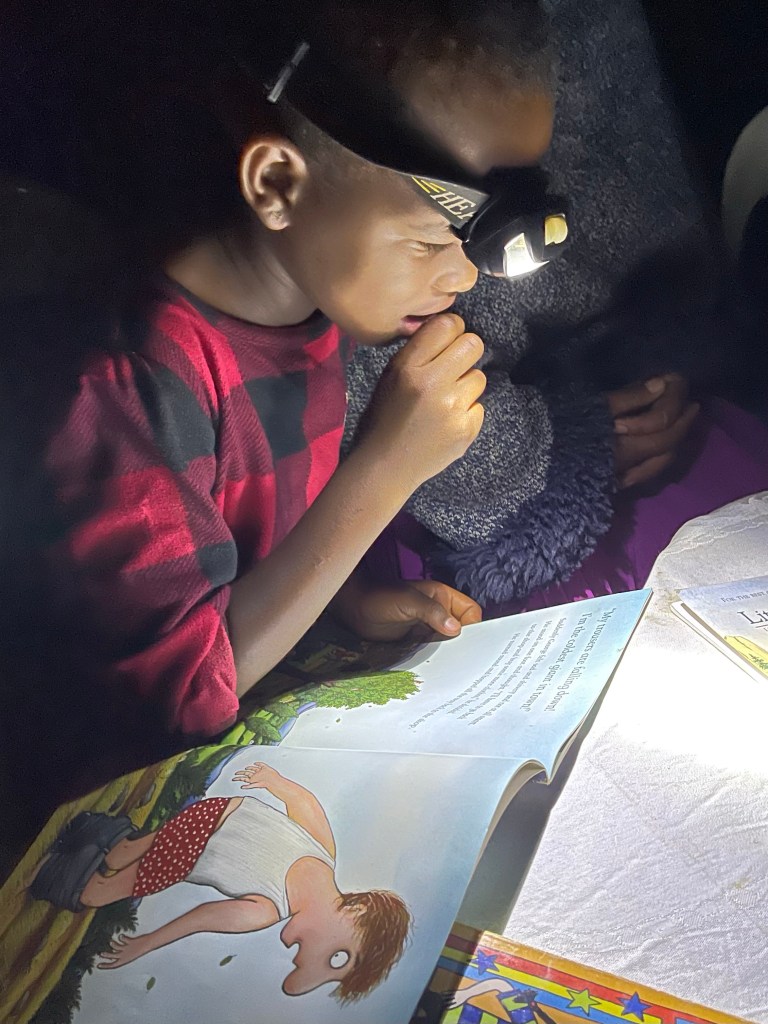
Keilah and the magic of a book
I’ve brought Keilah some ‘story books’. I want to encourage reading and imagination. I know it’s probably the vain hope of an old bloke who grew up without phones and You Tube, but I must try. There’s some hope here, where the power’s off so much. She loves the pictures and turns the pages with pride. She’s never owned such wealth. Five secondhand early-reading books I brought from a street stall in Nairobi. There are five more in a bag, but I suggest to Precious that that is extravagant for now. “Keep them till later,” I say. But where do you keep things safe in this place that hasn’t a SINGLE cupboard or shelf? It reminds me of a jest that Alex made the other day: “If you want to hide something in Africa, put it in a book!” Few houses have even a single book. No one reads, and now phones supply endless trivia to fill the hours.
Keilah shows me a picture in one of the new books
Storage in this house is in heaps on a bed in a room with an earth and gravel floor. Or piled in corners amongst old clothes and torn sacks. There’s nowhere to get rid of rubbish, except by burning. Where do we get rid of broken plastic basins, the legions of plastic bottles, the endless Chinese plastic bags – in which EVERY purchase (except those made by me, a fussy mzungu) is contained. In this compound, they build up in the scruffy spaces beneath the wooden restaurant, or get burned with clouds of black pollution in the fire pit. Most places, they just end up in the matoke and coffee fields, inside the cattle and blocking ditches and drainage channels. Crunching underfoot as we walk. I realise that I am FAR too fastidious to live in Uganda! I hate clutter, mess, untidiness, filth, MUD. “Your house is so CLEAN and tidy when we see you on the computer!” declares Alex in wonder.
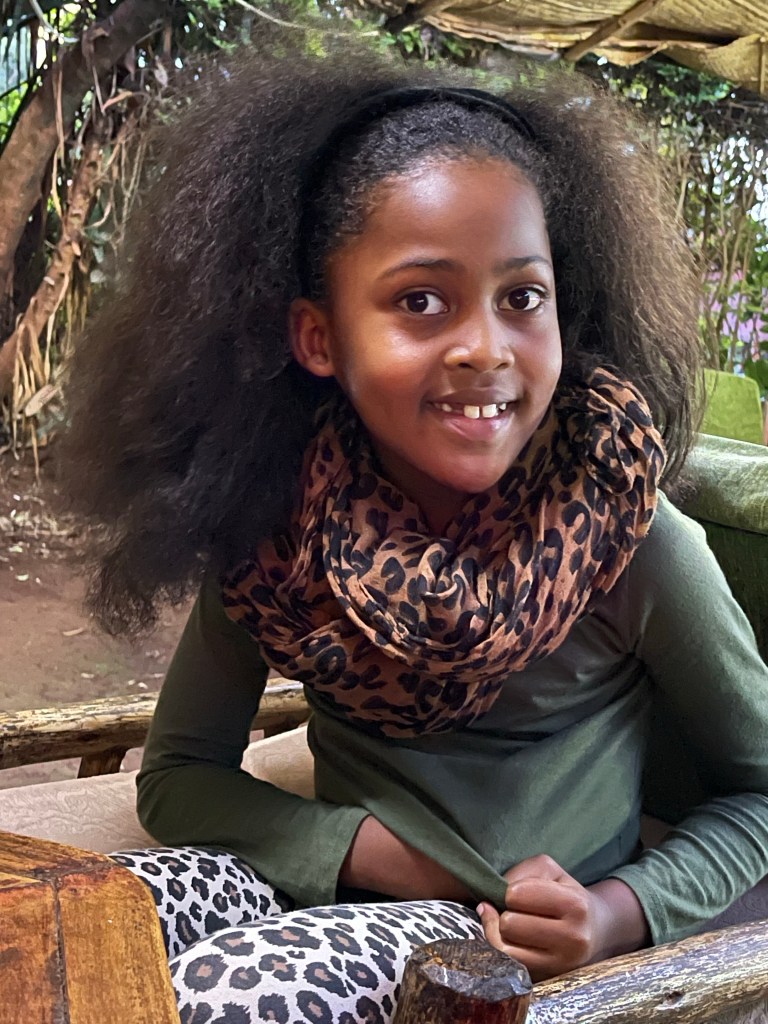
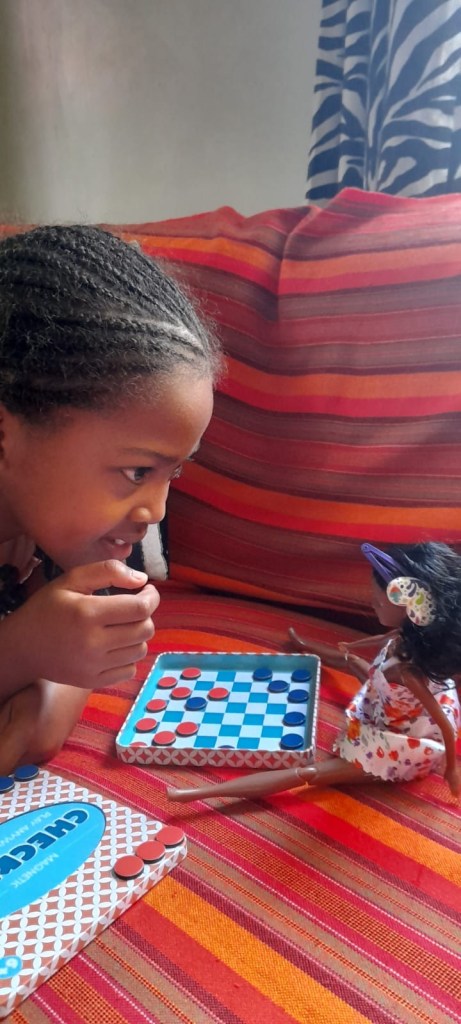
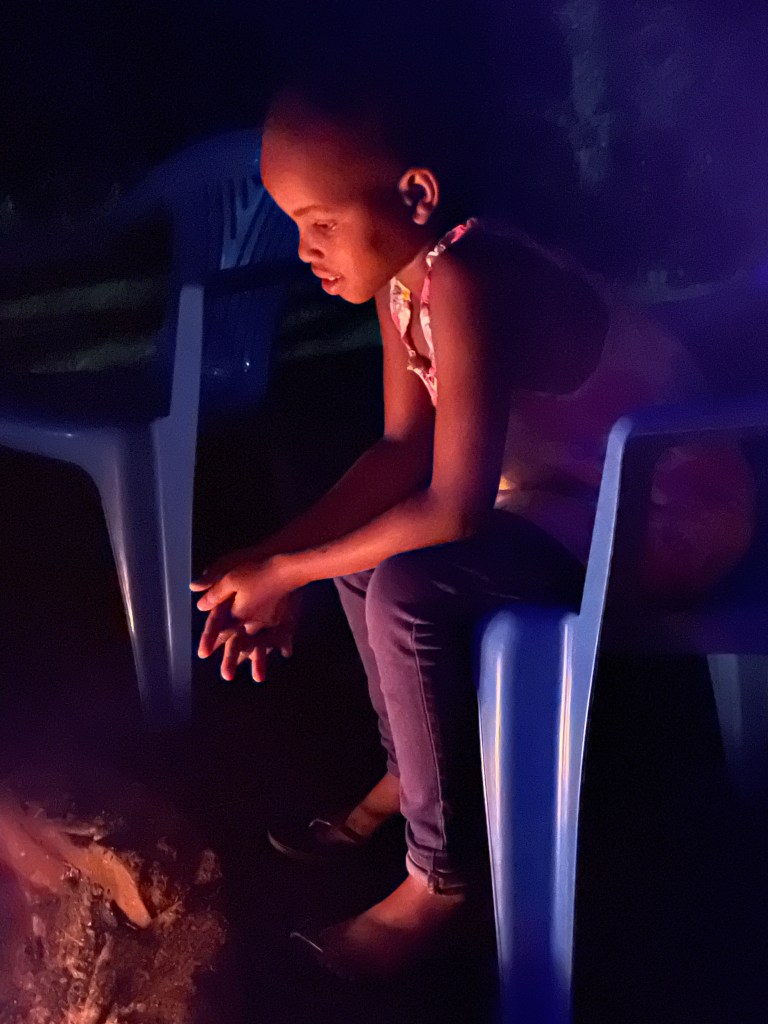
But for now, by the fireside – it may be the novelty of possession – Keilah turns the pages by torchlight and exclaims. She reads very slowly. It’s interesting to compare her progress with Maria in Kitale, just months younger than Keilah. Maria comes with her homework to Rico and I as we drink our beer in the evening. She’s reading words like ‘contaminated’. Keilah, at the best private school in the region in eastern Uganda, is still on ‘my name is…’, ‘my school is…’. But education here is extremely poor, even if Keilah is consistently top of her class. Schools closed for 22 months for the pandemic, longest in the world. Classes are large and most learning by rote. And of course, as a mzungu father, Rico stimulates pretty Maria, a much more sophisticated child, every morning and evening, reading with her, explaining things, inventing stories, drawing pictures. In Uganda, a country in which 48% of the population is below 15 years old, such poor education is a disaster for the future. But no one in Uganda, from top to bottom, thinks of the future: life here is about short term thinking. Money now, not investing for later. Why else would any country start to drill for oil in its most famous national park..?
Maria in Kitale
***
For all this, it’s the future of the two children that brings me back again and again. They need me now. I AM their future. Here are two delightful children, in a failing land, who might HAVE a future. I’ve promised them education. It’s the only way to prosper here. I’m inculcating in Keilah that even for a mere girl, intellectual pursuits and a profession are possibilities. She doesn’t have to be an uncounted child-bearing vessel of no credibility. She can make her own decisions, follow her own dreams – as far as is possible in this country. She leans on my shoulder now, reading laboriously from ‘The Smartest Giant in Town’, a fantasy story book. It’s the one she likes best for now, but she tells me she’s taking the pink paperback with the naughty twin girls illustrated on the front to school with her on Monday. Funny how, whatever the culture, it’s the pink cover that attracts small girls: that’s conditioning!
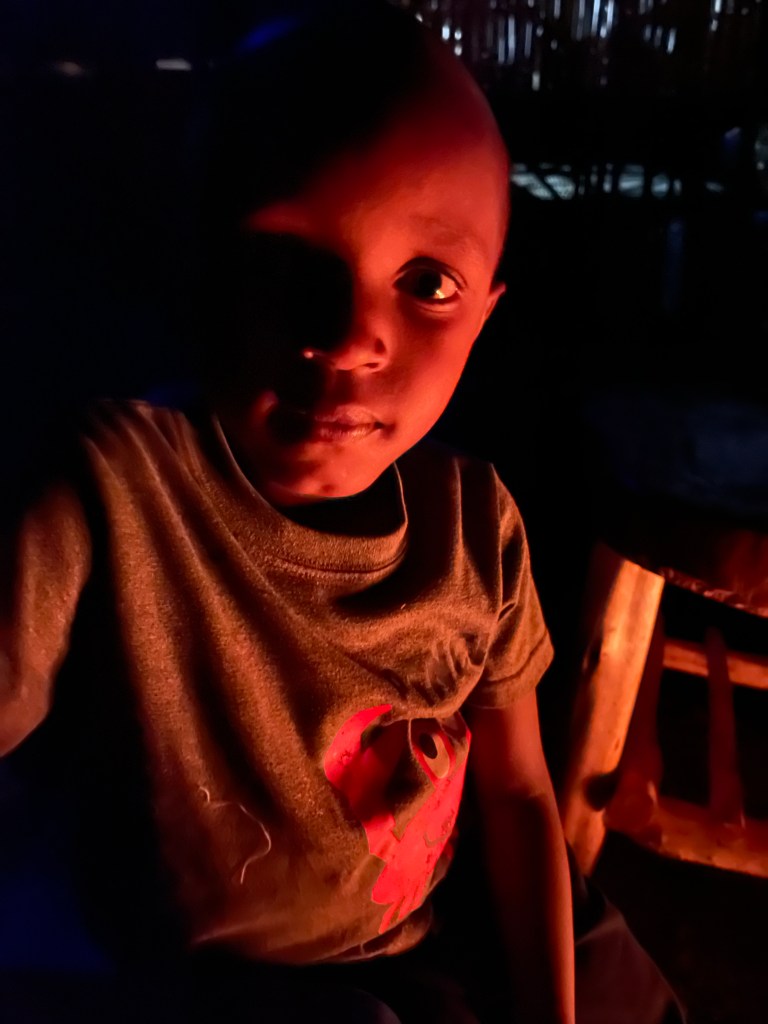
Jonathan, tired from a day of invention, endless talking and playing in the muddy compound, now brown with Sipi dirt, falls asleep on Precious’s knee. Keilah and I read the ‘Smartest Giant’ as the fire flickers.
Then comes the rain again.
Rain… and more rain
***
On Monday, the children leave for school at 5.30 in the morning. Marshell takes them on his small motorbike. I shall miss those two – until December this time, I suppose.
We’ve a guest since yesterday, an elderly Israeli man called Shaull. He talks a lot, and it’s amusing to watch Alex and Precious struggle with his humour! Africans generally don’t understand irony. “I want a job!” he exclaims when he arrives. “Give me a job. I’ll only charge $75 an hour!” I set him to make a new handle for the lump hammer that’s had a five inch stump for at least two years. Alex comes to me, whispering in concern. “I can’t pay $75!”
“He’s joking!” I assure Alex, but he doesn’t look convinced.
“Eh! your food is awful! It’s so uncomfortable here! I think I must leave in the morning,” jests Shaull, meaning the opposite. Alex is worried: Precious is beside herself. “I think I might stay for ever!” says our jocular friend later, who, it turns out as we build steps together, is 79. “But I can’t put him up for so long. And he wants $75 an hour! What will I do?” wails Alex. No, irony doesn’t make it here. But after 36 hours, Alex learns and returns the insults with a wide smile. He’s learning from his exposure to so many cultures. I laugh. Precious is still wary.
***
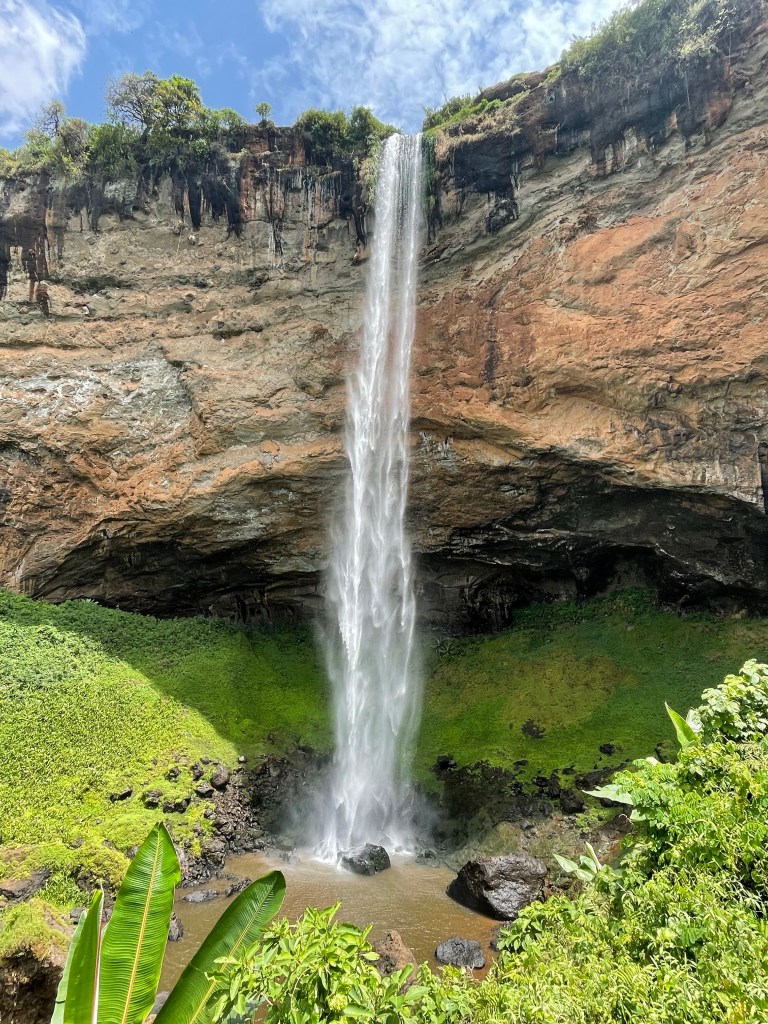
One of Sipi’s falls
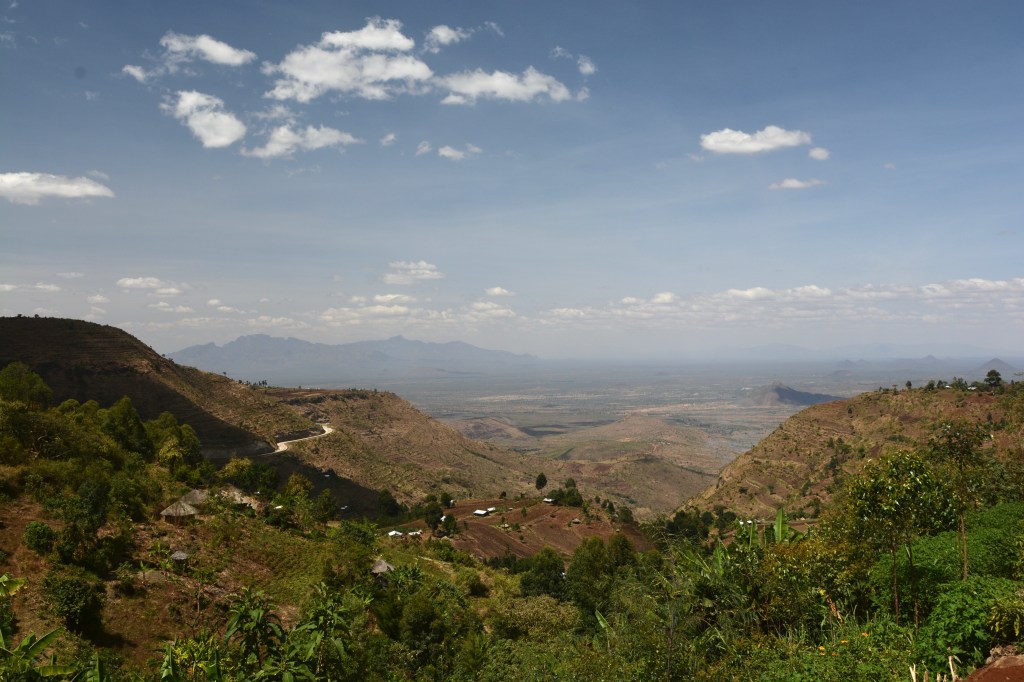
I’ve insisted to Alex that we must spend at least a day walking. We need different perspectives, and he’s developing an ulcer from too much worry and work. He seldom rests. We’ll walk to ‘Town’ again: Kapchorwa, the busy trading centre 17 kilometres up the hills, back towards Kenya. As we leave the compound, I suggest we take a boda to Kapchorwa this morning – and walk home instead. We’ve walked the other way twice in the past two years, on trails over the hills. “It’ll all look different, coming the other way!”
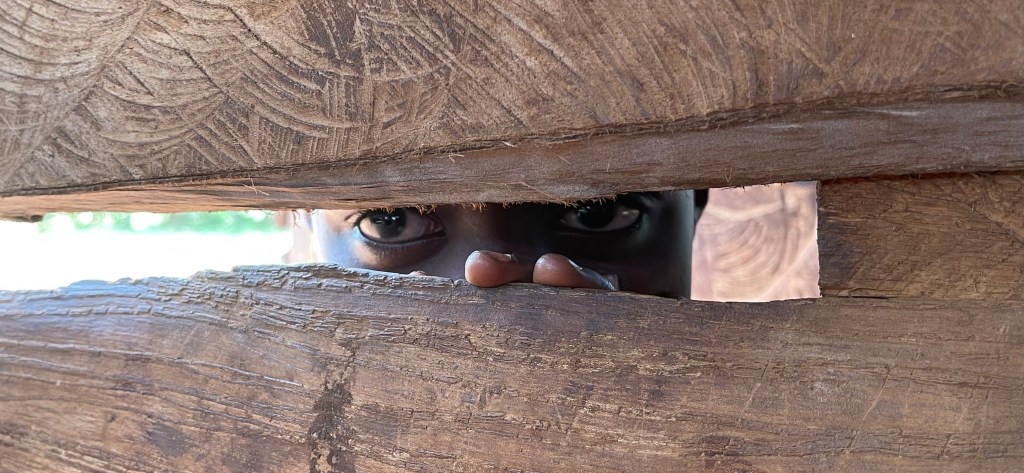
So we set off, having instructed the riders how to carry this 45-year-experienced biker somewhat more safely, and consequently crawl to ‘Town’ in a manner no boda-boda rider recognises. Then we walk for several hours, a lower route this time, without the stiff climbs over the ridges. I’m happy for the relief: my cold is really sapping my energy. The weather is cool and cloudy; the landscape fine; flowers line the small fields and people watch us walk in wonder. Why walk like this unless there’s profit? Best is our stop for milky African tea in a wayside shack in the centre of a straggly rural village. Three kind ladies invite us to join them in the tumbledown shed as their friend makes tea and chapatis through a rough-plank divide. They are full of questions, but respectful and friendly.
Tracy, fascinated by a mzungu up close, peers through the planks of a rural tea shack
Despite the frustrations, the awful short-termism, the greed and petty crime that’s so normal, this is still wonderfully friendly country. Despite all that. We eat delicious chapatis and chatter for most of an hour, before getting directions for the rest of our hike home.
***
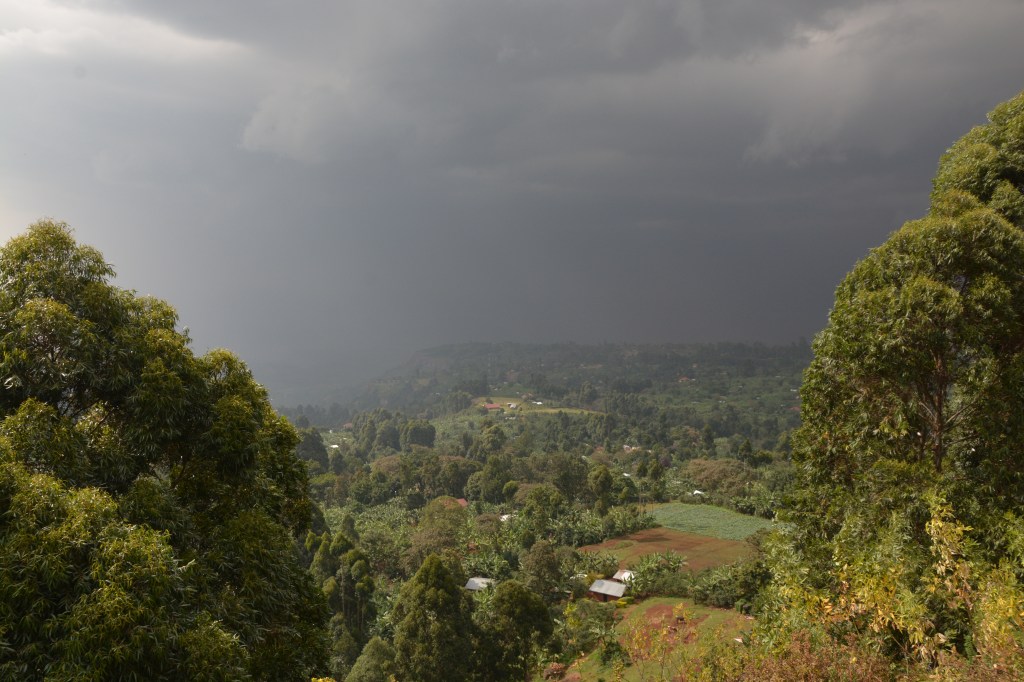
As we approach Sipi over the hills, clouds gather behind us. Thunder rumbles closer. “I think it’ll miss us!” I say hopefully. But it doesn’t of course. We must scurry the last mile through large droplets of the coming rainstorm.
And it RAINS! All night and all next day – the day I had elected to leave. I can’t ride in this! Even if I could negotiate the slippery, cloying mud to the tar road now, I’d be drenched to the skin in minutes.
We spend most of the day watching rain fall; cascades invade the compound; a lake forms where the fire pit should be. It’s utterly disgusting. The mud sticks to my shoes in clumps if I venture across the lawns. Alex and I dig desperate drainage ditches to divert water. No, I am FAR too fastidious to be here in the rainy season!
It rains on through the night. I listen apprehensively. I pretty well HAVE to leave tomorrow. I’ve promised to go for two nights back to Kessup to see William before I leave. Now I’ll have to reduce that to an overnight visit.
***
On Wednesday there’s an uneasy truce with the rain. I’m to set out early, back to Kenya. But the Mosquito won’t start! I try and try. No joy. We try bump starting. No joy. We send for Kato, the reliable mechanic from ‘Town’ who understands Japanese machines: he maintains most of the NGOs’ bikes. It takes an hour for him to get here. He prods and pokes in the electrics – and diagnoses a fault in the ignitor box, a sealed plastic component under the seat. He gets the machine started and I carry him to town on my way home so he can make some adjustment.
Work done, I ride home to Kitale. It’s just about dry for the early part of the journey – just riding through thick damp clouds on the heights. Then the sun comes out and I spin along on the smooth Chinese road, twisting and leaning happily. The border’s a farce as always: the customs officials have gone off for lunch! Forms and statistic no one will ever read. But I get home dry and still smiling.
***
So, on Thursday, I have a bit of difficulty starting the bike, but it runs well and I ride off into the Cheringani Hills for one last time this year, climbing up to the heights at 10,000 feet on a clear day. I’m right on the top – the remotest part of the ride – when the engine stutters and fails! I get it going again with the kick start, but my Mosquito doesn’t feel happy at all. I limp a mile to the next scruffy hamlet, and stall in the street. In a moment, a drunken woman is at my side pestering! How do they KNOW? I yell at her to ‘go away’, but she staggers at my elbow pointing to the engine, mumbling, “…probleerms there…” I get increasingly angry. I’m a dreadful mechanic and these instances are the worst moments of my motorbike safaris. The anxiety, the ‘what if’ moments. I manage to kick the engine to coughing life and roar away from the drunkard. The engine is misfiring, as if the choke is on. It’s really rough. Uphill is a struggle, but we’re moving. I’ve done 74 kilometres from Kitale, and there are 60 left to Kessup. If I can nurse the bike that far, William will know how to get help. It’s a slow, alarming limp for those 38 miles, but I make it to Kessup.
It rains again in the night. I sleep fitfully, wondering how to deal with everything. But William has many contacts here: he’s lived here all his life, and his family is large. His brother Joseph has agreed to take me back to Kitale with the Mosquito in his pick-up. £40 is a fair charge for the three hour each way rescue. And this would’ve been my last ride this year with the Mosquito anyway. I’m flying down to Nairobi on Monday, the 4th. Kato in Uganda has sourced a secondhand original Suzuki ignitor box from Kampala and I’ve sent money via Alex. He’ll get it to Rico and there’s plenty of time to make the repair now – nine full months!
It’s an ignominious end to my motorbike safari – but it’ll all work out. Somehow, things do…
***
I’m back in Jonathan’s House in Kitale, packing my belongings now. Tomorrow, Monday, I’ll fly the 50-minute flight to Nairobi (can’t face that ten hour bus ride for a fourth time this trip, and it’s only £38) and on Tuesday I’ll take a bus to visit Scovia in her new home of Narok, southwest of Nairobi. I fly back to wet, cold England next Sunday.
This morning, Alex rings to say his unpleasant neighbour has got in debt and offered him the plot right next to Rock Gardens. It’s a couple of acres and adjoins his guest house! It’s an investment we probably can’t miss. It’ll cost just £1000 but bring so much benefit to Alex, Precious and my ‘grandchildren’. Land is wealth in Uganda. He can grow food on the doorstep, graze Elio there – so save the garden plants – and one day, Ugandan custom being what it is, he’ll have land to divide between Keilah and Jonathan Junior.
It’s been the most expensive trip of my life – but at 74, what else to do with my money? (Well, you can think of things no doubt; so can I: it’s a throw-away phrase! But few of those things would benefit so many people). Let’s hope the American work – which is paying for guest houses, school fees, chicken businesses, trips across Africa for my brothers, dairies for cows given out, shoes for my friends (three pairs this time!), and now an extra couple of acres of Uganda, let’s hope the American projects keep coming!
“We like it when you get a job in America!” says Wechiga with typical candour. “We know we all chop from it!”
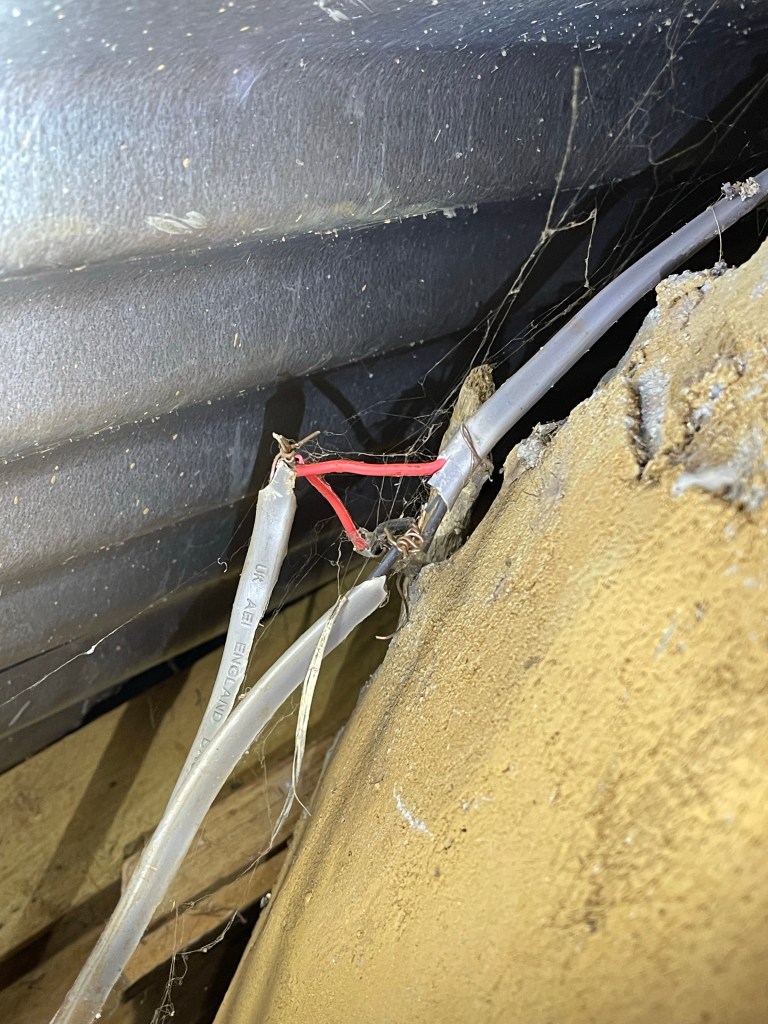
A shocking – potentially literally – bit of Sipi wiring. 240 volts and a tin roof… At a nearby hotel in Kitale! How Africa loves this stuff!! Maria and her doll from Leslie in Florida
TWO WEEKS IN UGANDA, WORKING LIKE A SLAVE. I LEAVE THE GATES OF THE COMPOUND TWICE. I BECOME BUILDER, ELECTRICIAN, PLUMBER, DECORATOR, AND (I hope) WISE OLD TRAVELLER BY THE FIRE PIT AT NIGHT. ELIO, THE FRIENDLIEST COW IN AFRICA DISAPPOINTS US.
Rock Gardens, the three round rooms
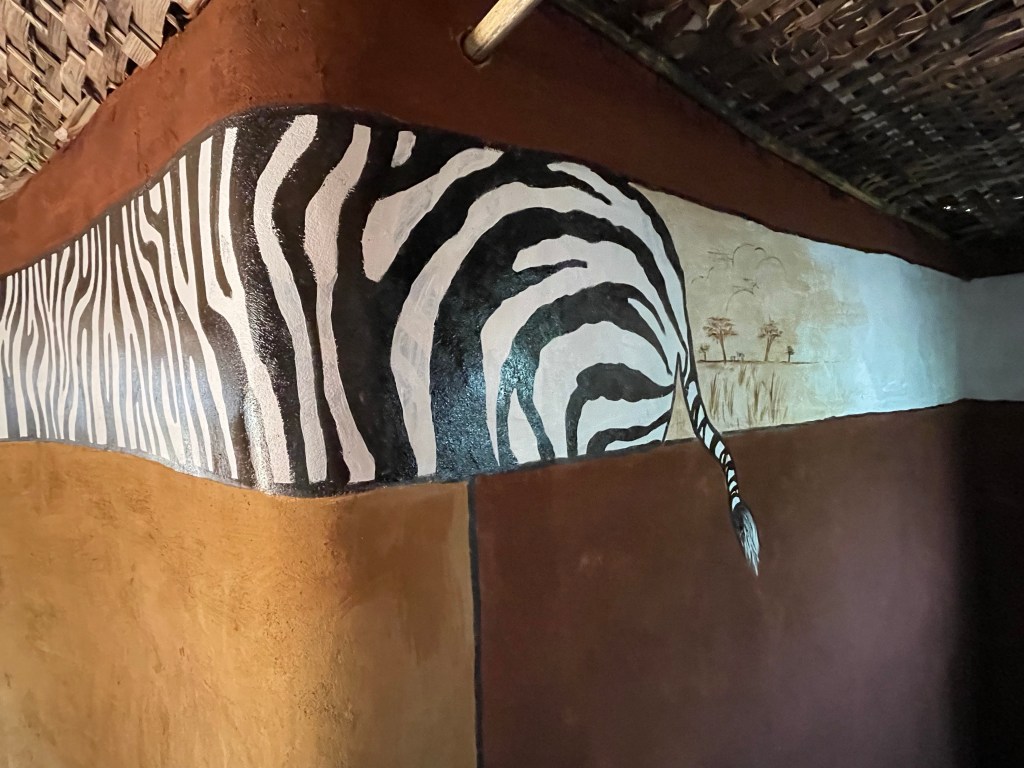
Painting the stripes of a zebra’s bum on the walls of the new round house at Rock Gardens, it struck me that I have built the sort of guest house for which I’ve always searched in my travels! Funny, that.
Keilah by the fire pitJonathan Junior by the fire pit
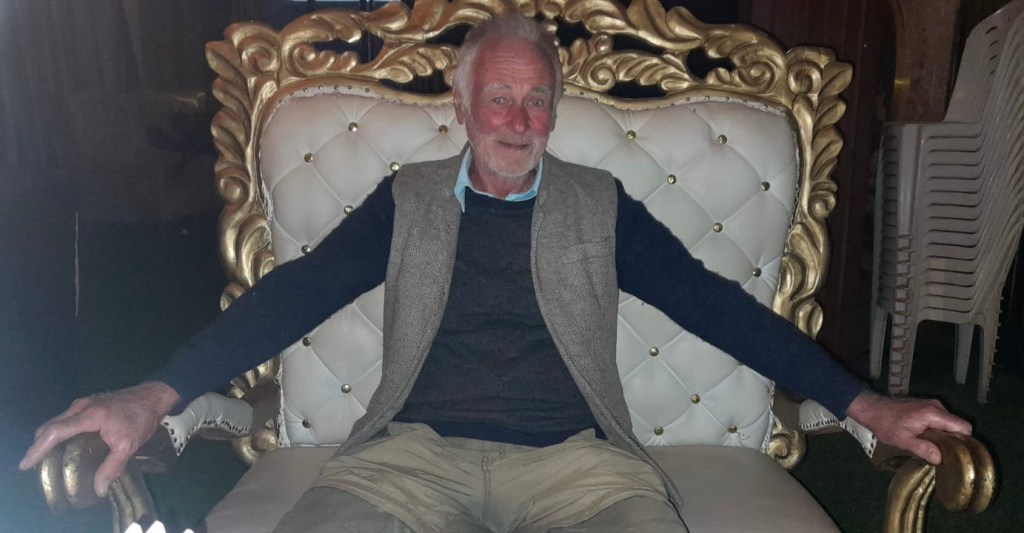
This journey has been different to many others. I’ve concentrated on my African families and travelled independently for only a few days. As the families become an increasing influence in my life, it’s fitting that I spend more time in theirs. And my surrogate grandchildren have become a joy of my journeys here. Funny that in my childless life, I should come to love these two so well in my dotage! Haha. Maybe that’s what happens with age? None of us know, until it begins to hit us, just how to handle old age, that’s a fact of life. We never listen to older people’s experience, always thinking age is something that happens to others. Then up it creeps. Suddenly you realise that the image others have of you, is not at all how you see yourself. I remember my mother telling me she could be shocked to see an old woman reflected in shop windows and it’d bring her up sharp to see what others saw. But did I ever think it’d happen to me? No, of course not. Old age happens to others! But now I am called the ‘mzee’ (old man) and must adapt reluctantly to the fact I am no longer seen as a youth.
Oh well, it’s only vanity. And I can still throw my leg over the (quite high) seat of my blue Mosquito and roar off into the African hills with some aplomb and a good deal of energy. I can still dance about on my footpegs and fling the little bike round the Chinese bends on the mountain roads. I can still be plumber, builder, painter, joiner and instigator of guest houses in rural Uganda! I can paint zebra’s arses on the walls of my grandchildren’s guest house in the hope of making that family independent in the collapsed economy of Uganda.
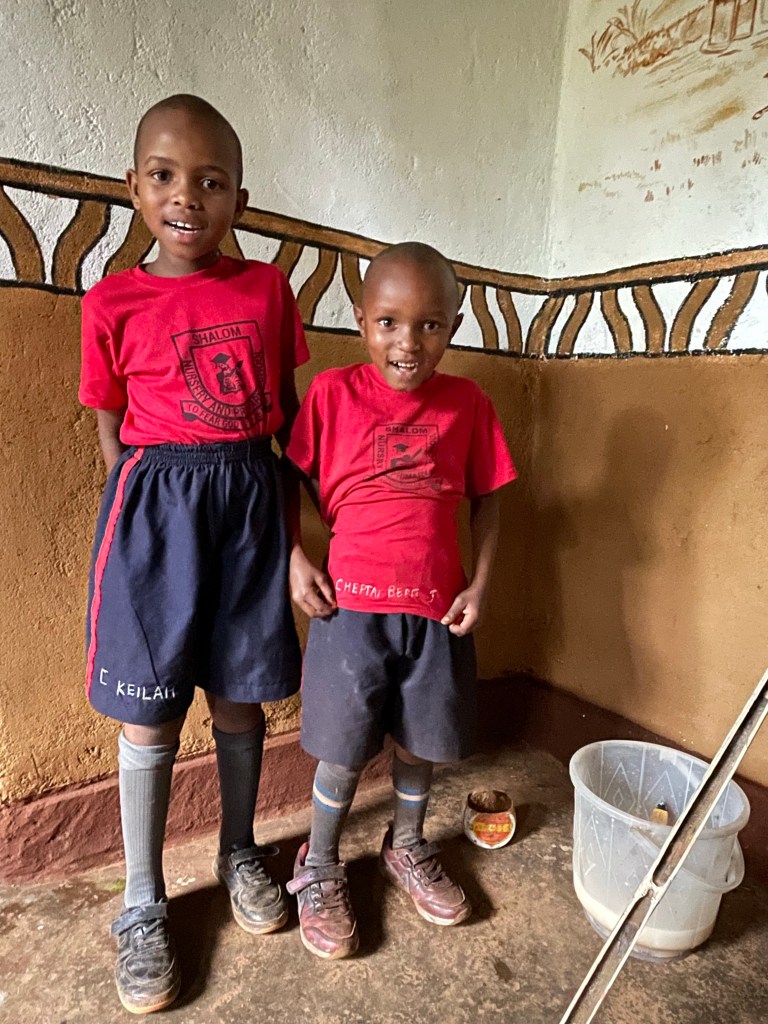
JB’s school tee shirt is embroidered, ‘Cheptai Bean J’!
***
So why am I painting zebra motifs on a Ugandan wall..? I’ve written often of how I met Alex and Precious six or seven years ago, managing a derelict guest house in Sipi, with not much to recommend it but a view across half Uganda. It’s still like that, despite huge investments – in ugly concrete construction by its new owners. It had, apart from the view, one asset: Alex as manager – a fact the current owners didn’t recognise.
Back then, Alex showed me his plot – bare but for a simple earth and stick house he’d built for his small family; just Keilah had been born then. He told me of his plans and ambitions – impossible dreams, more like – to construct his own guest house. With no capital. And I, perhaps foolishly, and certainly innocently, agreed to help – a bit, as I thought. We talked of plans: I told him he should try to attract visitors like me (!): overland travellers and people who wanted an individual ‘traditional’ family stay that they wouldn’t find elsewhere. We came up with the idea of round thatched houses, actually based on a house in which I have loved to stay in Lesotho. I sponsored the first ‘traditional’ house: ‘JB1’.
JB1, the first round room
JB1 led to JB2, a smaller, neat rondavel with a thatched roof of pretty proportions. We had local beds made from tree poles, and I introduced the concept of paints made from local earth mixed with PVA and water. With this, we saved hundreds of my pounds, mining the soil within yards and by chance enhancing the feel of ‘traditional’ decoration, even if I invented it. We eschewed the horrible paint colours so common here, vibrant, unsympathetic hues used by the ubiquitous phone companies. Rock Gardens, named after my Rock Cottage, took on a look and feel of no other guest house in Sipi – itself a stop on the Uganda Tourist Trail, thanks to its tall waterfalls, mountainside situation and verdantly profuse greenery.
Famous for its falls, Sipi has become part of the Tourist Trail in Uganda
But the guests didn’t come… Well, we had a pandemic and the plot is a kilometre from the main road, up rutted and often muddy tracks. We had signposts painted. I made a brochure. Still no travellers found us. Alex remained confident, “Oh, visitors will come. You see!” I began to despair of my – now considerable – investment.
Then some of his colleagues – who now manage his booking system, on commission of course – put Rock Gardens on the unstoppable booking website (soon to extend to the moon, I suspect) that we all know but I can’t write, for fear of inevitable links invading your device as you read. And it went onto Google Maps as well. Suddenly, a bit before Christmas, the visitors started to arrive. This is the new tourism… It’s a concept with which, as I wrote last time, I am out of touch – and propose to remain so. New travellers have phones in hand – as indeed so many used to have their Lonely Planet guides in former days – and move from one place filled with people like themselves to the next. They read reviews and follow an increasingly deeply rutted trail of footprints around the ‘sights’ of foreign countries, leaving so much of what I enjoyed for 50 years – the serendipity of travel – out of their plans and thinking. It ends up, as with the old guide books, with so many staying amongst their compatriots at the expense of finding locals with whom to commune. Now it’s comparisons on phones instead. I, and most older travellers to whom I speak, are happy the world was so much larger and adventurous when we travelled it; brought more sense of achievement to succeed and cope with what chance threw at us.
Still, it’s bringing visitors to Rock Gardens, now the most popular guest house in Sipi, amongst a veritable plethora of competition. Alex and Precious are good at what they do, adding small extras, like greeting new guests with a couple of local bananas or sliced pineapple; bringing them free homemade passion juice and pots of tea as they sit in the gardens with their phones; bringing chairs for chatting guests. “It costs me almost nothing, but people remember…” says Alex wisely.
***
Sipi Falls – with artistic (?) license…
But how do you build and improve a guest house, with many rough edges that the visitors appear to disregard, while it’s full of guests? It’s not easy, I can attest! Much of the past two weeks, we have been firefighting, desperately slapping a coat of paint on bathroom walls even while visitors were approaching from Mbale, down the mountainsides. Uncle Jonathan has been smothered in paint, glue and dirt; becoming plumber, electrician and builder – being better at all than almost all the disinterested workmen in Sipi.
As I painted, I pondered the total lack of motivation and care – the prevalent work ethic in Sipi, probably indicative of most of this failing country. The workmen available, self-styled at their trades, come only to do the minimum and get a pathetic pay packet at the end of the day. They care not a jot for the quality of their work; they use copious amounts of materials without any economy; they create a godawful mess; do third rate – at best – work; fail to clean up before leaving – and then steal any tools they can lay their hands on. It’s depressing and disillusioning, and infinitely frustrating. I make a fuss: insist on cleaning the site, rail about low quality work, sack the ‘electrician’ who has no more than insulating tape for 240 volt connections and leaves two bare three inch copper strands hanging at child height without any protection – and leaves the site for the day. “Oh, take care, those wires are with electricity!” another worker tells me next morning, before I hit the roof, as Keilah and Jonathan almost electrocute themselves. “And don’t come back!” I yell at the irresponsible ‘electrician’, and proceed to turn off the power and fix the plug socket – to which the ‘electrician’ has lost the box screws, so I must tape it together… Later that day, the ‘electrician’ phones Alex pleading for more work. “Talk to the mzungu!” he replies with a private smile. Most workers don’t come for a second day when I am directing work!
‘Tradition’, totally invented
So, I’m wondering, as I slap brown earth paint on the walls of JB3, just why there’s this total lack of responsibility and commitment? Why the poor morality, the jealousy, the cheating and petty thievery, and the mild aggression, corruption and greed of this country, otherwise so friendly when commerce isn’t involved?
I decide it’s the inevitable result of lack of moral leadership. When you look up at your leaders and see cheating, lack of concern, arrogance, vanity, robbery (why call it corruption?) and nepotism, why would you think integrity, honesty and compassion pay off? The message and lesson is that only cheating your fellow moves you forward. Thus greed and jealousy, graft and petty crime appear excused and become accepted behaviour, such that honesty and compassion for others become weaknesses. And it’s no longer an African problem…
Look at other leaders: the Trumps, Johnsons, Goves, Camerons, Lord Snootys, Putins, Melonis, (insert names yourself) of the world and understand why 2024 is so socially unpleasant and alarming. Totally uncaring people. What examples of moral leadership are they? Thatcherite greed is the way you get up in the world. Look after Number One. I’m alright Jack… I think it was Denis Healey who so succinctly summed up the morality of the day: “Margaret Thatcher turned compassion into a weakness.”
The recipe for modern times…
***
More invented tradition…
I’m so proud to watch Alex and Precious buck the trend, gain respect from their visitors and become exposed to so many influences. There’s no doubt Rock Gardens is a roaring success and the most popular of the plethora of guest houses in this greedy, commercially aggressive tourist town. I’m delighted that my instincts were spot on seven years ago.
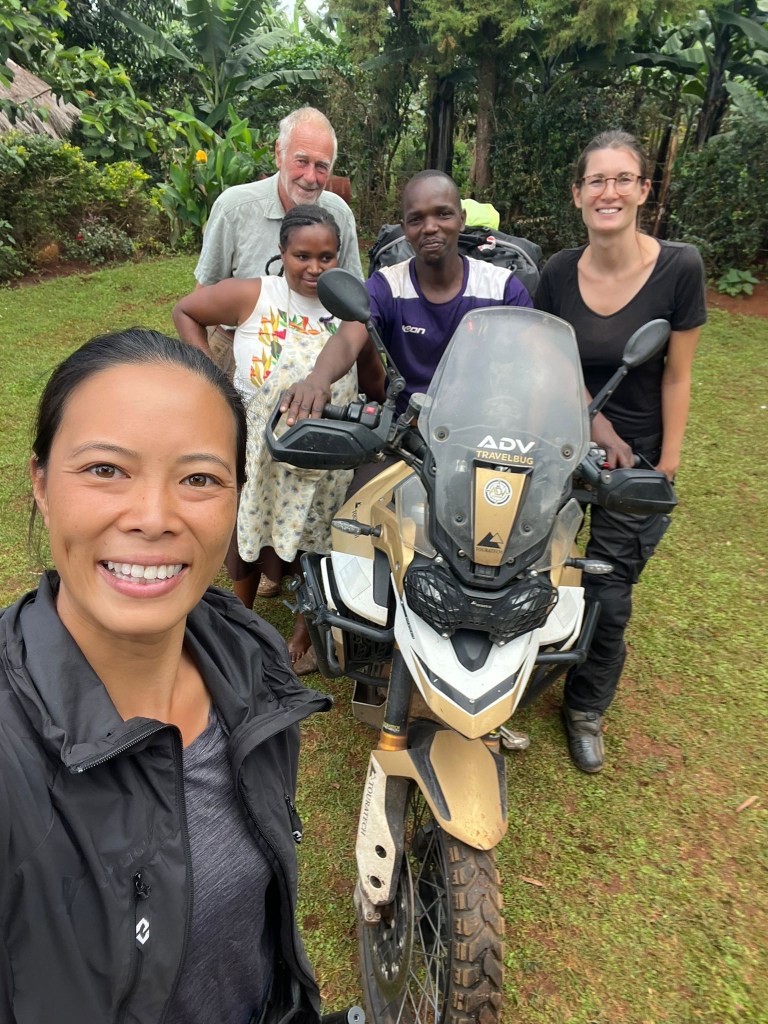
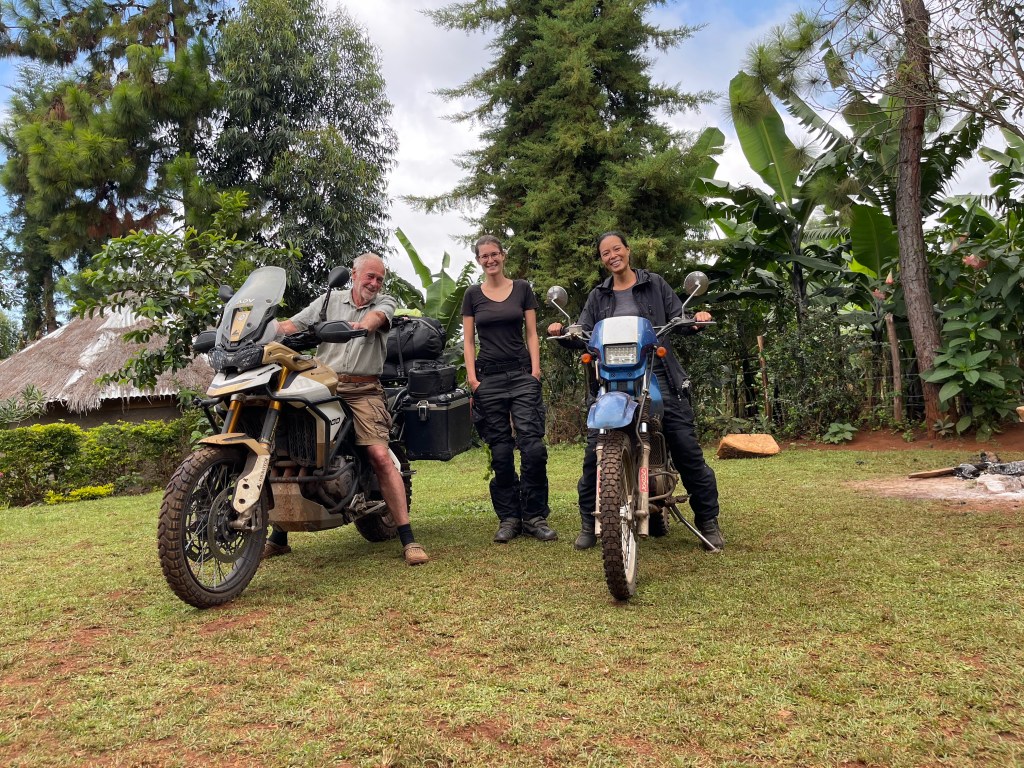
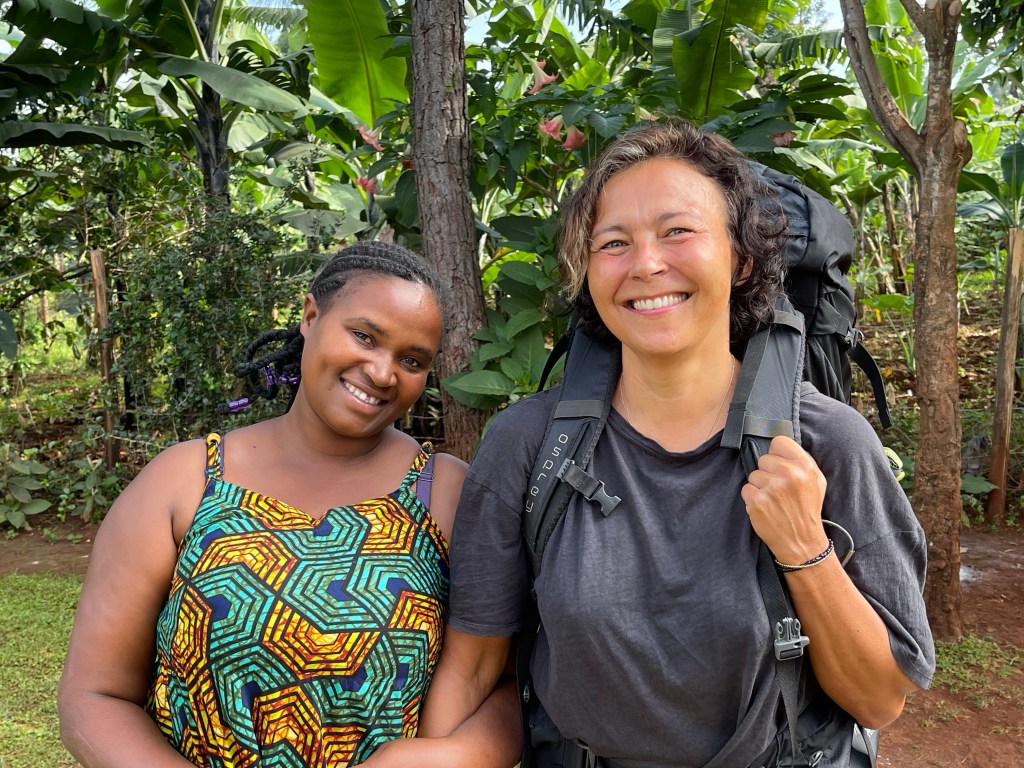
Some charming visitors are now enjoying Rock Gardens. Sandra and Fiona, from Germany and Leicester, turned up on a VAST, heavily loaded Triumph 900cc motorbike. They even carried camping chairs. Both slight, Sandra is pernickety and likes things done sensibly and with logic, the German way. Fiona is more easy-going and adaptable. “I think it’s a woman!” whispers Precious in amazement as the two helmeted figures ride through the gate. They take the only room left, JB5, a room with no bathroom. I reckon Sandra will only stop the night; the latrines are basic, to say the least (lots of work required yet) and at the bottom of the plot. But they enjoy the atmosphere so well that they stay three nights and we all bond. They might even visit me in Harberton in April!
Fiona and Sandra with their giant TriumphFiona, perhaps slightly envious of my Mosquito…Haruto gets a washing lesson!
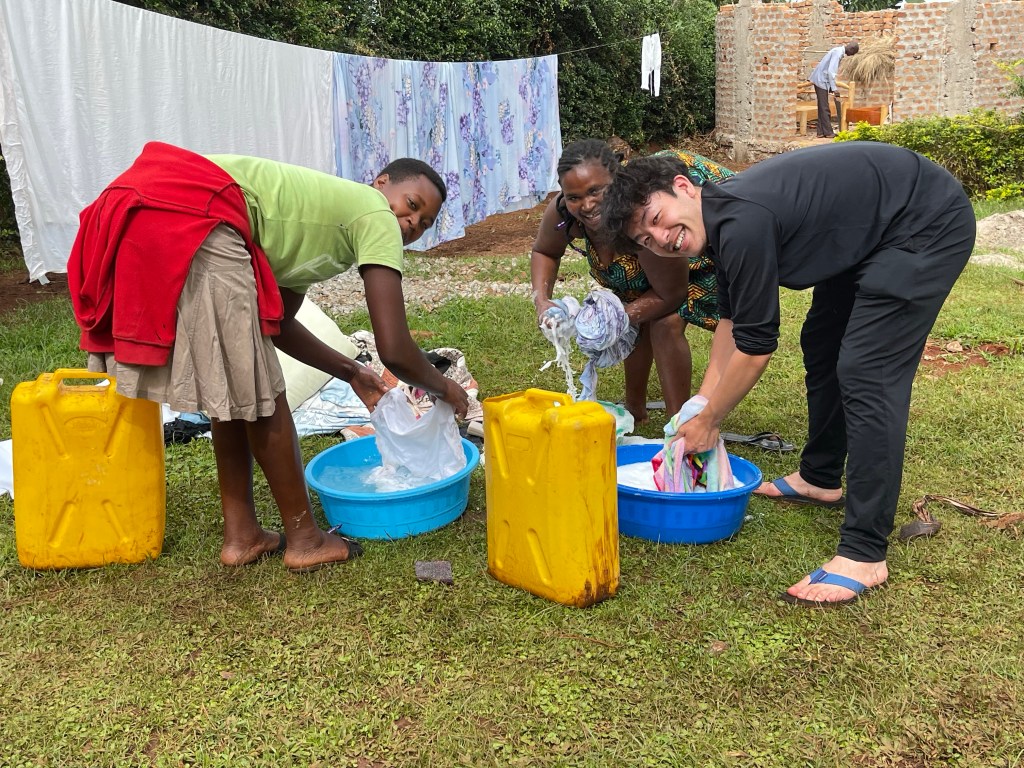
Haruto from Japan, is a youthful charmer. Slow to join in, by his second day, he’s bonded with Precious and is sitting on a low stool in the kitchen watching her cook and helping her with the endless hand washes caused by so many guests. The garden is festooned with bed sheets.
Precious bonds with Anja
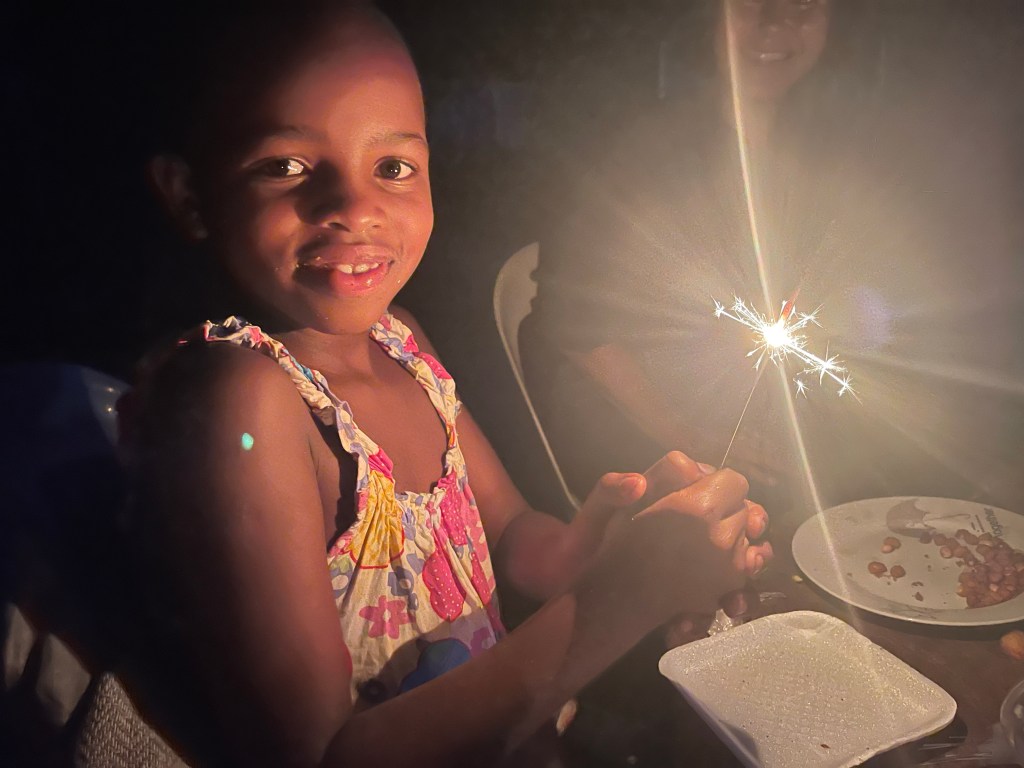
Anja and Peter are from Denmark, Anja of Greenland parentage. We have fascinating conversations by the fire pit, about the competition of USA, Russia and China over the vast wealth of unknown resources that will be exposed by the melting glaciers, riches unseen for ten million years. And the ocean passages that are opening across the polar region. They come for a couple of nights, stay three, go away for one – and come back for a fourth night, they are so relaxed at Rock Gardens. Anja brings sparklers for Keilah and Jonathan.
Jonathan’s first-ever sparkler Keilah gets one too
Helmut, a 70 year old biker from Germany rides in, also on a huge machine. He’s come from Namibia and hopes to ride back up the west coastal route. He’s frightened by an attack of vertigo. Head spinning and unbalanced. I’ve had it a few times and can comfort him that he’s not having a stroke on his African safari. “Sorry, chum,” I say, “it’s age-related!”
***
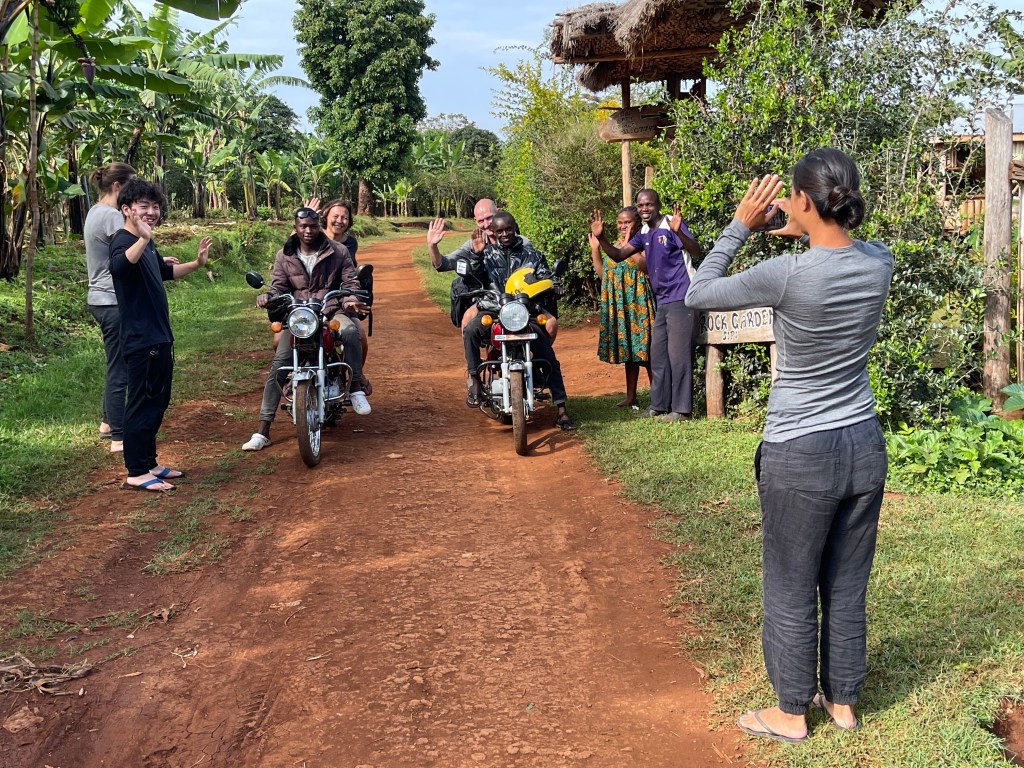
Fond goodbyes as Anja and Peter leave – only to come back two days later!
Guests come and guests go. All are charming, cooperative and relaxed about the building works and compromises they must make to live in our rough-edged place. Alex has to juggle rooms constantly and I must rush in, wet paintbrush in hand whenever I get opportunity. The rugged kitchen, made of wood and cement last year, when I decreed, “You can’t cook for mzungu guests on the floor…” is constantly in operation. Alex is rushing from buying building materials, matoke, ‘Irish’ and chickens to preparing meals and advising his guests. He falls asleep across plastic Chinese chairs by the fire. I don’t get to leave the compound for eight days, except for a quick run to the bank in Kapchorwa, 17 kilometres away, for more money. I wear the same socks, tee shirt and grubby shorts every day. I travel light and can’t afford more clothes spattered with mud and homemade paint.
Precious with endless washing up.
***
But my greatest relief is in Joshua. Joshua is a young Sipi worker, usually words that fill me with gloom. But Joshua is great! A quiet, charming young man, he is self motivated, thoughtful, economic, cares about his work, and gets calmly on – doing excellent work. It’s a first for Sipi. He’s first to arrive, last to leave – and even cleans his tools at the end of the day! Here in Sipi, he expects to be paid a mere 20,000 Uganda Shillings for a day’s work. That’s a little over £4! It’s obscene to think what I get paid for a day’s work in America by comparison… But it’s more than most are worth. The first few days, I tip him an extra 3,000, and he’s quietly delighted. By day four, I up his pay to 30,000 and compliment him every time I pass. He’s restoring my confidence. We work together happily. “We have to keep Joshua as our builder!” I instruct Alex.
Joshua gets a young helper while paddling mud for building
Joshua tells me he has two children, a girl and a boy, and that that is enough: wise thinking in this crumbling country where education is so poor and families of such numerous proportions. As I write, back in Kitale for two days (to do shopping for materials just impossible to source in Uganda), he’s making stepping stones in moulds we’ve invented from plastic paint containers and carrying out various works to upgrade the latrine. He has weeks of work. I trust him.
***
Alex relaxes at last on our hike
One day only, Alex and I get out for a walk. We both need wider views and to forget the work for a day. We drop down onto the edges of the great plains below Sipi’s escarpment and wander in green matoke and coffee for a few hours, before the inevitable puffing clamber up the cliffs again. But we approach too close to one of the waterfalls for my pleasure. Whenever we get close to the attractions of Sipi, there’s jealousy and commercial tension that Alex is ‘guiding’ me for free – my son-like companion. So-called guides compete for business here and insult him and argue over the pennies they lose by me not being a customer – a wallet on legs. A mzungu. We are seen as no more than cash machines. I prefer that we walk away from the town into rural areas, where I am an excitement for children at a crude mud primary school who break into a welcome song for the visiting mzungu. This is why I travel; not to watch water falling over a cliff – something I can admire as I ride past on the road on my piki-piki.
A reason to travel the world
***
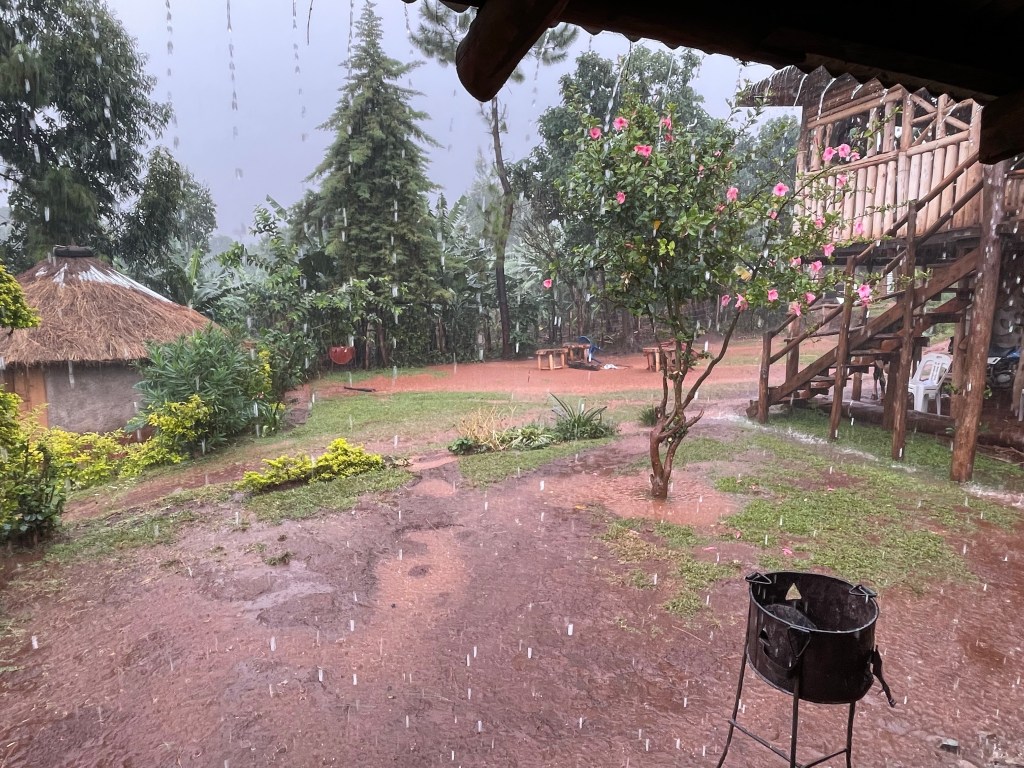
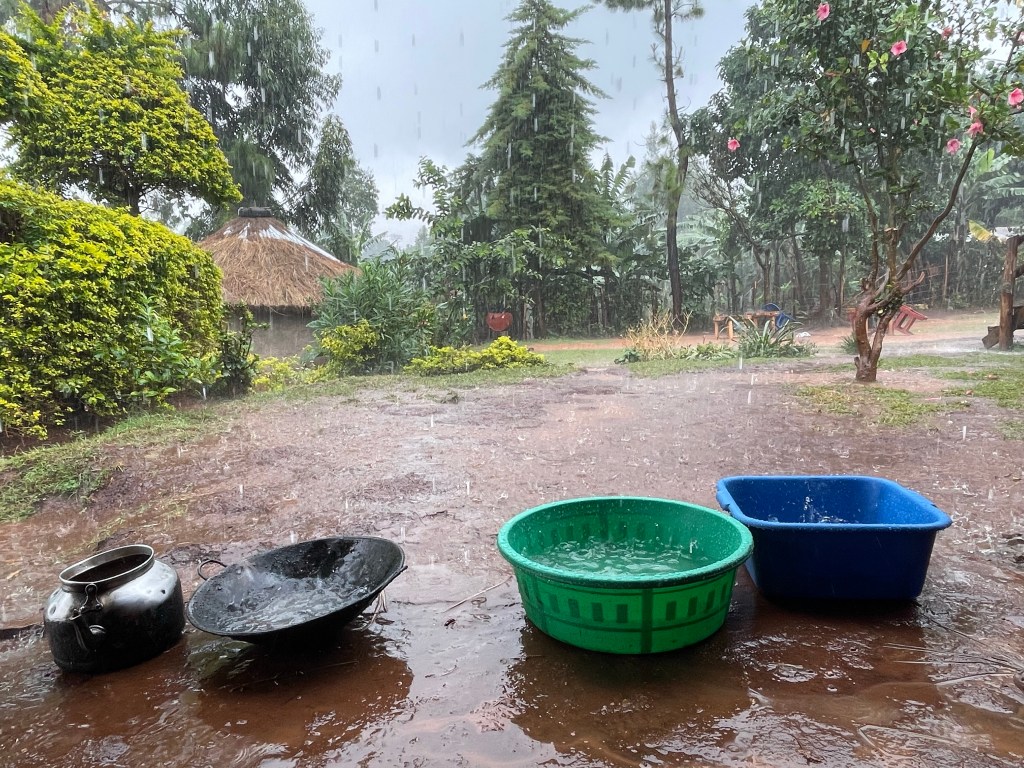
One Rock Garden’s afternoon, we suffer a thunderstorm and cloudburst of biblical proportions! Rain dislodges fir cones like bombs from the high pine tree in the middle of the garden.
Biblical punishment..?
In minutes, we are all stuck in the kitchen, unable to talk over the machine-gunning on the tin roof. The garden becomes a roaring river; the lawn becomes a lake. This should be the dry season, but this is Climate Change at its most extreme. Almost every day we have showers. In the ‘dry’ season… It’s vibrantly green everywhere, but no one knows if they should plant early or wait out the vagaries of the weather and risk failure of crops. What to do? This is the reality of Global Warming, as suffered by those who create the least pollution, but rely most closely on the dependability of regular seasons.
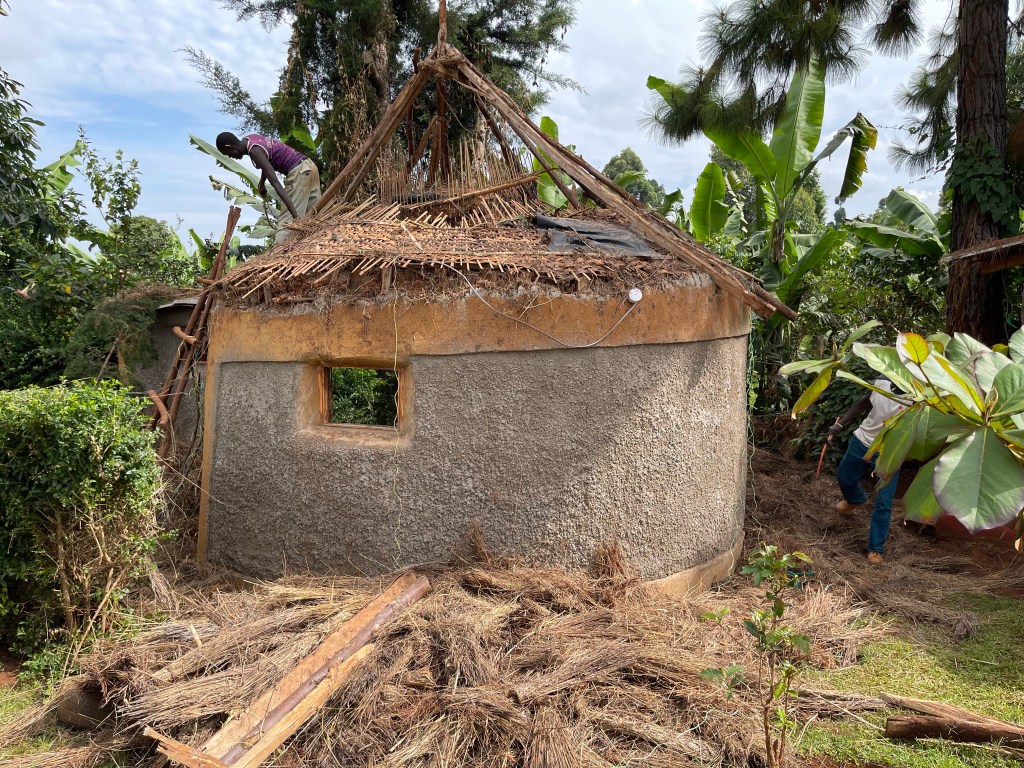
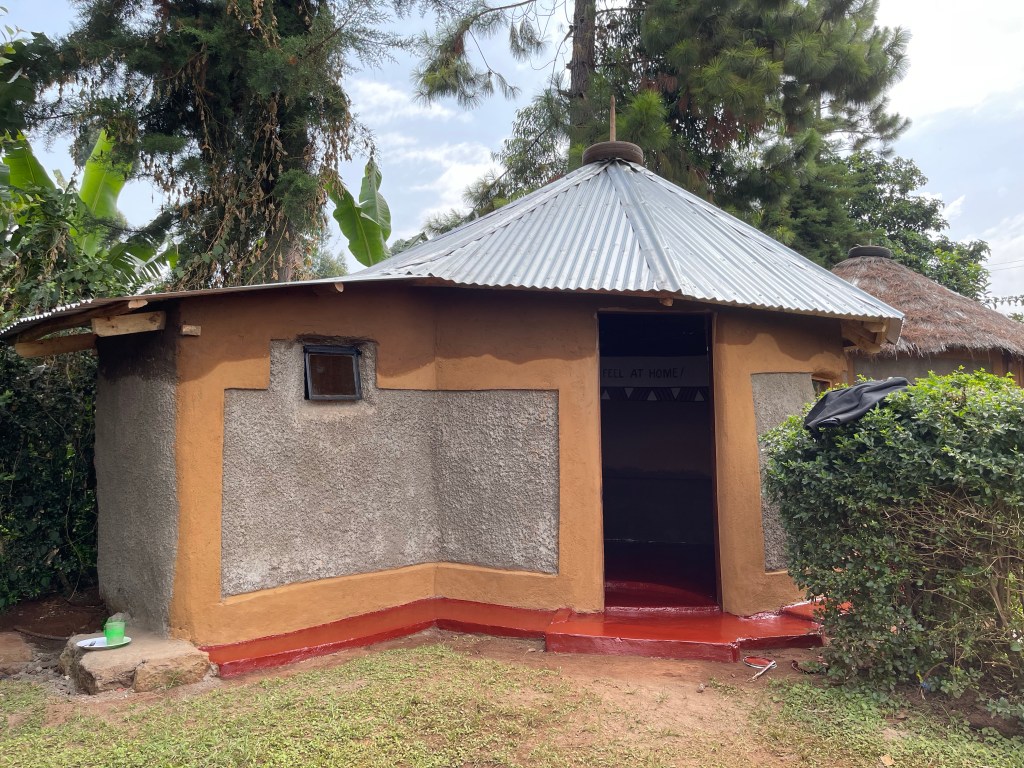
Another consequence for ‘The Money’ of Rock Gardens is that I have to take off the thatched roof of JB2 round house and replace it with corrugated metal, with straw on top. An expense we could have done without. But having dried ALL my clothing and possessions after the storm – fortunately it was me sleeping there that day – it’s an inevitable choice. We have to take the room off the booking system for five days or so; I move into the unfinished, rather damp, new round house, bucket-wash in a corner of the garden, pee in a bucket at night – and workers make the new roof. Then we have to completely renovate the house.
Removing the leaky roof of JB1
One day, Mark the barman comes to me and says, “Uncle Jonathan, I need 50,000 for a crate of beer…” I’m tired and I flip: “Why don’t I pay for the bloody visitors’ holidays?” Then Alex comes for money to buy goat-meat for their supper… So, Alex and I have an important conversation. “Separate Operations from Building. I pay for construction, you take operational funds from income. I’ll invest more money to get the place up to scratch for all the new guests, but YOU pay the bills.” Trouble is, he’s embarrassed to request funds, coming to me endlessly for small sums, when his pocket is empty.
With all the zeros in Ugandan currency, it all appears SO expensive! So, I transfer money to him and he pays the bills. It seems less that way, even though it counts in hundreds of pounds, not millions of an almost useless currency! Odd thing, perception…
Oh well, it’s a good way to spend my pension..!! Haha.
***
But with all my work – and the idea of lying on a beach reading a book is anathema to me as a holiday – I need activity, and this building work suits me just fine – with all that, it’s the children who make my stay so wonderful. I’ve come to love these two so much.
Assistant painters. The colour is natural soil.
However, they now board at school. It’s odd how much I miss them during the week. It may seem callous to send a five year old and seven year old to boarding school. It’s just another reality and practicality here. The government schools locally available are worthless, so Keilah and Jonathan go to private primary school in Kapchorwa, ten miles up the road. For their first years, they were picked up in a school van at 5.30 and returned at 6.45 in the evening (Jonathan was three when that regime started). The van can’t get to Rock Gardens, on its filthy mud track, in the rainy season, so Alex must walk them a kilometre to the road. “Huh, it was costing me in shoes for Jonathan!” and the school van, often out of service (maintenance only when school fees are in, so usually not running for the first days of term…) carries about 50 children. The road to town is extremely dangerous and the drivers tired. So Alex made the decision to board the children from Monday to Friday. The cost is a bit balanced by not paying for transport, and the children get basic food and accommodation in rough dormitories. And accept it with pleasure! Both love school and are bright, intelligent small people. It’s only we who miss their cheerful company and Jonathan’s endless chatter. “Uncle Jonathaaaan…” His school clothes are embroidered across the bottom: ‘Cheptai Bean J’.
So I make sure I am there for two weekends, and have now returned to Kitale midweek, to ride back tomorrow, Thursday, laden with floor paint, zebra fabric, shower curtains and tile cutter, to work again for a few days. My time is running down now, just 18 days to go before I am back to the rain and gloom of Devon. At least after rain here, the sun shines again! It’s been a different visit: Family, not Adventure. But for an obsessively independent old bloke, maybe family IS an adventure! Here in Kitale, I am welcomed like a brother and uncle; in Sipi a father figure and grandfather. Not a bad development in life! Not bad at all.
The roof goes back on JB2. To be disguised by straw
***
But I still haven’t told you why I was painting a zebra’s bum on a wall in Uganda!
But the painter has to sleep in a building site…
I’d painted zebra stripes in JB3, in panels on the wall. I brought some prints taken from the internet as inspiration, and developed a blister on my finger freehand painting with a small brush, nasty black oil paint on vinyl silk from Kapchorwa. I needed to ‘round off’ my design into the bathroom area. “Has anyone got a connection to get me a Google Image of a zebra’s backside?” I asked at the fire pit. Fiona went one better. “Here, it’s pictures we took in one of the parks!” Close ups of those bizarrely beautiful animals. And their backsides.
So, round the corner of the bathroom entrance, I extended the zebra panel into a flapping tail. A visual joke we all enjoyed.
The zebra’s bum!
***
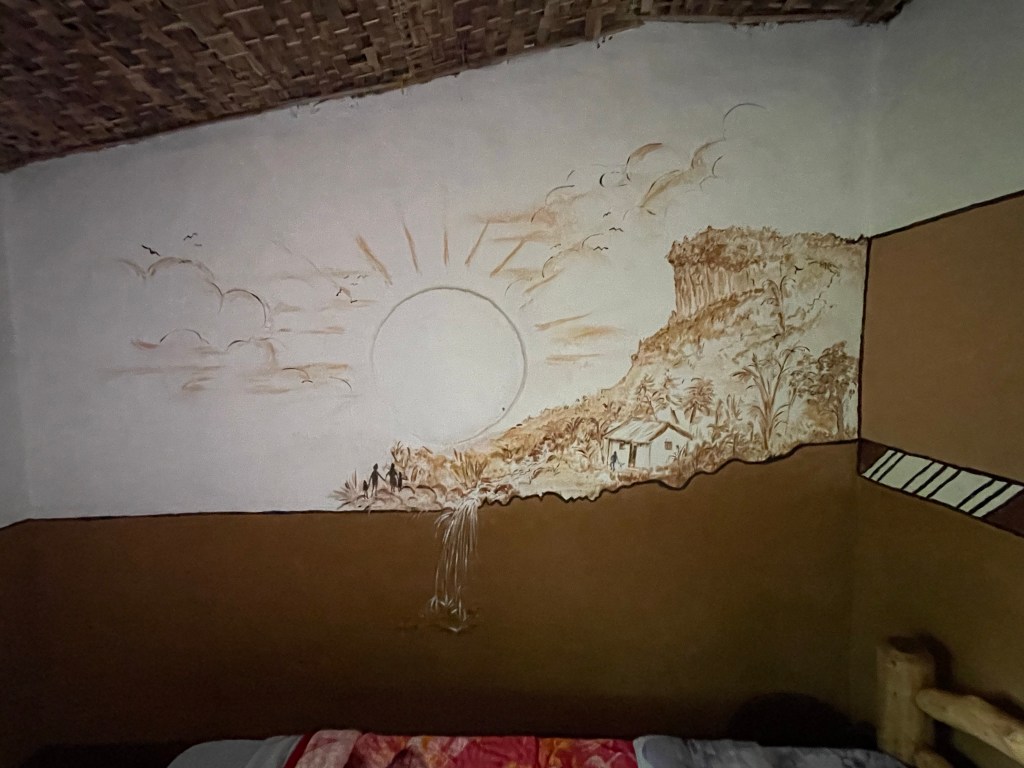
In another room, I painted an illustration (in brown earth paint) of the round houses and the tall pine trees. In front, I drew Elio, the cow, the friendliest cow in Africa, who actively seeks human company. One night, by the fire pit, she puffs heavily beside us. She’s pregnant and Mark, the barman, has worked with cows. Everyone lifts her tail and views her backside. Silly animal, she loves the attention. Mark declares that he thinks she’ll soon give birth, maybe next day. How exciting, Alex and I think, as Precious rubs Elio’s neck in sympathy. Amusing animal, she loves it.
How disappointed we were, not to wake to a new Rock Gardens member, but a big fat cow that had had indigestion..!
A wonderfully foolish animal! Elio the cowAnd finally, an insect disguised as a leaf lands on my leg

















 jonathansjourney.net