EPISODE TWO 2025

IT’S TOUGH, AFRICA

6th JANUARY 2025

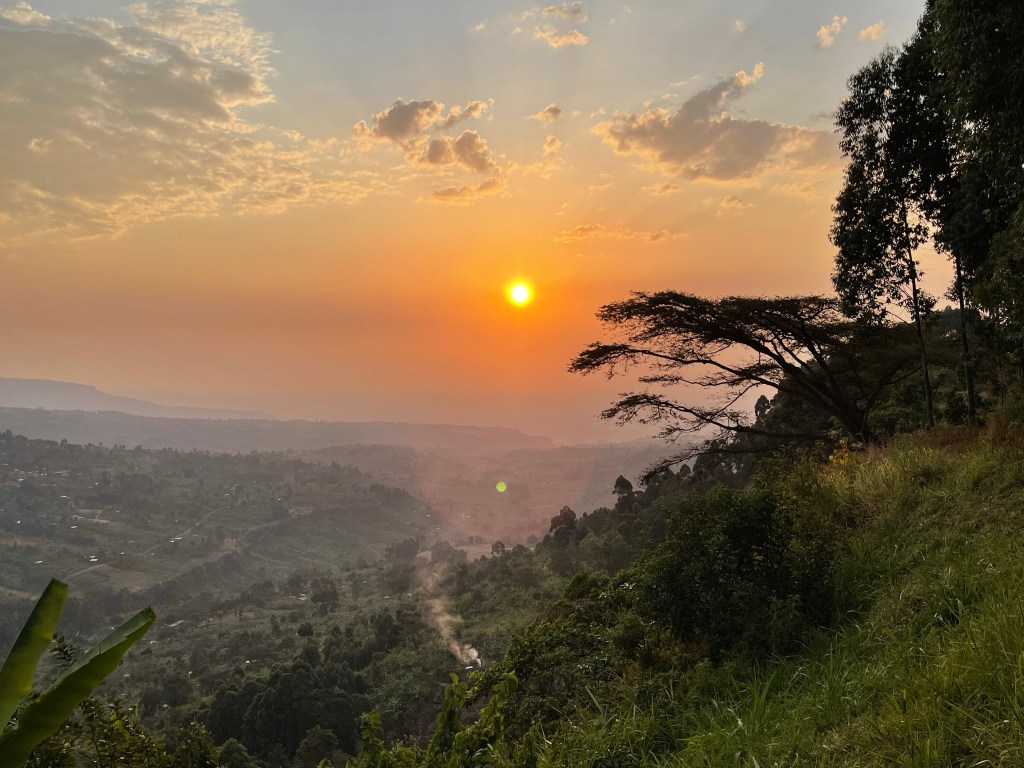
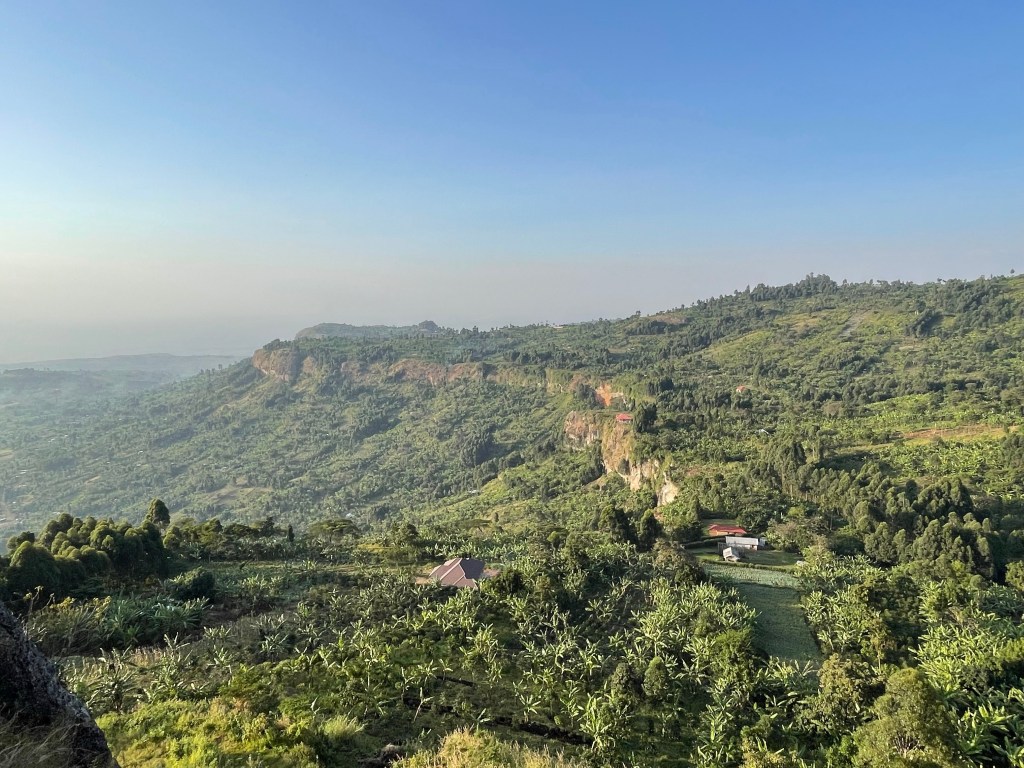
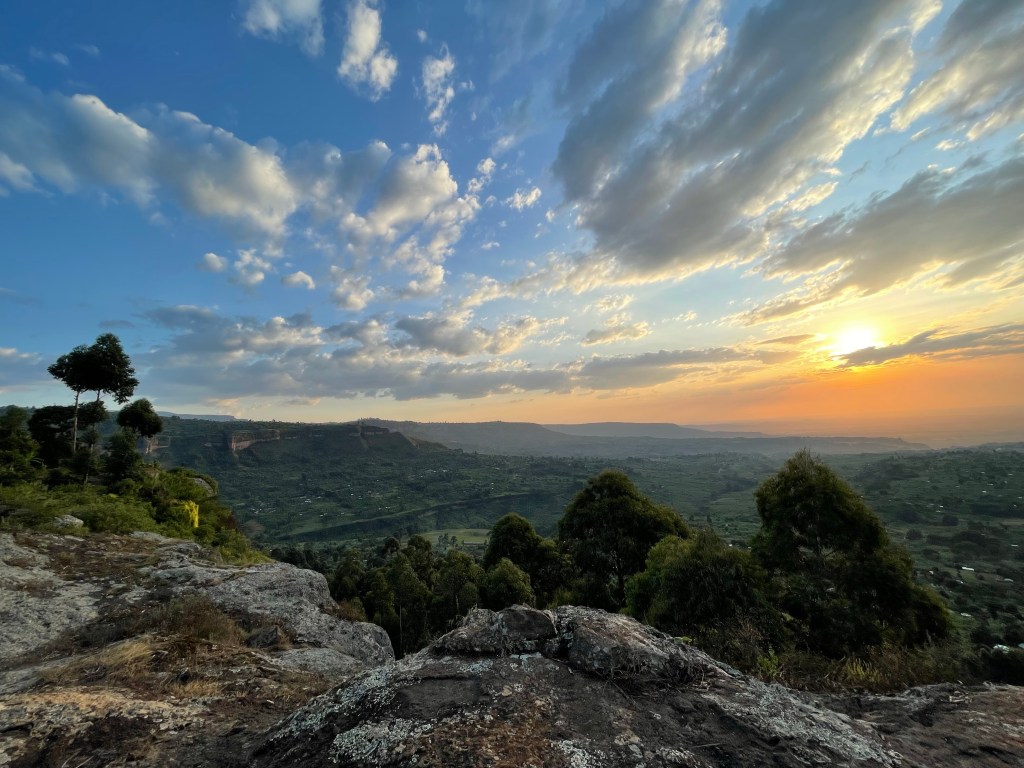
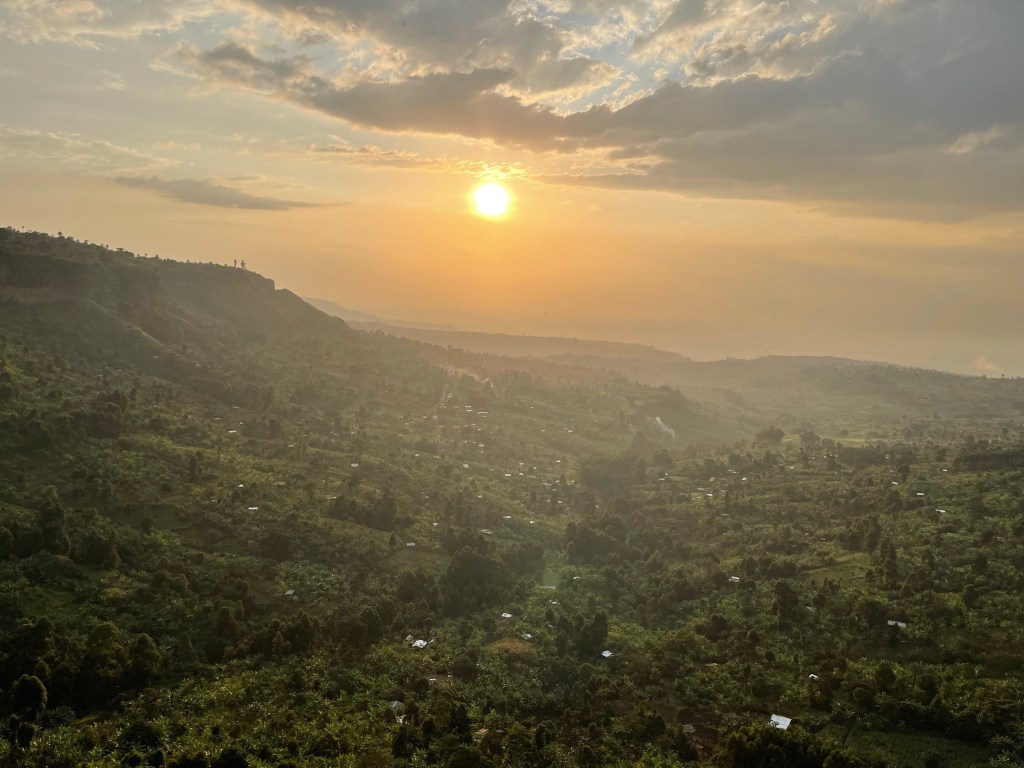
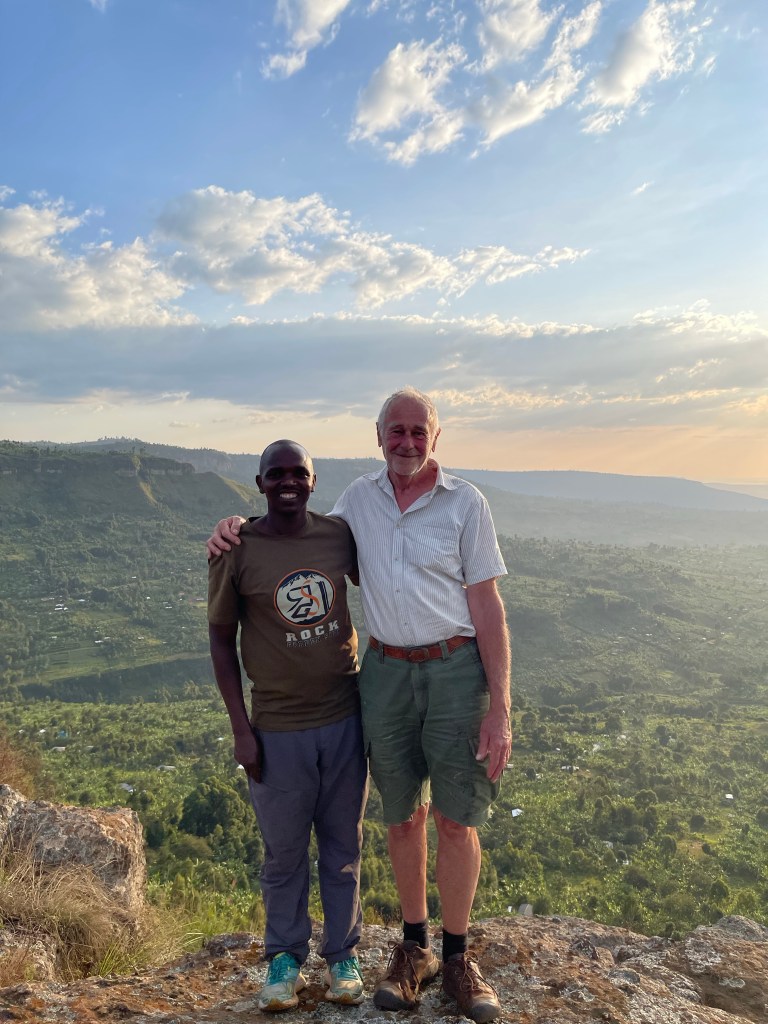
Sipi sunset

Grandfatherly duties take a lot of time, hence the long gap in my updates. Well, they’re not duties of course: they are pleasures; pleasures I never really expected to enjoy until I gained my two surrogate grandchildren in my ‘old’ age. A great gift.

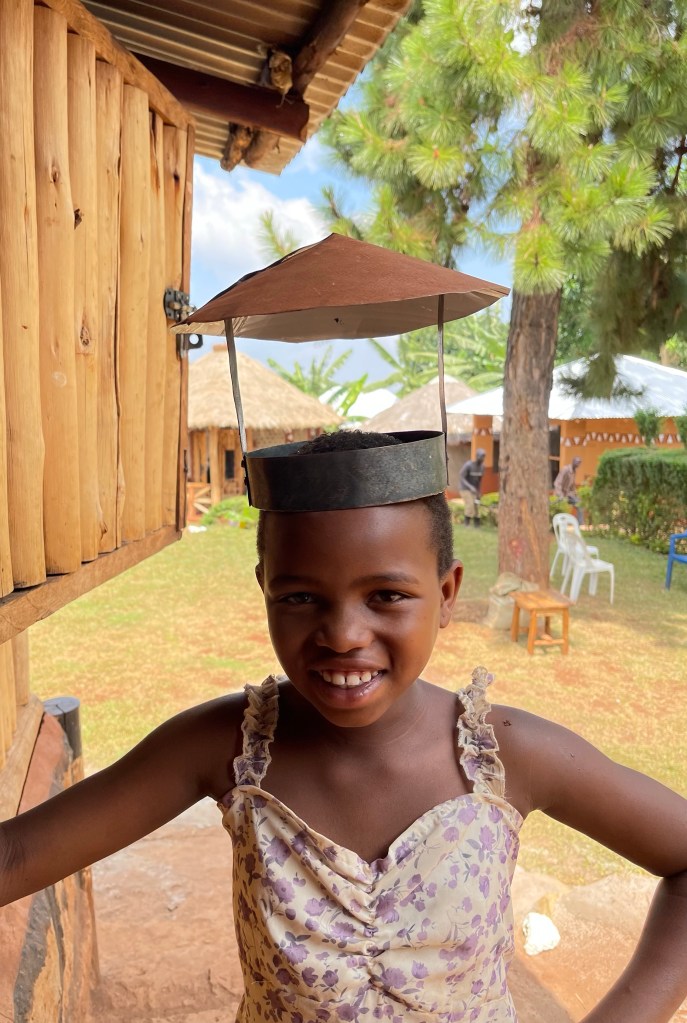
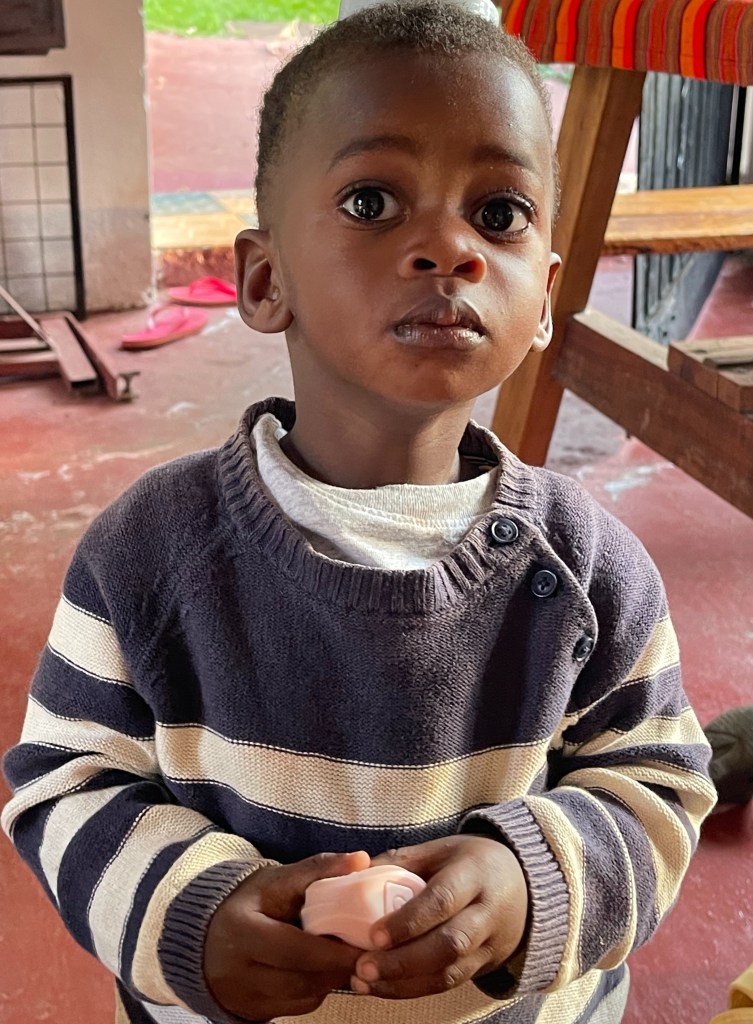
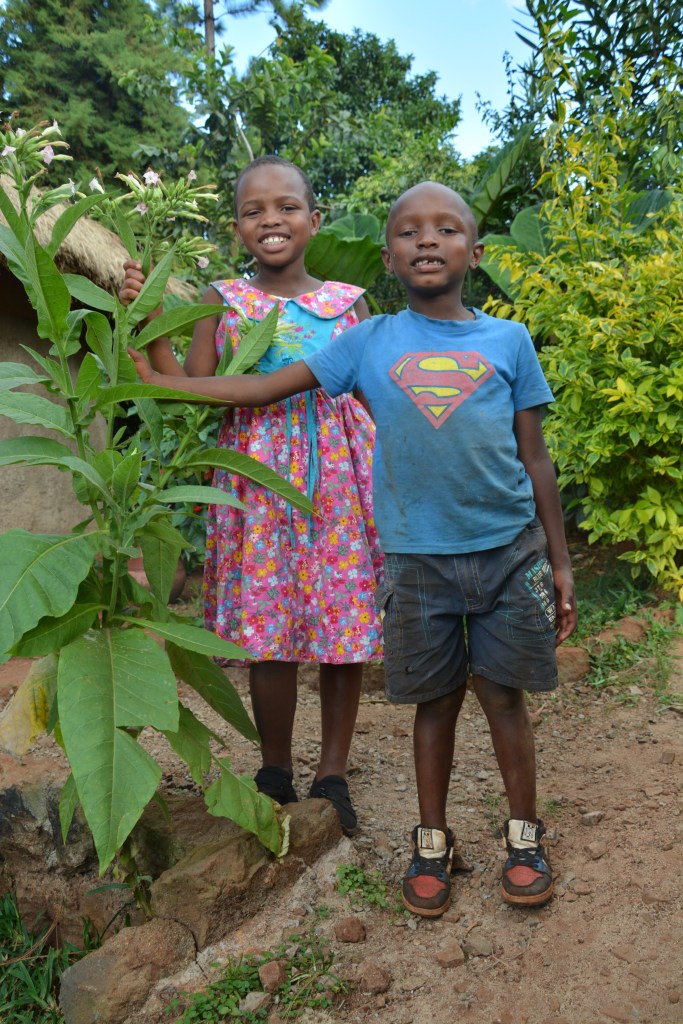
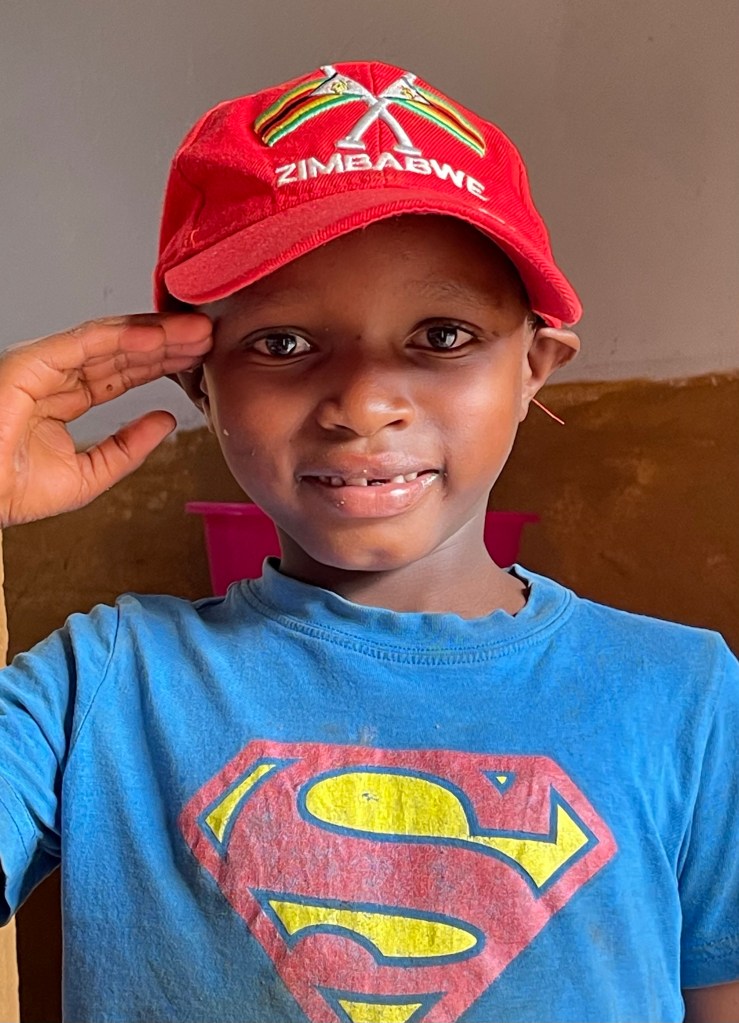
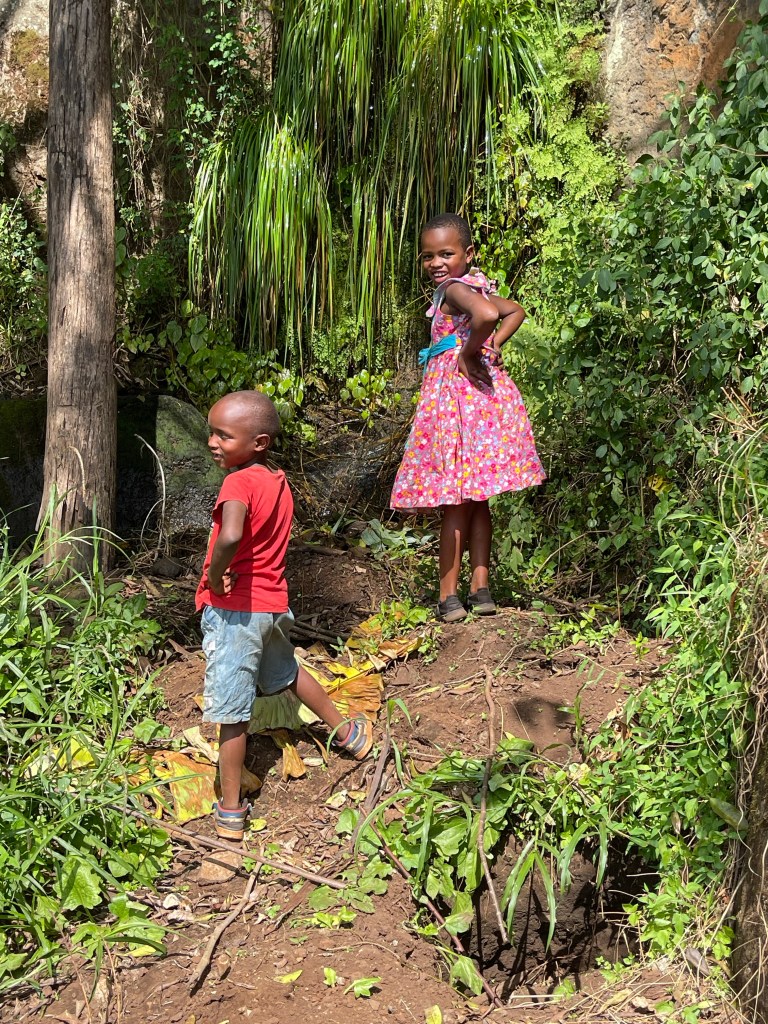
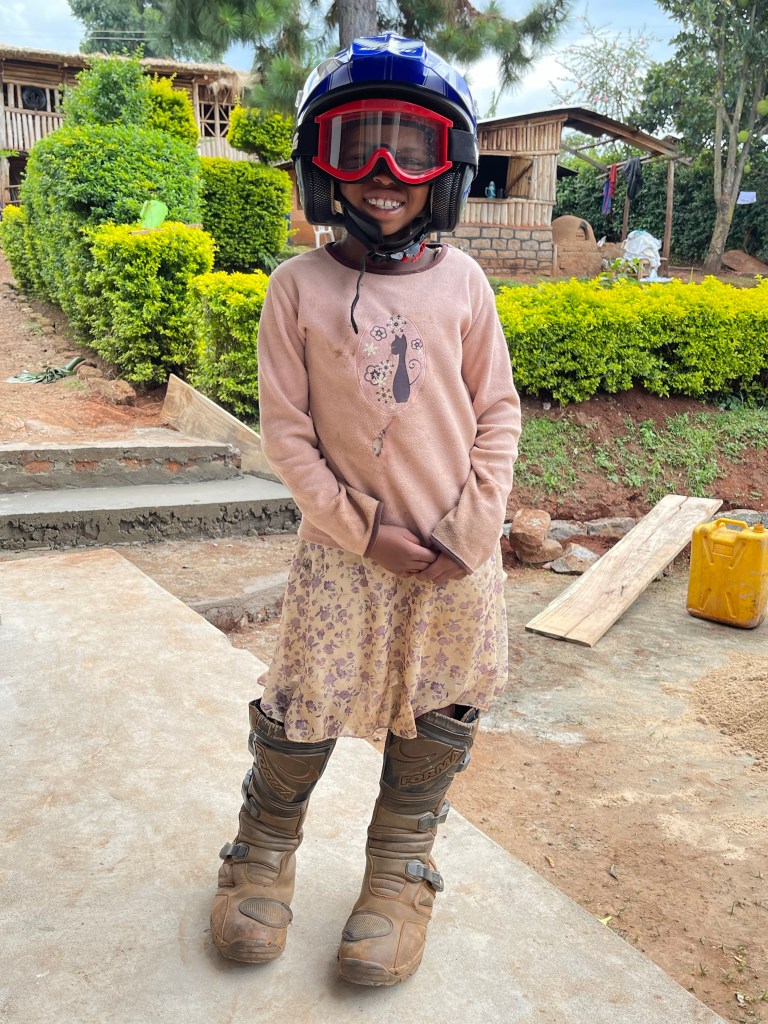
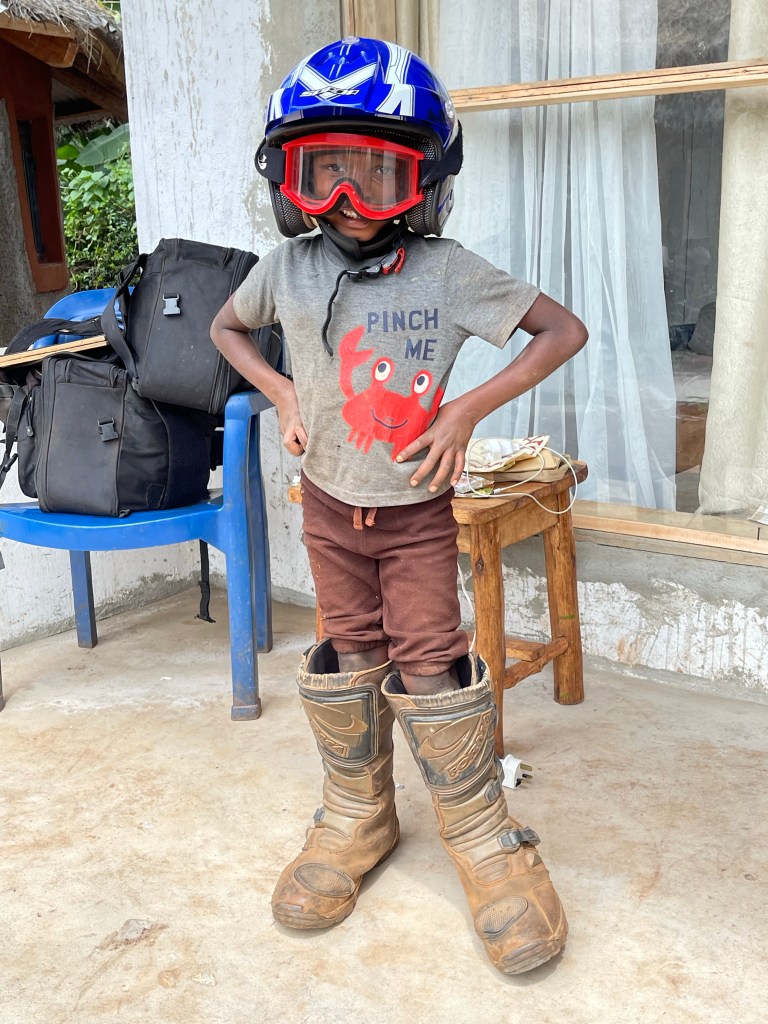
Keilah and JB

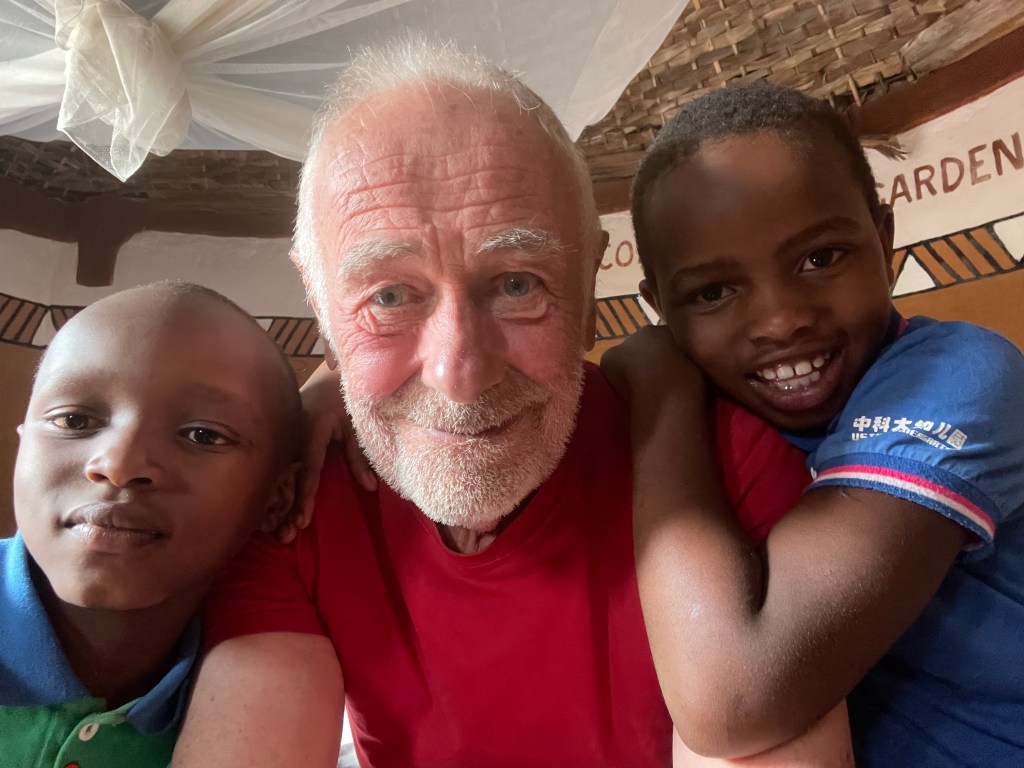
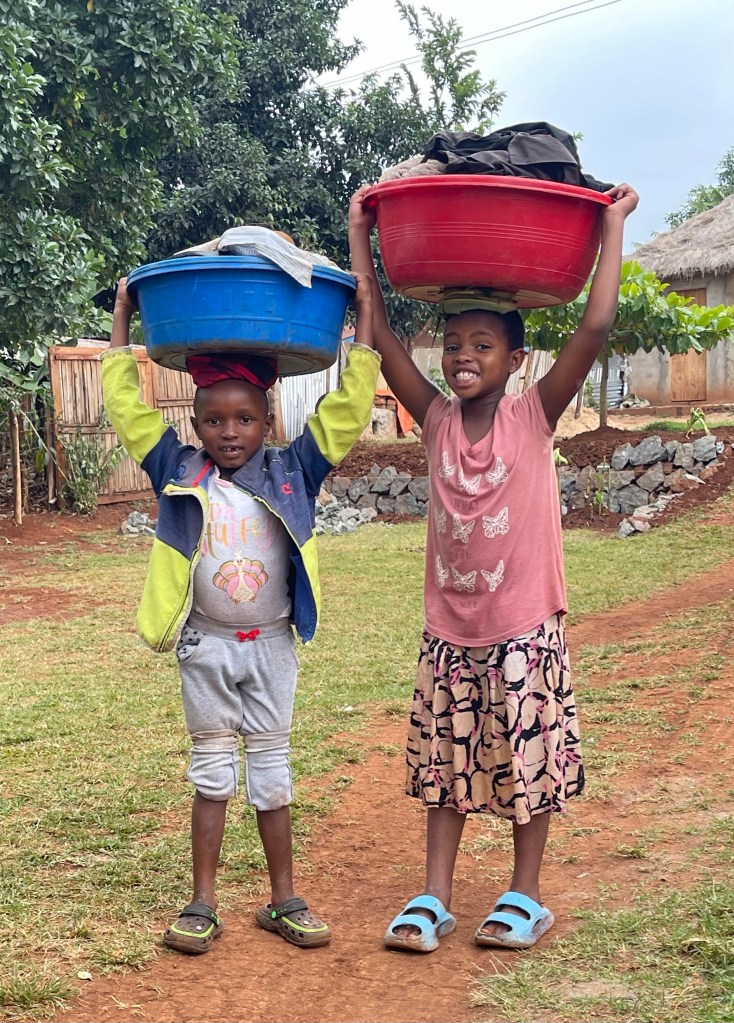
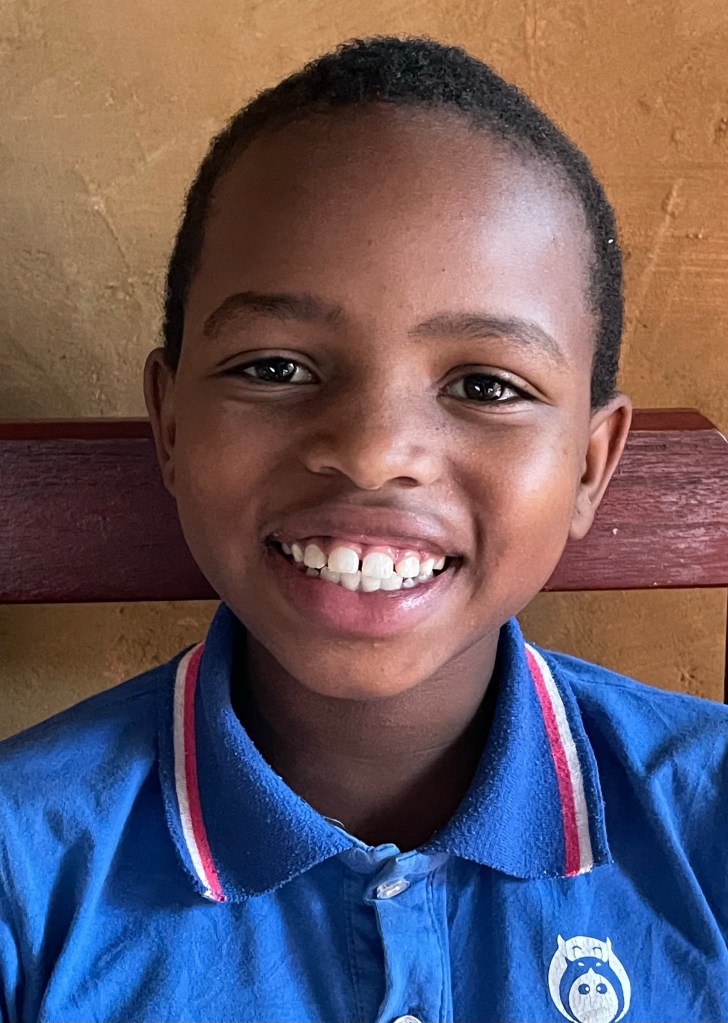
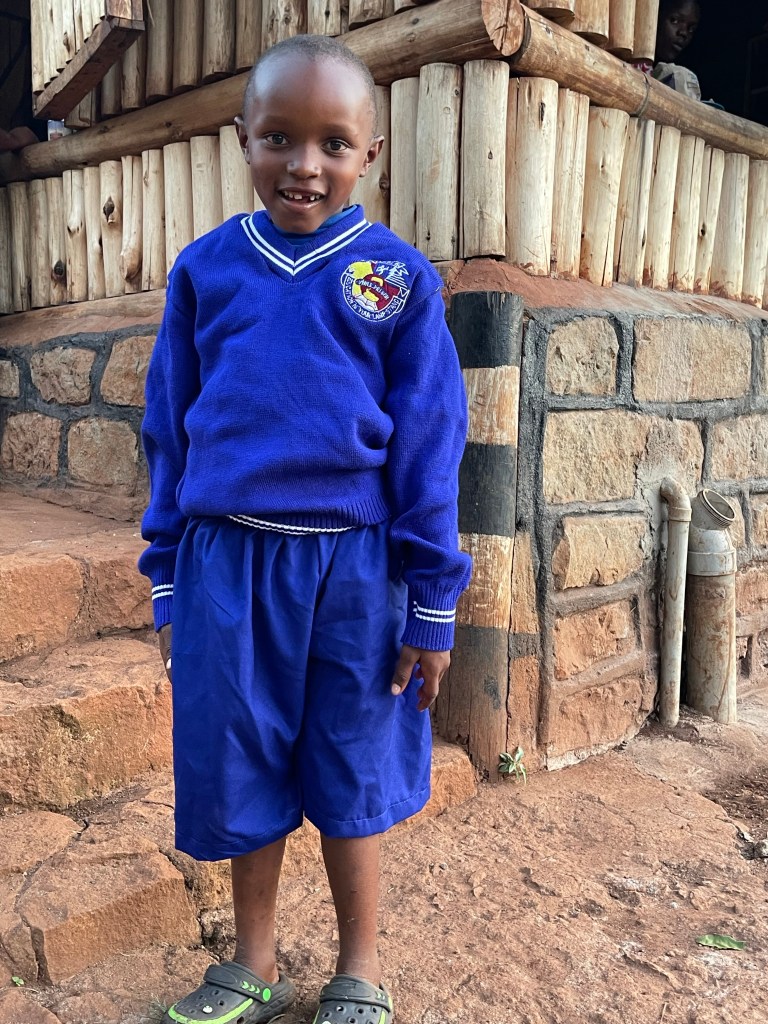
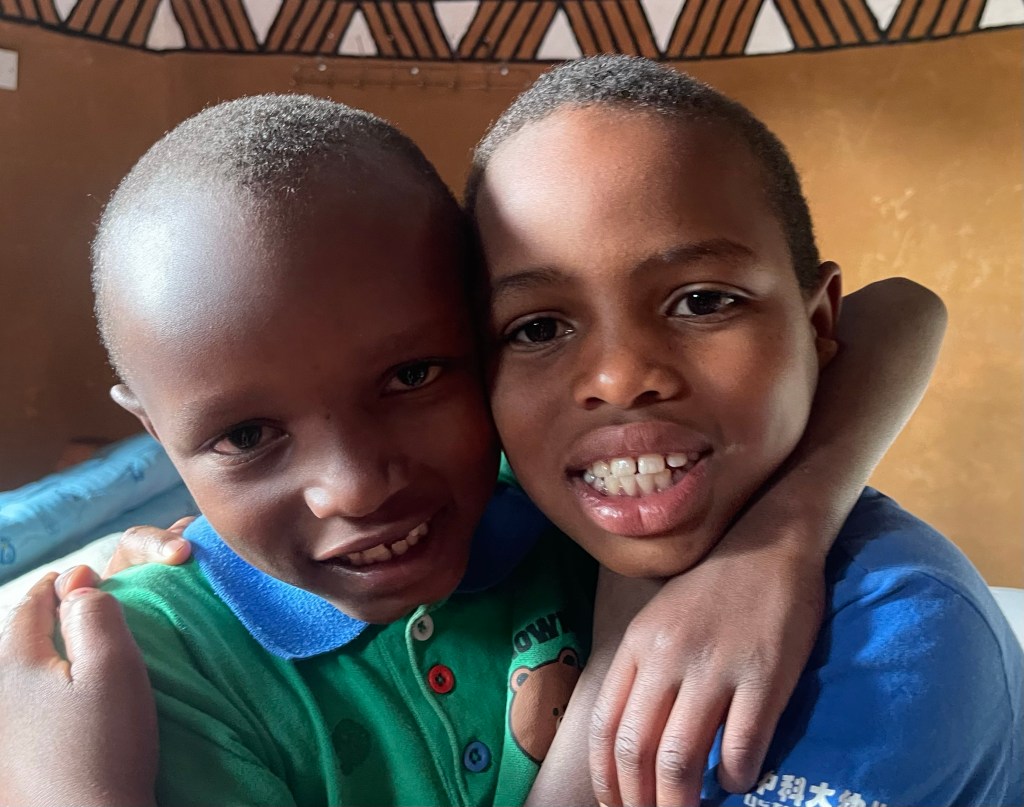
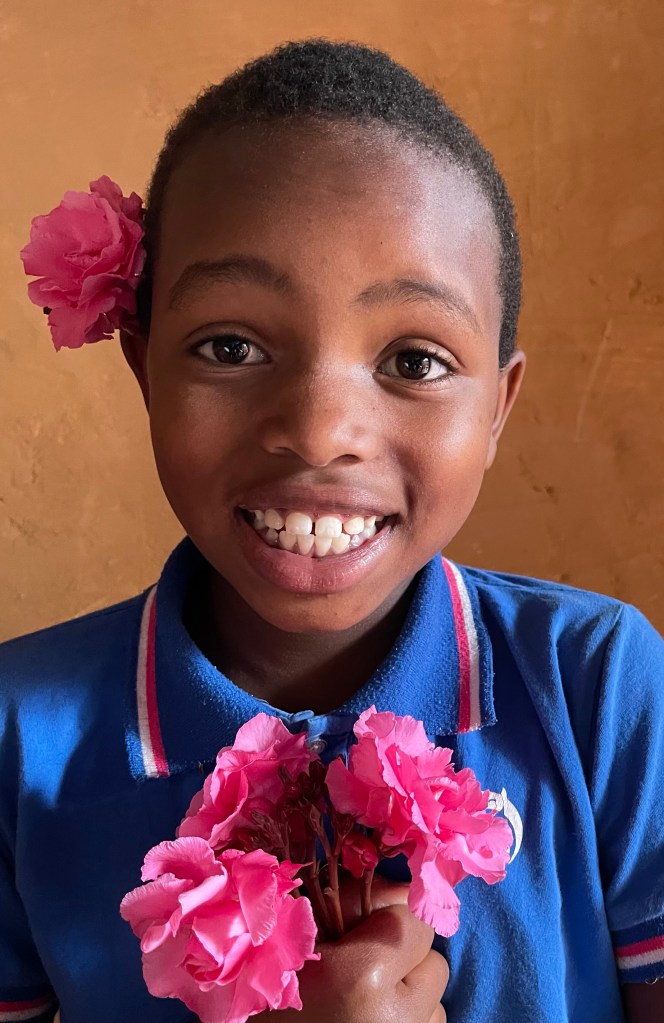
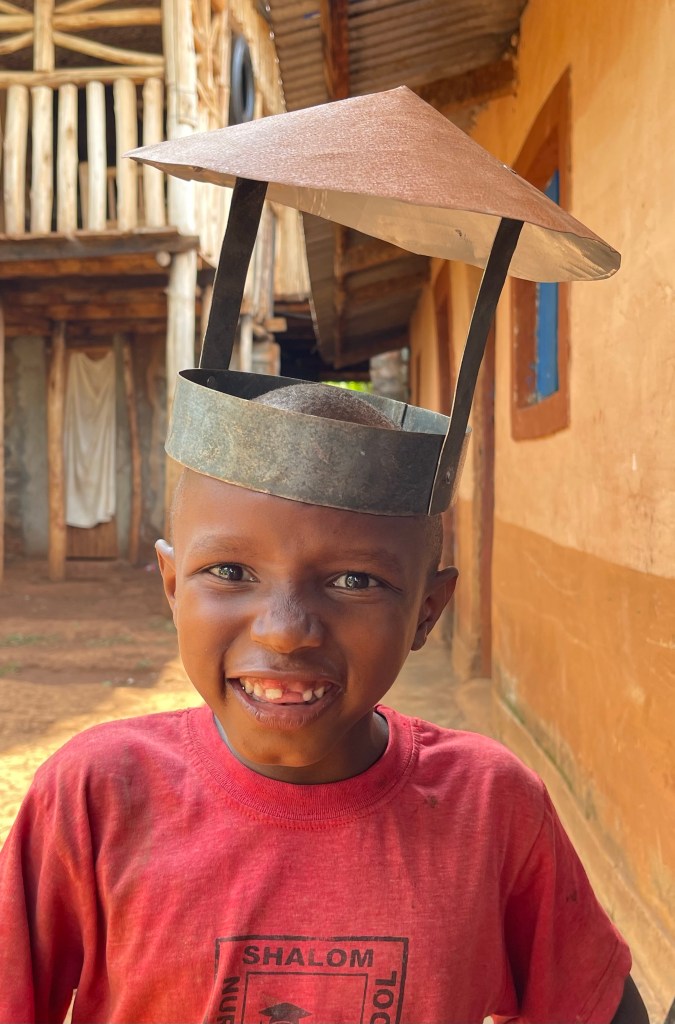
My favourite African, charming little Keilah, eight years old, is a warm-hearted, unsophisticated but intelligent little girl. We rather love each other! Jonathan Bean is a boisterous fellow, just turned six years and full of life. He copies most of Keilah’s actions and they entertain one another happily, with few spats or battles, perhaps thanks to Keilah’s patient nature. They join in the household activity, as most African children do in a culture without ‘labour saving’ devices. Washing all the guest house bedsheets is a constant chore carried out in the garden in plastic bowls; cooking is over smoky open fires or charcoal; cleaning is with hand-brushes and cloths. Ask the children what they’ve been doing, and the response is invariably, “Sweeping…”

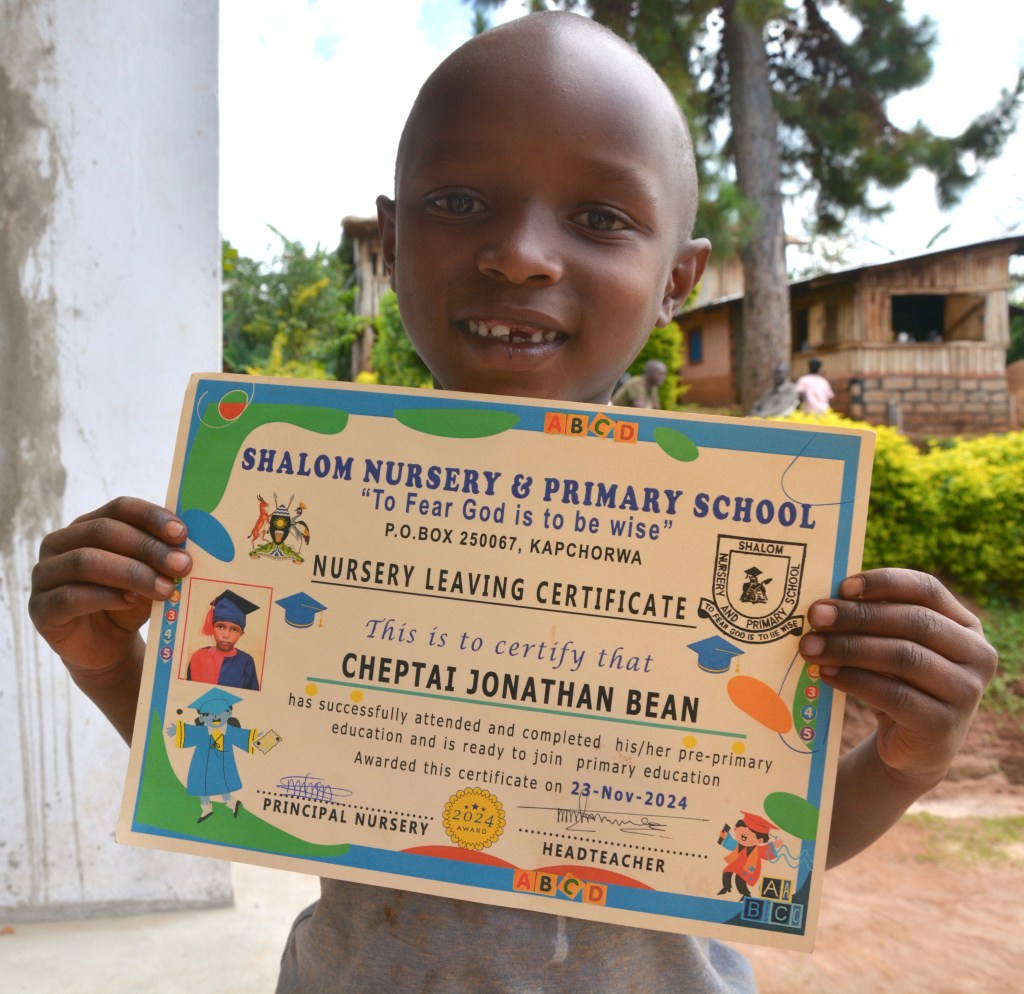
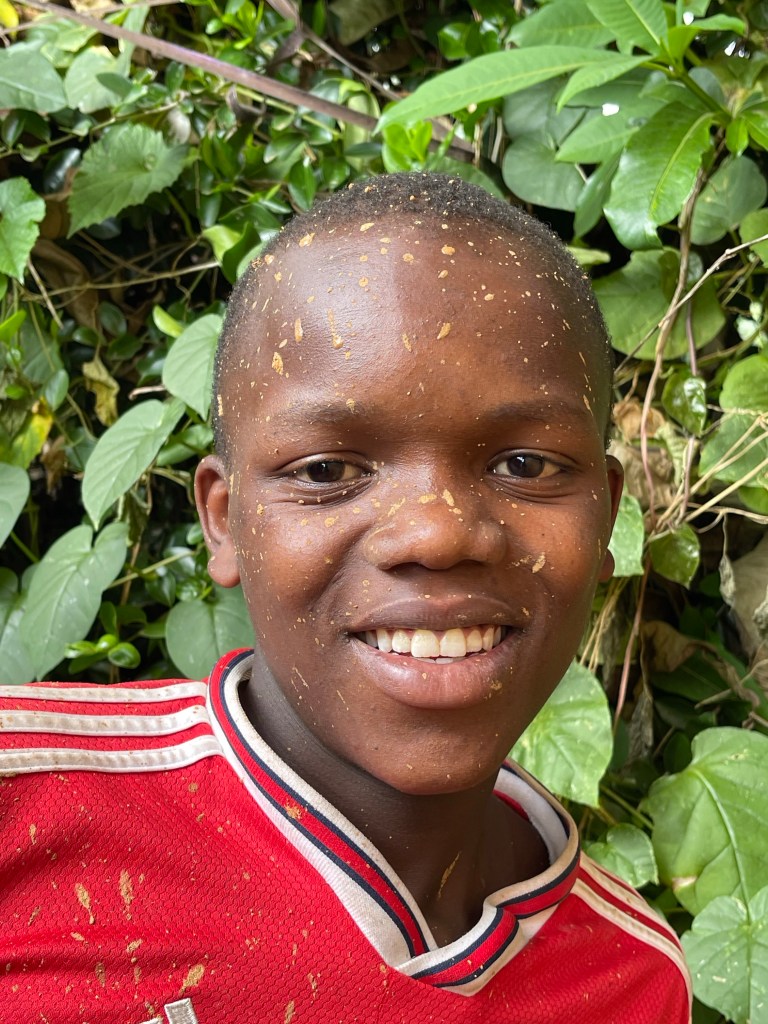
JB – ‘Beans’

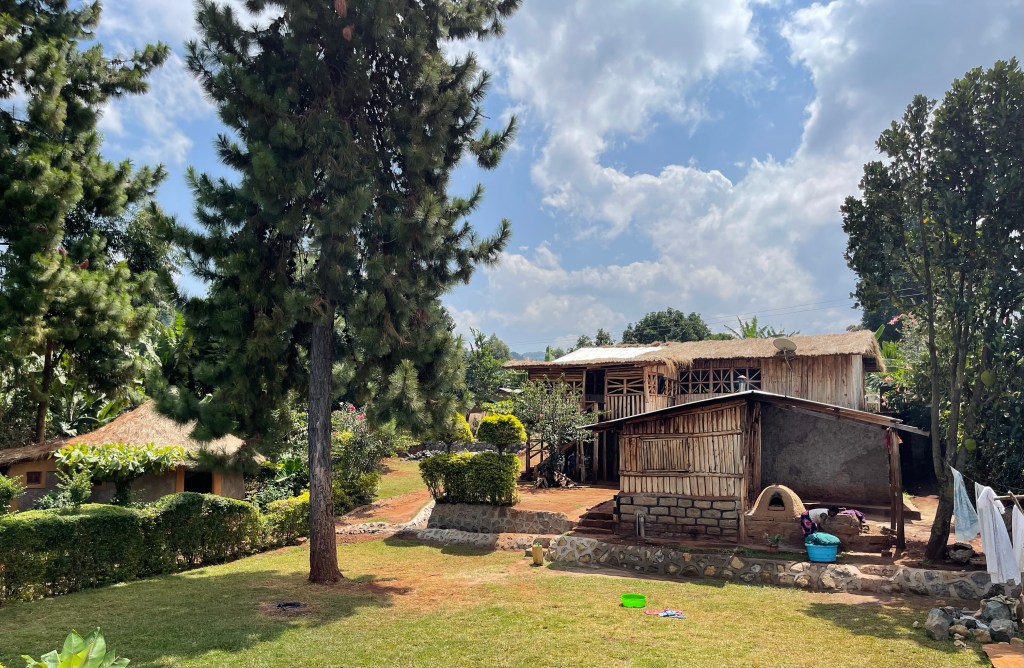
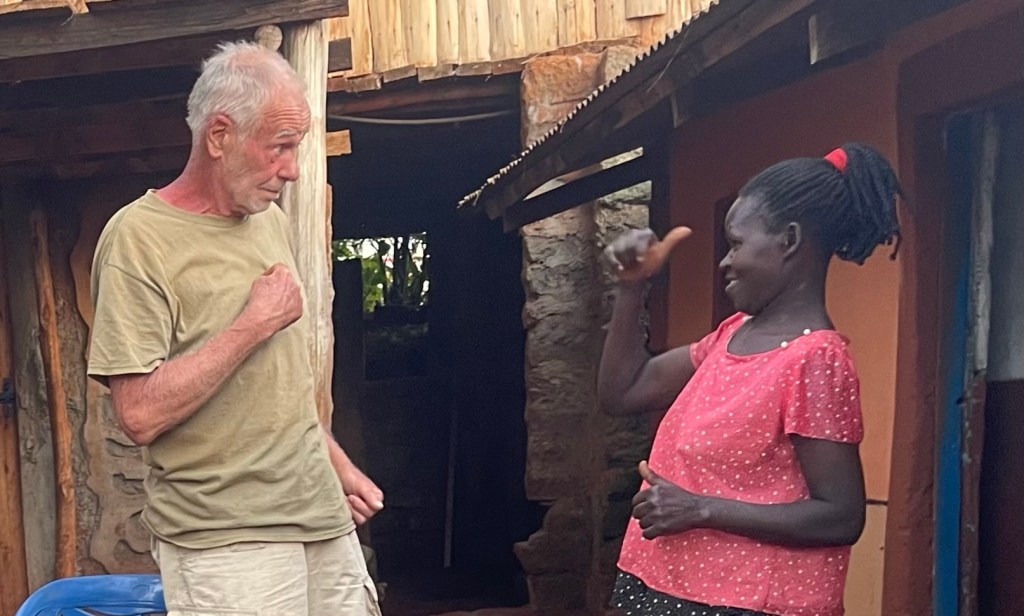
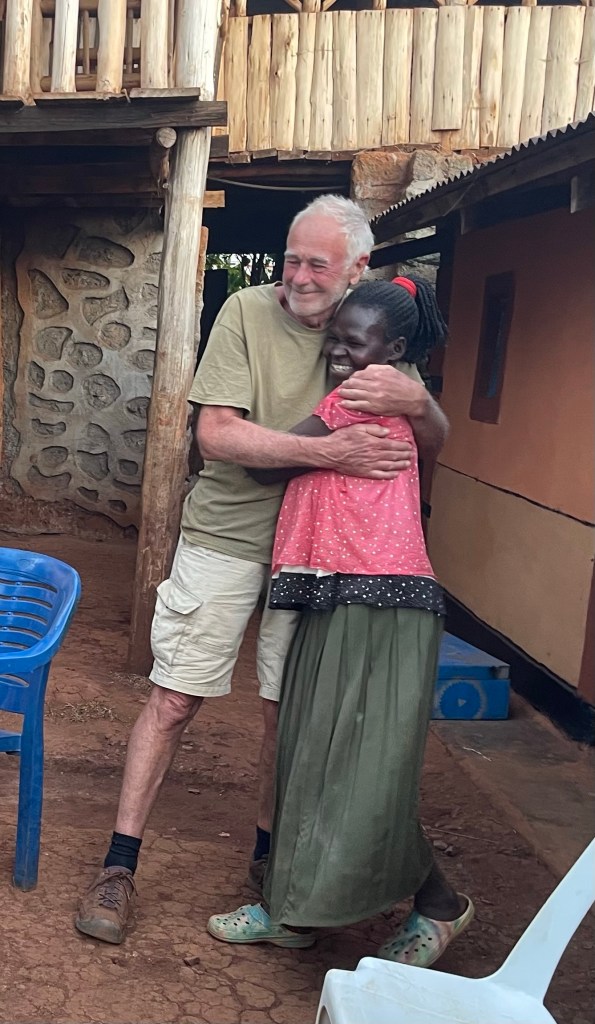
Now they are growing I don’t get wakened at their whim, but they watch for the door of my house opening, my signal that I’m ready for my morning hug and greetings. We breakfast together up in the crazy wooden restaurant, product of Alex’s imagination, all formed from wooden poles, elevated ten feet above the compound, decorated by me with line drawings in mud paint of local activities and scenes. I’ve come to love these two children – and perhaps I’m at a time of life to fully appreciate the joys of having small children around. I never felt the paternal instinct – too restless and free spirited for that, but I DO like children and finding two such delights now is a great joy. But they do demand attention that prevents the peace to sit and write…

****

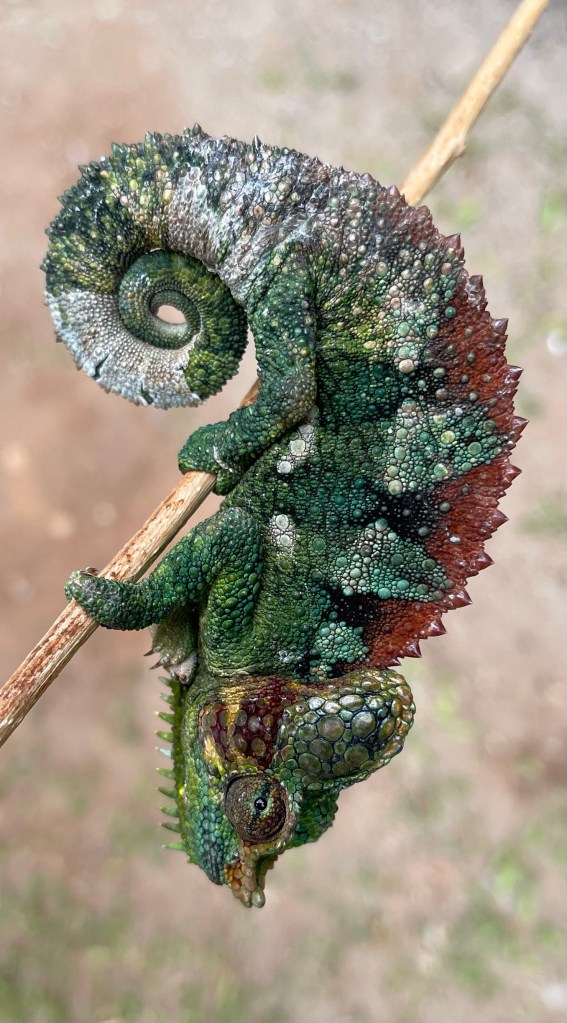
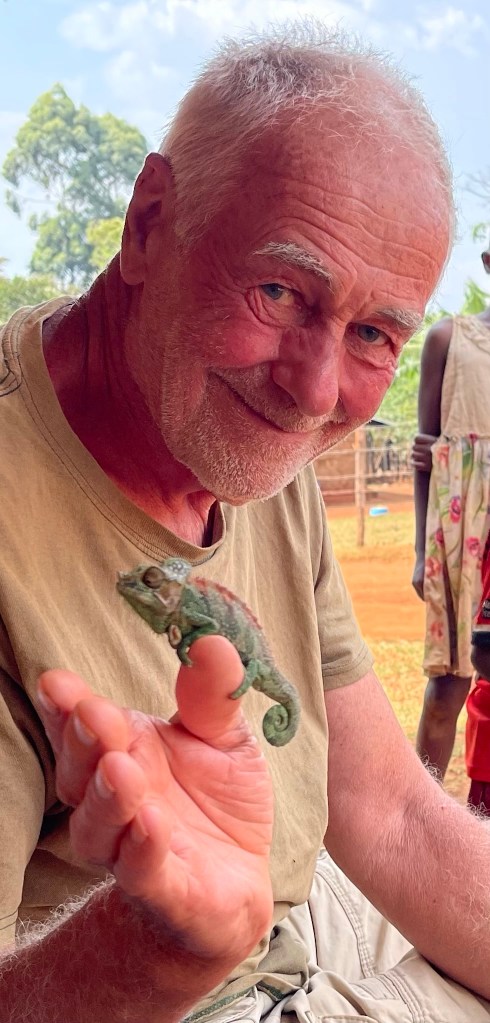
A magnificent chameleon. Great colours!

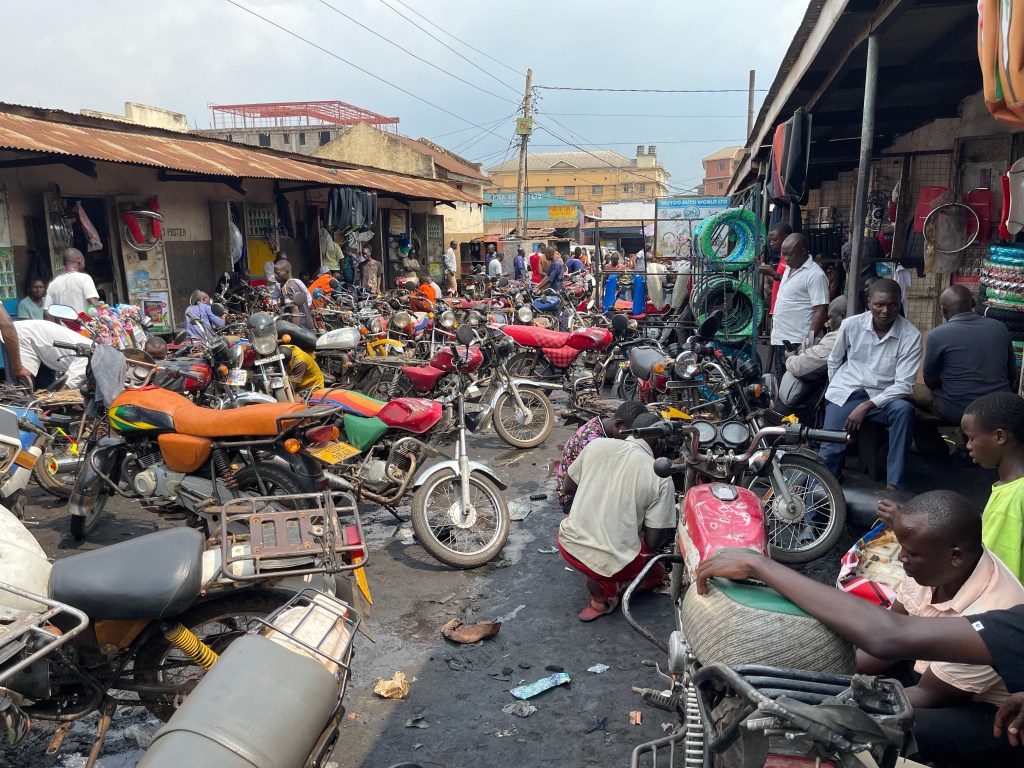
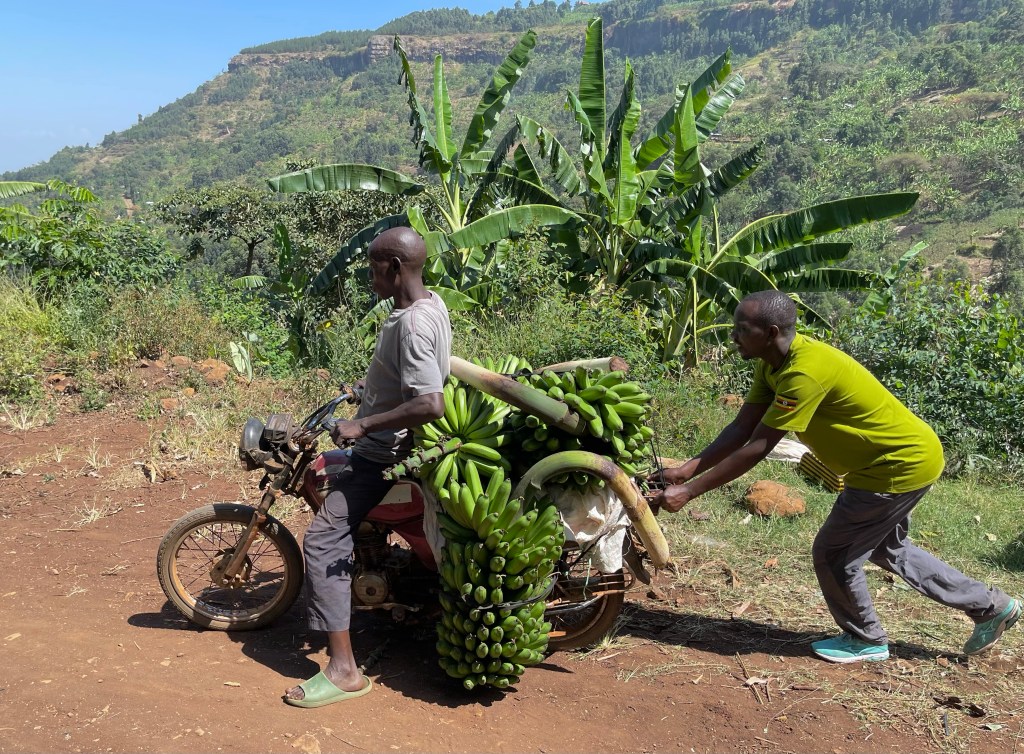
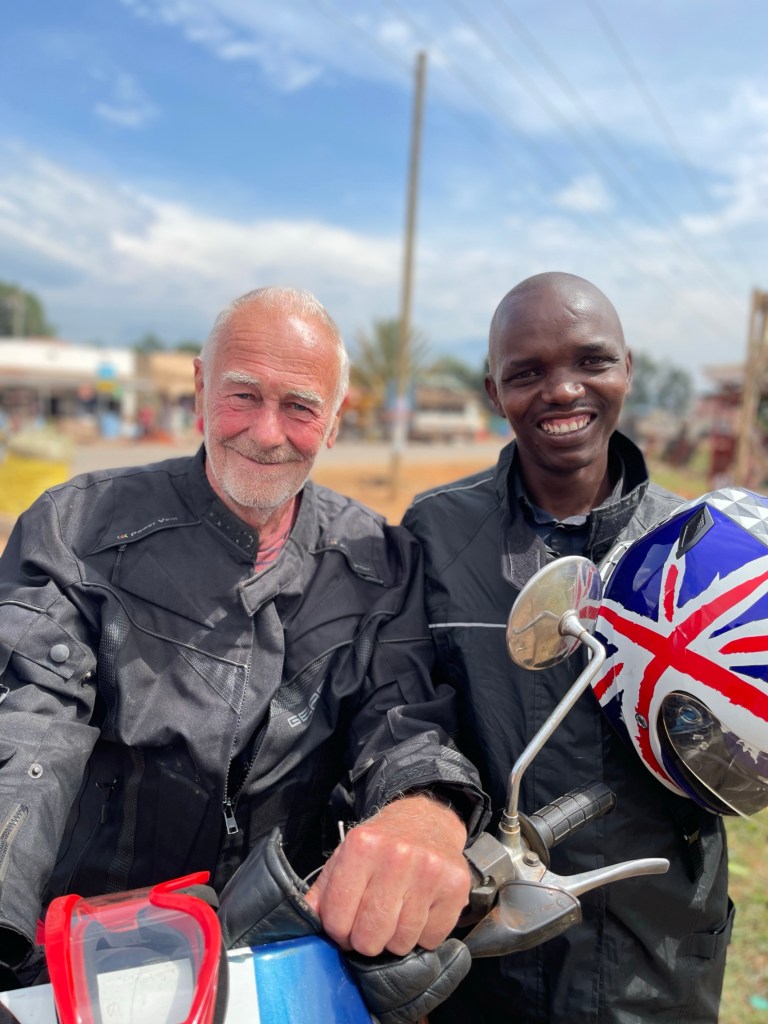
I rode round the mountain on December 28th, now a fine quick ride on the sweeping Chinese road. It’s twenty yards wide and empty of traffic, except local boda-boda motorbike taxis and a few labouring local trucks. Why the Ugandan government has elected to build this expensive folly, and the extravagantly vast ‘One-Stop’ border post (built by the Chinese State Construction Corporation…), is impossible to understand. No articulated trucks, the traffic that blocks the lower altitude border posts between Kenya and Uganda, is likely to opt to drive over these high mountain shoulders, with steep inclines and curving tarmac. And few tourists come this way to be impressed by the hubris of the ‘One-Stop’ border post, another source of immense debt to the rapacious Chinese government’s economic colonisation scheme. In lieu of debt repayment, China last year seized ownership of Entebbe Airport, Uganda’s state airport. (They tried to get Nairobi’s airport last year, but the Kenyans united in objection…) China does nothing for free, and the president is well entrenched in their pockets. Poor Africa. The British stole their resources for 150 years; the Americans imposed their hideous cultural colonialism; then the Chinese milk what’s left, providing apparently cheap loans that come with vast cost – repaid in land grabs of mineral-rich untapped mountains and deserts and natural resources.

The unhurried border officials recognise me now. My passage, with my hard-fought six month multiple entry visa causes a little consternation to Betty, the immigration officer, who has to consult her superior, but is apologetic for the delay. Business is still done by the same few officers in what appear to be huge garages; there’s been no progress with the giant architectural folly since March. Priorities are perhaps best proven by the only large poster in the Kenyan immigration offices: ‘8-ball English Pool Official Rules’. The pool table has been the centre of activity for the seven years I’ve been coming this way, since the days of the broken gate, the dust-covered tin huts, the concrete colonial bridge from 1956, and the rutted goat track across the rugged mountains. This time, I arrive at lunchtime and must wait upon the immigration officer’s whim.

****
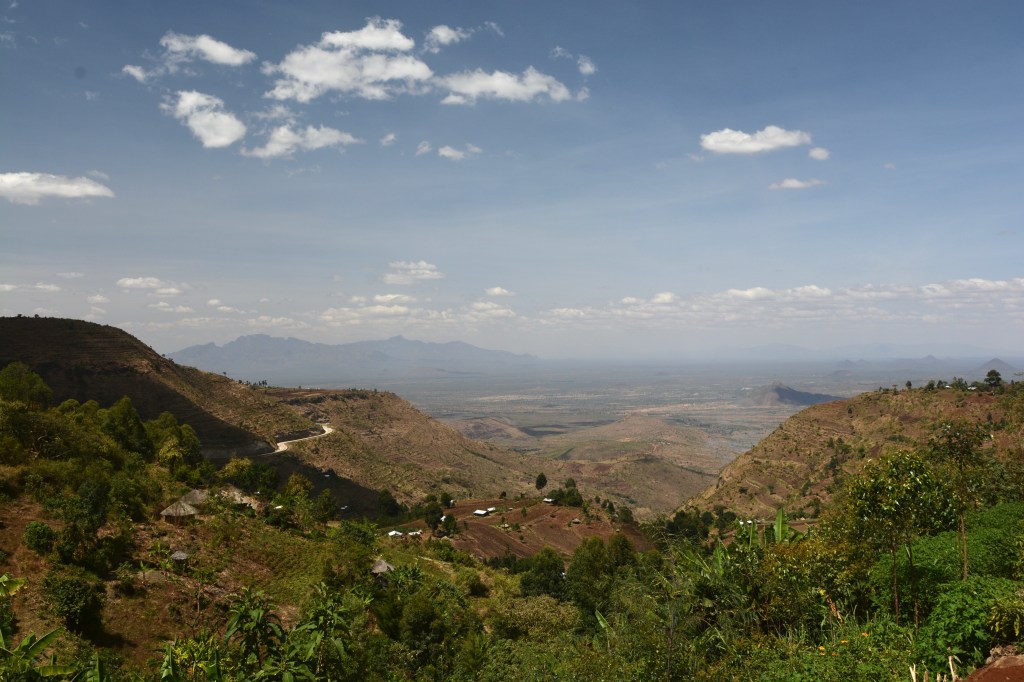
Half Uganda, it feels like

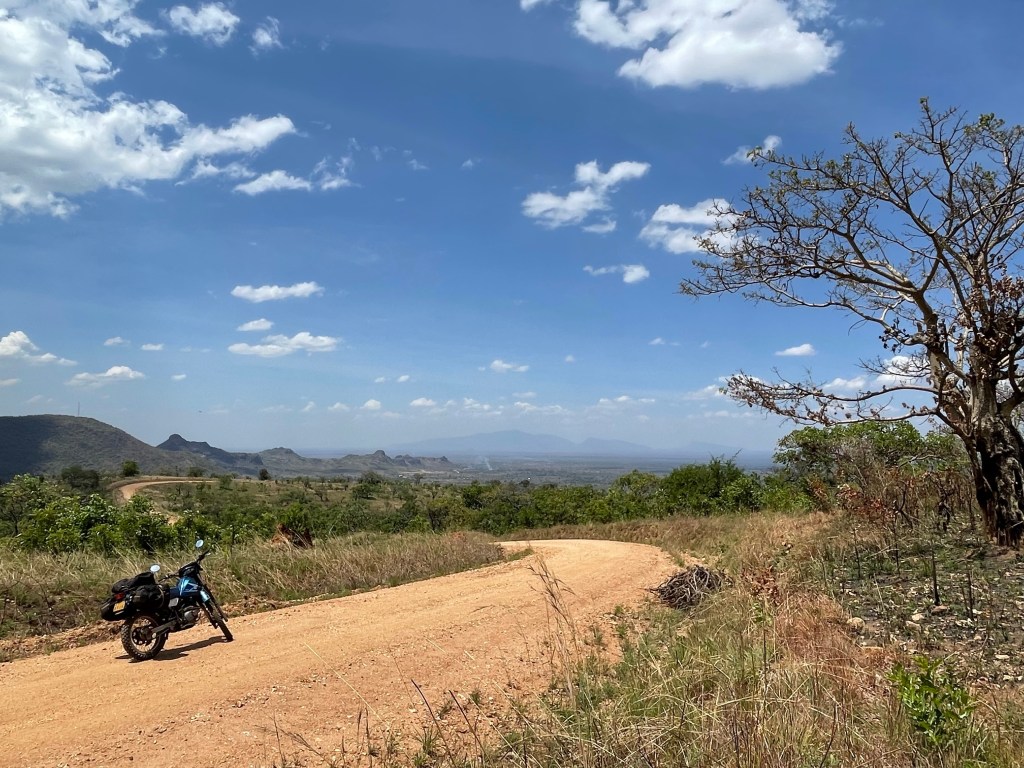
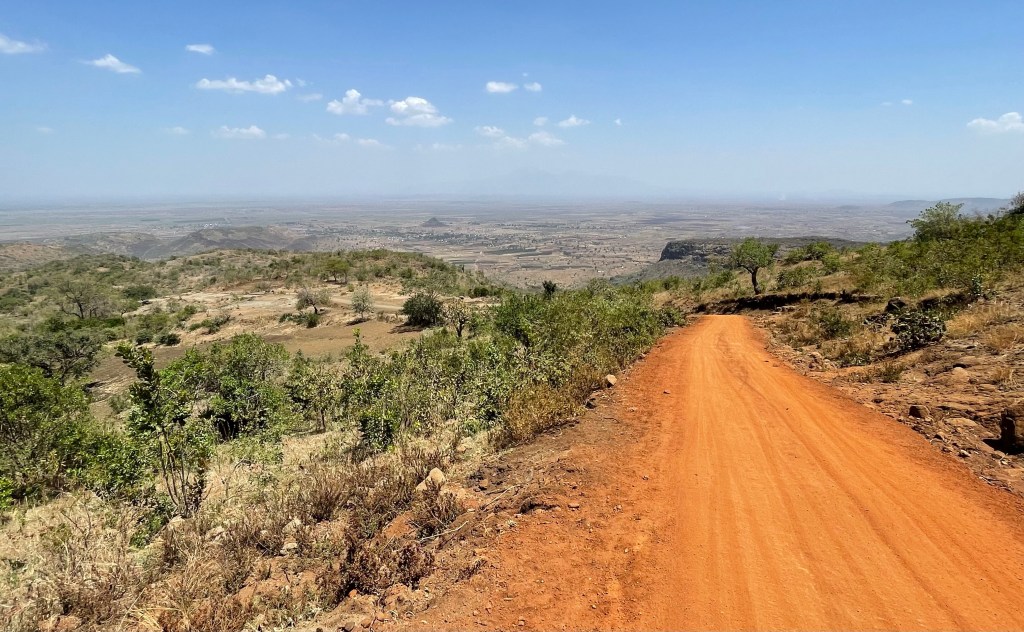
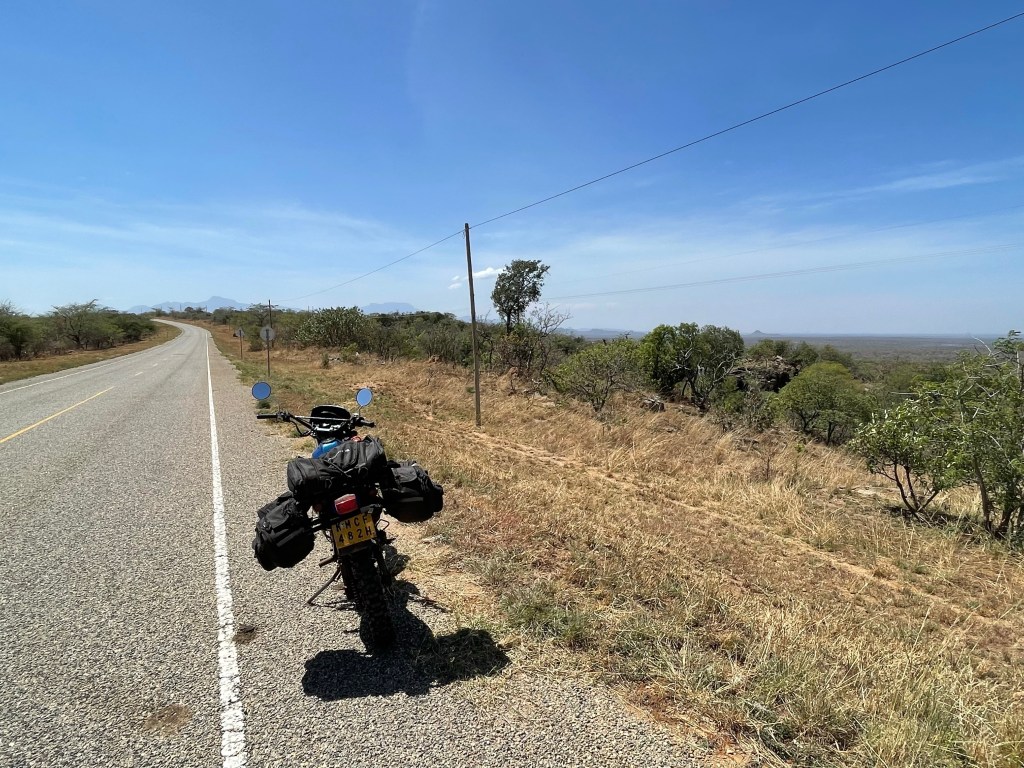
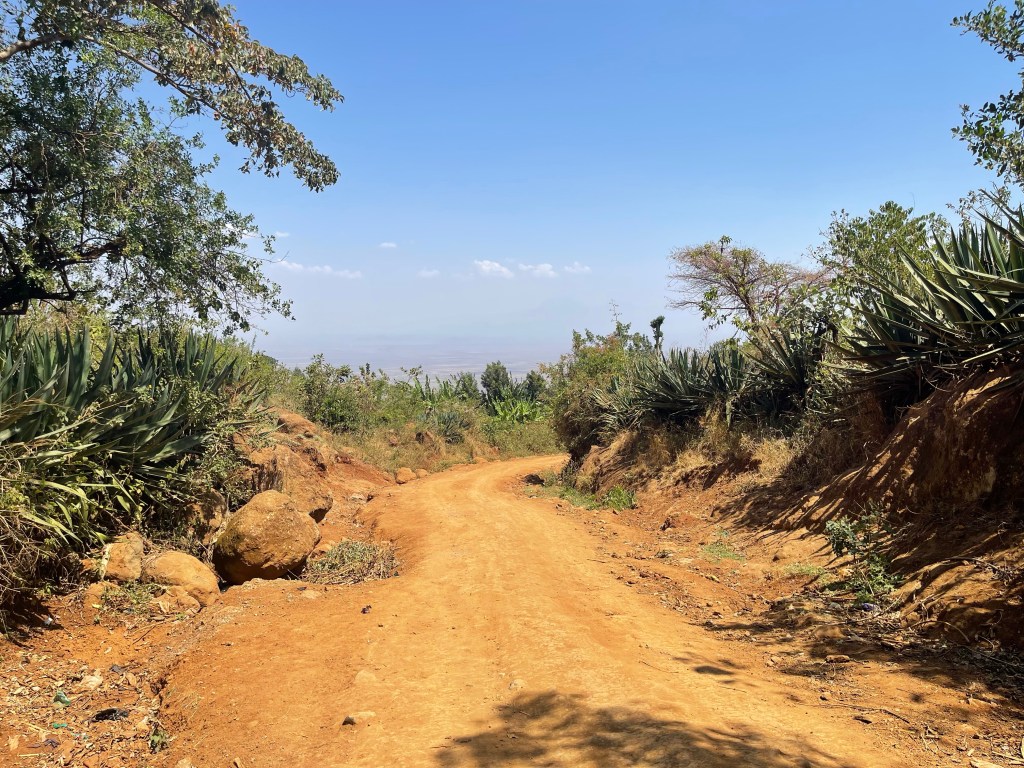
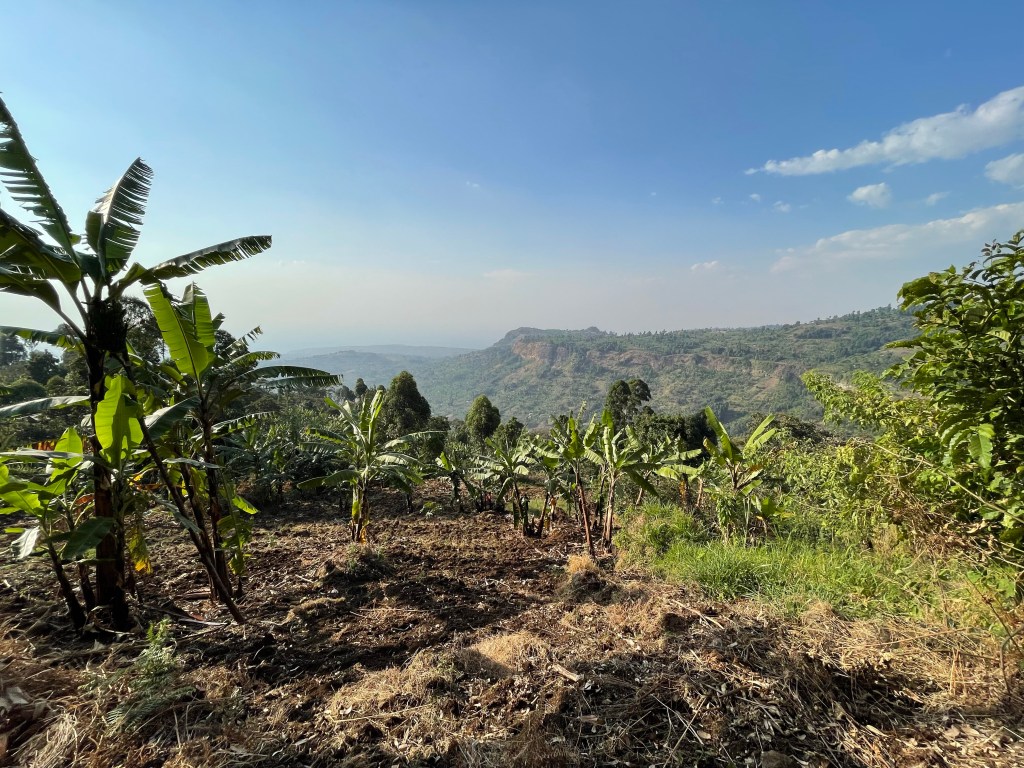
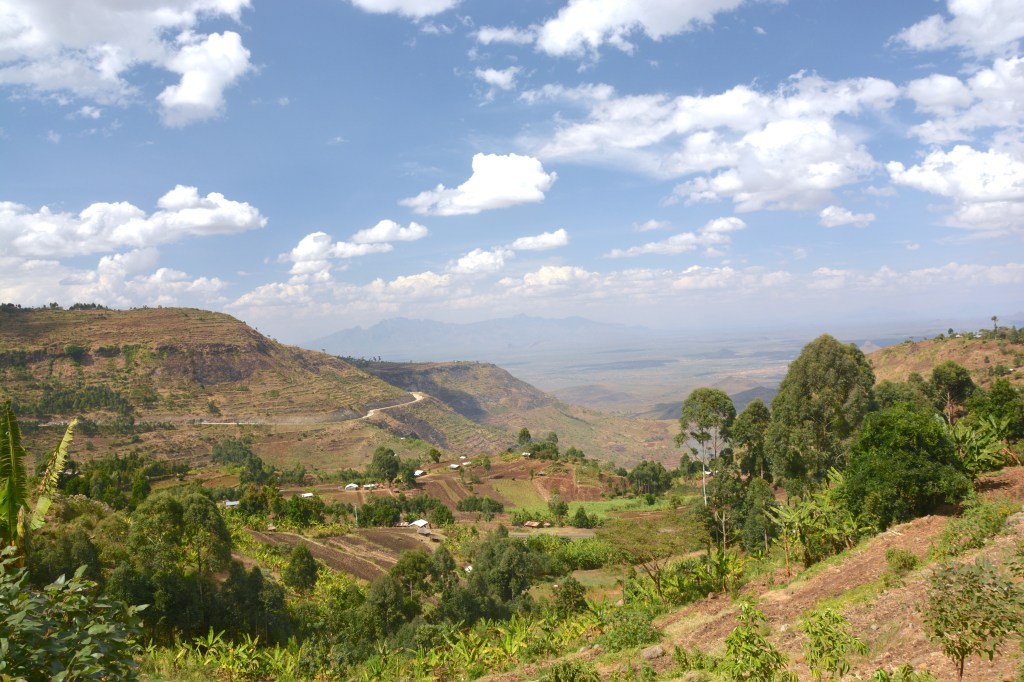
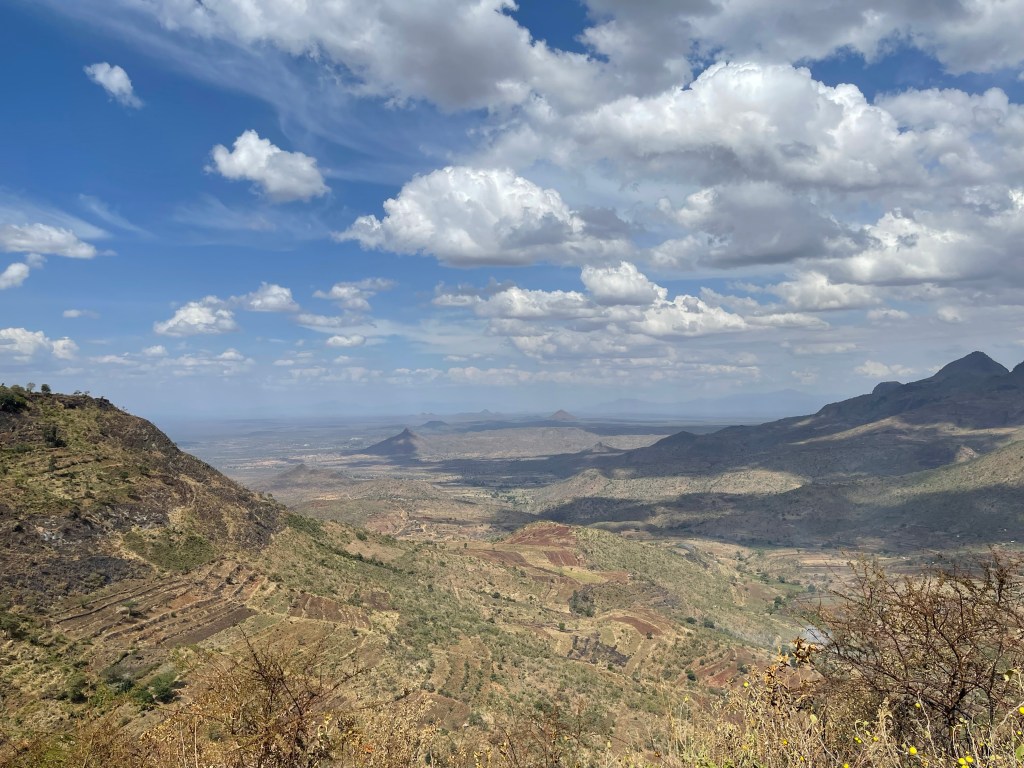
The views to the north feel as if I am gazing over half Uganda. Small pimples of extinct volcanoes prick the blue-hazed distance. I lean and bend; this is one if my favourite roads as it weaves its way along the mountainsides. It’s difficult to remember just how hard this road was four years back, a deep dusty, rocky rutted track – that was SUCH fun to ride on my small trail bike, 90 miles of exhilarating riding. Now it’s smooth and boring, but quick. I’m reminded very soon just how outgoing Ugandans are, as children scream from the steep banks and adults stare from their doors of tin-roofed, earth-built houses at the roadside. It’s fun to ride in Uganda.

****
JB

Then I’m at Rock Gardens for the welcome the children have anticipated for so long. Precious is ululating, the children clamouring. Alex is away at a clan function, elected MC yet again, this wise, smart young man.

Alex and JB

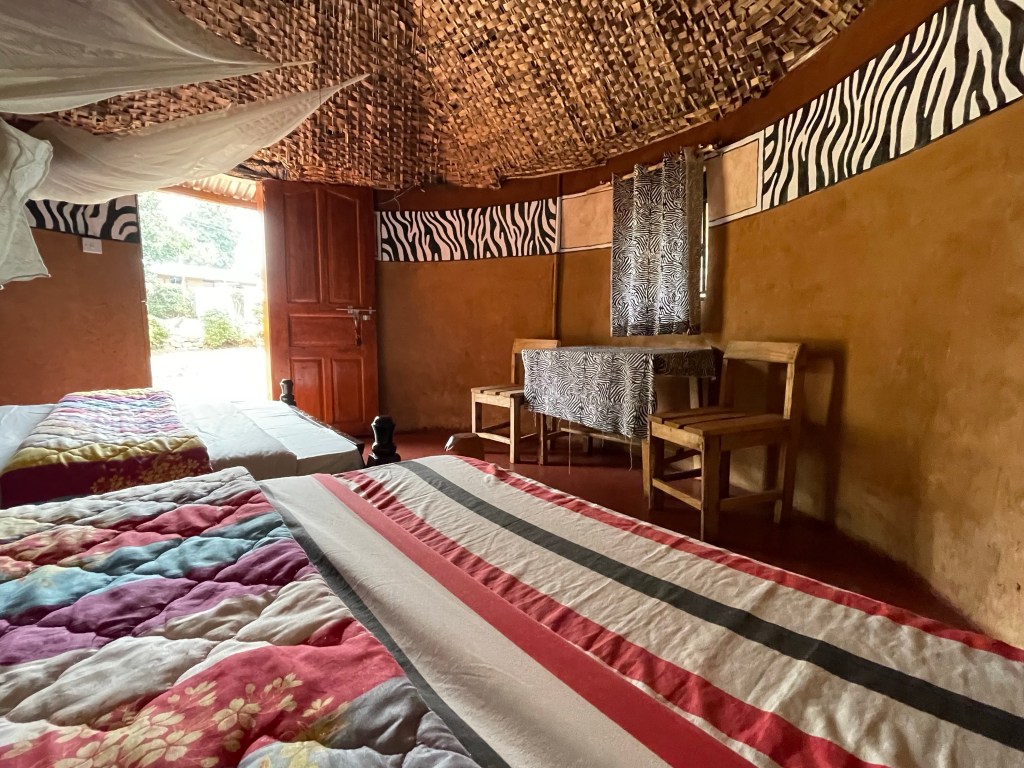
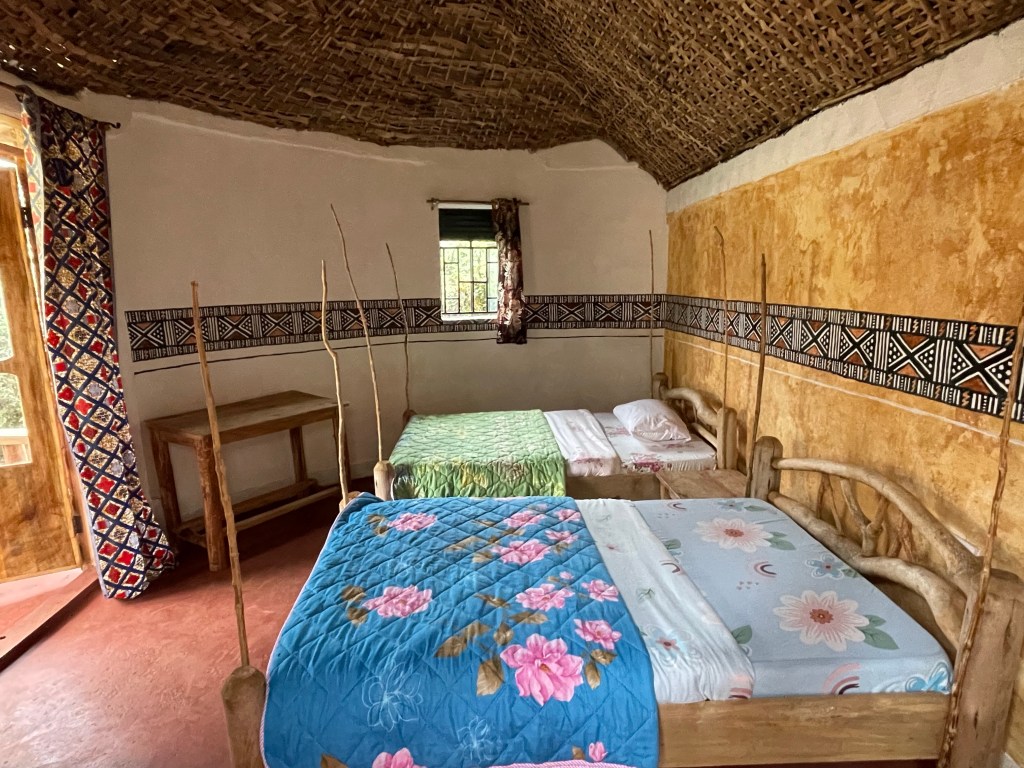
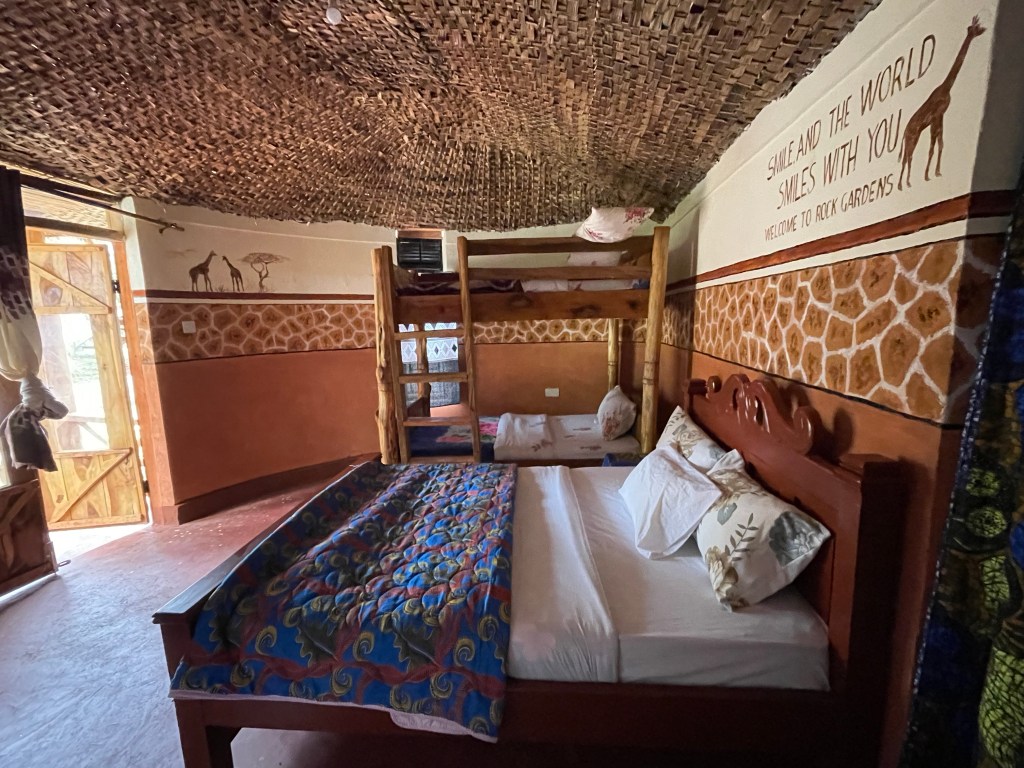
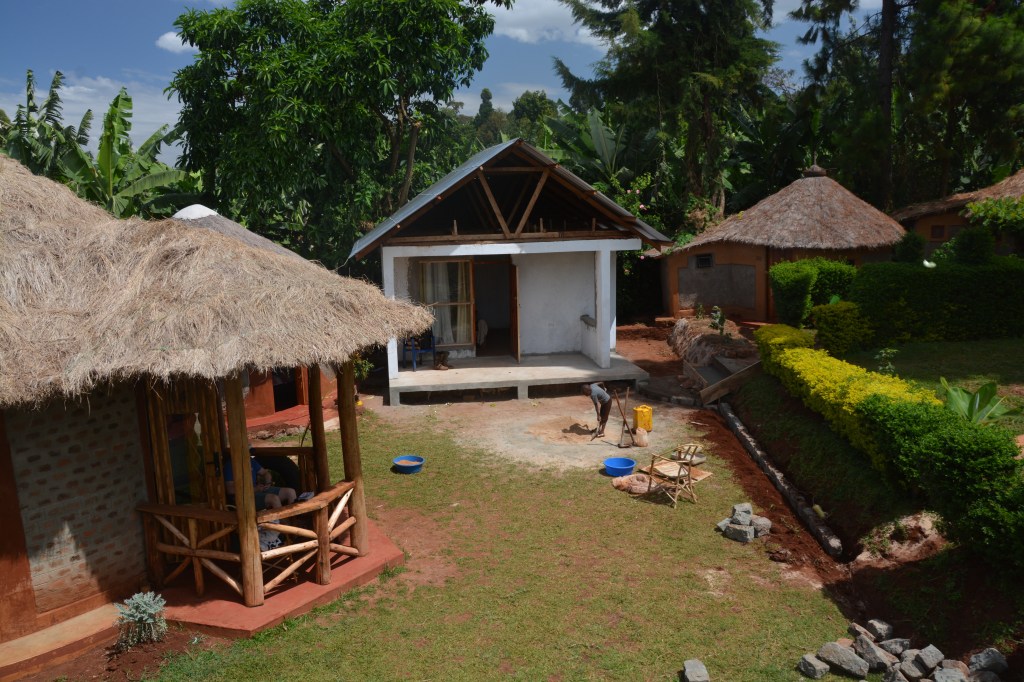
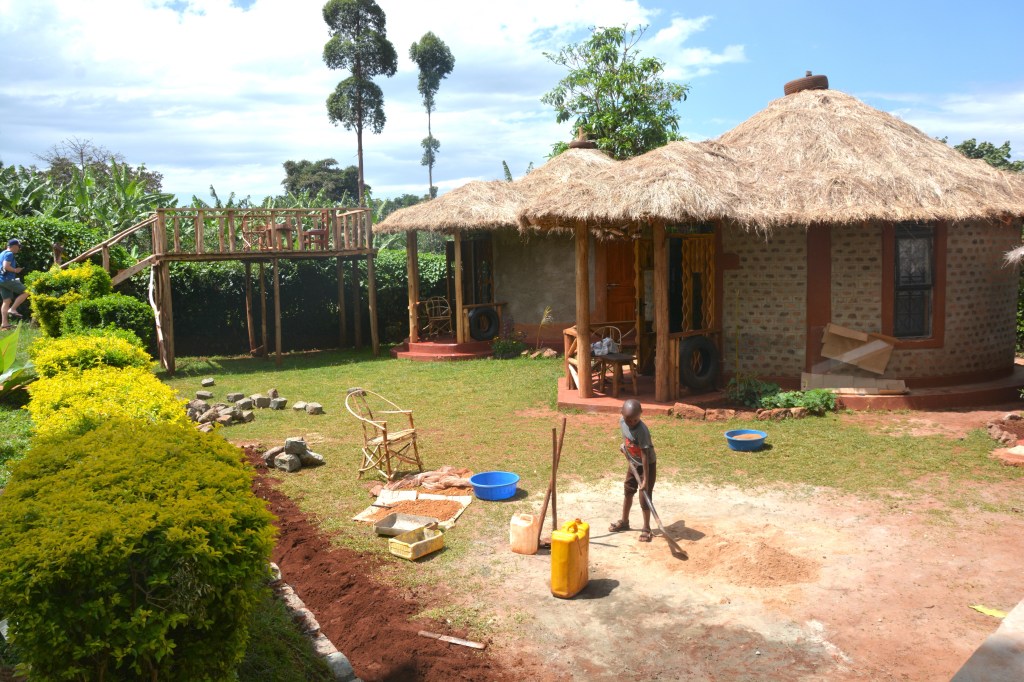
There are new buildings everywhere. This is where my money’s gone since March. Most of ten grand of it. Two new round houses with grass roofs (over metal sheets for the abundant rainy season), a new gate and gate house, a raised wooden terrace that stands higher than the hedges, and an ugly sort of bungalow block, imposed amongst the ‘traditional’ round houses.

An ugly Kampala bungalow…

It’s a mistake, I see immediately, out of proportion and angular, like something dropped in from a housing estate in Kampala, amongst our quaint structures. When Alex comes, he tells me he had to build it as Ugandan guests are too proud to sleep in our old fashioned African heritage rooms! Its ironic that he has to pander to pride here.

Rock Gardens is still the cheapest accommodation in Sipi, getting the highest ratings on the internet, popular and well booked. Travellers now use the multinational corporations to book their rooms; gone is the fabulous serendipity of going and looking for yourself. It’s in Alex’s favour, but I regret that so many young travellers have such a tame experience nowadays; it’s taken the adventure out of travelling. Even backpackers book ahead now, book guides, do the same activities as everyone else. It’s bland and lacks the initiative we older travellers required. Now they sit on their phones and ‘share’ it all with their friends at home, instead of being in the moment – in Africa. Well, times change I suppose and mine is only the bleat of all the old about the young…

****
We decide to remove the bungalow roof and redesign it: it’s far too dominant. As I write, the appalling workers are demolishing the zinc roof. Every construction job in Sipi is done with no more than a hammer, a panga (machete) and a hoe. Hammers have long lost their handles, replaced with odd bits of welded pipes; pangas are shortened by use and the hoes have rough sticks for handles. I lose my rag many times a day. Why not buy some simple tools? A chisel to separate bricks instead of a battered hammer: we might save the bricks. A jemmy, surely no more expensive than a couple of pounds here, to lever the timbers apart. They’re all nailed anyway: you can’t even BUY a screw here. Instead of a small outlay, they waste huge amounts of energy, doing things the difficult way. I’ve stopped buying any tools and bringing them from better supplied Kenya – they all get stolen within a week, or are destroyed by lack of care. One day, I ask for the spirit level. I bought it last year. Now it’s blathered in old cement, with its level missing and shaft bent. I have to throw it away. “Oh, do it your own bloody way!” I just yelled at Tom, the worst wood butcher I know. I have to walk away.

****
In October, two electric poles fell down up the muddy lane to Rock Gardens and its village area. A young woman died. It’s a common death here. Five people have been buried from deaths by electric shock in the past months. I’m not surprised. There’s a flagrant disregard for the dangers of 240 volts, where wires are knotted and bare, poked into sockets with sticks, and left in uninsulated twists, open to all. Right now they’re burying another victim down below Rock Gardens.

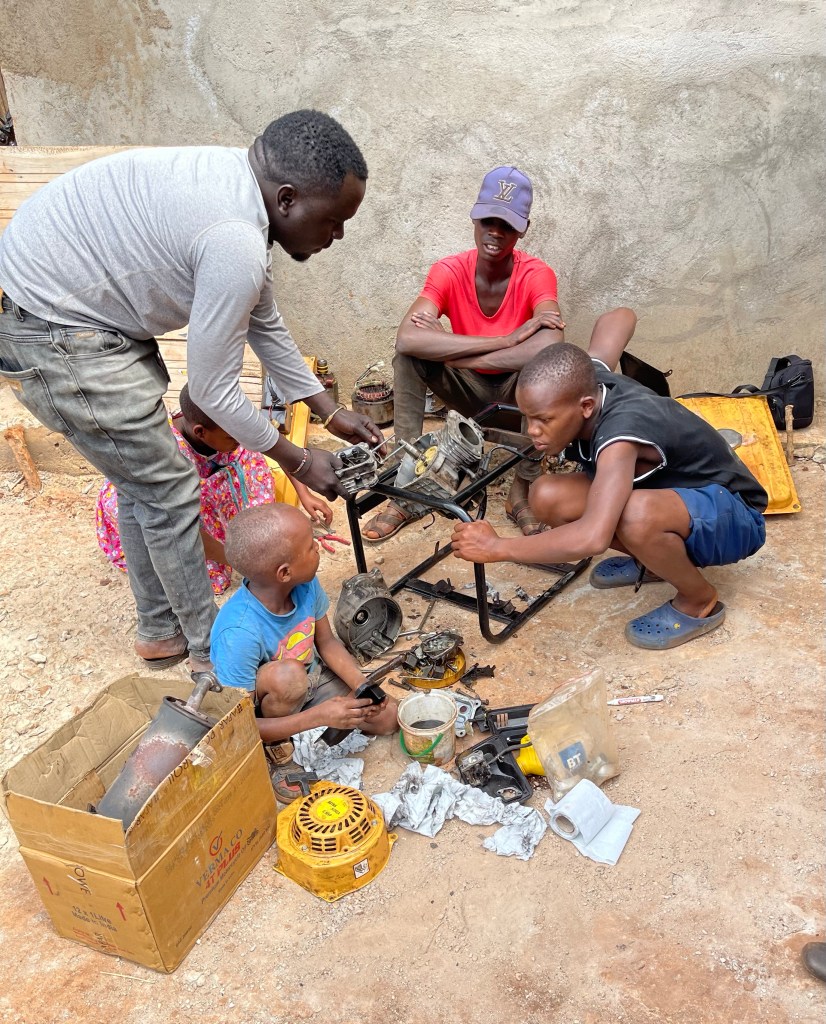
So Alex (me!) invested in a generator. It’s making a hell of a racket and something is very wrong. Even I, lousy mechanic that I am, can tell. When I investigate, I find that someone – ‘who knew the answer’ and fiddled, has stripped the thread on the spark plug housing. There’s no plug cap anyway, just a twist of HT lead. I forbid Alex from letting ANYONE else even touch the machine.

Kato confidently strips the generator

“Ring Kato now!” I demand, knowing that Kato, the mechanic that now looks after my Mosquito has more skills than any of the ‘mechanics’ in Sipi. He rides down from Kapchorwa, the town 17 kilometres back up the road. In twenty minus he confidently strips the machine. It needs a new cylinder head, the barrel requires reboring, so a new piston and rings; the silencer needs welding up where it is shattered right round. The valves need decoking and adjusting, the armature is covered in oil and the brushes knackered. It’s so far out of tune it’s amazing it runs at all. Most nuts are stripped and rounded.

A stick connection – 240 volts out of the generator…

It cost over £200. Sipi’s ‘experts’ have destroyed it already. It costs me £80 for Kato to get it working again.

It’s TWO MONTHS old.

****

Loading the water tank the hard way

Alex is stressed much of the time. It’s so difficult to run a guest house for so many strangers in an ill-supplied place like this. The state electricity probably won’t be repaired for years, and only then when there’s a big enough bribe to some official. On January 1st, the water supply mysteriously goes off. We spend the morning carrying water in 20 litre jerrycans up the hill from the spring, 100 feet down the hill. I make three trips: 60 litres. Water for guests who have no idea what it’s like to live without a tap to dispense purified water. We suspect that the minor ‘official’ in charge of this area supply has turned it off to get bribes to reinstate the supply on this public holiday. But everyone spends hours of labour trudging up and down the hill. The water comes back just as mysteriously at midnight. The water official is also the local ‘plumber’, moonlighting. He’s installed a lavatory in the new ugly room. “It doesn’t flush…” says Alex, “and there’s something wrong about the seat.” The ‘plumber’ left without adjusting the plunger on top, and fitted the seat brackets backwards, took his money and left. He hoped Alex would call him back and pay him to ‘repair’ his workmanship. He didn’t bargain on a practical mzungu!

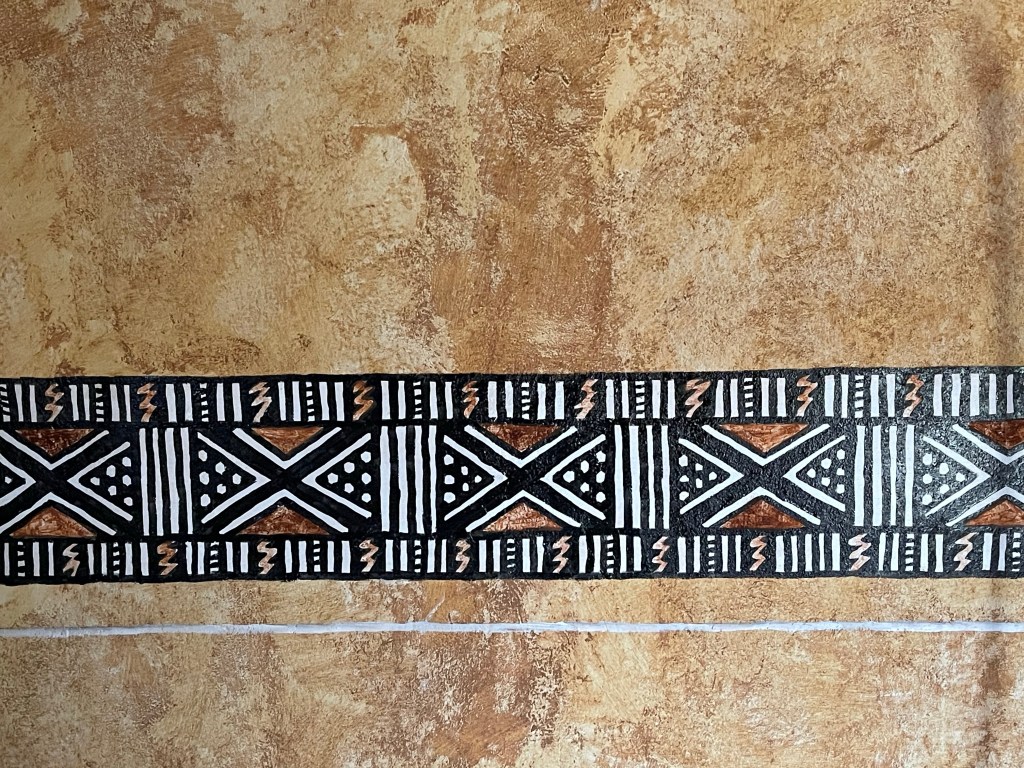
Rach, Alex’s half brother, a good worker, helps me paint the ugly bungalow with paint we make from local soil and PVA

But it’s this way all the time here: lazy, uneducated and backward. This clan, Alex admits, is known for its jealousy. They look at him progressing, and rather than cashing in and gaining from the tourists he’s attracting – setting up small kiosks with their produce, making handicrafts or souvenirs, getting together to put on cultural displays – they undermine his business. The local expensive hotel set up a scam to deplete his reputation: they got a young woman tourist to come to Rock Gardens, pleading poverty and needing a cheap deal. Alex is generous about this. “She kept herself to herself,” he says. “She didn’t come out of her room, and she couldn’t afford to eat!” Next day, she claimed that $500 had been stolen from her room. To avoid damage to the reputation of his business, Alex had to pay up. “I think she wanted her fare home,” he says with an ironic smile. “Even the police, so corrupt themselves, suspected it!” Later, he found that he had been set up by a jealous local hotel.

Locals constantly tear down his guest house signs, and have thrown stones through guests’ car windows. They break and steal out of jealousy. They ‘steal’ his guests, taking them elsewhere. He began to get bad reviews from guests who never even came to Rock Gardens, redirected to inferior places by his local ‘agents and guides’, forcing him to close his account with the horrid multinational booking company we all know but I can’t write without importing links to your device as you read. He sacked his ‘guides’, lost all fine reviews he had, and had to start again.

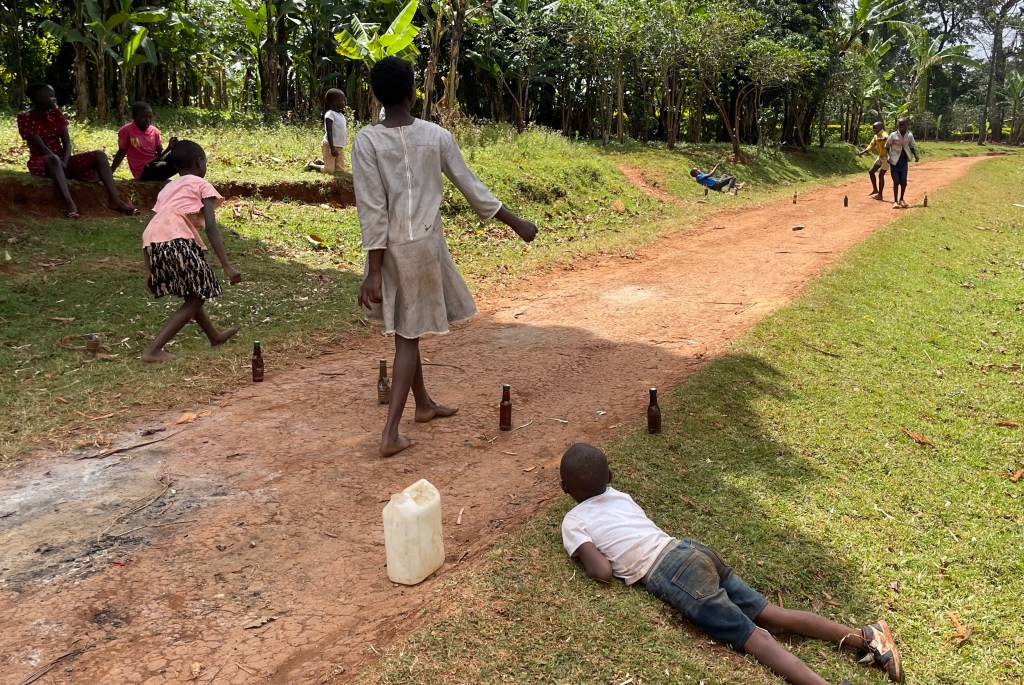
Girls v boys, skittles in the road with plastic bottles filled with sand. The girls won this round!

Scratch the surface of rural Africa and you see the truths hidden beneath. But where, in a country like this, is there an example of selfless decency? It’s corrupt and amoral from the very top to bottom. The president’s wife is minister of education and sport, his daughter head of the national bank, his son head of the army and president in waiting. Every official and politician is utterly corrupt. Nothing happens without greasing the wheels.

There is no example. Immorality spreads, especially amongst the misogynistic males. Rape and unwanted pregnancy is astronomically high: “Probably 85 percent of families in this village have had unwanted pregnancies amongst their daughters. Many of them schoolgirls!” Last year there was a revolting crime committed in this village. Two teenage girls, one of them with learning disabilities, were given the choice by a gang of drunken boys: either be thrown over the 200 foot high cliffs or be gang raped. The boys fled across the country but, Alex tells me, the father is a rich man and had the resources to insist that the police did not give up. Some boys were caught as far as the border to Rwanda. Several are now on remand, and may spend years in prison. But it was the father’s wealth that made for a measure of justice, not moral indignation. “The community kept quiet…”

****

Recently, Alex ‘rescued’ Josephine, left pregnant by a married boda rider, who subsequently threatened violence. She was rejected by her family; tried abortion herbs unsuccessfully; considered suicide. Alex employed her at Rock Gardens, a reserved woman with a gentle smile once she’s comfortable. This week, a baby boy was born in the hospital (another bloody Ugandan man in the making) and after two nights she came home. I can now add £100 ‘birth fees’ amongst my very varied expenditures in Africa, way beyond Josephine’s resources. Alex was going to pay, from his small profits.

Alex tells me about his latest ambition: to construct a sheltered haven for all these young women left with unsupported babies by irresponsible men – the ‘85% of local families’. He already completed a rough hall on a plot of land a few hundred yards away. He hopes to be able to provide a safe place where these often rejected girls and women can gather to share their lives and fears, perhaps to find mutual support to care for their babies and find some way to support themselves. He plans to set it up as a small local business and hopes for support from visitors and donors. He’s a determined young man with a strong social conscience. I will support him of course…

****

In Kapchorwa, 17 kilometres by road, where we’ve walked over the shoulders of the great mountain, probably 20 kilometres, with Sarah, a visitor from Germany, Alex introduces me to an age-mate, 74. As he leaves, Alex tells me, “He has 46 children! From six women.” Poor Alex, who volunteers to try to reduce the birth rate, increase education for girls, stop female genital mutilation. Men with whom we are sitting, laugh at my anger. They don’t understand anything but that he is a ‘strong’ man. I bet he can’t even remember the names of the average eight children of each woman.

This baby factory of Uganda undermines any hope of continued human life on this planet over coming centuries. Over seven children is the average per woman, most families include children by ‘outside’ women. Rape is endemic. Uganda has grown from 5 million to 50 million in my lifetime. The growth is exponential, rising to 100 million by the end of the century. Resources of land stay the same. Pollution increases. Food quality reduces. Education is low. Morality elusive. Good example rare.

But the Bible and Koran both, “Tell us to have babies…” No one understands the pressure on the planet’s resources. “God will hep us if we pray…”

****

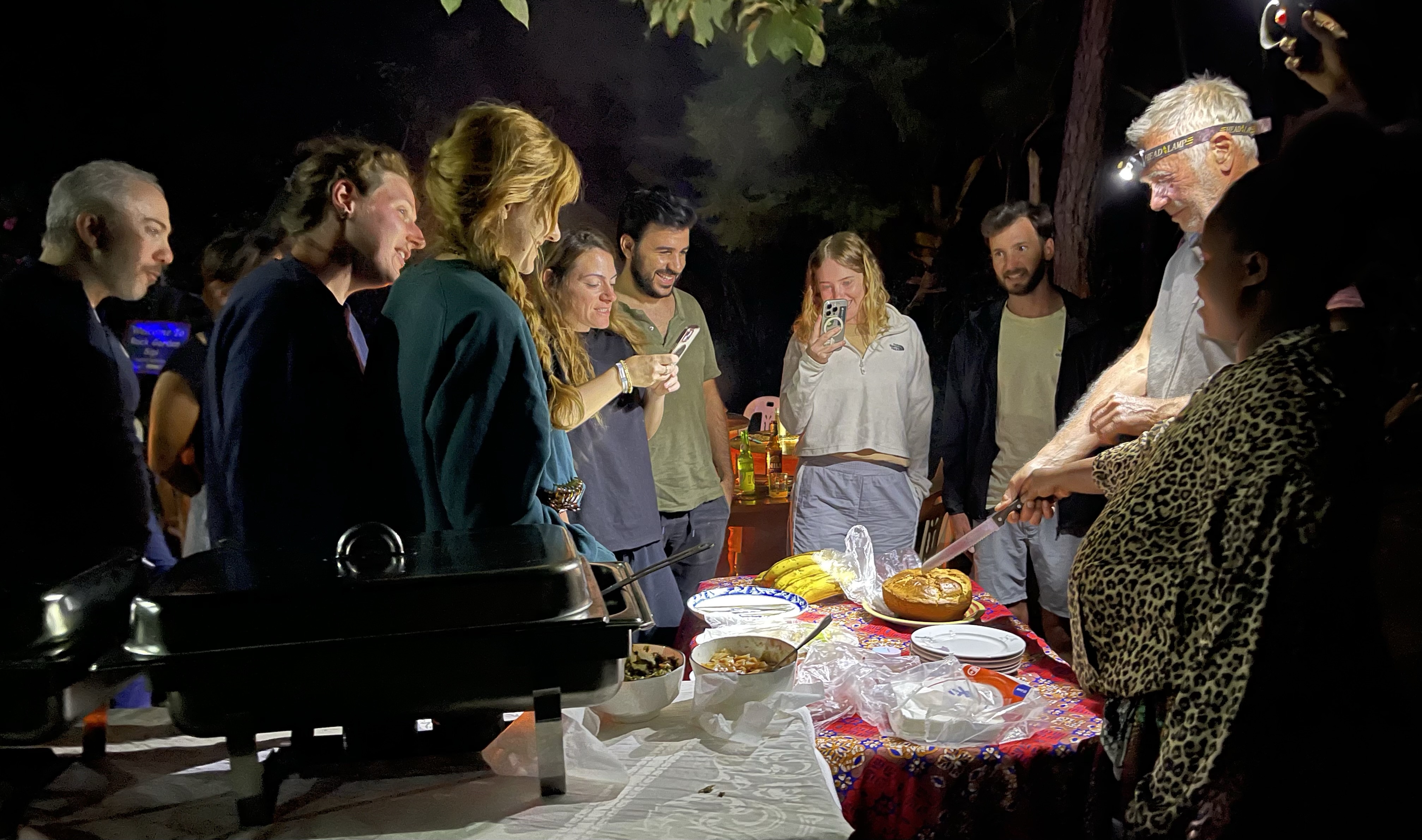
Uncle Jonathan cuts a New Year cake, thoughtfully baked by Previous for a varied group of guests

At Rock Gardens, we have varied visitors, most of them very congenial. Interesting folk from all over the world, the exposure for Precious and the children is terrific. Precious, now 29, has matured a lot, gathering liberal opinions from the many young people who stay. She now accepts that two children gives her family a chance to develop, be well educated and remain healthy, a fact that most rural Ugandans fail to grasp.

****

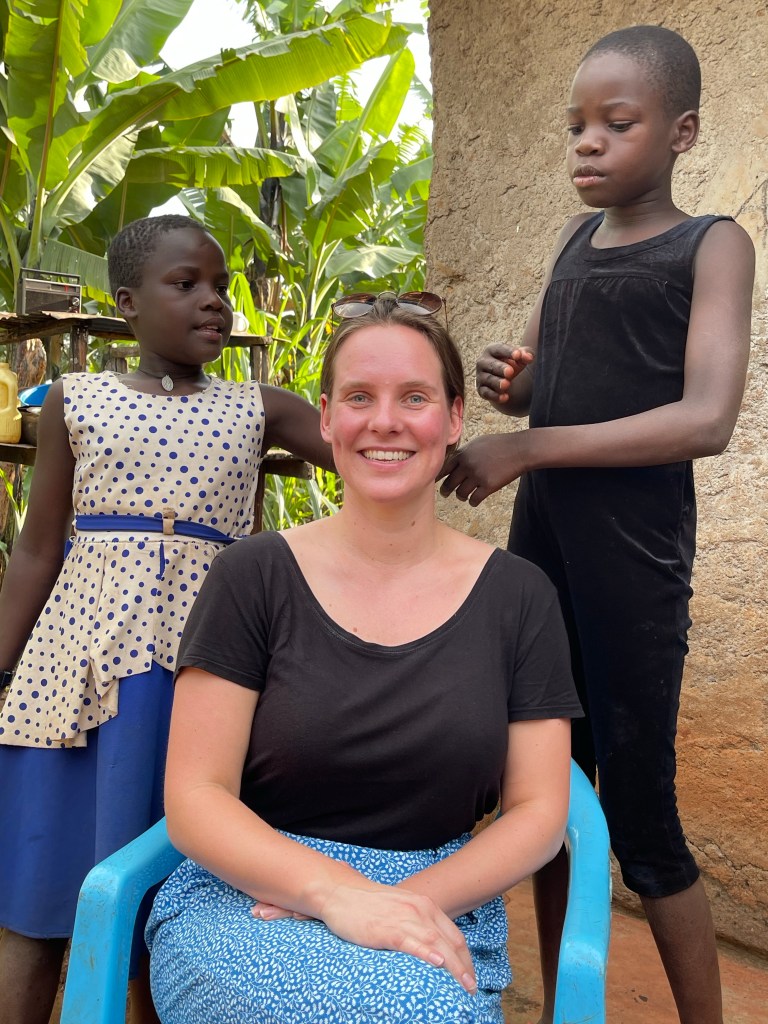
Walking down below the steep cliffs, accessed by dramatic ladders, we stop at a simple house amongst the matoke banana trees. I’m known here and the welcome is fulsome. Alex and I are with two smart, open minded Dutch young people, Rosa and Vincent. Two small girls are fascinated by Rosa’s long light-coloured hair. She’s a good traveller, patient. They stroke and play with her hair for half an hour. Miracle is a thin girl in a black leotard, cropped hair and a shy smile. Her friend and mentor is Elizabeth, a very bright girl of about eleven, I guess. (I can seldom guess ages as African children are usually so much smaller than Europeans). “What’s your ambition?” asks Alex, always quick to engage children in conversation.

Elizabeth and Miracle dress Rosa’s hair

Quick as a flash come the retort, “I want to be a lawyer!” We are all impressed by her certainty. She has an educated father, who’s a local small-time politician and clan leader, so perhaps she has a chance in this misogynistic society. “What do you think are the obstacles?” asks Alex.

“Ignorance of parents and the attitude of men,” Elizabeth replies confidently. We all praise her determination and encourage her. It’s always good – and sadly rare – to find girls and young women with confidence here.

****

Hard walking for short legs

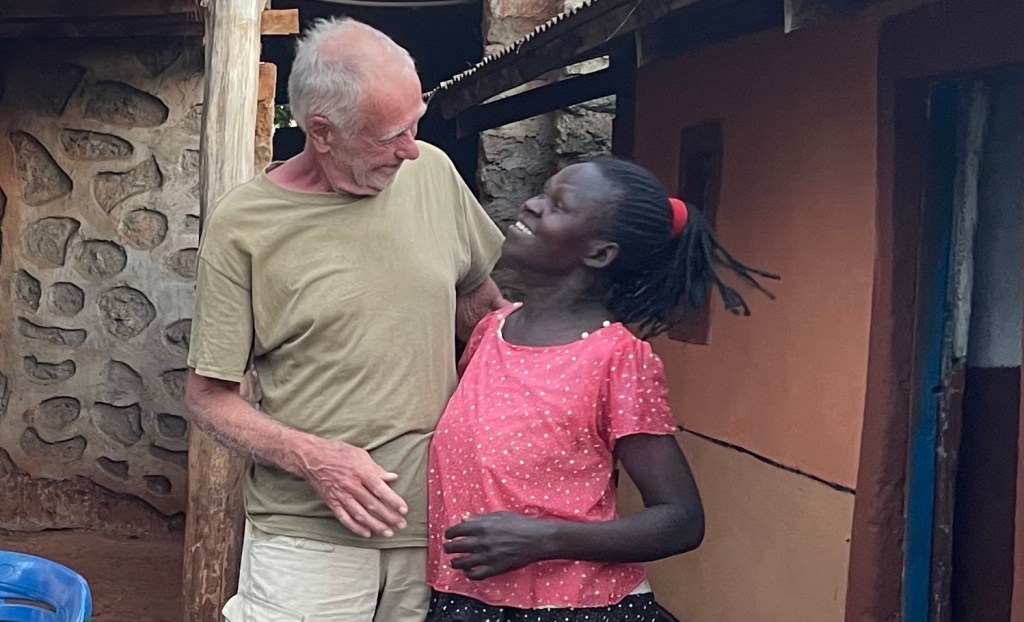
Thank goodness we have our hikes to get us away from the frustrations and irritations of local rural life, its jealousies and hatred. Alex is a great companion. He gets no support from his own family, despite being the firstborn so I’ve taken on the role of father-figure.

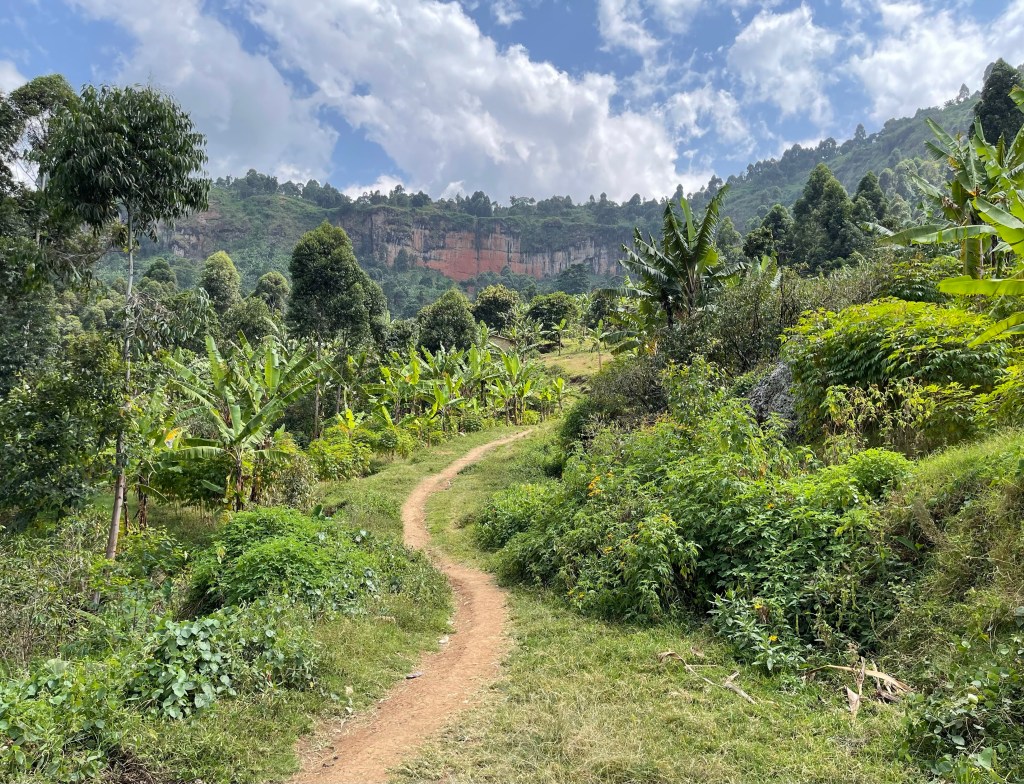
We have some long hikes we like, and are always looking to extend our repertoire. One day, we walk to ‘town’, Kapchorwa, a hike that he does frequently now, maybe 20 kilometres. We hiked it together for the first time three years ago. It’s varied country, dipping into the Mount Elgon national park with its old mature trees and birdlife. We cross streams, struggle up loooong hills of grass and colourful equatorial scrub. We climb to some high bluffs that Alex calls, ‘Jonathan’s Point’. There are vistas all around, green valleys with swishing banana trees, tall conifers, and winking tin roofs. Red dust roads wind around the contortions of the steep hills. The extensive plains far below fade to the horizon.

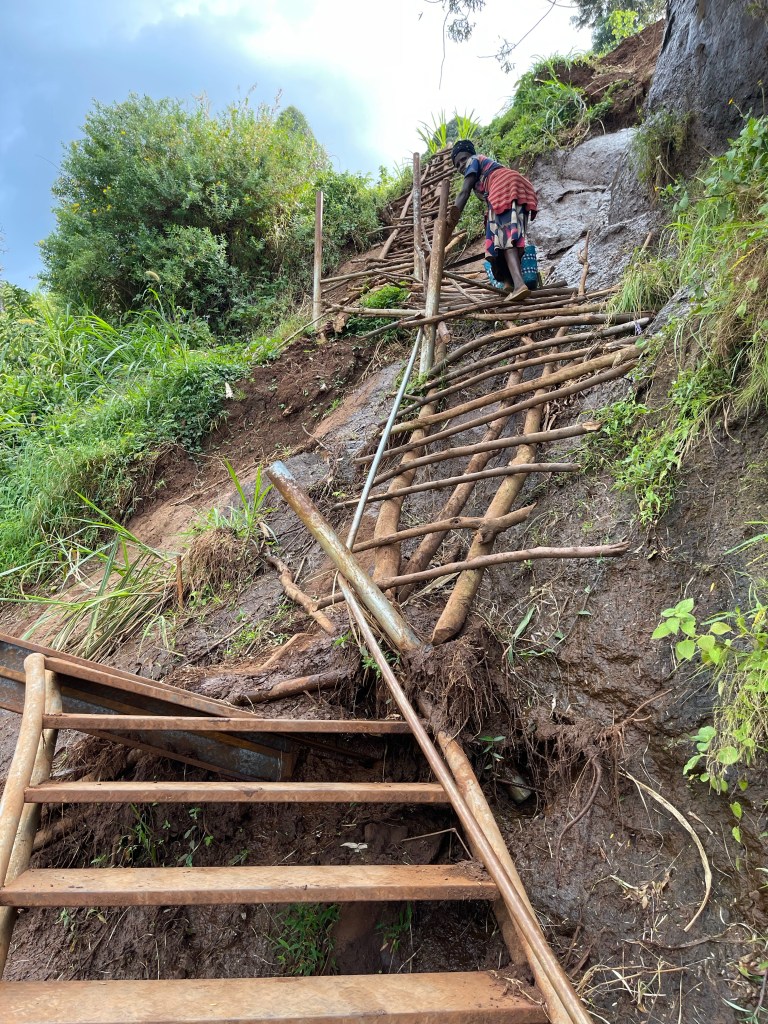
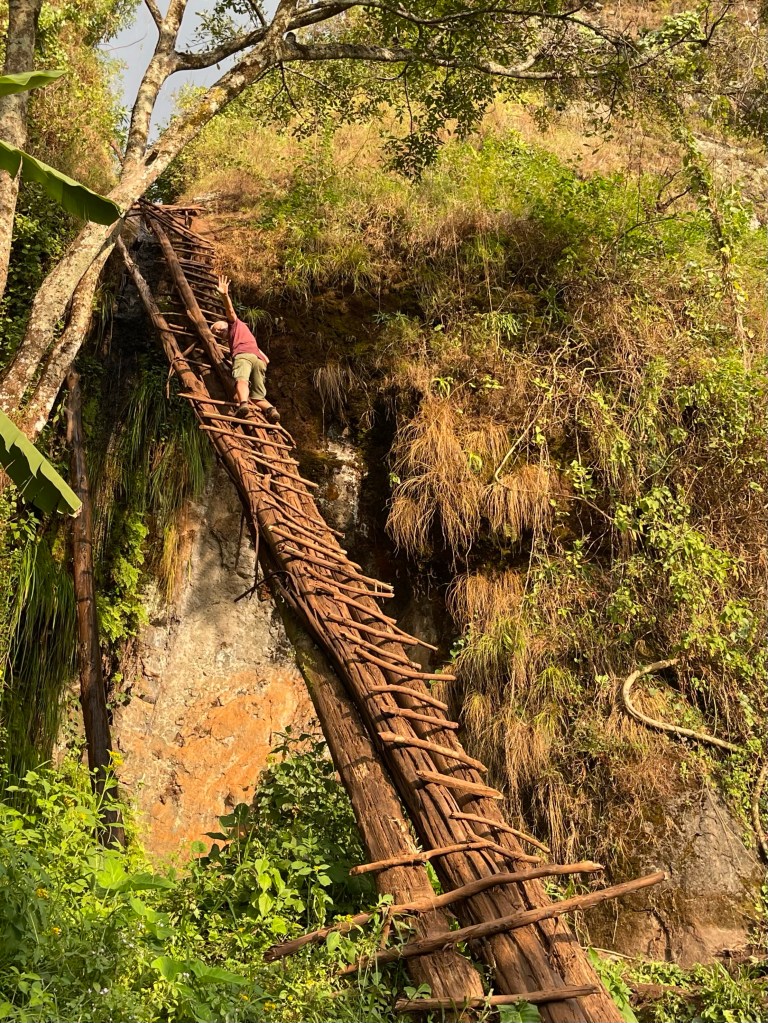
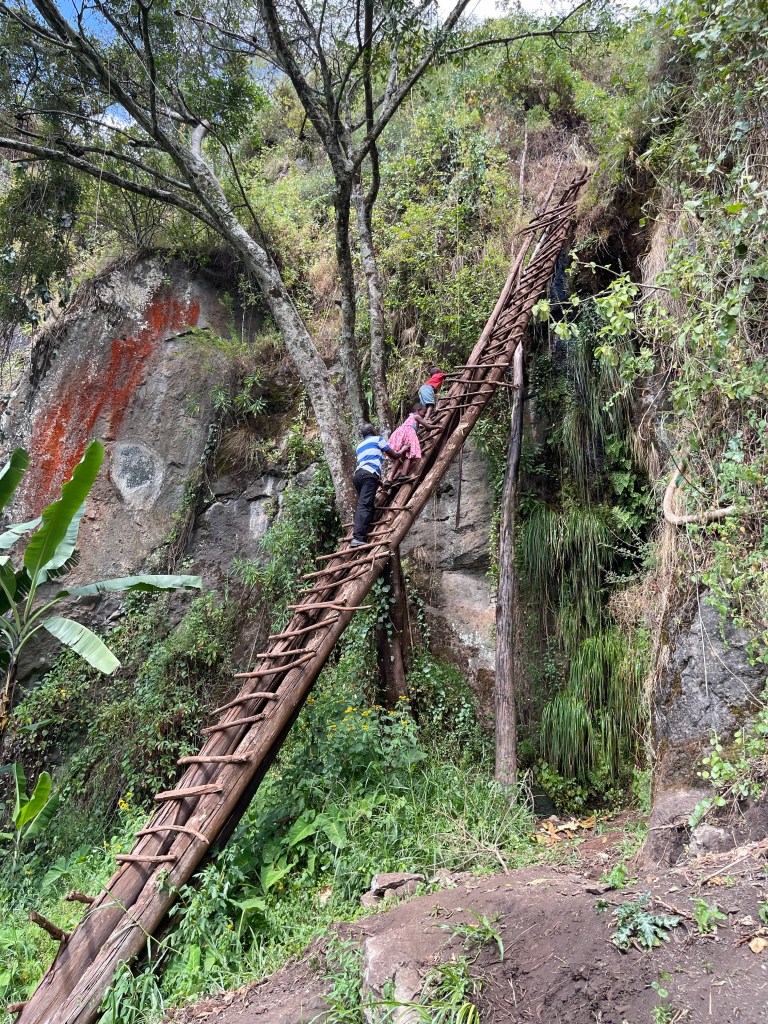
We relax and unwind. Here and there, our routes have a frisson of excitement as we must clamber ladders, some made of steel and others of rickety timbers nailed to tree trunks leaning on the cliffside.

My final adventure of 2024, up the crazy ladder on New Year’s Eve

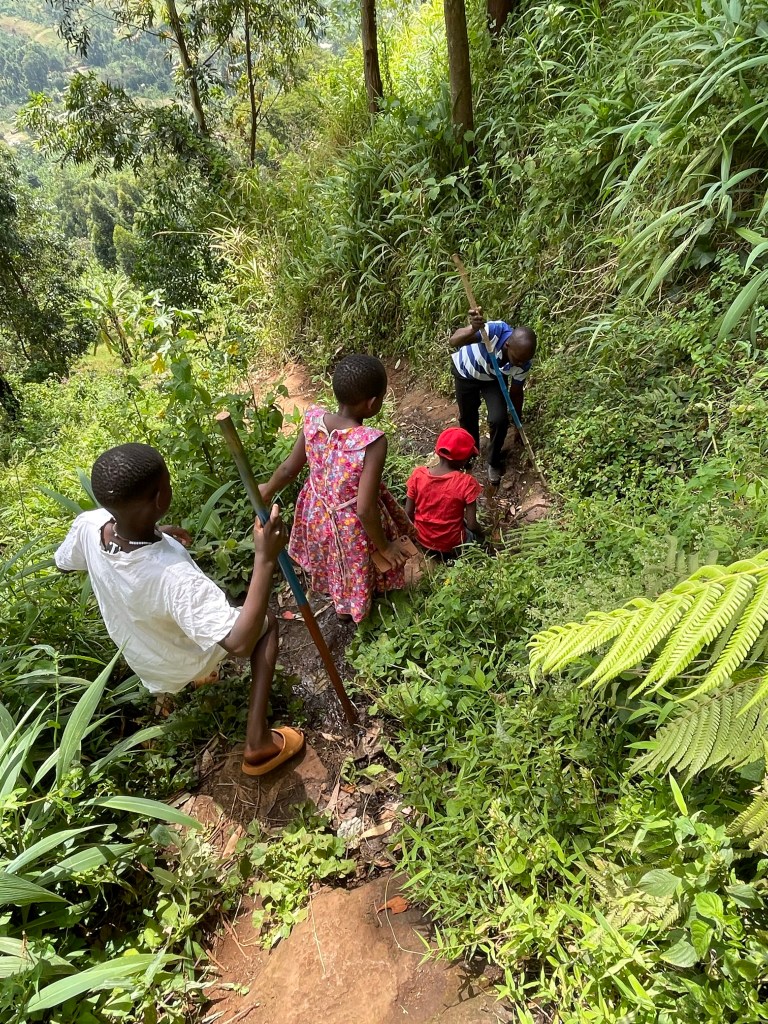
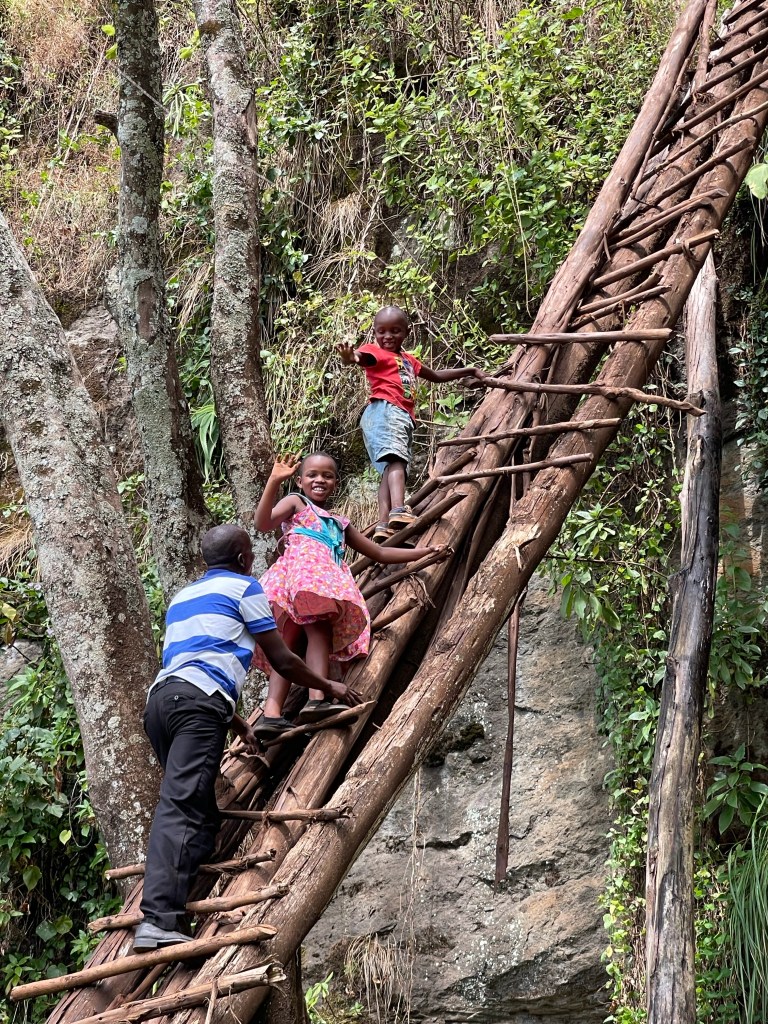
One day, we take Keilah and Jonathan up that crazy ladder. They love it! With no fear, Jonathan shins up the steep rungs, laughing in excitement. Both children, followed by their father, wave down at Uncle Jonathan 70 feet below. Uncle J ponders how we overprotect our Western children from all dangers and risks, limiting their the opportunities for such adventures. As we climb into the gulley at the top, two small girls – carrying bags of cassava – bounce up the bendy tree-ladder, as they probably do every day to get to school.

Jonathan shins up the ladder ahead of Keilah and Alex

Life in Africa is frustrating and often disillusioning. Tourists see the romance and glamour of traditional life; they see the wild animals (all in parks now), the exotic dances (posed for their benefit alone in modern African life), the quaintness of traditions and the humour of illogical situations. But when you stay here, become involved in family life in a rural area, amongst the ignorant and prejudiced, it all takes on an edge that is sometimes cruel, often aggressive and jealous. The ‘traditions’ can be barbaric, the uneducated mindset antique, criminal behaviour common, cruel practices all too prevalent.

It’s hard, not very romantic – but then I have made families whom I care for a lot, grandchildren I love, many I respect as they struggle against ignorance and narrow-minded attitudes. It’s both an education and a privilege. It’s tough and it’s warmly loving.

It’s my life now!

EAST AFRICA 2024-2025

EPISODE ONE – DECEMBER 2024

“AREN’T YOU AFRAID, THESE DODGY PLACES YOU GO..?” The most common question I am asked. AFRAID??? Read on…

My small friend Wesley. Smart, bright, intelligent. Adelight’s nephew, now living in the compound

If nothing else, travel teaches resourcefulness and patience.

I’m in a bus travelling up the M5 at 17.10 on Thursday the 5th of December. My flight is tomorrow, Friday, at 6.00am, so I’m going to stay in a cheap hotel by the grim Bristol airport, surely one of the tackiest in Britain.

A text message pings in: ‘Your flight KL1074 on 6/12 at 06.00 has been cancelled. New booking on KL1080 7/12 at 13.45’. That’s Saturday lunchtime. It’s Thursday afternoon! I’m stuck in Bristol for an extra thirty one and three quarter hours. Too late to go home now, and anyway, I’ve lent out my house. I have to book a £90 hotel for Friday night in the city, and fritter away a filthy, wet, chilly day in storm-lashed Bristol. Rain bounces off the pavements and flies horizontally round corners on the gales. Wet and windswept, chilled to the bone in mere cotton trousers suitable for arrival in the tropics, I get through the day somehow. Now I just have to get to bloody Nairobi…

I have to leave Bristol airport on Saturday, which I swore I’d never do again: crowds of hen parties of tattooed women wearing as little as possible, pink hats and obscenity-emblazoned tee shirts, necking cheap Prosecco, taunting stag parties downing pints of factory lager, off to vomit and piss in the doorways of the ancient cities of Europe with less economic wealth and cheaper booze. There’s not much to be proud of here. Flying has no romance. Especially at Bristol.

A bit how I felt that chilly Bristol day! This gentleman is in the parish church, waiting for 300 years!

Every plane I take is further delayed by one and a half hours, all three of them. In Amsterdam, we sit in the Nairobi plane – on the tarmac. After half an hour the pilot tells us that a baggage truck has bust a gut and leaked hydraulic oil under the plane. We sit and wait, cooking in the plane, while it’s cleaned up. Another truck is found and loading continues – for another hour, as the luggage is heaved aboard – well, (spoiler alert) MOST of it.

Despite paying £50 for an exit row seat, I’ve got a chicken perch in the back cabin on the new flight. I have a sleepless night roaring down across Africa and arrive at 07.45, thirty three and three quarter hours later than scheduled. Immigration takes only 20 minutes and then I’m at the baggage belt, waiting for my KLM ‘priority’ labelled bag. I wait. And wait. I begin to get a bad feeling that history is about to repeat itself. Now there’s no one left. The belt stops revolving. No more bags are coming. I’ve been here before…

I know the ropes. A pretty young woman takes my baggage tag and searches on her computer… “Your bag is in Amsterdam,” she tells me confidently.

I’m in Nairobi.

“This happened last year,” I exclaim. “It was ‘lost’ in that storeroom over there for a month!” She apologises in that oh so African way, as if it’s her fault. It’s impossible to be irritated with such charm. She promises it will be on tomorrow’s KLM flight. At least I left out the mature Stilton this year, just in case…

I leave with an instinctive smile. The first Uber doesn’t bother to turn up. I can see the little car icon driving in the opposite direction on my phone screen. It stops on a road half a mile away. I cancel the order and try again. This time the icon, and Newton, crawl towards me. At least I have no baggage to lug around. That’s three and a half thousand miles away.

Sorry, Harberton, but in view of your festival featuring angels while I wandered Bristol, this Banksy comment made me laugh out loud. Only laugh that miserable day!

Newton drives me to the old fashioned, homely United Kenya Club with its green gardens and echoes of colonial Africa. I’m well known here. The receptionist gives me my favourite room, although it’s hours before check-in time. I don’t leave again all day.

****

Sunday morning, it’s back to the bloody airport.

There’s no consensus. Is my bag in Nairobi or not? The desk officer seems to think it might be, but the people at the ‘sharp end’, squeezing between hundreds of lost bags in chaotic stores, reckon it’s not here. “No, it hasn’t arrived…” But I insist on searching ALL the bulging stores, repositories of so many travel plans and dreams. Bags and suitcases, boxes and bundles are stacked ten feet high. The floors are impassible, we have to cavort between tiny islands of space, clambering over mounds of travellers’ belongings. But I can’t see my bag, and the young fellow with me, charming and eager as he may be, doesn’t have a clue what we are looking for. “Is it this one..?” he keeps asking. “I don’t think it’s here…”

Some of these bags must have been here for weeks, months maybe. Doubtless, passengers have fought the arcane compensation system, but many, like me a year ago, will have capitulated in exhaustion. Then, in a distant corner of the arrivals hall I spot a miscellaneous heap of isolated bags. My bag is tumbled amongst them!

The young man is delighted. I must give him his due, his customer relations are typically African. He’s thrilled with (my) success. “Oh, that’s fine! Now, you must just sign the book.” He turns the battered ledger to me. “…And maybe something for my coffee..?” he adds with a gentle smile.

I lug my bag, which will return home empty, across to the domestic terminal, where the next flight is an hour and a half delayed…

****

Maria, so grown up since March. Almost eight now.

Half an hour short of four days since I closed the front door at Rock Cottage and set off to the airport, I step out of a plane in Eldoret, still 50 miles from my destination. Adelight, Maria, the late Rico’s brother in law, Jhost, and Rico’s Dutch grandson, Mano, on a visit, greet me warmly, and we pile into their hired car and drive home to beer time. At last.

It’s a slightly different visit this year. As you may recollect, as I waited for a taxi to Nairobi airport on my last evening in March this year, my friend Rico, who was the reason I first came to Kenya and began to build my East African families, died here in Kitale. We’d been friends since those heady days when we crossed the Sahara in 1987, he in an aged Land Rover with Liesbeth and Marti and me on my old friend, the African Elephant (still running at almost 43 years and 270,000 miles). We both discovered Africa together, that was our bond. Rico never really went back to Holland, and made a new life here, marrying twice and adopting a family of lovely girls, and eventually adding his and Adelight’s daughter, Maria, to the fold. Many of those girls, now all young women, have become my fond nieces, and Adelight a warm friend. But Rico’s not here to drink beer on the porch of an evening and tell stories of Africa. Now I have Adelight and Maria and my new small friend, Wesley, her brother’s five year old, to brighten my Kitale days.

Wesley and Maria. The iPad is a great toy for them

‘Jonathan’s House’, the small room that we built in the compound seven years back, is now home to Tito, Adelight’s junior brother, and Naomi, with their children, Wesley and Wayne. They’ve moved to the house to provide security and help in this large compound. The children are charming, although Maria confides that when adults are not here, Wesley plays rough, and sometimes pulls faces at his mother. I tell her to be strong against it; lovely as the five year old is, Wesley is an African boy and will probably grow into the usual chauvinistic African male. Anyway, I say, he’s smaller than you so you can thump him harder! Maybe not the advice old uncles should give, but African boys need to be controlled, always favoured and spoiled by mothers for their superiority over girls. My influence may move these young girls forward in some way, who knows? Rico made all his ‘daughters’ independent and tough. I tell Keilah, my dearest granddaughter, in Uganda, that she can have ambition to be not only a nurse, but a doctor, a surgeon, a pilot, lawyer – president (unlikely in totally corrupt Uganda!), and that she is at least equal to all the boys. She doesn’t have to grow up being a baby machine for Ugandan men, working herself to the bone for their comfort and gratification.

****

A barbecue with friends in the Kitale garden. Mano and Jhost on the left

Well, back in Kitale, we enjoy a congenial holiday with Jhost and Mano. It’s sad that Mano and Rico never met as adults: I can see many likenesses in his eldest Dutch grandson, 24. He would have been proud of him. Last year, his daughter, somewhat estranged for decades, made the trip to visit her father and restored relations – just in time, as it turns out. Mano and I bonded strongly. He’s a cheerful young man, a biker by enthusiasm and now a budding traveller. He tells me he finds me an ‘inspiration’ – a role I take on increasingly with old age. Most of the young bikers I meet on the road want pictures to send back to their friends, that show that age doesn’t have to be the end of enthusiasm! It’s a role I enjoy.

Jhost brought Mano to strengthen the bond between the Dutch family and their unusual African off-shoot, and it’s working well. Jhost, a retired high-flying optician, has been many times – we’ve travelled together here in the past – and he’s started many optical projects around the world, so he’s a seasoned traveller. It’s good for Adelight to bond with the Dutch family now Rico is gone.

****

Mount Elgon looms over Kitale. Altitude easily remembered at 4321 metres, highest in this part of Africa.

Since February, my motorbike, the Mosquito, hasn’t run. When I limped it back to Kitale then, I left it for Rico to work on. Now Rico is gone, I am in trouble. I wish I had the knowledge of motorbike maintenance and repair. It’d have been rather useful, the way my life turned out. But I have no aptitude – and even less liking for it.

I arrange for Kato, the mechanic in Kapchorwa, 70 miles away in Uganda, to come round the mountain to check it. He keeps telling me I have to replace bits, but I wonder? Why am I changing so many parts of the machine: the electronic control unit, the coil, now the valves and seals? Do they really need changing? Trouble is, I don’t know enough about it. Now he says the starter motor, that’s been turning the engine just fine as we investigated, needs stripping down. At this rate it’d be cheaper to send the motorbike down to the Suzuki dealer in Nairobi (they know the eccentric old mzungu too) and have it done expensively but with original parts. As I write, on the 23rd December, two weeks into my safari, I’m waiting for Kato to drive the Mosquito back round the mountain – repaired and strong, he says… I hope.

It’s remarkable that Kato can drive my motorbike back and forth across the international border, whereas they hassle me for documents, certificates, stamps and engine numbers. He just says, “Oh, we know people!” and even shows me a picture of the army officer he knows at Suam Border. So he can export and import my machine with absolutely no proof of ownership, insurance, and paperwork! African life.

****

The wonderful Kerio Valley, an offshoot of the Great Rift. 4000 feet deep. Fine hiking!

We see Jhost and Mano off from the airstrip in Kitale and a day or two later I set off to Kessup and the Kerio Valley – by matatu…

I sit in those battered minibuses and wonder that I have the guts to ride a motorbike in these countries! But when I’m riding, I know my senses are tuned, I know it’s fun, and I am generally hugely more observant and road-aware than most drivers. In fact, I must switch off and tune into a philosophical mode and let my European riding habits go. Then it becomes fun!

So, back to the lip of the magnificent Kerio Valley, to Lelin campsite, where I am so well known. William waits at the roadside for my matatu with a warm welcome: his mzungu. Now he has status again; is important while I am here. Also, he gets to eat meat, while I eat the greens with a bit of the meaty soup. Both are satisfied. He tells me that between my visits he almost never gets meat; I tell him that between my visits I am delighted that I no longer have to eat any meat.

Faith, the best worker at Lelin campsite ever. Great personality, efficient and even keeps to time! Even William approves!

It’s chilly this year. I find myself adding as many layers as I can in the evening, and piling the covers on the bed as if I was at home. Well, maybe not quite as if at home, since I am still sitting outside and it’s not raining…

No one could ever accuse William of ingratitude! Our conversation returns again and again through the day to all the good things I have done since we met. I gave him his cow – seemingly a reason to get up every day. Now she has a male calf. From the few litres of milk he can sell to the milk cooperative he can make 31 pence a litre, enough to keep him in his next-to-nothing lifestyle. I stopped him drinking strong, killer local spirits, wirigi and KK; I advised him to quit smoking. “Eh, you have made me a big man in Kessup! To have a mzungu friend! A white man! It’s not a small thing!” To me, it’s more of a criticism of white people.

The guest house is empty; the view the same magnificence. The local governor has taken a lease on one of the large escarpment-top hotels, and diverted all the political and civil service business to his investment, many of them groups who traditionally held their office parties and days out here at Lelin Campsite and Guest House. My gain, Lelin’s loss, I fear.

I DO like the fact that William, having had his meat and three Tuskers, leaves promptly for home. Tonight at 7.30. Then I can relax, and probably retire to bed at a ridiculous hour of the evening!

****

A mature tree on the way down. With a large parasite tree growing in it

We like to hike in this magnificent scenery, William and I.

Today, we walk to Singore, with its lofty preserved forest, along the plateau, a delightful walk, with huge vistas across the Rift Valley, green vegetation and red dusty paths. We have to clamber steeply up into the forest; it’s as high as 8000 feet. We meet people everywhere, it’s a feature of African travel. But everywhere my smile and I go, I am welcomed warmly, “Habari, Kenya!”, “Welcome mzungu!” Children call and shout and run to greet me, often rubbing the hairs on my arms in fascination. It’s just delightful. I feel like a celebrity, and SO happily welcomed to people’s social circles, their compounds and fields. I greet hundreds of people on a day like this, my own grin a permanent feature. People at home in England ask me, “Aren’t you afraid, these places you go?” Afraid indeed!

Park-like Singore forest

For five days, William and I walk, between eight and ten miles a day, I guess. The great valley yawns taunting and inviting before us, plunging steeply from these green heights. Top to bottom is about 4000 feet, but at Kessup, we are already 1000 feet down the escarpment, on a sort of natural plateau or step, about half a mile wide and three or four miles from north to south.

It’s a challenge to my spirit and ridiculous concept of the search for eternal youth, that I must hike into the depths several times when I stay at Lelin, on the very lip of the gulf. It’s a 2750 foot scramble down unstable paths on a billion rocks, pebbles shards of gravel and dust, all slipping beneath our feet, through thick, scratchy undergrowth, in heat that increases from Kessup’s reasonably temperate (at present) 25 degrees or so, to the mid-30s at the bottom.

One day, we stumble downwards into the searchlight, sun-bleached landscape of the Kerio Valley, one of my favourite parts of East Africa, from our vantage point, thickly pixilated by thorn trees. Out in the middle by the pea-green lake, elephants roam in the bush below. First, we drop gently through the Kessup fields and red tracks, towards the edge of the plateau. William owns a tract of land down here, just a few hundred feet down, stretching to the dramatic lip of the valley, where the scrub-covered slopes drop away, the views expand and the heat builds. We slip and slither down the precipitous slopes.

The path is rough, but this is as good as it gets for a direct highway into the valley, where many families have land and graze cattle on the thin vegetation. William’s family owns a lot of land down here, on the slopes and across the valley floor. We stop, most of the way down, at a crude goatherd’s hut of sticks and mud and drink rather brown, earthy-flavoured water from a margarine tub, with a woman who tends some of William’s mother’s – one of the richest women in Kessup – goats. A small boy is fascinated, struck dumb by the rare appearance of a mzungu.

Praise and his sister Gloria

William hears that today his senior brother (by another mother) is holding a ceremony at his compound. William says we must show our presence. If his brother hears that William was so close the insult will be serious. And in this close society, it’s guaranteed that they will hear that William and his mzungu were in Rimoe. After all, we are News. We must divert and visit the event. Suits me!

A winsome smile for the mzungu

From above, in a side valley, almost at the bottom of the Kerio Valley, we spot rented gazebos, filled with the white plastic Chinese chairs of every Kenyan event. Not much looks to be happening, but nearby on a hillside compound, is much activity. Women are cooking and preparing huge plastic bowls of intestines, smashed and splintered goat, potatoes and voluminous quantities of rice. The compound consists of a zinc house, a grass roofed round house, a building of smoke-blackened planks, and a brushed mud floor around a shady mature tree. It’s surrounded by thick bushes, but we approach from above, where all activity is exposed.

A mzungu arriving is a HUGE surprise! It’s such fun to be the focus of all this goodwill and welcome. Everyone wants to shake my hand and greet me. My visit is considered an honour to the event. What’s happening is that a bride is being ‘given away’ and presented to the bridegroom’s family. But I take photographs of several delightful children, the progeny of bride and groom! Gloria is eight years old, so this ceremony has been a long time coming! It’s not unusual that formal events only happen when families have saved enough money to throw such a big party. Such a party as this usually involves the slaughter of a cow, William says. We arrive at 1.00, but the celebration will last into the night. Later, as we leave along the long bumpy rock road that traverses the valley bottom, we will see dozens of guests arriving in matatus, on boda-bodas and on foot, even in a school bus. Africans love a party!

Brenda, the bride, even though she has an eight year old! Formality and tradition are important here

As surprise guests, our host insists that we must eat, although we make an excuse that we cannot stay the course of the event. But we will do our duty to William’s brother, and take a dish of goat, potato AND rice AND chapati. I’m afraid that my teeth won’t cope, especially now I am missing the two front teeth – the ones you REALLY need for pulling stringy African goat apart! But the meat is reasonably soft, the potatoes delicious and the sauce tasty. We make a good meal, and honour has been served. I take pictures – the bride, Brenda, is a very attractive woman, with her four appealing small children, all in matching dresses and suits for the day. I must join a family photo group, to prove that the celebration was honoured by a mzungu guest.

At least, I have the wisdom now not to walk both ways in a day. Even at the valley bottom, we are three and a half thousand feet high. Our destination is over 6600. I need more oxygen to operate. Slowly, I feel my body attuning to the altitude of the Kenyan highlands but it’ll be a few days before I really acclimatise.

****

In lands so dependent on reliable seasons, climate change is making drastic alteration in much of Africa. While climate change is existentially crucial to all mankind in the longer term, it’s felt with more immediacy in subsistence living, when crops rely upon certainty of rains and temperature. People used to know from hundreds of years’ of folklore and experience, that the rains would start in Kessup on March 10th. Now, it’s anybody’s guess. This year, as we walk down the steep hillside by the guest house, the river is in spate and the waterfalls worrying noisily between wet rocks. This time last year, the river from the high cliffs up there to the west, was almost totally dry, just a dribble between rocks covered in dried grasses and vegetation. And now too, in the evenings I must don my jumper and jacket as we eat supper outside above the deep, dark valley, where lights twinkle from small homesteads far below. Two evenings, we had to retire to the shelter of the verandah of my room to escape sharp showers. It shouldn’t be raining now. Across the mountains in Sipi, Uganda, it’s hardly stopped raining all year, and rained all through the dry season when I was there last year. Too much or too little rain here makes the difference between hunger and plenty, the ability to pay school fees, or purchase medicines.

****

Like most men of my age, I suffer the universal ‘old man’s urinary problems’. My best coping method is to make a story and a joke out of these things, and in so doing, I have come to realise that I am in plentiful company. I suggested to William that perhaps I should try some local, African medicine…

God, the things I put in my stomach as a world traveller… From snot-stringed dried and reconstituted okra (NEVER again!); fresh sheep’s milk yoghurt in a Syrian village chief’s house (sour lamb fat flavour); chewing on a still somewhat hairy goat’s foot and stew (when I had better teeth) at a Ghanaian wedding; a dribble of fire-peppery sauce on a rice flour dough ball during a siege in Sri Lanka, as tanks rumbled past the cheap hotel; roasted dog leg in a screw of cement bag paper in West Africa (tasty but tough – boiled in a thin Chinese soup is a lot better); pilot whale and blubber in the Faroe Isles, also ‘skerpikjøt’ (mutton air dried to aged leather) and puffin; crocodile curry somewhere in Africa (because it was on the menu); and now boiled sticks in Kessup…

A matronly woman, Elizabeth, trades in local medicines at the roadside in Iten, 1000 feet up the hill from Kessup, sitting behind a low stall filled with bits of roots, bark and sticks, dried bits of god know what and various battered plastic containers, frosted by time, containing mashed and powdered stuff. Elizabeth rooted about the stall for some minutes; it looked random, but she scrabbled convincingly, assembling about a sugar bag’s worth (£1.80) of desiccated bits and pieces, instructing William on preparation – although he knew most of this anyway, it’s old local lore.

“I’ll boil the medicine tonight,” he told me, “you must be ready to drink it at 7.00am.”

Elizabeth selects the correct prescription sticks…

Next morning, sharp on seven – William respects discipline (a policeman, “Trained by the British!”) – I glugged down the filthy orange mixture. It was sour, a taste reminiscent of burned toast spread with rotting fruit. A tumblerful. Disgusting. Landing in my stomach as a definitely alien invader. I went back to bed, guts grinding disconcertingly. William had comforted me: “You might feel like vomiting, but even if you vomit, not all the mixture will be lost.” Oh great…

My breakfast – Spanish omelette and pancake, with milky African tea, was a challenge. The mixture is supposed to flush my kidneys and bladder. I had to put up with four doses. But I’ve been taking equally unknown chemicals for years, expected to trust unprincipled multinational pharmaceutical giants, and assist their mega-profits, with no more guarantee that they are doing any good, and a strong suspicion that they may cause nastier side effects than some dusty old bits of timber boiled in a dented African saucepan.

****

I’m satisfied that I hiked into the Great Rift Valley once again. 75 and still scrambling 2750 feet down to the burning depths. I’m also happy I didn’t attempt to hike back up the same day, though. Maybe that IS a thing of the past..? But even as we walk, William and I were discussing other routes we might try – up and down – this immense escarpment.

We’ll see…

For now, I’m back in Kitale for Christmas. Next week – complete with Mosquito, I trust – I shall go to Sipi, Uganda, for New Year with the family there. Life is good.

Continue reading

EPISODE SEVEN – March 4th to 10th 2024

AS I WRITE MY FINAL SUMMARY OF THIS JOURNEY, EVENTS TAKE OVER…

Constructing a chicken coop for Scovia

I’m sitting at my own breakfast table in Harberton. I returned last evening from my 2024 trip. I must update the last few days for those of you reading this remotely. The last day was rather overtaken by events…

Let me start with what I was writing before that, sitting in the Nairobi sunshine…

***

My 2024 safari is coming to a close. I dislike this last day, killing time as I wait to leave to the airport for my one minute to midnight flight. I check out at eleven from my old fashioned room at the gentlemen’s club, the United Kenya Club that provides me with a central, peaceful stay in Nairobi, for an economic £24. Then there’s nothing to do but sit about the gardens reading, take a pointless walk in the streets of central Nairobi – which irritates for its lack of ANY provision for pedestrians. Then the long evening wait, until that car ride to the airport once again.

So, I sit and ruminate on another African journey… There have been almost 40 of them now, the most recent seven in East Africa. Increasingly, the motivations for these latter trips has been Family.

There’s something special about African life, that manages to persist despite the increasing influence of Western family values: it’s that wonder of which I’ve so often written, the extended family, with its admirable flexibility: that allows even a distant foreign visitor to become an integral part of African families. It’s more than friendship, for mutual responsibility is accepted, a two-way trade of affection and care. It’s genuine, deep-felt – and about so much more than the money I inevitably bring to the deal – my resource that’s so much more available to me than to anyone burdened with the unbalanced economies of Africa. Latterly, my ability to reset this balance and assist at least a few good people to a better life has become important to my sense of justice.

Scovia, Deon and Marion family

***

I’ve spent about 30 days in Kitale, with Adelight, Maria and Rico, and the same in Sipi with Alex, Precious, Keilah and Jonathan. Kessup I have visited four times for my hikes with William. I’ve travelled independently for only about three days! I just returned to Nairobi from three nights with my Kitale ‘niece’, Scovia, her husband Webb, and their two year old son, Deon, a delightful charmer, and Marion, staying with her sister while she patiently awaits employment – something that comes infinitesimally slowly – even for a graduate with a distinction in her Tourism and Hospitality degree… All call me Uncle and Brother. I feel interest in them all and in their successes and challenges.

Deon

***

My closest brother, Wechiga, of whom I haven’t written much since his return to Ghana following our safari to introduce him to my East African families, has been going through hard times since he flew home. On arrival, he learned that his firstborn, Romanus, about 40, was sick in Cape Coast, the southern Ghanaian town in which he was posted as a police sergeant. He went directly to Ro and found him gravely ill with Hepatitis B, that went undiagnosed in several hospitals, until diagnosis came too late for poor Ro. I knew Ro from the age of six. Sadly, for Wechiga, the excitement of our time in Kenya and Uganda is likely to be overshadowed by his grief at losing his firstborn son. “But what can we do..?” he asks, now busy arranging the funeral at home in Navrongo. A tragedy to end Wechiga’s adventure in East Africa.

***

Long and involved negotiations have taken place in Sipi, since Alex’s neighbour sounded him out on purchasing the adjoining plot. It seemed, even to me, ‘The Money’, an opportunity too good to miss. Alex assures me, with a photo of an agreement written on the page of a worn school exercise book, that the deal is done, witnessed by the clan elders despite some awkward members of the neighbour’s family – some of whom had to be persuaded (in the usual African manner) to comply with the agreement. So, Alex tells me, I am now (technically) a landowner in Uganda! ‘We will plant coffee, Irish and more matooke,’ he says. ‘A demonstration garden for our ‘Jonathan Bean Speciality Coffee’. We are sooo proud of you!’

Precious wails at my final departure from Sipi

***

I talk to my sister Adelight in her chicken house, the squeaking of day-old chicks deafening. She’s bought the new brood that I sponsored to get her back in business after the bird flu epidemic that’s gripped Africa this winter.

Later, Keilah rings me to hear Uncle Jonathan‘s voice. I feel that I am doing my bit for the future of my families, against all the odds that life in Africa throws at them.


Our completed coop. Brilliant bodging, though I say it. Wet timber, assorted bent nails, a cheap saw and a hammer…

Scovia uses my advanced bodging skills to build her a chicken coop in her minute back yard, for 20 birds to provide eggs and perhaps some small extra income. Webb’s a chef in a very upmarket resort in nearby Masai Mara, the famous game reserve. He makes a spectacular curry! I work hard with them for two busy days, the only available tools a hammer, a cheap Chinese handsaw and tape measure I must go and buy

***

And there, as I sat writing on my last afternoon in East Africa, events overtook me.

Approximately half an hour before I was due to order a car to take me on the familiar ride to the airport in Nairobi, Rico died in hospital in Kitale.

I didn’t find it altogether a surprise. On Monday when we said goodbye at Kitale airstrip, I wondered if I’d see him again. His health has been failing badly. Some years ago, an insect bite became infected and his right leg has been swollen for years with serious oedema. It’s been getting worse, to the point that he could not stand for long and frequently had to rest. These past few days, his leg became very swollen and uncomfortable. A couple of years ago, he was hospitalised and severely ill, but lived to fight another day. This time, however, I believe a fatal embolism formed and even as we were arranging funds to get him transferred to a hospital with more ICU facilities, he expired. It was too late.

I knew Rico since 1987, our original meeting being on the very northern edge of the Sahara Desert, me on my motorbike and he in an old Land Rover with his young companions Marti and Liesbeth. We drove south together for the most memorable journey of my life and ALL my travels. The three weeks of my life I would so happily repeat: crossing those empty sandy spaces with my good friends, sharing the best scenery and achievement of life. Rico never really returned to Holland, living the rest of his life in Africa, and I never really travelled the rest of the world again. It’s that time that we shared and a love for Africa that bonded us in these later years. Well, life is a delicate thing, and he’s gone now.

What this means for the family, or my trips to East Africa remains to be seen. Time will tell, but it’s a sombre end to my 2024 safari. I left the family in confusion as I rode off to the airport to head for home.

Now I am here, tired from the journey home, and I have to pick up the story and deal with some of the fallout. As I wrote above, the extended family is so much ‘more than friendship, for mutual responsibility is accepted, a two-way trade of affection and care.

I accept that…

A picture taken by our German friends, Jörg and Wanda to Kitale in late January. Wechiga in his smock, Jörg at the front, me, then Adelight, her friend Judith, Wanda – and Rico

***

It’s an odd irony that Thursday, the 14th and Saturday 16th of March 2024 will be the day of two funerals in my African families. Romanus Tungwandia Adamba in the family compound in Navrongo, Ghana, on Saturday – and on Thursday, Henricus Simon Johannes Maria van den Hurck in the family compound in Kitale, Kenya…