KENYA, UGANDA AND GHANA, THE 2026 AFRICAN JOURNEY. EPISODE FOUR

THIS IS EPISODE FOUR – March 5th

I’m putting up TWO episodes today, as I’ve had no internet for month. They’ll appear with the fifth episode first, so SCROLL DOWN to episode FOUR first.

I’ve just returned to Kenya from a 23 day visit to Ghana, at the hottest possible time of year, leaving me exhausted.

****
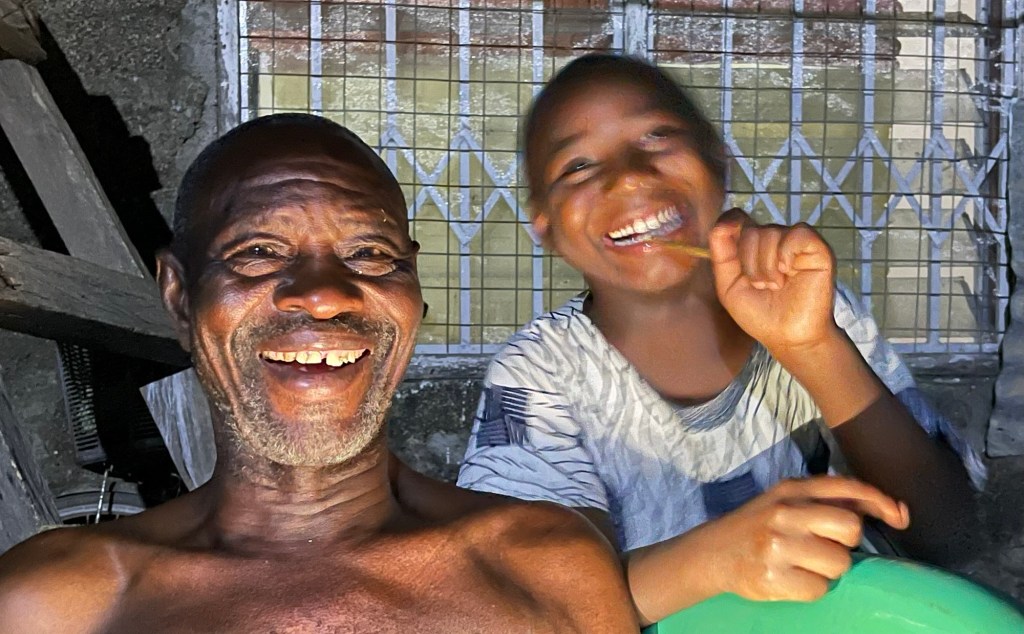
Wechiga laughs with his youngest child, Faustina

My timing, arriving from East Africa was ill-judged. Firstly, this is the hottest time to visit this Ghana; up north the temperatures hover consistently around 37° to 39°, five degrees north of the Equator as the sun climbs to the equinox. The coolest temperature was 33°, and that was by the ocean, as humid as a sauna… The sun BURNS down 12 hours a day. It’s no joke taking ANY activity at ANY time, yet I walked miles.

But worse was to arrive and find my old friend Perry seriously ill in Accra. I met Perry when he joined my English family as a Christmas guest in 1987, a student alone in London seeking a ‘Typical British Christmas’. Of course, with a guest from a Ghanaian subsistence farming family – from a small town through which I had ridden on my first Sahara crossing on my motorbike in earlier in 1987 – it was anything but typical.

Poor Perry, try as he did to be host, was very unwell. If I’d been told, I probably wouldn’t have come. There seems to be a social taboo to talk of sickness, but arriving into family dramas of sudden hospital admissions is not easy for hosts or guest.

Thus it was that I travelled north quickly to Tamale, an hour’s flight into the brown dust and burning temperatures of the dry season north; and on three hours to Navrongo by racing-driver piloted minibus; his main proficiencies being with the horn, accelerator and texting on his smartphone on the deteriorating road. It’s a dismally dry landscape, grey soil, burned bush and scraggy shea nut trees. All the big Ghanaian trees have gone – to smart furniture in the West, construction and charcoal for cooking.

****
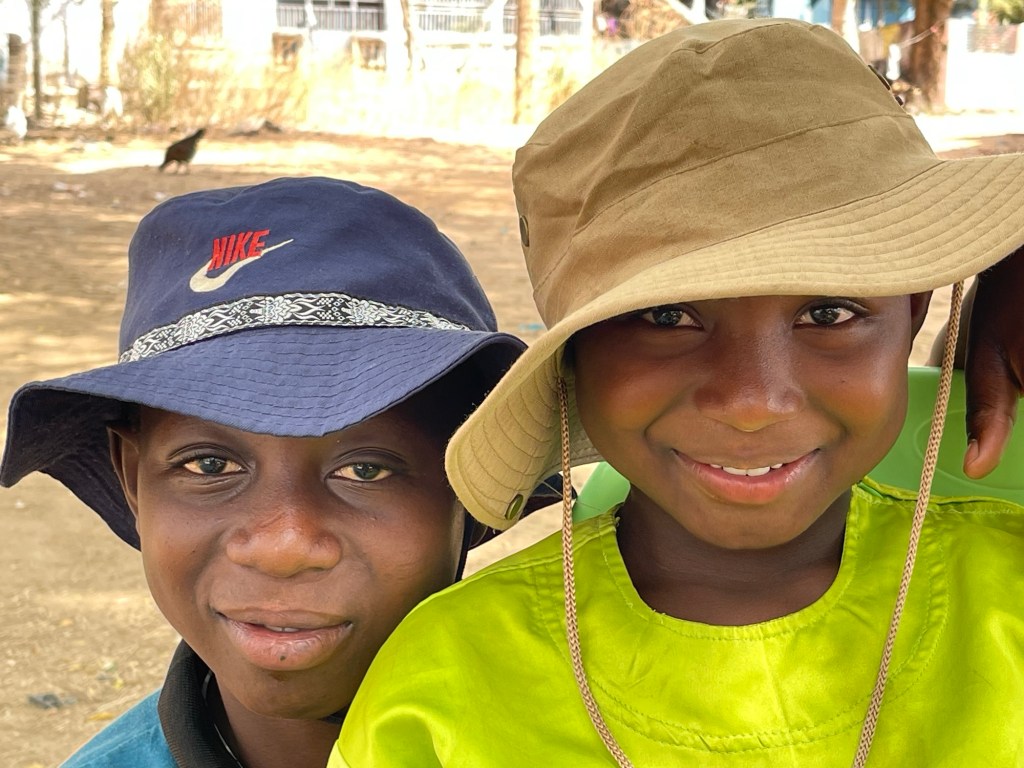
Faith and Faustina – Wechiga’s ‘pensioneer’ children

The town of Navrongo in the furnace of northern Ghana has been a major influence in my life, affecting my moral beliefs, ethical standards and how I look at life at home. It’s been in the background of my thoughts for 37 years, since I arrived on my motorbike two days before Christmas 1989, and met my brother Wechiga and became part of the Adamba family. As much as it’s possible for an outsider, I got inside another culture and saw life through their eyes; lived in their earth-built compound and came to know the old generation, last of the old order in Ghana. Although I didn’t know that then…

Now, in 2026, I’m back in this place I came to know so well on 21 previous visits – and I’m totally lost, physically and culturally – and emotionally.
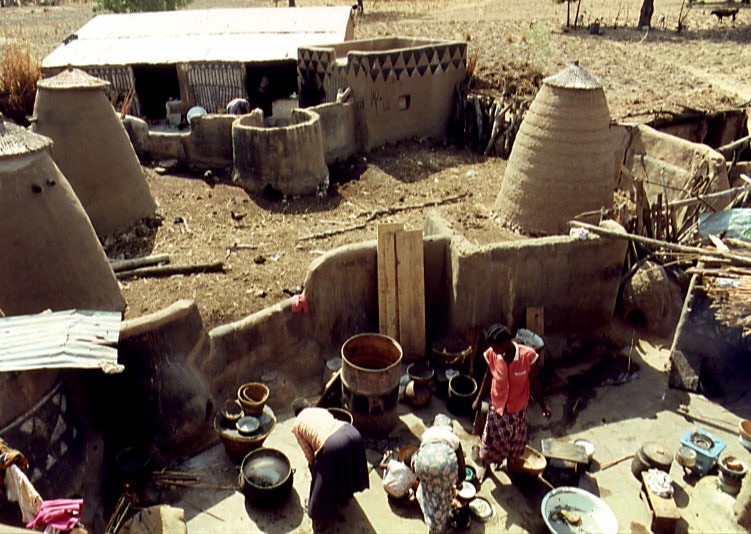
A view of the compound, 1992

I knew the old compound was gone – razed to the ground, to my unforgettable shock, between two of my visits after Akay died. Now, narrow footpaths are informal even dustier roads, abuzz with a thousand motorbikes and scooters, old cars and 4X4s. A fluorescent rainbow of Chinese-paint walls and ugly security railings surround hideous mouldering bungalows dotted with rusting satellite dishes; all set in a desert of blowing plastic refuse.
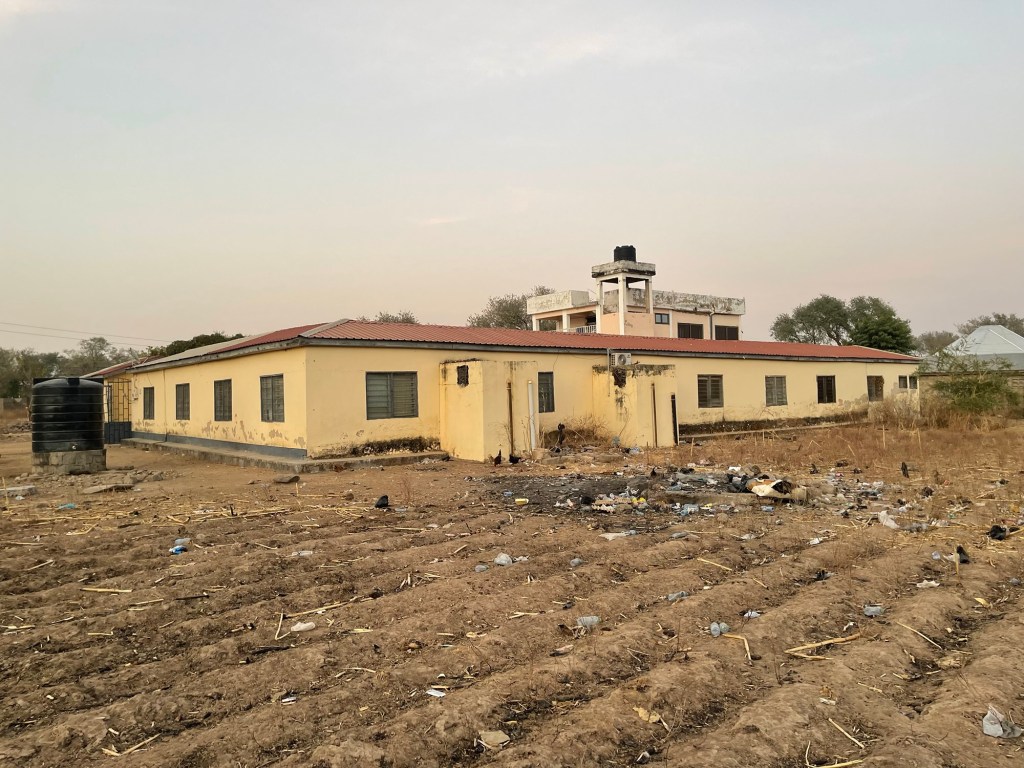
This replaced the old compound

There’s no vernacular architecture, just hubristic designs on display to outdo the neighbours. Where there were fields of groundnuts and millet, grazing cows and earth-built compounds, there’s concrete and zinc, scruffy grey block bungalows and part-finished palaces, all unmaintained. This is considered development.

I’m not sentimental for the old days – when so many died in childbirth or in the first years of life; when hunger was endemic and ancient cruel practices masqueraded as culture. No, now people live longer – to kill themselves of drink, drugs, bad riding, envy, stress and junk food: exploited for the profit of the few.

Mutual support and strict social conventions ruled the the old life; there was a strict moral structure that controlled behaviour. There’s no SHAME any more, like the West. Now the relentless desire to accrue and display material wealth brings murder, jealousy, crime, disillusion, stress and lack of fulfilment. In copying the materialist Western life, the baby’s gone out with the bath water. Akay wouldn’t like this Navrongo. I don’t either.
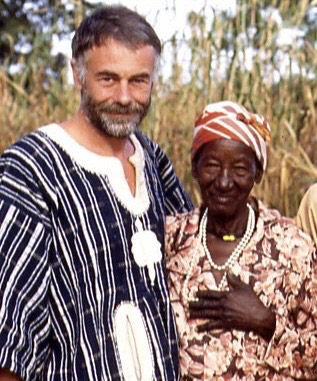
With Akay 1992

Akay is still the most impressive person I’ve met in all my African travels; my African ‘mother’, mother to my brothers Perry and Wechiga and my ‘mad sister’, the irrepressible Gladys. It is Akay who directed this family into the 21st century, an illiterate woman with no status as wife of a junior brother, but of the finest natural wisdom. I couldn’t speak with her, but that never mattered: we recognised basic integrity and trust instinctively. She was the force of the family, relentlessly making her groundnut oil and kuli-kuli biscuit from the peanut waste to educate her three surviving children in Navrongo. In other circumstances – girls weren’t educated in her day – she’d have been a natural leader. As it was, people young and old listened to Akay’s advice.

Akay wouldn’t like the place Navrongo has become… She was the strongest proponent of the extended family, one of Africa’s greatest institutions. She forever respected hard work, community and mutual support; championed the belief that what she had, she must share. No beggar went empty away despite the hardships and poverty of her life.

The majority of the neighbours are now strangers in rental bungalows, the new income earner for the wealthier men of Navrongo, from lecturers and employees of the university faculties that were set up here 20 years ago and brought money to the town, but also brought a transient population – flitting by on motorbikes – that decimated the old traditions and values. Most of those who make the money from rents don’t live here any more: sons who live and work in the big cities or abroad but capitalised on the family lands in their poor origins. Many houses are empty, junior family members now mere caretakers.

Community, for so long the lifeblood of Africa, its way of overcoming hardships, is a washy version, everyone ‘too busy’ now, despite having more leisure time than any time in history. Time maybe to fritter away in endlessly scrolling screens and ‘liking’ new friends’ activities.

Akay’s Navrongo is gone.

****

I think back to that first time… It was two days before Christmas 1989, the end of my second Sahara crossing. I was met by Wechiga at the border of Ghana, just ten miles north of Navrongo, having ridden 13,000 miles from Yorkshire on my ‘Big White Moto’, as my BMW motorbike became known as we rode about the area: me suddenly a celebrity. I knew nothing of Wechiga’s culture: how to behave, what habits I must adapt to, what was expected of me. It was in those early days, while I depended on Wechiga’s wisdom inherited from his mother, that I came to respect him so much and built a firm brotherhood – for he knew nothing of my culture and habits either, but guided me instinctively through the minefields of social convention of that old Africa.

In 1989 I remember, many people came in the darkness of that first evening in the original compound in the dusty fields, where my motorbike stood beside the conical mud grain stores with the thatch hats. My big bike was a wonder, its technological presence alien to the earth-built, rounded organic structures around us, decorated in black and white patterns. All the local families came to greet their white guest. By lamplight I could only make out smiling teeth in black faces, but it was warmly sociable and communal and very exciting. Next day, we had to visit all the local houses to pay our respects. It was how life went round in the old Africa.

Now those houses are mostly filled with strangers.
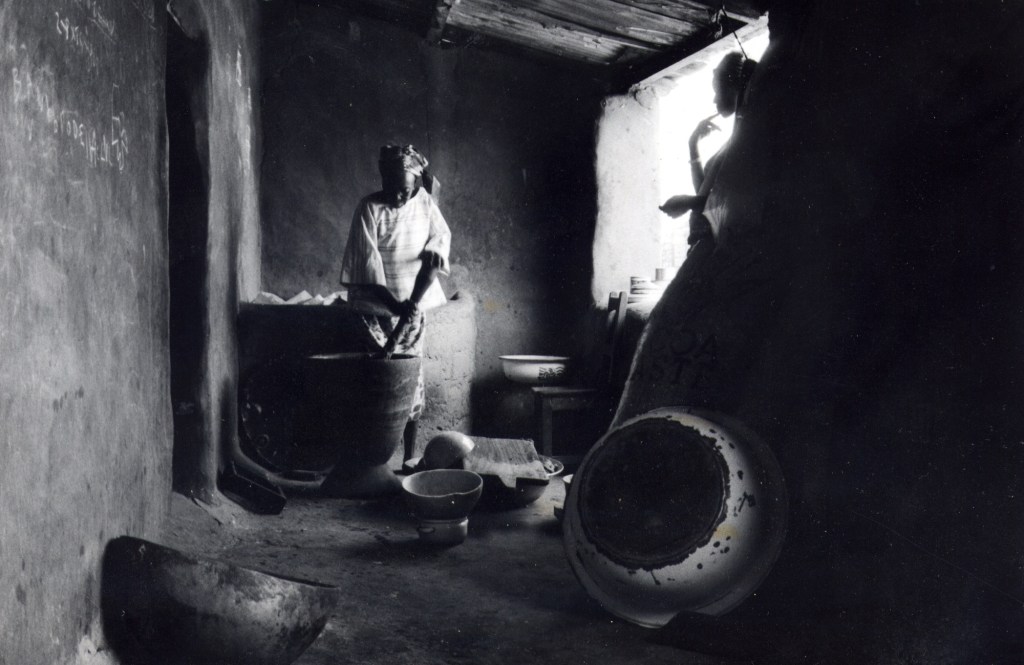
Making groundnut oil, the basis of the family economy, 1992

Only a vestige of the old welcomes survives; there’s little of the social formality left. It’s a handshake in passing and “Welcome back. Long time!”, not the formal visitations, ‘sittings’ and extended greetings. It’s a wave from a moped and a shout of, “Eh! Navrossay, you are back!” Navrossay, ‘Navrongo accepts you’, my local name for these 37 years. There’s no time for those old fashioned formalities. We’re all too busy, despite the fact that no one goes laboriously to the well for water – they have big black plastic tanks above their bungalows pumping from boreholes to wash their motorbikes; no one walks to market – they ride; few hoe their compound fields – the only crop is bungalows.

Wechiga and I amble to visit neighbours; some around still know me, but none of them return the visits as formality demanded. There’s little excitement to see the white man; there’s a cheek to the children, a swagger from teenagers who know the worldly wisdom of their smartphones.

Many people I came to know, of all ages, have died anyway. Far more than die in my own circle. It’s a tough life; life expectancy here is lower and fewer people get medical help for ailments. Many die from problems of their own making too.

****
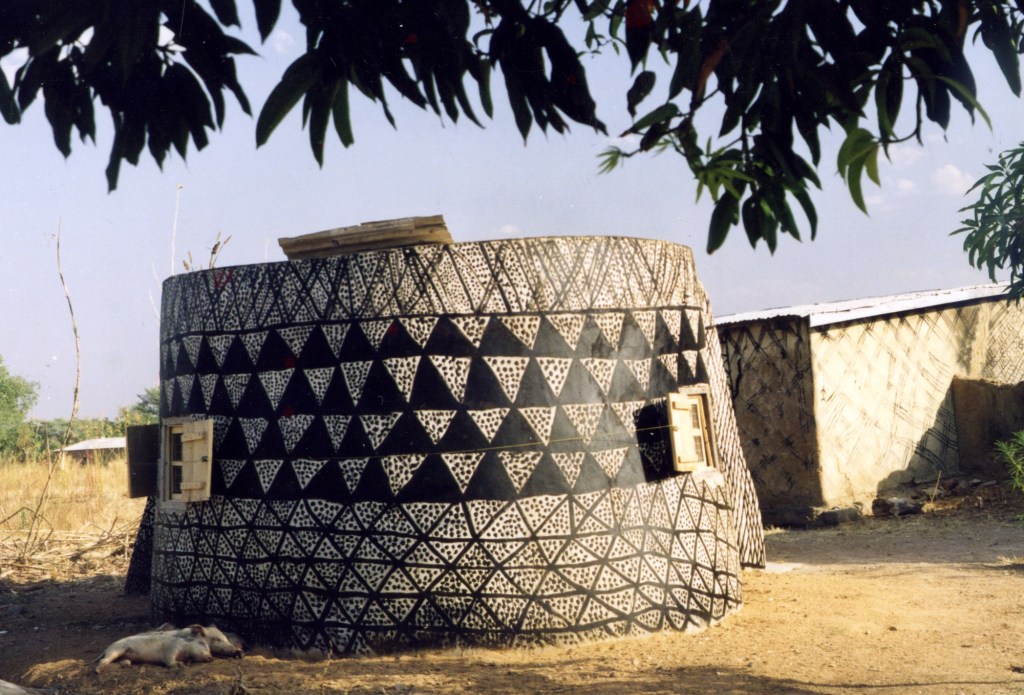
Navrossay’s House, 1998

In the 1990s, I built my own block in the then family compound, a design that incorporated traditional with practical modern knowledge. It stood at the edge of the earth-built compound. I imagined it would be absorbed into the compound in time. But in the new nuclear family divisions of Navrongo life, that ‘old fashioned’ compound was razed to the ground in a frenzy of ‘modernisation’; replaced by a two storey block house surrounded by rental rooms, and several ugly rental bungalows. My idiosyncratically quaint round house with its black and white patterns ended up marooned in the remnants of the fields.

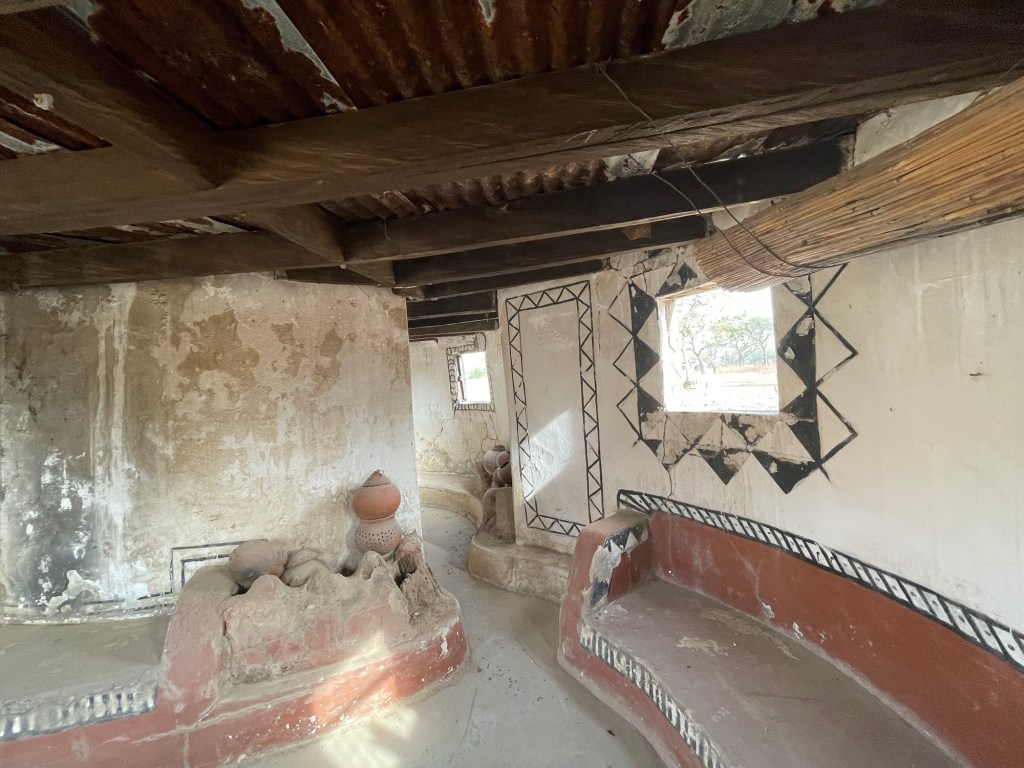
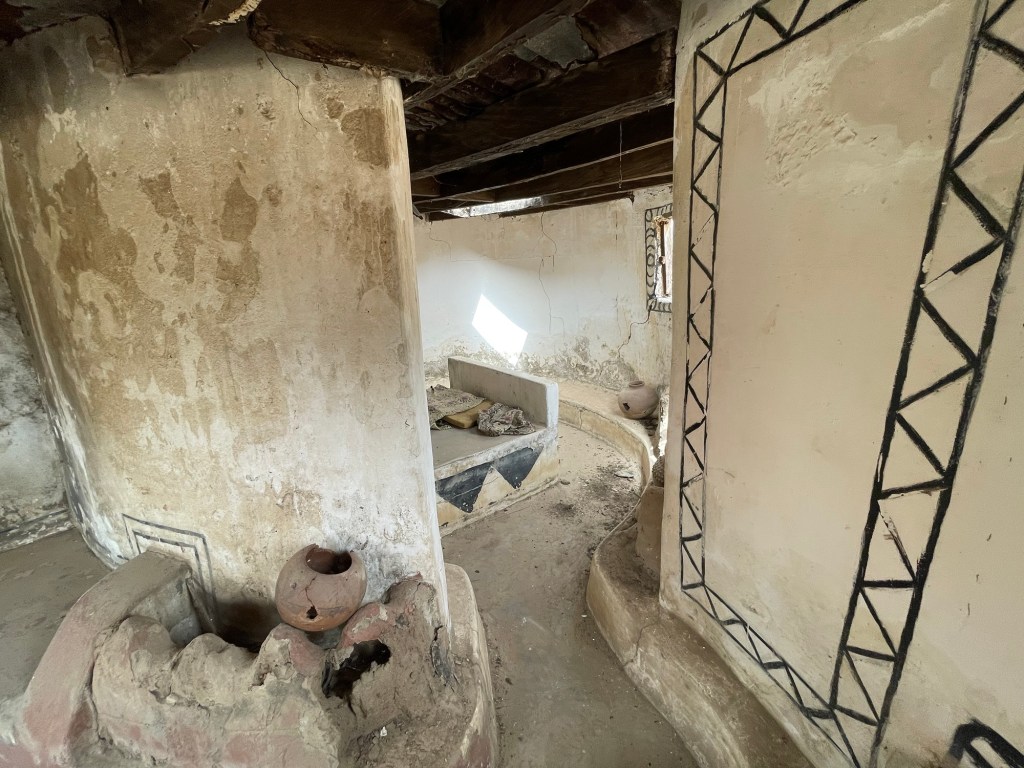
Jonathan’s House is now a ruin unworthy of repair; nothing is maintained here and I’ve been away for eight years. It’s stained and gloomy, an eyeless face. The roof is weak, the window frames rotted and eaten by termites. Children have chalked their alphabets where once I had traditional designs.
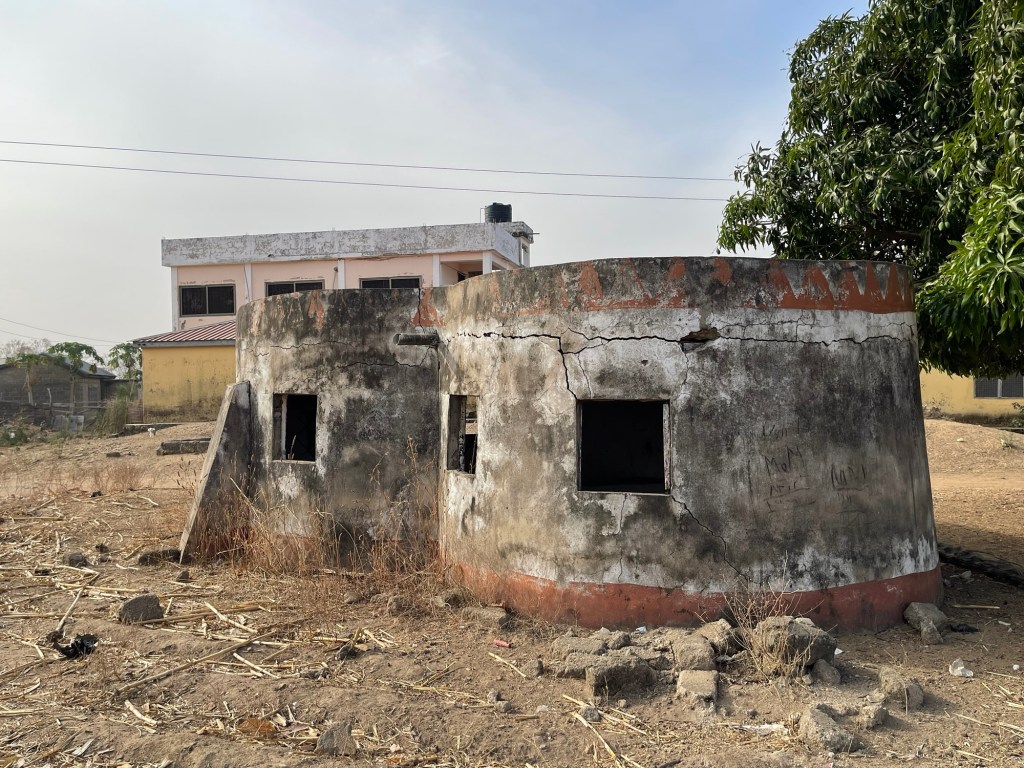
Navrossay’s Ruin, 2026

I made a little museum of traditional items: old pots, one or two unbroken ones rescued from a pit into which all Akay’s carefully safeguarded earthen pots were thrown during the clear out. I collected pots, calabashes, Uncle Gwea’s elephant-headed walking stick, the old men’s tobacco pipes. Very few survive, cracked and ignored in the ruin of Jonathan’s House. I could preserve them, I suppose – but mine’s another culture. Why bother?

No one here wants to remember that their parents and grandparents carried water from distant wells on their heads in fine earthen water pots with incised designs. It’s an embarrassment to preserve memories of their ‘backward ways’. Now, all have plastic containers and vacuum flasks from China, complete with ubiquitous peony decorations. I guess I’ll forget MY tradition and let the pots crumble with the house. No one here looks to the past, that’s a Western tradition… Perhaps my house should be best seen as a metaphor for the lost life of Navrongo. A decaying ruin covered in childish charcoal graffiti disintegrating into an ocean spume of plastic filth. I must ignore nostalgia; perhaps its value always rested in the story not the actuality..?
****

Navrongo has become one of the dirtiest towns I have seen in all Africa (and I’ve seen some FILTHY towns). The plastic problem is disheartening. To one who tuts censoriously at any piece of blowing litter in my home village, it’s distressing. Rotting plastic carpets the ground, flutters from every dead dry season plant and crunches underfoot. The biggest culprit is a piece of total commercial exploitation: half litre plastic bags of water. Sold as ‘pure and hygienic’, it’s almost certainly tap water made pure and hygienic with Ghana’s taxes. It’s the con of the century: tap water as luxury. It tastes of cheap plastic and the bag is discarded in a moment, to blow for evermore about the environment.
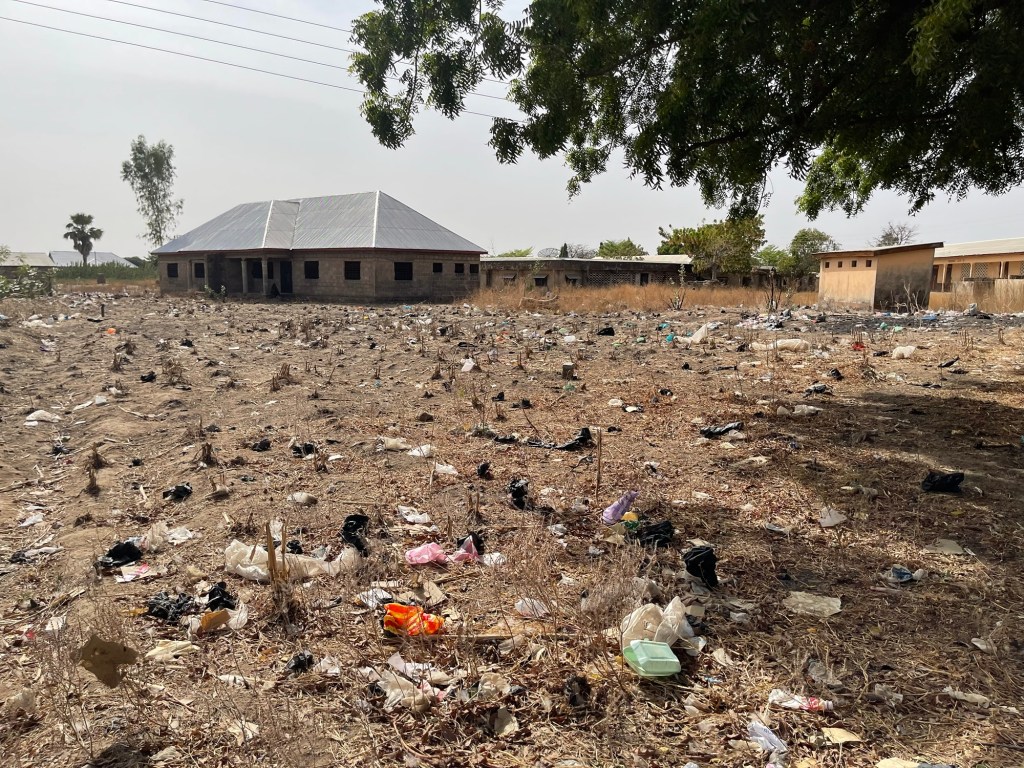
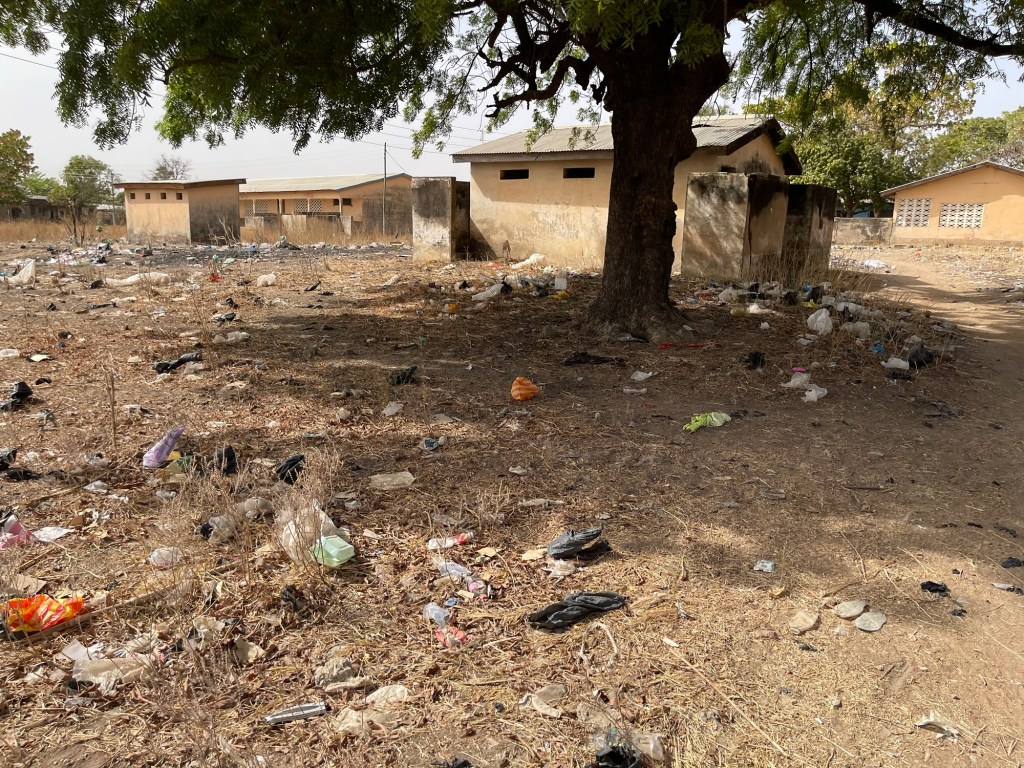
In places it’s ankle deep: single-use bottles; ubiquitous black plastic bags, the reflex reach of every trader; a million water bags; medicine containers, used ‘disposable’ nappies, sanitary towels; sachets from every sort of processed food, Chinese plastic shoes by the thousand – (‘buy Chinese, buy again next year’); sachets from killer alcoholic spirits; soap bags, cooking oil sacks, tattered remains of plastic mosquito nets, fertiliser bags, cement bags, margarine sachets (yuk!), carrier bags, styrofoam junk food containers; household utensils, ‘convenience’ food wrappers, bags, bags, bags, bags, bags, bags, bags. We don’t deserve this fragile planet – and in her wisdom I believe Akay would have sensed that.

****

Maybe I settled a bit once my initial disappointment was past? I tried not to see the filth and pollution, to be more philosophical about the fact that in 37 years almost all the world has gone the same ways. I think I knew, rather than suspected, that this visit would be a disillusioning visit.

Perhaps I just had to finish my Navrongo Story?

*****

I’ll post the conclusion of this Ghana story shortly, a little more upbeat I hope, before I return to Uganda and no internet at the weekend.
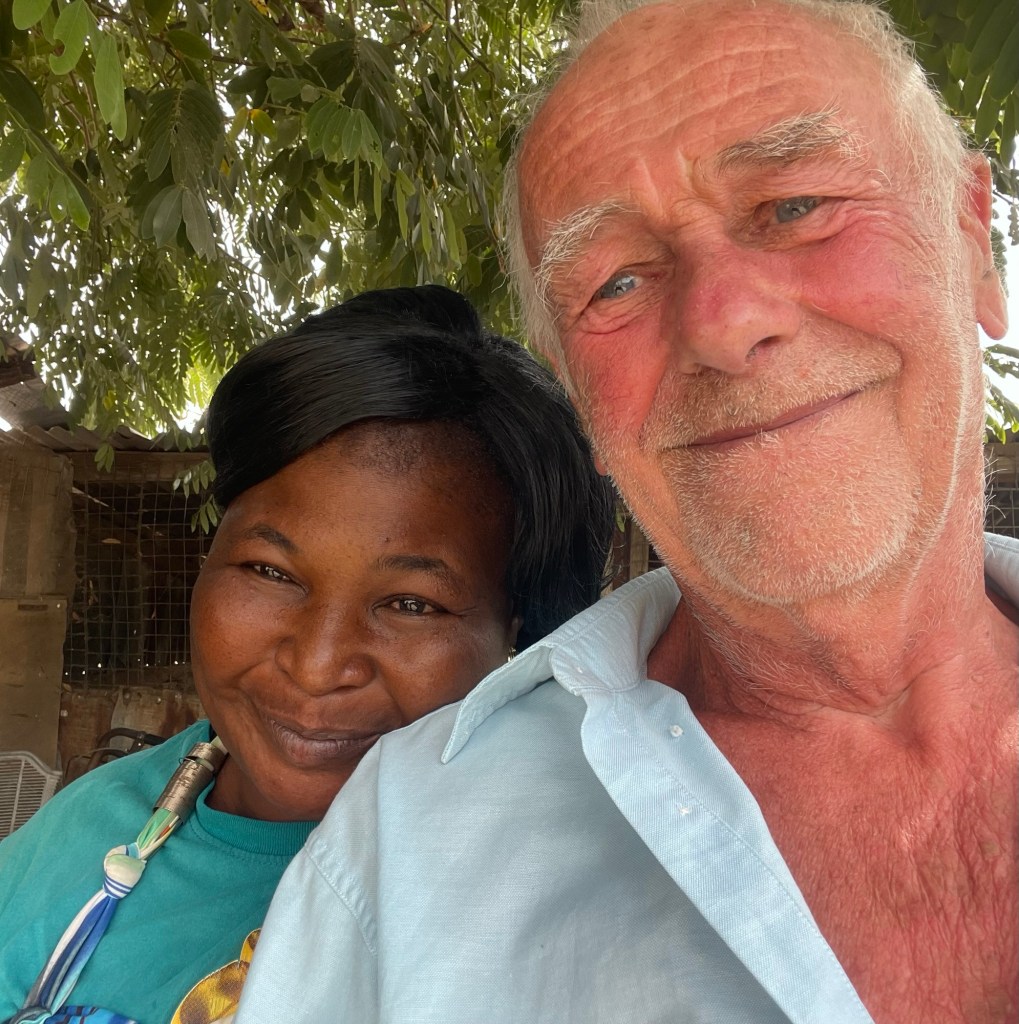
With Mary, Wechiga’s second wife. His first wife, Grace, died about 15 years ago. He remarried Mary, hence his ‘pensioneer’s’ children.

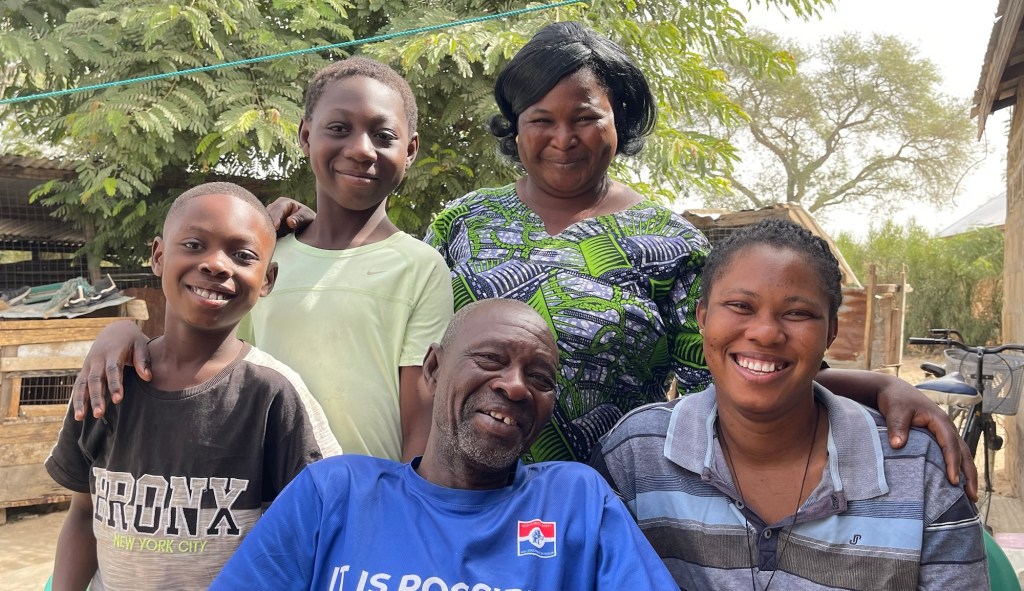
Wechiga’s grandchild Manuel 7 (the same age as his daughter Faustina), son Faith 13, Mary, Wechiga and his daughter Rhoda – (who was a baby when I first arrived in 1989), mother now of Manuel!

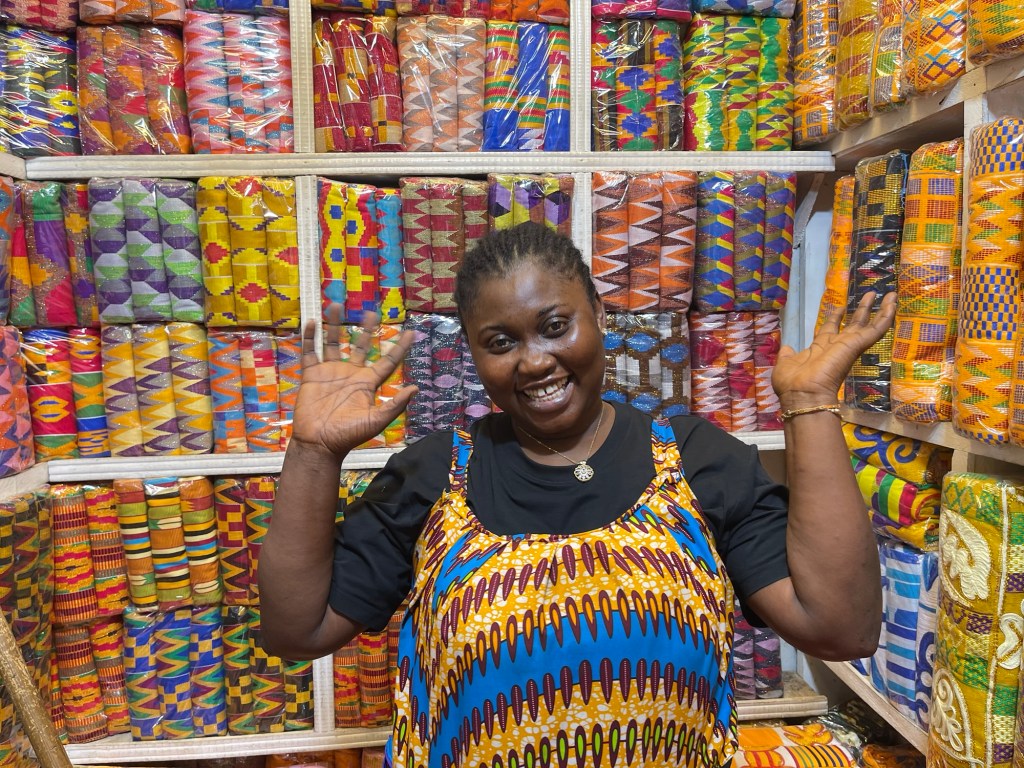
Ghanaians are still SO friendly! Rutina sells traditional handwoven Ghanian Kenti cloth in Kumasi. Beautiful weaving, but about £300 – £400 a length

KENYA, UGANDA, GHANA – THE 2026 JOURNEY

EPISODE THREE – January 31st

Isaac, grandson to Alex’s father my another mother (I think!). Relations are complex in Uganda…

For some inexplicable bureaucratic reason, I can stay in Uganda until the end of my visa in March, but my motorbike is only allowed in for 14 days without paying a £50 tax.

So here I am back in Kenya…

****

If the middle part of the ride between Sipi and Kitale wasn’t one of Africa’s finest rides, I’d be rather bored by it by now. Fortunately, the slopes of Mount Elgon and the swooping Chinese road combine to make it a special journey. The views to the north are magnificent; the engineering – perhaps especially because I first knew it as little more than a chaotic footpath – combine to make this a memorable ride. My road is twenty yards wide and still in good condition. I can choose my riding line on a whim, it’s so devoid of traffic. I’m so well known at the border that I can cross in minutes.

“Do you know where you are going?” asks the immigration officer in the empty echoing halls of the ridiculous Chinese-built border post, “…Exactly?”

“Yes, I’ve been this way many times.”

“Well, you can’t use GPS! There’s no internet.”

Biting back the retort that I was born fifty years before GPS was even thought of, and mankind has found its way for tens of thousands of years without it, I assure him I’ll be able to find my way.

With a ridiculous ‘election’ tomorrow, a purely hubristic exercise on behalf of the inevitable winning party – there being no chance of any other outcome – the president has demanded that all internet services are switched off for the next days. Such is the power of despots (watch out USA). It means that all banks must close, hospitals, communications and most services will be disrupted. Recent events in Tanzania in which people died during election protests assures the ancient president of an excuse to take draconian action. As if he needed an excuse.

****

Keilah in my awful hat – but at least the top of my head isn’t sore

My ‘grandchildren’ jump up and down in excitement as I ride down the track to Rock Gardens at the end of my journey. Alex is hurrying from Chelel, having asked Precious on the phone, “Has my father arrived yet?” I feel at home.

For the next several days, I’m engaged in putting chain link security fencing around the guesthouse. Digging soil here is like mining plastic: crushed single-use bottles, countless thin black bags, sachets, wrappings, broken plastic plates, plastic shoes that lasted only days. The filth is painful to see. And how old is plastic as a material? About seventy years? Yet all the world is thus thickly polluted. There’s no rubbish collection in Africa.

Ryan, a willing helper, fixing fencing

I take charge of the cheerful, fun teenagers: Charles, Rach and Ryan, and we erect the fence to Rock Gardens, fun days with the young men. I do like to be around young people – and here in Uganda it’s pretty impossible to avoid them! These boys are polite, thoughtful, respectful and endlessly full of life and jokes, while including me as a sort of equal too.

Charles, a charmer; one of Alex’s junior brothers

Seven days of chain link fencing, with sore hands and punctures and scratches all over legs and arms; working with sharp wire, rusty barbed wire and no proper tools except small pliers from my Mosquito toolkit is trying. For cutting, no saw, just a panga (machete). For drilling, just a six inch nail (bent). For nailing, an twisted broken hammer with a welded handle that transmits every blow. For digging, only a hoe – if the bloody neighbours haven’t taken it.

Joshua, a guide and helper at Rock Gardens, overhears someone say, “Alex has his own engineer! It’s a mzungu!”

“Ha!” laughs Alex, “Don’t joke with me. I can even employ a mzungu!”

****

But there are frustrations too. This village is poorly educated and many wish Alex ill for his success. Some even use ‘African Magic’ to try to bring him down – but that only works if you believe it…

The trouble starts when it’s reported that Alex is enclosing his compound. Perceived as rich, it’s seen as an opportunity to attempt for some quick money. First the neighbour to the side objects that the outward angling tops of the concrete posts have taken a few inches of his land, on which, he says, he’s going to build. Alex must pay compensation. He’ll never build. Instead, we remove the poles and turn them round. Frustrating, but somehow satisfying.
Then, the neighbours at the bottom of the plot see opportunities to extort money and claim that we’ve encroached onto their land by eight inches. This discussion brings the father, a fat, ill-tempered drunkard, who’s abandoned his family for drink (the African problem). He claims two million shillings (£400!) for our encroachment. Angry discussions continue, the gleam of money-for-nothing in their eyes. Eventually, 300,000UGX (£65) is decided upon.

“I won’t pay the bastard even a glass of gin! Not ONE shilling!” I tell Alex angrily. The land in contention wouldn’t even grow a row of potatoes, even if the man tilled his land, which he doesn’t. We undo our day’s work and move the poles back out of sheer but satisfying spite!

I must remember they don’t represent cheerful Uganda, just this village that so much resents Alex’s success – although he buys their produce, chickens and goat meat and brings tourist money to their village. Lack of education in this derelict country is a sad fact. Fortunately, It’s a very local phenomenon to the village where Alex was born, who cannot bear to see one of their own progress, while they stagnate through lack of effort.

****

Precious and Keilah make the first chelel coffee

Happily, the Chelel villagers aren’t like this.

Chelel is where our future project is slowly maturing into coffee plantations and the next hotel: the Chelel Starlight Hotel on its wonderful mountain terraces. Here, we meet friendly people, thrilled to have a mzungu investing in their area for the development they hope it will bring. We receive gifts of local honey and a big heads of matoke (the savoury banana staple). They put the local Sipi village to shame. Back in Rock Gardens, everything has its price, even to having to buy old newspapers when we built the earth oven – and accusations of ‘stealing’ a few inches of land!

****

JB1 and JB2

Fortunately, Chelel is where my pension+ has gone in the past year. A future for my Ugandan family.

I never felt the paternal urge, and I couldn’t have lived the life I have with a family to care for. I doubt I could have borne the restrictions on my liberty and self-reliance anyway; I’ve protected that to an almost absurd degree and lived life very much on my own terms, without many compromises.

So it comes as a big surprise to find how much I have come to love two small brown African children! I find I have the infinite patience required to be in the company of a seven year old boy, full of questions and limitless energy, and an affectionate, increasingly smart, questioning nine year old girl. Both JB and Keilah are benefitting by their exposure to so many people of different Western and African cultures at Rock Gardens, and live a life not dissimilar to that of my own childhood – from a now very different age. There are few ‘sophistications’ and very little access to ‘devices’ that limit imagination. They have an active life filled with familial duties and small adventures; allowed to take risks – perhaps the most ‘natural’ existence and growing process any child is allowed today. They play imaginatively, despite their many privations of situation, and it’s an enviable childhood I think.

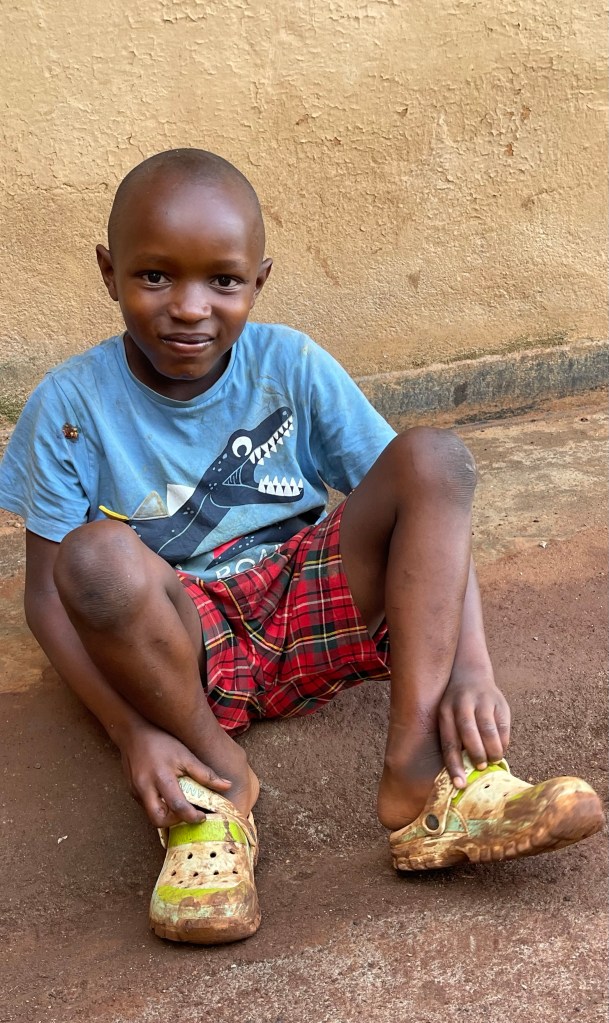
Bean

Jonathan and Keilah will grow with ideas of their own, rather than influence from the manipulative control of other agendas. I can see a growing natural wisdom in these two children: Keilah is already forming her own independence of opinion and character, and JB will follow fast, as they are intelligent children. Perhaps their biggest benefit is to be just two children, close to one another, playing generously together without dispute and sharing happily. They haven’t 6, 12 or 13 siblings – or even 64 by one father and ten women, the most prolific producer I have heard of in this baby-factory of a nation. They have an intelligent father and a caring family situation. They go to a good school, which they love, and are well fed and healthy – things impossible to guarantee in this country where education is rudimentary at best, and health a matter of chance and money; where no one has been taught to plan for tomorrow, let alone future years – and half the population of 50 million is less than 14 years old.

Keilah and JB do household chores, play endlessly and proudly look after the five cows or go walking with us, which often turns into a nature study walk. They’ve had hours and hours of fun with colouring books and pencils, creating images from their imaginations.

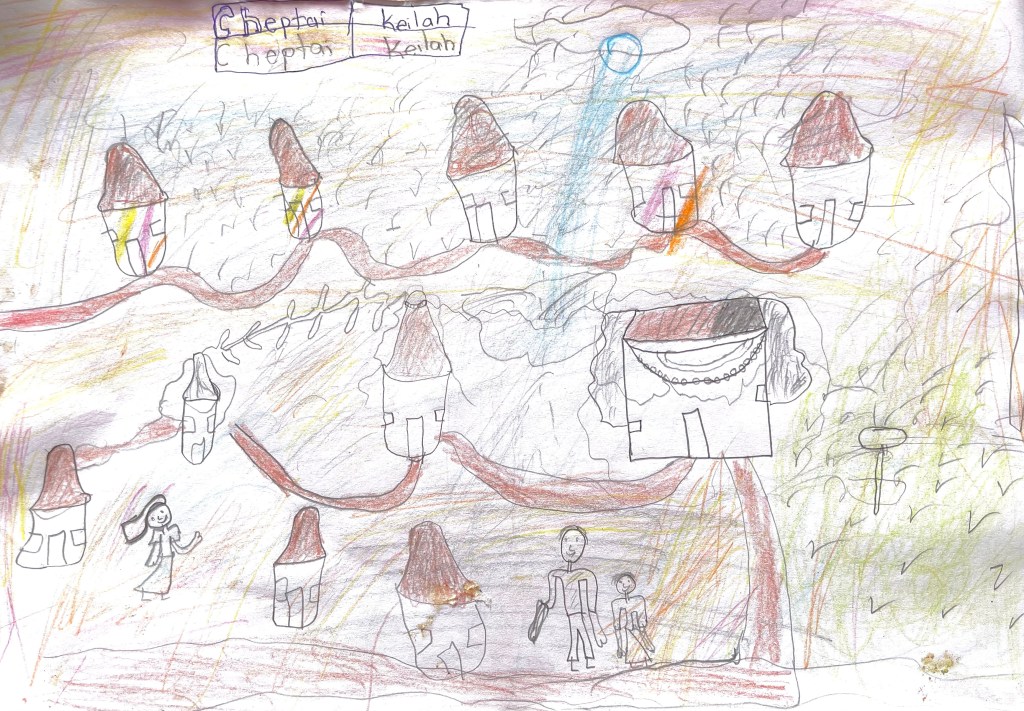
Keilah draws Rock Gardens with its round houses. She and I are at the bottom

****

I’m not ‘rich’ in many people’s terms, but I did sell my Yorkshire house for 34 times more than I bought my first property 30 years earlier; a short-term madness that’s preventing so many from enjoying wealth in the future. A few years ago, my wise financial adviser (and I NEVER thought I’d have one of those!) gave me the best (and most surprising) advice: “Jonathan, I think it’s time you started giving the money away. Your African families are important to you. You’ll have much more fun watching those families progress, than waiting until you’re dead.”

We Baby Boomers, we’ve had embarrassing riches to enjoy… Not only have we had the ridiculous change of economic values that brought us the ‘Housing Boom’ with, for some of us, the lessons learned from the DIY revolution that kicked in during the privations of our parents after the war. We may be one of the wealthiest generations, in all senses. We’ve lived at the start of the destruction of all that maintains life, rather than suffering the consequences that are coming. We’ve had all the advances of science and social welfare reforms, now being stripped bare by selfish, prejudiced rightwing politics; we’ve enjoyed freedom to do things our way; we had optimism in our youth that we were going to change the world (although, in the end, we changed only ourselves…). We’ll probably be one of the longest-lived generations, growing up before the industrialisation of our diet and ‘playing out’ as children.

The pleasure I am getting from my advisor’s advice is immeasurable. We’ve created Rock Gardens together, Alex my ‘son’ and I. Now there’s the coffee plantations and Chelel hotel. The children are at the best school available (rated 17th in Uganda). Adelight is gaining independence in Kitale, assuring me that her next government contract is almost assured, thanks to my loan last year, (now half repaid). William counts himself a ‘dairy farmer’, with his three Holstein cows, and is becoming modestly self reliant. I’ve given modest interest-free loans to other family members to invest in their future, and over many years I’ve been able to give support to my Ghanaian family as well, and help for medical and family emergencies.

In my world travels, so many strangers have shown me TRUE generosity. The most generous are those who give what they can ill afford: food they would eat themselves but that humanity and culture insisted they gave to me; they’ve opened their homes and hearts. It’s a lesson I’ve not forgotten.

****

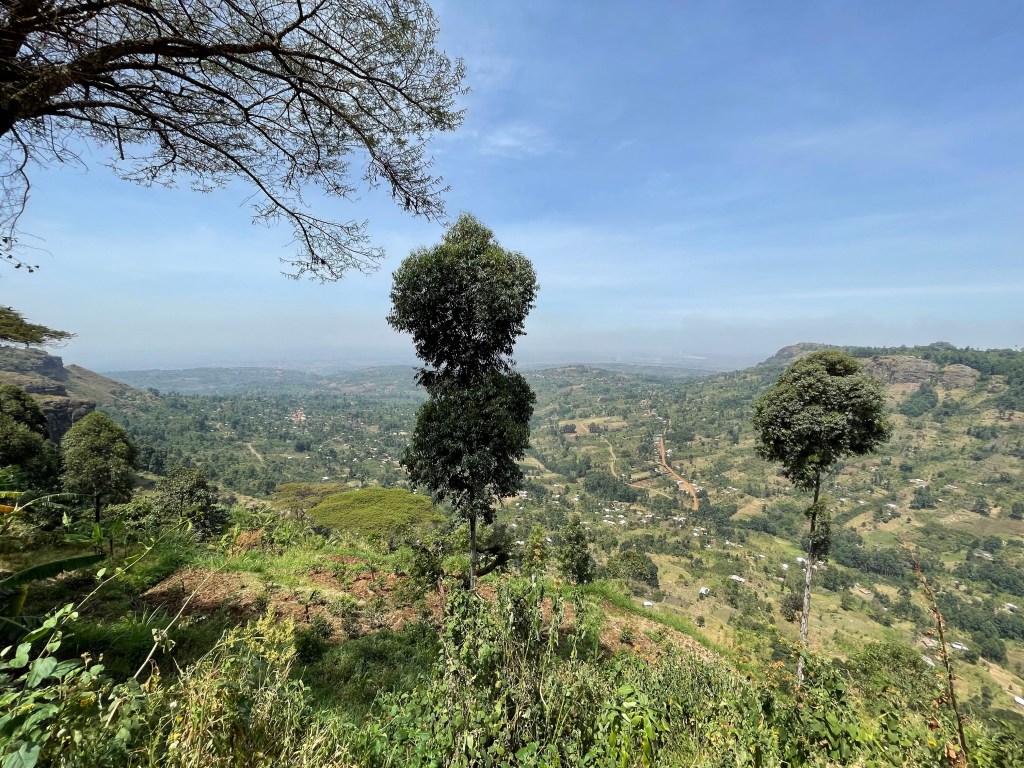
The view from the new plot

Last week, I bought another acre or two of Ugandan mountainside in Chelel. It has an even better view, but I’ve told Alex, no more building! I’ll allow him a small thatched shelter under which his guests can drink coffee or beer and enjoy the view of the vast yawning valley that stretches to infinity, but now it’s time to invest his effort in getting the farming business up and running.

Meanwhile, the new hotel continues to grow. Moses, the best worker, is digging foundations for the kitchen and restaurant. Local boys are laboriously hoeing acres of land to plant more coffee seedlings and ‘Irish’, as potatoes are known in Uganda. There’ll be onion fields, passion fruits and local vegetables that will help to make Rock Gardens and the Chelel hotel self-sufficient.

Alex is already bringing work to Chelel villagers. And they support him happily.

****

Travelling is frequently tedious, uninspiring and trying, but there are days that make up for all that. I guess life is always like that: a few highs worth waiting and working for…

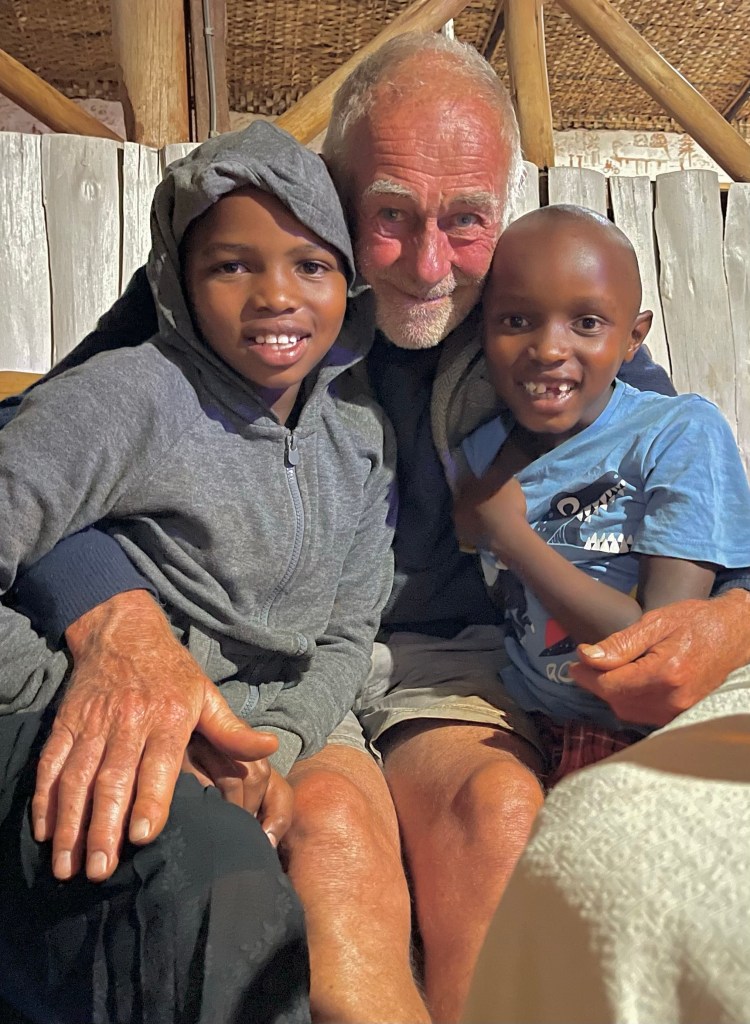
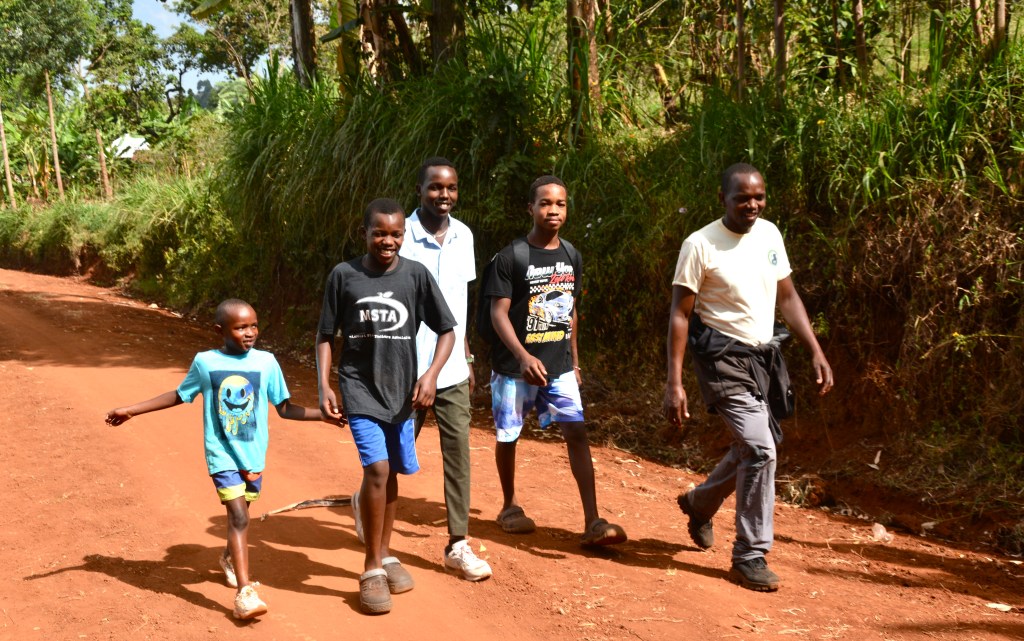
JB, Isaac, Charles, Ryan and Alex

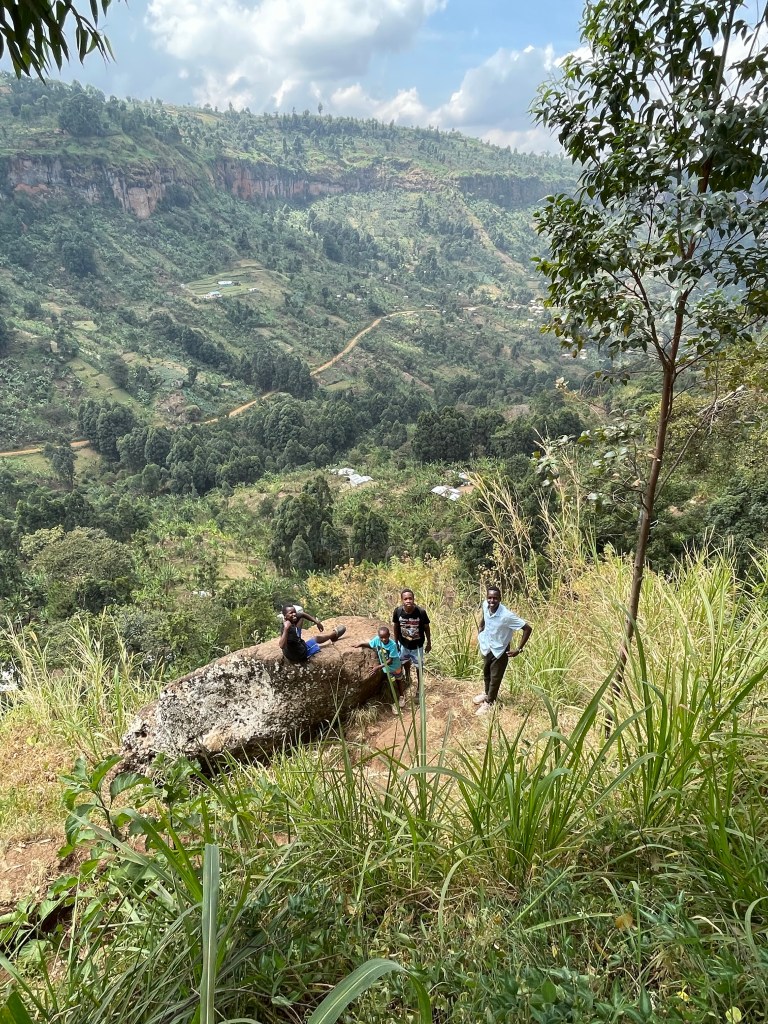
Alex and I keep on hiking for relaxation. With the delightful, laughing company of the young men, Charles and Ryan (18) and Isaac (13), Alex, little Jonathan and I hike about 15 miles with punishing ascents and descents, stairways, ladders and clambering up mountainsides, all ending, long after dark, with the usual eight hundred foot clamber up to Sipi.

By the time we stagger back into Rock Gardens, long after dark at 8.30, we are exhausted from an accumulative climb of perhaps three and a half or four thousand feet and the altitude: never less than 4600 feet, topping out at 6450. We’ve clambered ladders and slithered down dusty rocks and climbed rocky volcanic slopes, scrabbled through vegetation and stumbled through matoke plantations and miles of coffee bushes in this magnificent countryside.

Down this side and up the other side…

We’ve met hundreds of people; been called to excitedly by thousands of children; we’ve been disturbed by hoards of noisy election crowds clamouring for the pennies handed out by agents for local candidates (as little as 20 pence buys a five-year lucrative office for these corrupt officials).

Rural routes full of mild adventures

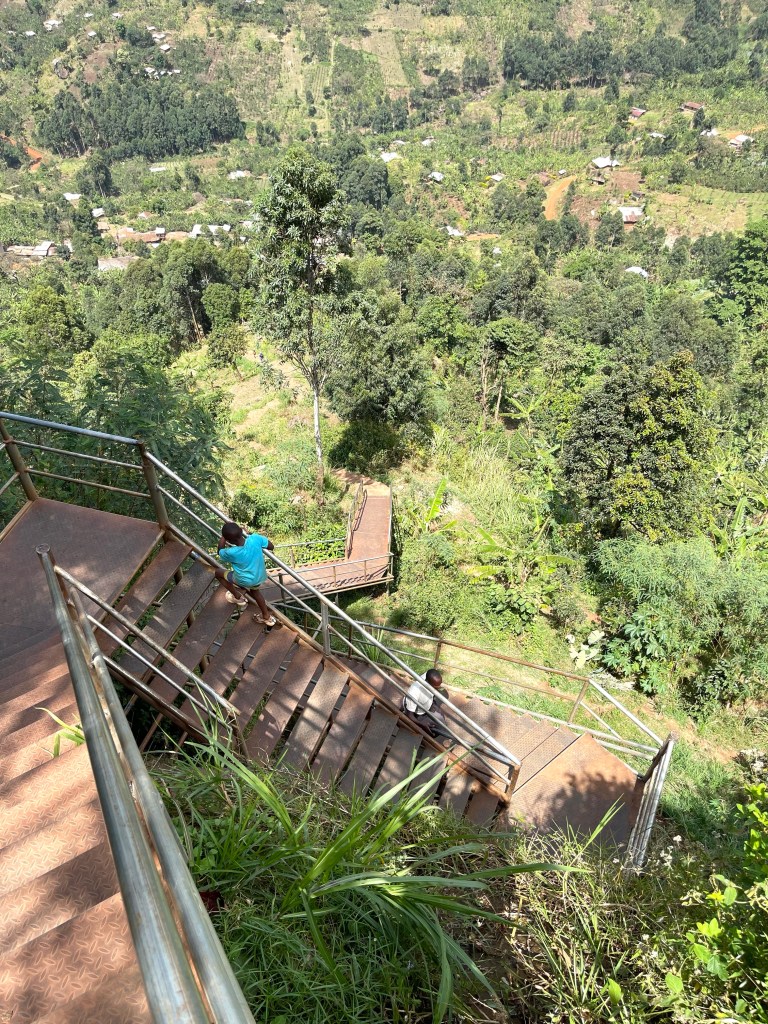
733 stone and 213 steel steps, straight up the mountainside. Punishing!

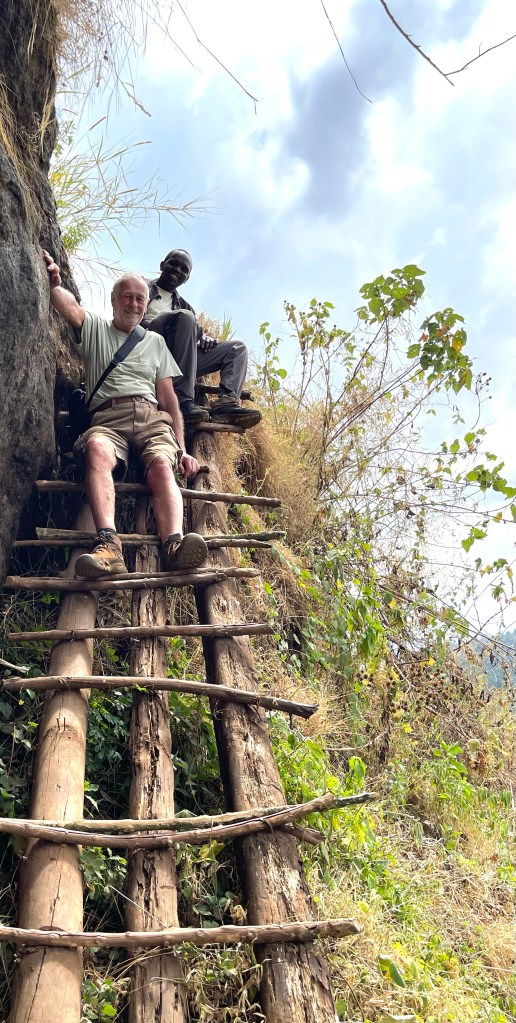
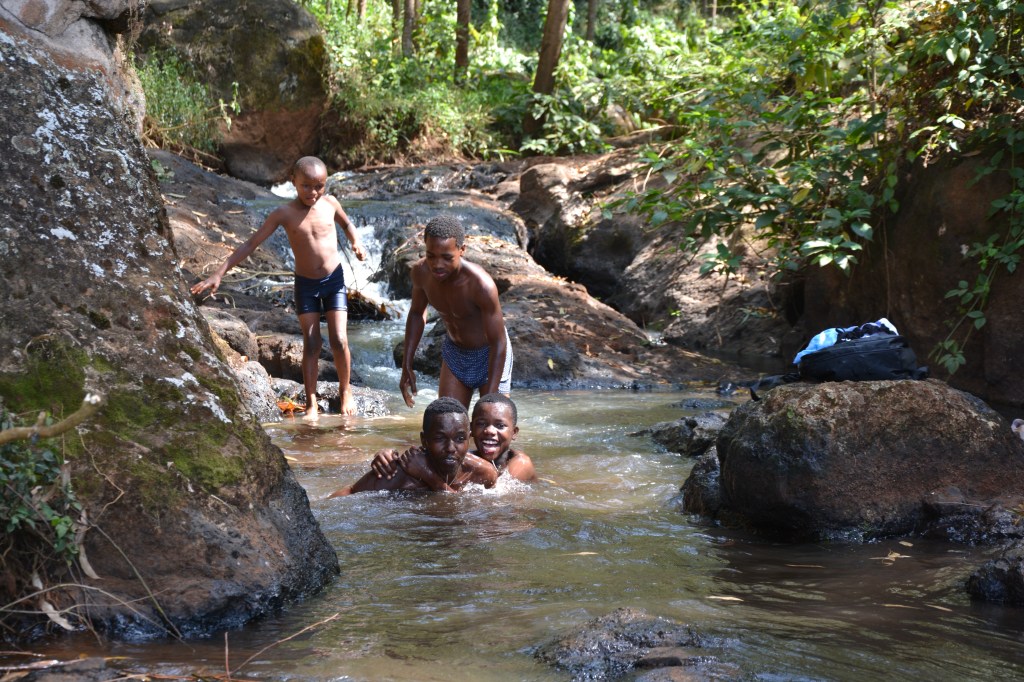
Tea and chapatis in a scruffy village and then those punishing 946 stone steps, back up 650 feet to the heights. After that, a rising and falling wander through forests and coffee bushes with the yawning gulf alarmingly close, slipping away sharply from our grassy path. No place for those without a head for heights or of suicidal tendencies – or the drunkards who sometimes go over the edge. On a clifftop above a slender spray of a waterfall, that shimmers down 200 feet, we find a pool in which the boys frolic noisily. Then the two long steel ladders Alex and I have used several times to descend to his sister Doreen and husband Leonard’s compound far, far below.

100 feet or so, down the STEEP ladder to Doreen’s

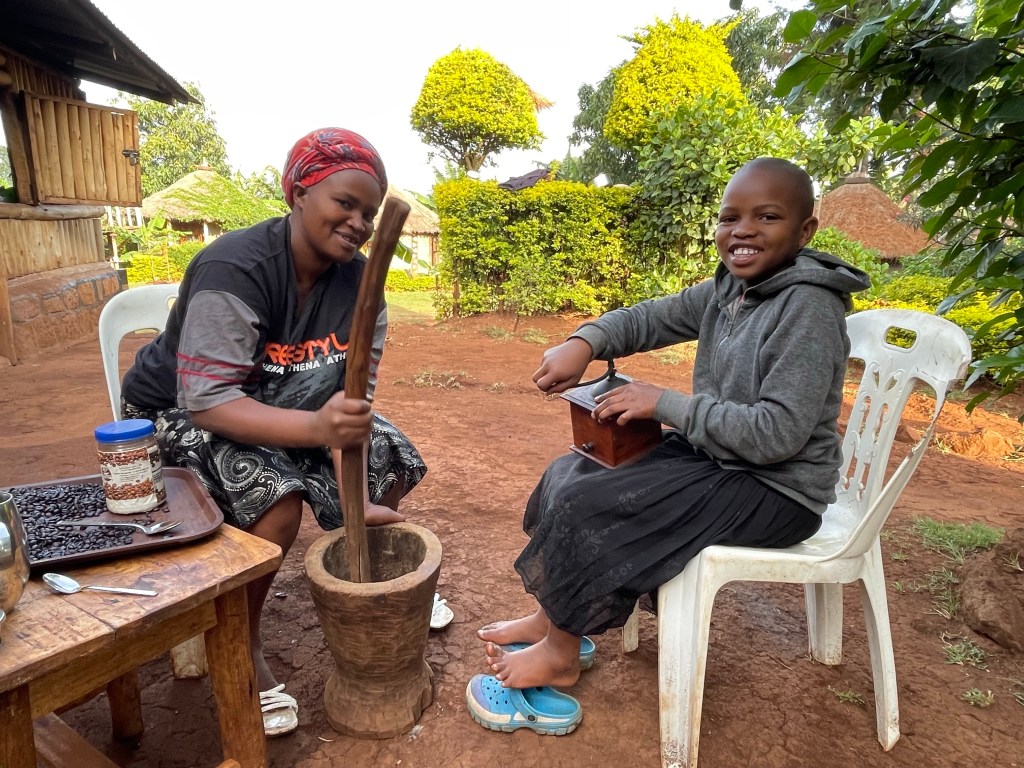
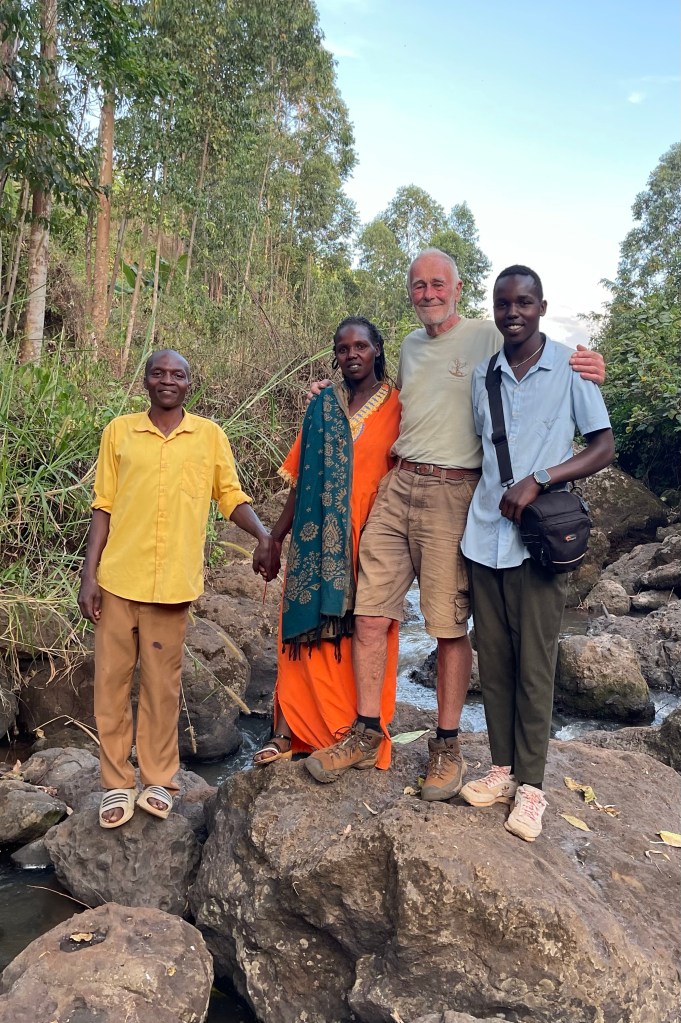
We are welcomed warmly, with thick fresh chapatis and eggs – you can’t visit family without food and drink, even when the sun is slipping down the western sky and you still have four miles to walk and 1000 feet to climb. Leonard’s coffee must be ground in a mortar, roasted and prepared. By now I’m watching the orange sun sinking and glad I brought my torch.

Leonard, Doreen, Charles

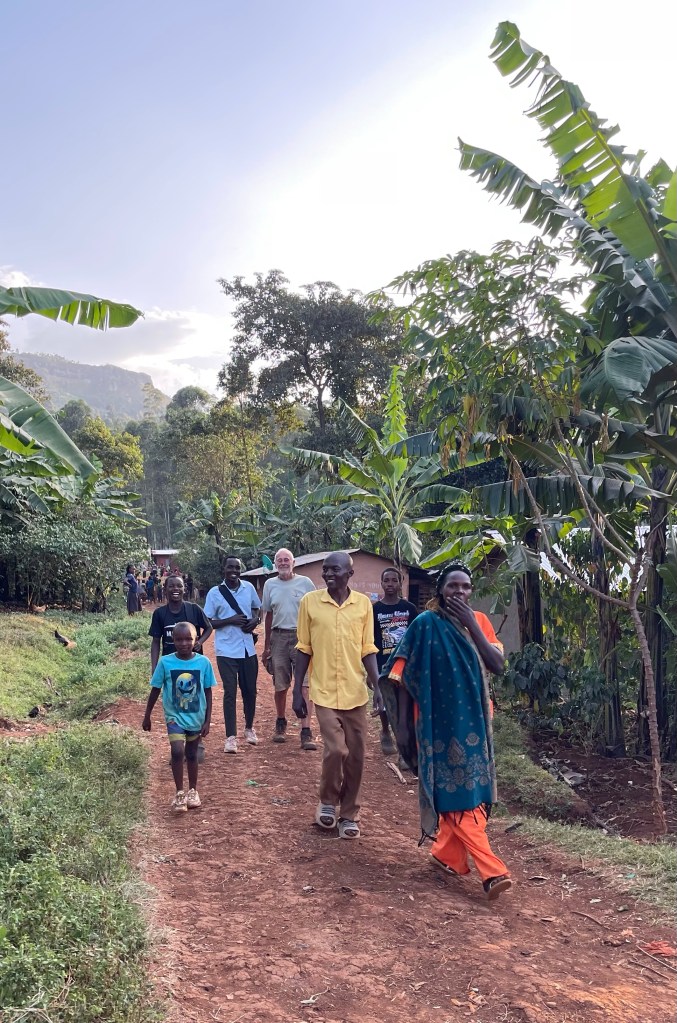
Happily, Leonard knows a short cut. It proves to be a mile of coffee shambas and farmland, dotted as everywhere in this vastly overcrowded country with mud and earth homes with corrugated roofs. We must stop to greet the householders. Judging by reactions, it’s likely I’m the first mzungu to go this way.

Leonard and Doreen leave us at a dust road. We put little Jonathan and Isaac on a boda-boda as dusk sets in. They’ve walked at least ten or eleven miles. Now Alex is concerned for my safety. Unlike my companions, I can’t see in the dark, but I am determined to complete the hike.

Children everywhere. This country is second youngest in the world

In one village, as darkness falls, I am followed by a huge gang of children and youths, pretending to be a bodyguard for the mzungu election candidate. By now, I am getting beyond being the endless, day long – Africa-long – joke: “EH! MZUNGU!” from every corner, as I concentrate to see where I’m putting my feet on the now dark, dusty road. We finally stumble up the 800 foot escarpment, only Ryan’s light shorts visible as I flounder upwards in starlight, the sky filled with diamonds.

The best feature of my day is the company of the young men; Isaac, with his perpetual happy grin, and JB2 with his boundless energy. They make the day special. It’s so good to be around young people.

****

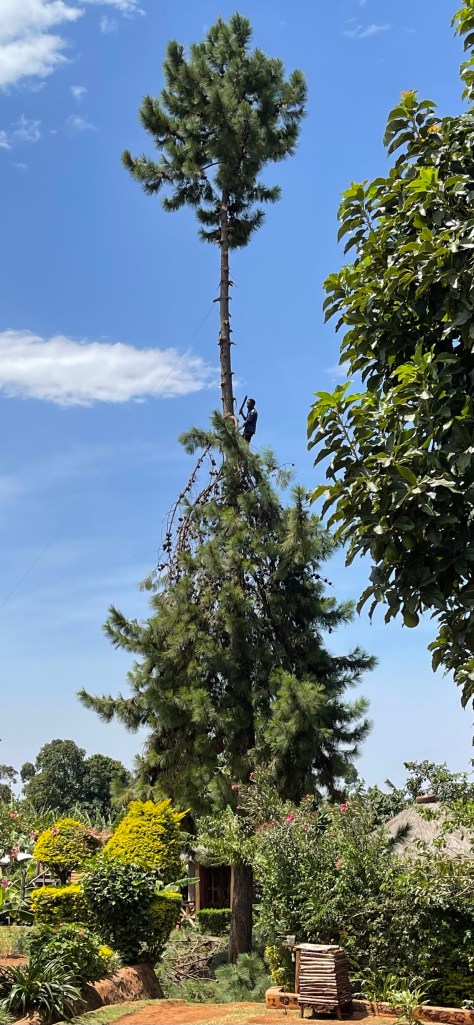
Alex and I have been long concerned about the fast growing pine in the middle of the guesthouse compound. It’s immensely heavy, slender, tall and shallow-rooted. If it falls in the evening winds that blow up from the plains far below, or gets struck by lightning again, it will demolish all – and anyone – beneath its trajectory. Reluctantly, we decide it must be felled.

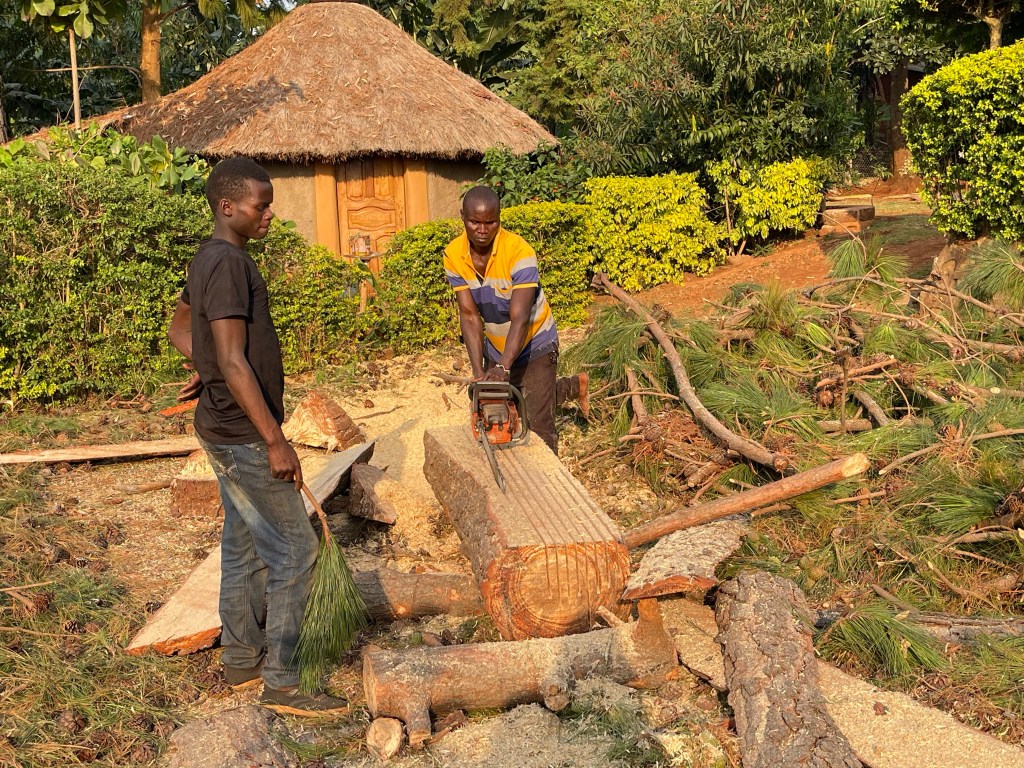
Watching a 72 foot pine being trimmed to a bare trunk by a fellow with bare feet and a panga, and then felled by a man in flip-flops with a two foot chain saw, is an anxious activity for a Northerner. Later, the trunk is cut into one inch boards with the same chain saw, by a man in a tee shirt, with no eye protection, gloves, hard hat or ear defenders – let alone SHOES. It makes even me wince. Life is cheap in Uganda, and safety not considered. Perhaps such poor education causes a total lack of imagination? It’s the same with boda riding, 240 volt electrics, sharp tools, fire, construction work – every potentially hazardous activity: a fatalistic belief (or lack of imagination) that nothing will go wrong. A man, 60 feet up a swaying pine trunk, with no safety rope or protective gear whatsoever, wielding a panga… God’s will is in control, maybe?

Not even shoes…

****

In a week’s time, I fly from Nairobi across to Ghana for 23 days. Ghana, my first and longest African influence; my 22nd visit. Where and when I’ll find internet, I’ve no idea. I do know it’ll be the hottest month of the year, a decision I made to make the most of the school holidays of Keilah and little ‘Bean’ in Uganda.

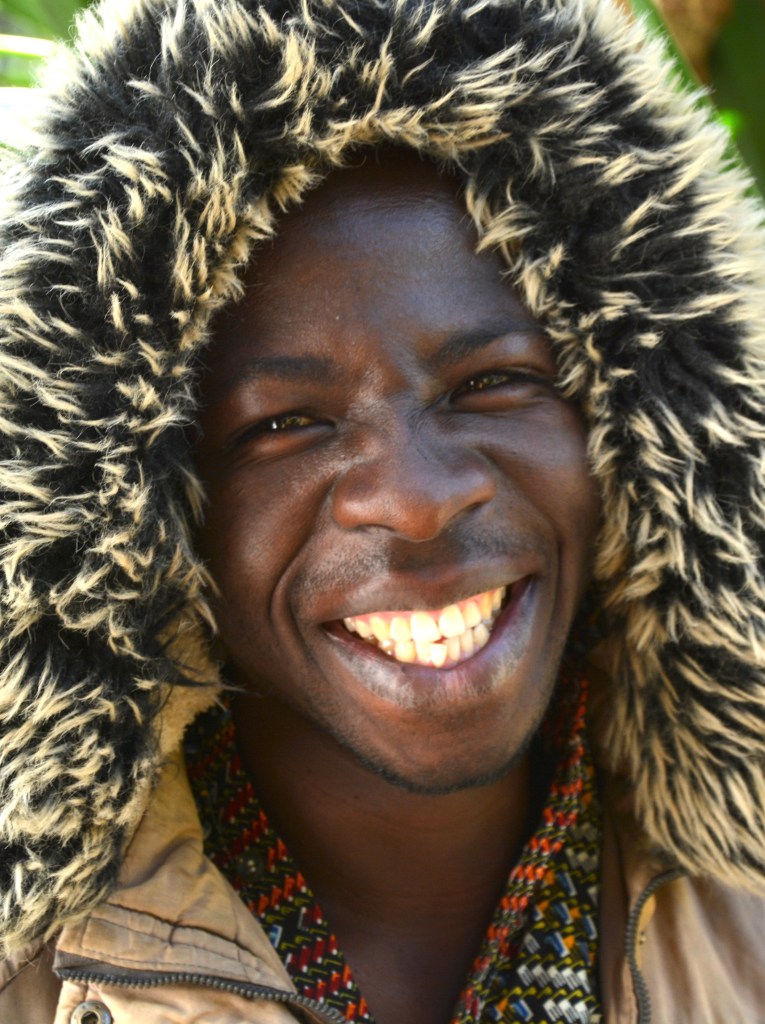
Kevin is Adelight’s compound helper. For him, the mornings are cold!

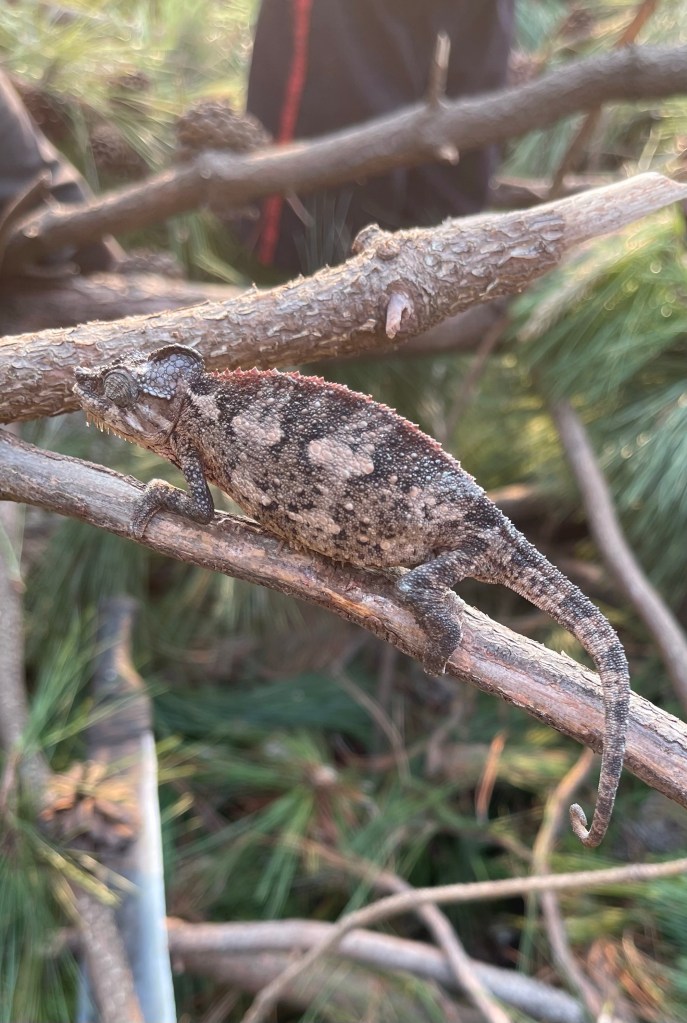
Chameleon, well disguised on the pine tree. It seems to be chameleon season in Sipi. They can live up to 11 years

KENYA, UGANDA, GHANA. THE 2026 AFRICAN JOURNEY

EPISODE TWO – JANUARY 14th 2026

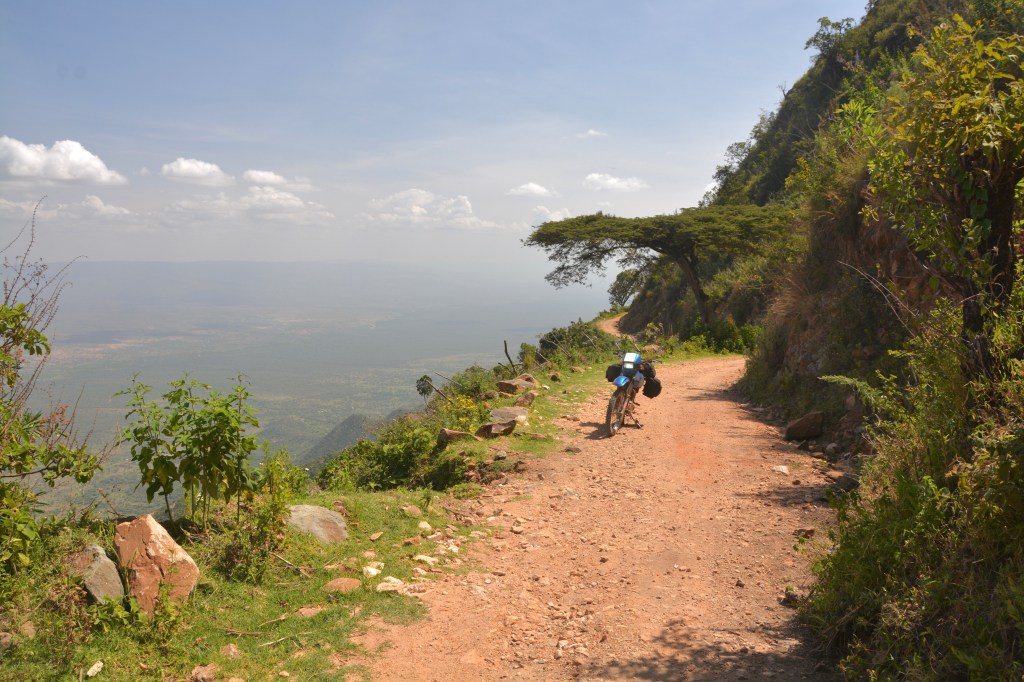
Trail riding doesn’t come like this in Devon!

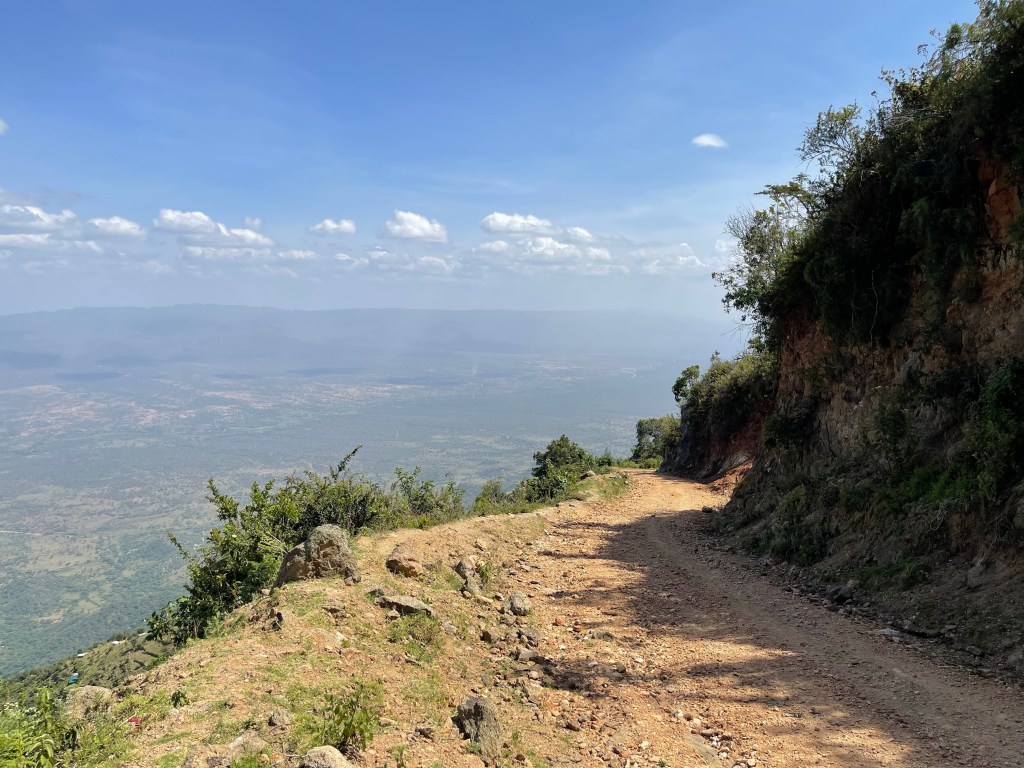
I’m often struck by just how remarkable all this is. Here I am riding a high precipitous rock and gravel road along the very lip of the Great African Rift Valley, inches from a great plunge into the oven-hot depths. I started trail riding forty eight years ago – but then it was for fun, brief Yorkshire trails over boggy moors and up and down stony tracks. Here, it’s sometimes the only road to use. But, I admit, it’s usually the one I choose, even if there’s a tarred alternative.

Riding along, bumping and bucketing about on one of the most impressive trails I can imagine, people run to the roadside to stare and wave; crowds of schoolchildren cheer at me, a flutter of pink palms and white smiles on young black faces, skin so smooth, unlined yet by the hard lives most of them approach, here on this escarpment slope. They’ll scratch at the red soil and herd a couple of cows and some goats, until they end up creased and dressed in tattered clothes like the old crone with one eye on the back of a boda I stop to ask directions from the rider. She looks at me like something from another planet – about her age, in all likelihood, but a world apart, a result of an easy life in the profligate North, good nutrition, education, medical intervention when required, relative wealth and CHOICES – the biggest difference between the prison of poverty and my relative ease of life. I’m choosing to ride this stunning track; she has to, bumping about on the back of a small motorbike in such discomfort for an old woman. Time was, of course, she’d have had to walk this way, without even the pennies for the ride. The ride is perhaps a luxury conferred by her old age.

It does make me reflect on the inequalities I witness everywhere around me and puts life in a different perspective. No one here, in their late seventies, in any condition – of wealth or health – can CHOOSE to do what I’m doing. Even if they wanted to.

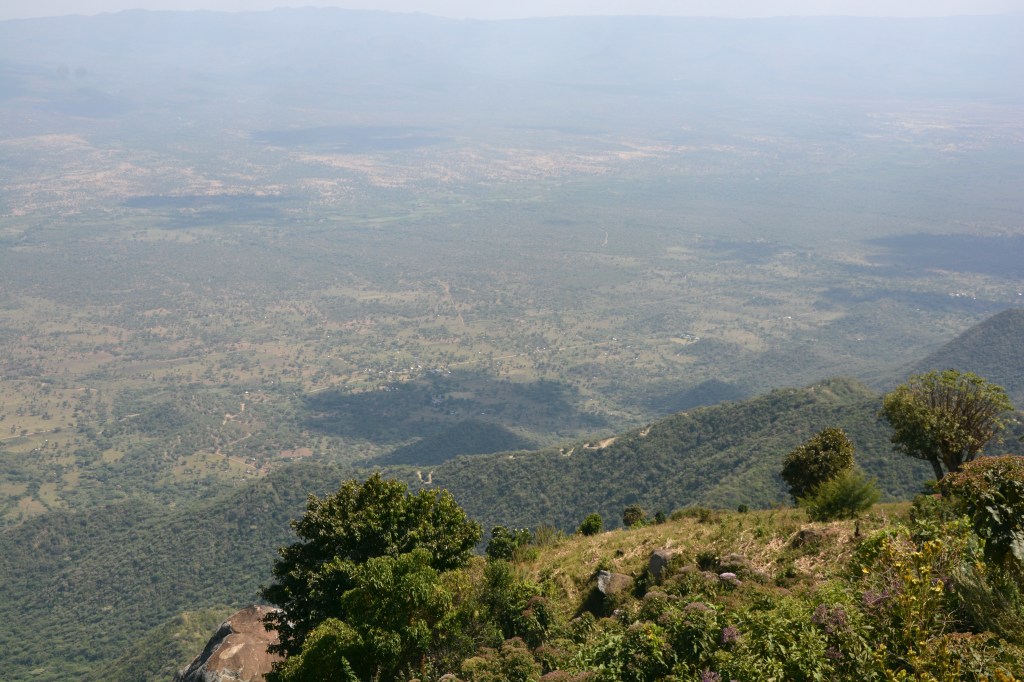
The view downwards…

****

Thirty kilometres on this punishing red road bulldozed across the steep slopes and I get lost. But there’re always boda-boda riders to flag down and ask the way. They make a living – of sorts – riding their unmaintained small Chinese machines on these vague roads. I follow this rider for several kilometres, breathing in his cloud of dust. My eyes are prickling, despite goggles; I think I’m suffering a paucity of vitamin A. My diet here is pretty simple, although mangoes, of which I have about five kilos (for £1!) bouncing on the back of the bike, contain it. It’s mainly in liver, fish, cheese, butter, squashes and greens – none of which feature much in the African diet. Lack of vitamin A, I found from a clever Ghanaian doctor years ago, is a cause of much blindness in Africa, as the surface of the cornea becomes dried and crazed. Feels like mine’s going that way these past weeks, with itchy eyes. Again, my knowledge and wealth mean I can get some supplements from a pharmacy tomorrow.

He puts me back on my road and I twist and turn on the high Cheringani Highway once again. It’s a fabulous road – tarred, this one, for now at least, depending on maintenance. It clambers through high scenery, hills rolling off into the blue midday, the sky deep blue above. I’m always conscious of the sheer immensity of African skies. As I ride up to 3060 metres (10,000 feet) above sea level, I dodge cows and sheep; people wear woolly hats and coats up here, and I must stop to put on a jumper under my jacket. Surprising how cold 15 degrees can feel!

There’s a road I’ve never taken, that drops sharply over the southwest face of the hills to the straggly town of Kapcherop, where tea bushes carpet the slopes around town. From Kapcherop, I’ll sweep on down, on deteriorating tar, full of dangerous holes and speed humps, the obsession of Kenyan road engineers, to the Kitale road. I was told of this road last year by some fellows in a tea house. I’ll try it…

Never again! It’s an APPALLING loose rocky staircase slithering downwards. I must concentrate and leap and dance about on my little bike. TEN MILES of this punishment. Good exercise, I tell myself. But I’m aware too, that a small mistake can cost me dearly. I mend much slower now. However, I stay upright and my Mosquito, now running soundly, does good work. We eventually emerge onto tar again – both of us worse for wear.

Then, with speed humps, wandering cattle, mad boda riders, straining vastly overloaded lorries with bits flapping, potholes and grumbling tractors almost as wide as the road with dry maize stalks, it’s the usual African riding back to base at Kitale.

****

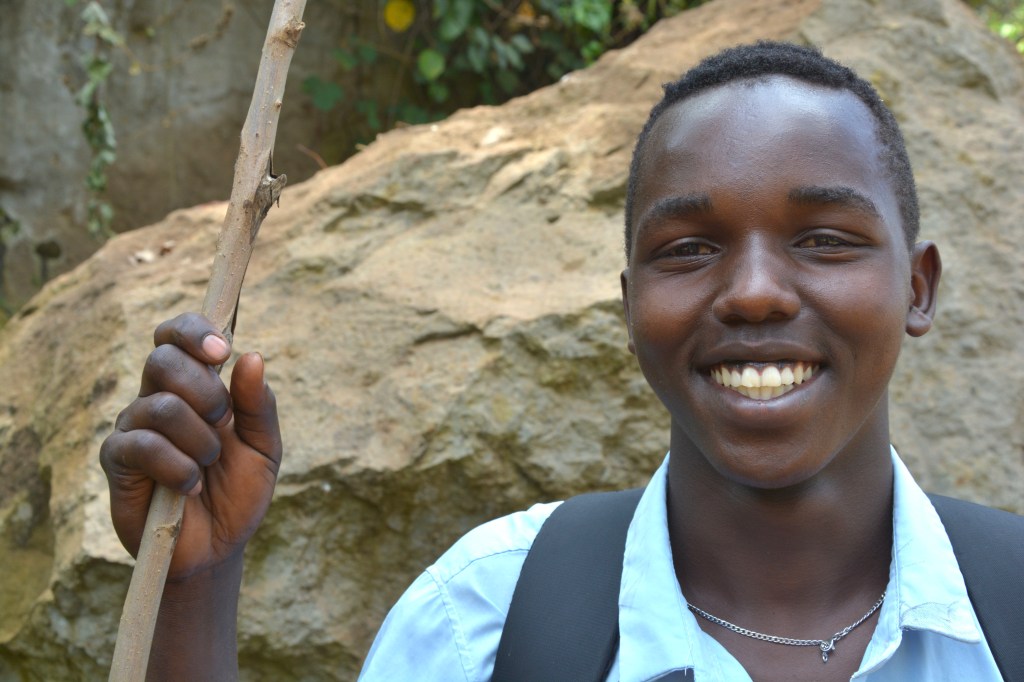
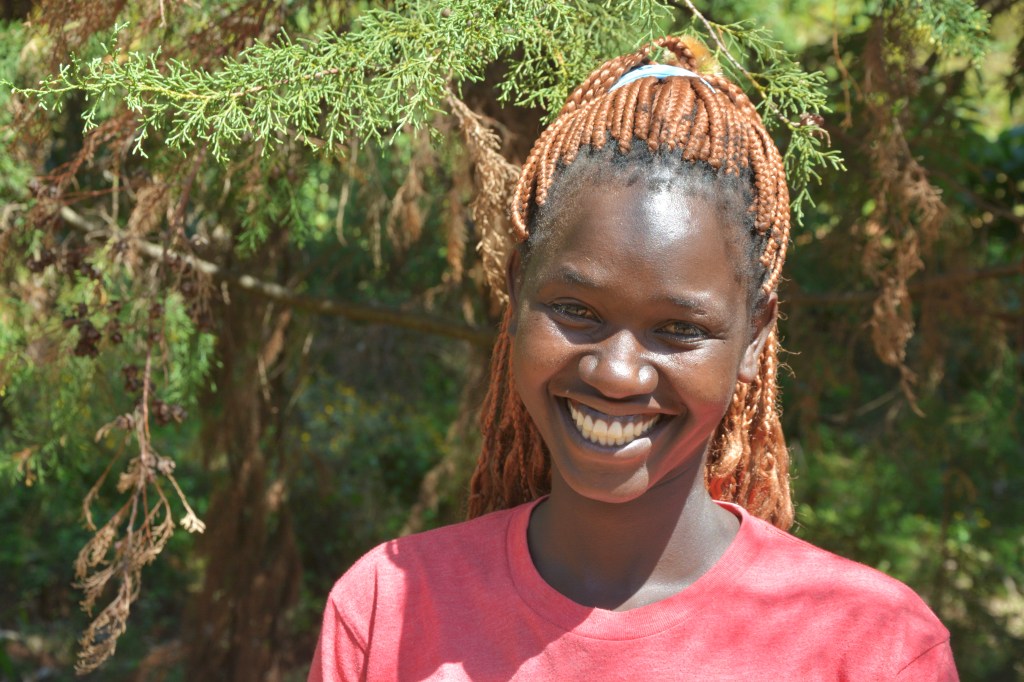
Faith. We hiked 11 miles to visit her! The best worker the Kessup guesthouse ever had

For four days, I went to Kessup to hike in and around the Rift Valley with William, the friend I made nine years ago. ‘The goodness is…”, as he so often says, is that we both like people and we both enjoy walking.

Three or four years ago, I gave William a Holstein cow. He called her Dutch. The best way for me to help my friends in Africa is to encourage financial independence. The cow cost £375. A year on, she gave birth to British, a male calf. Another year later, last October, she gave birth to Joy (named after my mother!). A few days ago, while we were hiking into the great valley, Dutch was bellowing all day, a sign that she was ready to be ‘served’, in the coy, apparently sexist, phrase. William, in great excitement, called the vet who specialises in artificial insemination. He guarantees a female calf – or money back (£40). William dreams of Wilhelmina to complete his dairy farm. With three milking cows, and the sale of British, the male, his dairy will be complete. I’ve also paid for a rough wood shelter, and to bring water pipes down the mountain to his shamba. About £750 of my money can make William self-sufficient, able to sell milk to the cooperative for a few pence a litre and feed his cattle on homegrown maize.

Half way down the escarpment, William takes a cooling rest

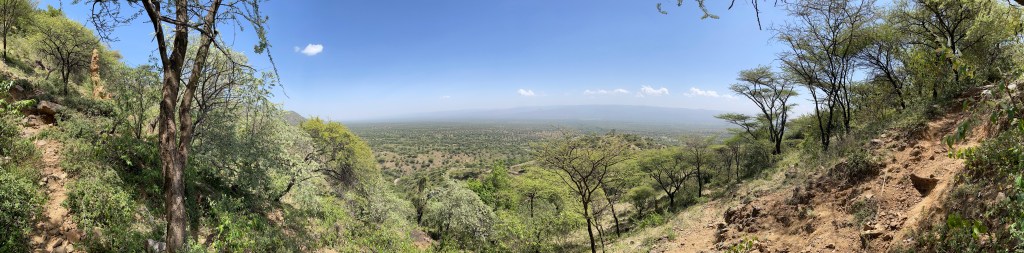
The Kerio Valley. Great hiking but HOT

In return, William introduces me to his community on the edge of the Kerio Valley. ‘William’s Mzungu’ is well known on the red dust tracks and amongst the fertile shambas below the soaring cliffs that top the Rift Valley here. Each day, we hike in the fine nationally protected forests on top of the escarpment or down through fertile smallholdings into the burning depths. The bottom of the valley, where the finest mangoes in the world grow, is 2750 feet lower than the guesthouse where I stay; the top of the cliffs are another 1250 feet above. That’s 4000 feet from bottom to top! All on friable rocky, stony informal footpaths in the hot sun. Eleven mile, five mile and eight mile hikes, staggering up and down these step paths at between 3900 feet at the bottom and 7750 altitude at the top. Mighty exercise.

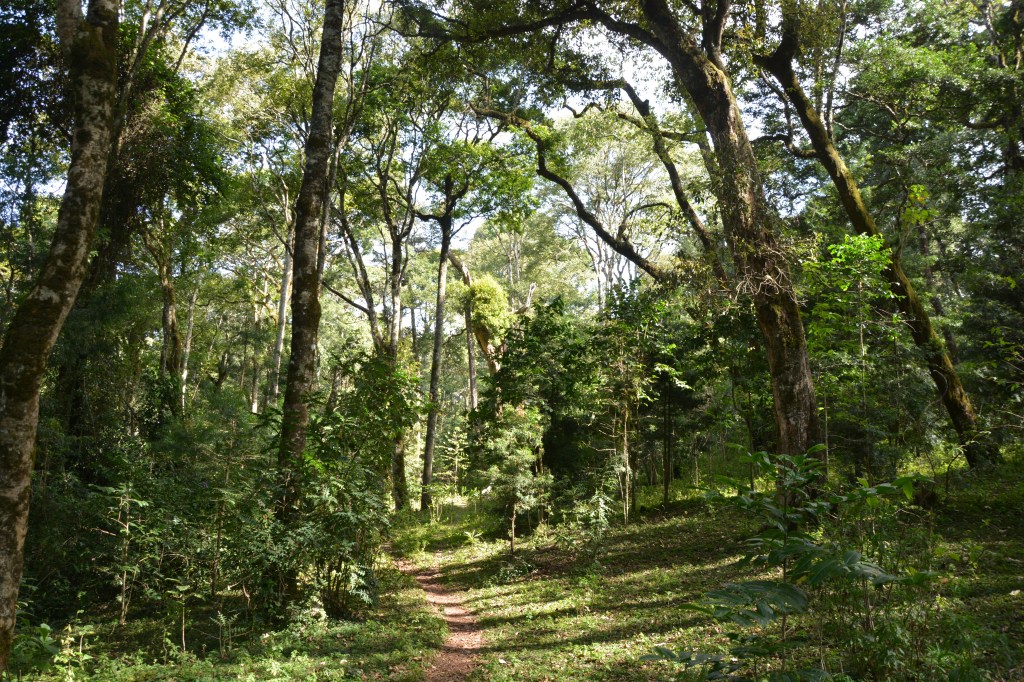
Kessup Forest, well worth the climb

The forest on top of the escarpment is magnificent and silent, filled with birdsong and dappled light. A still day, the shadows merely flicker and dapple the bright undergrowth. A few cows graze, with bells tinkling. Deep blue acanthus blooms in spiky leaves. The sky above is crystal blue, unblemished.

Then the great chasm of the arm of the great African Rift Valley appears through the trees far below. So dramatic, this vast plummeting 4000 foot deep natural cleft. Just now, it’s filled with haze and the other face, twelve or fifteen miles away, to which I once unforgettably hiked through vicious thorn bushes and between grazing giant elephants, is invisible.

****

11 pennorth of spinach!

Desmond, an intelligent 27 year old I’ve met in past years, joined us on the walk up to the top to drink moratina, a home brewed, brilliant yellow honey wine, brewed on Sundays. The government has imposed tax and restrictions on its sale, but this being Africa, there are ways around things. It’s just less visible.

Apparently, I influenced Desmond to ‘get his life together’ a few years ago, with advice to take charge of himself, stop wasting time at home as the last born of nine, and go out and face the world. I have NO recollection of any such sage advice, but it’s remarkable where a mzungu’s influence lands! An onerous responsibility.

One day, Desmond stopped behaving like a teenager, upped and left home. He did menial work in a city hundreds of miles away, renting a room for £30 a month, but determinedly paying his rent on time. His landlord was impressed, and happening to be an official in a far distant education authority, he offered Desmond, trained as a teacher, a post. It’s in an end-of-the-world town, in the farthest corner of Kenya, sandwiched between war-torn Somalia, and troubled Ethiopia. You can’t go further east or north in the country, than this place that ends as an arrow head of Kenya, with two war-torn countries actually visible on either side. I suspect Desmond got the job because no one else wanted it. It’s a tough area of Islamic fundamentalism, where life is cheap. He will be authorised as a fully fledged junior school teacher in a few months, launched on a career without the bribery usually necessary.

To buy a teaching job, the going rate of bribe in Kenya is about £2900. To enter the military, expect to buy your job for £5750 at least. It’s for this reason that everyone is propositioning the mzungu to buy their land in Uganda, where these bribes are correspondingly enormous. Selling land that has passed through generations of peasant farmers and which can never be rebought; capital that is irreplaceable. Better to get your son (seldom daughters, of course) a paid job in some form of government work, than be a farmer – despite these being some of the most fertile regions of Africa. Government jobs bring the bribes and backhanders and the only potential to make you rich – if you have no ethics and only the morality assimilated from your leaders.

Queen, a Kessup schoolgirl

Chirpy, optimistic Desmond is committed to his post. He reckons to stay for five years, in a prejudiced Moslem area where Christian Kenyans aren’t popular, there’s no alcohol and no women. His ambition is to earn enough to start farming back here in the Kerio Valley area. He deserves to make it, this fellow with good integrity, admirable moral concepts and determination. But he’s made a hard choice – or perhaps, as so often in Africa, he HAD no choice.

****

Schoolchildren everywhere love a mzungu

Some of Desmond’s pupils, aged as little a 12 or 13, are married already. And those are the fortunate ones: allowed an education by their fathers. FGM, officially illegal in Kenya, is still practiced in remote corners of the country and women have so little status. Many die, too young for childbirth. Only education has any chance of changing habits and opinions in Africa – and even then, the majority of educated men retain their sexist, misogynistic, homophobic, superior attitudes. (Look for a feature film called NAWI, made in Kenya recently and entered for the 2026 Best Foreign Film Oscar – a powerful film).

At breakfast, a week ago in Uganda, a tiny girl came selling bananas from a tray on her head. A shy smiling child, she looked about six, surely too young to be trading, even in Sipi? But Shiela said she was nine. Precious thought she might indeed be nine years old. “There are five following her. I don’t think she’s reported [for school]; she takes care of the younger ones. The mother is just… huh…”

What chance has a child like this? Condemned from birth to poverty and probably a mother by fifteen herself. A baby machine for life. ‘Tradition’.

Alex and I came upon a couple of lads wasting their time. With election fever hotting up in Uganda, Alex quizzed them about a female candidate campaigning for their rural district.

“Huh! We don’t want to be controlled by women!” exclaimed the older boy. “Women are for marrying!”

There’s little hope for change in Africa. The boy is 16 years old. All over the continent women do ALL the work, despised by men. To most men, they are little more than baby machines and slaves. “Lower than donkeys, then?” I ask. My audiences laugh at what they see as my joke, but they don’t argue.

Changing habits and attitudes in Africa is painfully slow, if at all. “It’s the way we do it here. It’s tradition…” The excuse for every bad practice all over the continent.

****

Tomorrow, I’m going back to Uganda. Just in time for the ‘election’ on Thursday, not that there’s ever been any doubt of the winner. It’s just a costly exercise to show there’s ‘democracy’. I’m told that the internet has been turned off by the ruling power, so I’m writing in sunny Kitale this morning instead.

Oh, I forgot to say. Adelight GOT PAID! For the contract signed off before the end of March last year. They government has retained a significant sum for six months as a guarantee, in case ‘anything goes wrong’ – with a job satisfactorily completed already eight months ago…

But she’s singing this morning as she mops the floors!

I’m still surprised to find such scenery less than a degree from the Equator, but we are at about 8000 feet