EAST – AND NOW SOUTH – AFRICA 2020 – EIGHT


F0209E9C-BEA0-4D2A-81DC-168477F264DA

Maria – an ever-cheerful child


DAYS 58-63. SUNDAY 23rd – THURSDAY 27th FEBRUARY 2020. KITALE. KENYA

Lots of things different on this journey, even my diary writing. Not my daily discipline, but written in batches as activity dictates.

And activity didn’t change a lot this week! A pleasant, homely time with my Kenyan family, who accept me as part of their extended family. I’ve so often written that the most admirable single element of life all over Africa is its continued adherence to the extended family system. Blood relations mean less than proximity and an ability to adapt to one another. Here am I, from another culture completely, accepted as a brother and uncle figure to these fine people, some of whom are themselves not related by blood. In the West, we put so much emphasis on that close blood relation, defining our families, dividing our wealth and possessions, our loyalty and support in much narrower confines. Some of the ‘sisters’ in this household are indeed Adelight’s direct sisters, but frequently there are other young women and girls around. They have no actual blood line in common, sometimes even arising from other tribal roots, but they act as much sisters as any nuclear family. Rico’s flexible family is a unit to be admired, as is he, for his commitment to these girls and young women, brought up at his own considerable personal sacrifice of money and comfort, but to his greatest satisfaction in his large and lovingly warm family who look on him as their father.

It’s been amusing this week to give Adelight some bread lessons. She told me that she’d been trying to make her own bread but had produced only bricks. I diagnosed flour with insufficient gluten and went with her to peruse the available selection. Somewhat nervously, I made bread one afternoon – the very afternoon I had elected to provide the wherewithal for a family barbecue party before I left. Thankfully, my baking impressed. A second batch the next day confirmed my ability! The Joy Bean bread technique has now a foothold on the continent of Africa! She’d be happy to know that.
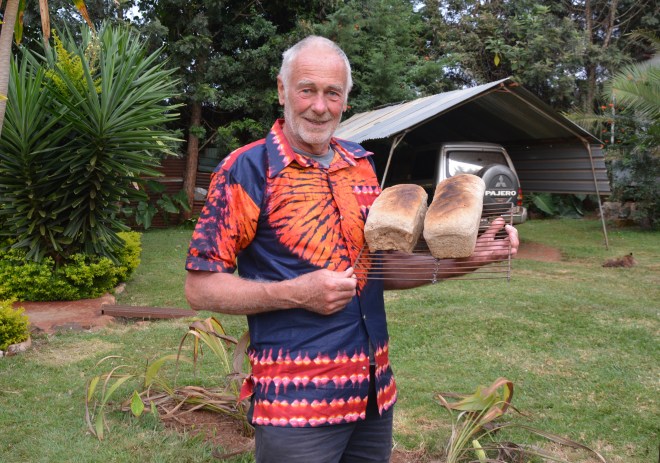
Joy Bean’s bread recipe reaches Kenya

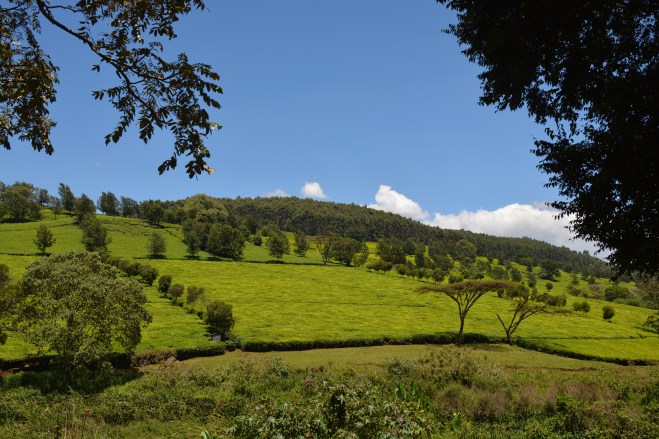
On Sunday, from Kessup I headed back by the Cheringani Highway again to Kitale – the newly tarred and magnificent road that now sweeps through fine scenery, where once I bounced and struggled on the dusty track that wound its way over these magnificent hills – and, truth be told, I loved much more. I knew it is always quite chilly in those hills, formerly kept at bay by the exertions of the bumpy road, but now the empty, smooth tar road takes little physical effort and the chill is apparent. I looked up the road on the map and find that it climbs as high as 2900-plus metres (nine and a half thousand feet). At that altitude, even on the Equator, you need some exercise to keep warm. It’s a glorious ride, huge views down to the north on the latter part and extensive vistas over plunging valleys and forested mountainsides elsewhere. Small villages scatter along the roadside, rough places of earth and rusty iron sheeting. The farmlands are green and fresh, the clouds scudding high in the blue dome above. It’s good to be alive on such a ride. And good to be on a motorbike, out in the freshness, experiencing the changes of temperature, the scents of the forests, the occasional scattering of light raindrops from the high, unseasonal slate clouds that drift past above; to wave at the surprised populous and the calling children; weaving my way between errant donkeys and goats and matted sheep with Rasta dreadlocks from mud and shit. Birds, some of them spectacularly sequinned flashes of iridescent feathers, others large lazily floating raptors, their eyes peeled onto the ground below for vermin and carrion, soar and wheel about on the wind. Joyful yellow sunflower-like bushes line the roads, happy against the red earth embankments. The road winds and rolls over the glorious hills. People wave. I am happy and content, riding along at often no more than 25mph, stringing out the pleasures. These Kenyan highlands are some of the finest scenery in Africa.

So back to Kitale and family warmth and a few final days of organising the last part of the 2020 safari and preparing the bike and belongings to be stored in Kitale until my promised return next Christmas. Uncle Jonan (Maria’s delightful diminutive for me) is now a fixture! And next year maybe I’ll be less restricted by ridiculous leg injuries and be more fully active. Precious and Alex want to take me to stay with her parents, in the far western part of Uganda (the part I have admired most) on an island on the very scenic, large Lake Bunyoni, one of the beauties of Uganda.
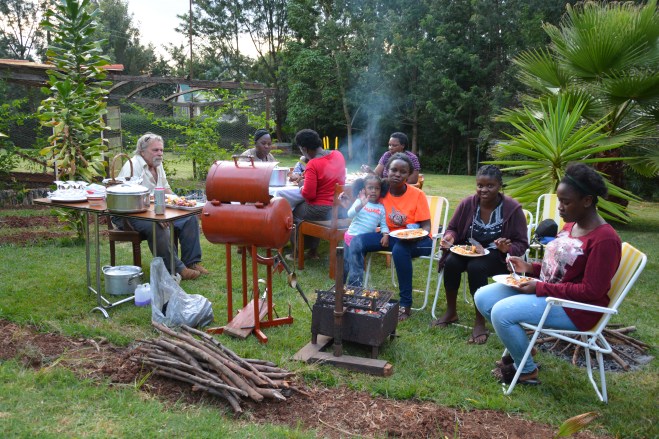
Family barbecue

By the time I return, delightful little Maria, a bundle of ever cheerful energy and charm, with her idiosyncratic three year old chatter, will have grown to be a four year old. She’s been a highlight of my stay. I’ll miss the family unit. It’s been easy. Adelight said one day that I felt like a brother, and we certainly enjoy one another’s company. I’ve the patience to actually enjoy going shopping with her! In the evenings we are Scrabble opponents, a game at which she quite often beats me, a testament to her intellect, since she is playing in her second language against a native speaker with a large vocabulary. Marion and Scovia brighten our days and the other various girls who come and go, do so with a cheerful positivity and joie de vivre that is engaging. I hope I can be part of this happy family again in nine or ten months’ time.

Well, that’s all in the future. ‘Who knows tomorrow?’ they ask in Ghana. Who indeed? Still, good to have future ambitions!

My Kenyan family says goodbye at Kitale airstrip

AND SO TO SOUTH AFRICA

DAY 64. FRIDAY FEBRUARY 28th 2020. JOHANNESBURG. SOUTH AFRICA

Culture shock can be just as disorienting within this continent as coming from Europe to Africa. In a matter of four hours I am in a totally different African atmosphere. I’m in a cheap hotel rather close to the end of the Oliver Tambo International Airport runway in Johannesburg. Of course, this is not a new experience. I’ve been here in Johannesburg at least a dozen times. But it’s the first time I flew in from another part of Africa. It’ll be interesting to see how it measures up. It’s also going to be different in that I have no motorbike in this country at present.

I’d been considering the possibility of a ‘two centre’ trip this year for some time. Then the restrictions of my Achille’s tendon injury, the reduction in realistically feasible bike miles, the fact that back in April I came down here as a ‘consultant’ on a new museum project, and then the happy coincidence of Kenya Airways emailing me as a ‘valued client’ about their special 40th birthday offers, all coerced me into purchasing this ticket and travelling on down to the bottom of my favourite continent. If I’d booked my flight when I first considered the idea, it would have cost me £523. By the happy chance of that email a few days later, my ticket cost £414. Considering I got my return flights from Bristol to Nairobi for the grand sum if £1.46 (see day one), it seemed a lucky opportunity. Here I am in South Africa.

Up early and a prompt breakfast (homemade bread) and a short ride to Kitale airstrip, with the whole family to see me off. An hour’s flight to Nairobi airfield and the inevitable taxi negotiation to the main international airport. Few airports in Africa are accessible by any means of public transport. The rapid transit railway DOES actually reach the Johannesburg international airport these days, but the fare is £9 from the nearest station. It’s £8 from much further away by taxi. It smacks of efficient lobbying by the taxi companies! Fred, a friendly driver, conveyed me from the Nairobi airfield busy with small aircraft to the anonymity of the vast airport. Gladly, I have my frequent flyer lounge access that makes flying such a much more pleasant experience.

We landed into pouring rain – there was over 12mm, half an inch, of rain forecast for Johannesburg today – and a second taxi (in one day! This is NOT JB travel!) to a cheap hotel in a wasteland of car dealerships and garages. But at £15 in South Africa’s most populous city, it’ll do for the night.

As darkness fell, I walked out to seek supper. I am in Kempton Park, by the looks of it, a fairly run down suburb of this huge city, of which most travellers are fearful or at least apprehensive. I had to walk a mile or so, on broken pavements on this rainy night. Coming from another part of this wonderful, absorbing continent, I suddenly realised, as I walked the scruffy streets amidst noise, people and incessant activity, that I wasn’t in the least nervous. How well I remember my first visits to this country, when everywhere I went people – almost exclusively white people – enumerated all the things I shouldn’t do and all the things of which I should be frightened. The word used was always the perfidious ‘they’, the threatening ‘others’ – aka black people. I’ve just spent two months amongst black-skinned people. My friends. In fact, I spend a quarter of every year now as the conspicuous ‘other’, the odd man out. I have completely stopped seeing people as black-skinned. It’s odd, I just see ‘people’.

Walking through the wet streets, I thought to myself that most of my white acquaintance here would be having kittens to see where I was! It was noisy and boisterous. And very human. It was extravagant and natural. A few youths called out, not taunting, just perhaps surprised, rather loud greetings. Much more brazen than in East Africa, but not unfriendly or disrespectful. They hung about outside ‘bottle shops’, noisy, bumptious youths. I even entered a ‘bottle shop’ to buy myself a couple of long-missed Castle Milk Stouts.

Assuredly, I wouldn’t walk down those dimly lit streets late at night with my camera over my shoulder, or my pocket bulging with money. But then I wouldn’t do that in Leeds, Plymouth – Totnes, for god’s sake, any more. I felt no threat whatsoever. It’s all in the mind. And when you look frightened, you are the most vulnerable.

I remember my first visit. 2002. My Elephant was stuck in a crate, bobbing around in a cargo ship outside Durban harbour, beleaguered in a dock strike. My poor motorbike, in a crate, inaccessible. The dock strike lasted three weeks. Though I had friends to generously host me, neither they nor I had expected that hiatus. So I took off on buses to see a bit of South Africa while I waited. I rode south and on the first night of my short solo tour, I ended up in the coastal town of East London. It’s a large regional town and something of a black seaside resort. I found a hotel, of sorts. My room had a balcony (!). I leaned on the railing looking down towards the sea and over the streets. I didn’t dare to adventure into town.

I stood for half an hour looking out. It was just a pleasant seaside sort of city, the usual restaurants and cafes visible, the Indian Ocean tossing along the shore. Suddenly, and I can remember this now as I write, I thought to myself, ‘What are you afraid of? Think of the very dodgy places you’ve travelled all over the world! The backsides of Asian and Latin American cities, in the cheapest hotels known to man!’ The roughest villages in the Hindu Kush, the Andes, North Africa, Middle East you name it, I’d seen the seamy sides of those places. I’d travelled on the most impecunious budgets in the toughest, roughest places. And here I was, in semi-westernised South Africa, in a pleasant seaside city – a sort of Yarmouth or Cleethorpes of the southern hemisphere, and I was AFRAID?

I was afraid because every white person I had met in the previous two weeks had insisted I should be afraid! Stuffing my valuables under the bed, I walked out with a few pounds in my pocket and a smile on my face. I walked confidently down the centre of the pavement, greeting people (rather surprised people, it must be said) and smiling broadly. From that day – to this, walking through a run down black suburb of the ‘evil’, ‘dangerous’ city of Johannesburg – I have had NOT ONE moment of apprehension in all the time I have spent in South Africa! And I have spent months here all told, riding my motorbikes through townships, cities, villages and remote countryside. And I’ve come to enjoy the place and I respond to noisy youths with a big smile and a raised thumb. They love it! An old white-bearded bloke giving as good as he gets from them. It’s all they want. They are so unused to it.

It’s not so frequently that people smile at me here in South Africa. There’s always this distance, this suspicion, this inferred inequality. I don’t feel that in Kenya or Uganda. There, we’re equal. My fast food supper was served by a pretty young woman. She reacted to MY smile so happily. I felt I had scored a victory. I had made a young black South African woman respond with the attractive warmth of her smile. It’s not something that you witness often in this strange, unhappy land. I have to work harder for smiles here.

Most people around me now are lighter complexioned than in East Africa, and they do things with a certain bravado and lack of respect or modesty. It’s noisy, brash, flashy, more competitive, a trifle more aggressive. Faces are ‘deader’, less expressive, less eager to engage. Eyes look away, they don’t return my smile. It’s more like being at home than in Africa, where everyone loves to talk. There’s a wall, a barrier, a doubt, reluctance. A slowness to smile, to laugh, to make human contact.

I’d forgotten the South African propensity for kitsch and sentimentality – and for trying to hide paucity of taste and luxury by adding numerous silly pillows to the beds. Pillows that then have to be stored somewhere when I actually get into said bed – the usual place being flung in a corner, where I fall over them if I get out of bed in the night. This rather basic, ostentatiously unpretentious hotel has pillows everywhere to try to disguise the utilitarian furnishings and the camouflage-green emulsioned walls. Two of the pillows have the silliest text imaginable: ‘wifi + food + my bed = perfection’. Those two stupid pillows had an extra energetic trajectory into the corner of this militarily green room.

This is a land of appalling fast foods, with attendant obesity problems, often exaggerated in black races, as with African Americans. The South African diet has to be one of the least healthy in the world. Those with money eat red meat and starch, those without eat dire junk food – fat, salt, sugar. South Africa appears to take all its foodie influences from USA… The queues for McDonalds go round the block… There’s KFC, Chicken Shack, McDonalds, Wendy’s, Debonair Pizza, Burger King, all the rest. Hardly a scrap of food I want to put in my mouth!

DAY 65. SATURDAY FEBRUARY 29th 2020. HARRISBURG. SOUTH AFRICA

So, the choice was Kentucky Fried Shite or an Afrikaans rugby bar at the back of a petrol station. In the interests of travel experiences, the latter won hands down.

I think…

This is a country that brings out all the prejudices in me, all the ones I pretend I don’t have, with my extreme exposure to the world in all its glories. This is a country, the only one in Africa, this astonishing continent, that makes me conscious of my skin colour. It’s a country that confuses me as much as did Japan – the country I still sum up, when asked, by: ‘I had preconceptions when I arrived. When I left, even those were wrong!’

Anyway, I chose the smoky (yeah, this is South Africa) Afrikaans bar across the road from the deadbeat Grand National Hotel, in which I have stayed on my motorbike journeys on several occasions, Harrismith being a convenient staging post to and from Lesotho and my friends in Durban and Bloemfontein. It’s a tired sort of town, dating back to colonial times and Harry Smith, who founded the place. There’s a bizarre war memorial with an obviously English soldier bowing over his rifle in respect to the fallen of World War One; another commemorates those who fell ‘in the service of South Africa’, in the Boer War. I could find no memorial to the many thousands of black African soldiers and support staff slaughtered in the causes of those foreign wars. There are odd colonial overtones, utterly at odds with the brashness of this tired African town. I wandered into the town centre, such as it is, and found the end of a street market, noisy, incredibly littered, with an undisciplined, down at heel atmosphere that, on one hand I rather enjoyed but could also be read as pretty deeply depressing or threatening. This is a town down on its luck. In fact, it probably never had a lot of luck. It’s here perhaps as a junction on highways. Maybe it always was. The major toll highway from Durban to Bloemfontein and south to Cape Town passes by. Much of South Africa passes by. It’s a backwater going increasingly stagnant. The old colonial Grand National Hotel echoes the turgidity of the town. Electric security gates on the doors. Worn cord carpeting, scuffed furnishings, metal framed windows, empty corridors and a sense that life has passed by. Without taking much notice.

There are bottle shops everywhere and a lot of drinking going on, exacerbated by the end of the month pay day. Men are gathered noisily around the bottle shop doorways, getting drunk. Empty and broken bottles litter the streets: the usual African problem of low employment and lack of self discipline. Rico blames African mothers. He explains how they treat male children in a completely different manner to their daughters, cosseting the male babies, spoiling them, respecting them and teaching them to believe themselves to be more worthy than their sisters, the also-rans of Africa. It’s deep set prejudice, centuries of male privilege. And it manifests itself here on a Saturday afternoon like this. Men drink; women work. A few drunks lie already in doorways and the wide main street, Warden Street, resounds to the noise of young male revellers in cars with short exhausts and huge boombox speakers. There’s considerable drink driving around poor, forgotten South African towns like Harrismith. My solution to many – most – of Africa’s ills remains the same: put the women in charge and ban the production or sale of all alcohol over 4%ABV.

While the men drink away their meagre salaries and ruin their health, the women sell or shop, filling a million plastic carrier bags (South Africa hasn’t banned bags like Kenya) with groceries, often the products in the most lurid packaging, as if there’s a siege coming.

I had forgotten it was the end of the month. A mistake worth avoiding in South Africa. People are paid at the end of the month and ATMs have lines round the block. By good fortune, I had just enough cash from last April’s visit to tide me to Harrismith. Most Africans live hand to mouth and here, where the infrastructure is developed and people paid automatically into bank accounts, the end of the month is an important time. It fills the shops to capacity. Families shop as if the stores will be closed for the next month – as for many, without further economic support for four weeks, they will. All I wanted was a plug adaptor… It took 15 minutes at the tills to pay my £1.50. The hotel is aged enough to utilise the old three round pin 15 amp sockets that were once the norm in South Africa – and still are in backwaters like Harrismith.

Harrisburg and its peeling hotel suits my budget at £15, and it’s convenient to meet Michael, my old Durban friend, who is on his way to the national park nearby tomorrow. It’s also a stop on the long distance bus route from Johannesburg.

This Afrikaans bar shakes to the volume of rugby on multiple TV screens. This is a sport played by 90% white men, watched by almost all white South Africans. Soccer, meanwhile, is a game played by increasingly numerous very good black players; a game adored by every black African I ever met. The game that roars about this bar: “AAAAAHHHH! Kick the fucking BALL, you stupid oke!” yells a mountainous Afrikaner with pendulous flesh that is difficult to appoint to any known physiological map. He rises from his bar stool in necessarily slow motion; folds of flesh slumping knee-wards by gravity. He wears sloppy grey track suit shorts dangling about his knees. His Xtra Large tee shirt hangs like old theatre curtains from the cantilever of his vast wobbly stomach. While I have been here, he has downed three one litre bottles of Black Label lager. He must be three times my girth, with a long white beard. He scratches his crotch and waddles to the gents. Pasty faced, vastly obese, coarse, tattooed, probably horribly prejudiced about most of his neighbours…

And yet… He welcomes me warmly, as do those around the bar. Of course, my prejudices (that I don’t think I have) ponder whether they’d make the same welcome if the outer half millimetre layer of my body was black.

This is the ugliest nation on earth. You see, I said I have to accept that I too have prejudices! Fat, immensely fat, gigantically, waddlingly fat, pasty faced, unhealthy, bad skin, covered in tattoos. Or sharp featured, pasty faced, unhealthy and bad tempered like the witch who accused me of sitting in her seat on the bus. Happily, I had an upstairs seat at the front of the bus and a view of the wet road. At Vereening, up came a sour-faced Afrikaans woman of very acid demeanour, insisting that I was sitting in her seat. “It’s disgusting, I paid for this seat! It’s MY seat. I have seat 5A!”

“Yes, and this is seat 5B!” I pointed out reasonably. But she was so bad tempered she wasn’t listening. All the young (black) men around me pointed out that the alphabet generally held to a norm of A-B-C-D, but her anger was burning. The young man in the window seat – seat 5A – should have been sitting in seat 16D, down the back somewhere. I explained to him, but he seemed to have some sort of learning difficulty or perhaps he’d burned his brains on something earlier today. I pointed out to the screeching woman that I was in the seat assigned to me. Other neighbours spoke to the man in seat 5A in his own language but he either didn’t comprehend or wasn’t bothered. The Afrikaans woman fumed and spat behind me. “It’s disgusting!” she harrumphed. “It’s MY seat! Quite disgusting! You’re in my seat.” But I wasn’t. She’d picked her argument with the wrong passenger. She should have been railing at the (black) passenger next to me. Maybe I read more into her disgust at me, a fellow white passenger, not him? I stayed put and replaced my headphones. One thing Africa has taught me is that argument and bad temper solve no problems at all. Politeness is natural for most in this continent.

Looking for non meat food in South Africa is a generally pointless task. Especially in an Afrikaans sports bar. I ordered lamb curry. “What’s skilpadjies?” I asked the overweight Afrikaners at the bar as I searched the menu in vain for the vegetarian option.

“It’s liver,” replied my neighbour in a friendly manner. “Coated in… In…” He dried up as he tried to think what the coating might be in English. “Hey,” he called to one of the bar women, “you speak English. What’s XXXX? (I cannot begin to write whatever the word was).” The bar began to discuss how to describe the filth in which the liver might be coated. “Well, it’s like haggis…” said one. “No, it’s a sort of bacon!” said another. They compromised that it was liver wrapped in something unspeakable from a lamb’s intestine. “Oh! I think I have eaten it!” I exclaimed, remembering the time I attended an Afrikaans motorbike rally (!!) with Steven. I made the mistake once, and ate what I can only politely call ‘fat on a stick’. It’s one of the most repulsive things I ever ate (and that’s a pretty long list). “Yes, it’s VERY good! Good food,” said my immensely overweight, tracksuit shorts friend at the end of the bar, scratching his crotch again. “You should try it!” Hmmmm.

At the back of this bar is a small room. It’s lined with ‘slots’ – slot machines, one-armed bandits. It’s glittering with flashy lights and incessant visual interference. Six addicted gamblers – black – sit, glassy eyed with fatigue and tedium, unable to stop… They are the only black customers in the bar.

At the corner table sit a band of middle aged people. Smoking heavily. Bad skin. Beer guts. Tattoos. Three women, four men. Huge beer bottles in front of them. Bike helmets on the table between us. Their bikes are outside, fat, slobbish motorbikes that make a lot of noise and probably go fast, but don’t really go far and certainly never leave smooth tarmac. I’d put £100 on the fact they’ve never been to nearby Lesotho, best biking country in the world. Afrikaans people don’t go there, despite the fact it’s usually less than 70 miles away. Actually, I’d safely wager ten time that! One of the women is getting up to go. She’s pulling on a jacket and leather waistcoat. Free State bikers all belong to clubs. They have big embroidered badges emblazoned across their jacket backs. This dumpy lady has badges all over her waistcoat. Most are in Afrikaans. The only one I can read in English boasts the recommendation, ‘100% bitch’. I wouldn’t tempt fate that far, if I were her.

Afrikaners tend to hug a lot. Men and women. Imagine, if you can, two large rubber exercise balls trying to hug one another. You’ll see what I am seeing as I write!

So, you see, all my prejudice comes out here! Is it my age and conditioning? I grew into my political awareness at a time that we believed that apartheid was one of the biggest evils in the world of the sixties (as it was). Am I projecting that onto these people? These people who are at the same time immensely friendly and often generous too? I suppose we all see the world through our own filters. Mine are predisposed to sympathise now with indigenous black African people, from whom I have received more love and generosity than anyone else. Perhaps my prism is skewed here? Yet these people too, after 300 years or more, are indigenous African people. Just another colour and tribe. Another race. Yet they’ve fought alongside black Africans for their freedom. They qualify as African as much as anyone.

So why are they in their own bar? Separate, in this ‘rainbow nation’ that’s supposedly been united for 25 years?

The lamb curry wasn’t bad, however. But I had to resort to the jar of pickle to find some vegetable. I am in Afrikaans South Africa, where chicken is considered a vegetable!

What of the rest of my day, before I sat here with my three Castle Milk Stouts? (Small bottles!).
It was a half hour walk from last night’s cheap hotel to the efficient, relatively expensive rapid transit railway that brings the population – those that can afford the luxury – into the centre of Johannesburg. The rest (mainly black) go by minibus. The line is speedy, the distance surprisingly long, past mining exploits (gold is the reason for Johannesburg’s existence) and sprawling suburbs with a dotty pox of satellite dish disease, separated by wide greenswards and green-fringed motorways. The train deposits me into the heart of this seething city and to the main bus transit hub. “Do take care! Everyone wants to rob you here,” warned one kindly paranoid white woman as I stepped from the train. I felt no threat whatsoever, beyond normal city centre watchfulness in a rather run down area round the bus stations.

The road south from Johannesburg is through South Africa’s most boring landscapes. This is a huge area of gently undulating grasslands and farmland, split by occasional motorways. It rolls on and on, and then on. I recollect interminable tedious bike journeys here in the Gauteng region. From Harrismith the scenery becomes more stimulating. I’m approaching the magnificent Drakensburg Mountains that hold wonderful Lesotho so far up into the sky, where the range is called the Maluti Mountains. It’s Lesotho that has brought me back to the foot of this extraordinary continent.

“Oh, you’ve put the prices up!” I told Rose, the receptionist, as she processed my £15.38 on my credit card. “I hope you’ve repainted the rooms since I was here four years ago!”

“Noooo, I don’t think so…” she pondered with chuckle.

Correctly.

Golden Gate National Park. The view over my beer glass.

DAY 66. SUNDAY MARCH 1st 2020. GOLDEN GATE NATIONAL PARK. SOUTH AFRICA

Perhaps my greatest stimulation in travelling is not knowing what tomorrow will bring. Tonight I am staying in the middle of the Golden Gate Park in the Drakensburg Mountains, close to the new museum building being constructed in the valley below, a museum about the dinosaurs who roamed this area a couple of hundred million years ago. A museum on which I acted as a consultant (at last! It took me until I am 70! Haha) on a trip to South Africa last April.

My friend Mike is a facilitator of projects, mainly in museum conception now. He works out of Durban but we’ve known one another for many years, originally through his wife, Yvonne, long long ago my neighbour in the flat above mine in Ilkley, Yorkshire. They’ve lived in South Africa for over 30 years, and been my hosts and base for five motorbike trips. The fact that Mike and I work in the same field is coincidental, but fortuitous for me as it now provides a few days (unpaid) consultancy with my peers, in another culture. We’re here with Kath, researcher and writer for the project, for some creative meetings tomorrow and Tuesday.

We’d arranged to meet in Harrismith at 1.30. They have to drive within ten kilometres of the town to travel from Durban to the museum site and the well equipped national park campsite and the chalet in which I find myself tonight. I’ve a room with a view of the very scenic mountain ranges, curving walls of red and yellow rock rising in bluffs to oddly mushroom-like tops across the narrow defile. I’ve ridden here before, but never understood the geology and significance of the fossil beds that abound. It’s a geologically remarkable area, thick ancient mud layers topped ancient sand dunes, then topped and burned and pressed by volcanic waste. The rocks contain a plethora of fossils of great interest and amazing preservation. Fifty years ago a palaeontologist discovered a rich seam of dinosaur fossils marking the birthplace of thousands of dinosaur eggs. The great prize of the region is a fossilised egg, complete with hatching tiny dinosaur. The artefact is only palm sized, but of extraordinary detail – enough that the park service is spending millions to build a museum and interpretation centre in the valley below the discovery site. Of course, there could be hundreds more fossilised hatchlings in that ancient mudstone layer.

Harrismith is not a place to be stranded on a Sunday. “Where can I get breakfast?” I asked the Grand National receptionist about 9.00 this morning. She pondered my strange request for a moment. “There’s KFC and Wendy’s.” I consider neither of those purveyors of food. I spent a couple of hours criss-crossing the decrepit town, but sure enough there was no place open with so much as a cup of coffee. I was forced to purchase items in a supermarket to make my own scratch breakfast, eaten without cutlery or crockery. It was also impossible to find a single place to sit, until the same Afrikaans bar of last night opened its doors late morning and provided a bench for the final hour if my wait. Not so much as a public bench in town…

“This used to be a thriving town,” said Mike as we drove away, swinging down litter-strewn streets of decrepitude. “It was a centre for the Free State agricultural life. Now the citizens have taken over their own repair of roads and infrastructure from the municipality as it’s so inefficient.” I’d noticed that the town had very little civic pride and diagnosed that there was probably very little civic money either. It’s a sad place, thickly littered and scruffy. Residential streets lined with torn bin liners, from which vermin and birds have scavenged food scraps, and ditches and roadsides strewn with fast food packaging and plastic bottles. Afrikaans residents live behind electric fencing, spiked railings, razor wire, security bars and signs emblazoned with warnings of armed response from security companies. It’s grim. These are a people buttoned up, separate, enclosed, barricaded from the world around them, embattled in their own country. Why, even the churches, on just about every corner, are segregated – black churches and white churches. Could there be a greater contrast? Friendly, loose limbed, freewheeling East Africa to the Orange Free State in 36 hours?

I’d repaired to the Afrikaans bar by about noon. I don’t often take beer at lunchtime any more, but really, what else was there to do? I’d hiked three or four miles about this faded town looking for little more than a public bench, to no avail. At least there was a table on the pavement outside the bar. Mike and Kath rolled up about one, and we set off to drive another hour or so into the mountains. High above me now, the mountains hold up Lesotho. Later, touring some of the local sites that Mike wanted to show me – the rocks where the eggs were found, and that still contain many more clutches, a ridge of dinosaur bones visible in the mud layer, the fossilised sand ripples of an ancient dune – we ran into four cheerful dumpy Basotho young women. Seeing their smiles, their delight and excitement of a day out together by car, I realised how much I have missed Lesotho these past four years. These girls came not from Lesotho itself, but from one of the three South African Basotho tribes, each with their own royal family, some of whom we are here to meet tomorrow. These tribal offshoots live in the high regions of the Free State here on the edges of Lesotho and the mountain range.

My idiosyncratic ‘career’ has brought me many treats, not least the ability to work on four continents. I am content to be in the Drakensburg Mountains tonight, learning some ancient Basotho lore and a bit about the origins of diverse dinosaurs. I didn’t expect THAT a couple of days ago.
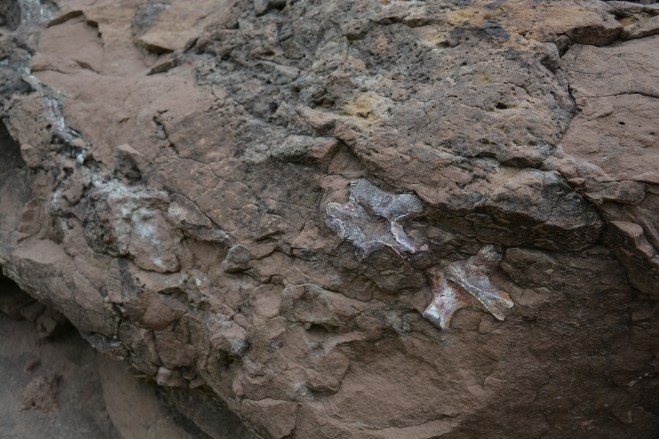
200 million year old dinosaur vertebrae

It’s cold and silent. Around me stand the silhouettes of the jagged dragons’ mountains, guarding the bones of legions of dinosaurs huge and tiny. I’m happy for a radiator in my room. It’s also drying my washing – for I have travelled perhaps the lightest yet to be here. One small backpack about two thirds full. It weighs less than seven kilos and will suffice for the next three and a half weeks. I can put my luggage on my back and just go whenever and wherever I want. I relish that freedom!
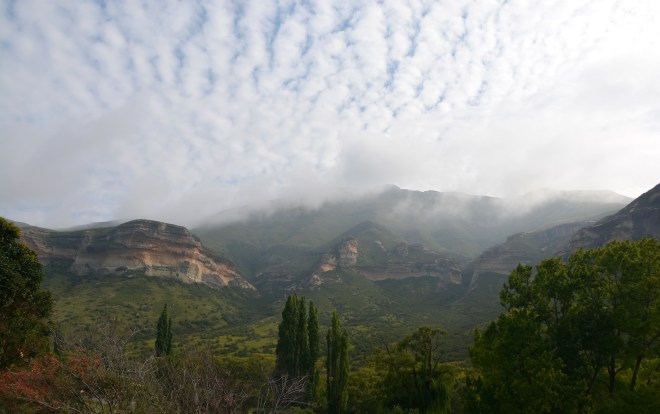
The view from over my breakfast coffee cup

DAY 67. MONDAY MARCH 2nd 2020. GOLDEN GATE NATIONAL PARK. SOUTH AFRICA

I do have – and appreciate – a lot of good fortune in life. For nothing more than any advice and ideas I might have for this team, I have two days accommodation and food and drink in this fine national park. I’ve paid for that with a few (informed, I suppose) opinions on museum design and concepts, and perhaps three new design ideas. I can swan in, sound wise and clever, and swan away again without the least responsibility. I don’t have to carry out those apparently clever ideas, only to suggest them and retreat. That’s consultancy for you! Haha. I wish I’d discovered this earlier in life.

The museum will be a magnificent affair. It’s the usual over-pretentious architectural vanity statement with exhibits added as an afterthought by the clients and planners. I’ve seen this so often in my career as a museum scenery designer. Architecture and ducting, bricks and paving, windows and floor coverings can be quantified by number crunching surveyors. Fascinating exhibits rely on creative minds and intellectual concepts. Most clients, especially government or corporate, understand buildings and are keen to make a proud impression by over-designing structures. Yet it’s the content that the visitor will come to see, the majority never noticing the ridiculous feature brickwork and vastly extravagant sloping curved glass window walls. Sometime late in the process the clients usually remember that they must commission the exhibition, at which point poor suckers like me are asked to fit exhibits into totally unsuitable gallery spaces for a minuscule portion of the overall budget. It’s happened on every new museum with which I have been involved – apart, oddly enough, from the last one: the Collings Foundation collection of military vehicles in rural Boston. They very sensibly built a vast dark hangar and allowed us to spend the money on displaying their fine collection. It was an uncommon approach.

This morning we toured the semi-complete museum building, all curved brickwork, glass curtain walls and soaring columns. The team (with just a very few days’ input from me) have done well to plan an engaging exhibition within this pretty unsuitable building, which will be filled with African sunlight that gives so many display headaches. Doubtless the architect will preen about his sloping curtain walls of curved glazing, more suitable for a smart hotel dining room or conference hall… But the public will come to see the dinosaurs. There will be life sized models – formed in reclaimed steel in a very African fashion by a team of Zimbabwean metal sculptors. I encouraged this concept last April and look forward to seeing the work in progress this week back in Durban. There will be replica rock outcrops with dinosaur bones, an infinite storeroom of bones like the stores of Witwatersrand University (an idea I threw up, using a wall of mirrors). There’ll be timelines and artefacts, a replica landscape of 200 million years ago, with dinosaurs, flying pterodactyls and a final exhibit telling the folkloric tales of the local indigenous Basotho people and their myth of a great monster that swallowed villages alive, after which the museum is named – Khudomodomo. This important gallery is being guided by the royal households of the local tribes. We were joined today by a charming, delightful couple, Mpho and Tsolo, wife and husband, members of some part of one of the royal families. Their enthusiasm was infectious, providing us with an enjoyable day, brainstorming, touring local sites, lunching in the smart park hotel and joining us for a presentation by Mike to his clients. The project is well advanced, and the building – as usual in my experience – increasingly behind schedule, almost a year – so far. Also as usual, the deadline for the installation of exhibits doesn’t extend, but squeezes inexorably tighter. I really HAVE seen it all before, having now been involved in some 30 or so major projects of this sort. The exhibit designers always draw the shortest straw and make the most compromises. Ho hum…


Well, as I said, I can wander in and out with no responsibility. I have no fee but receive my ‘payment’ in kind – the chance to visit South Africa as a guest and meet my peers, and enjoy the perks of seeing great places of the world. That suits me as much as being paid a fee!
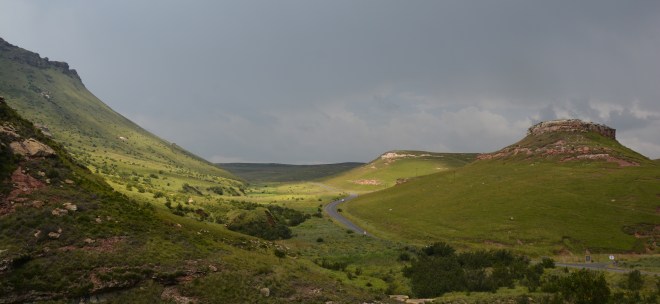
Golden Gate National Park

Changeable weather rolls about these high places. We’re at 2000 metres. Oddly, I’ve spent most of the past nine weeks or more at that sort of altitude: the Kenyan highlands, around Mount Elgon, Nairobi and Johannesburg and now the Drakensburg. From here I’ll also go up to Lesotho in due course, also at altitude. Tonight there’s heavy rain after a day of scudding clouds, bright sun, sharp breezes, rainbows and chilly winds. It’s a fine landscape. And close by is Lesotho, most magical heart of the globe.

An odd coincidence this morning. In January 2012 I bought a motorbike down here. I found it on the internet and negotiated by email with the seller, a kindly fellow in East London, down the Indian Ocean coast. I flew down and stayed a few days with Garvin and his wife, Mia. Then I rode away. I kept in very sporadic touch, enough that Garvin has my email address. I haven’t heard anything from him for probably four years. This morning I got an email from him, just down the road, in relative terms. He’s Cape Coloured – there are so many racial diversities and hierarchies in South Africa – a biker and a keen rock climber and is about to undertake a fund raising challenge to help purchase equipment for poverty stricken local hospitals where his Belgian wife works as a paediatric trauma surgeon. I was relating the odd fact that he had included me in his email, after several years’ silence, to Kath over coffee this morning. “Oh, I know Garvin! We’ve climbed together. He’s stayed in my house!”

I am in South Africa, maybe 7000 miles from home. I am acquainted with perhaps fifty people in this part of the world. The old cliche is so true, the world IS small, and maybe we ARE all related within seven removes.
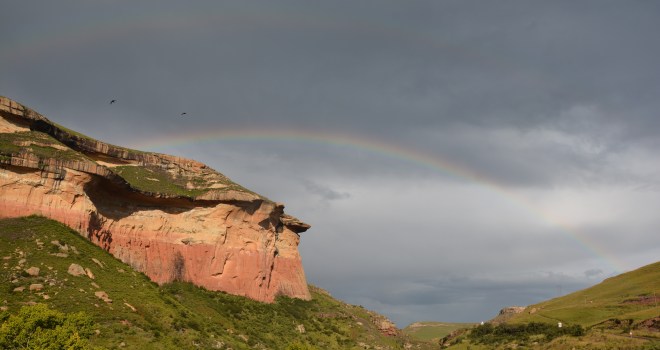
Changeable weather – at 2100 metres

EAST AFRICA 2020 – SEVEN


Eugene, a natural performer

DAYS 49/50/51. FRIDAY – SUNDAY 14/15/16th FEBRUARY 2020. KITALE – KAPSABET. KENYA

After two unremarkable but warmly welcomed days at ‘home’ in Kitale, I have set off for a few days – the final short journeys before I leave East Africa this year.

It’s Sunday evening now, in a noisy (football league) Moslem hotel in Kapsabet, a bustling town of little attraction except the handsome surroundings of the Nandi Hills, carpeted with tea estates and graced by tall dark woodland. It’s fifty or sixty miles south of Kitale, on the way towards Lake Victoria. I’d intended to get to the town of Nandi Hills itself, only a few miles further along the hilly roads, but heavy rain once again intervened. I stopped and found a place to stay, where I have to drink tea instead of beer!

It’s not easy, finding my way in rural areas utterly lacking in signposting. There are few direction posts anywhere in the country, and none whatsoever on these dirt back roads. The consequence? I rode fifty rough kilometres and ended up about 25 kilometres from where I started, on the wrong road. Somewhere I made two thirds of a circle instead of a direct line to the small town I was seeking. It’s often pointless to even ask directions, as I often find that the people I ask – usually boda-boda riders, on the assumption that they at least know the roads – perhaps don’t actually understand my question and answer the one they think they might have heard! I probably added at least forty very hard kilometres to my ride today – having asked my way and received extravagant confirmatory nods.

On a few occasions, I’ve ridden back and forth on these hills and have a couple of pleasant short cuts. Well ‘short’ isn’t very accurate, I suppose. They are long rugged tracks over the rolling hills. One of them I discovered about three years ago and actually marked on my map as a lovely road. It WAS a lovely road, even a year ago. Now it’s severely damaged by the constant rains of this climate-changed dry season, surely one of the worst roads in East Africa. Of the 100 miles I rode today, about seventy must have been the hardest trails I’ve ridden in a long time. The rains have certainly altered the process of moving about this year. Today I have been shaken, rattled and battered. Only a year ago this was a pleasant smoothish gravel road. Not now.

It’s fine scenery though, stretches of forest and farmland and a hundred dilapidated ribbon villages of general ugliness. There’s not a lot of time to study them. I have to keep my eyes glued to the pitted track ahead. Every yard is a potential hazard on these roads. A moment’s inattention and I’m in trouble with the deep, serious parallel ruts, often a foot deep. I wonder if the physio nurse at Totnes hospital had anything like this in mind as a recovery technique for my Achille’s tendon! I doubt it somehow. But much of the way is only made bearable by standing on my foot pegs and transferring my weight to the front wheel and the centre of gravity down to the footrests. That way I can dance and weave, anticipate and correct. It’s hard exercise. The little bike takes a lot of punishment too.

It took over four hours to reach Kapsabet. For the last hour, I watched heavy storm clouds gather and hoped I would make it to the tarred road before the rain made my trail a slippery ski run. I knew the final miles would be surfaced and didn’t let up until I was there. Light rain began minutes later and I cut short my journey, finding a round thatched hut in this slightly down at heel guest house for £11.50. It has a fine, big bed with spotless sheets and a vast red Chinese blanket that never saw a sheep or any other living organism in its production. There’s a small bathroom with a warm shower to wash off the appalling red dust. (Except the water heater fused!). It’s chilly now. Kapsabet is quite high and the rain has cooled the air up here. I’m almost exactly on the Equator, but elevation signifies more than latitude. And this year the weather is so much cooler than usual. There’s much talk, too, of the record plague of locusts invading and stripping the vegetation of the northern desert and bush lands of Somalia, Kenya and Uganda. Biblical proportions, I guess you might say. Had I succeeded in my ambition of making the safari round the north of Uganda in the Karamajong region ten days ago, I might have been fighting off locusts as I rode. Pictures show them in veritable clouds up there.


I’ve just eaten parts of a chicken that ran a marathon recently. Quite likely won. The rice and vegetables were beaten to submission and held down until they drowned in oil. And, add to this, I have to drink bloody tea! And there’s a certain pall of deep misery that hangs over Moslem hotels. It’s a joyless religion and its women particularly gloomy. The travelling life. It’s not all exotic and adventurous by any means!

dsc_2931

DAY 52. MONDAY 17th FEBRUARY 2020. BROOKE. KENYA

I’m sitting in the terrace of the noisiest hotel in Kenya, shuddering to the sounds of large lorries with air brakes hissing and racing to a halt at the bottom of a long hill and crashing and rattling over the speed humps on the main East African highway outside. The road runs from Nairobi to the second Kenyan city, Kisumu, down on the lake. Rain is pouring and tumbling on the tin roof over my head. It’s cascading down. I’m wearing my jersey and fleece. This is the hot season. The dry season. In East Africa. Meanwhile, Australia is on fire, England is getting a month’s rain in a day and has 400 flood alerts, there’s a plague of locusts just to the north of here and the Antarctic recorded its highest ever temperature. And people claim climate change is fake news.

The Brooke Hotel is a vast ugly heap of pink and grey concrete with hideous pea green highlights, five storeys high around a central well. It’s a place of studied ugliness and bad design. It’s one of those places that when the cook drops a saucepan lid, the reverberations echo for minutes amongst the hard surfaces. So what does the bar staff do? Wind up the sub-bass speakers to rock the hotel in accompaniment to the screeching brakes, the rattling empty wagons and the rain hammering like machine gun fire on the tin roofs. I only stay here because all the hotels around the town of Kericho seem to have an over-egged view of their worth for some unaccountable reason. It seems to be one of the most expensive towns in which I ever searched for accommodation. Just out of interest, I asked the tariff at the next guest house up the road, a fancyish place set amongst the beautiful tea estates. The price for a resident is a bit more than double the room here, at £24, and for a foreigner it tallies at no less than 80 US dollars. I forbore to ask why it costs more to look after a foreigner than a Kenyan resident. I just puffed in disgust and left! I hate this extortion of outsiders. It smacks of exploitation. I rode away and returned to the Brooke Hotel, noise and all. I insisted on a room at the very back of the block, and being Monday night it’s probably quite empty anyway. I’ve an adequate room and a sense of justice preserved all for less than twelve quid!

I took against Kericho the very first time I visited – in 2001. It appears to have a snobbish appeal that is uncommon in Kenya. It’s the centre of the tea industry, surrounded by magnificent rolling hills carpeted in close-cropped tea bushes. But the town itself is as ugly as any other, crazy traffic, coarse petrol stations and supermarkets, glass and steel edifices of supreme architectural horror, and just behind the facade, the usual shacks and businesses of the struggling populous. Brooke, four miles to the north, is a squalid place, a rough trading centre. The poor relation to Kericho’s imagined splendour. So the hotel costs a fraction.

Tea, like an expensive carpet

The ride down from the Nandi Hills is fine. A winding road that drops to the lower lands that now run away towards Lake Victoria, itself at over 1000 metres high. Tea and sugar are the main crops, on an industrial scale hereabouts. Brooke, this straggly marketing centre, is synonymous with Brooke Bond, the centre of endless tea estates. Estates, I found a couple of years ago, that don’t like visitors. I suspect that might be to hide some pretty awful employment practices… Tomorrow morning, hopefully back in sunshine, I’ll sit on the first floor terrace of this hideous hotel, as now, and look across the smiling miles of brilliantly green tea bushes to the black tree-clad hills under blue skies. It’s a magnificent landscape. When it’s not bucketing with rain.

I came this way round once again, to say hello to Nashon, the kindly, shy mechanic who has helped me out on various occasions with my little Mosquito, since the time we fortuitously met when the starter gears shed several teeth into the engine of my machine, necessitating the entire stripping and washing of every cog, chain, pipe, pump, shaft and nut of the bike. All this carried out onto a flattened cardboard box and greasy nylon sack on the oily mud at the edge of the road, under my very anxious eyes. A process that took a couple of days and a lot of my peace of mind. But it turned out that Nashon wasn’t a Chinese-bike butcher, but a reasonably knowledgeable mechanic who went way beyond the call of duty to a passing customer. And one thing I have learned – and appreciate – in Africa, is that going back to say hello shows respect and bolsters the standing of my acquaintances and friends. Nashon’s a kind man. Worthy of passing by to pay my respects.

DAY 53. TUESDAY 18th FEBRUARY 2020. ELDAMA RAVINE. KENYA

It’s the third time I’ve stayed in Eldama Ravine, and the third hotel. I wish I’d found this one first. The first night I stayed here is memorable for the noisiest disco I ever suffered, with bass beats that shook the entire, vast, four storey hotel. Last year I stopped a night in a scruffy place off the road, which was acceptable, but now I’ve found a decent room at the back of an interestingly designed building with raised bridges leading between the upper rooms, and even a balcony looking over some scrubby fields to distant hills. A good place. Quiet, comfortable and cheap. And a not bad outdoor restaurant too. The only trouble with the place is heavy cold rain tonight once again. But the hotel can’t help that, and again I reached dry accommodation before the rains.

This was a light day. I spent some time in gentle conversation with Nashon and his wife in their one room home. They’ve a girl and two boys and how they manage in one 12X12 room I’m never sure. But many many Africans do just that. A bed behind a curtain, raised up on boxes to utilise the space beneath, a pile of old suitcases for wardrobes, an easy chair and settee, a coffee table, stereo system, TV and gas ring. All in one room beneath a tin roof, cheek by jowl with seven other rooms in two rows, a narrow walkway and communal washing space between. This is life for millions of African people. There’s a row of latrines and a scabby yard with worn grass and mud. Inside, the walls are covered by religious posters and calendars. It’s not so different, I suppose, to working class Britain a bit over 100 years ago . It’s surprising how we forget our own history and react with horror to others’…

Nashon’s workshop is nearby, a greasy, oily lock up by a broken street in the market area of the unattractive town. Kindly, his wife insisted on making milky chai and I only just managed to avoid fried eggs, having just finished breakfast in my hotel up the road. Nashon and the family borrowed a car and went home to visit his mother yesterday, a village about 40 kilometres away. He was taking today off, but generously replaced my brake shoes in an attempt to give me a rear brake again. A pair of Indian brake shoes cost £2.30, probably one tenth of what I might expect at home. He’s a conscientious mechanic, always going beyond the minimum and doing a professional job. The bike is better for 45 minutes’ of his ministrations.

We then rode to find an arboretum for which I have searched on various occasions, a pleasant public park owned by the major tea estate, itself part of the giant Unilever multinational. He also showed me a charming garden, open to the public on a private farm – tea and dairy – a few miles from Brooke. Set in a valley backed by woodland and carpeted by tea bushes, was a small lake and trickling brooks. Abundant bird life swooped and flitted about. Peaceful and brightly sunny under the blue dome of the sky.

Then it was off on a winding road through hilly country, riding northwards to Mau Summit, where the old colonial railway from Mombasa on the coast to Kampala, half way across Uganda, toiled towards the heights of the Equator. At 8300 feet, the air has a chill that forced me to stop and put on my fleece jerkin under my riding jacket. Tonight at Eldama Ravine I even resorted to a bowl of soup to warm up. I had to join the unpleasant main highway for some miles, the one that carries all the traffic from Nairobi and Mombasa up to the Kenyan highlands and on to Uganda. I dislike this road very much. It’s a constant line of steep hills with toiling lorries belching their incontinent way at crawling speed, causing faster vehicles to risk all in a race to overtake. Happily, I have only about fifteen miles of this to suffer. Another year I found a direct short cut on an appalling, rock and dirt road, but discretion suggests I avoid the unnecessary ones this year; they are so damaged by the recent weather, and my foot damaged by rounders. Turning off onto the quiet road to Eldama Ravine, I crossed the Equator once more.

And so to this busy small town an hour before the rain began. A gentle day of generally pleasant scenic hills. I know this region quite well by now and always enjoy the ride. Spacious country.

DAY 54. WEDNESDAY 19th FEBRUARY 2020. KESSUP. KENYA

It’s three months since my orthopaedic boot was removed. As I wrote before, I rather doubt that the hospital had in mind quite the exercise regime I have undertaken. Three to six months was their diagnosis for recovery time. I can’t claim recovery, but it IS getting stronger with my harsh treatment. The ankle swells less each day now. I was happy this morning to see that my ankles matched exactly when I got up from a long, good sleep in the quiet hotel. Progress, I felt.

One of my favourite roads in this part of the world is the one that winds from Eldama Ravine, a regional town of little attraction, via Tenges to Kabarnet. I’ve ridden this way at least once each of the years I have spent riding in East Africa, sometimes more often. I like it because it has such variety and such scenic splendours. In only about 75 miles it coils through climatic zones, climbing alongside yawning drops into the Rift Valley on one side and the Kerio Valley on the other. In the day I climb and drop thousands of feet, twisting down to spiky acacia, aloes and cactus-like plants scratching a life from pale sand and rocks, upwards through thirsty eucalyptus trees, leaves shimmying in the breezes from below and on up to coniferous woodland with magnificent views down into deep valleys. Then, from Kabarnet, the process unwinds the other way, serpentining down into the vast split in the Earth’s surface, deep into the dry Kerio Valley, the green forested opposite wall of which looks entirely unscalable – and I know of only three ‘roads’ that do scale the heights. Two of them are seriously rough rocky staircase tracks and the third the only viable road on four normal wheels, that wriggles and clambers back up to Iten, some five thousand feet above, atop the jagged precipices of the cliffs of the escarpment. Two thirds of the way up is familiar Kessup.

Another reason I relish the Tenges road so well is that it is amongst the friendliest of the area. I suspect that the education level is high in this county. This could be explained by the county being that of the birthplace and home of the late crook, Daniel Arap Moi, president of Kenya for many years. The home regions of presidents in Africa get preferential treatment. It’s the payoff for buying all those votes. I remember back in 2001 I noted that this region had the best, smoothest roads in East Africa. “It’s the home of the president! Of course it has the best roads; you could play billiards on them!” declared Rico.

One of my happiest activities on these footloose safaris is to stop and meet the people. Towards the top of the winding potholed road, a view of the huge Rift Valley was suddenly released from constant roadside growth. On rounding a bend I looked down onto an open saddle with big views far into the sun-bleached distance. I pulled up and stepped over the steel accident barrier to enjoy the vista and take a picture. Within moments I was joined by a whole family, and friends, from the only visible homestead on the saddle, their small home 100 yards away on the precipitous edge of the road. They came to welcome me and out of open curiosity. And curiosity is an attribute I greatly admire. Curiosity and compassion, I always say, make people good humans. I stayed half an hour with those ten cheerful, respectful people, four men, some teenagers, a number of children and Priscilla, a smart, handsome middle aged woman. Boda-bodas pulled up to join the interest. Everyone exuded warmth and welcome. I felt very privileged to be sitting on that remote roadside barrier with such charming, warm-hearted people. The one thing we shared was common interest and warmth. I felt accepted for myself, with no real sense that I represented anything other than a different human being, with unusual attributes that they didn’t often get an opportunity to investigate. It was a delightful meeting.

Riding on, the road wiggles along the very ridge between the two giant valleys, irregular fields hacked and fought from the steeply sloping mountainsides through generations of hard physical work. Small houses cling to the slopes and fences of vertically split logs add staccato graphic hatching to the green roadside, the views downward pixillated through the bright gaps. Mature trees spread their glorious shade above and glimpses of incredibly scaled panoramas flicker behind the abundant growth. High on the mountain, the woodland gives way to rich natural forest, heavy leafed trees draped with lianas, the sunlight dappling and flashing in the canopy high overhead. It’s simply magnificent. From one small rocky promontory, I seem to be able to gaze over half Africa, displayed into endless heat haze at least 100 miles to the east.

Spotting a ‘hotel’ – a mean shack with a large Chinese flask prominent on its wooden counter, I chose to stop for chai. Served by polite Alfred, thrilled to have a mzungu stop by to chat and drink his sweet tea and eat a couple of dry chapatis, I was immediately joined by two small girls, pulling a Chinese chair ever closer to the white ancient, and politely greeted by most of the village elders and cheerily acknowledged by every passing pedestrian and vehicle. I stayed an hour, relaxing in the welcome of a whole community. “Aren’t you afraid?” so many ask me at home. Afraid of feeling so content I move to this remotely splendid mountain village, maybe!

From that tea house I texted William that I would arrive later at Kessup. I’d thought I might stay somewhere on the road, but Kessup was only another 60 kilometres or so, and I know I am received so kindly here. It felt like a good way to end a contented, people-filled day. So I rode on, down into the steamy Kerio Valley so far below and toiling up towards the familiar guest house and my usual room. At this rate they’ll change the room’s name from Mexico (I have no idea…) to another ‘Jonathan’s Room’.

It’s one of the best 75 miles you can ride in this part of the world. Eldama Ravine to Kessup. Just lovely. Of course, I am assured of a happy welcome from William and the guest house staff. I’m almost a fixture this year. It’s considerably warmer tonight than on my last perishing visit. We’ve sat outside in the open garden, with a young Norwegian traveller, as the night drew its veil over the spreading valley far below, now a mystery of darkness, a few winking lights and the promise of an elephant or two beneath the equatorial stars. It’s a fine place to be.

Leaving the hotel this morning, the gateman came to unlock the steel gates. I’d woken to dull skies, chill and damp earth. Unpromising, although the gloom burned off in the equatorial sunshine. I was, after all, only about five miles from that tantalising imaginary line.

“I don’t like your weather much this year!” I quipped, as I zipped up my jacket, pulled on gloves and swung my leg over the bike.

“Yes, it’s all changing! But it’s down to God!”

“Don’t blame God for this!” I exclaimed. “This is Man! Entirely Man! The selfishness and greed of mankind!”

“But what can we do? God makes the weather…”

And there you have a problem to ponder. However much climate activists may try to change perceptions in the West, much of the world is educated in old religious dogma and myth, and is persuaded only God can change the fates of the planet. “Oh, we’ll pray! What can WE do? It’s the will of God!”

I rode the next few miles somewhat despondently.

Philemon

DAY 55. THURSDAY 20th FEBRUARY 2020. KESSUP. KENYA

A typical day in Kessup is for William and I to walk down in the villages. It’s funny how this has become so much part of my East African experience. After breakfast we wander off down the stony pathways between small houses and shambas and just see who we meet. Today, young Nore, a charming and mature 21 year old Norwegian student accompanied us. He appeared to get great satisfaction from the activity too, reacting happily to the many excited children who greeted us, clung to our hands and pulled the hair on our arms. He was patient and intrigued and actually commented at one point that this was the best day he’d had. He’s on a six month world tour, starting recently in Oman, on to Kenya and will wander down through some of Africa, down to Australia and back through California. A warm young man, happy to join in our unexciting peregrinations on the green hillsides.

We walked contentedly northwards along the plateau. It’s half term, so many were the children calling and following us as we meandered amongst fields and homesteads, women hard at work planting, weeding and harvesting and many of the men, as so often, sitting about talking and drinking bulsa.  We too joined some men beneath shady trees to take fibrous bulsa. Nore impressively tried his best, even if he didn’t express much enthusiasm. Just being seen to drink the rather sour liquid, made from dusty fermented maize, gains a good deal of respect. He’s the makings of a good, sensitive traveller. I’m amused to find that his father crossed the Sahara in 1987, as did I.

Everywhere, people greet and chatter. We shake hands a hundred times, laugh with cheerful children, excited to touch not just one, but two, mzungus. It’s happy fun and warm-spirited. William is a good guide. He knows his community well, and his community knows him. He’s respected and well thought of, a man with integrity, honesty and good sense.

It’s rough ground and taxes my ankle. But a long rugged walk seems to be good recovery exercise. The swelling is less each day. Tomorrow is, though, to be the big test. We intend to hike all the way down to the Kerio Valley bottom, hundreds of metres down the steep, rocky slopes into the furnace below. I wonder how that will go..? I’m in kill or cure mode, fed to the teeth of this frustrating disability.

DAY 56. FRIDAY 21st FEBRUARY 2020. KESSUP. KENYA

I’m rather self satisfied tonight. I did it. Obstinate maybe, but I walked, indeed scrambled, down no less that 810 metres of the escarpment into the Great Rift Valley! That’s 2630 feet. A three hour hike on rough rocks and slippery gravel, tiring more for the intense concentration to carefully inspect each footfall, than the distance. Three to six months’ recovery, the hospital warned me. Well, after three months and two days, maybe I am not CURED, but I certainly feel that I am well on the way to recovery, despite the fact that the three month cure is probably for people half my age.

We set off at nine, William, Nore and I. Taking advantage of the cool of the morning. Every metre the heat increased. We walked across the plateau to the edge, where the slopes drop away dramatically, with enormous vistas of the Kerio Valley far below.

At this point, last evening, I realised that sleep was more pressing than my journal. The light went out at 8.30! Twelve hours’ sleep was required. This morning, I wake with two matching ankles. No swelling. It seems that hiking to the bottom of the Great African Rift Valley is good physiotherapy!

So, back to the clamber to the depths… Kessup sits on a plateau, maybe three miles long by three quarters from the high cliffs up to the highlands, to the drop to the steaming depths below. In total, the depth of the Rift here is about 1500 metres – 4900-odd feet. Kessup sits at about 2000 metres, the valley floor, where we emerged from the wooded hill, at 1190.

It’s hard walking, but of course local people do it frequently – often up and down in a day. Many families, William’s included, graze their cattle down there, under the care of herders. Atanas is William’s herder, a cheerful, spare man prone to cheerful drunkenness at any opportunity – like the visit of a mzungu and the infusion of a pound that will buy him enough of the killer local spirit to add to the bulsa that William will drink here, to make him inebriated for the remainder of the day. It’s a life of privations but not an arduous one, looking after grazing cows and goats. They do all the work, Atanas just has to sit under a tree and gaze into space. Once again, I wonder so much what occurs in his head in the hours he can doze patiently on a rock in the Rift Valley? He can probably read and write, just about. He’s some basic English. He has – of course – his phone. No doubt he fills the wonderful silence with terrible (to me) music played from a speaker the size of a drawing pin. He probably communes with the few other people who choose to live in this outpost of humanity. He has milk and ugali for basic sustenance, and a rugged stick and mud hut in which to sleep – and tonight to sleep off the alcohol. There’s nothing much to talk about but goats and cows – and probably league football. He’s a house and family up here on the Kessup plateau; I’ve photographed his daughter Sharon in my peregrinations with William. I guess he has domestic problems to ponder: where the next money’s coming from; how to arrange his food for the evening; a few practicalities about the animals. Maybe that’s all any of us think about most of the time. I suppose life’s not made up of philosophical musings – but it is greatly stimulated by reading a book; appreciating thoughtful opinions; considering the diversities beyond our own very limited community. Things to which Atanas has little exposure as he sits on his rock on the scrubby hillside in the furnace of the Rift Valley.

We only have to do it once, thankfully. William and I have talked of this for four years, walking down to see Atanas and William’s cows. This trip has been inspired by my Harberton neighbours, Jill and Ken, keen beekeepers. I was in touch by email last week (about the water from three consecutive storms probably flowing down my chimney!) and happened to send them a photo I had taken of a small commercial bee farm project that Alex and I discovered near Sipi. By return came an enthusiastic response and questions that I’d never considered, here in Africa, where I often see local beehives hanging in trees as I pass. “Can we find some hives and a beekeeper?” I asked William a couple of days ago. “My neighbours would be very interested.”

“Oh, of cooourse! We can find many! But not here. We have to go dow-en to the valley. There are many keeping bees there.” Immediately, out came his phone. “I will ora-ganise it! But your foot..? Will you manage?”

Manage it I did! I admit I’m happy it was no further. By the time we reached the valley floor, almost three hours after starting out, I was exhausted, as much by the intense concentration for every footstep as for the exertion of the scramble itself. I have lost some confidence as a result of my stupid injury. I don’t have my usual easy balance and quickness of recovery from a misstep, and am terrified – as yet – of damaging that ankle again. And the muscles in my right leg are still quite reduced. William, with his love of discipline and time, allowed us two ten minute breaks (phone clock in hand!), but for two and three quarter hours we stumbled and slid down those narrow cattle paths. He’s informative too, is William, and has a new listener in Nore. He pointed out medicinal trees and a tree from which, in former times, before all the animals were hunted to extinction or escaped to reserves, hunters used to poison their arrows. “Oh, if it gets into your blood, you are a-gone! Huh! No chance, if it gets in the blood!” William, as a youth, remembers hunting for antelope down here. “Are there animals now?” asks Nore.

“NOO! Only in the reserves!” William’s 54. They’ve been wiped out, unless protected by national laws and rangers, in his lifetime. Over most of Africa. Now and again, outside a park or reserve, I may see an odd antelope, zebra or ostrich. They are in remote places far from habitation, on dirt roads in the backwoods. Only in the wildest areas, deep in the deserts maybe, will you see animals really in the wild. Most game is behind fences now, corralled largely for tourist dollars, managed and accessible. “Aren’t you afraid of wild animals?” people ask me. About the biggest I see is a squirrel, unless I am on a public road that happens to pass through a park or reserve.

The sun was high when we reached our destination, a glade of trees by a water tank where we could rest and William could arrange with his brother in law to bring us bulsa for him and Atanas – with a gesture for me – and milky tea for Nore and I to rehydrate. William’s brother in law, Philip, keeps bees, but here it’s a young man’s game, and Philip at 63 is, in Kenya, too old for it. Leonard was to be our guide to the beekeeping arts in the Kerio Valley.

Leonard shows me, on an empty hive, how he opens a hive to get the honey.

A smart young man, with a decent education and a determined business acumen, Leonard took up the beekeeping mantle from his grandfather. “Since 2008, I went with my grandfather, even as he grew holder.” Leonard has an odd habit of adding an ‘h’ to his vowels. “Heven when he left this a-world, he was a man of bees!” He scrambled down the hillside to a tree in which one of his hives was suspended, busy with bees. “It’s han inheritance of sorts in a family. Somehow a talent. This beekeeping, we prepare ourselves. Hit is somehow in the blood of someone! You love honey, somehow it’s a-good to keep bees!” Leonard keeps seven hives down here and thirty up on the highland plateau far above.

A low level hive

Leonard clambered agilely into another tree, where a big hollowed log hive, about a metre long and half a metre in circumference, hung from a fairly spindly branch. The upper half of the tube was raised. They had opened it, taken the honey and the hive had needed some restoration. By leaving the hive open, the bees had been driven to find an alternative home. Leonard and his boys had repaired the old wooden log and now it was ready to host another colony. He now closed the two halves together and stuffed leafy twigs into the surrounding gap. “We close, and may-a-be by next week we have new bees!” This was a big hive. “From this we may only harvest once in the year. In Haugust or December maybe. We can get maybe 20 kilos of honey from this hive,” he called down, balancing on a bouncy bough. “From the smaller hives like the one there, we may harvest twice.”

“Eh! It’s a young man’s game, working up there!” I exclaimed, watching the bough bend.

“Yes, we will have to be three men to hempty this hive. When it is full of honey, it is a-heavy!”

“What about protection?”

“Hah!” he laughed. “We can use hoveralls and protection on the down ones,” pointing to a big hive hung only at shoulder height nearby, “but if we use hoveralls and gloves in the big trees high we damage the cloth-es. So we use mud.”

“Mud?”

“Yes, we put mud on our skin. Loam mud.”

“What about your head and face?”

“Yes, there too! Hall over our skin. To hide the smell of our bodies. And we hopen the hives at night when the bees are quiet. We use smoke to drive them out and we pull the honey with our a-hands. We tie a plastic container in the tree and we scoop the honey and lower it down. We honly put hives in trees where we can climb!”

I imagined three men hanging about in that tree, at night, surrounded by disturbed bees, pulling horribly sticky honey from the upper half of a heavy log with their hands, stickiness everywhere imaginable, mud on limbs and faces, bees buzzing, the tree shaking… “I hope you get good money for the honey?”

The bees build their combs either longwise or diagonal

“Yes, it’s good business. We get about 4000 to 5000 Kenya shillings for 4 kilos!” That’s about £8-10 a kilo, pretty good money in Kenya – but of course, they only get it once or twice a year. “We let it settle and the top honey, we get more than 1000 bob a kilo, the bottom a bit less. Our hives? This one is from 2008. The time? Oh, about four more years maybe. This hive was for my grandfather.” He showed me his stock of heavy log hives, marked inside with the patterns of combs. “Some go this way!” he pointed out the diagonal pattern across the hollow of the thick wood, “and hothers, they make it along the hive. These hives are from cypress wood. We used to make cedar, my grandfather, he made cedar, but now there’s no cedar left. Oh, I like bees! My grandfather, I inherit from him.”

Leonard

We clambered back to the grove where William was drinking bulsa and Atanas by now had moved on to the wirigi, killer spirit.

Atanas, so pleased to have wazungu visitors

A shy boy, Rogers, had brought a green plastic jug of tea for Nore and I from the distant road, 250 feet below and a quarter of a mile away. Philip had brought us honey to taste – about half a teacupful each – with a spoon. I’ve never eaten half a teacup of honey in my life. “Oh! It is good for the energy!” exclaimed William. I spooned in the honey, complete with dead bees, doubtless some mud and fibrous bits and pieces. It was as if I could feel the energy flowing back into my blood! It was delicious and a miracle of nutrition to tired muscles, still tingling from a 2630 foot scramble downhill. The sun was intense. Goats scavenged around us. Atanas drank himsel-uf a degree closer to an early death and William and Leonard chatted quietly. We two Europeans were happy to sit and stare at the wide valley below, content – as no Kenyan will ever be, William admits – to just think. “Oh, we like conversation! When we are walking or sitting like this we MUST talk!”

Philip

In the mid afternoon we stumbled the rest of the way to the white dust track in the valley, where some benighted families live in this inferno and stoney inhospitability. Even Nore, a tough 21 year old, admitted he was happy we had decided on the strength of my damaged leg, not to climb back the 2630 feet to
kessup.

William, Nore, Atanas, JB and Philip at the bottom of the Rift Valley. Kessup is somewhere far above us! I have to build those muscles back on the right leg!

We negotiated for a boda-boda ride to the road junction at the bottom of the long, winding climb back to the plateau. Four up – and Nore is perhaps even a centimetre or two taller than me, and a good deal tougher – we ground along on a 100cc motorbike. The rider, Sam, would rather make an extra 50 bob (40 pence) and have the tyre rubbing on the underside of the metal mudguard than sympathise with his machine. I remember that road from four years ago, when it seemed like elastic and never ending. I’d ridden down from the top of the escarpment on a sandy, degraded track beyond the north end of the Kessup plateau and had not reckoned on the fact that the return to the road was 50 miles of sand and rock. It was that evening, exhausted and filthy, that I found the Lelin Campsite and guest house, and next morning the manager introduced me to William, now perched on the carrier of the boda-boda behind a rider and two very big wazungus.

At the road we pushed our way into a vastly overcrowded matatu, 21 adults, a baby and assorted bags boxes and rolls of roofing sheets, to uncomfortably grind our way back up the 800 metres height to our evening beer. “Walking down was more comfortable than the journey home!” I joked with William, falling undignified from the packed vehicle.

And, amazingly, almost no oedema in my ankle, despite the exertions. I must suggest to Torbay Hospital that a cure for a ruptured Achille’s might involve scrambling down into Africa’s Great Rift Valley! At least it’s entertaining. Better than stretching that damned rubber exercise band all the time.

DAY 57. SATURDAY 22nd FEBRUARY 2020. KESSUP. KENYA

Another easy day of meeting the people as we wandered the village lanes. It’s been fun to have another mzungu along, with his obvious enthusiasm for the simple activity – unusual in one so young. Nore has enjoyed his interaction with many village people and learned a good deal about rural African life quickly, something that’s often not easy for a mzungu to investigate, yet is how so many African people exist. He’s a good traveller and already says he thinks he may travel quite a lot, more than his contemporaries, most of whom appear to have taken a year’s placement in another university, while he chose a footloose period. He’s a surprisingly mature attitude to all he sees about him, and a pleasant confidence that makes him popular with the villagers.

Blessing

Once again, we drifted about the red tracks and lanes, greeting all we passed, sitting here and there, spreading a bit of understanding, we hoped; purchasing some green vegetables for supper – the guest house, like most African kitchens, relies on scraggy meat and starch; drinking some bulsa in one compound, to the excitement fo the inhabitants and seeking avocados unsuccessfully. We met Martin, an age-mate to William, a wiry man with a lined face and shaggy hair now touched with white, who made the foolish decision to look for some money by smuggling on the Uganda border in 1986. Not a good time to enter that country without papers. It was the time that the present crook, Museveni, was leading the resistance to the previous (even worse) crook Idi Amin. The young fellow was arrested on suspicion of spying, threatened, tortured, saw some appalling atrocities and mass graves filled with skulls – Africa can treat life very cheaply – and was tried. He avoided execution but the soldiers destroyed his right forefinger and thumb so that he wouldn’t be able to fire a gun. Now, 34 years on, he tells the story with a laugh at his own adventurous stupidity. Underneath, no doubt, the trauma must be real. What is it about Africa that causes such terrible cruelty? Ordinary people, largely compassionate, professing allegiance to Christianity or Islam almost universally, who then carry out unbelievable atrocities on their fellows, sometimes even in their own kith and kin. It’s difficult to forget the story of the Hutu child in Rwanda who killed his Tutsi mother because she was of the ‘wrong’ tribe in that awful conflict – the evidence of which I have witnessed in all those broken skull and shattered bone mausoleums outside almost every village in the small country. Mind you, I ask what it is about Africa and forget to question the atrocities amongst ‘normal’ people in Nazi Germany, the Balkans, the Chinese Cultural Revolution, Syria, Iraq, the Gulf States… Yes, Africa has no monopoly on massacres of their fellows.

Invited into numerous houses, we managed, by William’s diligence with his clock, so frequently in hand, to return in time for the first football match of his day on the satellite TV that his daughter sends him on the proceeds of her nursing studies in Australia. It was a bribe to stop him wasting his time, money and health on booze! He laughs as he tells Nore that story. “Oh, Jonathan and my daughter, they both told me to leave the alcohol! And the cigarettes! Now I only take a little bulsa sometimes.” He is passionate about football, especially ‘his team’, Manchester City. He showed us his TV, and innocent that I am, I had no idea that you can watch football, from somewhere, at any and every hour of the day or night! His house is basic, a place of wooden walls and a burning zinc roof. He has some battered and threadbare foam armchairs and a settee, an untidy sideboard and a small table with a gas ring and his entire crockery, cutlet and utensils. A tattered net curtain divides off the plywood-enclosed bedroom area. It’s the necessities, with no frills or comforts except the TV. It’s how most rural Kenyans live. I was impressed to find his house without any security whatsoever. “Oh, no, everyone knows William, and William knows everyone! No one will steal here.”

William and Nore and a couple of villagers drink bulsa on a hot morning

Tomorrow I’ll head Kitale way once more. I’ve just a few more days in East Africa before I fly to South Africa on Friday. It’s been a different sort of tip, this time. I’ve not ridden far and seen no new horizons, but there’s a satisfaction in strengthening friendships and becoming a familiar figure – evidenced by how often in the past couple of days I have been hailed from fields and compounds by my name. I’ve broken through some of the exotic mzungu state and am accepted as an equal in these villages.

EAST AFRICA 2020 – SIX

Mary, a niece of Alex

DAYS 42 – 44. FRIDAY 7th to SUNDAY 9th FEBRUARY 2019. SIPI, UGANDA

These have been quiet, uneventful days with my ‘family’ in Uganda. Alex exploited at work by his mean-spirited boss, who embodies all that is bad about African management; Precious delighted to have her mzungu to look after; the children Keilah and Jonathan, cheerfully filthy in the mud and dust of Sipi. Jonathan, at only 15 months, pisses as he goes and then sits about in the dust and still-damp mud. He’s probably the dirtiest child I’ve ever seen! If he wears them at all, he goes through six or seven pairs of red mud-stained trousers a day. Keilah, at almost three, is a bit more self controlled, but ends the day with a red hue. Washed for bed, they look wholesome and happy, contented, healthy children living a very natural life, building immunity every second. “You should eat a peck of dirt before you die,” was the wisdom of my grandmother’s generation. It kept us immune to illnesses and allergies so prevalent amongst over-protected modern children. Little Jonathan must have had his peck already. And he’s only 15 months! As I look down from my plastic Chinese table on the raised restaurant-to-be, he is sitting happily in the mud flower border, spooning dirt and weeds into his mouth, where everything goes.

Dirty but happy. Jonathan, ‘JB’

There are children everywhere, shouting happy ‘hellos’ from the track that passes the new restaurant on stilts, that displays the mzungu so well to the passing villagers as I write. I wave back every few moments as I try to recover from Precious’s vast breakfast.

Family life in the Rock Gardens compound

No child in these rural villages has any toys except those created by lively young imaginations. An old motorbike tyre used as a hoop is one of the most common. Trucks made from scrap and pushed on a stick. On a local walk we found eight children having raucous fun bouncing up and down on a long springy eucalyptus tree that had been felled across a small valley, some of them falling off into the undergrowth by a muddy stream. Great glee when the mzungu joined in for a few moments. Mud makes a glorious plaything of course. They live amongst cows and goats, muck and filth. Many will never attend school.

A felled tree for a plaything

A pretty young girl, maybe 11 or 12, is sometimes around the house these days. She’s Lizpa, one of a relatively small Ugandan family of merely seven children to illiterate, unemployed parents. They live in a rude compound nearby. The father does nothing much; the mother has babies. And probably works herself to the bone. None of the children go to school; there’s no one to encourage them to do so. Lizpa helps Precious around the compound, doing small menial jobs in exchange for some food and second hand clothing. She doesn’t go to school, will probably never read or write. Her role in life will be having lots more babies – who will never go to school or learn to read and write. Like family cattle, she represents wealth: one day, probably very soon, she will be worth a dowry…

The first born of her family, a girl, is already married at 13 or 14, Precious tells me. And so history repeats itself. The churches do nothing to stem the overwhelming flood tide, the mosques no more; the appallingly corrupt government under its ruthless crook, Museveni, one of the richest presidents in Africa, responsible for so much unrest and crimes, has an interest in keeping the populous uneducated. They’re easier to control, don’t make waves, can be bought off with pennies. It’s one of the most corrupt, cynical regimes in Africa. A ballooning population. Half of Ugandans are under the age if 15. Literacy is low. Poverty is widespread. And not one of the so-called morally responsible authorities – the churches, the mosques, the government – does a damned thing about it, all self-interested in their profits and power.

Sons are still a gift from god, girls a trial and mothers who produce girl babies punished and discarded. No man would admit to the science that the man might have a part in transmitting the ‘wrong’ genes. It’s a woman’s responsibility to produce sons, not daughters. Men whose wives produce daughters find other women. Precious tells me the shocking story of a mother who died two weeks after giving birth – to a girl – whose husband ‘married’ another woman the day after the death. Women are baby-producing machines for many Ugandan men. Sadly, most of the ones sitting about the local bars drinking violent local spirits all day, don’t drink themselves to death until AFTER they father numerous children, leaving their upbringing to downtrodden, hard working, largely uneducated mothers. It’s a pleasure to be for a few days part of a responsible, thinking family here in Sipi, a family that enlightens me so much about the life around me.

Alex in his mother’s kitchen

Alex paid for much of his education himself, taking whatever small jobs he could find. One of nine children, there wasn’t enough money to pay for all. Alex is also committed to his voluntary work as a Youth Champion, volunteering for various causes, working out of Kapchorwa. These idealistic men attempt to spread messages of limiting family size, stopping FGM, educating girls, preventing violence against women and girls and the equal worth of girl children. They are relentlessly optimistic in the face of the appalling inequities all about them. “I was talking with one of my colleagues today. He was telling me how he regrets the third child. He has two boys and a girl”. Alex stirs our fire with a stick. “He wonders how he can educate the third one? He looks at his small salary and wonders how he can make it meet three children… So I see change! Change in people’s thoughts.”

Precious and Alex intend to stop at two. “Even the second, well, he was really an accident!” They both laugh as little Jonathan clambers about the flaming fire.

A view from the Sipi escarpment

Walking with Precious amongst the local shambas, deep in the matoke trees, we met a sister-in-law to Alex. She’s a house in a lovely situation, on the edge of a steep bluff, a small lawn looking west into the sunset across half Uganda. She has a girl and a boy. “It’s enough!” she exclaims. “Two, I can feed and educate them”. Maybe enlightenment is dawning? But is it too late, in this alarmingly over populated land, in which the message only reaches those with the education and freedom to reject overarching ‘traditional’ attitudes? A land in which the majority of women share status with the pack animals? More cattle, more children – the ambitions of the overwhelming majority of African men.

With lovely Precious I sit and talk. She doesn’t get the exposure to the outside world that Alex enjoys so much. Her education level is lower than his, but she’s a natural good sense and sense of justice. Her knowledge of the world may be smaller, but her thoughts and opinions of what she sees around her are astute. She’s from the other side of the country, somewhat marooned here amongst another culture. Where Alex is separated by his well developed intellect, she’s also an outsider in this traditional community. Oddly, they face a lot of jealousy for their drive and ambition. Locals would quite like to see them ‘brought down a peg’, despite their humility, and respect for their neighbours. My impression is that much of this envy comes from the deep, deep corruption inherent in this country. Values based so firmly on the jealousy of relative wealth from hard work and endemic poverty from idleness – and witnessing so many clamber the ladder by petty corrupt means.

Lunchtime at home

Corruption is commonplace at every level. Petty opportunist dishonesty and exploitation of any small employment advantage. Maybe this is why I found Alex and Precious so attractive, for I instinctively KNOW that they are 100% honest with money, in a country where few are. Precious tells me that any money I send to Alex for their guest house project is scrupulously used and accounted for. It’s never diverted to frivolous use. “Not even a soda! He uses it all very exactly!”

I’m not in any personal danger whatsoever in Uganda. This is a country with no threat of theft of any sort except in the handling of money, especially other people’s. It’s a land that issues summary local justice. Cry ‘thief!’ here and the mob will exact swift revenge on any miscreant. It’s in financial dealings that the corruption lies.

Says Alex, “The NGOs know how corruption is so common, so they won’t deal with the local managers of their projects at all. They say they’ll only pay money direct to the service providers. Straight to our hotel in Kapchorwa, for instance. But we Ugandans, we find ways around that! The local managers do a deal with the hotel owners. They report to their NGO sponsors – the Western charities – that they have a training session or a workshop for 44 participants. But there are really only 34. The NGO pays the money for 44 trainees and the hotel event organisers share the rest with the charity manager…” He says it with no pride. Alex despises this corruption. “How can Uganda develop if it’s people are like this..?”

“It is a behind country, a very behind country!” agrees Precious.

“Me, I won’t have anything to do with money in my hotel,” Alex says. “It’s just the sort of area where the owner would blame me for wrong dealing, so he could cut my salary even more!” He’s wise, is Alex. His pathetic salary is already small enough at about £60 a month, on call all hours, criticised by a bad employer, no employment rights in this country. Hotel manager for two pounds a day.

This corruption comes down from the very top, of course, from the crooked president and those about him. A fine example to a poverty-wracked country. Probably the richest president in Africa, utterly corrupt through and through. He buys off or ‘removes’ any opposition. Is surrounded by a phalanx of sycophants. Unlike the late Mugabe, Museveni doesn’t aim to insult and belittle Western leaders and contains his corruption and political meddling generally within East Africa enabling him to hold on to power for, so far, a 34 miserable years.

The wind has been cool, gusting up from the vast lowlands below. There have been wispy clouds dancing and coiling above us. Precious and I watched their antics, fascinated.

One day it’ll be a guest house!

“So you say these clouds are at what distance?” she asks. I explained to her how my aeroplane flew above the clouds the other day, showed her the picture of sunset over North Africa that I took on my flight south in December. I suggest that these are low shreds of cloud, not rainclouds, just a bit of water vapour spinning through the blue, caused by the recent rains and the wet ground.

On the Sipi footpaths

“So is there a distance from the clouds above to heaven? What’s that distance?”

Precious has a very literal concept of heaven from the fake pastors of the millions of church businesses that abound. It’s where Jesus sits on the right hand of God, somewhere up above the blue stuff overhead.

Trying to explain the geography of what’s still known popularly as ‘the heavens’, isn’t easy… She expresses amazement that the sun is so far away, has never considered what stars might be, no idea of planets and space. Trying to explain that her ‘heaven’ is a metaphorical concept, rather than somewhere she will sit down at a big canteen table with the late crook, Daniel Arap Moi (corrupt ex president of Kenya, who just died amidst great noise), overseen by Jesus sitting on the right hand of God at the high table, is difficult. Alex laughs at her questions later, by the fire in the evening, home from his exploitation at the ‘smart’ hotel. He’s better educated, questioning, knows about the moon missions, has a concept of space and infinity and the distance to the stars, the fact that we are living on the only planet so far known to support life.

“So where is heaven?” Precious persists. Instead I try to explain how far away is that shining dot – I guess it’s Venus tonight, glaring from the western ‘heavens’. I try to explain the fact that the nearest star is four and a half light years away. But I rather spoil it by not remembering how long is a light year! Alex laughs. It’s companionable to be here with these two young people, alternately smart and aware and innocent and gullible. Nice mixtures. Fun conversations. My injured foot up on a plastic chair, the fire is dying away now, here where the bar will one day be at Rock Gardens, named after my house in Devon. It’s fun to enjoy the respect, admiration and love of these two, enough that they named their grubby cheerful boy after me. Life’s good when you go out and meet it. Maybe this trip WILL be as good as the others after all… Just different, I suppose. Restricted by the stupidity of playing rounders on a beach – when I’m really old enough to know better.

Or should be.

Keilah

DAY 45. MONDAY 10th FEBRUARY 2019. SIPI, UGANDA

A day or two ago, I burned my feet, sitting unthinking in the sun, unusually wearing flip-flops. The skin is very tender, stretched by the continued swelling of my right foot. Alex’s mother, Florence, who lives in the neighbouring compound, broke her ankle a year ago. She wanted to help my foot with local medicine. I’m always open to that, as she pulled leaves from a nearby hedge bindweed. She crushed the leaves in her hands and set to to rub the abrasive fibres over my foot as I sat in the shade of one of the conifers. How I screeched and leapt from my Chinese chair! It was very difficult to explain to her and Precious that I wasn’t objecting to her medicine but that the skin was burned – “Burned as if I’d put it in fire! Look, the tops of my ears are red too, and sore. And the top of my head!” The old lady wanted to help my foot. I wanted to protect the intensely sore skin from her rather rough ministrations. We compromised. I kept my hand on the sore areas and let her spread her green goo over the rest. It’s complicated to explain melanin and racial genetics to people who seldom see white skin!

Each afternoon, I have taken a good long rough walk in the village area. It’s attractive here. Very green and fertile, matoke trees making way-finding impossible for one not born to the village. We walk through people’s shambas on the winding red mud paths, climb the huge scattered rocks for views from the escarpment, meet neighbours and watch life, frequently in very basic earth and stick houses with zinc roofs, mud yards and few comforts. If any. It’s a life for most bordering on poverty, entirely dependent on the food they can grow for sustenance and small sales. When seasons fail, people suffer. It’s a simple equation: total dependence on the continuation of the usual cycles of nature, now severely threatened by climate change.

Shifra, a girl coming home from school

For four years now I have stood on the high edge of the escarpment gazing over the huge view westwards over a giant tract of Uganda. Right below wanders a red dust road through green matoke bananas, shambas and fields, separated by tall waving eucalyptus. Uncountable corrugated iron roofs punctuate the view, the newer ones winking as the sun lowers in the western sky. It’s a handsome scene and many’s the time I have said to Alex, or whoever my companion was – as I usually have a guide through the endless matoke trees and numerous shambas on the Sipi ridge – that one day I must go and take that weaving road. On Monday, Alex and I did just that.

Together on the Mosquito, we rode some way down the twisting tar road towards the great plains below. This is a road with appalling accident statistics. Driving here in Uganda is so bad and vehicles frequently dangerous and hugely overloaded. Matatus plunge over the edge on the steep bends, overbalanced trucks lose control of defective brakes, buses periodically leap from the turns and boda-bodas, insisting that there is economy in switching off their engines to coast the miles downhill, thus losing engine braking and lubrication, fly into the treetops below. The few road barriers have been long flattened – one truck took out a line of about thirty of the safety posts (years ago) before soaring into the void. It’s a one-hill population control facility, most drivers using brakes rather than gears to control – or not – their descents.

Some way down, using my gears and limiting my speed as boda-bodas freewheel past at silent speed, we turn off onto a dirt road amongst the ever-present habitations. For the whole 35 kilometre ride we will not leave the ribbon development of the last decades. “When I was small,” says Alex from the back, “there was forest here. Now look!” Alex is 34… I look. Hardly a shred of natural landscape is visible until the heights and precipices of the soaring cliffs above us. Even the high, apparently inaccessible ancient rock falls and soil slippages are now cultivated in small terraces of matoke bananas. Only the vertical red rock cliffs are in their natural state now. No one’s found any economic plunder from them yet.

Sharifa. Everyone has work to do. Especially if you’re female…

The red dust road is damaged from the rains, but it’s quite well used here and the ruts have been ironed out by countless boda-boda motorbikes. Few walk any more. Alex is greeted with laughter by acquaintances, amused to see the mzungu as his boda-boda rider. He’s popular and well known, born to a long-resident local family, first born of nine children, some of whom have married into these communities lower down the mountain; also from his volunteering work in the reproductive health unit of the region, spreading wisdom with his fellow ‘Youth Champions’ to attempt to alleviate some of the self-inflicted suffering in these uneducated communities. It seems an impossibly daunting exercise to me, but he is always optimistic. He’s delighted to find some of his fellow volunteers down here on this winding dust road. They are doing important work, but scratching at the edges of an overwhelming problem. He taps my shoulder to stop. A new house is being built by the road, a crude structure of handmade red bricks and hand-poured reinforced concrete beams. An expensive house for the region, but coarse and ugly to my eyes. One of his friends, Tom, a tall gangly fellow, unusually tall for Uganda, where the majority are short, is a carpenter. I know Tom, he’s visited us and we’ve walked and talked together, a quiet, rather dignified young man. He is delighted by our stop and we sit with his workmates and the new owner of the somewhat rudely built house. It’s like a million others – hideous, functional and far from the vernacular. This is, I suppose, the new vernacular. ‘Vernacular Ugly’. Not an improvement, with its blocky shape and iron roof. I know it’ll have nasty steel welded doors. It’ll probably never reach the stage of rendering the rough bricks, that are held together by thick, squishy black cement. The roof timbers that Tom is nailing with six inch nails, are rough cut, warping and bowing. They are fresh from the tree, cut by chain saws in a manner I watch with trepidation. Men wield three foot motor saws in flip-flops, no eye protection and thin mtumba wear office trousers and dirty tee shirts. “Many of them die early,” Alex told me as we walked through a plantation on a steep hillside the other evening, where villagers had gathered to carry the off-cuts for firewood. “The vibration of the saws day after day does something bad to their livers.” I guess that’s the ones who don’t die from gory mistakes or falling trees…

The workmates are taking their break when we arrive, delighted to invite us to sit with them for a time. After the customary, “How OLD are you?”, comes the inevitable second question: “How many children do you have?”

I used to answer with a simple, “Two.” It saved any further discussion and contented everyone, even though they thought it FAR too few. Now, I have understood that I can help Alex’s dedicated volunteer work to shock the audience with, “None!” and encourage a conversation – the conversation Alex and his colleagues are trying to spread to rural communities. About the impossibility of educating and raising ten, twelve, fifteen, howevermany, healthy children on the proceeds of a miserable stretch of Ugandan shamba that grows bananas and coffee. News of the extreme damage to the planet is unknown. Global warming is unknown. Climate change is just a wetter year than usual. God will make it all fine again soon. We’ll pray. The fact that we have gone far beyond the reach of prayers is unknown. Alex joins me, his Reproductive Health hat on now. The man with whom I am mainly conversing is coy about the size of his family. I talk of the stupidity and vanity of ‘wanting people to remember me’ by producing untold numbers of off-spring. “They’ll remember these men alright, but for the wrong reasons! For lack of self control and vanity. How many here remember even the name of their great grandfather? No one! So what’s the point? In 1950 there were about 5 million Ugandans; now there are 46 million; by 2050 it’s estimated there’ll be 90 million! Uganda stays the same size, with the dwindling resources!”

“Yes, but the Bible says…” Here we go! I point out that the Bible was written one thousand seven hundred years ago, when the world was very different and population, estimated at a mere 300 million, three thousand TIMES less people! Well within the capabilities of the planet to sustain. And no one had discovered fossil fuels, motor cars, aeroplanes, materialism, the ‘free market’. But my words fall on generally deaf ears. The Bible is THE authority. When it’s not the Koran if course.

Alex laughs as we ride away. “Huh, that man has ten children! Haha, how you told him! But it’s good you come. We will make changes. But here in these villages education is so low. That small boy, the one sitting by me, I asked him, ‘why aren’t you in school?’ He said because his uniform was dirty. The other man said the boy’s father had died and the mother is going from man to man around the district. The family is disturbed. It’s the parents. They don’t guide their children.” Here, a woman without a man has nothing – no land, no rights, no support. Alex is wise and thoughtful. Compassionate too, but clear eyed about the problems of the communities around him. A young man who paid much of his own education. A man who has determined to have only two children so he can raise them well in the challenges of life in this poverty-stricken, overpopulated land. A man with dreams. Ambitions not just for himself but for his community and country. A man who sees, but doesn’t follow the easy route of corruption and exploitation. A fair man. A young man I am proud to know, whom this week has stood higher in my estimation the better I know him. He’s inspiring.

We ride on, a beautiful landscape, the high red and brown cliffs far above to the left, fine views downwards to the right. There are children everywhere. Calling. Excited to see a mzungu here, where obviously few penetrate. Waving. Chasing the motorbike with its assorted passengers. They should be in school. A minority are in school uniform here. We never leave habitation. Not for 100 yards. Every scrap is cultivated to attempt to provide a living for this vast population.

Miles on, we ride through a small village centre, scruffy and sculpted in dry mud, like the ‘road’. Men hanging about, women doing the domestic and farming work. People stare. Many wave and greet. It’s rough going. Then a lovely view ahead, the cliffs forming a high sunbathed wall, a waterfall pouring in suspended motion from the dark green edge against the deep blue sky. “Stop here!” says Alex, pointing to the side of the red path. It’s his sister’s house, next in line to Alex.

Riding the red trails

Doreen is smart and educated. Much like Alex. She finished senior school and was destined for university but, “That boy, he stole her! I was annngry!” says their mother, coming next morning to thank me profusely for our visit to her daughter. Alex’s mother is a cheerful woman with a commanding nature. A bit older than me, I imagine, I wonder if, given the power, she’d have limited her family, instead of the nine children? It seems to me that she has a common sense beyond her probable education as a woman of her generation. If she’d had only two children, she’d have worked hard to educate them. She obviously brought them up on sound values. “I made them WORK, from a young age! I said, ‘do this, do that…’ so they would know how to work.”

“But now,” she says with concern, “no jobs in Uganda. Very big problem, no jobs…” Yes, the inevitable consequence of everyone having seven, ten, twenty children.

So Doreen, like Alex, could have soared higher in different circumstances, become leaders of note, not just role models in their limited communities. But she married a farmer and lives in a remote village. Her husband, Leonard, is charming and hard working. I like him instinctively – my only guide. His elderly mother – 83, she says, but looking younger – equally hard working, hacks at her steeply sloping fields with a mattock, clearing coffee to plant vegetables to restore the field’s nutrition. Leonard has cows and pigs, and several large areas of coffee, matoke banana and vegetables. I am surprised to find that coffee has a magnificent spread of delightfully sweet-smelling white blossoms.

Coffee, with a smell to match the beauty

We tour Leonard and his mother’s shambas, impressed by the order and productivity. But Leonard’s father married five wives and the land is divided and spread about the hillsides. Dangerous hillsides in heavy rains, the soaring cliffs above fragile and quickly draining. “I have land up there!” Leonard points high above, to where a terrace, tiny from down here, has been hacked from a rock slide far up the cliff face. “Those are my matoke trees. Next time you come, we can go there.” And maybe climb the steep steel ladders that access the villages on the plateau several hundred feet above the vertical cliffs.


Next time we visit, I should like to stay a night with that attractive couple, surrounded by openly friendly people, happy to welcome a mzungu into their village. It was a delightful couple of hours. Who wants a safari park, when he can have an African village? My presence causes such pleasure and happiness. Doreen phoned her mother in greatest glee that Alex had brought his mzungu to visit her. It’s a wonder for me to be able to provide that thrill. Just by proving my equality.

The road home was little more than footpaths. Now we had several kilos of green tomatoes to carry as well as ourselves. Hard work, two up on those tracks and trails. With only one brake on the steep hills, for my rear brake has failed again. But we persevered through magnificent scenery under the sunny African skies, happy with our journey, home to supper by a fire floodlit by the full moon.

I was planning to return to Kitale on Tuesday, but Precious has claimed HER day with her mzungu! Alex had his, now she is jealous, so I must go with her and the small children to the local town, Kapchorwa, a wild west place up the hills from Sipi. It’ll be no penance, with happy Precious!

“But we MUST have children! It’s our culture!” Almost every Ugandan exclaims. The ‘tradition’ that holds back so much of Africa. And so many of its thoughtful, educated young people, the Alexs and Doreens, as well as her father in law – with his five wives and countless children.

A gift of a new shirt.

DAYS 46/47. TUESDAY/ WEDNESDAY 11th/ 12th FEBRUARY 2019. SIPI, UGANDA

Each day, Precious and Alex persuade me to stay one day longer. Well, I have had to accept that this trip is different from all the others of the past seven years, slower, more circumscribed and concentrated on getting to know my various East African friends and families better. Narrower horizons, but none the worse for that.

Precious got her day out. As with so many Africans, time management is not her strong point. “We leave at one!” she told me, about 11.30. At 12.00 I suggested she started to get ready. She had to wash and prepare two toddlers as well as herself. So at 12.15 she started washing the breakfast things. It was 1.45 before we even left the house, on a long way round to the road where we hoped to get transport. We were walking, of course, at 3 year old speed – until I put Keilah on my shoulders to speed up the process. Not that it did, much. Precious isn’t the fastest walker either. By 2.30 we were at the roadside. No cars were available at that time, no matatus, only boda-bodas for the 16 kilometres up the mountain to Kapchorwa. I had refused to travel by boda-boda. In the end I had to accept that it was the only option we had.

After a serious lecture on the lack of concern for their own or their passengers’ safety, I climbed onto the very small motorbike. I doubt the rider had ever taken a slower journey, the 16 kilometres up to Kapchorwa! He crept along steadily, heeding my warnings for once and terrified maybe of the ire of the mzungu behind him. Little Keilah, almost three, rode between me and the rider. She’s comfortable with the mzungu grandfather now, and within minutes fell into deep sleep, cradled in my arms such that I had difficulty keeping us both balanced on the too small machine. She slept all the way to our destination, a guest house opened by a white man from the Netherlands. Head flopped on my forearm, she slept on over the badly deteriorated town dirt roads, waking only when I lifted her from the boda-boda. She’s a serious little girl, slow to smile, unlike her energetic, never resting little brother, my namesake, who plays with great independence around the compound all day long, filthy but concentrating and engaged all day. He seldom sleeps, but when he goes to bed at night he sleeps the night through quietly. I’ve become fond of them both. Engaging children.

Coffee and snacks was a family treat in the select surroundings of the mzungu’s green acre of a smart guest house. White people tend to like to stay at white owned guest houses – unlike me, who looks assiduously for African owned ones. I can stay in white guest house in Europe, why should I want to do so here? I observed that none of the white guests greeted us as they passed a few yards away. I find it natural to greet all Africans, as they do me. The four or five white guests appeared to have their own private but invisible ‘zones’, uncrossable barriers they’d instinctively set up. One of the things I love about Alex’s soon-to-be guest house is the way I am constantly greeted by passing locals.

Little JB shows more interest in football than his mzungu ‘grandfather’!

To return from Kapchorwa, now with Alex and Innocent as well, and weighty bags of foodstuffs from the market, we negotiate with a matatu and pile into the cramped minibus. If I believed in the efficacy of prayer, this is a time I might indulge – screaming along at speeds I wouldn’t attempt even in a well maintained vehicle, let alone a derelict jalopy with no rear suspension and in all likelihood, bald tyres. I’m not sorry we are alighting at Sipi, before this mad driver careers down the twisting, dangerous hill towards Mbale below. We’re packed in, my knees to my chest, nowhere to put my legs and very little cushion left to the rear seat that I share with Precious, Keilah, Jonathan and all our shopping, a branch of green matoke bananas crushing through the back of the seat.

I am shocked to find that Alex’s cheating, miserable boss, the owner of the hotel who exploits his staff on the understanding that with so much unemployment, they are expendable and easily replaced – perhaps the worst, most mean-spirited management style imaginable, has still not paid his employees for January. It’s February 12th and most people here in Uganda live from hand to mouth. He is responsible for numerous poorly paid workers. School started over a week ago but few of the employees have the money to pay fees, so children are excluded while they wait on the pleasure of the disrespectful owner. I found this out, not because Alex or Precious informed me or asked for help, but in conversation about Keilah being ready to start at school. “We have no money for the fees, the books, the uniform, the pencils…” admitted Precious unwillingly. “Until Alex is paid, we have been living on the money you gave me when you left to go to Karamajong…” I gave Precious £10 when I left, knowing I’d be returning and would leave more when I go back to Kitale. “Why don’t you ask?” But Precious is too shy. “Oooh, Jonat’an, we cannot ask for everything from you!”

How hard life is for honest Ugandans with education. When I paid Keilah’s first term school fees (£40) and transport money to and from Kapchorwa (another £40), Precious burst into tears. These young people have so little support. It’s so sad to witness the realities of life in an African country.

Alex and his favourite aunt, Khalifa and some grandchildren

Before I left, Alex was determined to set up the new signboard for Rock Gardens on the lane that passes his property. As the sun set, he hacked a couple of holes and called Innocent to bring out the newly painted sign that advertises his dreams. The village came to watch, idly gathering to see this new development. It’s sad, though, that so much jealousy exists in these rural communities. They assume that Alex is getting preferential treatment from ‘sponsors’ and are envious.

Precious with the first public exposure of their dreams

Villagers gather to gawp 

With Precious or Alex I wander through the matoke amongst local compounds, greeted by all. For many I am probably the first mzungu with whom they have shaken hands, which for them is a big excitement. Why, I wonder, when we are all the same apart from a microscopically thin layer of outside covering? My whiteness just marks me out as somewhat exotic in the rural shambas of the sub-villages of Sipi. There are white people to be seen in the Sipi trading centre at the top of the winding hill, but they tend to be aloof from the locals, specimens to be viewed at a distance. “Thank you to see me, thank you to see me!” repeated one elderly woman, pulling forward traditional folding wooden chairs for us.

One old lady of 102, lives in her basic mud walled home, a place dark with woodsmoke stains and bereft of comfort beyond a couple of old low stools. She was in the process of rolling a cigarette in what looked like a page torn from an exercise book. “She smokes this,” said Alex, fingering a tobacco plant outside her door. Well, it hasn’t done her much harm. She chattered with Alex, this oldest inhabitant of the area. “She is saying I should bring her sugar,” laughed Alex. Many of the old ladies, if they make it to old age, are still hard working women. Alex’s favourite aunt, Khalifa, made us tin mugs of black tea in her compound, a talkative woman, maybe about 80, first born of Alex’s father’s generation. She lives alone in her brown mud houses, her sons and daughters all living in neighbouring compounds. The other day she came to Alex’s place to fetch about 20 kilos of thick, clayey building earth that she would use to patch the plaster of her house. Rather bent over, with a long stick in one hand, she swung the bag onto her back and shuffled home.

I was shocked to watch the clouds gather to the north east (the way I have to go tomorrow) and later for steady rain to fall yet again. This safari has been impossibly marked by rain and mud. It’s chilly enough for a blanket round my shoulders by the campfire – tonight under the shelter of the one-day-to-be bar. Now, as I head for bed, storms are rolling around again.

Keilah celebrates the news of going to school with pen and notebooks

DAY 48. THURSDAY 13th FEBRUARY 2020. KITALE. KENYA

On Thursday, after a week, at last made I my goodbyes to my Uganda family and set off back to ‘base’ in Kitale. The morning was cool, the skies filled with clouds, and thunder had rumbled below Sipi, down on the lower plains (where I had aborted my exploration of the northern tribes last week), through last evening. I was nervous of the road ahead, as I decided to ride my favourite East African road back through the remote border post at Suam River. One day there’ll be a tarred road here, but for now the new tarmac has reached all of three kilometres from Kapchorwa – on the 75 kilometre journey to the border. I’ll be able to enjoy the rigours and rewards of this beautiful, remote road for some time longer.

Rain clouds hung about the slopes of high Mount Elgon as I travelled eastwards, watching apprehensively, riding the earth surfaces. It doesn’t take much rain to make them very slippery on two wheels. But the rain held off, just about, only some drizzle making a few patches dicey amongst the road building works. All was going reasonably well, with a bit of caution.

I reached the forest area. In past times this has always provided the most challenging ride on this 125 kilometre journey back to Kitale. It’s a region with some steep hills and beaten through thick red dust that sits on top of very uneven rock. It’s the highest part of the trail, at 2555 metres (8300-odd feet), and has often been hard going here. I’ve struggled up and down one particularly bad hill a few times. But they were nothing like today! About a kilometre and a half of disgusting red clay, thick and greasy. There’s a steep hill down to an old, narrow colonial era bridge over a roaring mountain river, and an even steeper ascent to the top of the route. It’s like a ski run (and remember, I have no rear brake right now!). Boda-bodas slipped and slid and a car was slithering and revving, a crowd trying to heave it upwards. I skied downwards in low gear. The deep mud filled my knobbly tyre tread within yards, by boots grew in size. A third of the way down, still upright, my engine stalled from the build up of claggy mud that had locked my rear wheel! It took minutes to push and winkle the mud from my frame. It’s an old chain, from which Sam, the mechanic in desert Marabit, last year removed a couple of links to make adjustment easier. That’s fine under normal conditions, but it brings the wheel an inch nearer to the frame – perfect to make a thick, gooey, mud pie, sticky enough to lock the engine! 100 metres downward and it happened again. Again I mined the clay from my wheel. I splashed through deep brown puddles on the bridge and stopped wearily.

Mud to stall an engine

A policeman on a small trail bike laughed to see me. “Where to?” I told him Kitale as we laughed about the terrible conditions. Happily, he assured me that after another few hundred metres I would have no trouble all the way to the border. “The road is dry; there’s been no rain.” I struggled up the opposite hill, weaving amongst flailing boda-bodas, a marooned car and sliding people with bags and baggage. At the top lorries waited for their attempt. Maybe gravity would help them down to the river, but how they would all ascend the other slope I decided not to wait to see!

The challenge

Mud!

The challenge overcome, for the Mosquito. Trucks wait their turn to ski down.

The rest of the ‘road’ was indeed dry and presented no more challenged than those to which I am used – rocky trails and a million or two bumps and potholes. The views make up for much of the hammering ride. It’s one of the most glorious bits of this part of the world. I just love it and ride along with what’s probably best described as a foolish grin of pleasure at the experience. People call and greet, children are excited. It’s just wonderful.

In the crude village of Tulel, I stop for chai and a rest, the sinecure of all eyes as soon as I take off my helmet and take a small wooden stool in the shade of a rusty roofed mud shack, grandly called the ‘Star Hotel’. The tea is hot, milky and sweet – and reviving. Hundreds gather to watch and talk with the white man. Not many of us stop in Tulel. I sip at my scalding enamel mug of tea as everyone one discusses the ‘mzee’ (elder) who has stopped in their midst and appears to them too old for all this. Two men who later lead our discussion are fifty and frankly look older than me. Gangly boys and girls flow from the local school, bright yellow shirts and blue shorts and skirts. An ancient holey tarp lies on the dusty ground on which pale cream coffee beans are drying. Coffee is almost white until it’s roasted. A small naked boy baby sits amidst the beans, perhaps adding his flavouring to the eventual brew. A line of idle men sit on a plank bench opposite me, debating my details. Green mountain slopes back them, glinting like a disco ball with zinc roofed habitations. The women, of course, are working, most of them with a baby on their back or crawling about nearby. There are children everywhere – this country with a median age of 15.8 years, beaten only by Mali at 15.4. (World median age is 30.4. UK, 40.5. Thank you Mr Wikipedia!).

The ‘Star Hotel’ at Tulel

After a time, one man ventures forth to talk with the mzee mzungu. I know the questions before they are uttered: “Where from? Where to? How old are you? How many children? What religion?” Usually followed by, “What team?”

This time I borrow my two children (thank you Sam and Alice!) and fake my protestant beliefs. It’s just TOO much to go into here otherwise. But we start a lively discussion – I’ll be here for an hour – about self-inflicted poverty, the education of children, the state of the planet (from my point of view, of course. Theirs is governed by God and the Bible), the rights of women (widespread disbelief at the very concept) and the relevance of the Bible and Koran to today’s situation (“But it’s the word of God!”). “Do my children look after me now I am old?” No! They are independent! That’s why I educated them! “Why don’t you help us? You are rich, you mzungus…” I tell them how much my mug of tea would cost in England. They are silenced in horror for a moment. I tell them the price of my boots. Shock!

These are conversations I have time and again, especially in Uganda with its deep rooted cultural belief that they must have more children. It turns out that the two fifty year old leaders of our crowded discussion – there are about thirty people crowded in front of me now (I feel not a jot of apprehension or threat, only human warmth, even if what I’m telling them isn’t really hitting home much) – the two men have eight and ten children. A woman trader, sitting nearby, slightly outside the discussion group – she’s a woman, after all – smiles and chuckles at my opinions of uncontrolled Ugandan men and the need for women to take over the reins. She’s right there with me, but she hasn’t the right to express her opinion if the mad mzungu (who’s only got two children anyway) isn’t there to encourage her laughter.

“Oh, but for us, woman is below children!” says one of the old-looking 50 year old men.

“Slightly above donkeys, then?” I quip. Everyone laughs happily. Even the women. It’s hopeless!

After an amusing hour, I gather my riding clothes, pay my 8 pence for the mug of tea, giving the cheerful trader the remainder of my change, to the laughter of the men, and her delight. I’ve tipped her 6p! “I’m leaving the country, so you should have my coins!”

No doubt they’ll discuss the stupidity of white men for a while after I leave. But I do little to change perceptions that they gather from the media, peddling the wealth and luxury of the West. And let’s face it, I AM the one who rides through their lives with all this material wealth – such that I can tip 6 pence to a tea trader in her ‘hotel’ – owned by a man, I have no doubt at all. Women own nothing here in Uganda, except the work.

My Mosquito and I bounce through endless small rural villages and past countless semi-vertical shambas. The sun’s out now – more the African landscapes I have come to know and love. Without sun the smile fades from Africa’s face.

Now I am looking down far, far to the northwest, across those vast blue plains, dotted with dormant volcanic pimples – the area of Karamajong that I set out to see last week, and failed.

Even now I can feel my foot swelling inside my big, supportive bike boot. It’s getting a lot of physiotherapy… The hospital told me to stand on a step and raise and lower my weight on the toes. It’s pretty much what I have to do, standing on the foot-pegs on my little bike, dancing this way and that over the roughest of roads, down virtual staircases of rock and dust, correcting and balancing, weaving and dodging. There’s a reason for my foolish grin! I’m having fun.

So, home to my East Africa base and warm welcomes again. Little Maria’s ‘Uncle Jon’an’ and Adelight’s Scrabble opponent has come home for a day or two to think about the next short safaris. It’s proving a different sort of journey this year, but I am consolidating friendships and families, and that’s a very African way of looking at life. A way that I am adopting more and more as the years pass.

Alex, on the right, and tall Tom and children everywhere, fascinated by a mzungu

Family