At last, a legible version of Jonathan's travel dairies after all those years with fountain pen and ink bottle in my rucksack and motorbike panniers. Welcome to Africa…
“Oh, we are working on it! Come tomorrow.” It’s the call of all African officialdom.
On Monday, I set out to visit the family in Uganda. Alex and Precious and the two small children live only 100 miles or so from Kitale, around Mount Elgon, the spreading mountain that raises its shoulders over the west of Kenya and the east of Uganda. My ride there is one of the finest I know in Africa – hard, rocky, incredibly dusty and endowed with magnificent scenery. The track winds about the slopes of the mountain, sometimes carved from the hillsides, with misty views into the expanses of northern Uganda. It’s rural and lined with friendly people who don’t see many mzungus going that rough way.
At the remote border post, Suam River, marked by a muddy trickle beneath a tumbledown colonial era concrete bridge, I discovered that to enter Uganda I needed a negative Covid test within the last 72 hours. Checking the Uganda government website, the information is ambiguous at best, referring to arrivals at the international airport but not to those at the land borders. Wanyoni, the Kenya medical officer of health, was helpful. He would walk down to the broken bridge and talk to his opposite number, the MOH on the Uganda side.
To save a ride back to Kitale and a wait of a day or three, Harison, the Uganda MOH, agreed to do the test and let me in. It would cost me £48. If it was the only way in, then so be it… I was checked out of Kenya, immigration stamp, customs for the Mosquito. I rode over the bridge and parked up before the nail-porcupine barrier dragged across the rutted track that forms the international highway.
Harison took ages to input my details, take my money, issue receipts and exchange phone numbers. As he wrote, his colleague put on full sci-fi anti-hazard gear, from hooded white overalls to slip-over shoes and face visor. Then he poked a swab uncomfortably up my right nostril and wriggled it about, before proceeding to remove the entire anti-hazard gear as Harison bagged up the sample.
I walked over to the immigration building in the hot sun. Lucy, overweight and quite bizarre in a hat-like wig of magenta Afro-curls, took one look at my papers and asked where were the results of my test? Well, across the track in a plastic tent so far…
“But you can’t enter Uganda without a negative test!” I referred her to Harison, who limped over on his different-lengthed legs, poor fellow. A quite impassioned discussion ensued. Finally, I was stamped into Uganda. Then it’s a clamber up a broken two metre embankment to Customs for the motorbike. “Still no steps, then?” I called to the watching policemen.
“But where’s your test result?” By now it had all taken two hot hours. The final policeman, it seemed, had the veto and he wasn’t going to relent. “You must come back on Thursday, when you have the results; if I let you go now, you will be stopped often and people will make a lot of trouble for you, and ask for money everywhere.” Quite possibly correct…
Of course, I had to be stamped back out of Uganda and into Kenya! “That’s my shortest stay in Uganda!” I called to the officials – all of them charming and friendly. “We will let you pass quickly when you return on Thursday,” they all promised with big smiles for the old mzungu on his motorbike, who really ought to know better, in their opinion.
‘Lay an extra place for supper!’ I texted Adelight.
So, home to Kitale.
*
Now Thursday is here. At 08.00, boots on, bags prepared, I phoned Harison. “Are my results back?”
“We expect them today or tomorrow. We are working on it! Be patient, come tomorrow!”
“But tomorrow will be 96 hours since the test and you say it must be 72 hours maximum…”
“No, we will let you go! Come tomorrow.”
Well, we’ll see, I suppose. But it’s equally likely that the final policeman will exercise his veto again. Just another day in Africa…
*
I have a quite philosophical attitude. I’m the lucky one. I have time on my side. If I have to, I can afford to take yet another test, maybe at Kitale Hospital. I am not shut in my house in Harberton in the gloom and cold. I am free to wander the roads of Kenya in the sun. I have a comfortable base here in Kitale, where I am surrounded by warm, cheerful people. “Don’t worry! You can stay in Jonathan’s House!” says Rico as we sit and drink beer on the porch in the equatorial sunset. And Adelight keeps her Scrabble opponent. I am still determined to go to Uganda for a few days somehow, if I can. “I don’t know how I will tell Precious!” exclaimed Alex when I rang to tell him I was returning to Kitale. “She has been cooking and preparing the whole day!”
In those uncertain reaches of the night in my garden house here in the compound, I have woken and worried a few times about the decision I made to escape – those hours when you ponder anxiously in the dark. Should I have stayed and waited out the dramas at home? What if things change here? How and when will I be allowed to go home? Did I compound the difficulties and uncertainties of life in these odd times?
Then I rationalise… I made my decision and must make the best of it. Nothing I hear from home convinces me that it was mistaken. On an online calculator, I checked the assessment of when I might expect a vaccination. A day or two after Christmas, this was put at between February 7th and March 12th. Checking two days ago, this had extended to the 29th March to 23rd May. Already. There are between 6,029,525 and 9,926,645 people ahead of me in the queue, despite our inept prime minister’s foolish promise that ‘all the over 70s will have been vaccinated by mid-February’. He’s not managed to organise anything else as promised yet, so this seems equally as vacuous as all other predictions. I’d like to be wrong.
Yes, I made my choice – and so far, it’s been a grand one. This journey may be a little more circumscribed than usual; I may be less able to roam easily and I will probably have to stay within Kenyan borders except for a brief trip round the mountain to Sipi in Uganda. But Kenya is a huge country, and there’s still plenty I haven’t really explored much, and a lot of places I’ll be happy to revisit. My way of travel is much more relaxed these days and I am philosophical about the restrictions I may face. These countries seem to have a hold on the regulations and the virus has a low statistical profile. Africa in all has recorded just 66,672 deaths (out of one point two billion population) and has 2.8 million cases and 2.3 million recovered. Kenya, a land with pretty good infrastructure and statistical recording, has 96,802 cases, 1685 deaths and 79,073 recovered. My temperature is taken in every shop and business and, as I found this week, I cannot cross land borders without a recent negative test, and require one to come back if it’s after two weeks. Hotels and restaurants are open (and probably rather desperate for business) and life does not revolve around the crisis – it tends to be on about page three in the national newspapers. I do note, however, that the government just extended the nighttime curfews for a further 69 days to March 12th, and – surprise, surprise – bans all political rallies and demonstrations! A very convenient excuse for an authoritarian government…
*
It’s been a relaxing week, with plenty of goodwill around me. Each afternoon, I try to take an hour or two walk – often in the hot, high sun. We live just far enough from town – about 6 kilometres from the centre – to have rural areas around the house. I can walk into fields and tracks, undisturbed by traffic. Small homesteads and rural shambas (smallholdings) stretch away towards the floating mountain to the west, eucalyptus trees wave and shimmer and new crops grow. The orchestra of birdsong is a joy down in the fields – natural woodwind and tympani in the trees. Hornbills, with long ugly curved beaks, break cover with a strident HAAAH! HAAAH!, a flash of viridian on each wing but shimmering with a deep indigo ripple as the fly up, alarmed. A tall heron stands on the dust road, flapping ungainly away as I approach to twenty yards. Two giant crested cranes, over a metre high, lope off across a field, their topknots flickering, their gait somehow expressing offence at my presence. Pigeons call everywhere – and unseen children chorus, “Mzungu! Mzungu! How are yoooo?” from amongst shambas and crude homes of earth, sticks and rusty zinc.
*
Maria started school yesterday. She is a very bright three year old. We went to inspect the new school, run by Eva – Kitale born, married to a mzungu, who trained in Kenya, did a masters degree in Slough and lived for a time in USA. Her private school is impressive, neat, tidy and well cared for, with a patch of green grass and a huge sandpit too. Maria watched all the activity around us as we talked to ‘Miss Eva’. She has been excited about going to school, and not disappointed by her first day.
It’s not cheap, at about £550 per year, which includes her tuition, uniform, three simple meals a day, books and activities. Extra options include swimming – at the Kitale Club, where we all spent an afternoon last weekend; skating in the big school hall, and chess, a popular pastime in Kenya. Rico has found these sums for many years and for many girls, now mainly young women, but Bo and Marion still needing fees. And now Maria. He’s paid for education from primary to the end of senior schools and training colleges for his clutch of a dozen or so Rico Girls, who all look to him as their father, despite no blood relations, except Maria. A selfless generosity to be much admired.
*
Tomorrow I will phone Harison and attempt once again to get to Uganda. If I go quiet for ten days, then perhaps I got there! If nor, I shall abort the mission and replan later.
I’m settling in and just adapting to African rhythms. Much of the past week’s been spent in the warm atmosphere of the Kitale family, with a short trip to Kessup, to greet my friend William and be, for a day and a half, ‘Kessup’s mzungu’. “Oh, that’s our mzungu!” William reports people say as we pass. Everyone waves and calls out. Returning to see people again confers respect in Africa. The fact that I have been to this rural area so frequently in the past five journeys allows the populous to ‘own’ me and know me. I receive great respect myself. For many, I am the only mzungu with whom they have felt some equality or even greeted close up. It’s always fun to go back to Kessup on its green plateau threaded with red trails, part way down the wall of the Great Rift Valley. I stayed just the 29th and 30th, back to Kitale in time for New Year celebrations, which said more about saying goodbye to the grim year of 2020 than greeting the uncertainties of 2021.
On the Cheringani Highway
Every time, I forget how chilly it can be to ride a piki-piki up here at the altitudes of the Kenyan highlands. For the trip to Kessup, I decided to ride the new Cheringani Highway. It’s not the first time: I have been riding this way for several years, but never in this direction, always the other way; on one of the finest rides in the region, over high rolling hills and along the dramatic edge of the huge escarpment into the Rift Valley, sometimes five or six thousand feet below, apparently stretching implausibly far away into hazed blue infinity. I knew this road first before the Chinese highway was constructed. It was, for me, more fun, more sense of achievement, as a long rugged dirt and rock road through rural scenery. Now, as elsewhere across this continent, the Chinese footprint is heavily imposed in a new sweeping road that carves through the hills and along the high ridges. It’s fine engineering, this largely empty road to almost nowhere. Of course, it’s opened the region for the local people, mainly the Pokot tribe, a rather aggressive lot, quick to fight their disagreements bloodily.
*
It’s still a mystery to me why such a bad mechanic should enjoy so much to ride motorbikes in rural Africa. I sit and worry almost constantly, listening for the knock and rattle of disaster, or the silence that spells trouble. Oddly though, when it happens, I am calm – and if I diagnose the problem (not that difficult on such a basic, simple machine actually) I am inordinately proud. It was the unsettling silence of complete engine failure this time. It didn’t take long to discover that I had ruptured the earth lead from the battery, leaping rather too enthusiastically over one of the thousands of speed humps. I cut some barbed wire from a nearby fence and effected a temporary repair to get me to the next town, where a boda-boda butcher stripped the cable and knotted it around the terminal. Most of the boda-boda boys would call this a permanent fix, but I shall be going back to Rico in due course. He won’t accept this bodge.
*
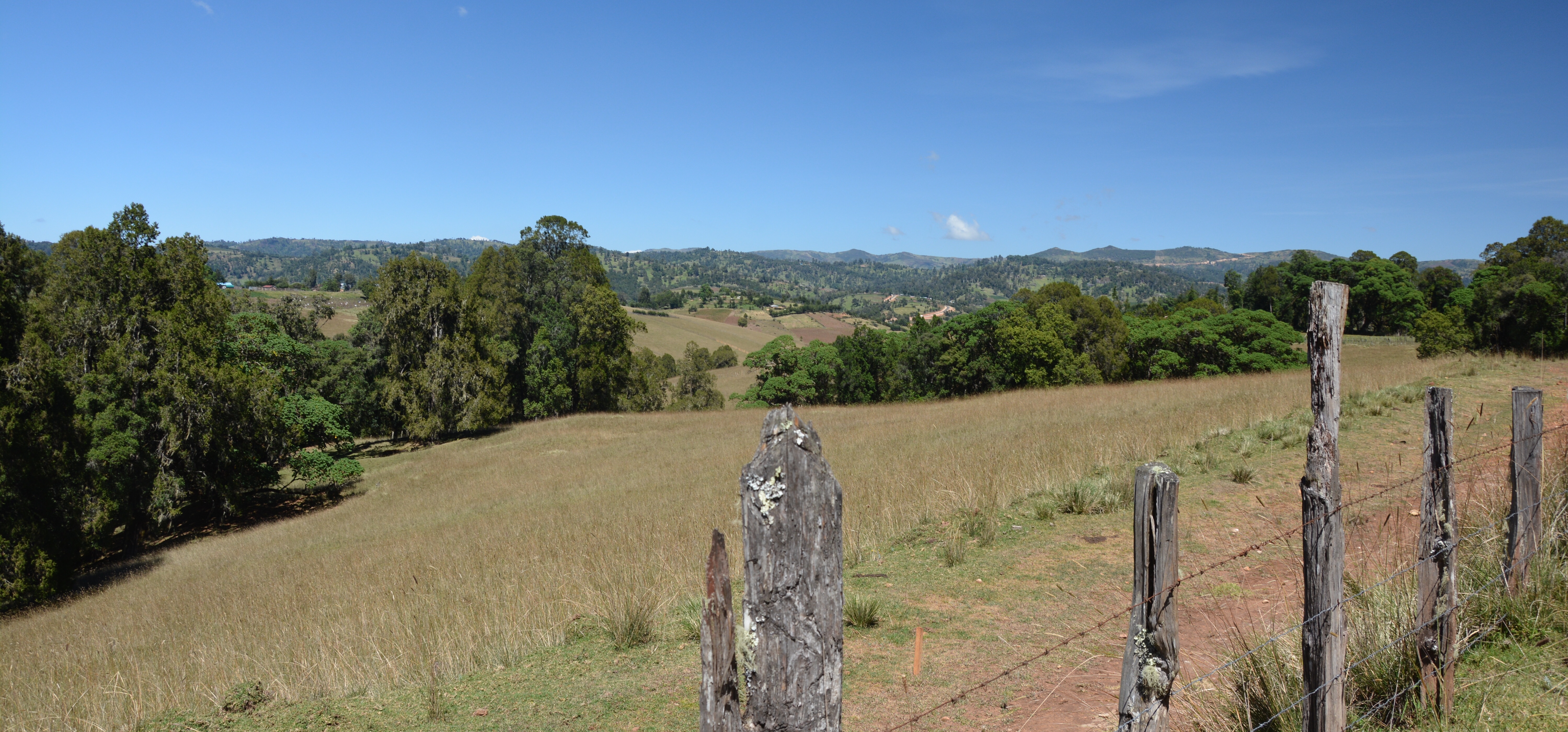
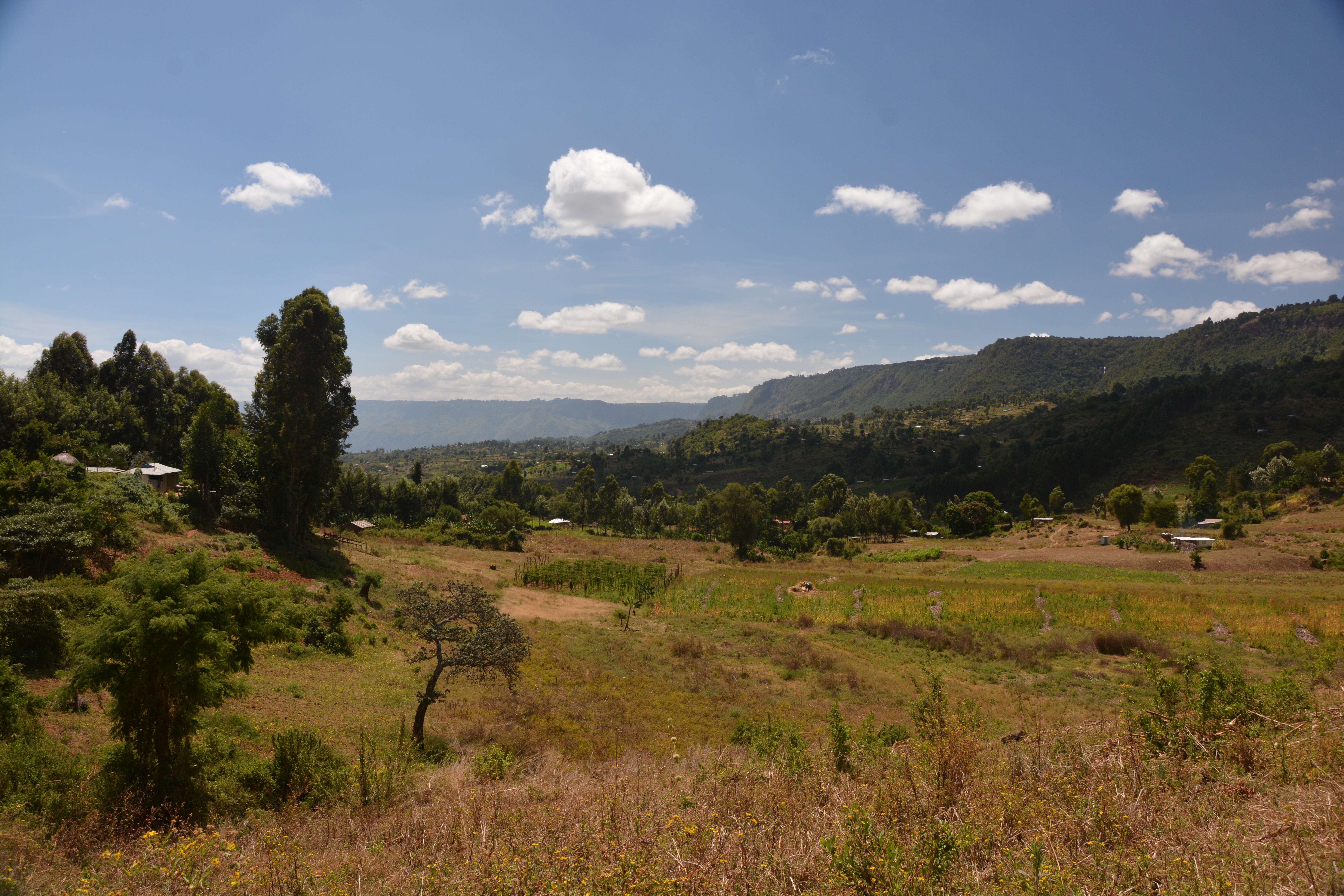
It’s chilly up there, even in the searing sun beneath a vast dome of uninterrupted azure sky. I’m chilled, riding at altitudes around 2500 metres, sometimes above, where the air is cool on my chest. The valley below simmers in the heat of its depths, so far below, where the landscape spreads in endless bush lands. I am only half a degree from the Equator. Then, after the high town of Iten, where many international athletes train at its altitude, the road plunges down the side of the Rift, starting with an almost laughably theatrical reveal as I turn the corner out of the untidy commercial town. Suddenly the Rift explodes dramatically ahead and below as I start down the edge of the escarpment in a series of tight loops. I vividly remember the moment I first saw this thrilling reveal twenty years ago, on my first bike journey in East Africa. The temperature rises for every metre I descend. Down the bottom, another fifteen kilometres ahead, the warmth is dramatic. But my destination is only 500 feet or so down the escarpment, on the long narrow plateau that forms the villages of Kessup and its satellite communities. It’s like a big green step in the landscape, the vast valley as a constant backdrop, hazed by distance and heat.
The Kessup plateau
I first stopped at the Lelin Campsite at the start of my earliest journey in Kenya with my Mosquito. Rico had recommended a road I would enjoy, the one I can gaze down on from my ‘banda’ at Lelin – my room on the edge of the world. Rico knows the rides I relish and suggested the steep track down into the Kerio Valley – an arm at the side of the Great Rift – and the white dust and rock road along its floor. I was new to my small motorbike then and unaccustomed to distances that looked so insignificant on my map of this large country. I slithered down the steep curling dust over 3000 feet into the valley, the escarpment looming above to my left. Then, at the bottom, I turned right, south, and bounced through the bush lands on a remote trail. Habitation was thin and the bush dry and hot. In the only small, remote village I stopped for refreshment – the last time I drank Coca Cola: the ONLY refreshment available there. I didn’t yet know to ask for sweet milky chai, far more energising and healthier (and so much more morally justifiable than supporting the multinational corporation that has done so much to damage the health of most of the world in pursuit of vast profit). If I’d known that I still had fifty miles to slip and bounce to the tar road, I’d perhaps have stopped at the basic hotel in that village, Arror. But I assumed that fifteen miles or so would bring me back to civilisation with a wider choice of accommodation. When at last I reached the junction I felt like giving the tar a Papal kiss. I was exhausted. I rode back up the curling road looking for a place to stay. Which is how I found the campsite at Lelin. It’s a bit of a misnomer, as I hardly ever see anyone camping there. It serves the local community as a place for outings, and relatively few guests enjoy the self contained rooms with a huge view across the valley. Next morning the then manager introduced me to William, a neighbour to the guest house, retired from the police in Nairobi after a serious attack by a criminal with a machete that shocked him so much that, lying in hospital with a possible brain operation looming, he decided to return to his humble shamba at Kessup, his home village. Sometimes he worked as a guide for the few mzungu tourists who stopped at Lelin. “So, shall we walk to the waterfalls?” he asked. “I’m not very interested in waterfalls,” I demurred, “I’d rather walk in the villages and meet your neighbours!”
And so I became, first ‘William’s Mzungu’ and then ‘Kessup’s Mzungu’.
Ivana
“Jambo!” people call cheerfully, giving me a fist bump, the Covid greeting that has been universally adopted from the previous acknowledgement of the youth. Voices of children cry, “Eh! Mzungu!” lost amongst fields and vegetation, running to greet and follow me like the Pied Piper, laughing self-consciously as they joke and jest shyly behind us. Rills ripple and worry down from the wooded escarpment rising almost sheer above us, water that brings life and green richness to this agricultural plateau. Water gurgles and fizzes from breaks in the many snaking plastic pipes that feed homes and locally made sprinklers in small fields wrought laboriously from the hilly terrain by generations of Kessupians. This is the planting season and there are small seedbeds of brilliant green as we walk, people bending and planting expanses of young onions on terraces distorted by the rocky landscape. “We will harvest in about two and a half months,” says Robert, bending all day long over his small earthy steps of onion seedlings.
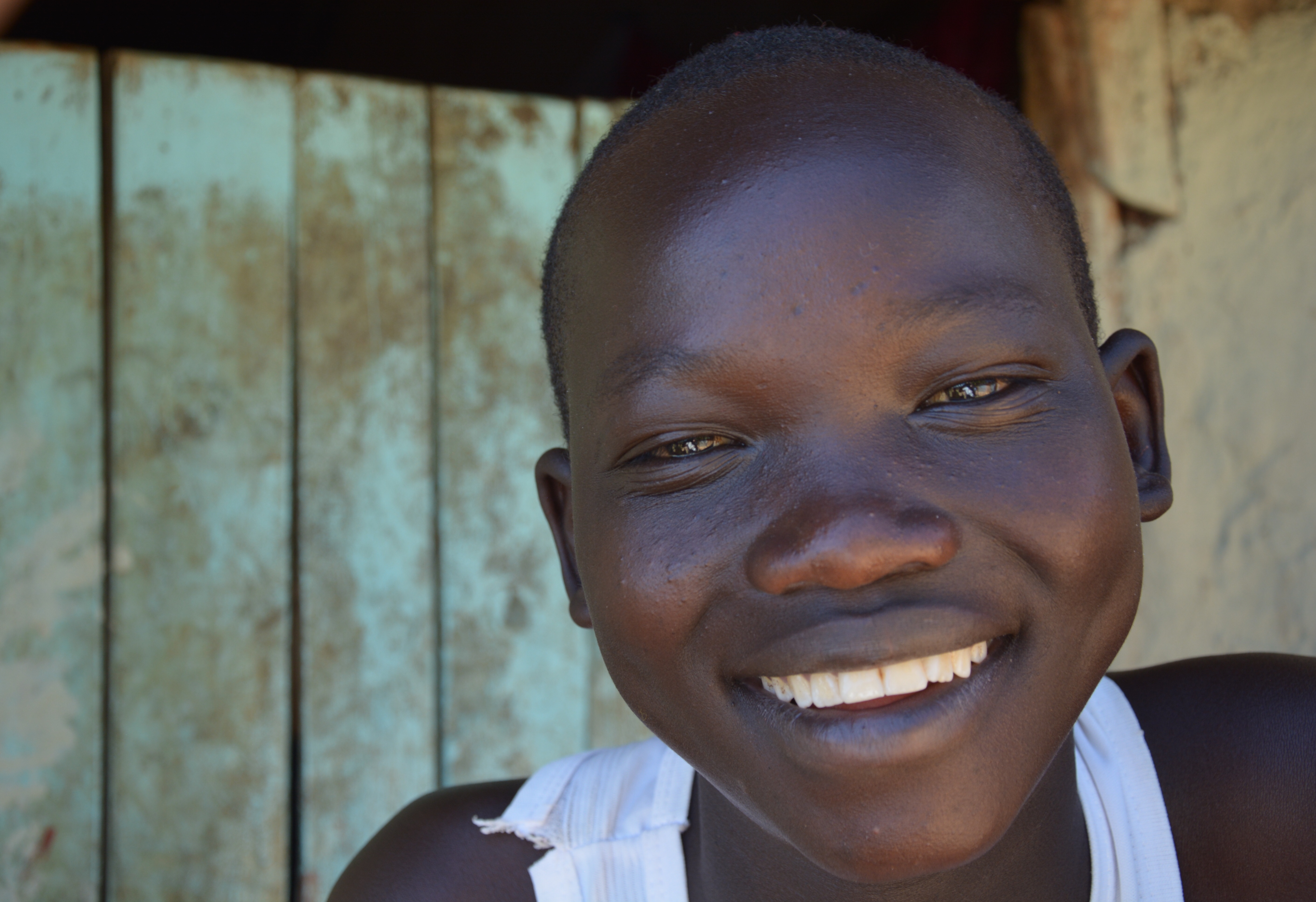
As well as Kessup’s Mzungu, I have become Kessup’s photographer, with now hundreds of portraits of the people hereabouts. William clutches a small folder of photos that we distribute from last winter’s journey. And Robert and his handsome, happy family want to join the rolls, many of them on my walls at home. “I need some shade!” I say, for photos of black faces in this high-overhead bright sunshine make only silhouettes. So we repair to the family homestead below the red dirt track that winds through their small fields. It’s a typical home of rough boards and zinc sheets, dusty and rusty. There’s some fine stonework too, sharp-edged volcanic rocks, black and purple, with grimy (very photogenic as backgrounds) doors and metal framed windows that sport no glass. Many houses here are constructed from red mud plastered on sticks, the local vernacular. There aren’t many possessions or comforts inside, just the basics for life here – some foam-cushioned wooden settees, low tables, religious posters, simple crockery. Cooking is done outside, on charcoal or sticks and the crockery, cutlery, pots and pans drain on a stick platform in the yard. A clutch of banana trees gives a little shade. I am made very welcome and offers of chai come quickly. But we drink local water from chipped enamel mugs. It’s untreated, but clean and tasty. Later, we return here and eat some kitere – local beans and maize that serves most here as lunch. Now, the family lines up, laughing for my photos. “You have to smile for me,” I joke. They all begin to laugh, for Robert is my first subject. “Oh, he won’t smile!” says his wife Zedi. “He has no teeth!” Everyone breaks in peals of laughter at the joke, and I tell them that I have all-metal teeth, smiling widely to show my implants. “Oh, you must tell us how to do that!” says Zedi, but for the price of my teeth, I could probably purchase much of this village. My privilege…
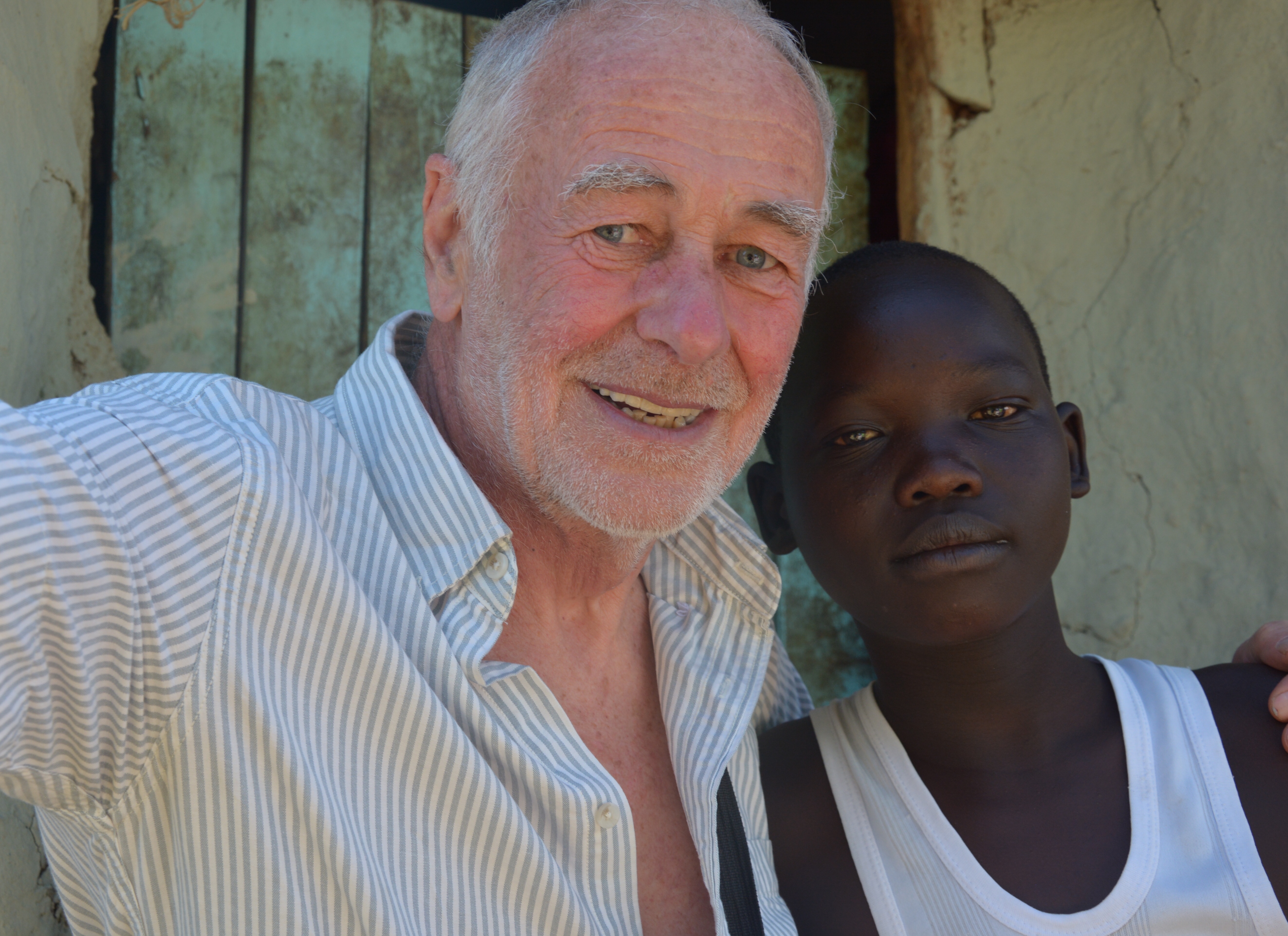
They’re a nice looking family, poor Robert’s teeth notwithstanding. Young Kevin, 15 years, smart and respectful but questioning, makes a lovely photo, and wants a photo with the old mzungu too. The family has wide-spaced, almond-shaped eyes and the customary bright smiles. They laugh and joke, and William is well practiced at parrying the jests and easing my way into these warm family gatherings. We’ve done this many many times on these slopes. We order 50 bobs’ worth (about 35p) of black nightshade, a rich dark green vegetable leaf that I like. We’ll call on the way back and collect a bulging bag, freshly picked from the dry fields, to take back to the cook at the campsite for our supper.
Kevin
With Kevin
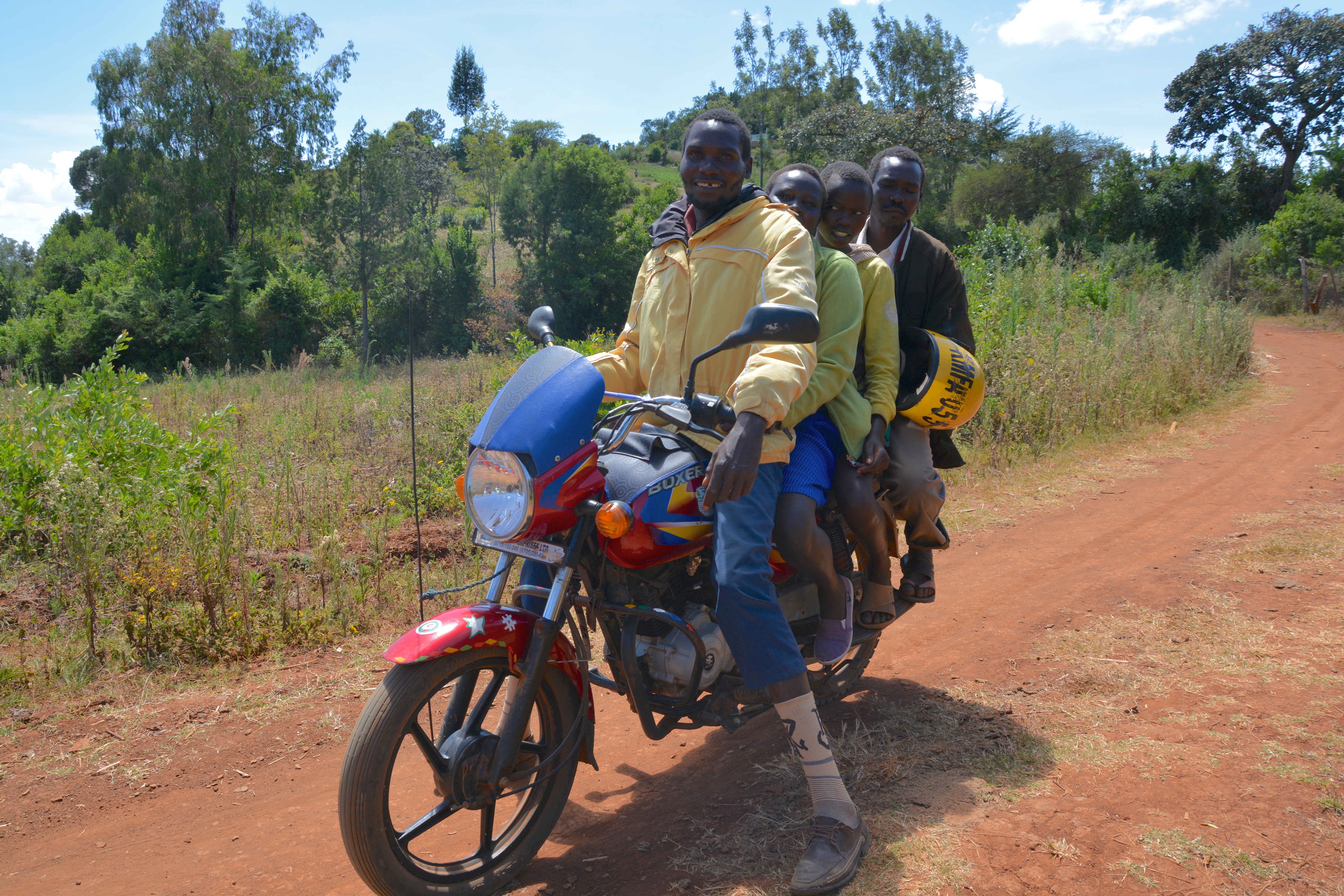
William is known everywhere about the plateau. He was born here 55 years ago. All his extended family lives hereabouts and he is related by distant convolutions to many. His father has two wives and relations are complex. A boda-boda stops and William greets the rider, his cousin, he tells me. As the motorbike with its rider and three passengers moves on along the rocky red track, I ask William his cousin’s name. “Oh, I don’t know!” he hesitates, chuckling. “He’s the son of a half sister by my father’s other wife… I can’t remember!”
William’s unknown cousin and passengers
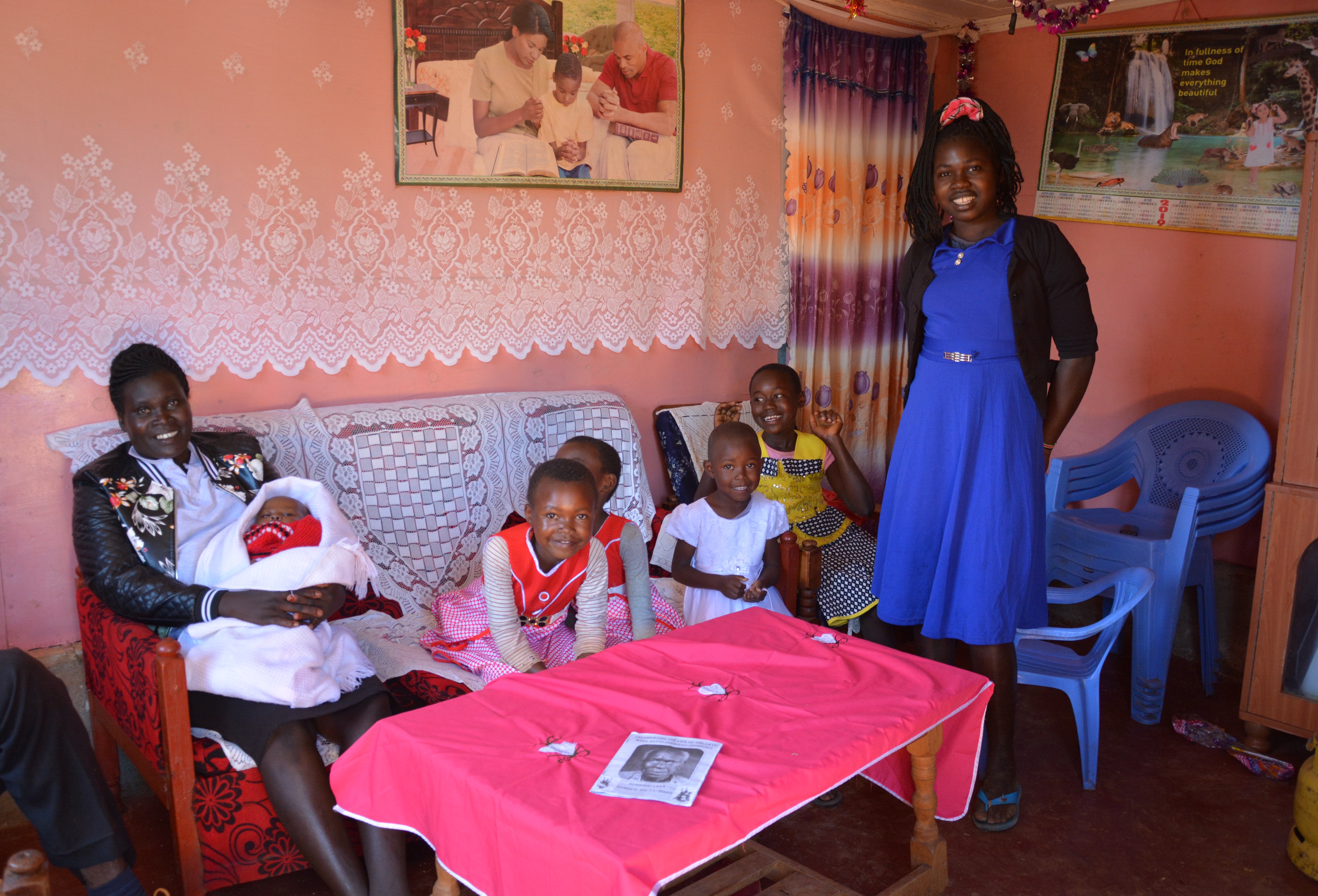
Mama Tabitha and family
Mama Tabitha has a new baby. The baby, Jaden, is the great granddaughter of Rongei, whom I have photographed these past couple of years. But Rongei died in late November, shortly after Jaden was born. Rongei was 92 or 93. Latterly unable to walk unaided, he lived in a small mud house, looked after by his grandchildren in shambas nearby. It’s one of my photos the family used for the funeral leaflets, something that happened many times at Navrongo funerals in Ghana over the years too. Sadly, in the photo I brought back this year of the late Rongei, I managed to elicit a small smile from the old man, who was accustomed to pose formally for his rare pictures. William encouraged him in February to smile for the mzungu, who had brought him a small twist of chewing tobacco.
William
We walk thus for three or four hours, meandering the red tracks winding across the low hills of the plateau, the plunging valley always away to our east. Meeting and greeting. There’s a precious breeze rising up the slopes, tempering the heat of the sun, but I can feel the tips of my ears reddening and becoming sensitive again. I’m wearing an ugly cap to protect the top of my head but I need a pint of water to regain my flagging energy. It’s like magic. Suddenly all interest is renewed and the spring back in my step. For I love this activity. It’s largely what brings me to Africa so often: meeting such warmly welcoming people and investigating their lives.
Now it’s time for William and I to repair to The Rock, a bar set in lovely gardens amongst vast boulders that have plunged down the steep mountainside, most of them back in times immemorial. But there is one, the size of a family car, embedded in one of the rental rooms at the back of the terrace, from two years ago. Bright magenta bougainvillea spreads over some of the trees, backed by the dense dark green of the conifers clinging to the cliffs above. It’s very beautiful, all this luxurious growth amongst the giant rocks and green lawns. We drink a Tusker or Guinness, and chat to William’s friend, the local vet, who rides his Chinese motorbike about the whole region. I tell him how expensive is his calling in Europe, mainly tending to pampered pets at huge expense. He laughs at the very concept of pet insurance. “Wow! It’s BIG business!” I assure him. His trade is more down to earth, keeping alive and healthy the cattle and domestic wealth of the small-time farmers everywhere. He has no permanent clinic with nurses and fancy operating theatres to treat illness in pet dogs and cats. That’s Western luxury. “Here’s the tools of my trade!” he laughs, holding up a leather holdall as he mounts his 100cc Boxer motorbike to attend to more chickens and cows. “We’ll meet again!” he promises as he rides away.
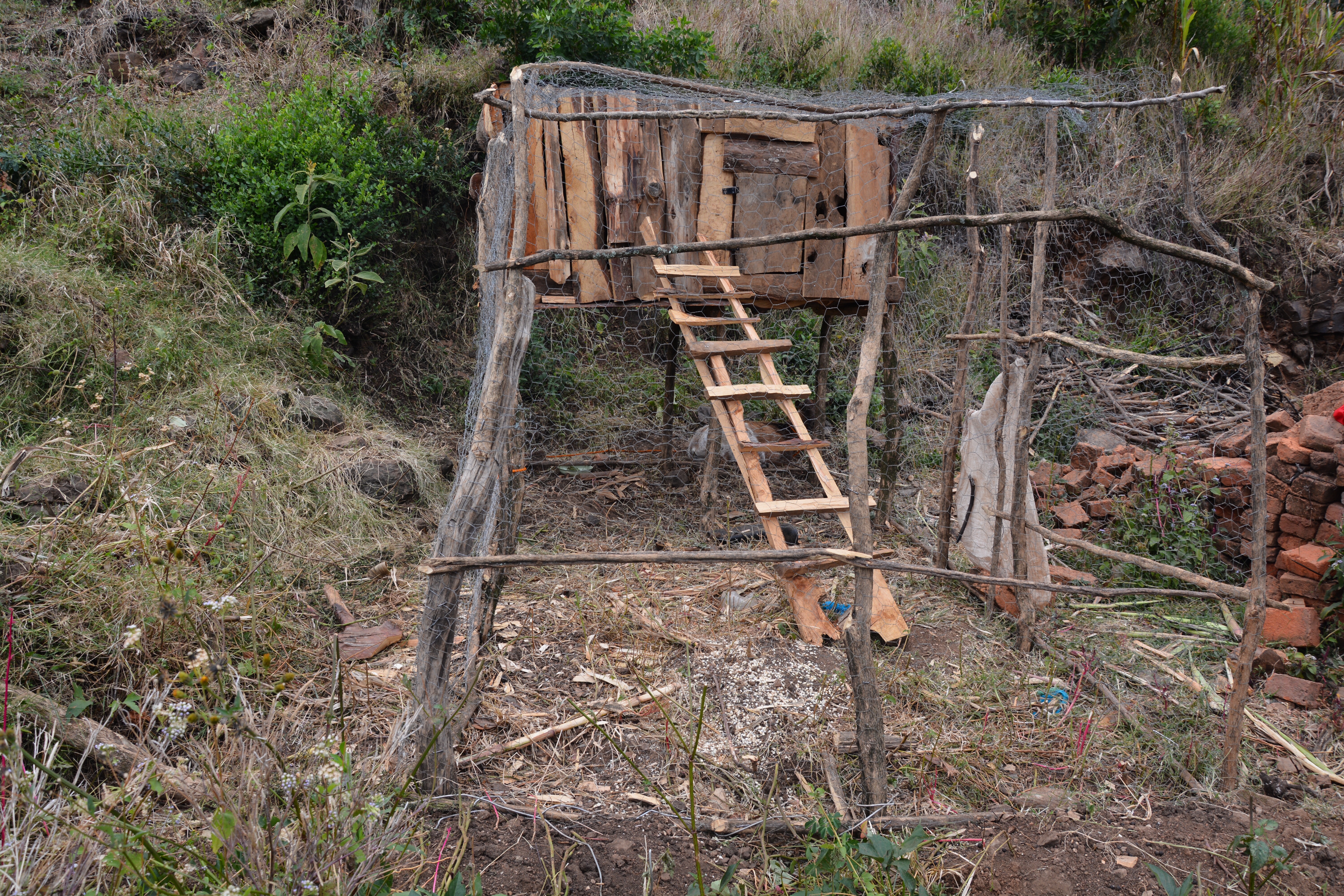
A new hen house
We return to the guest house to rest for a couple of hours. “I will water my cows and come at 5.30.” William is a compulsive time-keeper. “In the police, they LIKED me for my time and organisation!” He was in the Nairobi flying squad. I know he will be at my door within minutes of the time he says. Later, we sit at a plastic table overlooking the enormous view into the valley. Elephants roam in a small reserve down there. There’s a green weed-filled lake that puddles in the middle of the bush-filled expanse on the flat valley floor. A range of mountains rises at the other side of this side-valley of the Great Rift; they’re perhaps fifteen miles away. As darkness falls, the valley takes on mysterious dark depths, just a few lights, probably small fires and an occasional boda-boda headlight glinting on the one dusty white road that snakes the length of the valley. It’s the one where I fell off my Mosquito, laughing as I was helped off a sandbank onto which I had reclined, my foot under the pannier bag when my rear wheel shook loose, that day I discovered Kessup.
Now a fabulous full moon soars magnificently from behind those distant dark mountains and climbs into the enormity of the equatorial African sky, beaming brilliance onto our supper of Zedi’s black nightshade, and ughali – the dry maize flour mash that forms the basis of most East African diets – and some surprisingly tender goat meat. The young cook knows his trade this year. William, as usual, eschews the vegetables: “Why should I eat vegetable? I live on vegetable!” He gets much less chance to eat meat, so he takes the lion’s share of that while I eat a whole dish of black nightshade, the rich spinach-like chopped greens, with slivers of tomato and onion.
William managed to raise the considerable money and papers to allow his daughter, Lydia, to study nursing in Australia. Now she is sending money from her student nurse’s salary to build William a proper house to replace the crooked timber shack in which he lives. “Next year, when you come, you won’t need to pay Lelin,” he assures me. “You will be guest in my house. We will take our beers at Lelin, or maybe on the terrace of my house. It will be complete then, God willing. I’m a Catholic, you know!” He always adds this in deference to my lack of belief – we’re both quite comfortable about that.
*
On the morning of the last day of the grim year of 2020, I ride back to Kitale. From a pharmacist in Iten, the ragged town at the top of the escarpment – Kessup’s ‘big city’, I hear that the new road is now completed, through the village of Moiben to Kachibora on the Kitale road. I once tried to come this way before the road was built, and got comprehensively lost in muddy field tracks. I’ve tried various routes home, with varying success. Some have been wonderful bumpy rides on the old rough trails, but today’s ride is fine. It’s a sweeping Chinese road, with no traffic at all, spinning through lovely scenery, curling over hills, with bends to make a motorcyclist smile – but it’d be better with another 200ccs, I must admit. Still, it’s a memorable ride, even if I don’t really know where it’s taking me and I realise, half way along the 80-odd kilometres, that I have put my trust in a random pharmacist in Iten. I know better than to put faith in a single informant. Usually I ask a series of boda-boda riders, for they use these local routes. It’s no use in Africa to ask a non-driver for directions. People will tell you what they think you’d like to know… I’ve learned the hard way.
But eventually I recognise Kapcherop, a small regional town through which I struggled on broken dirt roads some three years ago. I know now that I will descend to the main road back to Kitale. And I sweep down the bends that replace the rutted trail I used before, and emerge in the chaos of the small roadside mess of traffic, boda-bodas, jostling matatu minibuses, market traders’ stalls, scruffy lock-up shops with obtuse biblical names, cows, goats, and noise that is Kachibora. I’ve another forty kilometres or so back to Kitale.
*
Adelight’s having her hair done at a salon for New Year. I’ve three missed calls on my phone. She wants to liaise on our plans for the evening. But the line is bad, a lot of background noise from the town. She says the car is opposite Best Lady, a bright pink emporium of make up, hair braids and glittery confections. I wait. And wait. I’ve parked the motorbike amongst boda-boda riders, always friendly to me, admiring my ‘big’ piki-piki (all 200ccs of it). Finally, she comes and I say I’ll head to the supermarket, agreeing what I shall contribute to the evening: a bottle of wine, a bottle of not-bad champagne (£8.50), beer for Rico and I, a block of local ‘Cheddar’ cheese – expensive here at about £10 for a half kilo, some more peanut butter and honey. My bill is about £45. It’s bedlam in the Indian supermarket. Why, on such a busy day, in aisles too narrow for comfort, does everyone indulge their small children to push their trolleys? People stop and chatter in throngs, amble the narrow ways and debate long over small purchases. Outside, it’s not much better. The steps are crowded with traders, a woman carries – or tries to – a folded double foam mattress through the mess of people conversing, selling tomatoes, greeting and chatting; begging street boys sniff plastic bottles of diesel mixed with glue, brains half-gone; security men watch the cheats and traders; women sell phone time scratch cards beneath dangerously spiked umbrellas, tannoys screeching tinny advertisements over and over; boda-bodas jostle, heavily overloaded; driver discipline is scant, everyone just wants to get ahead.
I’m happy to get back on my Mosquito and take the back way home: a rutted dirt road that exits town avoiding traffic and police check posts, where few other vehicles bother to go. I seldom use the tar road now. I’ve ridden over 100miles today, senses alert as they must be here, for ill-disciplined traffic; wandering cows, goats and sheep; creeping, smoking antique trucks; mad matatu drivers desperate for a fare, and the ever-irritating boda-bodas that clog the roads.
*
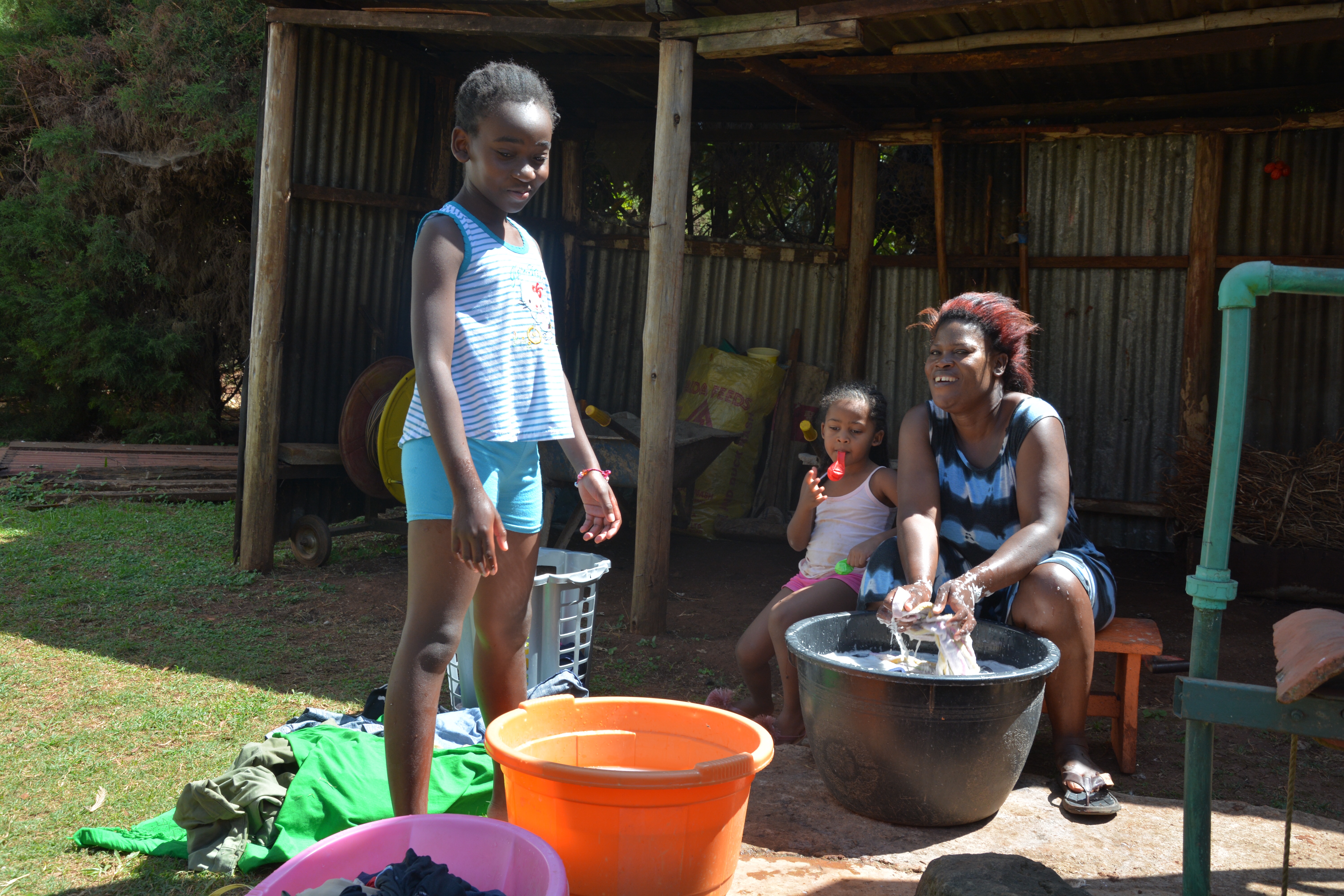
Adelight does a huge wash with Shamilla and Maria…and no washing machine
So, back to the kitchen-chatter and cheer of the family. We’ve spent the past few New Years’ Eves together, but this year there are no celebrations at the Kitale Club – everyone has to party at home. I’ve promised the bottle of champagne. Adelight says she’s never tasted it, so it’s something to make the evening special. We decide over supper – pizzas with very tasty tomatoes I’ve brought from Kessup, where I sponsored William to buy the seeds earlier in the year to occupy his lockdown time usefully and make some income – to make New Year at 10.30. A sensible decision that omits that long dragging wait for midnight. “After all, it’s midnight for someone!” says Adelight logically. “Some people are already in 2021!”
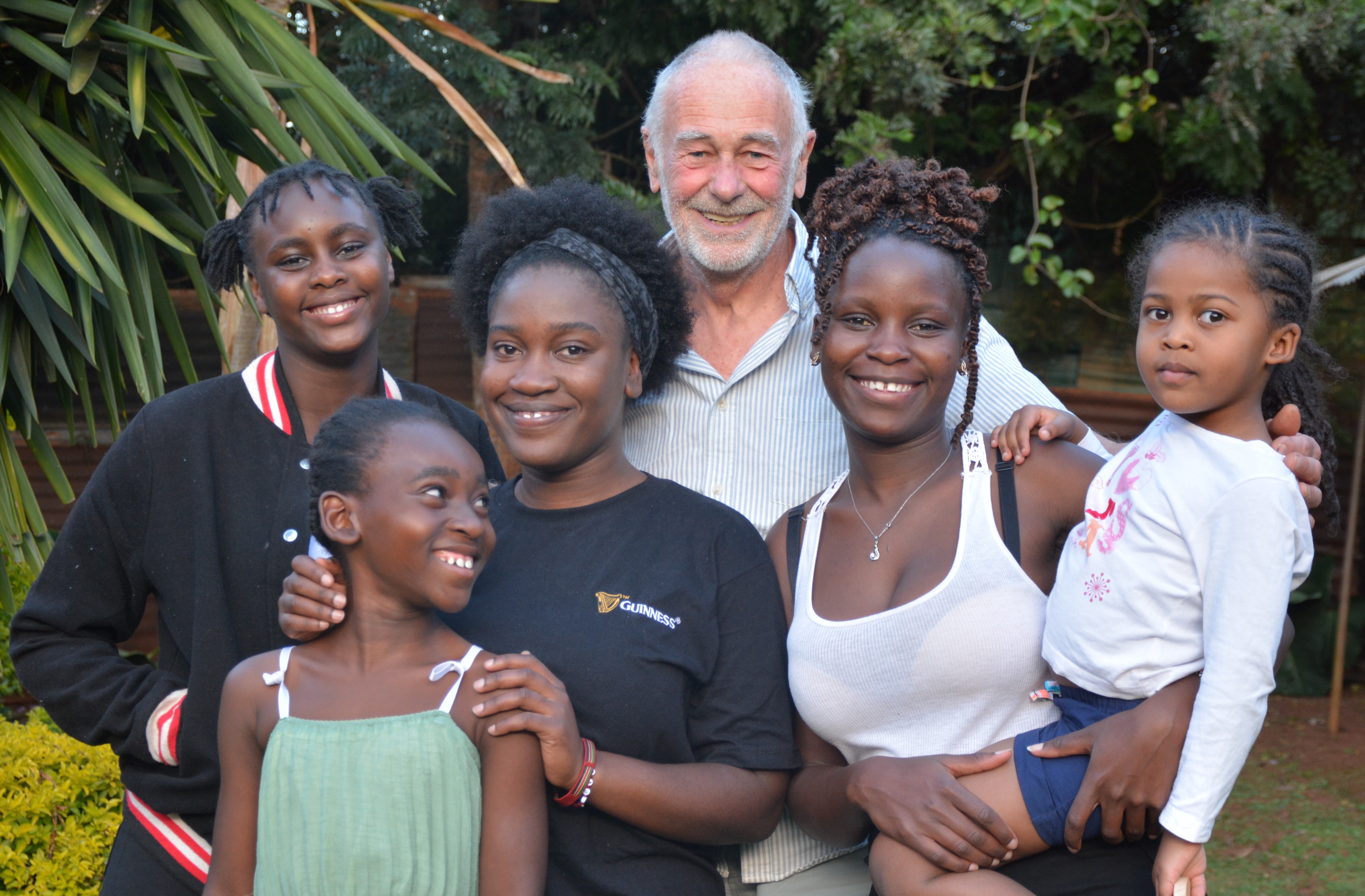
I don’t think anyone’s very impressed by the champagne really, but the cork ricochetting off the ceiling and the novelty is fun for everyone. We take a family photo and make toasts to a better year than the one to which we are saying a thankful farewell. We toast the members of the family dispersed around the country, and Faith in distant Berlin. Then, happily, it’s time for bed. Let 2021 bring what it will, I suppose. It can’t be much worse for anyone than 2020.
A toast to 2021
cynthia and SharonClouds roll in, in the Kerio Valley
Bo, Shamilla, Marion, some old mzungu, Scovia and Maria
DAYS 1 TO 8. DECEMBER 18TH to CHRISTMAS DAY 2020
The elation at getting under the wire, out of the tunnel, over the wall – maybe I feel the sensations of an escaping prisoner as I sit in Kenyan sunshine with happy people around me? I’ve a sense of extreme relief to be out of a country ruled by hysteria, political incompetence and populism, manipulation of right-wing mean-spiritedness, impending national suicide and grim darkness. Not to mention the endless rain and relentless media excitement. I tell you, Africa – for all ignorant Trump’s ‘Shithole Countries’ – gives impressions of stability, rationality and common sense now lacking in my embarrassing homeland.
There, I’ve said it. Now I’ll try to put it behind me and tell a story of hope, cheer and optimism. I promise. I’m back on my favourite continent, that has so obsessed my life these past three decades. Back in Africa!
Three weeks ago, I assessed the choices: winter in doom-laden UK as we head for disaster, or winter in the warmth – emotionally and physically – amongst my East Africa families and friends. It was really no choice at all.
*
Fortunately, it was Wednesday the 16th of December. Escape was still relatively simple and even without much frustration in those halcyon days, less than a week ago… Train to Heathrow and a faceless hotel at the edge of the A4, the lights of the terminals gleaming across the wet tarmac and a hotel take away – one of the worst meals of my life (a life with considerable occurrences of culinary tragedy). I’d walked to a distant petrol station through the drizzly, chill evening, along the wide A4. There, I considered the sandwiches as I bought a couple of bottles of beer, but dismissed them in favour of a hot meal. The ‘hot meal’ came slopped into a shiny brown cardboard box, was greasy, unappetising and unrecognisable as the item on the menu. A bendy plastic spoon to scrape out the £12 filth. Fuel, of sorts, to eat in disgust in the horror of a purple and grey room as traffic splashed along the Westway outside. Hindsight is so unhelpful.
*
There were a few formalities and extra forms to fill in to facilitate escape. I had to self-administer an expensive virus test (£120) on Monday last to allow me to board the plane on Thursday morning.
THAT brought me some ironic laughter… I’d taken the test: poking the swab around my tonsils until I gagged, and then far up my nostrils until my eyes watered and I sniffed for the next hour. Following the instructions, I placed the swab into its small sterile tube and screwed it shut. That was inserted into a well made plastic envelope with a tight self-adhesive seal. The envelope went into a small cardboard box, which was itself sealed into a heavy plastic envelope with another tight seal. It was self-addressed, by the private clinic making a fortune on this adversity, to a laboratory. ‘Take this envelope to a post office. Record the tracking number’. The instructions were clear; the process well organised.
I took the envelope to the post office.
“I can’t touch THAT!” exclaimed the counter clerk in horror. “I’m not allowed to handle it! You must put it in the box outside.”
“But the instructions say, ‘Do not put in a post box’.”
“It’s a priority mail box. You have to use that.”
Don’t get irritated, turn it into a story, I told myself. “Oh, and I need to post this as well.” I had a large envelope to send to Scotland. It’d been on my table at home for days, I’d handled it many times, licked closed the seal, breathed on it and mauled it about. The clerk picked it up unconcerned, weighed it, stuck a stamp on it and threw it into the waiting sack. I took my small package, in its three clinical seals, to the box outside… Ho hum, logic evaporated sometime in March.
*
So there I was, equipped with test result, face mask slowly and resolutely carving my ears off, on my way. Heathrow to Charles de Gaulle airport, Paris, also quiet. A wait of six hours – fortunately, KLM extended their loyalty levels for another year and I still have the perk of lounge access, that makes air travel almost pleasant. An overnight flight to Nairobi. Entry was the simplest in years and I was soon in the early morning sapphire blue sky sunlight at Nairobi’s 5000 feet. Here, five more hours to wait, and a mile to lug my bag to the smaller terminal for a short internal flight upcountry to Eldoret, where I touched down mid-afternoon on the 19th.
Rico and Adelight, with bright three year old Maria, were waiting with a hired driver to bring us back to Kitale up the congested East African Highway, that carries so much of the traffic from far off Mombasa on the coast to the interior in Uganda and Rwanda. Sometime after six, I finally achieved my goal of a Tusker on the porch with my old friend of many years, surrounded by the smiles and cheer of the family of girls. I’d made it.
I decided years ago never to listen to the doubts of ‘what ifs’ and ‘if onlys’, words that limit a million dreams and so many lives. I’ll let the future take care of its unknown self. I’m in Africa until March. Maybe longer…
Four days later and I would have been imprisoned in Little Britain with everyone else.
How things have grown in nine months
*
It’s easy to settle in, in Africa. That’s an inevitable generalisation on a continent of 54 countries and one point two billion people, but there’s an honest warmth and expression of emotions almost everywhere that is one of the aspects that attracts me back to this continent time and again. I first ‘discovered’ the attractions of Africa in 1987, with my first Sahara crossing on my motorbike. Since that time, this numbers my 34th journey I think, thirteen of them with a motorbike, free to roam.
Back in 1987, in the last cheap hotel in Morocco, I met three Dutch adventurers. “Would you like some soup?” asked Liesbeth, as she brewed up a meal on a gas stove on the wing of their old Land Rover. What I wanted that evening was company, more than soup, after a week riding alone through southern Morocco. We three became immediate friends and travelled together across the world’s largest desert to West Africa, me on my African Elephant, my old motorbike, and them in their aged vehicle. The best days of my life. Three friendships that remain strong, because of the time we shared.
Especially warm is my brotherhood with Rico, for that early trip changed both our lives fundamentally. I stopped my footloose world travels and hardly journeyed again beyond Africa. Rico committed the rest of his life to live in Africa. He hardly returned to Holland, working as a mechanic with various aid organisations, based in war zones, famines and strife – a hard introduction. He eventually based himself in East Africa, moved to live in the northern deserts of Kenya, married a Turkana woman and adopted numerous children. Some of those children, almost all girls, are now producing grandchildren. After the death of his wife, Anna, he remarried lovely Adelight, now my ‘sister’ and Scrabble competitor, moved to Kitale, and took into the house more young women, some of them Adelight’s junior sisters, others unrelated. Rico and Adelight have their own small African, delightful three year old Maria, the apple of everyone’s eyes. Together, this makes the happiest family it’s my privilege to know – and join. I’m with them now. Totally accepted into the extended family, an uncle, brother and friend.
*
With Adelight, I have become a fond friend. Of an evening, we play Scrabble, frequently a close competition, despite English being her second language. On my first Christmas here, we were in a big supermarket in Eldoret for me to buy some gifts for the family, that I hardly knew then. Without my knowledge Adelight had steered me to a shelf of board games. “Oh, I think the family would enjoy Scrabble,” she declared guilelessly. Little did I know that I now had an occupation for every evening in the house. She was the enthusiast. No one else plays!
We also enjoy our trips to town together. I have infinite patience with her shopping trips, a quality I’ve never possessed at home. There’s so much activity to watch and people to interact with, a raised eyebrow here, a wriggle of the hand, a wide smile; fruit sellers to exchange a joke; a child to talk to; boda-boda boys to laugh with. People in Africa meet my eye and give just whatever cheek or cheer they receive. It’s lively and fun, warm-hearted exchanges, laughter and human contact. No one looks away and a mzungu attracts attention everywhere. I travel as a celebrity. It is infinite fun. I found myself smiling to myself, beneath an unhappy virus face covering…
It’s mandatory to wear face covering in all public places, in the street, on the roads and even in cars. “Watch out,” says Rico, “a mzungu is attractive for the police to stop and fine!” It’s Christmas time too, a time when the police gather money for their holidays. The smiles, partially what brings me so much back to Africa, are sadly hidden today. Out in the rural areas, the face coverings are more relaxed, as indeed they often are in town, where many seem to wear them as a chin-strap decoration. Beyond that, restrictions are few and neighbouring borders open (more than can be said for Little Britain today). I believe there’s still a curfew in place from 10 to 4 at night, which will affect me not at all, for in Africa I sleep well and long. It appeared to me, on evidence of a morning in town, that track and trace is more efficient than that imposed at a cost of many millions by Boris the Bodger. We were expected to sign in to the post office and our temperatures are taken at supermarkets and offices.
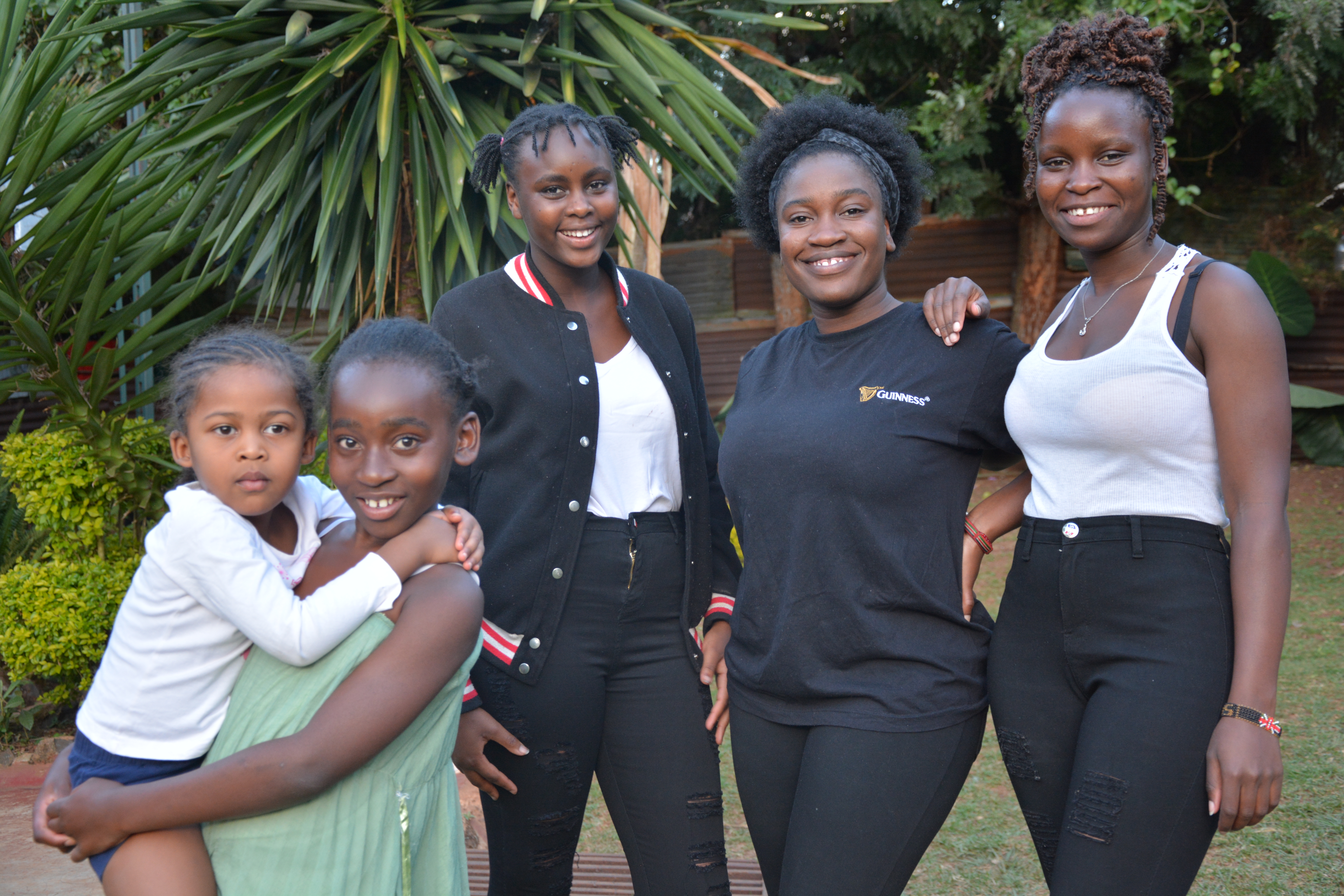
But it’s the streets that supply my entertainment. Crowded and colourful, all African life is here. As Adelight shops, I watch. There’s chaos in the Transmatt Supermarket, trolleys and people everywhere in the before-Christmas rush. Transmatt is an Indian business, common here in East Africa where many businessmen are Asians, often of many generations’ standing, but usually not much integrated with their Black countrymen. Asians often remain aloof. The name’s a diminutive of Trans Mattress, doubtless the origins of the trade. In a corner of the store, a booth stocks the booze. That’s my department this Christmas time. I purchase a big box of red wine. The girls at home only drink alcohol on high days and holidays, birthdays if they are fortunate and only when anyone can afford it. It’s my pleasure here to provide some treats, a role I relish in this happy family. Adelight and I buy a present for little Maria. Maria is a delight, Rico and Adelight’s own contribution to the family. All the other girls, who look to Adelight as mum and Rico as father, are from various sources. Lovely Scovia, one of my all time favourite Africans – pretty, endlessly cheerful, cheeky with her old uncle, positive and a pleasure for the eyes in her short, wide skirt, just turned 22 last week. She’s actually Adelight’s junior sister, adopted, with younger sister Marion, into the family as a sort of replacement for dowry – and because Rico has over his years in Africa adopted a variety girls and educated them and brought them up. Now some of them are producing his grandchildren, spread across the country, and even the world. There’ve been at least a dozen young women who call Rico dad – many of them unrelated to one another, but more ‘family’ than any other I know. Bo, now about fifteen, is a child of one of the original Rico Girls, a sort of granddaughter. Totally unrelated to Scovia and Marion – or to Rose, now in Nairobi but originally rescued from the Kitale streets after running away from an abusive auntie, or to Maureen, now down in Mombasa, another ‘original’ that I first knew aged about two or three back in 2002 – Bo is sister to the older girls, daughter to Rico and Adelight, just as much as if she were their blood relation. In Africa, the extended family is such a flexible unit, such that I also become uncle to these girls, father-figure to my Ugandan family, and now granddad to small, happy, muddy Ugandan children.
For Maria’s Christmas present I buy a pink schoolbag. She’s an intelligent, bright three years old and will go to school in January. She’s excited about that and will probably spend Christmas wearing Uncle Jonathan’s lurid soap-pink backpack. We’ll put some pencils and notebooks in it for her.
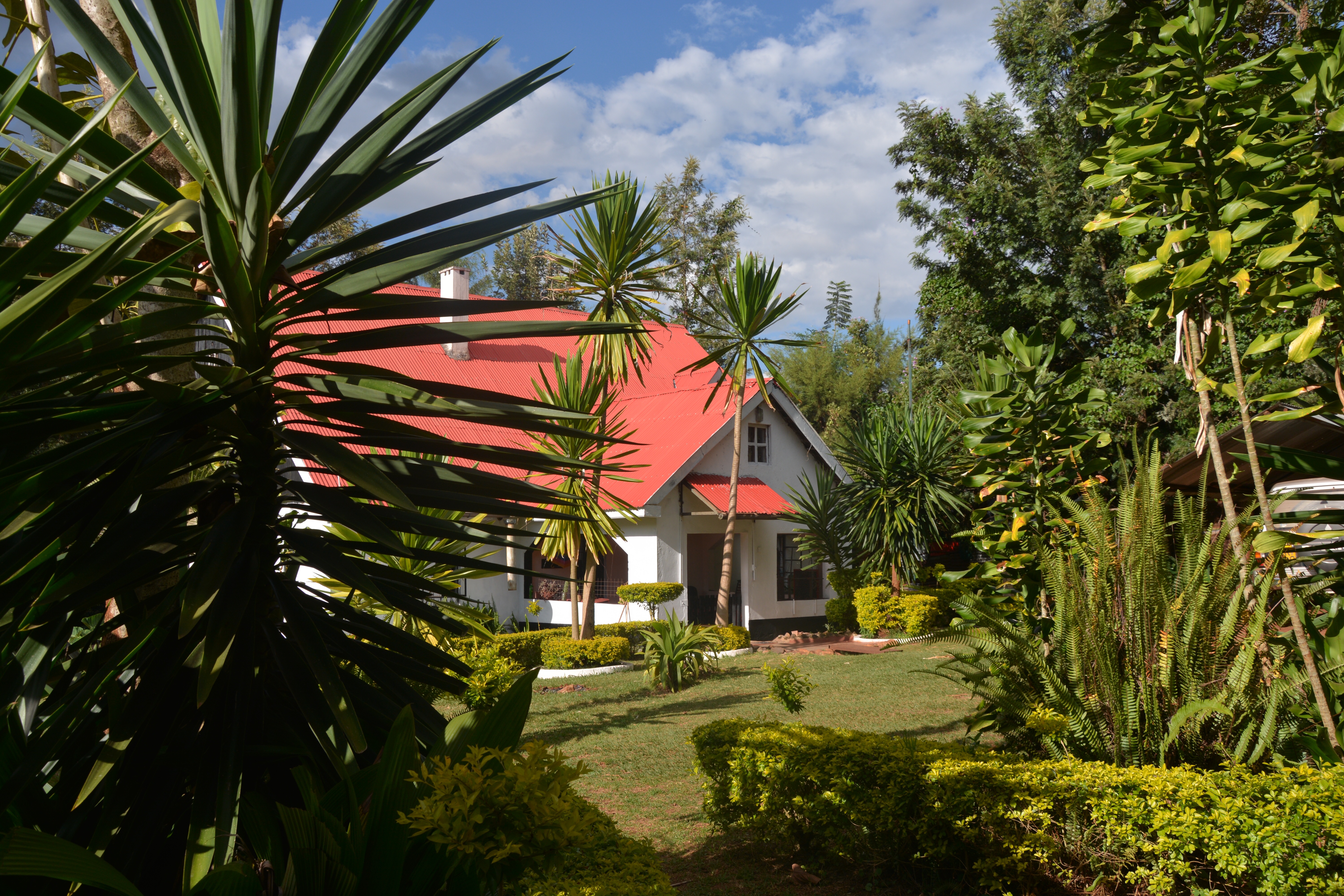
I pay with my credit card. We’re in the modern, consumer world now. A smiling young man helps pack our purchases and jokes that my backpack, now full of no less than £56 worth of booze, will be too heavy for me to carry. I’m impossibly ‘old’ to his 20 year old eyes. In Africa, where average life expectancy is 61.4. I’m already a decade beyond that. Riding my motorbike about his continent. Not surprising I have gained celebrity status now. I laugh him off and shoulder my bag. A good looking, open-faced young man, he carries the big box of groceries to the car with us, cheerful, helpful, smiling brightly. Outside the supermarket, noise fills the sun-dazzled street. There are traders with barrows of fruit and tomatoes, bags of potatoes, succulent pineapples, small red onions, mangoes, huge avocados. A pickup is piled high with enormous cabbages, giant ballooning cartoon vegetables. It’s astonishing how things grow in Africa, given rain and sunshine. There’s been plenty of rain this year, too much. Climate change is affecting the weather systems of Africa even more than the northern world. And it’s more crucial here, where subsistence farming keeps many families alive. A small change in the times of the rains can bring untold suffering – and often does. Too much or too little, and people have no spare resources to tide them over. It’s a hand to mouth economy. Too much rain; too little rain and hunger is an opportunistic enemy. Since I left in March, it has rained a great deal. The trees outside ‘Jonathan’s House’, my simple room here in the family shamba, beneath an avocado tree, have grown by maybe ten feet in height in nine months. Many of the trees and plants are double the size they were when I left.
But there are plenty of vegetables this year, piled high at the roadside as we weave between knackered boda-boda motorbikes like insects. These are the employment opportunity in all Africa now: 100cc Chinese irritants ridden by maniacs for whom time is money. A passenger here, a load of crates, sheets of plywood balanced across the seat and rack, settees, iron rods, cement, vegetables, schoolchildren, teetering boxes heaped high, a passenger with his leg in plaster stuck dangerously sideways, a crutch across his legs. Sometimes a boda-boda carries another motorbike to repair, strapped on its side behind the rider. Frequently, with heavy loads or multiple passengers, the rider sits with his balls on the tank, the bike wobbling on the broken roads. The hospitals fill up and accidents are common. But in a subsistence economy, you do what you can to earn the school fees and put food on the family table.
From a woman at a picnic table under a bright sunshade advertising inevitable phone companies, we buy a new sim card for my cheap phone. We register it to Adelight’s Kenyan ID. It’s too complicated in these money-laundering days for me to get one in my name. My motorbike ‘belongs’ to Adelight for the same reason. A pretty little girl, about four, gazes fascinated into my blue eyes, coyly smiling at the mzungu from amongst her mother’s skirts. I love these little encounters, but I can’t hear her whispered name. Around us whirls Kitale street life.
We take my pannier bag, that needs a repair, to look for a ‘fundi’, or repairman. These clever fellows own a sewing machine for their livelihood and sit beside the street under shady arcades outside small lock-up shop booths, most of them garishly painted in the livery of the various mobile phone companies. Africa has adopted the mobile with alacrity. It jumped the whole landline generation and went straight to cell phones. There are more mobiles in Africa than either Europe or America, they say. Fingers twitch everywhere, even amongst the boda-boda riders, pressing through the crowds, the cars and smoke-belching trucks and pick ups, carelessly texting as they ride, or with phone tucked in beneath the regulatory, but usually ignored yellow helmet, yelling into their phones as they ride. The fundi we need isn’t at his machine. We sit on a convenient bench nearby to wait, but he doesn’t come back. I watch the activity swirl around me. An elderly gent has old leather shoes, once fashionable in another existence, with long pointed toes that curl upwards like bananas. Everyone wears mtumba clothes, the secondhand rejects from our European and American charity shops. I wear it too, and often reimport my wardrobe! Adelight’s a star at finding what I need in the mountainous piles of clothing on street-side stalls. She delights in an order from me for some more shorts as she flings aside festoons of clothes, bought in great bales by traders from middlemen in the cities. It’s all the stuff we don’t want in our profligate Western lives where consumption is a thing of fashion rather than necessity. But it’s wonderful to see the creative uses to which the girls at home can mix and match their fashions – and look terrific. Probably I’ll get some mtumba wear under the winking Christmas tree. Christmas presents here are refreshingly unmaterial. No one counts the cost as we do in the West. They are happy for any small gift. We accept from the heart in Africa, the way gifts are given. The most difficult lesson for visitors to learn. But one of the happiest.
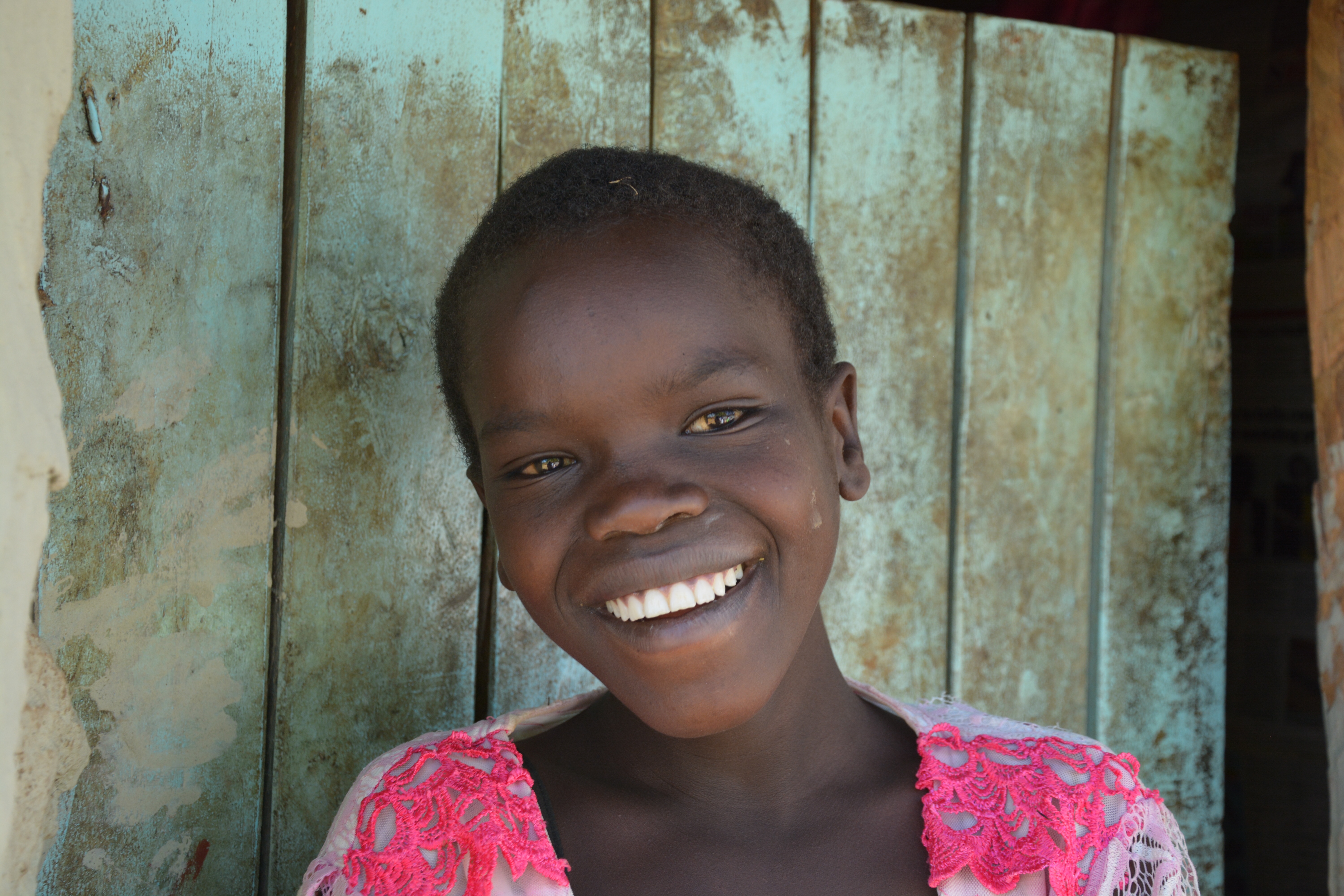
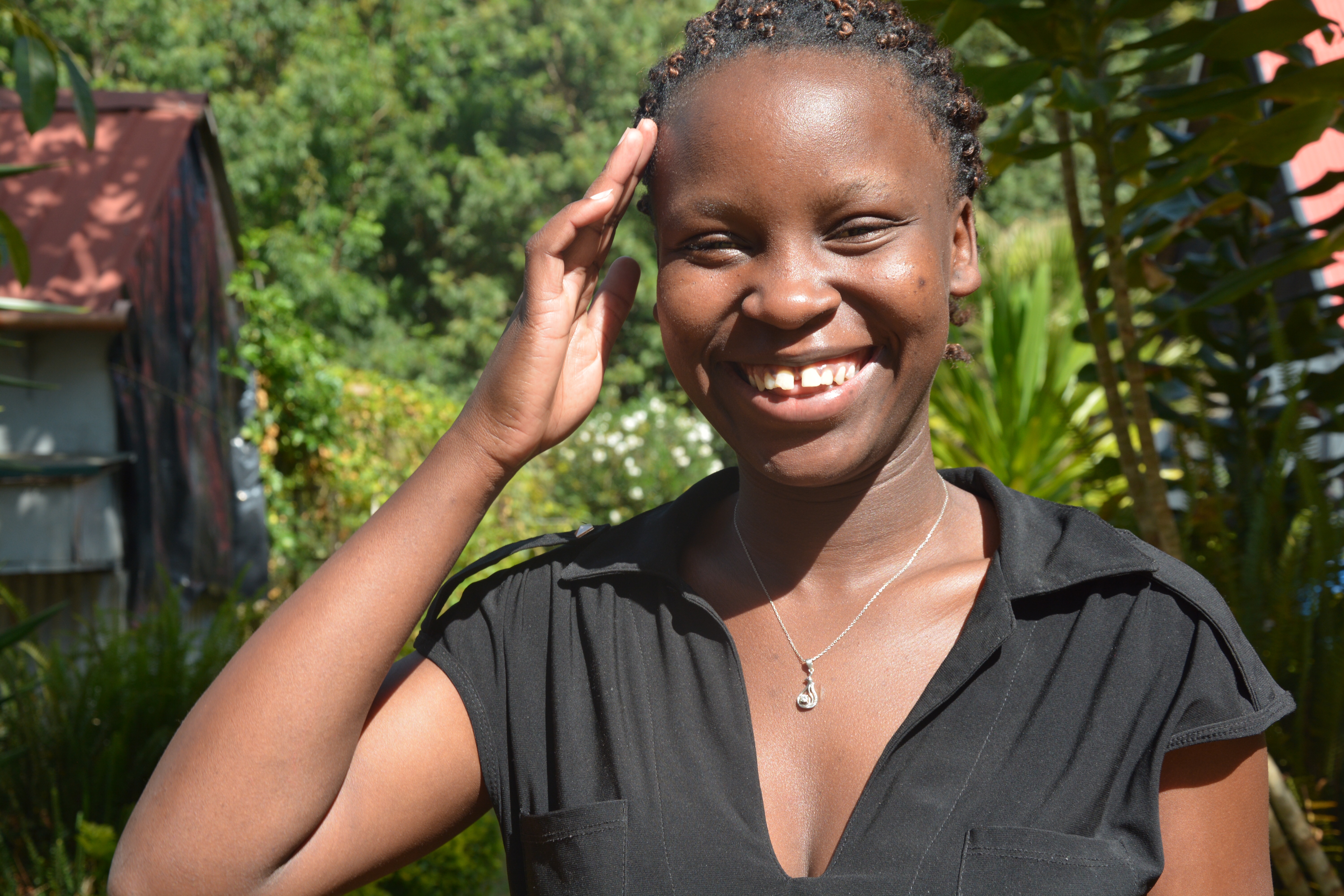
Scovia. Who wouldn’t smile when they see this lovely young woman – always cheerful?
*
So, what about the Coronavirus crisis that is rocking the world? What about poor Africa, on which the rich world dumps so many problems, seldom of the continent’s making?
There are various theories as to why this pandemic has affected Africa least of all except Oceania – which, let’s face it, is a random collection of far separated islands. According to a Guardian article – and it’s rare to even see Africa mentioned in Western news, unless it’s disaster, unrest, famine or mayhem – a mere 57,000 people have been reported to have died in from Coronavirus. That’s 57,000 out of about one point two BILLION people. Pretty insignificant. Less, so far, than Britain with our mere 67 million population. Yes, there will be a certain under-reporting of death here, where there are few checks on causes of death and doctors few and far between (many of them working in the NHS and similar institutions in the West). One of the few countries in Africa to have suffered more seriously in the pandemic is South Africa. I note that it’s also the only one, in my experience of 23 African nations, in which I have seen old people’s homes, largely populated by elderly women of European, white origin; where junk food chains are popular and where the Afrikaans nation tends to obesity. I just comment, for I don’t know the significance of these observations…
There’s a totally different attitude to death in Africa. More fatalistic. No one demands eternal life, frequently supported by drugs, as we seem to do now in the West. You get old – if you’re lucky – you die. You get ill, you die. It’s a sad fact of African life. So very many people I knew during my African travels have died – young and old, children, teenagers, chiefs, farmers, male and female. I have witnessed the demise of many more acquaintances in my African circle than in my European circle, by a factor of tens of times. There’s scarcity of treatment for common diseases, almost no surgical intervention for complex conditions. Just a fact of life here. Life is short and risky.
The average age of people dying from the virus in Britain is 82.5 years. Average life expectancy is 81.5 years. So the majority of those dying are the very old. Average life expectancy in sub-Saharan Africa is a shocking 61.4. Shocking that is, until you remember that it’s not so long ago that we in the West had similar life expectancy. Our perceptions of age and expectancy of long life have changed hugely in the last century. 100 years ago, I’d have been amongst the aged and revered already. Here I am still riding my motorbike about a foreign continent. Occasionally I meet very old Africans, in their 80s and 90s, one or two even make it to the century. But they are a rarity. An old man whom I have photographed a couple of times in nearby Kessup, died three weeks ago at the extreme age of 93. In Navrongo I met an old man who was perhaps as old as 110, gauging from his memories, for of course no one kept records back then. His wife was over 100. These people are celebrities in their communities and very rare.
So Africa has a generally young population. The median age of Africans is a mere 19.4 years – Uganda, a bit over 15 years, and in Britain it’s 40.6 years. Factor number one in the light footprint of the pandemic.
Other factors are proposed. Africans have a far higher natural immunity to so many other diseases. We’ve lost that immunity with our medicines and ‘safety’ measures, let alone the way we treat our foodstuffs and agriculture. Africans live largely out of doors, particularly in rural areas. This, we know, limits transmission. All life is in the streets and fields, and even at home much of everyday life takes place in the open air, cooking over charcoal or sticks in the compound, eating outside, in some places even sleeping outside in the heat of African seasons. I ascribe a good deal of my own strength and health to staying a quarter if the past decade in Africa, with pretty casual regard to hygiene and cleanliness – if the locals drink the water and eat the food, so do I. My immunity is a great pride on my journeys; I seldom succumb to even the trots. It’s been acquired the hard way as I drink local brews from old calabashes and recycled drugs containers and eat roadside snacks.
Obesity, hypertension and diabetes are rarities in Africa, many of these conditions caused or exacerbated by our wealthy lifestyles, lack of exercise and industrial food. Ironically, you may live a shorter life here, but it’s probably healthier for most. Many of those suffering most from the virus in the sick West have these underlying health problems.
Then there’s the possibility that vitamin D is a useful deterrent in Coronavirus infection rates. Scientists have put forward this theory. Vitamin D is synthesised from natural food products in mammals by exposure to sunlight – actually, it’s considered a hormone, rather than a vitamin, but let’s not go that deep! There’s infrequently any lack of sunlight over most of this continent.
When I left – in a hurry – in March, it was supposed that the virus would spread rapidly here as the weather cooled, but it seems that this did not materialise. So it’s probably the relative youth of the population that is keeping the virus more at bay than anywhere else but Oceania.
Shamefully, with the richest 14% of the world’s nations snapping up or reserving 53% of the available vaccines (in Canada, enough to vaccinate everyone five times, in Britain three times…) it’s just as well that cash-strapped Africa is less exposed to the disaster. For once in its history, Africa is benefitting from some of its demographic and economic problems.
*
We’re running up to Christmas, not a rabid commercial festival here. We will eat some treats and the girls will enjoy the wine I bought. For fun, I’ll wrap it under the little winking tree in the corner of the living room – just as in poorer days, my mother would include new school shoes amongst my presents. Expectations are modest, a few small gifts and plenty of family fun. The Ghost of Christmas Past, in fact. I’ve a pile of small gifts in glittery Chinese wrapping in the corner of my room, visited in anticipation by chirpy little Maria, the family’s joy.
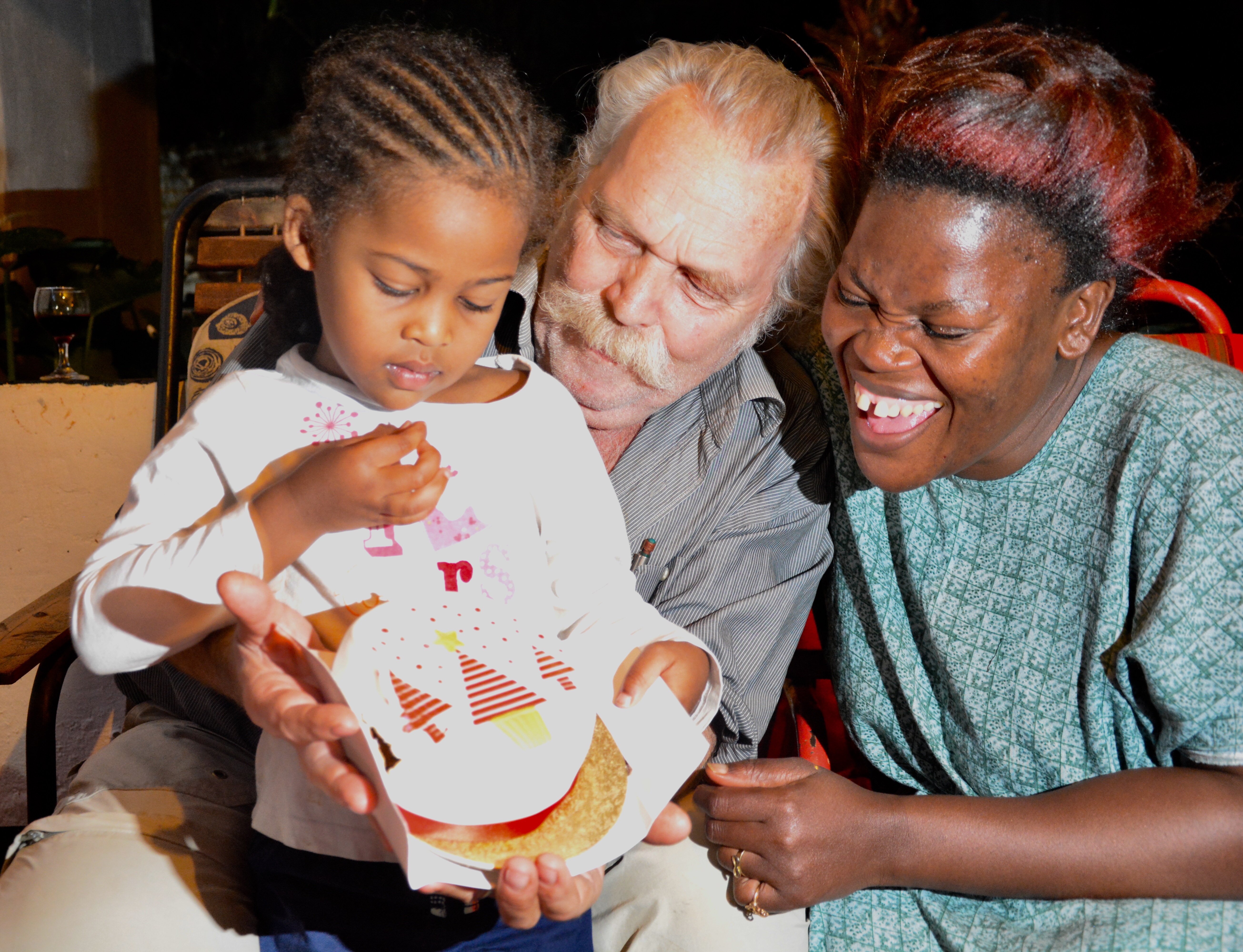
Maria, Rico and Adelight – and a Christmas cake given to me by my 93 year od neighbour, Betty
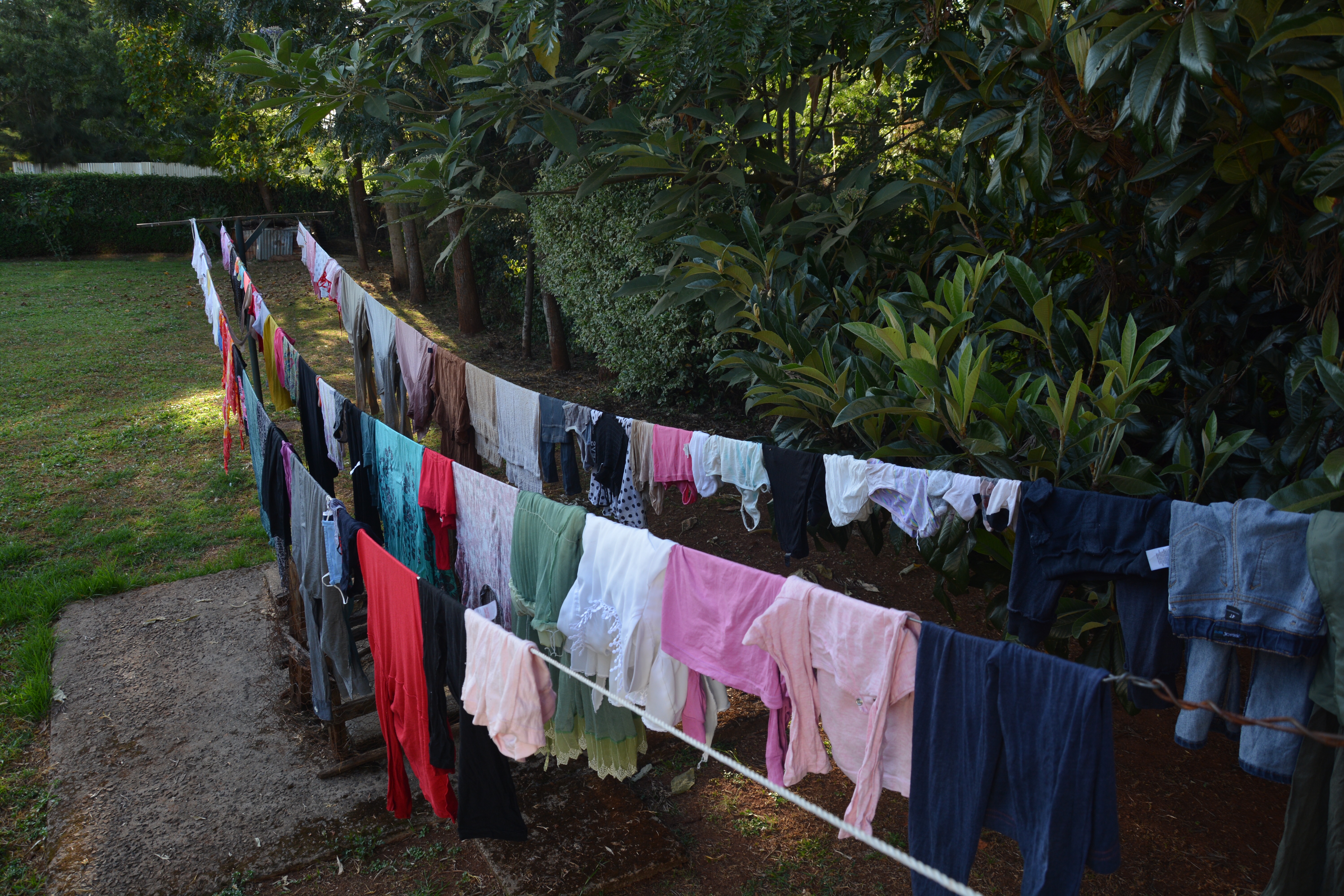
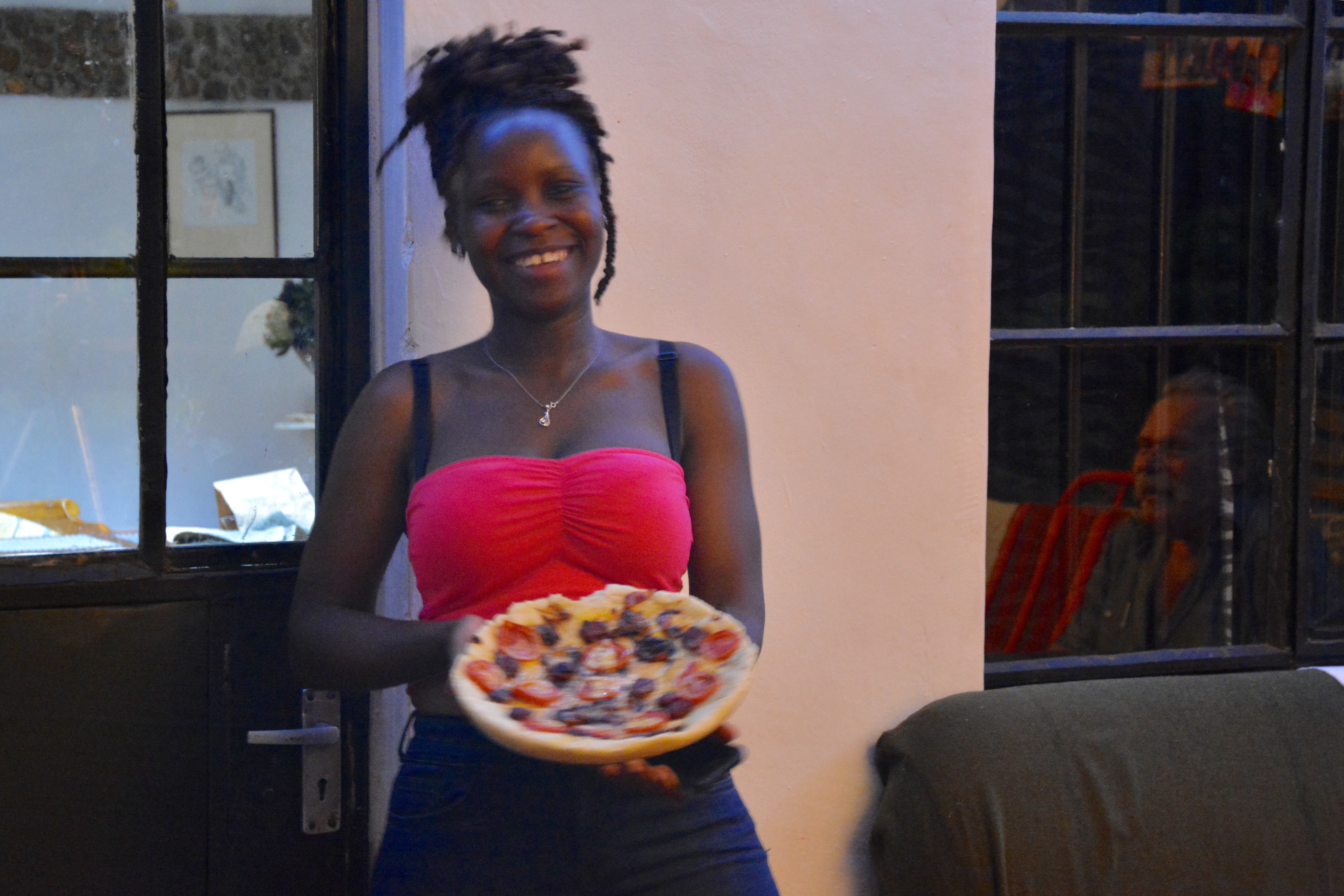
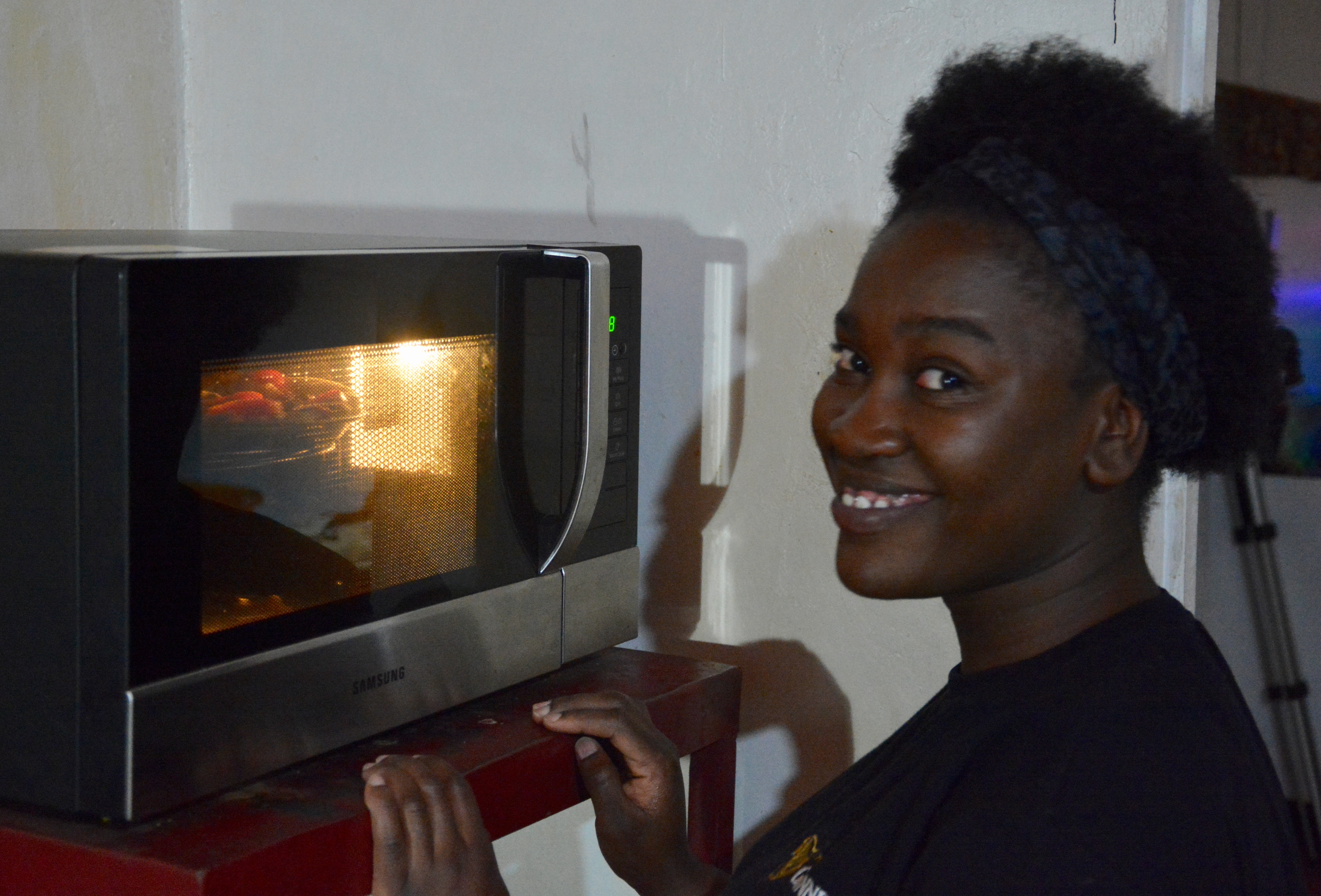
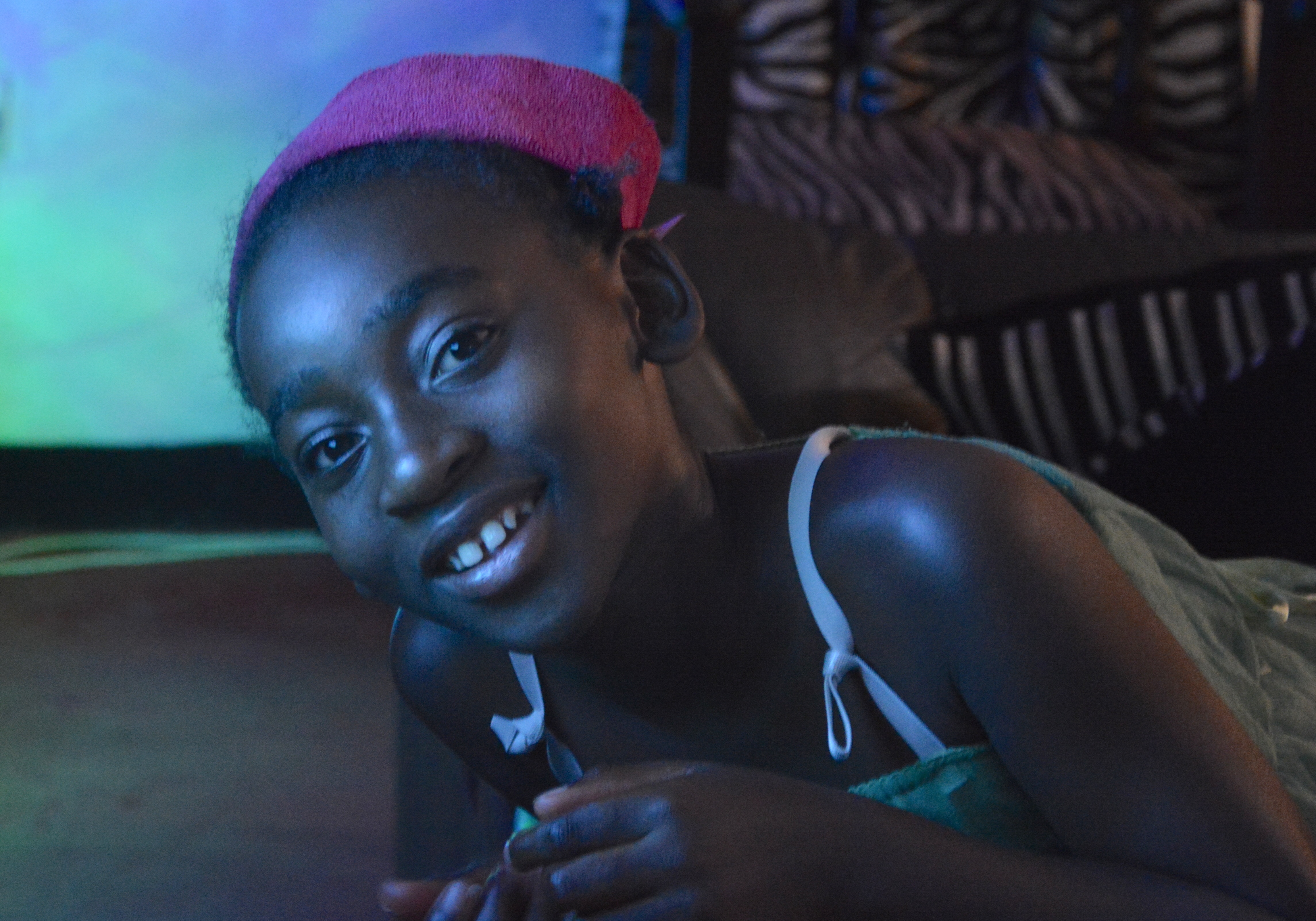
All day long, the girls accept their duties without rancour, cleaning the house, preparing meals, mountains of washing up, cleaning the compound, watering the chickens, hand-washing piles of clothes in their unwritten rota. Later, Scovia attempts her first pizza – but who’s looking at the oddly shaped pizza when Scovia is holding it, this most attractive of all Africans? I catch Marion gazing intently into the microwave, giggling when I snap her picture. Bo washes saucepans – and there’s no hot tap. Everyone just gets on with what needs to be done. Uncomplaining. There’s never discord in this happy house and no one is addicted to devices.
Scovia’s pizza. Who cares..?
The sun’s shining warmly. Adelight’s twin sister’s charming daughter, Shamilla, eight years and a great favourite with us all, has arrived. Not surprisingly, she loves to be in this family, where the young women pamper the two small girls – their nieces I suppose, but in an African family no one much bothers to assess the relationship. Scovia, lovely Scovia who never fails to bring a wide smile to my face, is in the kitchen. Soon we will open the presents that she has arranged on a table behind me on the porch. She’s hung some twinkling lights in the blazing sunset. She went to town this morning. Shamilla being a recent announcement, I needed some extra small gifts, so I commissioned Scovia. Brilliantly, she found a small cardboard suitcase on the market filled with beads and jewellery-making items, thrown out by some rich child but now to have a wonderful new life in Africa. I spent an hour wrapping Maria’s new schoolbag in many layers of brown paper and string, a treat I always enjoyed as a child. This is the spirit of Christmas.
Marion
*
CHRISTMAS DAY, MORNING. Christmas music plays from someone’s phone. Adelight and Scovia pluck our supper, chickens from their own farm here in the shamba. Bo and Marion have yet to appear. Shamilla is playing with the beads and threads that Scovia so cleverly found. Who cares that they’re secondhand? They don’t.
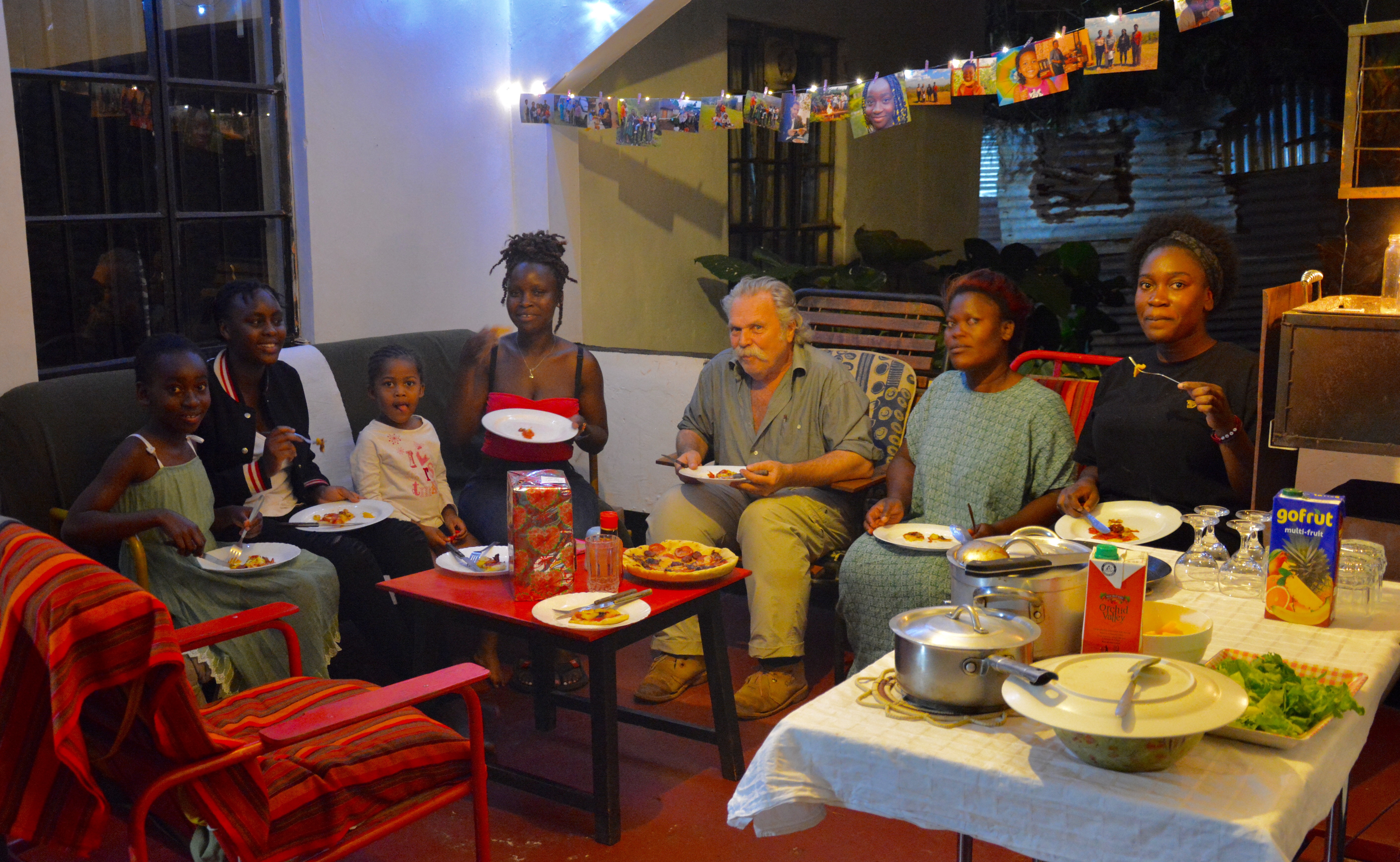
Family gathering
Last evening we enjoyed the best of Christmases Past, with a cheerful party on the porch, during which the smile never left my face. This is how Christmas was meant to be; not extravagance, cost-counting in exchange of gifts with guilt or pride. No expensive ‘devices’, new phones, ‘designer labels’ – materialist insignificance. To see the delight expressed at a new pair of sandals, a small box of lipsticks or nail varnishes, a bottle of something called ‘body splash’, a box of crayons, is humbling. A few glasses of sweet red wine is a treat for the older girls. There’s laughter and jokes, cheek and cheer, heartfelt love and generosity, sharing – of emotion, not Stuff.
Maria sits beside me at the table, with paintbrush and colouring book, new gifts. The sun is bright in the garden. Rico flattens and recycles the wrapping paper. Nothing is discarded unnecessarily in this economy.
Christmas Day is ahead. Tonight we’ll barbecue chickens on a spit in the garden around a cheerful fire. More family will visit: Halima, a girl that Rico took in years ago, when her guardians had to move away, and her small family who now live here in Kitale. Others will come and go, greet and chatter.
Shamilla, lit by the TV
*
The presents I received last night, were so thoughtful. More valuable than all the Stuff you could think of. Not the mtumba tee shorts I expected. From Rico, wrapped in many layers, as I had done with Maria’s bright pink schoolbag, was a tiny tin of fine Sahara sand from one of the first days we met in January 1987. Kept for almost three and a half decades, since that journey that so changed our lives.
From the three young women, I found a water bottle for my journey – but it wasn’t that simple gift that gave me a knot of emotion. It was the letter, written on a sheet of exercise book paper decorated with florescent felt-tip hearts and the words ‘lots of love’.
Their words contained the REAL Christmas spirit. That Ghost of Christmases Past, before it became a commercial festival for so many of us:
‘Dear Uncle Jonathan
We are glad that you became part of our big happy family. At first when you came to Kitale for the first time, we received you warmly because the minute you stepped out of the car, you kept on a nice warm smile that assured us you were a nice sweet person.
As time went by, we kept on knowing you more and loving you more because you showed us gratitude and love in return and that made us to keep on those smiles that we keep on showing you and in return it has also helped you in writing journals, hahahaha!
To make it clear and short, WE LOVE YOU SO MUCH UNCLE JONATHAN!!!
Lots of love from Marion, Scovia and Bo
This, from warm young women, young enough to be grandchildren, expressed with love and equality. My escape is complete. I am with family.
*
To my readers, I wish everyone as happy a Christmas as you can manage with all the antisocial restrictions. I know just how fortunate I am to be with my families – FAMILY as much as if we were blood related. It’s the wonder of this continent for me, the strength and flexibility of the extended family, in which even I, from another culture, generation and economy, am adopted from the heart. The most difficult lesson for a non-African to learn is to accept from the heart, the manner in which friendship, love and support are given here.





 jonathansjourney.net