EPISODE FOUR 2025

FEBRUARY 10th 2025

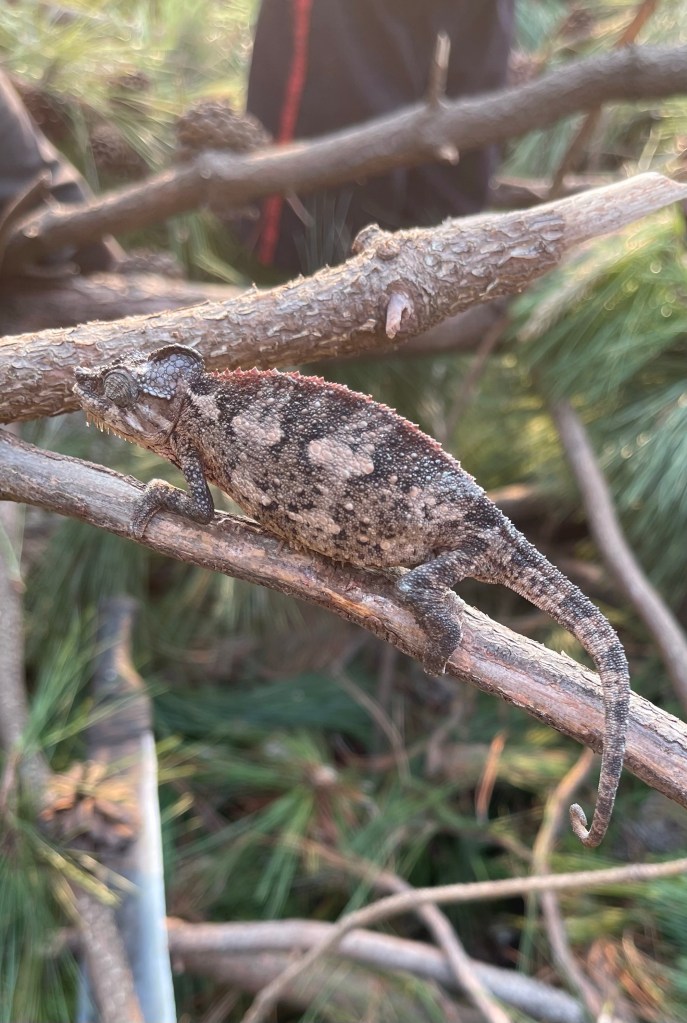
Most Africans run in fear from harmless, fascinating chameleons. My red tan must be a challenge! Pity I don’t go brown

BLOODY ENGINES… ROCK GARDENS TO MOROTO, NORTHERN UGANDA

As well as discovering a real love of the small children, this journey is notable for the amount of work that’s been required on my ageing motorbike, now 17 years old. It HAS had a hard life since I bought it seven years ago, with 45,000 miles on the clock. It’s done 25,000 more varied miles, on all sorts of terrain from smooth Chinese tarmac to appalling rutted, bumpy, sometimes risky mountain goat tracks.

Riding near Nakapiripirit on the way north

I’m riding into northern Uganda, going to the desert town of Moroto, remote, and home to the Karamajong people, colourful tribes with a bit of the feeling of ‘old Africa’. Out in the country, I see the lithe young women sporting their swinging, flared, multicoloured pleated skirts – above the knee, and men draped in coloured cloths, wearing the most bizarre headwear: crocheted hats like something Chaplin used to wear for laughs; tall, ringed with bright colours of wool, sort of bowlers crossed with top hats, with small upturned rims, often surmounted by a big feather – an ostrich for the fortunate.

****

The new tar road north

As I ride north from Sipi, the engine starts to stutter. I put it down to the blustery wind. I’m really not sure if I’ve another problem with my engine, perhaps as a result of all the bodging repairs done over past weeks? I remember that ‘Karachi’ will be in Moroto. He’ll help if required. Five years ago, by odd coincidence to the very day, he supplied a new front tyre for the Mosquito.
I treat myself to the pleasant Mount Moroto Hotel, £18 for a room opening onto the large garden, and a view of Mount Moroto beyond the french window, chuckling at how my travelling life has changed since my all-time accommodation lows in Coatzacoalcos, Mexico, and Yusekova, Turkey, many years ago. Moroto’s a hot, pleasant town, calm and clean, probably thanks to the army presence.

Next morning, I buy a new front tyre from Karachi and set off to investigate the mountain range that borders northern Kenya. I bounce along uncomfortably, the new tyre is rather harder than the old one. It isn’t long before I begin to ask myself what I’m doing. I’m riding on uncomfortable, dusty tracks in hot sun to go to look for a view that might not even be there! What am I proving? That I can do it? Well, I know I CAN do it, but do I WANT to? What will be my reward? Why am I bothering? That’s the trouble with lone journeys: all the soul searching and personality analysis.

Then my decision is made for me. The engine starts running unevenly again. This time it’s not the wind, it’s as if it has dirty petrol. Could be, I think: I was forced to purchase that Coke bottle of fuel in Sipi. I’ve a reason to turn round. I ride back to Moroto, and ‘Karachi’.

Order and efficiency in the Asian influence

****

I sit in hot sun outside the workshop, watching Francis, a mechanic who gives me confidence, try to identify the problem. He appears methodical, disciplined and efficient – rare qualities. He’s worked for Ali for nine years. Ali, AKA ‘Karachi’, a Pakistani motorcycle dealer here in remote Moroto, came from Pakistan in 2002, opening a business in Kampala. Somehow, he ended up with this up-country offshoot in the deepest north, supplying the large army garrison in town.

Francis strips and services the carburettor. It takes most of the rest of the hot day. In the evening I take it for a fast test ride but it still coughs and stutters. Back I come on day two for further adjustment. Another test ride. After 30 kilometres the machine dies, fortunately just two kilometres from Karachi’s workshop. Francis rides to the rescue. Immediately – and rather impressively – he goes straight to the source of the problem: rough, twisted connections by Kato, the Kapchorwa mechanic, who hasn’t got a roll of insulating tape!

I ride the bike 20 kilometres round town in case it stops again, but it feels like my old Mosquito at last. Now I have to decide which way I’m going, north to hot remote mechanical uncertainty or back south to green mountains and family?

I think the decision is contained in the semantics of the question.

****

Wanda and Jörg join the family in Kitale for supper

To go back a bit… On January 28th, I rode back round the mountain to Uganda. I’d spent a few relaxed, enjoyable days in Kitale with Adelight and the children, and Wanda and Jörg, now old friends from Köln, who keep a camping car in Tanzania and, like me, travel to escape European winters. They are cheerful, curious and kind people who’ve made many friends in Africa.

Ugandan schools would start the school year on the 3rd of February, after a nine week holiday. I wanted to spend the last of the holiday with Keilah and Jonathan. I rode back.

Back to the ‘grandchildren’

The standard of Ugandan education is dreadful. I’m tempted to say that it’s a policy of the dictatorship to keep their vast population (49% below 14 years) in ignorance: it makes for easier control. In rural districts a minority attend school. Government schools are lamentable, while private schools operate as a business (many of the better ones mysteriously owned by government officials…)

Carrying the washing. Everyone has a part to play, whatever age.

My mission, having accepted the education of my two ‘grandchildren’, was to find a better school for them. They’ve been at a boarding school in Kapchorwa, 10 miles from home: boarding being a choice forced upon us by the lack of safety of the school transport, with 50 or more young children packed in a minibus on the dangerous mountain road. Last year, an exhausted driver from their school caused an accident that killed a family on a boda-boda. The school paid off the police and relatives to avoid bad publicity. At that point, in disgust, Alex and I made the decision that Keilah and Jonathan should board at school. Their attainments suffered, the food was negligibly poor, they often had to share beds with older pupils in search of owners’ profits and Jonathan was sometimes sick and losing weight. Precious had many arguments with the administrators, to no avail.

Learning by repetition and rote. An exercise book from last year

Alex’s brother, Cedric, whom I like a lot, told us of Tower Primary School in Mbale, 30 miles down the mountains. Cedric, as a computer technician, runs the school’s gadgets and knows the staff. We went to inspect – and were impressed, instantly enrolling the children for the year about to begin. The school’s not cheap, almost certainly owned by someone in government, as is everything of quality in this utterly corrupt regime; it was rated seventeenth in the country in the recent academic year.

Tower Primary school, Mbale

The children will live in basic dormitories, each overseen by apparently kindly matrons. They will eat not very interesting food: mainly carbohydrate and oily stew, little meat or vegetable, and very few luxuries, unless supplied by parents. It’s a hard life – but Keilah and Jonathan are wildly excited by the news that they are to go to a big school in the city, which boasts a (rather small) swimming pool! Their delight knows no bounds. In the evening, after I pay £250 for registration and uniforms, they dance about my room, climbing all over me exclaiming at their new clothes and wondering at the coloured pictures on the school’s 2025 calendar, thrilled by the swimming pool!

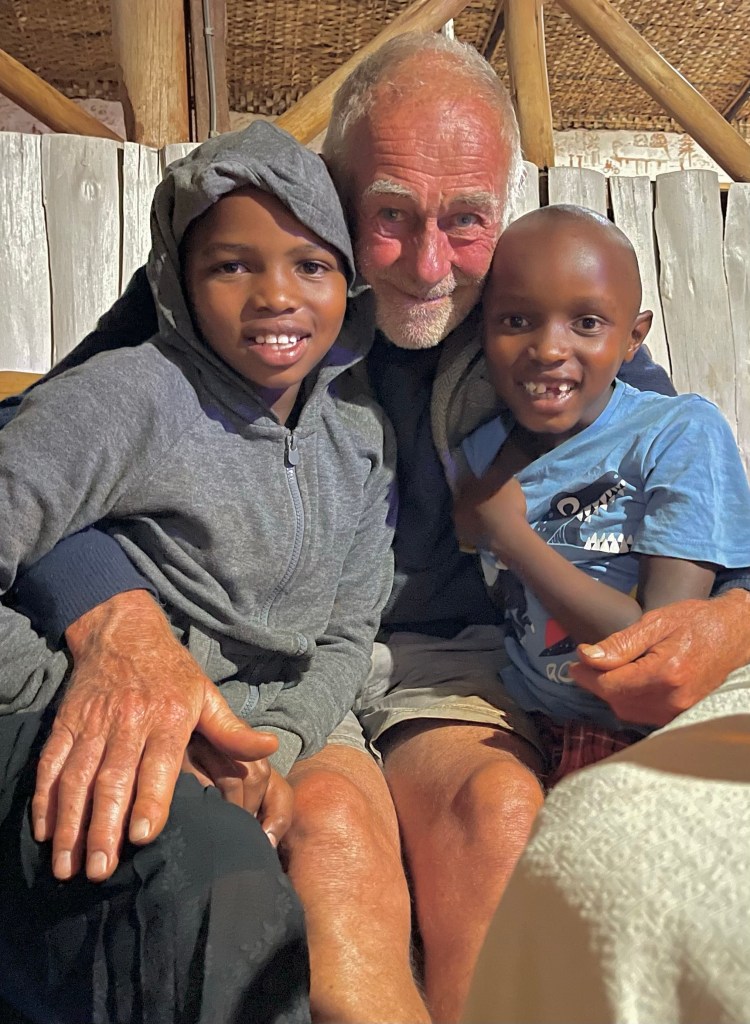
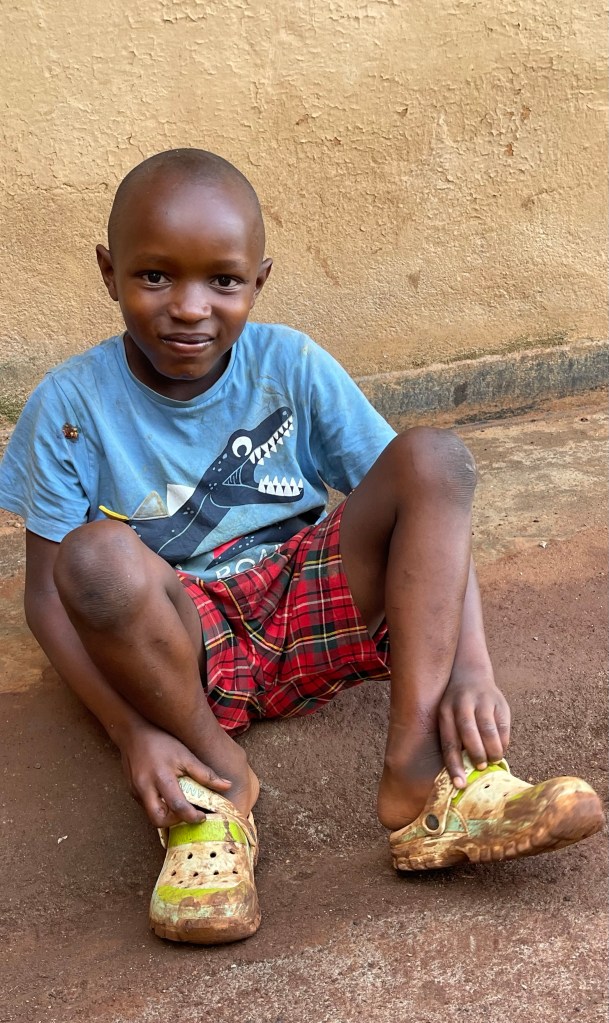
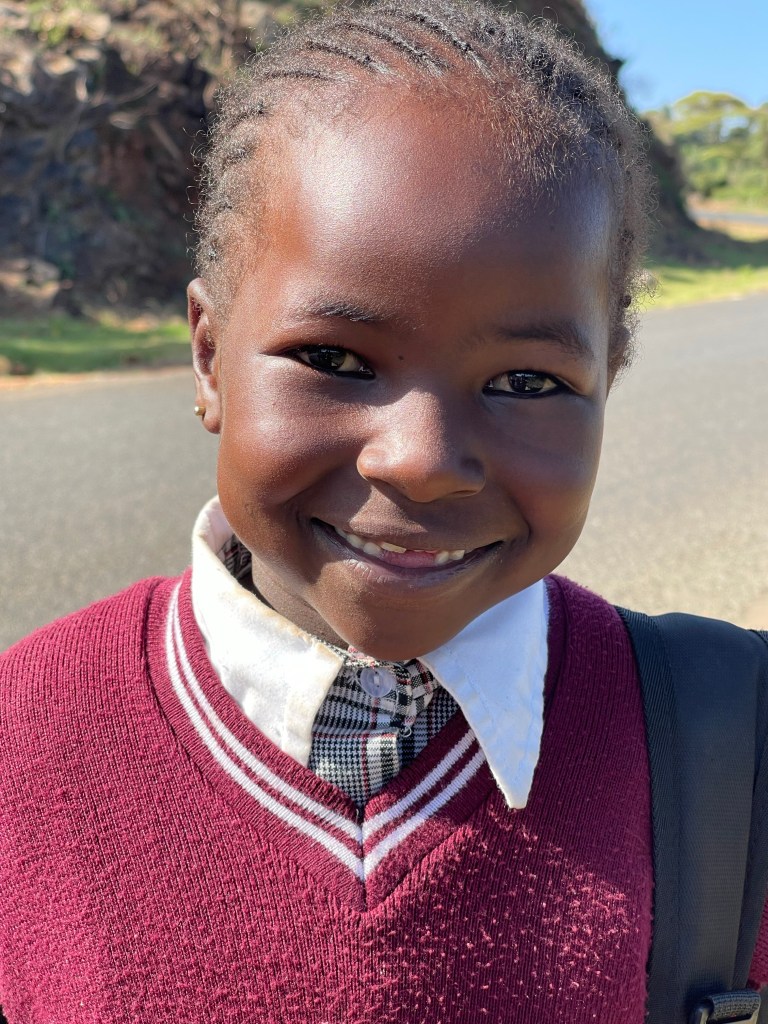
Keilah, who charms the socks off this old mzungu!

Next comes shopping for the long list of requirements. Alex takes the cost of that, another £250-plus from his guest house income. I transfer the £500 to cover the term’s fees for the two gleeful children. Half a day is spent sorting and packing new tin trunks with copious amounts of toilet paper, kilos of soaps, no less than FIVE KILOS of sugar each (with, happily, four tubes of toothpaste and a toothbrush!), pens, pencils, bedding, books, paper, buckets and basins. The children dance and exclaim in delight. They LOVE school, and this is an adventure.

New school uniform

Reporting time is 07.00 on Monday the 3rd. It takes a hired car to transport all the mattresses, buckets, bedding, blankets, basins and trunks – and two ecstatic children and their parents. I wisely stay in bed. I’m missed on the journey down, Alex tells me later, “Oh, I wish Uncle Jonathan was driving us!”, says Keilah, but I’m soon forgotten in the excitement of arrival. “There were BIG people there!” exclaims Precious proudly, “The parking was FULL! Big cars! Rich people. A lot of fat children!”

Soon Keilah and Jonathan dismissed their mother – Alex was at the bank paying the fees. “We have to go to class with our friends!” And away they ran, to their new adventure.

I’m delighted that my sponsorship of these two lovely, lively small people will provide a secure future for at least two African children, and ease the burden from Alex, a man of great integrity, who would struggle to see his children do so well. They are bright sparks, Keilah and Jonathan, now with a lot of exposure to so many mzungus. With the correct direction they can go far. I tell Keilah, who told me she wanted to be a nurse, that she, “can be a doctor, a surgeon, anything you want! Don’t ever let anyone tell you otherwise. You are equal to those boys.”

****

The children safely at school, the compound quiet, it’s time to continue my travels. BUT, the Mosquito isn’t working. Now it won’t start. Back it goes to Kato, the mechanic in Kapchorwa. It needs a new rectifier, he says. Kato always appears honest and decent, but he never tells me a price, getting me to look up the European price for parts and telling me that ‘original’ parts are expensive in Uganda. I wonder if he does deal with his suppliers? I’ve no way of knowing, and no one in this cash economy has heard of receipts. But what am I to do? He may not be Africa’s best mechanic, but he’s the best I’ve found (except in remote Moroto, a 200 kilometre ride into the sticks). I am dependent upon him. I have a trusting nature, judging others by my own standards, but when he says he paid £90 for the rectifier, that in the Netherlands costs €86, I begin to wonder. Am I paying the mzungu price? Is it an original item from Japan? I have no way of proving anything and must just trust him, I suppose.

‘Mbale Garage’, where most spare parts come from… Or is it just a bike graveyard?

After lunch on the third day he roars into the compound at Rock Gardens. “Your bike is good, very good!” It sounds good, and he sounds confident. “I took it to the Yamaha mechanics in Mbale (the Mosquito is a Suzuki) and they told me the rectifier wasn’t matching the control unit we replaced so it was not charging the battery. Now with the new part – original! – it’s good, very good!” Apparently, the mismatch was frying the cables in the charging circuit. I hope he’s right as it’s cost me another £120… Keeping the Mosquito running this year has already cost me £750.

The tacho tells me Kato’s ridden 230 kilometres. It reads 384 since I last filled the tank. “I’ve never seen it so high on one tank of fuel! There must be just a smell left!” He likes to ride my bike.

“No, it will be very OK!”

We get him a boda-boda to take him back to Kapchorwa. It’s too late for me to ride north now, it’s already 3.00. I’m desperate to leave Rock Gardens. Desperate.

Alex helps bump start what’s left of a vastly overloaded boda-boda. The clutch pivots on a bent nail

****

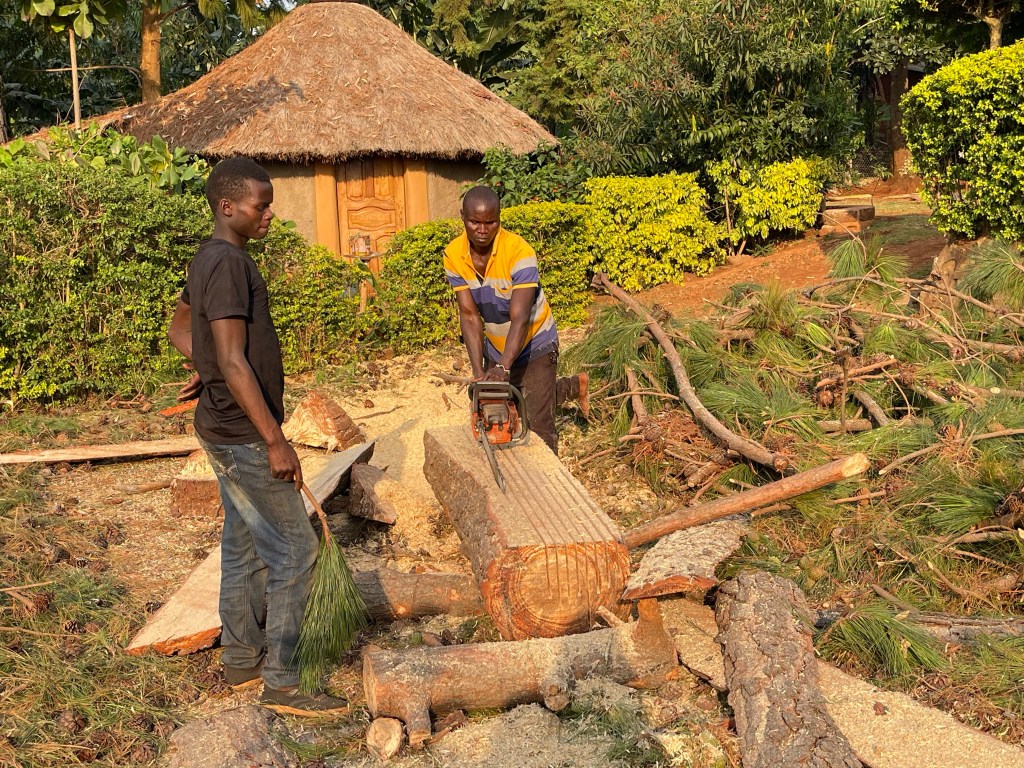
On the 2nd, Enoch died 100 yards down the lane past Rock Gardens. I remember Enoch, a cheerful child who looked about seven when I photographed him a few years ago. Alex reckons he might have been fifteen or sixteen when he died a couple of days ago. “They are small, they don’t grow with sickle cell disease. They don’t live past teenage.” So poor Enoch had a short spell and is now gone. I’m sorry of course. But death here means ersatz ‘culture’ intervenes, this godawful travesty of ‘tradition’. The new habit began just a few years ago: amplified pop music throughout nights until burial. A truck weighed down with speakers the size of capacious wardrobes pulls in to the bereaved compound. It’s big business, along with the rented gazebos and Chinese plastic chairs.

Now, after a night of pounding, unimaginative ‘music’ from gigantic loudspeakers 100 yards away, in this ghastly, disrespectful exhibit of local ‘culture’, I am determined to leave. But it’s too late. It’s after 3.00. I’m condemned to another night, tossing and turning with earplugs pushed tight, that can’t shut out the ‘thump, thump, THUMP, thump, thump, THUMP, thump, thump, THUMP, thump, thump, THUMP, thump, thump, THUMP, thump, thump…’ I can shut out the ‘music’ but not the sub-bass vibrations.

This is not culture or tradition, it’s just amplified noise pollution of no relevance whatsoever to a funeral, that’s become a habit. It provides excuses for morally bankrupt locals to get drunk and attracts disruptive youths and idlers. “But if you don’t have this music, no one will come,” protests Alex’s father. But who wants these elements at the memorial of their dead son?

Tradition used to be wailing, and in much of Africa, drumming. Then came amplification, generators and sub-bass speakers that vibrate for kilometres, and music made not by musicians but technicians and toneless singers (shouters) who rely on mechanical repetition for effect. So tradition sinks to exploitative commercialism.

And of course, it all costs a lot of money that poor rural villagers don’t have. Wood butcher Tom is part of the burial committee, being of the same clan. The estimates for burial are around three million Uganda shillings: £600+. No one in this community has that sort of money. Neighbours must chip in. Crooked politicians will come and harangue the mourners and use campaign funds to buy votes. The average manual worker gets about £4.50 a day, and most here don’t work anyway. Think of the school fees that money could pay.

Alex and I had planned a long hike for tomorrow, but he can’t go now. It would be an insult for him to leave for a walk while the burial is going on. And people in this poorly educated, jealous, conservative village take offence on a whim. So I’ll ride north instead.

After another noisy night.

When I DO leave, the petrol runs out 500 yards from Rock Gardens! Fortunately, I can freewheel downhill to Sipi centre and buy a Coke bottle of petrol, probably pinched out of someone’s tank. It’s JUST enough to reach a petrol station in Kapchorwa.

Bloody Kato, I think, as I fill up the entire tank.

****

On the steep short cut from the mountain to the inferno below

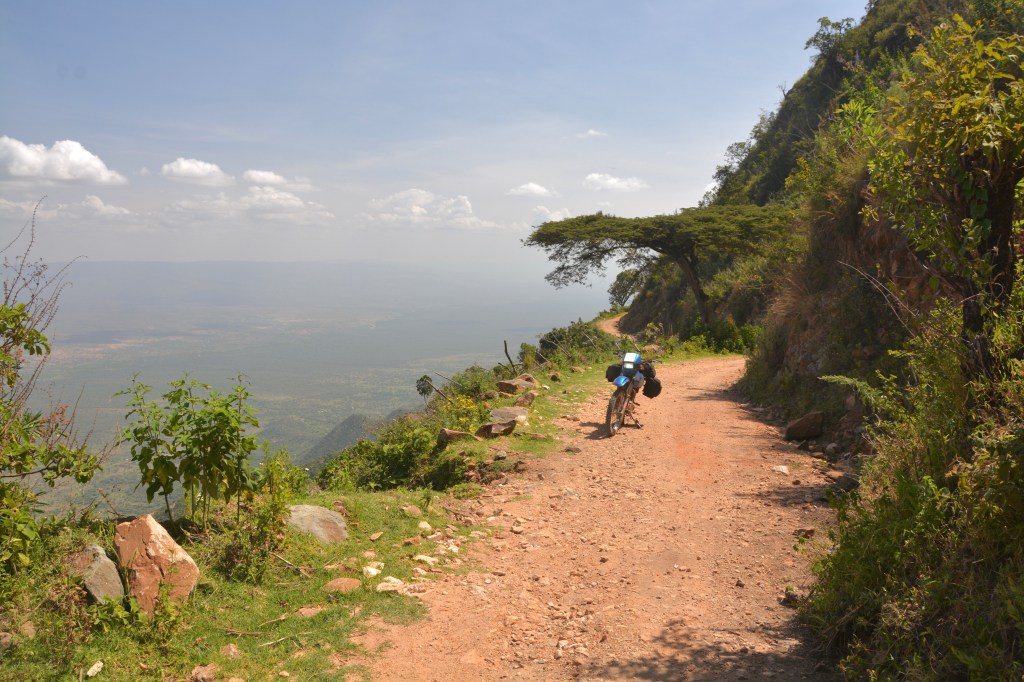
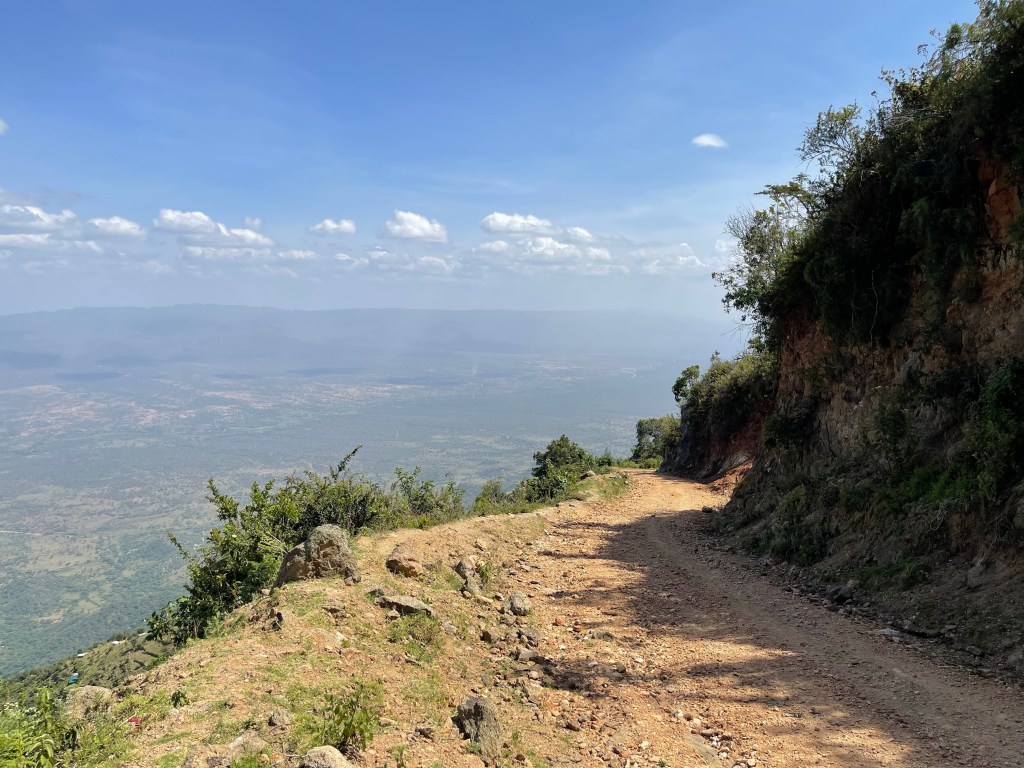
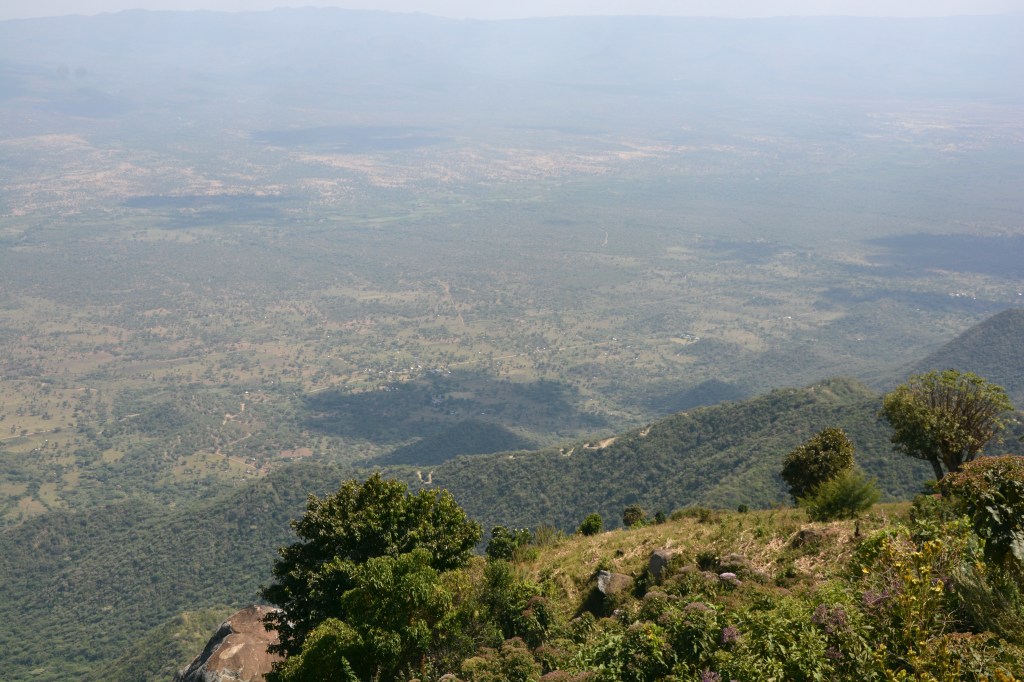
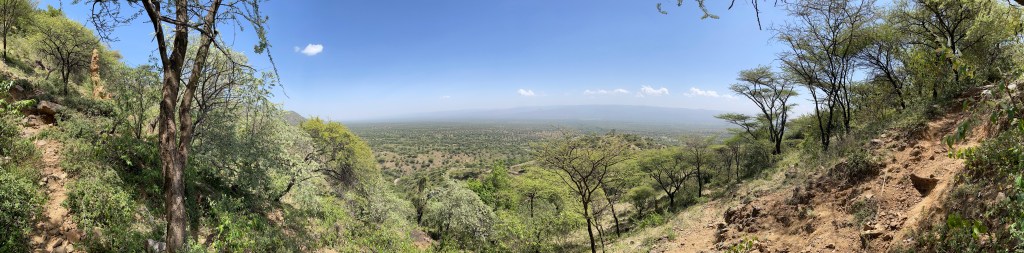
Leaving at last after the second disturbed night, I go to the ATM in Kapchorwa for cash. Somehow, Kato and Alex have eaten my previous £225, and I’m heading into remote areas. I’ve determined on a ride into Karamoja, the northern tribal regions of Uganda that border South Sudan. There’s a short cut that drops steeply down the mountainsides into the scorching plains far below. It’s bumpy and very dusty, with vistas of central Uganda fading in the misty distance. I’ve been told there’s now a tar road all the way to Moroto when I reach the valley floor. But somewhere after a few miles, I take a wrong turn and end up with 30 miles of disgusting earth and stone, smothered in red dust that infiltrates every nook and cranny of the bike, me and my bags. It’s disgusting, and the scenery is not attractive.

It’s my second attempt at investigating the tribal north. Five years ago, I turned round in the face of relentless mud and rain clouds. I struggled north through craters and ponds of clay mud, blathered and filthy, tired and wondering what the hell I was proving.

And, oddly enough, it’s much the same now… Maybe Moroto is my travelling nemesis! A place I reach, and wonder why. I go through the same soul-searching for 48 hours. Admittedly, a malfunctioning motorbike in these remote regions does focus my thoughts. Perhaps too, the vast and unleavened landscape doesn’t help. It’s scrubby bushland: dry, stunted trees – almost none of which reach maturity as everyone here depends on firewood and charcoal for domestic needs and rural cash sales – and spiky, sketchy growth spread over dull grey brown earth. The scenery is uninspiring. Very uninspiring. Just scrubby dry lands backed by ranges of blue mountains and the bland blue of the huge desert sky.

A HOT, somewhat uninspiring landscape that leads to introspection

****

It’s the people I’ve come to see, I suppose: these left-behind vestiges of an old Africa of colonial era encyclopaedias. These days though, I know much of this is just a facade: imposed by poverty, not culture. The colourful clothes are certainly for real, and the people often friendly, but I get edgy about the ethics of passing by and gawping, as Tourism booms in such places. It’s the only way to encourage any economy here, to bring in hard cash: exploit the curious ways of indigenous peoples… Tourism is becoming ugly as it’s now the richest business for so many African countries. The money falls overwhelmingly into the pockets of corrupt politicians and fat businessmen, not filtering down to rural communities who provide the ‘colour’. We come, we look, we take a selfie, we post our ‘exotic adventures’ on Instagram.

But do we really learn much about what we are looking at..?

****

Sometimes I ride through small towns and remote villages, past isolated dwellings, and wonder what it must be like to LIVE here, and in all likelihood, know nothing else but a stick and thatch hut in a vast flat expanse of bush land, with few trees that reach any size before they are culled for firewood and charcoal burning? No shade from the searchlight sun. Most here don’t go to school, and learn nothing of any wider life than this circumscribed poverty and drought, both physical and intellectual. Boys tend the family cows and goats; girls carry heavy containers of water and head-loads of firewood and become pregnant in early teens. Women have average six children, risking death in childbirth many times over, doing all the household and farming chores, and slaving over smoking sticks to make some sort of food for their multitudes of children dressed in rags and their useless men – who do nothing.

The landscape is denuded and dull, parched in the fiery equatorial sun. Knowledge, and perhaps curiosity, is limited to the immediate surrounding, augmented perhaps by tinny basic phones, the only possession for most. If accident or ill health intervene it’s ‘God’s will’ and just your bad luck. You probably die, or become crippled and beg. This is the reality of life in much of rural Africa. No comfort, a terrible diet of carbohydrate and starch, little stimulation – balancing on the knife edge of existence. It’s no romantic ideal of the ‘simple life’, just lifelong hardship little better than that of the desiccated animals ranging this dry scrub and desert. Experiencing all this changes my appreciation of the privileges of the life I lead. Unless devoid of compassion, you can’t ride through this without a certain horror that THIS is how most of the world lives, not with the comforts we take so much for granted.

And with a very deep gratitude that I am one of the lucky ones.

****

It’s more fun, I realise, to indulge in the warmth of my families. They too add a sense of the exotic as I get inside their lives, but with a reality and depth that is rewarding. Anyhow, after most of two days sitting outside the workshop of Ali Karachi, I’m not entirely trusting my Mosquito any more. Do I really want to venture into the remoter north, or will I be more confident riding back towards family, help and some good hiking with my companions for now? Probably.

I think I’ll cut and run again from Moroto. Back to the green mountains. And family.

Rock Gardens, now so popular

****

Spotting that my Ugandan bike insurance has run out I find that Moroto has just one agent. I’m now insured by the Catholic church, the richest organisation in the world. What power they have! One of the major Ugandan banks is also Catholic church owned – the Centenary Bank. Some pray, all pay, that’s the reality of Catholicism. Peddling hope and platitudes while the peasants pay, and faith leaders cosy up to the dictators to keep the people subservient… Cynical? You bet I am! I’ve seen a lot of these countries.

Cheerful Juliet, with an itchy hair weave that requires poking with a ballpoint at regular intervals, renews my annual insurance for £11, typing the document, one-fingered, on an old Olympia manual typewriter with a dicky ribbon, a machine I haven’t seen outside a museum display for four decades. Well, the Catholics don’t waste their astronomical wealth.

“Insured by the Pope!” exclaims Alex as Precious laughs at my story later.

****

Then I’m on my way south again. The sun hammers down out here in this vast burned expanse. I can’t escape it. There’s no ‘in-the-shade’ temperature on a motorbike. I leave Moroto behind, beating down the tar road with big views on both sides: scrubby growth dotted with pimples of ancient volcanic plugs, sometime backed by hazy, jagged mountains. But it’s too empty; and if it’s empty here, what the heck is the rural north like? With company I’d probably have gone on, on my own perhaps my discretion is wise: up there, the roads are dirt, and I don’t really trust the engine yet, although it does FEEL more like my old Mosquito after Francis’s care and attention.

People walk the roadside, sometimes a nod of acknowledgement of my wave, but these are reserved people. They have no discernible destination, loose-limbed, tanned black by the relentless UV from the big star overhead. It’s an African mystery. Where are they all going, miles from anywhere? A constant feature of this wonderful, strange continent.

Even on the endless valley floor, most of the time I am higher than Ben Nevis. We forget how high so much of these east African countries is.

A rough trail ride back up into the mountains

Baked to a crust, after about three hours I take the short cut again, steeply and rockily up the side of the mountains to Kapchorwa. In six or seven of the ten miles I battle up two and a half thousand feet. Serious trail riding; great exercise and good for flexibility as I dance on my footpegs over rocks and dirt. The bike enjoys the cooling air; it’s funny, I can FEEL the difference, as if it’s grateful for the coolness of the altitude. I am too. And it’s green again up here.

Elio, the friendly cow, and her calf Lala, in front of Rock Gardens’ restaurant. How things grow here!

Back at Rock Gardens, I am warmly greeted by all. Alex now has a small staff. Celestine is a sort of deputy manager; Shiela and Marion do the chores, and Eric works with the guests as guide and messenger. It’s bringing some efficiency, and Precious is better tempered now she has relief. It’s still difficult, running a popular guest house with no electricity, and currently no water. We DO have a better three quarters of a mile of gravel road from the centre of the village, but in grading that, they broke the water pipes! There’s no planning in Uganda. It’s been a week now – of carrying hundreds of jerrycans from the spring. It’s been going on so long that Alex now hires a group of boda-bodas to lug the water up the hill. More loss of profits.

There are always guests now; they’ve started sending one another – the best marketing, I tell Alex. They love the welcome, the atmosphere and the ‘traditional’ rooms – that I’ve invented! There’s just one left to decorate now before I leave in March.

Zebra theme in room JB4. The brown pigments are all from local earth. White = emulsion, black = headache-inducing Chinese gloss

Mud cloth theme in room JB6

Giraffe theme in room JB5.

Based on a traditional mud cloth design (from Ghana, but so what..?!)

Last week, Rock Gardens got its second award from the multinational giant booking company. “You can call yourself ‘Award Winning’ now,” I say. “Getting a Traveller Review Award two years running is not bad!” Best in Sipi, and probably in the region. He’s quietly proud of achieving his dream, is Alex. So am I. I never expected this success. But Alex has an attribute rare in Africa: he plans ahead. He’s canny too. As we walk locally, he shows me that he is quietly purchasing bits of land, four plots so far. He’s respected by his clan chiefs and does honest but smart deals with them, spreading the costs of the land over time, so they get an income, and he slowly gets the land.

One day: trees. Alex shows me one of his plots

Land is wealth in Africa. “Anything can change here. When this president dies, he intends his son to take over, but there are generals who object. Who knows, there could be civil war again. Businesses will suffer, but people will always need food. Land will always have value, especially with our high birth rate and belief that sons must own land…”

This new plot, which we are buying as I write, is in one of the richest coffee growing areas. Alex reckons he can get the money back in three or four years

He’s already using the plots to grow potatoes and matoke, and planning far ahead to planting trees. Smart man, thinking ahead. I’m so happy that all my instincts proved so accurate. He’s a fond friend now too. And I a father figure to advise and guide, and an intercontinental scenery designer whose skills have helped his business become a real success story.

Funny how things turn out.

****

Fortunately, the road between Kitale and Sipi is magnificent and I don’t get bored, despite the many times I ride it!

Keilah, my favourite African!

Communicating with lovely Rose, who’s deaf and mute is always amusing!

Sipi sunset

Perhaps my favourite photo of 2025! Keilah makes a Russian hat from her jumper

EPISODE THREE 2025

AFRICAN FAMILIES

23 JANUARY 2025

Alex makes a fine travelling companion

On December 28th, I arrived in Sipi, Uganda, home of my ‘Ugandan Family’, Alex, Precious and the two lovely children – my surrogate grandchildren – Keilah, eight and Jonathan Bean, six. I so much enjoyed the children’s company that I stayed over three weeks. And in answer to the common question I am asked at home, “What do you DO in Africa?” I can only respond, pretty much what I do at home: work rather hard and expend a lot of energy on practical projects. My ‘rest days’ involve long hikes up and down very high mountainsides… It’s a perfect ‘holiday’ for me: plenty to do physically, sunshine to do it in, and well fed and sufficiently beered by my hosts. Warm beer, of course…

Queen Keilah. Imagination instantly makes the cowl for the new kitchen chimney a plaything for those with no toys

My practical role is to provide design advice, paint and decorate the houses and redo most of the work done by inept Sipi workmen. Two of the new rooms had water drains connected directly to the soil pipe, without U bends, resulting in foul gases pervading the rooms. This, by an arrogant ‘plumber’ I dislike, who exploits Alex’s total impracticality. I’ve had to replumb most of his work. Twice, I lost my temper big time, berating ‘workers’ who refuse to invest in tools and rely on the bent hammer, a machete and hoe to do carpentry, make furniture and fittings. Tom, the wood butcher, won’t now come to Rock Gardens if I am there!

King Jonathan Bean Cheptai

Our quirky guest house, named after Rock Cottage in Harberton, comes along apace, with its six detached round houses. Actually, one’s rectangular: the Kampala Bungalow, as I rudely call it: Ugandan guests don’t want to stay in the ‘old fashioned’ thatched houses so popular with mzungu guests! The place is unique, with its quaint wooden restaurant up on stilts, its excellent food and its welcoming atmosphere that feels very ‘African’ by design. We are attracting many customers; some days, it’s booked to capacity. Just a day or two ago, we hit a record of 15 guests, having expected a quiet day with just two and me. That night, we had two young Israelis sleeping in a tent, one under the stars and all rooms occupied, even the ‘emergency’ rooms – the rather basic ones in the original family block. It begins to make some money for Alex at last; it must do, because the demands on my wallet have reduced. I still pay much of the capital cost, but running costs and maintenance seem to have devolved onto the Rock Gardens cash box, such as it is in a hand to mouth economy. It’s still the biggest expenditure of my life, with all my pension coming here, and a good deal more to the other African families, but I am financially secure now – something I never planned nor expected, but a benefit of being of the Baby Boomer generation, perhaps the most fortunate in history.

All this gives me the opportunities to indulge my passion of travel. For decades it wasn’t this easy; I had to make choices – sometimes difficult ones. I remained freelance and childless, I sometimes had periods of relative poverty while I had no income, and I always scrimped and saved for my journeys. Obsessively, some would accuse! But in the end, it’s all worked well, and I now have chosen families in several countries and can share some of my privileges. I can also travel pretty much at will, despite the economic turmoil of the world.

Brian gives his sister Fremia a ride in a homemade wheelbarrow as the adults work

****

It’s been great to be in rural Africa, totally avoiding all recent ‘news’. I’m told that the ignorant reality TV failure, now ‘leader of the free world’ (derisory laughter) who called all Africa ‘shithole countries’ did not invite a single African leader to his recent inauguration. Having studiously avoided even opening my Guardian subscription for over a month, I’ve been able to avoid witnessing the degradation and shame now being visited on the people of USA. Poor USA is now the shithole country. How angered he’d be to know how Africans laugh at him with such derision!

****

Betty, chapati cook in a rural village cafe

We hardly ever meet Americans travelling in Africa (except for hunting and expensive safaris: very few backpackers), but if more Westerners travelled in Africa (and thank god they don’t!), there would be a lot more understanding of the modern problem of immigration, and the reason that so many are willing to risk everything, even their lives, to achieve the vain dream that so many Africans (and Latin Americans) harbour: that riches and ease of life await them in the rich countries of the North.

At least every day, I converse on the futility of the African Dream. The Dream is that by getting somehow to Europe, Australia, Canada, USA, all problems will disappear and wealth will flow without limit. To understand it all, just look at what Africans see of life in our countries: not poverty, homelessness, white beggars, unemployment, racial prejudice, meagre living conditions, bad health, child poverty, unfair opportunities, divisive education – well, I could go on. What they DO see, on TV and media, and now overwhelmingly in the exploitative videos they watch endlessly on their phones, is glamour, rampant consumerism, commercial exploitation, wealth, fast cars, palatial houses, fashion, possessions, triviality and untruth: the myth that you are what you own. It is unfiltered, made to exploit, made to create customers. This great lie is taken as truth. It’s on TV. It’s on YouTube. We all live like this in our rich countries.

And of course, the only mzungus they see are tourists. I explain that we tourists are APPARENTLY wealthy when we come here because of the relative value of our money. But how do I make people BELIEVE me? I tell them that my 20 bob cup of tea in Kenya (12p) will cost them the best part of 500 bob in England. That a cheap room to rent in London will cost them at least 130,000 Kenyan shillings (say £800), and that if they are fortunate enough to even GET a job legally, they are likely to be on minimum wage (£10.90 I think). A meal will cost them that much, a bus fare to work a minimum £3. I tot up my monthly electricity bill in Ugandan and Kenya Shillings. They gasp. It’s more than most earn here in a month…

But The Dream lives on. Not a day goes by without someone asking me for help to reach Europe. Marion, a smart, clever young woman working at the Kessup guest house, passed out of school with the highest marks: university place almost guaranteed despite, William informs me, coming from a very humble family. But she’s fixated on The Dream, which will solve all her problems and make her rich. I point out that if she has any hope of raising the airfare, visa costs and the probably exploitative fees for some unknown university in UK, that is most likely nothing more than a sham business, then she has every chance of raising the deposit she needs to secure a government loan in Kenya to study at university, without wasting her resources on the chimera of The Dream, and suffering the prejudice, climate, restrictions and dislocation of family and culture. Stay here and do good things, where you have friends and family and are culturally secure, I tell her. She appears to take it in, but the lure of The Dream and all its glitz and glamour is very persuasive. Life to most young East Africans is on their phone screens now, and all they show is the consumerism and superficial wealth of our countries. All fake. All exploitation.

I’ve seen the other end of The Dream: Africans living in austere conditions in illegally sub-let council flats in London; a trained doctor selling train tickets for British Rail; a smart Ghanaian woman married to an elderly British manual labourer of very little education, living in a dowdy mobile home in dismal Lancashire; the prejudices flamed by the rightwing hate-speech of the Reform Party and their ilk; the inflammatory language of the Daily Mail and rightwing TV; violence of the ignorant; selfishness and mean-spiritedness of so many ‘superior’ white people. For god’s sake, I was just in Texas for the Trump election, so I’ve stared into the depths of the abyss! I’ve seen how mean and selfish man can become, when his own livelihood is threatened. That’s why Trump succeeds in his vicious, lying poison.

But this is the reality behind the desire to get to Britain, despite the appalling risks. Britain raped and pillaged for 150 years, and through some ancient propaganda, many still see those times as secure and stable. “You were our masters,” they say, with a misplaced nostalgic respect for a time when politics were stable – because dissent wasn’t allowed.

This is why so many risk all, even their lives, to reach The Dream… It is impossibly sad. I’m ashamed to be upheld as an example of living The Dream. I know the reality is SO devastatingly different… Poor exploited Africa.

****

The arrival of the bride and groom

Last weekend, Alex and I rode to a HUGE, extravagant wedding in Lira, in the middle of northern Uganda, 170 miles away and a couple of thousand feet below Sipi’s mountain shoulder elevation. On the first night, we stayed in Dokolo, in a calm, cheap £5 hotel of round thatched houses, setting off early next day to catch up with the Kapchorwa clan in Lira.

Thank goodness we decided to ride there. The local clan, from Sipi and Kapchorwa, travelled by a school bus, driving half through two nights, while we enjoyed a couple of nights away from home. The clan members are expected to attend, but it appears that the bride and groom, a mature couple with three teenage children, paid for everything. Alex guesstimated that the whole event may have cost at least £6000 or £7000, a massive sum in Uganda. It was a fine example of high African bling, and an occasion to dress up: women wearing all manner of African fashion, from traditional swathed African print dresses to clingfilm-tight fabrics that left little to imagination. The men, as usual, wore ridiculous, impractical, ill-fitting western suits (not me, of course, for I have only a pair of slightly grubby zip-offs and a relatively clean, crumpled long sleeved shirt!)

The large caption on the wall was ironically amusing to the mzungu infiltrator

The ceremony began in a big born-again church on the edge of sprawling Lira, an unattractive, surprisingly large town on the hot, swampy plains of central Uganda. 500 people packed into the tin-roofed church, including one very conspicuous mzungu, making it impossible for me to get out my phone and read a book during the extended shouty sermons and formalities by half-crazed business pastors. I could understand nothing, with the amplification of chest mikes, and exaggerated accents. I sat – as I have become accustomed in so many African events – with a smile and look of apparent interest fixed on my face, the sinecure of a thousand eyes. I’ve no doubt that the bride and groom, when they sit to watch the HOURS of video, will wonder who the hell the freeloading mzungu was! If they were listening attentively, they’d’ve heard me introduce myself on the microphone, as requested by a ranting pastor, to the entire throng. My years as a mzungu in Africa have accustomed me to such spotlit moments.

The ceremony over, we repaired to the Lira Hotel for a splendid glittering wedding feast, with gazebos decorated in orange and white furbelows, gold-encased Chinese plastic chairs and a white and orange arched bridal walkway to the high table with its acres of fake florality, golden chairs and backdrop of autumnal Canadian woodland. By some odd chance, Alex and I were not directed to the Kapchorwa clan tent, but to the ‘Church’ tent, a source of much private hilarity for a couple of avowed atheists. One of the pleasures of the serendipity of travelling is the play acting often required. And as members of the ‘Church’ contingent, we were then ushered to the front of the pressing line of hundreds of jostling diners, anticpating a free meal. A good meal it was too, cooked by outside caterers and served with aplomb by the hotel staff.

Maids of honour, I assume

Speeches were long and very tedious. Give an African a microphone and they seldom know when to stop. Everyone must be introduced and their status paraded at length, all pride and name-dropping. The MC decreed two minutes per speaker. Some chance. He gained a round of amused ironic laughter when he wrested the microphone from the bride’s sister after 25 minutes of tedious introductions, suggesting that we had already met every one of her aunts, uncles, sisters, nephews and nieces, and her children could just wave from the crowd to satisfy the final introduction he was allowing her. We all applauded the MC.

Bride and groom and high kitsch

We were entertained by a small troupe of male dancers from the northern Karamajong region of Uganda; energetic and lithe, they danced frenetically and often with humour. One supple young fellow was particularly humorous, dancing provocatively feminine roles to great effect with shaking bum tassels. They leaped in fast acrobatics, formed human towers, somersaulted through hoops and breathed fire. It really did seem that no expense was spared by the bride and groom – a professor at one of the universities. But quite what they thought of the unknown mzungu, now an honorary part of the Kapchorwa clan, I do wonder.

Acrobatics included!

Alex and I stayed the night in Lira and rode the 170 miles home on quiet Sunday roads across the flat interior of Uganda, where swamps and sinuous lakes make up some of the landscape. It was my third ride through the area, but Alex’s first, an experience – and well earned rest we both relished.

****

In Alex, I see a lot of myself… It must have been this early instinct that formed the bond, that first evening, seven years ago. Funny how instinct is often the surest guide.

In him, I see shades of my own somewhat obsessive, sometimes compulsive nature, my restless need for activity and order, my extreme sense of justice, impatience with meanness of spirit and my irritating ‘White Anglo Saxon Protestant’ work ethic, to say nothing of my obstinacy! Half my age, he never stops, is upset by injustice, has a great sense of integrity and thinks and plans ahead, vanishingly unknown qualities in so much of Africa. He’s become a steadfast companion, it’s easy to travel together, especially away from the stresses of Sipi. We both like people.

****

Great hiking country

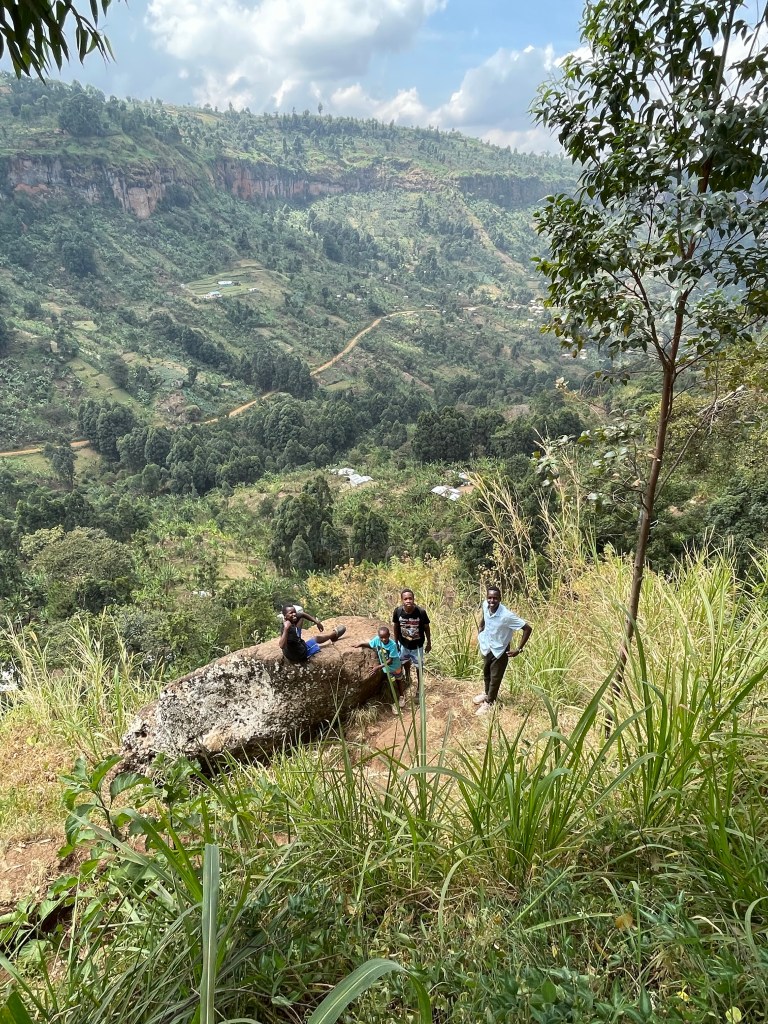
A day’s hiking in the rural beauties away from the tourism of Sipi, is Alex’s and my idea of relaxing, despite the energetic nature of walking in this steep country, with its dramatic cliffs and red mountain tracks. It’s hard countryside to tame, prone to many serious landslides and with tiny terraces of fields battled from the steep slopes over many generations. We seldom pass beyond populated places, every inch used for subsistence crops. But we DO get quickly into areas where a white visitor is rare, and I am feted all day by countless excited children (in this country where half the population is younger than 14 years) and shake their grubby hands hundreds of times. It’s fun progressing through in this celebrity manner. Alex and I chuckle at the antics of distant, often invisible children yelling, “Mzungu! Mzungu!” and calling their friends to look.

One day, we clamber down the ladder on the cliff near to Rock Gardens and drop to the slopes below, following a sinuous red dirt road through lovely scenery and many hamlets. At every house, crowds of children gather to stare and call. We stop in a scruffy village on the steep slopes for tea and chapatis. The people tell us that their community is due for resettlement to the hot dry plains far below, after the giant landslide that buried 12 hamlets and about 200 people last rainy season. Climate change is making many disasters in Africa, the continent that causes least pollution and is least prepared to deal with its consequences.

Tea and chapatis

We’ve spotted a track winding up the steep slopes. It rises from this decrepit hamlet. It’s a huge staircase of rock-built steps, rising over 650 feet! It’s a rarity here, where the paths are always informal, made by a million plastic flip-flops and Chinese sandals over many years. It’s amazing! A giant stairway to heaven, built in 2024 at the behest of a rare generous politician, the local MP, to get his constituents up this precipitous mountainside.

A giant stairway for about 650 feet

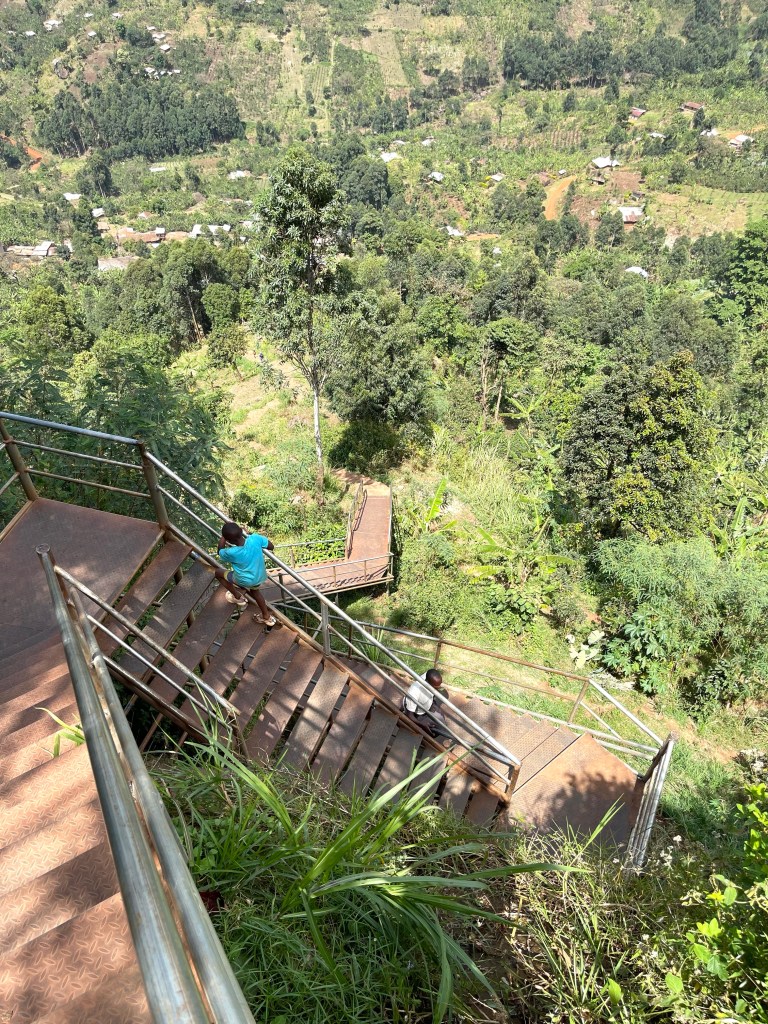
The steps end at a metal staircase, the last 100 feet up the cliffside at the top. Unfortunately, a rock slide has already carried away the top 30 feet or so and it’s been replaced by the usual rickety stick ladder above a dangerously slippery rock face. Some acrobatics are required above the cliff face to transfer from formal steel to the crazy sticks.

At last we are on top. We’ve climbed over 1300 feet since we spotted the path, straight up the side of the mountain, and now stand well over 6500 feet high. The air is thin, it’s good training. The views are magnificent from up here, but I know that our hike home will be relentlessly up and down, and still three hours or more. It’s great to be here. Great to be in rural Africa, with a smiling companion who treats me with fatherly respect and fondness.

Approaching Sipi as evening sets in. Such magnificence

****

It’s now January 23rd. A couple of days ago, I rode back round Mount Elgon to Kitale. What used to be a derelict goat track that took all day to ride, and made me arrive beaten, battered, smothered in dust (and highly exhilarated), is now a smooth road belonging to the Chinese government. “Cheap loans from China are VERY expensive!” I say to the staff at Suam border post.

The journey takes a record short time, door to door in two and three quarter hours, including half an hour of bureaucracy crossing from Uganda back to Kenya.

We are expecting Wanda and Jörg to visit today. I met them on my travels about four years ago and we became instant friends: an older couple from Köln, with an old camping car that they keep in Tanzania and use, like me, to escape from winters in Europe. They made friends with Adelight and Rico and now stop by most years on their wanderings.

As at the remote international border post, where I’m known by my first name, I’m recognised all over town in Kitale; even the street traders welcome me back, the shopkeepers, supermarket staff, all give me warm welcomes. What is there to be afraid of in Africa, the commonest question I am asked at home? Implied, of course, is a immense misapprehension of Africa, encouraged through 150 years of English culture, as we colonised and controlled ‘the natives’. Buried in the question is a huge sense of cultural superiority. It’s all so far from the actuality of what’s around me; of what brings me back year after year; of what’s caused me to form families across this misunderstood continent – where I am greeted hundreds of times a day, made welcome, respected and befriended.

Wayne, Wesley and Maria

****

Next week, I’ll ride back to Sipi. We have to find a better school for the two children. The quality of education in Uganda is abysmal, and they have not been doing well, despite their intelligence, at the best school available, 10 miles away in Kapchorwa, where they had to board thanks to the dangerous driving of the school minibus, packed with small children on the dangerous road. It’s likely that they may have to travel to Mbale, 30 miles down the mountain, to find a better education. Life is tough in Africa. Whatever age you are.

This year’s journey is remarkable for my delight in the small people around me. Perhaps they – and I – am at an age to appreciate this. Keilah is the eldest at eight, followed by Maria in Kitale at seven, Jonathan in Uganda at six, Wesley in Kitale at five and his brother, the wonderful Wayne, whom I could pick up and bring home, at eighteen months, a serious little boy with the biggest eyes and a habit of attracting attention by tapping you, rather than speaking.

I’ve come to adore them all! A fine gift for the mzee mzungu – the old white man! They are making this safari a delight. Who’d’ve thought it?

My smallest friend, Wayne

****

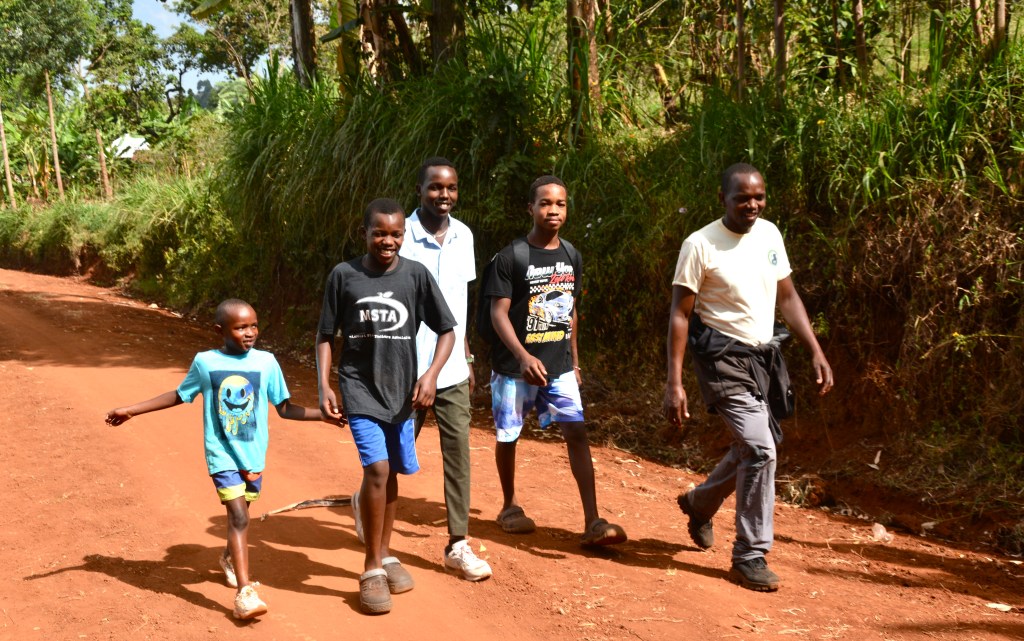
Friendly David, with nothing better to do, like so many young Ugandans, accompanied us for a mile or two on our hike

Eliza, met on the road, gives me a Ugandan smile

At this season circumcision takes place for late teenagers to ‘become men’ (huh, in Uganda?!). It’s common to find them wearing skirts for a few weeks after the barbaric traditional ceremony

Rose, who’s deaf and mute, can communicate amazingly. She’s a favourite of mine in Sipi. Recently, her useless Ugandan husband married another wife, leaving Rose with five children to raise alone. But she still laughs. That’s Africa!

EPISODE TWO 2025

IT’S TOUGH, AFRICA

6th JANUARY 2025

Sipi sunset

Grandfatherly duties take a lot of time, hence the long gap in my updates. Well, they’re not duties of course: they are pleasures; pleasures I never really expected to enjoy until I gained my two surrogate grandchildren in my ‘old’ age. A great gift.

Keilah and JB

My favourite African, charming little Keilah, eight years old, is a warm-hearted, unsophisticated but intelligent little girl. We rather love each other! Jonathan Bean is a boisterous fellow, just turned six years and full of life. He copies most of Keilah’s actions and they entertain one another happily, with few spats or battles, perhaps thanks to Keilah’s patient nature. They join in the household activity, as most African children do in a culture without ‘labour saving’ devices. Washing all the guest house bedsheets is a constant chore carried out in the garden in plastic bowls; cooking is over smoky open fires or charcoal; cleaning is with hand-brushes and cloths. Ask the children what they’ve been doing, and the response is invariably, “Sweeping…”

JB – ‘Beans’

Now they are growing I don’t get wakened at their whim, but they watch for the door of my house opening, my signal that I’m ready for my morning hug and greetings. We breakfast together up in the crazy wooden restaurant, product of Alex’s imagination, all formed from wooden poles, elevated ten feet above the compound, decorated by me with line drawings in mud paint of local activities and scenes. I’ve come to love these two children – and perhaps I’m at a time of life to fully appreciate the joys of having small children around. I never felt the paternal instinct – too restless and free spirited for that, but I DO like children and finding two such delights now is a great joy. But they do demand attention that prevents the peace to sit and write…

****

A magnificent chameleon. Great colours!

I rode round the mountain on December 28th, now a fine quick ride on the sweeping Chinese road. It’s twenty yards wide and empty of traffic, except local boda-boda motorbike taxis and a few labouring local trucks. Why the Ugandan government has elected to build this expensive folly, and the extravagantly vast ‘One-Stop’ border post (built by the Chinese State Construction Corporation…), is impossible to understand. No articulated trucks, the traffic that blocks the lower altitude border posts between Kenya and Uganda, is likely to opt to drive over these high mountain shoulders, with steep inclines and curving tarmac. And few tourists come this way to be impressed by the hubris of the ‘One-Stop’ border post, another source of immense debt to the rapacious Chinese government’s economic colonisation scheme. In lieu of debt repayment, China last year seized ownership of Entebbe Airport, Uganda’s state airport. (They tried to get Nairobi’s airport last year, but the Kenyans united in objection…) China does nothing for free, and the president is well entrenched in their pockets. Poor Africa. The British stole their resources for 150 years; the Americans imposed their hideous cultural colonialism; then the Chinese milk what’s left, providing apparently cheap loans that come with vast cost – repaid in land grabs of mineral-rich untapped mountains and deserts and natural resources.

The unhurried border officials recognise me now. My passage, with my hard-fought six month multiple entry visa causes a little consternation to Betty, the immigration officer, who has to consult her superior, but is apologetic for the delay. Business is still done by the same few officers in what appear to be huge garages; there’s been no progress with the giant architectural folly since March. Priorities are perhaps best proven by the only large poster in the Kenyan immigration offices: ‘8-ball English Pool Official Rules’. The pool table has been the centre of activity for the seven years I’ve been coming this way, since the days of the broken gate, the dust-covered tin huts, the concrete colonial bridge from 1956, and the rutted goat track across the rugged mountains. This time, I arrive at lunchtime and must wait upon the immigration officer’s whim.

****

Half Uganda, it feels like

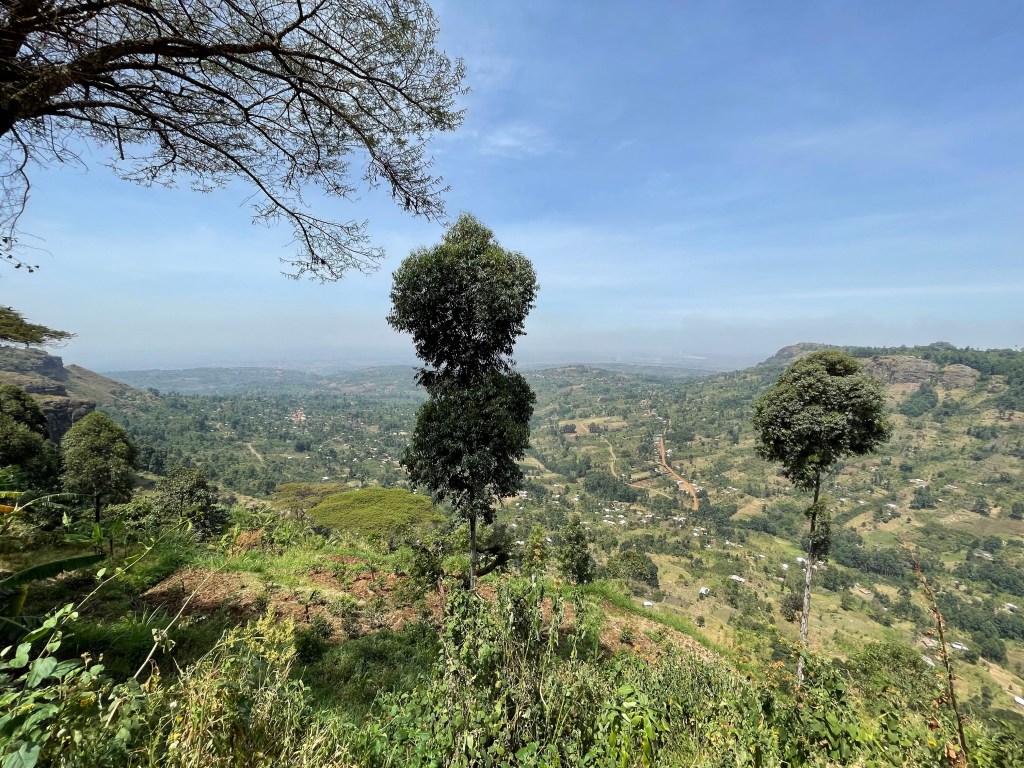
The views to the north feel as if I am gazing over half Uganda. Small pimples of extinct volcanoes prick the blue-hazed distance. I lean and bend; this is one if my favourite roads as it weaves its way along the mountainsides. It’s difficult to remember just how hard this road was four years back, a deep dusty, rocky rutted track – that was SUCH fun to ride on my small trail bike, 90 miles of exhilarating riding. Now it’s smooth and boring, but quick. I’m reminded very soon just how outgoing Ugandans are, as children scream from the steep banks and adults stare from their doors of tin-roofed, earth-built houses at the roadside. It’s fun to ride in Uganda.

****

JB

Then I’m at Rock Gardens for the welcome the children have anticipated for so long. Precious is ululating, the children clamouring. Alex is away at a clan function, elected MC yet again, this wise, smart young man.

Alex and JB

There are new buildings everywhere. This is where my money’s gone since March. Most of ten grand of it. Two new round houses with grass roofs (over metal sheets for the abundant rainy season), a new gate and gate house, a raised wooden terrace that stands higher than the hedges, and an ugly sort of bungalow block, imposed amongst the ‘traditional’ round houses.

An ugly Kampala bungalow…

It’s a mistake, I see immediately, out of proportion and angular, like something dropped in from a housing estate in Kampala, amongst our quaint structures. When Alex comes, he tells me he had to build it as Ugandan guests are too proud to sleep in our old fashioned African heritage rooms! Its ironic that he has to pander to pride here.

Rock Gardens is still the cheapest accommodation in Sipi, getting the highest ratings on the internet, popular and well booked. Travellers now use the multinational corporations to book their rooms; gone is the fabulous serendipity of going and looking for yourself. It’s in Alex’s favour, but I regret that so many young travellers have such a tame experience nowadays; it’s taken the adventure out of travelling. Even backpackers book ahead now, book guides, do the same activities as everyone else. It’s bland and lacks the initiative we older travellers required. Now they sit on their phones and ‘share’ it all with their friends at home, instead of being in the moment – in Africa. Well, times change I suppose and mine is only the bleat of all the old about the young…

****

We decide to remove the bungalow roof and redesign it: it’s far too dominant. As I write, the appalling workers are demolishing the zinc roof. Every construction job in Sipi is done with no more than a hammer, a panga (machete) and a hoe. Hammers have long lost their handles, replaced with odd bits of welded pipes; pangas are shortened by use and the hoes have rough sticks for handles. I lose my rag many times a day. Why not buy some simple tools? A chisel to separate bricks instead of a battered hammer: we might save the bricks. A jemmy, surely no more expensive than a couple of pounds here, to lever the timbers apart. They’re all nailed anyway: you can’t even BUY a screw here. Instead of a small outlay, they waste huge amounts of energy, doing things the difficult way. I’ve stopped buying any tools and bringing them from better supplied Kenya – they all get stolen within a week, or are destroyed by lack of care. One day, I ask for the spirit level. I bought it last year. Now it’s blathered in old cement, with its level missing and shaft bent. I have to throw it away. “Oh, do it your own bloody way!” I just yelled at Tom, the worst wood butcher I know. I have to walk away.

****

In October, two electric poles fell down up the muddy lane to Rock Gardens and its village area. A young woman died. It’s a common death here. Five people have been buried from deaths by electric shock in the past months. I’m not surprised. There’s a flagrant disregard for the dangers of 240 volts, where wires are knotted and bare, poked into sockets with sticks, and left in uninsulated twists, open to all. Right now they’re burying another victim down below Rock Gardens.

So Alex (me!) invested in a generator. It’s making a hell of a racket and something is very wrong. Even I, lousy mechanic that I am, can tell. When I investigate, I find that someone – ‘who knew the answer’ and fiddled, has stripped the thread on the spark plug housing. There’s no plug cap anyway, just a twist of HT lead. I forbid Alex from letting ANYONE else even touch the machine.

Kato confidently strips the generator

“Ring Kato now!” I demand, knowing that Kato, the mechanic that now looks after my Mosquito has more skills than any of the ‘mechanics’ in Sipi. He rides down from Kapchorwa, the town 17 kilometres back up the road. In twenty minus he confidently strips the machine. It needs a new cylinder head, the barrel requires reboring, so a new piston and rings; the silencer needs welding up where it is shattered right round. The valves need decoking and adjusting, the armature is covered in oil and the brushes knackered. It’s so far out of tune it’s amazing it runs at all. Most nuts are stripped and rounded.

A stick connection – 240 volts out of the generator…

It cost over £200. Sipi’s ‘experts’ have destroyed it already. It costs me £80 for Kato to get it working again.

It’s TWO MONTHS old.

****

Loading the water tank the hard way

Alex is stressed much of the time. It’s so difficult to run a guest house for so many strangers in an ill-supplied place like this. The state electricity probably won’t be repaired for years, and only then when there’s a big enough bribe to some official. On January 1st, the water supply mysteriously goes off. We spend the morning carrying water in 20 litre jerrycans up the hill from the spring, 100 feet down the hill. I make three trips: 60 litres. Water for guests who have no idea what it’s like to live without a tap to dispense purified water. We suspect that the minor ‘official’ in charge of this area supply has turned it off to get bribes to reinstate the supply on this public holiday. But everyone spends hours of labour trudging up and down the hill. The water comes back just as mysteriously at midnight. The water official is also the local ‘plumber’, moonlighting. He’s installed a lavatory in the new ugly room. “It doesn’t flush…” says Alex, “and there’s something wrong about the seat.” The ‘plumber’ left without adjusting the plunger on top, and fitted the seat brackets backwards, took his money and left. He hoped Alex would call him back and pay him to ‘repair’ his workmanship. He didn’t bargain on a practical mzungu!

Rach, Alex’s half brother, a good worker, helps me paint the ugly bungalow with paint we make from local soil and PVA

But it’s this way all the time here: lazy, uneducated and backward. This clan, Alex admits, is known for its jealousy. They look at him progressing, and rather than cashing in and gaining from the tourists he’s attracting – setting up small kiosks with their produce, making handicrafts or souvenirs, getting together to put on cultural displays – they undermine his business. The local expensive hotel set up a scam to deplete his reputation: they got a young woman tourist to come to Rock Gardens, pleading poverty and needing a cheap deal. Alex is generous about this. “She kept herself to herself,” he says. “She didn’t come out of her room, and she couldn’t afford to eat!” Next day, she claimed that $500 had been stolen from her room. To avoid damage to the reputation of his business, Alex had to pay up. “I think she wanted her fare home,” he says with an ironic smile. “Even the police, so corrupt themselves, suspected it!” Later, he found that he had been set up by a jealous local hotel.

Locals constantly tear down his guest house signs, and have thrown stones through guests’ car windows. They break and steal out of jealousy. They ‘steal’ his guests, taking them elsewhere. He began to get bad reviews from guests who never even came to Rock Gardens, redirected to inferior places by his local ‘agents and guides’, forcing him to close his account with the horrid multinational booking company we all know but I can’t write without importing links to your device as you read. He sacked his ‘guides’, lost all fine reviews he had, and had to start again.

Girls v boys, skittles in the road with plastic bottles filled with sand. The girls won this round!

Scratch the surface of rural Africa and you see the truths hidden beneath. But where, in a country like this, is there an example of selfless decency? It’s corrupt and amoral from the very top to bottom. The president’s wife is minister of education and sport, his daughter head of the national bank, his son head of the army and president in waiting. Every official and politician is utterly corrupt. Nothing happens without greasing the wheels.

There is no example. Immorality spreads, especially amongst the misogynistic males. Rape and unwanted pregnancy is astronomically high: “Probably 85 percent of families in this village have had unwanted pregnancies amongst their daughters. Many of them schoolgirls!” Last year there was a revolting crime committed in this village. Two teenage girls, one of them with learning disabilities, were given the choice by a gang of drunken boys: either be thrown over the 200 foot high cliffs or be gang raped. The boys fled across the country but, Alex tells me, the father is a rich man and had the resources to insist that the police did not give up. Some boys were caught as far as the border to Rwanda. Several are now on remand, and may spend years in prison. But it was the father’s wealth that made for a measure of justice, not moral indignation. “The community kept quiet…”

****

Recently, Alex ‘rescued’ Josephine, left pregnant by a married boda rider, who subsequently threatened violence. She was rejected by her family; tried abortion herbs unsuccessfully; considered suicide. Alex employed her at Rock Gardens, a reserved woman with a gentle smile once she’s comfortable. This week, a baby boy was born in the hospital (another bloody Ugandan man in the making) and after two nights she came home. I can now add £100 ‘birth fees’ amongst my very varied expenditures in Africa, way beyond Josephine’s resources. Alex was going to pay, from his small profits.

Alex tells me about his latest ambition: to construct a sheltered haven for all these young women left with unsupported babies by irresponsible men – the ‘85% of local families’. He already completed a rough hall on a plot of land a few hundred yards away. He hopes to be able to provide a safe place where these often rejected girls and women can gather to share their lives and fears, perhaps to find mutual support to care for their babies and find some way to support themselves. He plans to set it up as a small local business and hopes for support from visitors and donors. He’s a determined young man with a strong social conscience. I will support him of course…

****

In Kapchorwa, 17 kilometres by road, where we’ve walked over the shoulders of the great mountain, probably 20 kilometres, with Sarah, a visitor from Germany, Alex introduces me to an age-mate, 74. As he leaves, Alex tells me, “He has 46 children! From six women.” Poor Alex, who volunteers to try to reduce the birth rate, increase education for girls, stop female genital mutilation. Men with whom we are sitting, laugh at my anger. They don’t understand anything but that he is a ‘strong’ man. I bet he can’t even remember the names of the average eight children of each woman.

This baby factory of Uganda undermines any hope of continued human life on this planet over coming centuries. Over seven children is the average per woman, most families include children by ‘outside’ women. Rape is endemic. Uganda has grown from 5 million to 50 million in my lifetime. The growth is exponential, rising to 100 million by the end of the century. Resources of land stay the same. Pollution increases. Food quality reduces. Education is low. Morality elusive. Good example rare.

But the Bible and Koran both, “Tell us to have babies…” No one understands the pressure on the planet’s resources. “God will hep us if we pray…”

****

Uncle Jonathan cuts a New Year cake, thoughtfully baked by Previous for a varied group of guests

At Rock Gardens, we have varied visitors, most of them very congenial. Interesting folk from all over the world, the exposure for Precious and the children is terrific. Precious, now 29, has matured a lot, gathering liberal opinions from the many young people who stay. She now accepts that two children gives her family a chance to develop, be well educated and remain healthy, a fact that most rural Ugandans fail to grasp.

****

Walking down below the steep cliffs, accessed by dramatic ladders, we stop at a simple house amongst the matoke banana trees. I’m known here and the welcome is fulsome. Alex and I are with two smart, open minded Dutch young people, Rosa and Vincent. Two small girls are fascinated by Rosa’s long light-coloured hair. She’s a good traveller, patient. They stroke and play with her hair for half an hour. Miracle is a thin girl in a black leotard, cropped hair and a shy smile. Her friend and mentor is Elizabeth, a very bright girl of about eleven, I guess. (I can seldom guess ages as African children are usually so much smaller than Europeans). “What’s your ambition?” asks Alex, always quick to engage children in conversation.

Elizabeth and Miracle dress Rosa’s hair

Quick as a flash come the retort, “I want to be a lawyer!” We are all impressed by her certainty. She has an educated father, who’s a local small-time politician and clan leader, so perhaps she has a chance in this misogynistic society. “What do you think are the obstacles?” asks Alex.

“Ignorance of parents and the attitude of men,” Elizabeth replies confidently. We all praise her determination and encourage her. It’s always good – and sadly rare – to find girls and young women with confidence here.

****

Hard walking for short legs

Thank goodness we have our hikes to get us away from the frustrations and irritations of local rural life, its jealousies and hatred. Alex is a great companion. He gets no support from his own family, despite being the firstborn so I’ve taken on the role of father-figure.

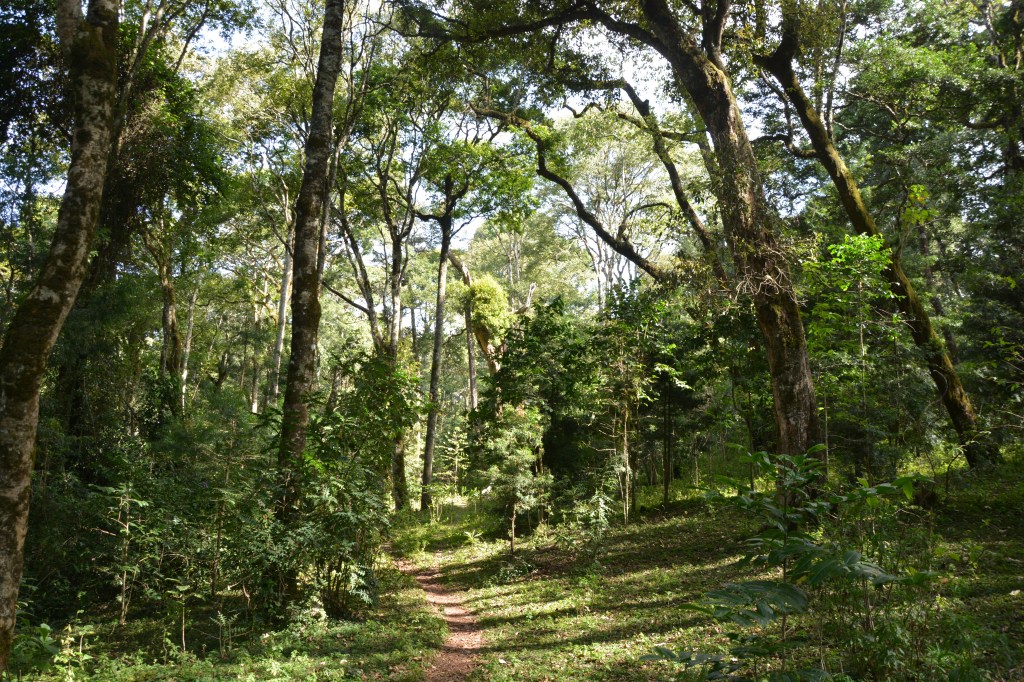
We have some long hikes we like, and are always looking to extend our repertoire. One day, we walk to ‘town’, Kapchorwa, a hike that he does frequently now, maybe 20 kilometres. We hiked it together for the first time three years ago. It’s varied country, dipping into the Mount Elgon national park with its old mature trees and birdlife. We cross streams, struggle up loooong hills of grass and colourful equatorial scrub. We climb to some high bluffs that Alex calls, ‘Jonathan’s Point’. There are vistas all around, green valleys with swishing banana trees, tall conifers, and winking tin roofs. Red dust roads wind around the contortions of the steep hills. The extensive plains far below fade to the horizon.

We relax and unwind. Here and there, our routes have a frisson of excitement as we must clamber ladders, some made of steel and others of rickety timbers nailed to tree trunks leaning on the cliffside.

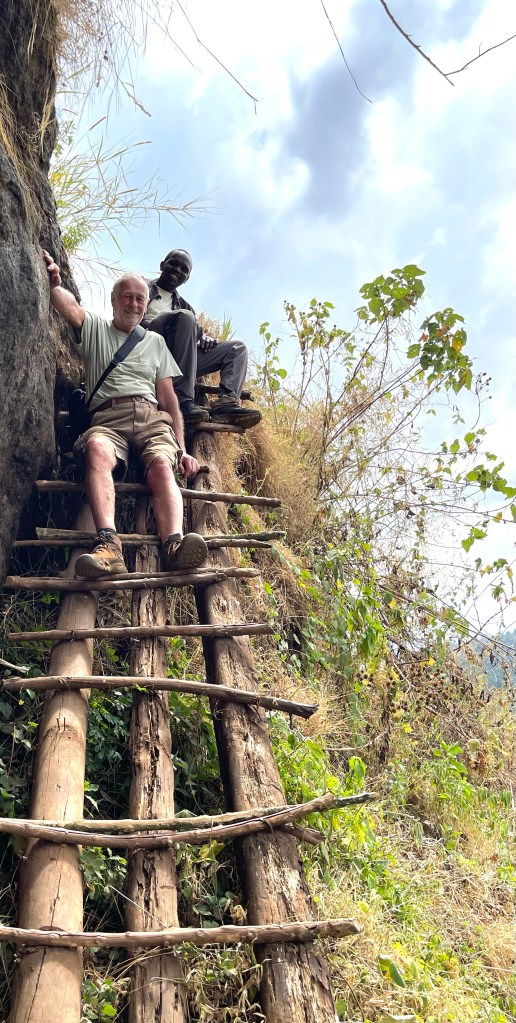
My final adventure of 2024, up the crazy ladder on New Year’s Eve

One day, we take Keilah and Jonathan up that crazy ladder. They love it! With no fear, Jonathan shins up the steep rungs, laughing in excitement. Both children, followed by their father, wave down at Uncle Jonathan 70 feet below. Uncle J ponders how we overprotect our Western children from all dangers and risks, limiting their the opportunities for such adventures. As we climb into the gulley at the top, two small girls – carrying bags of cassava – bounce up the bendy tree-ladder, as they probably do every day to get to school.

Jonathan shins up the ladder ahead of Keilah and Alex

Life in Africa is frustrating and often disillusioning. Tourists see the romance and glamour of traditional life; they see the wild animals (all in parks now), the exotic dances (posed for their benefit alone in modern African life), the quaintness of traditions and the humour of illogical situations. But when you stay here, become involved in family life in a rural area, amongst the ignorant and prejudiced, it all takes on an edge that is sometimes cruel, often aggressive and jealous. The ‘traditions’ can be barbaric, the uneducated mindset antique, criminal behaviour common, cruel practices all too prevalent.

It’s hard, not very romantic – but then I have made families whom I care for a lot, grandchildren I love, many I respect as they struggle against ignorance and narrow-minded attitudes. It’s both an education and a privilege. It’s tough and it’s warmly loving.

It’s my life now!