KENYA, UGANDA, GHANA. THE 2026 AFRICAN JOURNEY

EPISODE TWO – JANUARY 14th 2026

Trail riding doesn’t come like this in Devon!

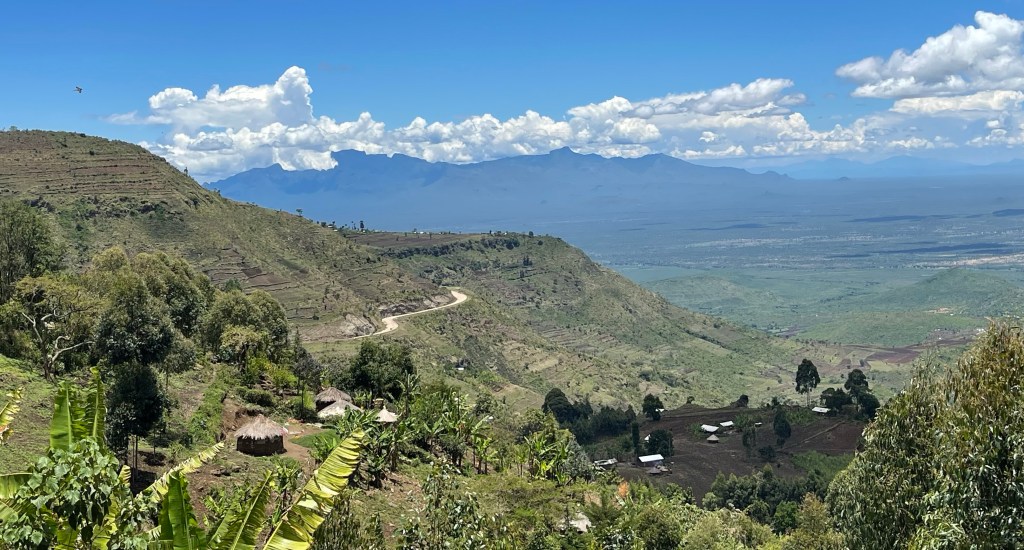
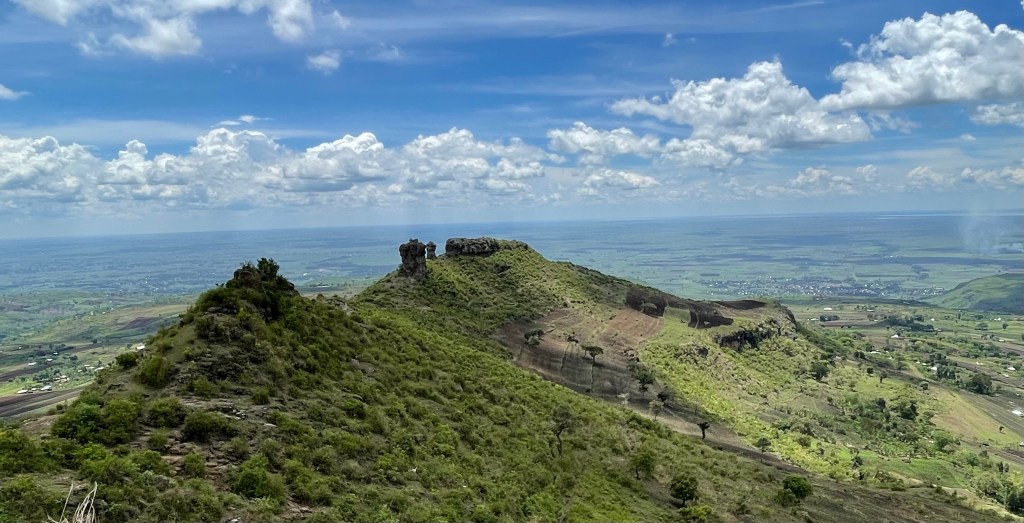
I’m often struck by just how remarkable all this is. Here I am riding a high precipitous rock and gravel road along the very lip of the Great African Rift Valley, inches from a great plunge into the oven-hot depths. I started trail riding forty eight years ago – but then it was for fun, brief Yorkshire trails over boggy moors and up and down stony tracks. Here, it’s sometimes the only road to use. But, I admit, it’s usually the one I choose, even if there’s a tarred alternative.

Riding along, bumping and bucketing about on one of the most impressive trails I can imagine, people run to the roadside to stare and wave; crowds of schoolchildren cheer at me, a flutter of pink palms and white smiles on young black faces, skin so smooth, unlined yet by the hard lives most of them approach, here on this escarpment slope. They’ll scratch at the red soil and herd a couple of cows and some goats, until they end up creased and dressed in tattered clothes like the old crone with one eye on the back of a boda I stop to ask directions from the rider. She looks at me like something from another planet – about her age, in all likelihood, but a world apart, a result of an easy life in the profligate North, good nutrition, education, medical intervention when required, relative wealth and CHOICES – the biggest difference between the prison of poverty and my relative ease of life. I’m choosing to ride this stunning track; she has to, bumping about on the back of a small motorbike in such discomfort for an old woman. Time was, of course, she’d have had to walk this way, without even the pennies for the ride. The ride is perhaps a luxury conferred by her old age.

It does make me reflect on the inequalities I witness everywhere around me and puts life in a different perspective. No one here, in their late seventies, in any condition – of wealth or health – can CHOOSE to do what I’m doing. Even if they wanted to.

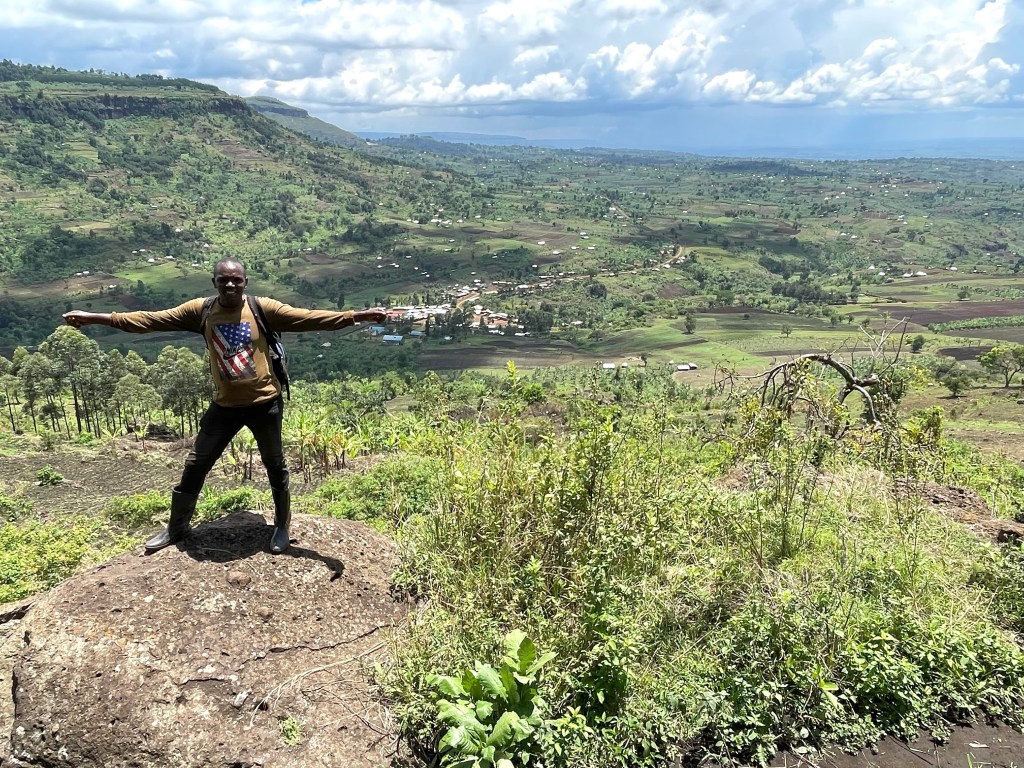
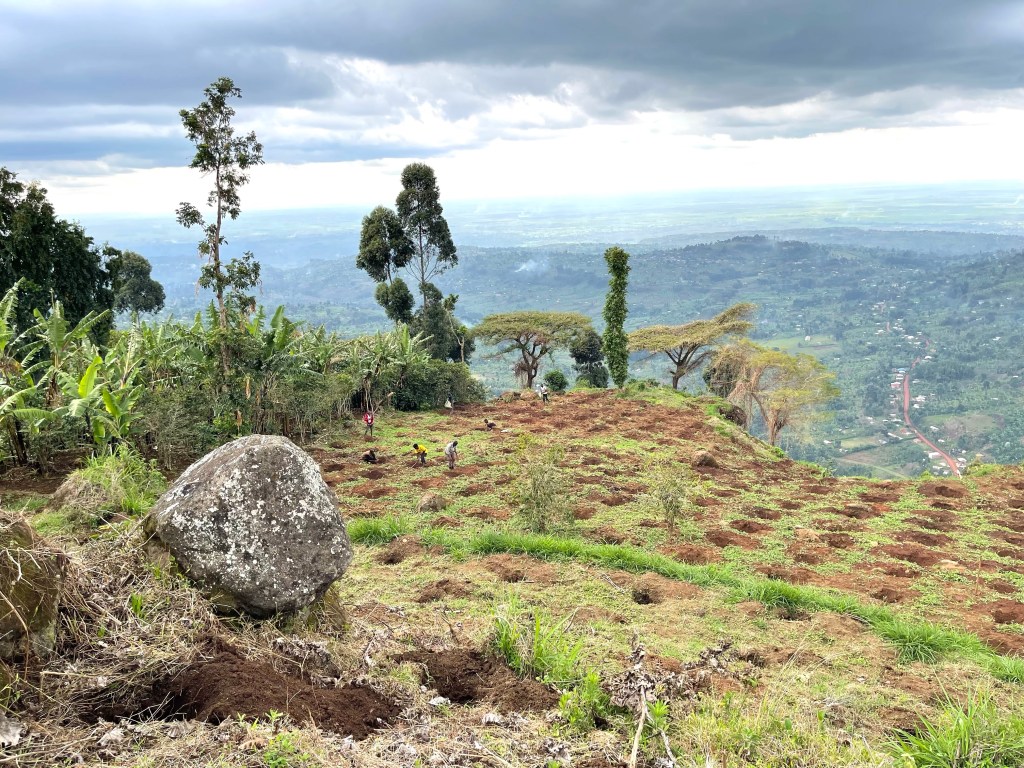
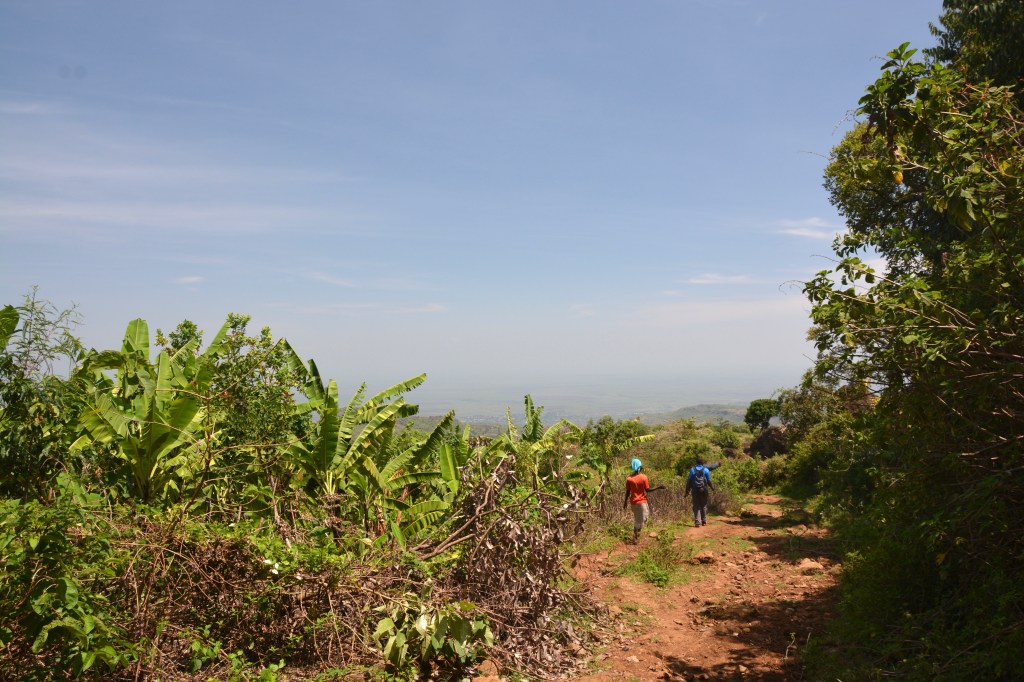
The view downwards…

****

Thirty kilometres on this punishing red road bulldozed across the steep slopes and I get lost. But there’re always boda-boda riders to flag down and ask the way. They make a living – of sorts – riding their unmaintained small Chinese machines on these vague roads. I follow this rider for several kilometres, breathing in his cloud of dust. My eyes are prickling, despite goggles; I think I’m suffering a paucity of vitamin A. My diet here is pretty simple, although mangoes, of which I have about five kilos (for £1!) bouncing on the back of the bike, contain it. It’s mainly in liver, fish, cheese, butter, squashes and greens – none of which feature much in the African diet. Lack of vitamin A, I found from a clever Ghanaian doctor years ago, is a cause of much blindness in Africa, as the surface of the cornea becomes dried and crazed. Feels like mine’s going that way these past weeks, with itchy eyes. Again, my knowledge and wealth mean I can get some supplements from a pharmacy tomorrow.

He puts me back on my road and I twist and turn on the high Cheringani Highway once again. It’s a fabulous road – tarred, this one, for now at least, depending on maintenance. It clambers through high scenery, hills rolling off into the blue midday, the sky deep blue above. I’m always conscious of the sheer immensity of African skies. As I ride up to 3060 metres (10,000 feet) above sea level, I dodge cows and sheep; people wear woolly hats and coats up here, and I must stop to put on a jumper under my jacket. Surprising how cold 15 degrees can feel!

There’s a road I’ve never taken, that drops sharply over the southwest face of the hills to the straggly town of Kapcherop, where tea bushes carpet the slopes around town. From Kapcherop, I’ll sweep on down, on deteriorating tar, full of dangerous holes and speed humps, the obsession of Kenyan road engineers, to the Kitale road. I was told of this road last year by some fellows in a tea house. I’ll try it…

Never again! It’s an APPALLING loose rocky staircase slithering downwards. I must concentrate and leap and dance about on my little bike. TEN MILES of this punishment. Good exercise, I tell myself. But I’m aware too, that a small mistake can cost me dearly. I mend much slower now. However, I stay upright and my Mosquito, now running soundly, does good work. We eventually emerge onto tar again – both of us worse for wear.

Then, with speed humps, wandering cattle, mad boda riders, straining vastly overloaded lorries with bits flapping, potholes and grumbling tractors almost as wide as the road with dry maize stalks, it’s the usual African riding back to base at Kitale.

****

Faith. We hiked 11 miles to visit her! The best worker the Kessup guesthouse ever had

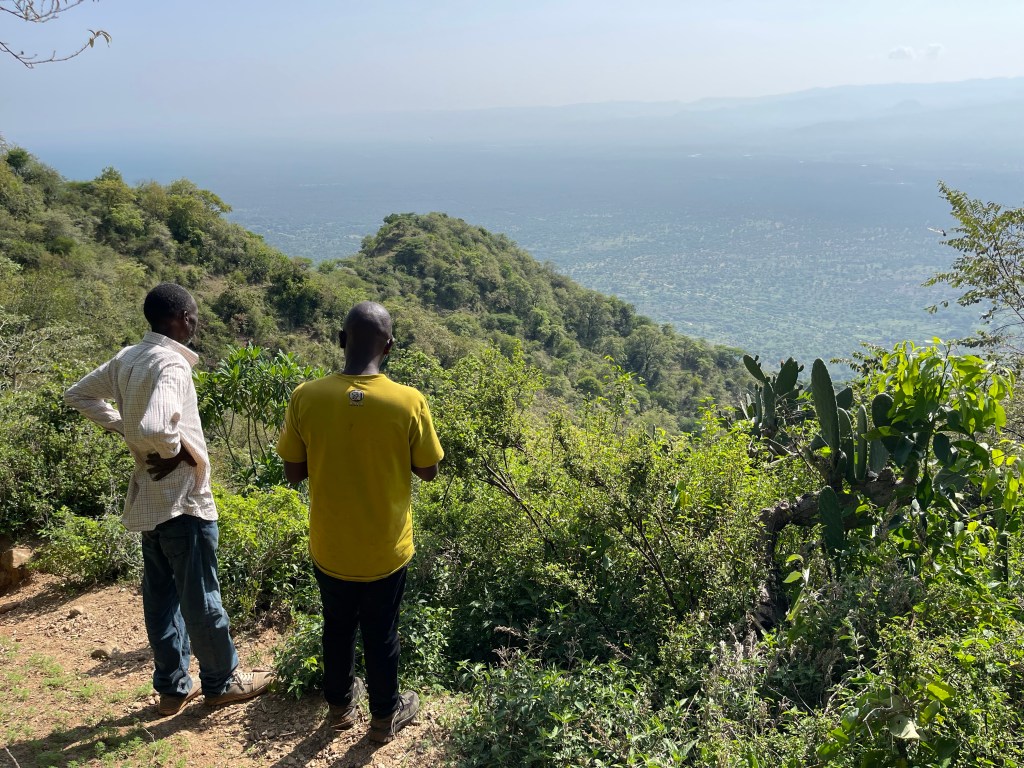
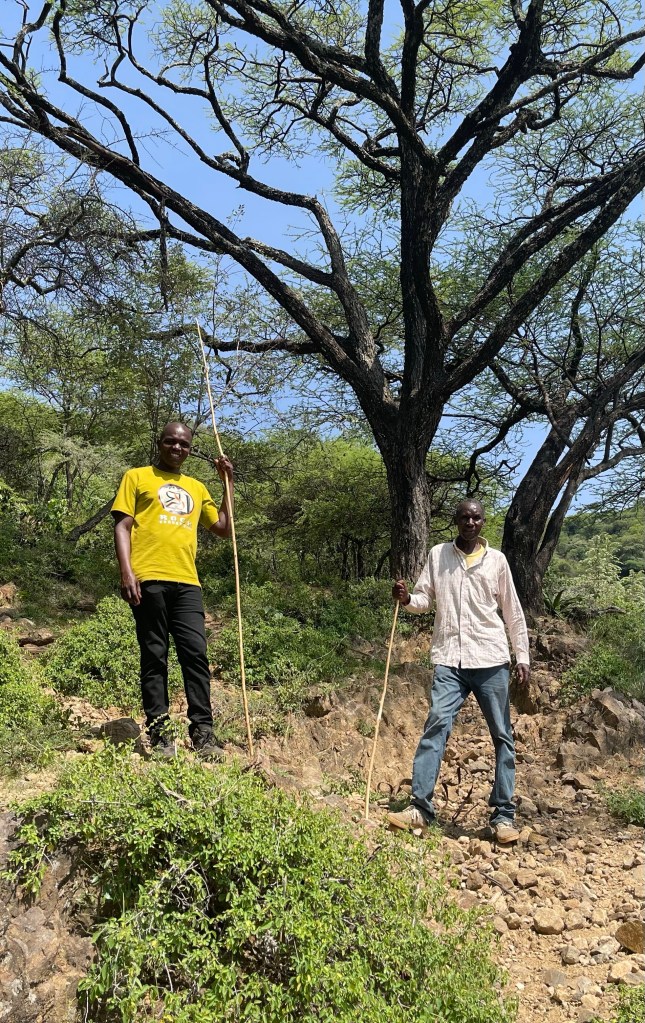
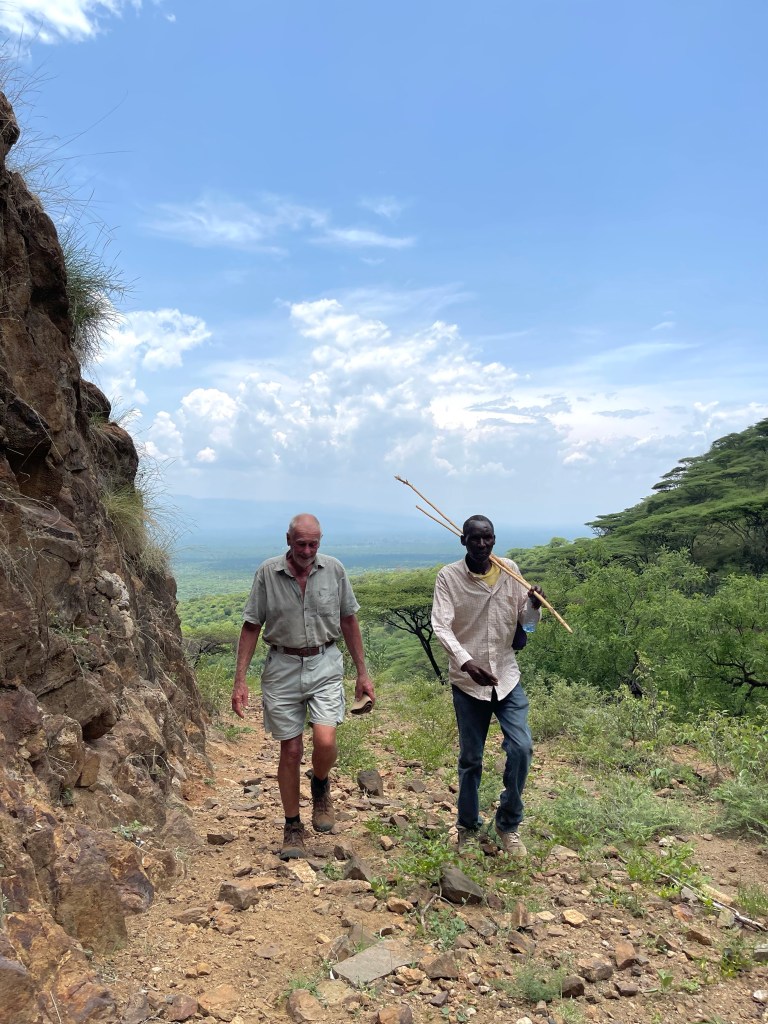
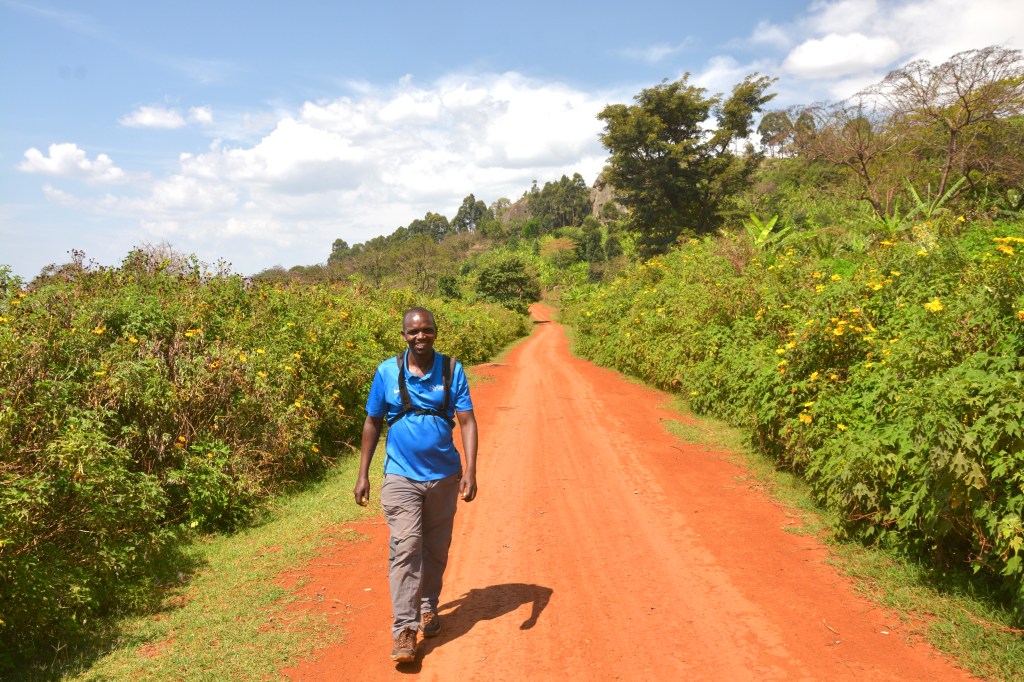
For four days, I went to Kessup to hike in and around the Rift Valley with William, the friend I made nine years ago. ‘The goodness is…”, as he so often says, is that we both like people and we both enjoy walking.

Three or four years ago, I gave William a Holstein cow. He called her Dutch. The best way for me to help my friends in Africa is to encourage financial independence. The cow cost £375. A year on, she gave birth to British, a male calf. Another year later, last October, she gave birth to Joy (named after my mother!). A few days ago, while we were hiking into the great valley, Dutch was bellowing all day, a sign that she was ready to be ‘served’, in the coy, apparently sexist, phrase. William, in great excitement, called the vet who specialises in artificial insemination. He guarantees a female calf – or money back (£40). William dreams of Wilhelmina to complete his dairy farm. With three milking cows, and the sale of British, the male, his dairy will be complete. I’ve also paid for a rough wood shelter, and to bring water pipes down the mountain to his shamba. About £750 of my money can make William self-sufficient, able to sell milk to the cooperative for a few pence a litre and feed his cattle on homegrown maize.

Half way down the escarpment, William takes a cooling rest

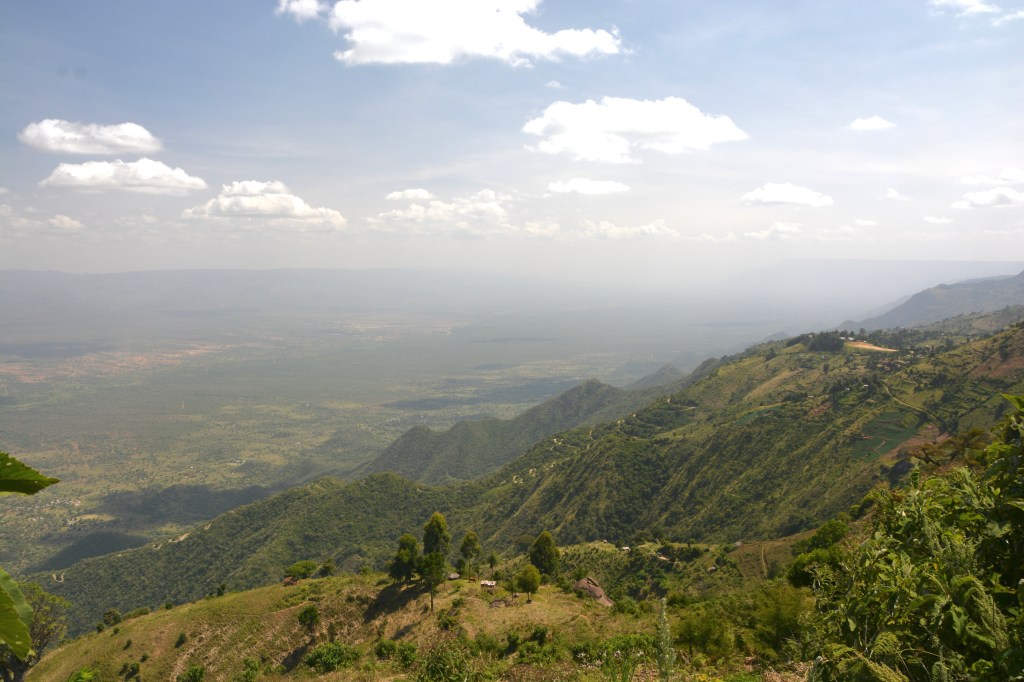
The Kerio Valley. Great hiking but HOT

In return, William introduces me to his community on the edge of the Kerio Valley. ‘William’s Mzungu’ is well known on the red dust tracks and amongst the fertile shambas below the soaring cliffs that top the Rift Valley here. Each day, we hike in the fine nationally protected forests on top of the escarpment or down through fertile smallholdings into the burning depths. The bottom of the valley, where the finest mangoes in the world grow, is 2750 feet lower than the guesthouse where I stay; the top of the cliffs are another 1250 feet above. That’s 4000 feet from bottom to top! All on friable rocky, stony informal footpaths in the hot sun. Eleven mile, five mile and eight mile hikes, staggering up and down these step paths at between 3900 feet at the bottom and 7750 altitude at the top. Mighty exercise.

Kessup Forest, well worth the climb

The forest on top of the escarpment is magnificent and silent, filled with birdsong and dappled light. A still day, the shadows merely flicker and dapple the bright undergrowth. A few cows graze, with bells tinkling. Deep blue acanthus blooms in spiky leaves. The sky above is crystal blue, unblemished.

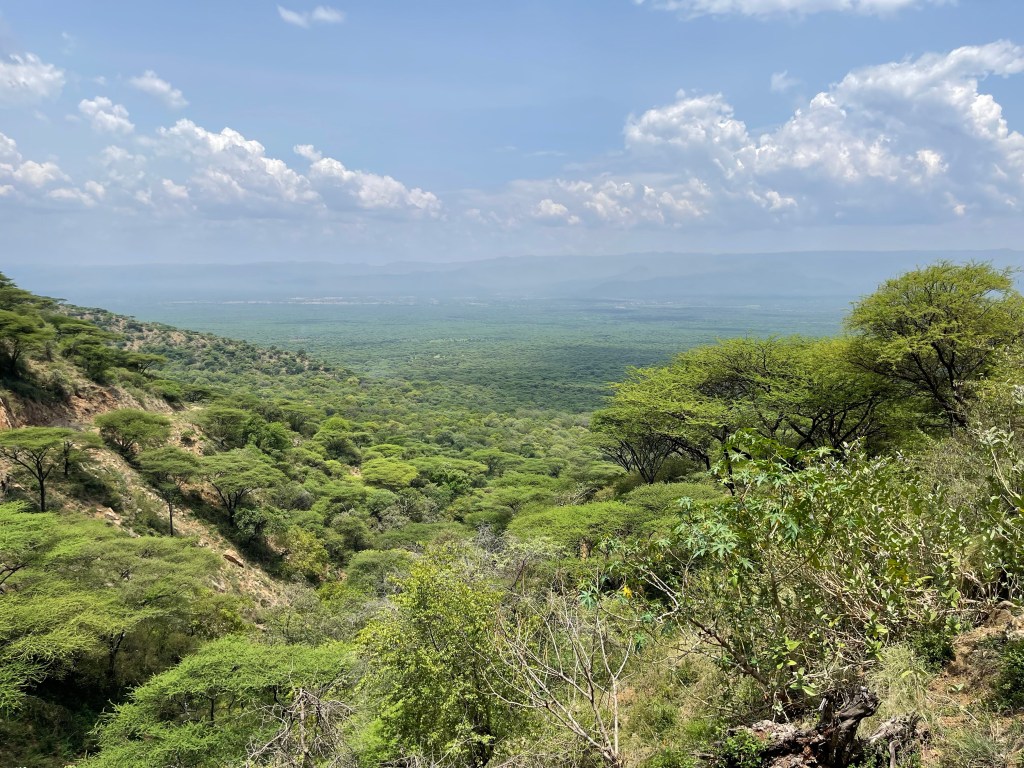
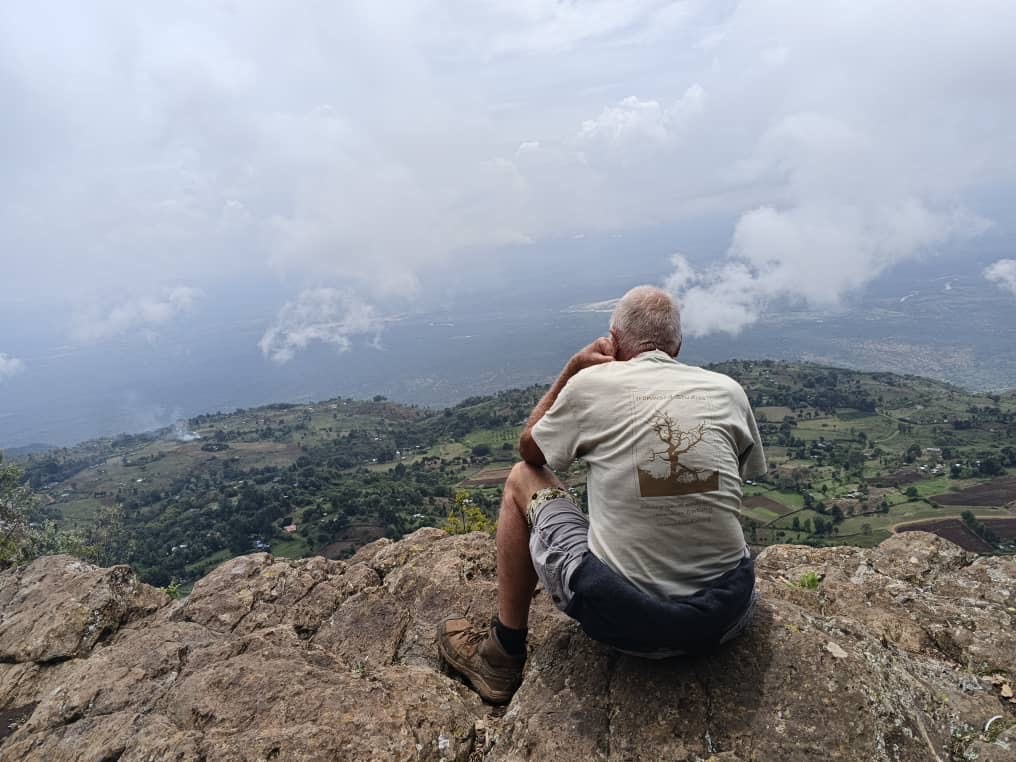
Then the great chasm of the arm of the great African Rift Valley appears through the trees far below. So dramatic, this vast plummeting 4000 foot deep natural cleft. Just now, it’s filled with haze and the other face, twelve or fifteen miles away, to which I once unforgettably hiked through vicious thorn bushes and between grazing giant elephants, is invisible.

****

11 pennorth of spinach!

Desmond, an intelligent 27 year old I’ve met in past years, joined us on the walk up to the top to drink moratina, a home brewed, brilliant yellow honey wine, brewed on Sundays. The government has imposed tax and restrictions on its sale, but this being Africa, there are ways around things. It’s just less visible.

Apparently, I influenced Desmond to ‘get his life together’ a few years ago, with advice to take charge of himself, stop wasting time at home as the last born of nine, and go out and face the world. I have NO recollection of any such sage advice, but it’s remarkable where a mzungu’s influence lands! An onerous responsibility.

One day, Desmond stopped behaving like a teenager, upped and left home. He did menial work in a city hundreds of miles away, renting a room for £30 a month, but determinedly paying his rent on time. His landlord was impressed, and happening to be an official in a far distant education authority, he offered Desmond, trained as a teacher, a post. It’s in an end-of-the-world town, in the farthest corner of Kenya, sandwiched between war-torn Somalia, and troubled Ethiopia. You can’t go further east or north in the country, than this place that ends as an arrow head of Kenya, with two war-torn countries actually visible on either side. I suspect Desmond got the job because no one else wanted it. It’s a tough area of Islamic fundamentalism, where life is cheap. He will be authorised as a fully fledged junior school teacher in a few months, launched on a career without the bribery usually necessary.

To buy a teaching job, the going rate of bribe in Kenya is about £2900. To enter the military, expect to buy your job for £5750 at least. It’s for this reason that everyone is propositioning the mzungu to buy their land in Uganda, where these bribes are correspondingly enormous. Selling land that has passed through generations of peasant farmers and which can never be rebought; capital that is irreplaceable. Better to get your son (seldom daughters, of course) a paid job in some form of government work, than be a farmer – despite these being some of the most fertile regions of Africa. Government jobs bring the bribes and backhanders and the only potential to make you rich – if you have no ethics and only the morality assimilated from your leaders.

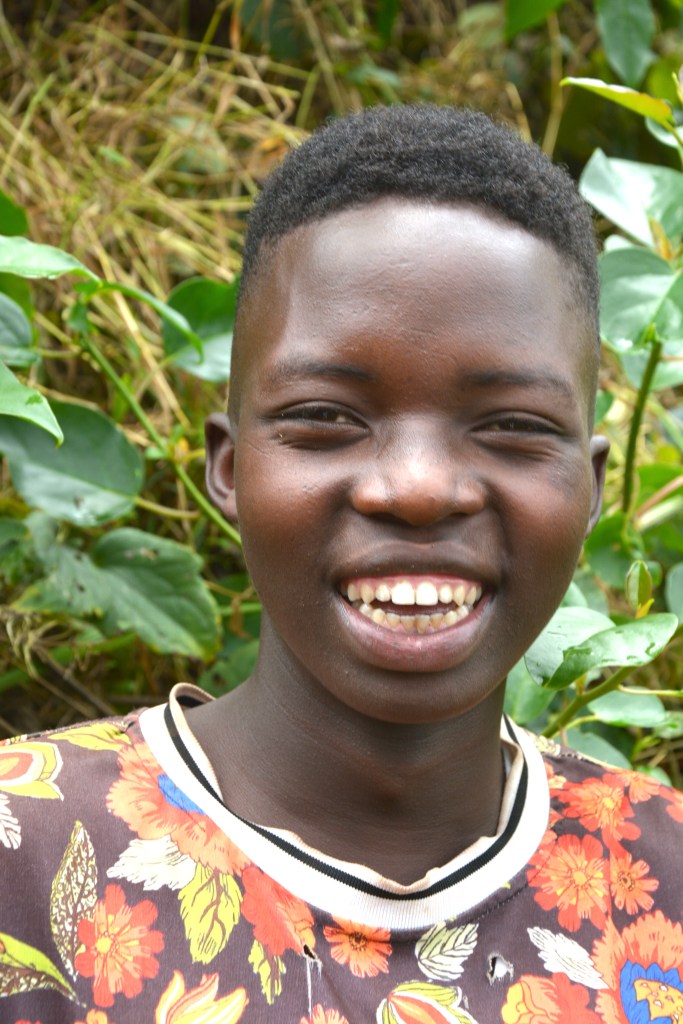
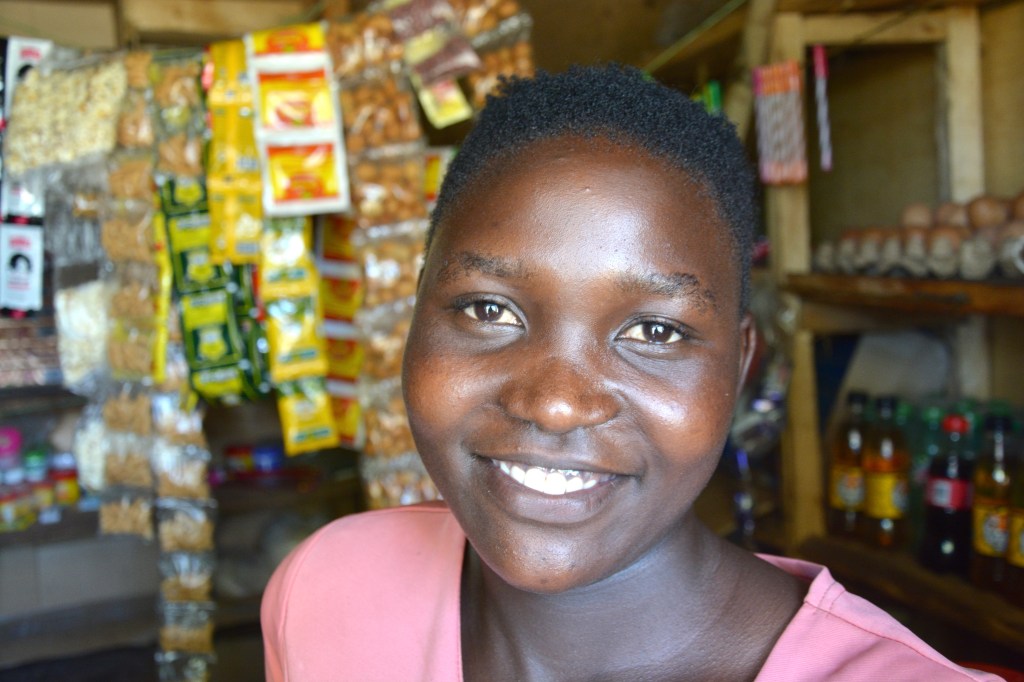
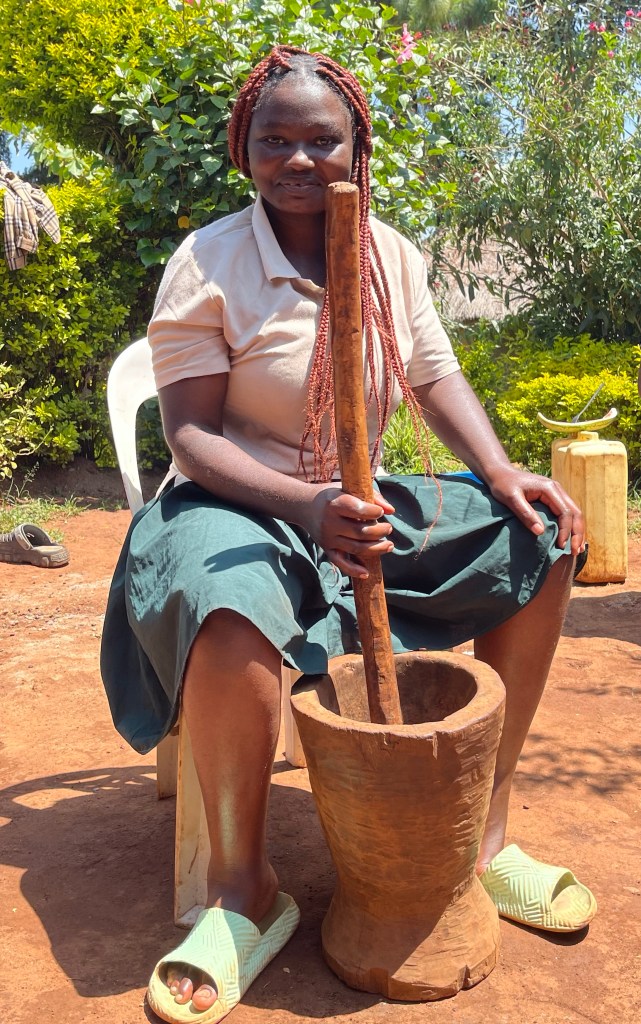
Queen, a Kessup schoolgirl

Chirpy, optimistic Desmond is committed to his post. He reckons to stay for five years, in a prejudiced Moslem area where Christian Kenyans aren’t popular, there’s no alcohol and no women. His ambition is to earn enough to start farming back here in the Kerio Valley area. He deserves to make it, this fellow with good integrity, admirable moral concepts and determination. But he’s made a hard choice – or perhaps, as so often in Africa, he HAD no choice.

****

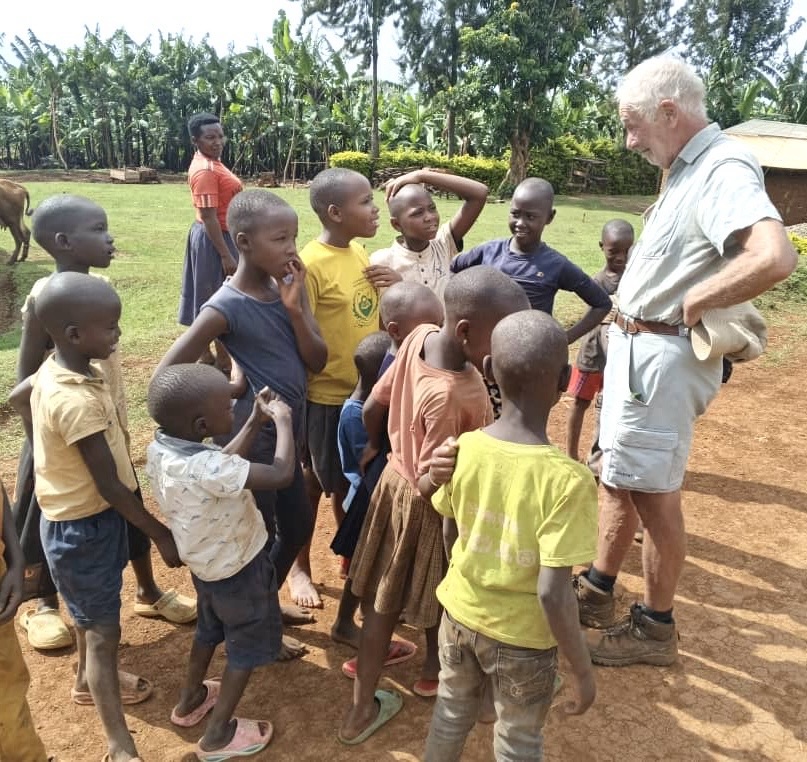
Schoolchildren everywhere love a mzungu

Some of Desmond’s pupils, aged as little a 12 or 13, are married already. And those are the fortunate ones: allowed an education by their fathers. FGM, officially illegal in Kenya, is still practiced in remote corners of the country and women have so little status. Many die, too young for childbirth. Only education has any chance of changing habits and opinions in Africa – and even then, the majority of educated men retain their sexist, misogynistic, homophobic, superior attitudes. (Look for a feature film called NAWI, made in Kenya recently and entered for the 2026 Best Foreign Film Oscar – a powerful film).

At breakfast, a week ago in Uganda, a tiny girl came selling bananas from a tray on her head. A shy smiling child, she looked about six, surely too young to be trading, even in Sipi? But Shiela said she was nine. Precious thought she might indeed be nine years old. “There are five following her. I don’t think she’s reported [for school]; she takes care of the younger ones. The mother is just… huh…”

What chance has a child like this? Condemned from birth to poverty and probably a mother by fifteen herself. A baby machine for life. ‘Tradition’.

Alex and I came upon a couple of lads wasting their time. With election fever hotting up in Uganda, Alex quizzed them about a female candidate campaigning for their rural district.

“Huh! We don’t want to be controlled by women!” exclaimed the older boy. “Women are for marrying!”

There’s little hope for change in Africa. The boy is 16 years old. All over the continent women do ALL the work, despised by men. To most men, they are little more than baby machines and slaves. “Lower than donkeys, then?” I ask. My audiences laugh at what they see as my joke, but they don’t argue.

Changing habits and attitudes in Africa is painfully slow, if at all. “It’s the way we do it here. It’s tradition…” The excuse for every bad practice all over the continent.

****

Tomorrow, I’m going back to Uganda. Just in time for the ‘election’ on Thursday, not that there’s ever been any doubt of the winner. It’s just a costly exercise to show there’s ‘democracy’. I’m told that the internet has been turned off by the ruling power, so I’m writing in sunny Kitale this morning instead.

Oh, I forgot to say. Adelight GOT PAID! For the contract signed off before the end of March last year. They government has retained a significant sum for six months as a guarantee, in case ‘anything goes wrong’ – with a job satisfactorily completed already eight months ago…

But she’s singing this morning as she mops the floors!

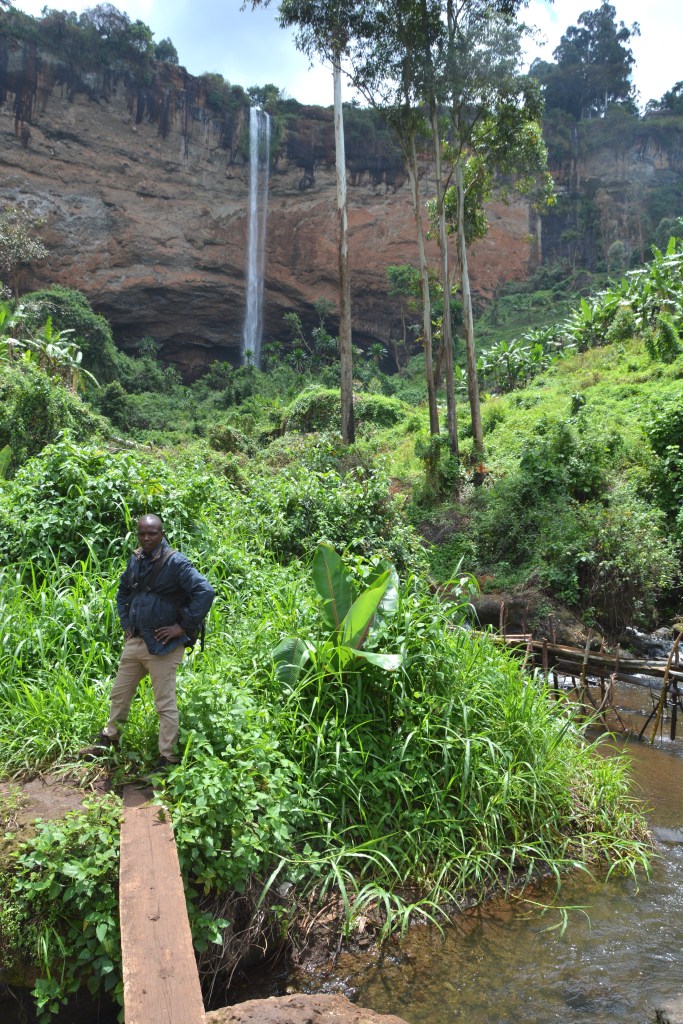
I’m still surprised to find such scenery less than a degree from the Equator, but we are at about 8000 feet

KENYA, UGANDA and GHANA. THE 2026 AFRICA JOURNEY – EPISODE ONE

THE view. Story below..!

It’s difficult to write in constant company with children. I’m a month into my current safari, and the best I’ve been able to do is to write a simple journal entry each night. 

A prerequisite for travel in Uganda is a liking for children. It’s a country in which half the population is younger than 14 years old – an extraordinary statistic that is obvious every second of the day. In a country that has swelled from five million to fifty million in my lifetime, it’s frightening too. A land in which education has been ignored for years; where the average woman bears over six children, and many more than ten or a dozen; where half of girls are married by 18, and hundreds of thousands are mothers while still in school. Most families in this village have schoolgirl pregnancies and child mothers. 

I’m fortunate in my Ugandan family. Alex is educated and intelligent. This will be a family of two children. They’ll be well educated, kept healthy and well fed. And they are an absolute delight!

Keilah, carries firewood and her muddy slippers from Chelel
Jonathan, with a banana leaf

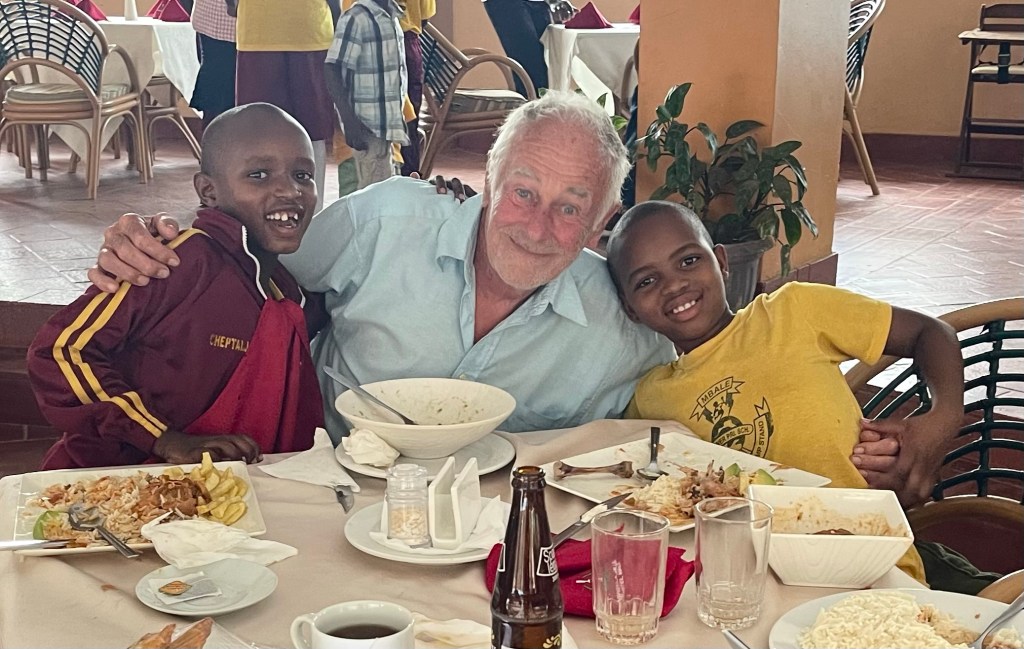
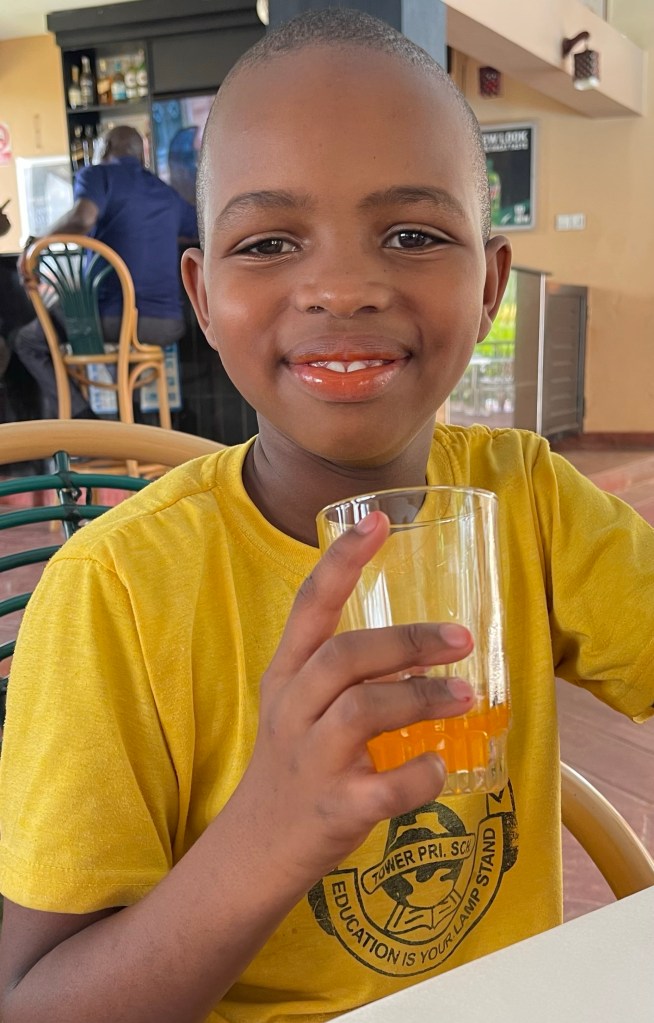
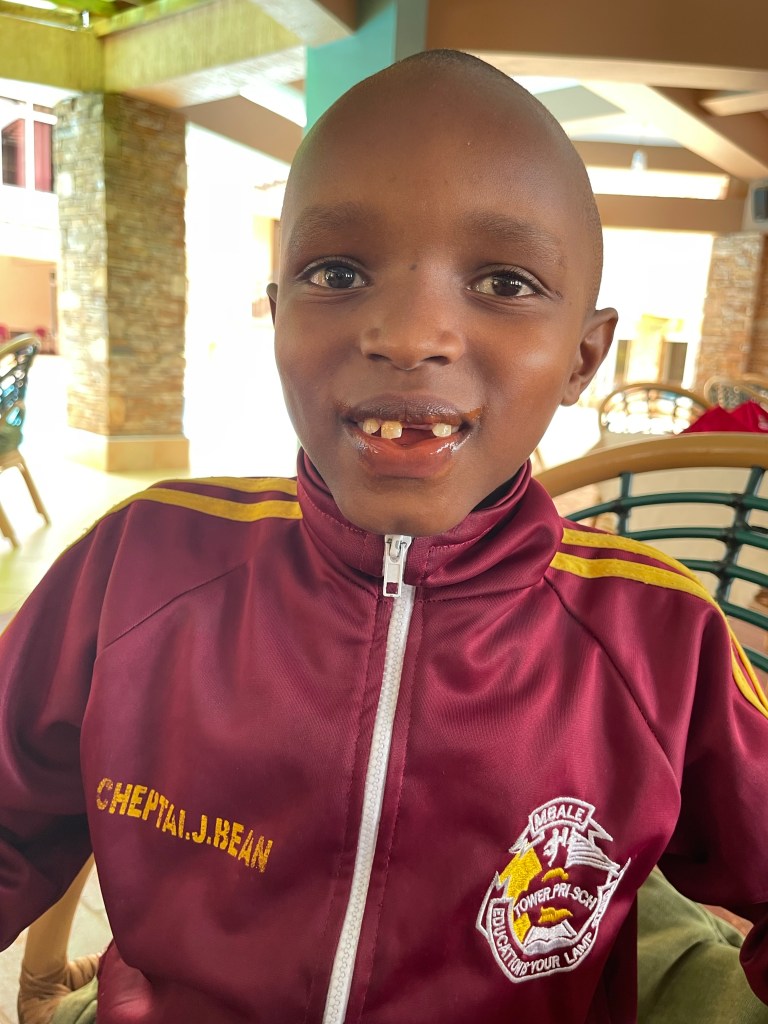
What a joy it is to be given such cheerful, affectionate, charming wonders in my ‘old’ age! I spend my days with two small children almost constantly at my side, curious chattering beings that keep a rather silly grin on my face all day long. Keilah is now nine and Jonathan Bean is seven. 

My ‘son’ Alex
Precious poses with a guest’s sunglasses

****

I travelled up by the ten-hour bus from Nairobi to Kitale, high on shoulders of Mount Elgon, to my Kenyan family, Adelight and Maria, and Adelight’s sisters, Scovia and Marion. 

People often ask me, “What do you DO when you’re in Africa?” Few realise how much time I spend WAITING!

A few years ago, I broke down in Kenya’s tea region. Flagging down a pickup, we took the motorbike to Brooke, home of the Brooke Bond tea estates, where the driver said he knew a trustworthy mechanic, Nashon. 

Last visit, my Mosquito gave me a lot of trouble. I brought spare parts with me this year, Chinese but made for my motorbike, unlike the ones that the Ugandan mechanic used. “Original! Japanese!” he insisted in February, as he charged me premium prices and fitted cheap parts for Chinese and Indian bikes of half the capacity. 

Nashon agreed to travel to Kitale, about 100 miles, to fettle my motorbike. He would arrive next day, Wednesday. I waited. By Thursday, he wasn’t answering his phone. “I know these people!” said Adelight. “He’s not answering; he knows our numbers. I’ll borrow a phone and ring him.” Haha. Adelight DOES know how Africa works! “I had trouble with the transport. I am just leaving now,” confessed Nashon. I waited. That was Thursday morning. 

It was Friday, 9.00 at night, when he arrived. He spent all of Saturday working on the machine. I cancelled my plans to ride to Kessup to greet William, my Rift Valley hiking friend. 

However, Nashon DID fix my motorbike efficiently. I have my ‘wheels’ back, and my coveted independence. But I didn’t get to the Rift Valley yet. 

****

Two days before Christmas, I rode to Sipi and the Ugandan family: a wonderful mountain ride in the sun on the new sweeping Chinese road. At the vast border post, that hardly anyone uses, I am well known. Few white haired mzungus ride motorbikes here. Despite the six windows for immigration, a huge customs hall and extensive brick plazas, there’s still only one immigration officer and little traffic will ever use this high route. The new road reaches over 8000 feet; no trucks will ever come this way. For whom is this vastly expensive border? It’s just hubris and a source of back-handers to Ugandan government officials. The crippling debts of this deeply corrupt government soar. China took the main international airport two years ago, in lieu of debt repayment… They will strip the land of resources, beggar the people, and buy influence from those at the top. It’s the hideousness of African politicians. The rich get obscenely richer. Not unlike conditions in the West I suppose, just more overtly corrupt. 

At Rock Gardens, the guest house that I have helped Alex to develop, my family wait excitedly. The children have been asking every day, “Will Uncle Jonathan come today?” 

With its six round ‘traditional’ thatched houses, decorated and largely conceived by me, we get congenial guests. For four or five years, we slowly built the business. The pandemic actually helped us to prepare for what’s become a flood-tide of visitors. A couple of months ago, Alex was awarded a young entrepreneur award as one of the ten best hotels in eastern Uganda! “Ha! They all think we are a BIG hotel!” he laughed from the award ceremony. We are, in fact, a glorified backpackers’ lodge, but one run on such professional lines that in its first two years it gained two international awards for best customer reviews, often 10/10. I’m proud of Alex’s achievements and his endless hard work. Precious is popular with guests, and the children are benefiting from exposure to so many foreign visitors. My grandchildren are smart, intelligent and aware. 

JB1 and JB2

****

In March this year, I was walking with Alex for a day. From constant phone calls I knew something was happening. It turned out that Alex and his ‘rich mzungu’ were being propositioned to purchase a tract of land, two miles from home. We went to view it, and I could see it was fertile land, with a running stream and a spectacular view – all in the richest coffee growing region on the slopes of Mt Elgon. I agreed to purchase – about £3300 for something over a couple of acres. Through the year, we added plots on all sides, investing in the rural village. It seems that the community – a friendly cooperative population – is enthused by having a ‘rich mzungu’ buy the land, believing it will bring development to their village. 

Alex bought 500 coffee bushes, which will crop in the third year. He rang me often from Chelel, from his coffee fields; he was there most days. What he was building was kept secret as a surprise, always turning his phone camera so that I saw only greenery and rampant growth. I got hints that caused me to imagine a modest thatched coffee house with a small restaurant for his international guests. 

JB1 and JB2 with Maria and Cedric, Alex’s charming junior brother, in the new coffee fields

On Christmas Day I was to receive my surprise… 

Every year, it takes time for me to adapt to this altitude. Twice in the past two weeks, we hiked 18 or 19 kilometres at 7000 feet plus. I puff and pant, these early weeks. On our second long hike, we climbed 936 stone steps about 650 feet straight up a mountainside! 

But the walk to Chelel is a bit more modest, just a two mile hike, the last 500 metres up what I call ‘Killer Hill’, steep as a ski jump. We’ve done that walk several times. By the fourth trek, I could walk up without stopping for a breather, the chatterbox children trotting along enthusiastically with Uncle Jonathan. We were a cheery group, taking a sort of Christmas picnic to the Chelel fields. 

Well, Alex achieved his surprise! I can understand his anxiety at my reaction. While I had images of family wealth established on coffee, he had an entirely different agenda. High on the steep slopes overlooking the amazing valley views, perhaps the best I’ve seen around Sipi, Alex has been building a two storey hotel. He had started even before I left Africa in early April! 

In eight months, Alex has built this! It’s an amazing feat, here where ‘workers’ are usually so poor

It’s a measure of the love and trust I’ve developed for my ‘son’ that I was excited rather than angry at his extravagant use of a good deal of my money (my entire state pension, plus..!) this past year and all the income from his guest house. He’s unusual in investing for the future, unlike the African default of living in the minute, with no plans for the next lean season. The first money I ever gave him, as I left for the border some years ago, was about £30 of remaining local currency. He used it to buy seed potatoes. Next season many people went hungry, but not Alex and family. 

****

The view alone will guarantee success

The half-built hotel stands on its new terraces, surprisingly well designed and constructed. There will be just four rooms, all with balcony views across mile upon mile of beauty to the hazed far-distant horizon. The foreground is of abundant growth and rocky precipices, over which fall delicate cascades of silvery water. It’s magnificent. 

The village council chairman and others joined our Christmas party. Many speeches were made, even Keilah and Jonathan persuaded to address the group, brave at their ages. The chairman, a close neighbour below the hotel plot, assured me that the rural dirt road is to be tarred as part of a marathon course from the national mountain stadium some miles away (We’ll see…). And the community welcomes the project for the potential development it can bring. Far from my embarrassment, they welcome that a ‘rich mzungu’ is a new member of their community. I am the new celebrity as I come and go. 

Community members join us on Christmas Day, with Jill and Nick from Belgium too

Looking at the sun-drenched view, I wondered about the night sky, here where there’s no light pollution. “I think we should call this place Chelel Starlight Hotel!” A name instantly adopted by the group, who then told me that, fittingly, Chelel means ‘bright’! 

****

The future for my charming Ugandan family looks good. It’s an achievement of which I am proud. The children attend a school judged 17th in Uganda; the guest house is successful; Alex is adding plot after plot to his land; he’s developing farming as well as the more risky hospitality business. His new hotel venture will undoubtedly succeed, compete with, and be the jealous envy of the best smart hotels in the region. It will succeed from the warmth of welcome and going the extra mile in customer service. 

Local girl Anna, joins Jonathan and Keilah in the Chelel cave on our property

****

Rock Gardens attracts some very empathetic visitors. It’s on websites for overland travellers, with whom I tend to bond. My stories of a different time bring respect and admiration. “You did it the REAL way!” says middle-aged Brandon from Idaho, riding the heaviest laden BMW 1200 I have EVER seen; his wife Katherine on another 1200, almost as mighty, travelling the world with their devices. They arrived shortly before younger Tom and Lauren from England, riding their 30th African country on Honda 125s, spending hours each day making and editing videos for social media sponsorship. Webcams bristle from their handlebars. 

“No internet, vague paper maps if you were lucky, no comfort of contact with home! I envy you. It’s so easy for us now,” says Brandon. ‘Easy’ isn’t a word I’d use for riding vast motorbikes the length and breadth of Africa and the world, but I admit I have NO regrets about being a traveller from the pre-internet age. The world was SO much bigger then. It all seemed more of an adventure. I formed my own opinions rather than reading the ‘reviews’ of others; I was not on a treadmill of ‘sights’ interpreted by guides and Wikipedia, (or godforbid Tripadvisor). I made my own stories; suffered from my own mistakes; had no instant comfort from home, no money transfers, no credit card payments; I didn’t spend half my time ‘sharing’ exotic locations with social media ‘friends’ and getting ‘likes’ as reward. I was THERE, in the moment, making of it the very best I could. My stories are now of a distant time to Tom and Lauren: before they were born. But I do bask in a certain respect that I did it then – and am still doing it now! 

Fernando from Mexico is a congenial forty-odd year old with the travel obsession: a globetrotter, a rolling stone, curious about life, a likeable fellow. I tell him stories of Mexico City from over fifty years ago, a decade before he was born. As we clamber those 936 steps and struggle up semi-vertical green slopes, we are a generation apart, but satisfyingly equal. 

And sharing the moment for real. 

Crossing a muddy river with Charles, another of Alex’s brothers, while out hiking far from home

****

A rainy New Year in 1818 restaurant at Rock Gardens.

But now it’s chatterbox grandchildren that bring the smiles to my face. The riding about is just a way to be independent as I travel between families. This is my old age. What a wonder to discover such love from my seven year old namesake and nine year old Keilah, my favourite small people. To have hugs and chatter, questions and stories, to have them fall asleep over my knees by the fire pit; to laugh at Jonathan using my beard trimmer back and forth across his shorn head, shiny as a chestnut, as I relax on my bed after a day’s work; then to find him experimenting with shaving the Chinese blanket when I’m not looking; to hear a loud proclamatory childish voice as I am washing down, having ejected Jonathan from my room, then to look out and chuckle that he is solemnly reading out the guest house sign, word by word, requesting that visitors be patient in their demands here in rural Uganda, where nothing works the way it does in Europe. We eat breakfast and supper together. They hug me as they go off to bed and run to hug when I open my morning door. I realise that I love these two small people. 

If I’ve achieved nothing else in my peripatetic life, I’ve secured a future for two utterly delightful African children, one of whom is named Jonathan Bean Cheptai. 

Hiking is interesting around the sheer cliffs of the SIpi area. This metal stair replaces the crazy wooden ladder of last year – but is actually more alarming…
Jonathan Bean 2
Keilah. I can’t help but include many pictures of my ‘grandchildren’!
The Kitale family join us at Chelel for New Year. LtoR: Cedric, Alex, Maria, JB2, Keilah, Scovia, Adelight, Deon (Scovia’s son) and Marion
Charles is 18, Alex’s junior brother. He was determined to hike with us because, “I’ve never appeared in one of your annual books!” He’ll be in the next one!
Isaac, Alex’s half-nephew (by another ‘wife’ of his father!) gathers passion fruits on the roof of one of the guest house round rooms
Jonathan gets a haircut from Alex, using my beard trimmer
Lastly… “Bring us CAAAKE!” is now an annual cry, thanks to Harberton neighbours. Jill Beagley generously made this one, that I carried 4000 miles! Jonathan, Maria, Keilah, Scovia and Adelight wait impatiently for the ritual photograph on New Year’s Eve

EAST AFRICA 2025 – EPISODE SEVEN

APRIL 2nd. THE END OF ANOTHER SAFARI

When you travel in these parts, the Equator becomes something of a feature. On some roads, I ride across it several times in just a few miles. Hiking at noon on the 22nd of March, 43 miles north of the equator, just 55 hours after the equinox, I asked William to take a picture. I really DO walk on my own shadow. Here’s proof:

****

A week later, as I bus through the highlands, it amuses me to watch one of the free apps on my phone, the compass that reads my altitude and location. We approach the Equator, tantalisingly slowly on the winding road, counting down the degrees, minutes and seconds of latitude and longitude, and the altitude.

Conveniently, latitude and longitude were invented in the old imperial days, and a degree of latitude is 60 miles so every minute is a mile (which, inconveniently, makes a second a 60th of a mile, 29.3333333 yards – revealing the clunkiness of the old imperial measurements).

Up here, we are very high. The bus grinds along in a line of labouring articulated trucks, matatus and the slowest of lorries. This narrow, winding main highway carries all the petrol and commercial traffic to Uganda and the interior of Africa from the coastal ports of the Indian Ocean still 400 miles away. The numbers count down slowly. The views are big, superb up here: forested slopes, dark conifers and flowering deciduous trees, high altitude meadows, giant vistas down to the south, red earth, and over it all, the cloud-dotted blue African sky. Women sit behind pyramids of delicately balanced red potatoes and cabbages like green footballs at the roadside. Most wear old mtumba anoraks and bobble hats, despite the extreme sun. To them, it’s cold! Could be down as low as 23/24°!

We make a sharp right curve and head south for five miles or so, through the straggly village of Timboroa. From here, the degrees count down at the speed of the bus: we are driving due south to the Equator. My phone tells me we are now at 2740 metres, 2750, 2760… At one and a half miles, 2790. One point two miles, 2820; one mile 2830; nought point six miles, 2840 (9318 feet). Then just 800 yards north of the Equator there’s a disappointing downwards tilt from this highest point on the road to Nairobi.

We cross the Equator at 2800 metres (still 9187 feet). The numbers, for just a moment, read 0°0’0”. We are 35°32’8” round the globe from the other invisible line through Greenwich. A tenth of the way round our planet. Amazingly, there are railway tracks up here. Those colonial Victorians certainly had ambitious confidence. The line’s being restored by the Chinese now: the next imperialists for poor beleaguered Africa. I saw a ten-car goods train lumbering towards Kitale the other day. With luck, it might get some petrol tankers off the high altitude road one day.

Then we are in the southern hemisphere. We roll past the village of Equator. Home, my phone tells me, is 4175 miles away. It feels every inch of it!

I wonder how many points on the Equator are this high? Was I up here in the metaphorical clouds that first time I bussed over the intangible line in Ecuador, fifty one years ago? I wonder how high I was on the Pan-American Highway on my way to Quito, itself about where we are now, 9350 feet?

Fifty one years… Ouch. Brian Tammen – a long haired, blond young American. We travelled together for a few days. We shook hands with portentous gravity as the concrete globe on a cement pedestal whipped past the third class bus window. I wonder where HE is now..?

Fifty one years. When you’re young, you never imagine being old…

****

William walks in the ‘hanging valley’ on a damp morning

Let me go back. A few hours after the equinox on the 20th, found me hiking into the Kerio Valley, down again to the burning equatorial depths, home of the world’s best mangoes and one of my favourite bits of East Africa.

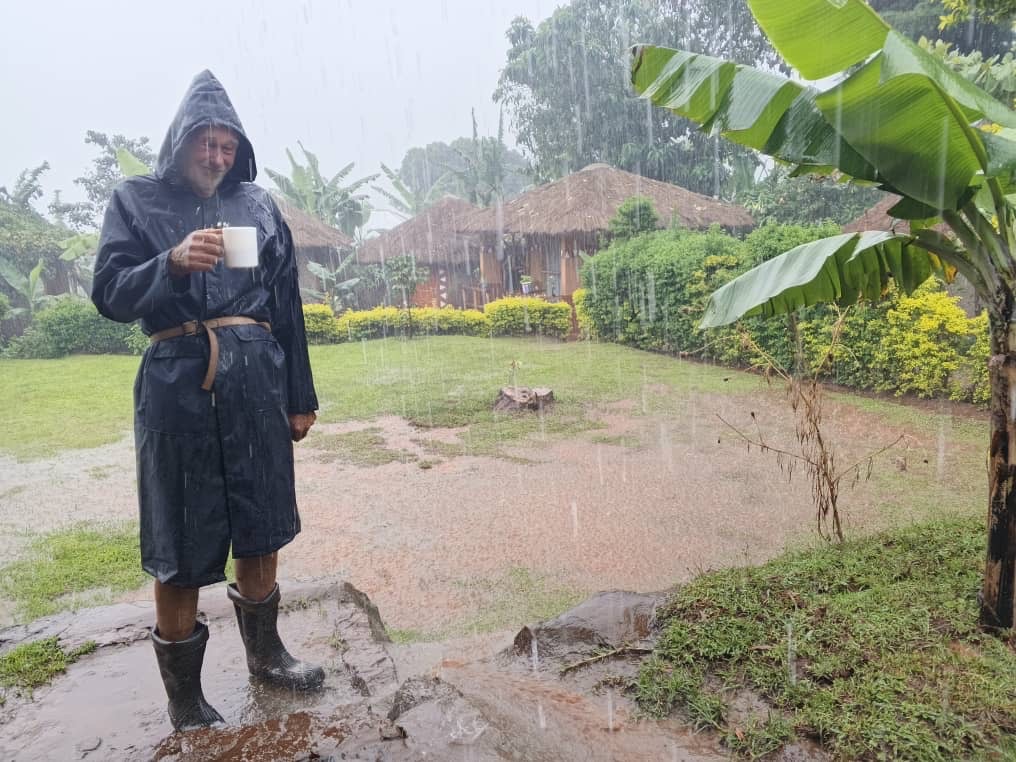
There’d been rain in the night, quite heavy, machine-gunning on the tin roof of my room on the lip of the great valley. Clouds hung like fog above and below the Kessup plateau, which William calls the ’hanging valley’, a thousand feet down the wall of the Great Rift. It made for cooler walking.

William and I could march along, using the putative road to the valley, which somehow ran out when the contractors hit 850 vertical feet of friable escarpment wall. William says cynically, “Huh, some officials made a LOT of money from this road!” The ‘road’ doesn’t actually exist, running out eventually and we must take to a steep slippery footpath and stumble down to where it starts again. The project is perhaps six or seven years old and already turning back into a goat track.

Soon, this will revert to a goat track. This is the end of the upper section of the ‘road’

****

We stay down on the Rift Valley floor, 2700 feet below Kessup. At least the heat of our last stay at Kipkoiywo Guest House has dissipated a bit. It’s just HOT now, not burning hot. But the start of the rains has brought out multitudes of flying ants and other insects. There are vast numbers of beetles on the ground, long black ones copulating furiously, small fluffy scarlet ones bustling busily, and many more. And this evening in the hotel yard, attracted by the light, I am plagued by flying insects by the hundred.

Beside my bed in the extremely basic guest house (and remember, I’m a connoisseur!) I find a crumpled leaflet.

Kipkoiywo Guest House is the combination of innovative design and crafted luxury and set apart by an unprecedented level of personalised hospitality… We combine comfort, personalised service and bespoke journeys… Exceptional values… Full time water availability… This is a place that is fun and filled with the unexpected…. And mindful that less is so often so much more.’

‘Crafted luxury’…

‘Innovative design’…

Actually, of course, less is often so much less. It’s a block-built hovel like all others, where the surprise is that there’s hardly any food available, no drinks; the rooms are completely basic: a bed, plastic basin and a pillow made from old foam rubber blocks. There’s no water except a battered jerrycan. The bathroom is an unpleasantly grubby unwashed latrine; the place is bonfire hot and bakes beneath tin roofs. For breakfast, if you’re lucky, you might get a couple of dry chapatis and black tea. Crafted luxury! ‘Your dream holiday destination’. Indeed… Another broken African dream; big plans, no reality.

****

Zigzagging upwards…

There’s not much to stay down here for, except the luscious mangoes. We’re really here to climb out again. Odd behaviour, unless you are addicted to hard hiking and have experienced that view of the huge valley expanding below as you clamber up its side. The routes up are impressive, but perhaps the Kabulwo track is the best way back up that we’ve discovered so far. We did this extreme climb two years ago. It was even hotter then. It’s terrific to see the snaking track zigzagging across the wall-of-death mountainside. From up above, it’s remarkable to see the spaghetti bends curling through the green carpet of growth below too. Like yesterday’s track, it’s deteriorating through lack of maintenance. Left as it is, it’ll become impassible again.

I climbed ALL that!

We clamber and climb, sweat and plod. There’s almost no metre of the track that’s not uphill. Two thirds of a degree from the Equator we are like indelicate ballerinas caught in a burning follow-spot on an unbelievably massive stage.

It’s one of our hardest hikes, not because of the distance, but because it is relentlessly uphill. From Kabulwo to Salaba is only a little over eight miles – but it is an immense 3480 feet in altitude! It’s exhausting. We start at an altitude of 1160 metres (3806 feet – higher than Snowdon) – and climb a further 3480 feet, which is almost as much as Snowdon. It’s like putting Snowdon on top of Snowdon! And then climbing the upper one…

Worth the hike. A panoramic view of the northern Kerio Valley

The effort is worthwhile for the reward of the expansive view of the northern end of the Kerio Valley, looking towards the huge dryness of the Turkana deserts – birthplace of mankind – that is suddenly exposed at the top of the main rise. Unfortunately, there’s a surprise in store though. There are another six kilometres to pant and plod from here to the ‘hanging valley’ road – all uphill.

By now, even William is tired and slowing. I’m struggling. But at last we reach the ‘main road’ – another gravel road snaking across the hills of the here narrow hanging valley. It’s a fine track, one of the finest – I took it a couple of years ago on the Mosquito, a very memorable day’s ride. The African blue sky stretches overhead and as the sun lowers in the west it defines the shapes and contours, its warm light enhancing the colour palette after the bleached quality of the day here, so near the Equator. The shadow of the escarpment slides across the valley floor, away from us up on its western flank.

We hail a boda to take us back to Kessup, ten miles away. Now I can gaze down – from the back of the excruciating hip-cramping boda, and feel satisfied that today I have hiked from that distant valley floor to these dizzy heights.

It IS getting harder, but I’m still bloody-minded enough to do it. A three and a half thousand foot climb in eight miles.

****

That was Friday: an arduous day. To keep the momentum, we hike again next day too. Even William is stiff and weary. He calls for a short day. I’m not disappointed, but I’m glad it’s he who makes the request!

We take a boda to Singore, high up along the escarpment, and walk most of the way home. It’s high altitude but largely downhill or flat. We visit William’s aunt in a rugged timber house on the cliff edge. He grew up here as a child, on the lip of the valley, going to a primary school several hundred feet below. Children play above sheer drops, but no, says William, no child falls off…

Beautiful hiking…

On Sunday, our legs loosened by the Saturday walk in Singore Forest, we decide to look for moratina. Of course, moratina is brewed up behind Kessup Forest, 1148 feet ABOVE Kessup…

The forest is cool and inviting, with high old trees, now protected by the government. Behind it, there’s a large cool plantation of conifers, then back to civilisation, Africa style – tin and timber houses surrounded by rough split paling fences, cows, goats and children, calling, “Mzungu! Mzungu!” I must greet and shake a hundred hands. How could I not? But sometimes (today being one) it just gets too much and I want to be anonymous and alone.

Of course, everyone’s friendly when a mzungu arrives, but they’re totally insensitive to my exhaustion after the 1150 foot climb and four miles from Kessup. In the past three days, we’ve walked UP no less than 3937 feet from the great valley! 7750 feet is HIGH! High altitude for one who lives 300 feet above sea level! Leave me to recover, fellows, and I can perhaps join in the joke. Right now, I’m merely so exhausted it’s not funny… Well, in a way it’s no longer funny anyway: I’ve spent almost four months being the butt of a million merry quips and friendly jokes. With the demise of the Mosquito, I’ve had no escape for a few days of reflection.

Bright yellow, I like moratina. With it’s alcohol content – probably about 4% or 5% – it’s popular on Sundays. I begin to relax. And smile at the goodwill.

Moratina is pretty much mead, said to be the oldest alcoholic drink in the world; fermented honey sometimes mixed with herbs or fruit, or in the case of the Kerio Valley, the ash of a tree seedpod. It takes eight kilos of honey to produce the forty litres of drink made in plastic barrels in this stuffy tin hut. Sounds like a huge sacrifice of bee effort, but then, no one here understands that human life can’t exist without bees, or the dangerous state in which they are currently suffering.

We drink our two Coke bottles of livid yellow alcohol, sitting incongruously on a velour settee. The men tell me that women aren’t allowed to drink moratina. I suggest that’s probably because they’re too bloody busy working – while their menfolk booze. They laugh at my idiocy, but the barb doesn’t hit home with anyone…

All the moratina, all forty litres of sunflower yellow sweetness, is gone by 2.30. Just as well we came when we did.

****

Jimmy Derek

I sleep better that night. Eleven and a half hours. Then I get matatus home to Kitale for the final time this visit. Adelight’s been pursuing her government contract to finish the two-classroom school building. She appears to be in her element, with a team of eight men on site, led by her junior brother, Tito. I can’t help hoping they finish on time and the government doesn’t make its usual delays and prevarications. A big chunk of my savings is involved. At present I technically OWN a lot of those two classrooms! My summer comfort, my lower teeth and hopefully a visit to Devon for Wechiga, all hinge on the government paying up in a timely manner.

Adelight’s team have been making desks for the school in Rico’s garage – from timber cut from the eucalyptus trees in the garden to save money. But this wood is so wet it must be soggy! There’s no such thing as seasoning timber here. One week it’s a tree, the next it’s a school desk, already curling and twisting.

Like most African ‘workers’, they’ve left the garage in a shambles, and walked away: wood shavings, rubbish and food wrappers littered everywhere. The rats’ll love it, and nails scattered on the floor foretells punctures. So Adelight and I turn to and blitz the garage.

I’ve been concerned about the value of Rico’s tools, specialist equipment and valuable instruments collected over a lifetime, now open to pilfering by any people with light fingers and big pockets. So we collect up most of the valuable items and lock them away in the cabinets and office. I drill holes in the cabinets so we can secure them with chains and padlocks.

In the afternoon, it rains heavily for the first time. The rains will now set in seriously. Time to move on.

Jimmy’s mum, Susan, mends my old backpack, veteran of many trips. In England, they just tell me to buy another one…

****

I get the Mosquito running that afternoon. It’s my penultimate day in the highlands. I ride to town then a short ride out along the roads that I know so well now.

I realise that I still enjoy the little Mosquito… It’s perfect for my use: it’s light enough and tall enough that a 76 year old (next time!) can pick it up, and I can dance about on the roughest mountain tracks like a 30 year old. Rico adapted it for my use. He put on his own wide BMW handlebars, a comfortable seat for touring, a strong rack for my pannier bags. We adapted and maintained it for eight years.

A garrulous American missionary has introduced me to a possibly honest mechanic in Eldoret, 40 miles from Kitale. The Suzuki dealer in Nairobi isn’t so optimistic. It seems they too were guessing what the problem may be. “Don’t spend more money!” says the kindly Sikh Suzuki dealer. I have a lightbulb moment! Mano, Rico’s charming 24 year old grandson, whom I met back in December in Kitale, is a biker! And even new parts are half the price in the Netherlands. I’ll ask him to look for secondhand parts. He found me ‘an inspiration’, biking about Africa at my age, he’ll help! Maybe the Mosquito WILL live on..? To be continued…

Next day, I packed up my riding clothes, helmet and boots and put them all back in the big suitcase until next winter. In that action, I am assuming another safari… Well, I can’t face winter in Devon until I really HAVE to!

****

Cooking supper. Scovia, Marion with Deon, and Eunice, house girl. Ughali is the staple starch. Fillingly boring!

This journey has been all about seeing family, so I couldn’t leave out delightful Scovia and Marion. So, from Nairobi on a damp, grey morning I take a bus to Narok, southwest of the capital, a three hour ride. Up out of Nairobi and down the side of the escarpment, the windows steam up, there’s no view outside either, just a duvet of foggy low cloud. The expansive vista into the valley depth disappears into thick drifting rain cloud. Curio stalls cantilevered out over the abyss are doing no business.

The bus toils down the shelf road into the depths, behind grumbling lorries. A woman yells into her phone, sharing an hour-long argument with some unseen antagonist. Funny how people’s concept of etiquette and privacy has changed with mobile phones. Many seem quite unembarrassed to share their personal thoughts and disputes in loud voices with the world. A woman across the aisle shuts her eyes in Nairobi and goes into what looks like a meditative trance all the way to Narok. I envy her and put in my ear plugs. A child wails and screams behind me, the woman argues on in front. Ear plugs are such a relief. There’s no magic to travelling by public means in Africa. I think with fondness of my motorbike independence.

Narok is the nearest town to the famous Maasai Mara national park. It’s a tidy town, clean, with rare pavements. It’s bright and developing. Scovia, looking terrific in black and white – she’s such a pretty, vivacious young woman – meets me. Actually Adelight’s junior sister, brought up by her and Rico, I called Scovia my favourite African until I knew little Keilah so well. I first met Scovia on her 18th birthday eight years ago. Now she’s mother to Deon, an obstreperous almost-three year old, going through a ‘difficult’ phase. Happily, I’ve had the bright idea of inviting and faring Marion, her sister, to Narok too. Scovia’s husband, Webb, a congenial fellow, a chef for a smart hotel chain, joins us for a brief day off, travelling five hours through two nights to do so. Employment can be hard in Africa.

****

Long journeys bring personal analysis. Actually, it’s a relief to be alone just for a few hours on the way back to Nairobi.

I never say I’m too old for anything, but one concession might be African public transport. I don’t think I have the endless patience I had as a young traveller. It’s funny… it’s my dignity that suffers now. Where did that come from? Dignity? I’ve always been an impecunious traveller – dignity had no place in that. Personal space, respect, status? Maybe I AM finally getting old? Certainly less patient and more crotchety.

And a bus, the back of which is filled with noisy, disrespectful, obviously privileged schoolgirls with the olfactory hint of teenage girls in polyester football strip isn’t easy. I poke in the earplugs and read my book. It’s the only book to be seen. There’s NO habit of reading in most of Africa, with the competition of minuscule attention spans as everyone surfs their phones for stories curated and interpreted by other imaginations. Alex jokes, somewhat ironically, given that HE doesn’t read either, “If you want to hide something in Africa, put it in a book!” How sad that imagination is stultified thus.

I read, buffeted by a 15 year old heavyweight schoolgirl who gossips with all the children around her. She’s pissed off with me because she was sitting in my seat, saying rudely, “You can sit over there!” only to be overruled by the conductor as all seats are full today. It’s a sudden bank holiday – Eid, the end of Ramadan. So buses are busy. She ignores me studiously for four hours. These sons and daughters of rich Africans are the worst: they grow up with a sense of entitlement and superiority in their poorly educated, impoverished homelands, arrogant and belittling their ‘inferiors’.

Across the handsome rolling hills, we reach the base of the huge slope. It’ll be ten miles or more of laborious climbing. And even I could probably outrun the heaving trucks up this long incline, as people overtake perilously, apparently oblivious to the expanding views over the increasing drop to the south: straight down, as much as it matters. Nothing beyond the frail steel barrier to prevent the long plunge from any error of judgement.

Not much to stop a plunging vehicle but a frail barrier rail

I can’t ever quite forget that I have – TWICE – somersaulted through 360° in buses just like this. A rare and unenviable record in my travelling life, I hope. I’m probably the only passenger actually using a seatbelt. No one imagines that big coaches can somersault. On both my previous acrobatic buses, the seatbelts were broken. I have the broken nose to remember the first one, slightly more visible with age, a 51-year battle scar. It’s interesting to think how formative a life experience that first accident was, without the pervasive internet to share my shock and be comforted by words of sympathy. The world was SO big then. I had to deal with shock, broken ribs and a broken nose on my own. And next day, I had to get back in buses and continue on earth shelf roads through terrifying Colombian mountain ranges. On my own. Lugging a rucksack with my broken ribs, a few painkillers from a local hospital my only comfort.

Astonishing that it happened again, some 35 years later! As we tumbled through space, all wheels off the floor, a rainbow of glittering window-glass shards cascading through the air mixed with shiny drops of tropical rain, I remember thinking, ‘Oh no! Not again! Not TWICE’.

I gaze into the abyss beside the road with some discomfort…

The Rift Valley, west of Nairobi. One of the sights of East Africa

****

My dignity affronted, I reach Nairobi. This is no city for any dignity at all! It’s crowded and chaotic with almost no provision for pedestrians, just oversized killer cars driven by entitled men, probably fathers of those rude schoolgirls. It’s no fun walking in this city.

I’m known well at the old fashioned United Kenya Club now. I have my usual rooms and my usual orders. I quite like this familiarity. I hope not too many tourists find this place. Maybe it’s too old fashioned for them. Tonight, people complain how cold it is… It’s 22°!! I’ve asked for a lighter blanket to replace the duvet. Ultimately, I sleep with just the sheet. Room service are shocked.

****

Alex took this picture of a chicken hat

Alex rings to say he’s been planting at Chelel, our newly purchased coffee fields. He’s already started constructing his coffee house and is moving forward in his determined, optimistic fashion, but he says that Keilah burst into tears not to see me at school last Sunday.

****

Adelight WhatsApps to say she’s meeting the inspector to sign off the school work and start the process of payment. Let’s hope the government, not known for straightforward dealing, keeps to their bargain. It’s that or continuing with the bloody temporary denture in my bottom set, I remind her..!

****

William rings to say farewell. “We’ll challenge ourselves to the valley again next year!” he declares cheerfully.

****

Sitting here writing in Nairobi, I wonder about homecoming.

This has been a different trip to any other. I haven’t been my usual peripatetic self. Partly, this was owing to the Mosquito, but also to the interesting fact of my discovery of Family. The strength of commitment to my African families (and I must never forget my closest brother, Wechiga, over in Ghana) has become a defining feature of the latter part of my life. It’s an unbreakable bond. It seems natural to be here now; in some ways THIS is the norm. Going home brings all the familiarity that is comfortable and easy, but so much of my thought and emotion is in Africa now. It’s a surprise how powerful these emotions have become, and this visit has enhanced the closeness.

By tomorrow, when I fly out, I’ll have spent 117 days in Africa. 54 in Sipi, 34 in Kitale and 14 in Kessup. I’ve found a purpose in helping Alex to flourish, in lifting Adelight to independence, and in his small way, William to call himself a ‘dairy farmer’ with pride. The children, especially Keilah, have been a source of the greatest delight. I didn’t expect THAT ‘at my age’.

I am now responsible for the education of Keilah and my namesake, Jonathan Bean. My privilege in being a Baby Boomer gives me a comfortable and relatively easy life. I never really felt the money was mine – and now a good deal of it isn’t! Haha. It’s earmarked for people who have so much less access to our comforts and financial security. It seems fair to me.

****

Yesterday… Alex called to say he’d been offered half the plot next to our Chelel coffee field! He’s agreed to purchase! It’s a good bargain: just 4,000,000 Uganda Shillings – about £900. His neighbour needs to raise money for two children to sit their National Exams, and like almost every Ugandan, has too many children and lives for the day, not realising that once sold, he can’t profit from his land again.

Alex takes a picture of the sellers and clan chiefs as an agreement is signed for half the neighbouring plot

I can only chip in £250 today; Adelight has the rest! Somehow, my determined young friend, as close to a son as I’ve got, raises the rest. Who knows how? It’s that truly African mystery… He’s a man of property. In Africa, there is no more valuable asset. I’m very deeply proud of him.

I fly out late tomorrow night. The forecast for Harberton is for full sunshine for the weekend. I had a feeling my extra month might pay off, after the misery of returning to dull rain and darkness last March. The clocks have gone forward. Everyone will look at me, tell me how very fit I look and tell me I’ve brought the sunshine from Africa.

I think ‘Sunshine’ is what I feel too…

Look carefully and you can see a small arc of white head!

For Samuel and Robert in rural Uganda, I was the first mzungu to pass their home – ever…

My favourite photo of the year. Keilah, my wonderful granddaughter

Thank you for reading my blog. I hope it’s informed and opened your heart to Africa. For me, as must be obvious, there’s nowhere like these countries on this always surprising continent…

JB 2 April 2025