
EPISODE SIX – MARCH 29th
Getting back to East Africa, I understand how the infernal heat of Ghana punished me. But I left Navrongo before the heat increased even more: a week later, it was 40° to 42°. Even as they cut the trees, people tell me how much hotter it is getting. Is there hope? Probably not.
Then a kindergarten ‘world leader’ who believes climate change is fake news, launches a war on enemies he just doesn’t understand, calling them, in his best diplomatic language, ‘demented scumbags’ (takes one to know one). I remember with great admiration my travels amongst the cultural treasures of Iran – now being bombed to rubble by a man who gets his cultural understanding from Hollywood action films.
I’m so glad I saw so much of the world when it seemed so much bigger – and before America started attacking it.
****
I never thought I’d see Nairobi as a clean city. Kenya was one of the countries to lead the way in banning plastic bags – even if every loaf of bread and most foodstuffs are still packaged in plastic. Without the billowing plastic water bags, like those infecting Ghana, the country seems clean. I’d dismissed the ban as a frail effort, but perhaps the publicity about plastic bags has had a psychological effect? At least people understand that plastic is a pollutant.
Pity Kenya doesn’t now concentrate on eradicating single-use plastic bottles, but perhaps even a sovereign African state doesn’t have the money to take on Greed Corp USA, (AKA Coca Cola), that produces the lion’s share of them…
****
Slowly recovering from the excesses of Ghana, it’s time to ride back to Uganda.
At the border, before the great white elephant of a vast immigration hall – nothing more than Chinese bribes and Ugandan hubris – I fall into conversation with Nancy. I must stop and chat; there’s still that cordiality here: a stranger about whom to be curious; welcomes to express. It’s delightful and restores some of the sense of ‘Africa’ that I lost as a largely anonymous outsider in Ghana. Petite, smiling Nancy is in her mid 40s. To my comment on the waste of this vast new border post: “How many teachers could this pay for?” she shrugs with a smile. She inured to the folly of those running her country. She’ll never express an outright opinion: that’s been removed from Ugandans by years of bad dictatorship.
The ride round the mountain is SO familiar now, still a pleasure. The weather’s changing. I’m caught at Bukwo by a torrential shower. The clouds are hovering just above the road as I climb the steep hills, red water coursing down the roadside channels. When it rains here…
Just in time, I pull on waterproofs (which aren’t, of course) so end up with not much more than a wet bum. Then, I’m out into expansive broiling skies.
The next minutes, as the clouds rise again, are magical as I coil through Tulel. Clouds dance and clamber into the deep blue sky. Those below are of many shades, some still filled with rain, others drifting languidly higher, relieved of their weight. It’s beautiful. Magnificent. The roads are steaming ethereally, as if on fire. I’m sweeping and curving along, parting the wisps and wraiths of mist. The views are sparkling after the rain, the banana leaves jewelled in diamonds. Children play in the brown puddles. I’m in Uganda again, and my smile is now instinctive. People wave, children are excited at the roadside; they’ve not yet lost that welcome, the novelty and curiosity about strangers. It’s gone in Ghana, where there’s little thrill at the unusual: they’ve seen it all – on their phones at least.
****
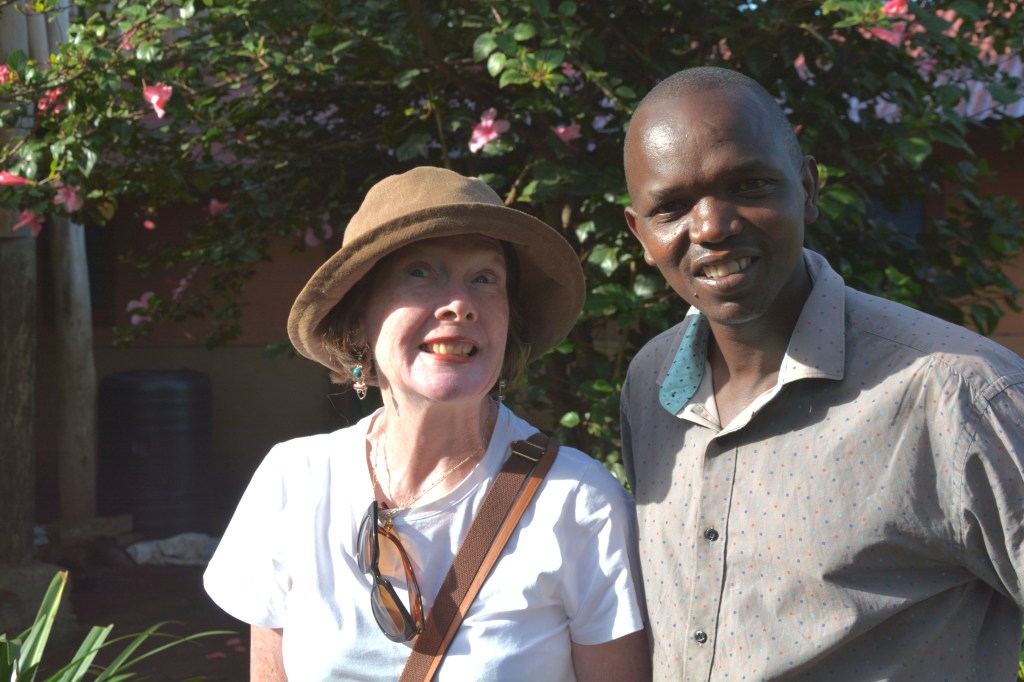
I’ve come to meet Debra from Australia. Three years ago, she visited and became part of the family, like me. She’s a traveller by heart: been everywhere and done everything; taken risks for her life’s story.
Debra and I have advised and helped Alex. We’re delighted with his success. His guesthouse is the most popular in Sipi. Full to bursting yet again, the best marketing – which his competitors don’t understand, is referral by other guests.
Unfortunately, we’ve little time to converse. Debra flew in on Qatar Airways and she has to cut short her trip and hassle to escape, now that bellicose Israel and the demented scumbag have targeted the oil of the Middle East. She gets out on one of the last flights through Doha.
****
A gathering of Alex’s Kapsomin clan was called in March, with members coming from all over eastern Uganda. Alex was asked to address the meeting and spoke passionately about his progressive beliefs: education, especially of girls; lowering the birth rate; abandoning bad cultural practices; respecting one another; working harder; moral behaviour and corruption – all subjects close to his heart.
He was met by a barrage of applause! There and then, it was unanimously decided to sack the current clan chairman, a traditionalist of the old school, and make Alex, just 38, chairman of the clan – a position with moral and judicious responsibility, making judgements on social issues and the first steps in any judicial action.
I’m so proud of Alex! His slow approach, rigorously keeping his integrity intact, brings MUCH more respect and influence than most Ugandans’ rush for instant financial gratification by corrupt means.
****
When it rains in Sipi I want to be somewhere else. It is utterly disgusting: the soil turning in moments to thick, cloying mud.
It came towards the end of an afternoon at Chelel, the clouds rolling in like a blanket, pouring over the mountain slopes and falling into the great yawning valley, soon obscuring the views in chilly fog. Then came a shower for twenty minutes – and a heavy-footed plod home in sticky red mire.
With local boys, we’ve planted another 400 coffee seedlings – (altogether about 1000) – on the lovely lower plot that I bought this year. Next month they’ll plant onions between the young bushes, which help fertilise the young coffee.
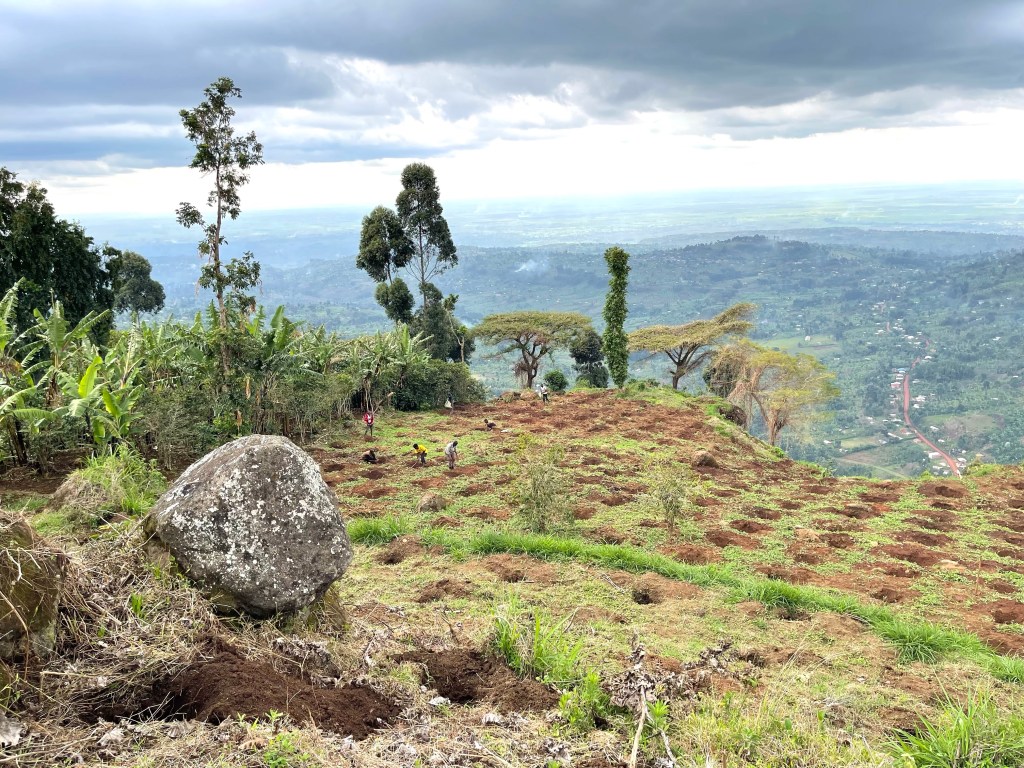
The first time I saw growing coffee was in Costa Rica in January 1974. Who’d’ve thought I’d be a coffee plantation owner 52 years later? Well, of course, I’m a coffee planter by proxy, having bought the land for Alex. In the future for which he unusually plans, he has the potential to be a wealthy man who can use that money imaginatively to advance people around him. It’s already bringing work for the young men of Chelel and a market for their manure, seedlings and goods.
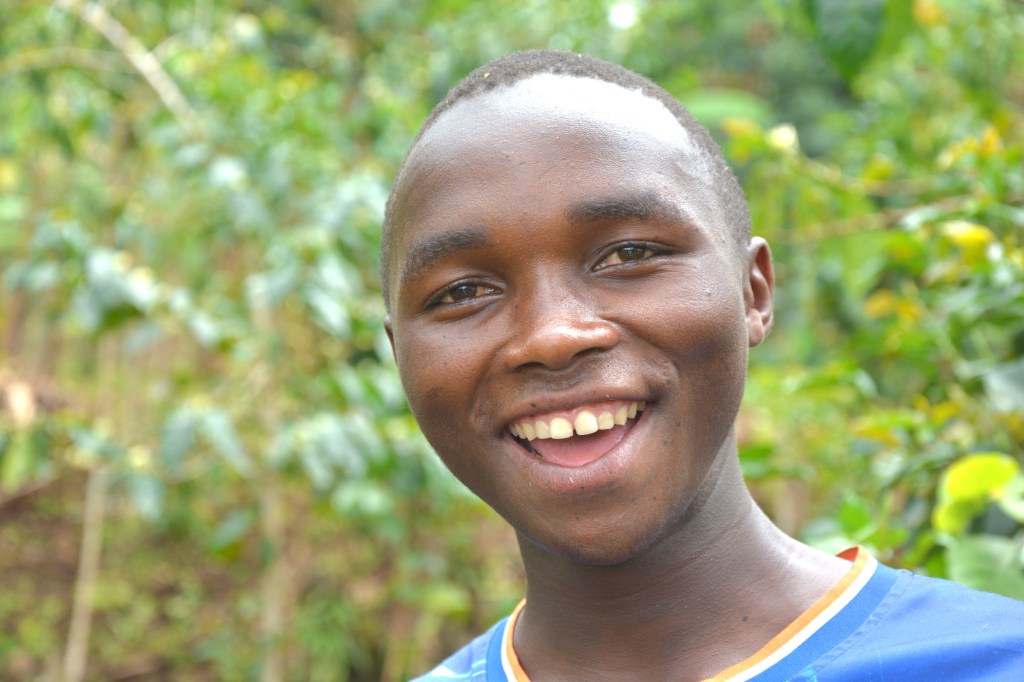
I’m relieved to see the investment in farming going so fast. The situation of the hospitality trade in this potentially unstable country is a concern – increasingly so, with unhinged demagogs in charge of the western world, to whom any ‘shithole country’ (his words, not mine) with some oil seems a prize worth attacking. Rumour here has it that he’s threatened the corrupt Ugandan leadership that he ‘will come for them’. Uganda has some untapped oil reserves – and is now drilling in their most famous national park. You wouldn’t believe these people if it wasn’t true…
Land and food will always be needed, especially with the ballooning population of this mad land.
****
Life here can be medieval. The jealousy that is generated when people see one of their own getting ahead is shameful. It’s the result of lousy education and consequent lack of imagination. If you are constantly taught that creativity and imagination are worthless, it withers on the vine. Lack of imagination causes so many here to live in the moment, never to plan, and makes life so cheap that all risks are thoughtlessly taken.
A neighbour comes ranting and shouting in pure envy that Alex has stolen his land. It’s undignified to witness this corrosive jealousy. This anger is caused by the usual family-breaking fact of a man who married several women. Polygamy is still common. The old man who legally sold the land to Alex didn’t consult the other children of the same grandfather – but different grandmothers! If that’s not medieval..?
****
As the rainy season starts, temperatures drop and the sun is less forceful, I begin to get a bit of ennui. I can get weather like this in Devon. Mind you, it may be wet, but it’s still 24° or 25°…
Everyone gets busy, hoeing, planting and sowing. We are no exception: past days have been involved with farming coffee, beans, potatoes and onions – and gardening. The seeds that I brought from Harberton have all germinated: hollyhocks from the Square, marigolds from seeds pinched around the village, sweet Williams and statice from cheap packets and everlasting sweet peas from my own garden.
The guesthouse compound is a terrific sight. Plant a stick here and it grows. Roses, hibiscus, angels’ trumpets, giant geraniums big as bushes, nasturtiums, coffee, camellias, passion fruits, palms, bananas, tropical trees and plants I can’t identify – and the two big Chelum lilies we scavenged from a field on a hike, are both coming into magnificent flower for the first time.
****
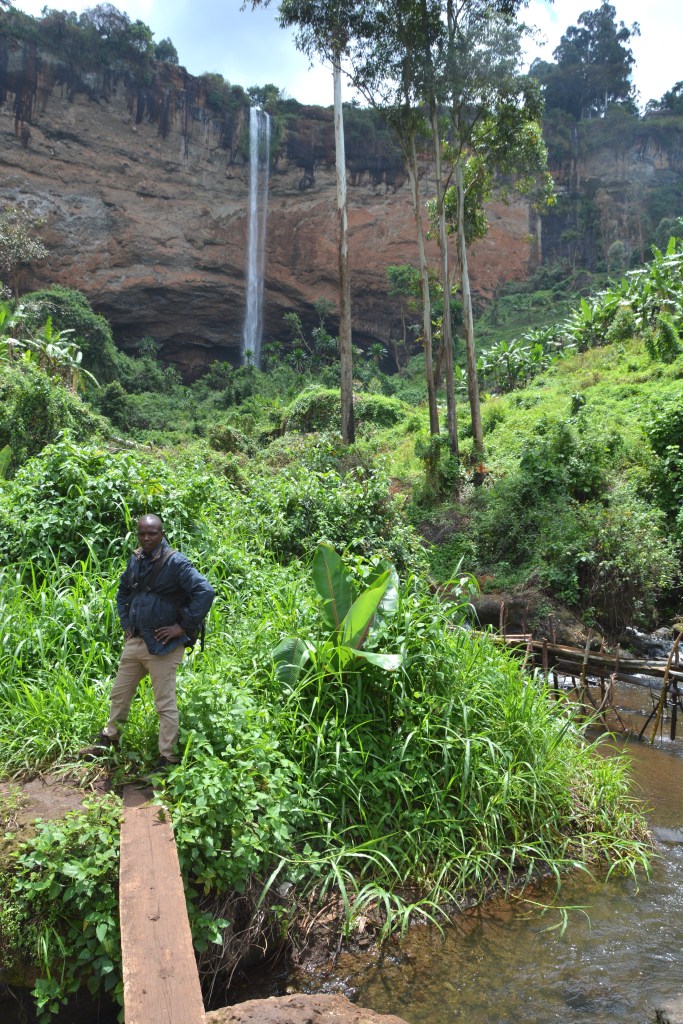
I’m proud I can still keep up with someone half my age for 18 miles at about 6000’ altitude! For that’s what Alex and I do between building and farming: keep hiking. I’ll steam along back on Dartmoor at only a few hundred feet above sea level!
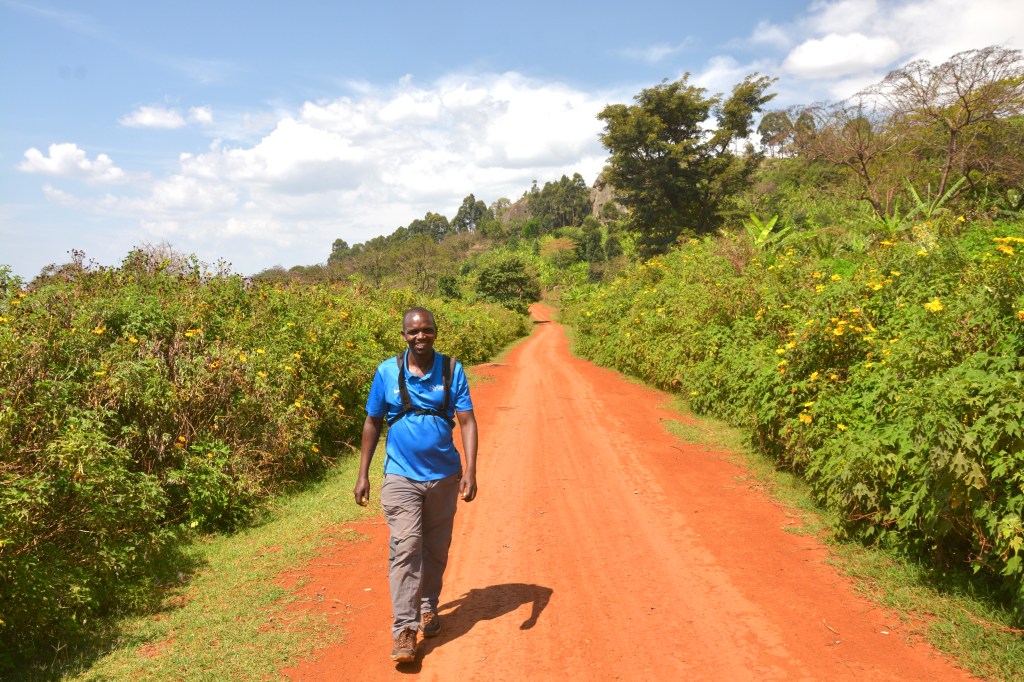
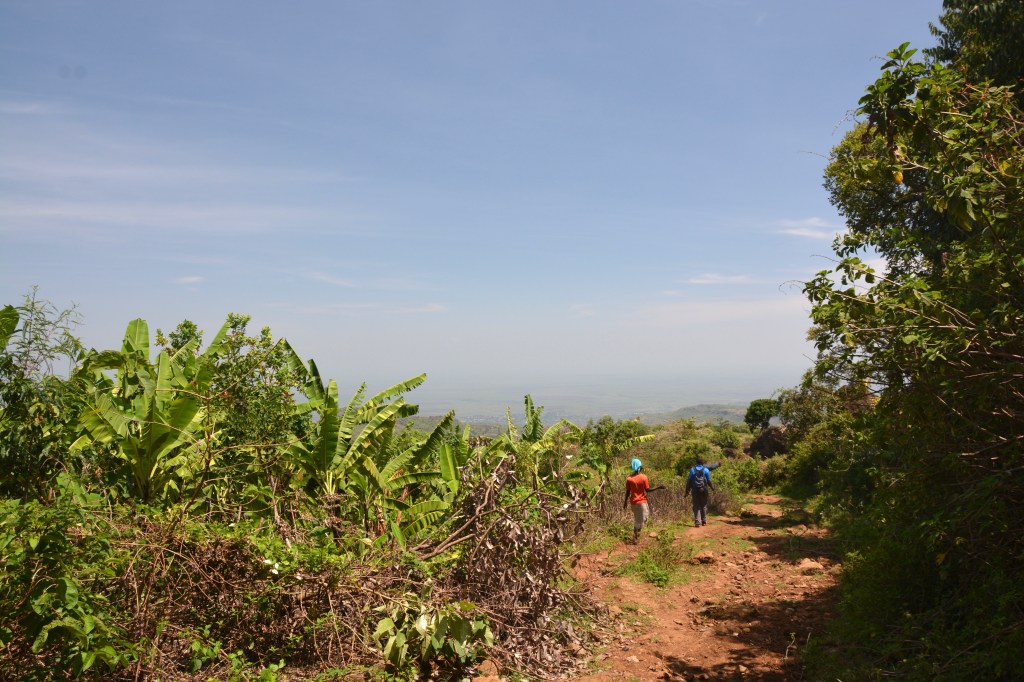
We hike across country and on the red dust country roads, through rural communities and small farms.
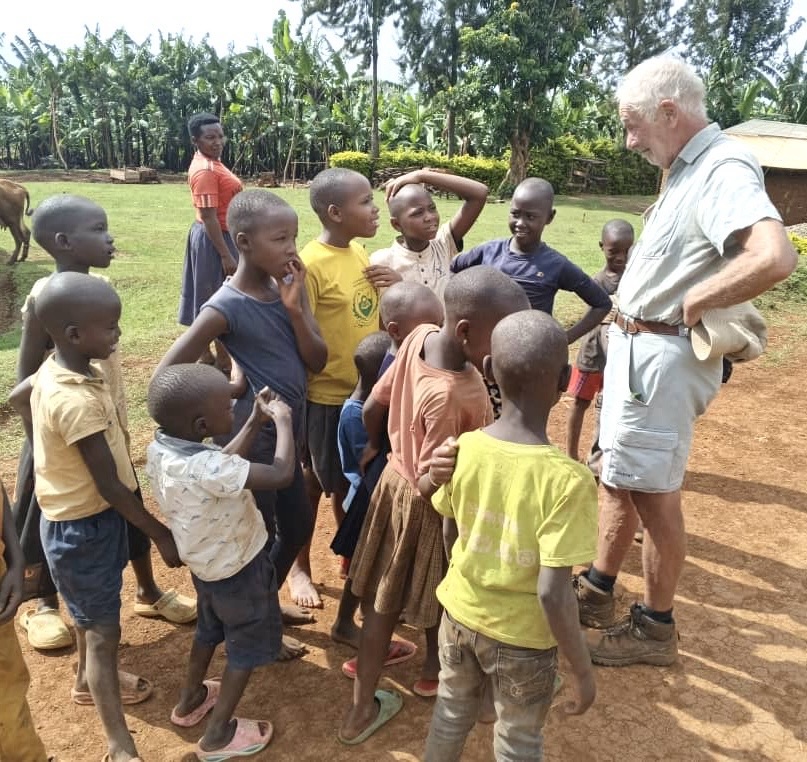
It’s a fine walk today; we’re off the beaten track and a mzungu is a rare feature here. I’m such a celebrity! I must humour hundreds of small children, racing to the roadside to greet me. Others scatter in fear or hide behind mothers’ skirts, wailing. A group of children gather to interview me: intelligent questions about my white skin, where I’m from, why I’m walking, are there hills and cows where I come from, why are my arms hairy? It’s a delight.
We stop for chai, chapati and beans in a scruffy makeshift cafe and request water here and there, and a couple of disgusting sodas for sugar. We walk happily, free from the strains of home. Alex enjoys this. As an ex runner, he’s happy to keep the pace going and I try to keep up, begging a minute or two under a shady tree now and then.
We walk for seven hours on a warm day – about 33°. The scenery’s fine, the big plains far below. People are happy to see us: many joke and comment, on this lazy Sunday. Today, we walk through a large area that is populated by Alex’s clan – of which he is now chairman! We make regal progress!
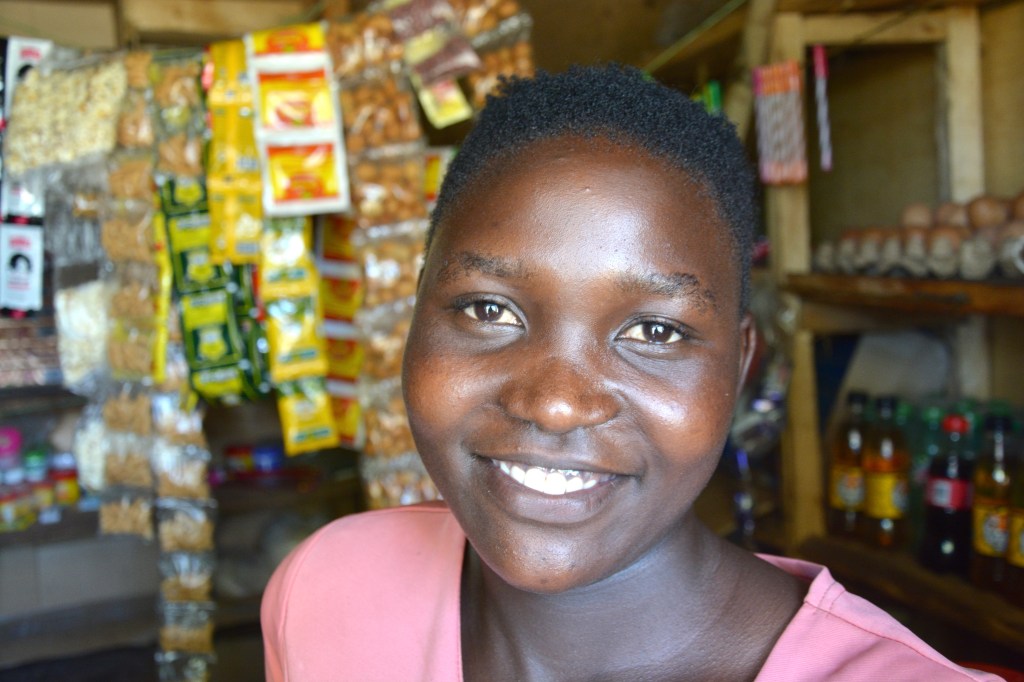
We stop to visit a great aunt of Alex’s – a charming, happy old woman, coated now in flour as she grinds maize. There’s a big dob on her nose that matches her curly white hair. She’s so pleased to see Alex and his visitor. When we leave she insists Alex takes some small money because her ‘eggs are finished’ and she must give her visitors a gift.
“Buy some eggs!” she tells Alex. Usually, we dash a few small notes to old ladies, but no, says Alex, this time we are her visitors and custom demands she must present a mark of respect. It used to be just this way in Navrongo. I wonder how much longer it will last here? Longer perhaps, with this dire lack of education and less exposure to the evils of antisocial media…
The next four miles are all uphill. Hard at first, then slowing to a slope that goes on and on.
The first hill is so steep it’s been roughly tarred. A motorbike taxi struggles with two passengers. It stops and the woman on the back, with baby tied behind, gets down to lighten the load. A middle-aged man stays aboard…
We catch them up at the top of the hill. “Huh!” I exclaim derisively to the man sitting complacently on the boda with the driver, “Always the woman who must get down and walk!” The man looks at me as if I’m demented.
“It’s good exercise for her,” he dismisses me.
“Yes, for you too!” I comment with a shake of my head. Does he listen? Do I change anything? No, this is Africa. A poor woman, in middle age, with a grandchild on her back, must plod up the 1:4 hill while the man remains seated, superior in station and ‘Tradition’: the excuse for exploitation largely invented – and maintained – by African men…
****
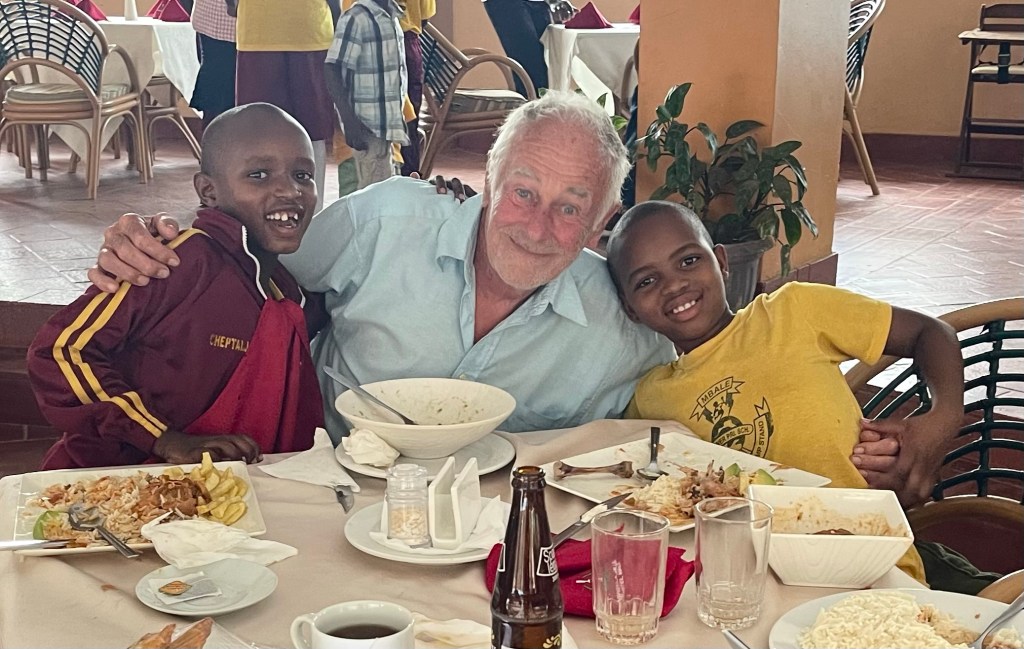
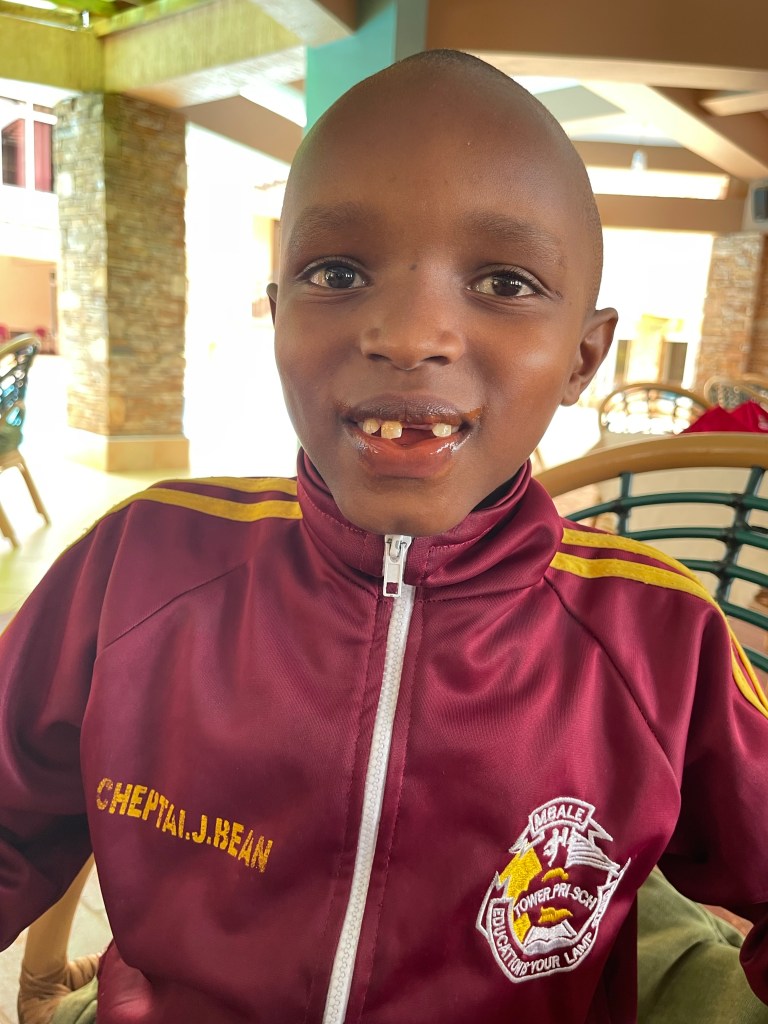
Hiring a local driver, Alex and I go to Mbale, the ‘big city’, 30 miles below Sipi, to visit the children at school. We miss them. I’m greeted with big excited hugs from Keilah and Jonathan.
We drive to a smart hotel – the Wash and Wills, that sounds more like a laundry – and buy them chicken and chips and pop. Two big bags of treats from the supermarket and the inevitable new shoes for JB, who gets through them at great speed. Fortunately, they love school, yet it is a Spartan life.
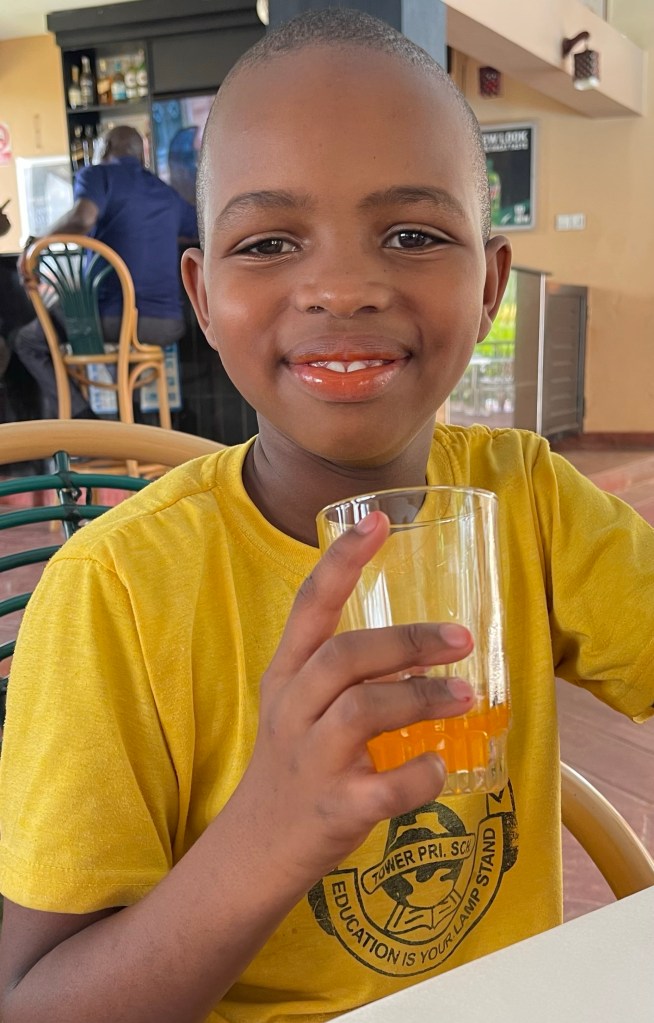
I’m amused to see that Keilah has adopted the name Joy on her schoolbooks! How does she know the name of my late mother, I wonder? With JB’s school fleece embroidered: ‘Cheptai J Bean’, I’m having quite an effect in this family.
I’m content to be able to pay back some of the generosity I’ve received around the world, frequently from those who could least afford it.
 jonathansjourney.net