
THIS IS EPISODE FIVE – MARCH 6th
NB. This episode FIVE will appear on your device ABOVE number FOUR. Scroll down to read chronologically
****
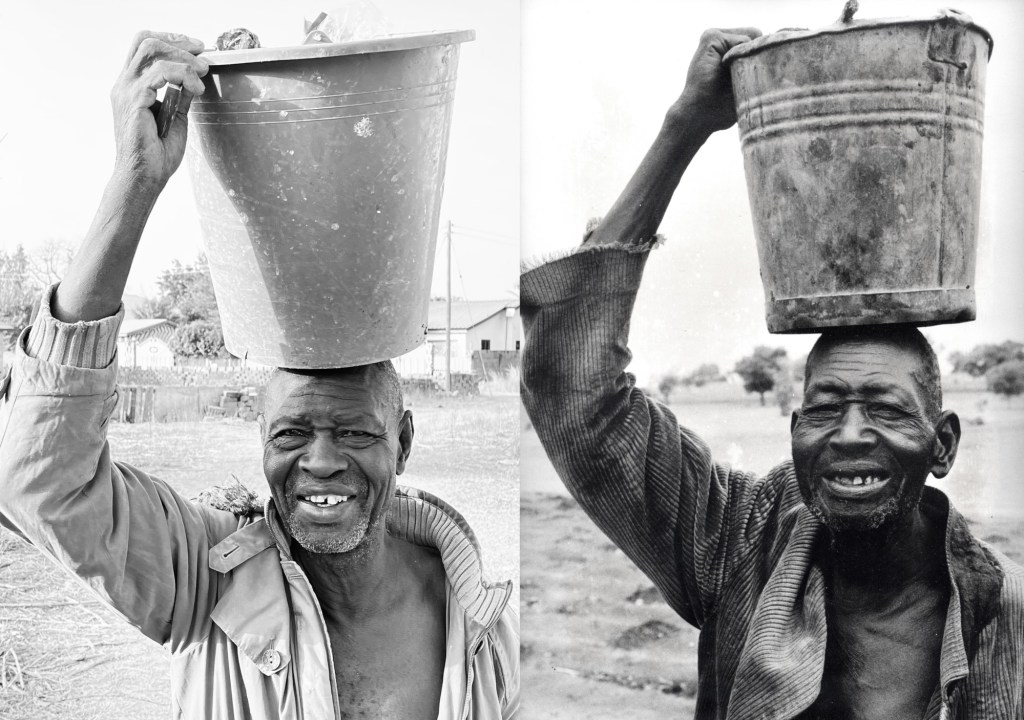
I don’t look back as I walk away from my little ruined Navrongo house, in which I slept for the first time in 1998 with such thrill and expectation. A £2 coin, newly minted then, set in the doorstep, reminds me of the date. Crunching over used nappies and plastic, I walk away, largely ignored by so many strangers, between the ugly dross of half finished, unimaginative, stained block bungalows. The story fades.
But I need to be a bit more upbeat and find the positive… I must try to relax a bit. I’ve always said a traveller must leave his values at home. And now I’m doing the opposite!
****
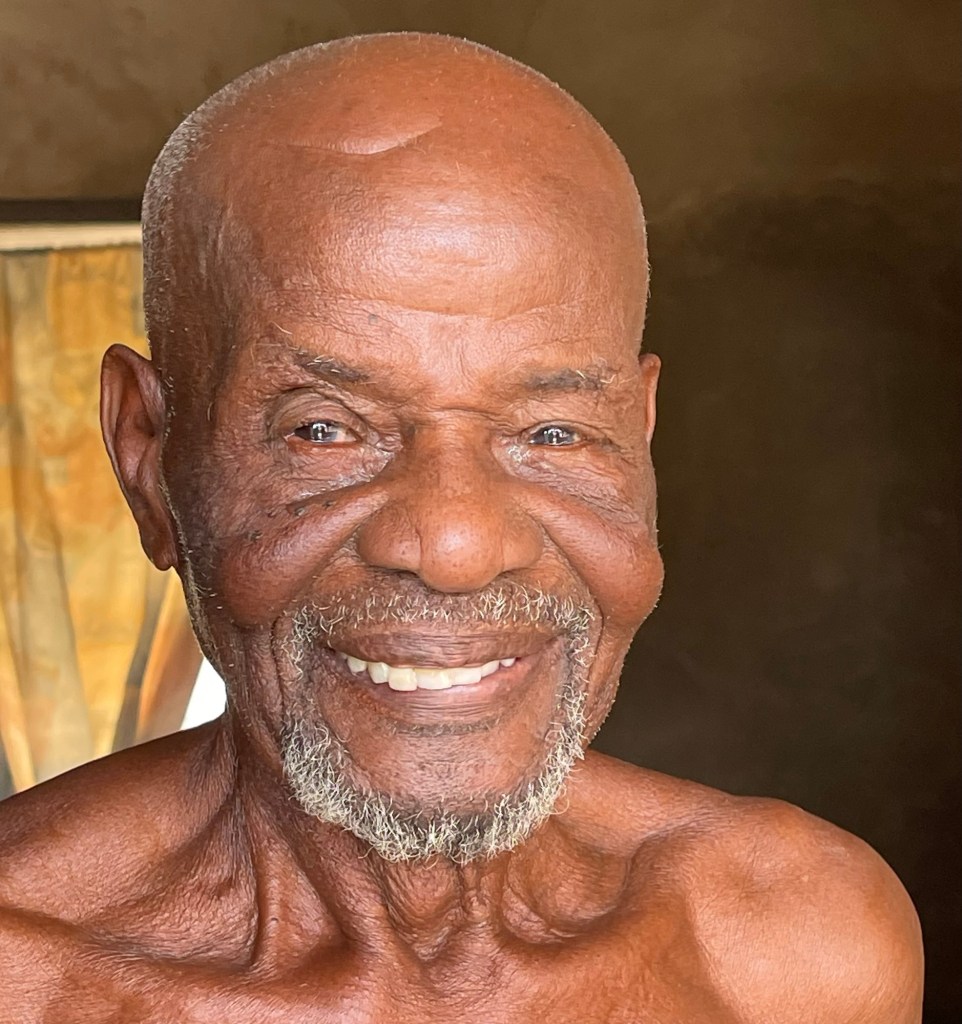
I’m heartened to find just a bit of old Navrongo left, even if it only confirms that it existed in the first place. I have to visit a man in his late 90s to find that vestige of old courtesy, respect for community life and mutual support.
Mr Atiim, is Perry’s father in law. He learned a bit of quaint antique colonial English when he worked down south in the 50s. He’s been a cattle farmer most of his life and has the formality and deep politeness of the old generation I met when I first came to Navrongo.
He’s very happy to see us, presenting us on parting with a cockerel, a mark of respect for a male visitor; the only one of this visit – where I used to get so many.
He has a spot-on memory for the old stories of past times and traditions: tales of beating down the mud to make a road for the first car; pesoas paid for labour; how far people travelled on foot before our modern times when no one walks any more, and digressions into the behaviour and habits of the old town, back before and after independence. Atiim is the last remnant of that generation; the oldest person for many villages around. His memory of ‘being quite grown’ by 1946 may mean he really is close to 100 as he claims.
He lives a couple of miles south, a walk we’ve taken several times over the years. But now there are no fields, no woodland and few trees. It’s hot as hell and twice as ugly. The place holds little attraction. A 100 foot communications mast towers over his house.
****
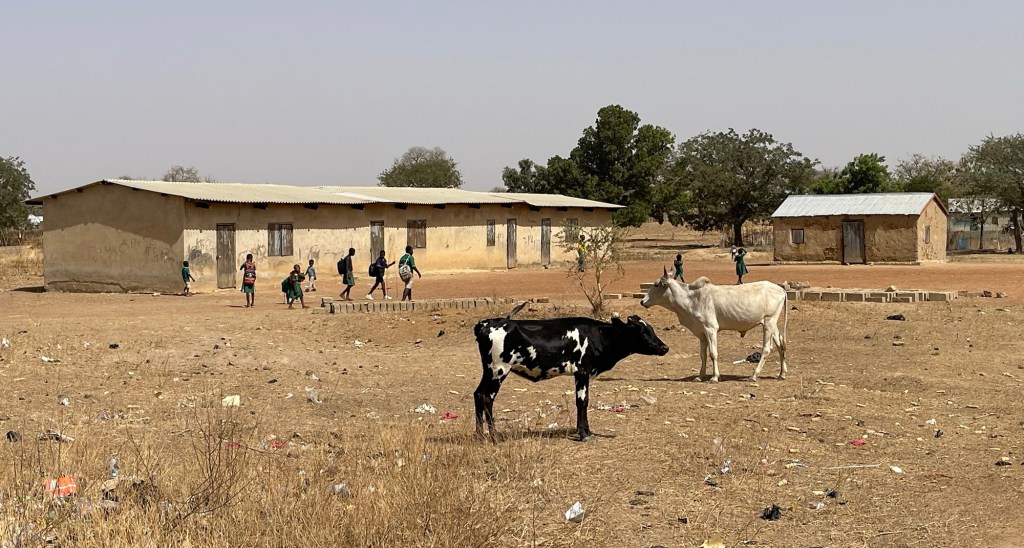
At Nyangua village I am still remembered: the white man who came and built their school.
The school now has 220 primary pupils and nearby is a JSS, almost certainly the result of the bargaining power enhanced by building their own simple school buildings for themselves with the help of private donors (Bedford Park Rotary Club and me). I’m proud of this basic project. It’s educated 33 years’ of Nyangua children.
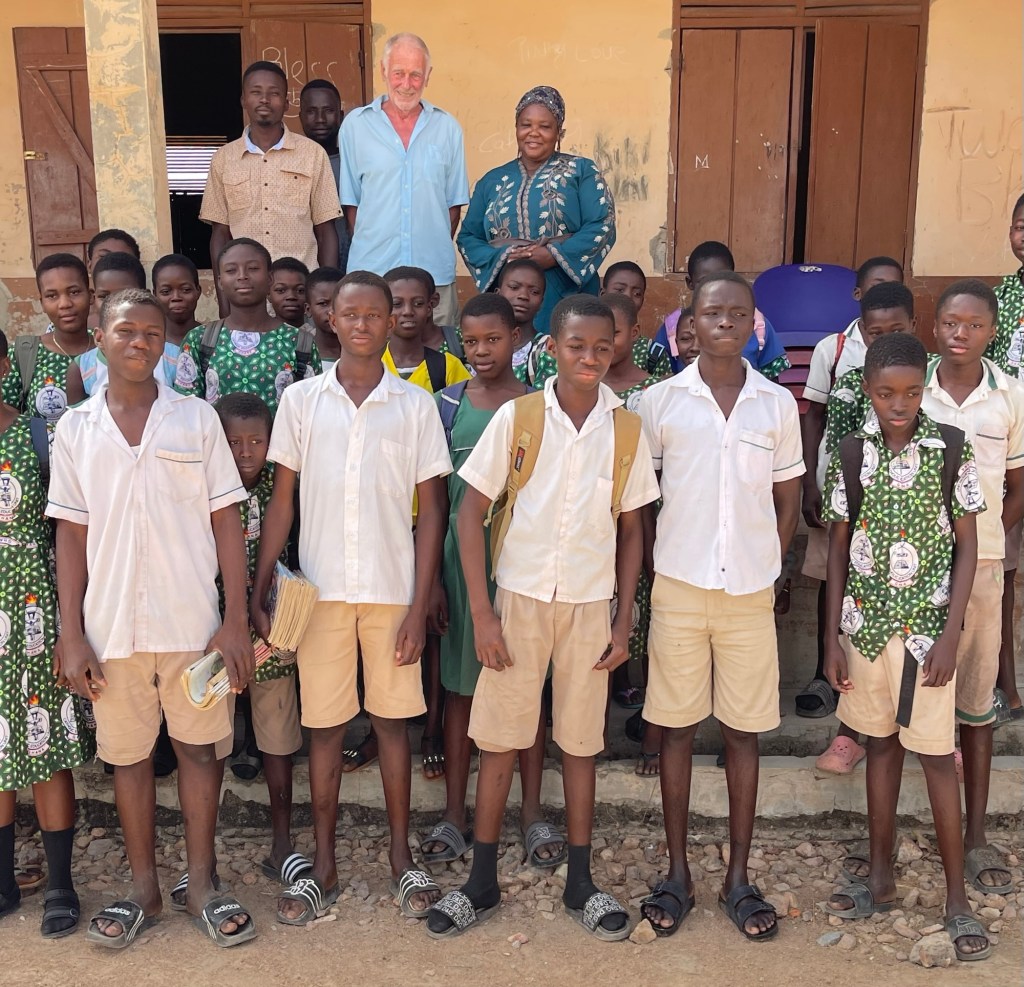
At the newer JSS, with 74 pupils – girls slightly outnumbering boys – we meet Vida, the headmistress, as the pupils break for the weekend. In the dust of the schoolyard, she tells them how a mysterious white man caused their school to exist, and here he is come to visit: excitement, applause and exclamations.
Then Clement, one of the three JSS teachers shakes my hand. Clement was one of those boys, then in P4, who sat at the broken desks of that original ruined mud classroom I visited in the early 1990s! He’s now 42, teaching another generation of Nyangua children. It’s a moving moment.
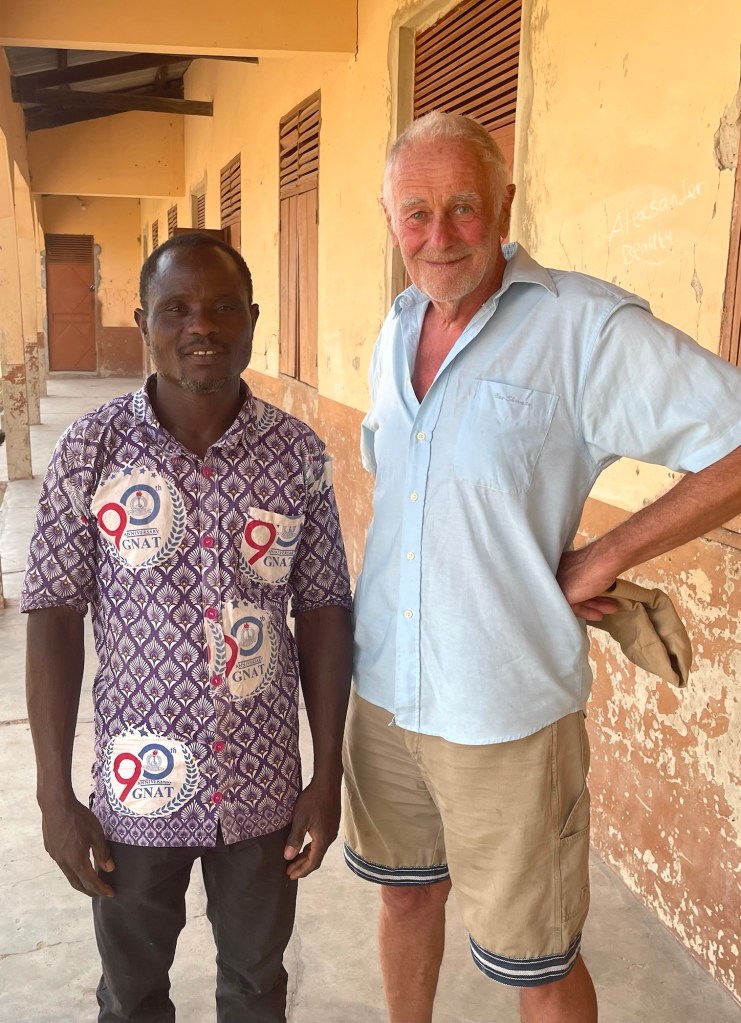
I’m happy today. We WALK the eight miles or so home in the 38° heat and increasing dust.
****
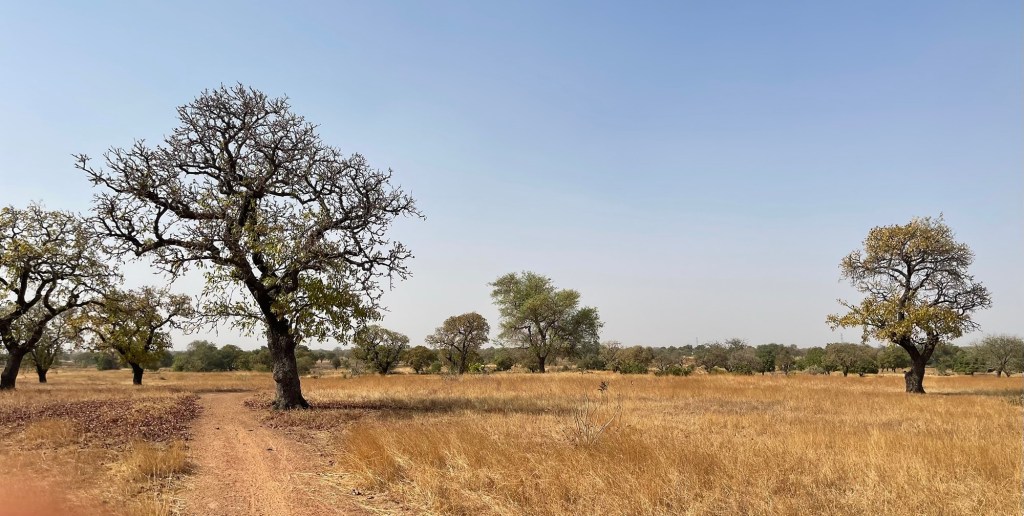
The Harmattan winds that cool Navrongo should happen in November/ December but now, mid-February, we are in the throes of these dust-laden northeasterly winds from the Sahara. What’s happening? You witness Climate Change so closely in Africa.
Few here comprehend the seriousness. They cut trees, build empty houses, waste water, overuse their soil, increase the population limitlessly, ride every inch they used to walk. Here, you witness this slow destruction incrementally. It’s unstoppable. It was always hot, but this is Climate Change in action. Everyone claims that the heat is increasing…
****
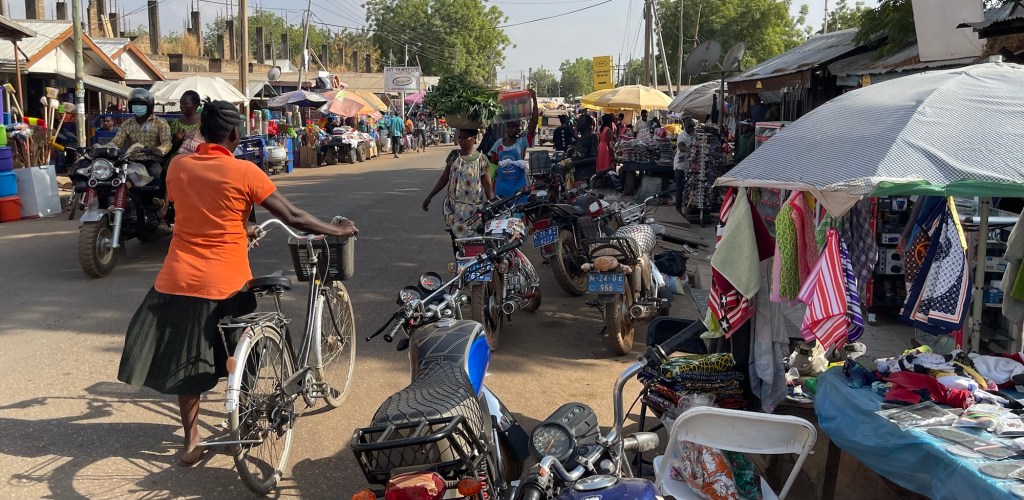
It’s market day every third day. I used to enjoy them so much, but with the narrow spaces now filled with the mopeds of women doing their shopping it feels like Morrisons filled with demanding, smelly mopeds in the aisles. It’s good to see so many women riding – something I’ve never seen in East Africa, but I find myself hot, fractious and short tempered. It’s not fair on Wechiga. I’m trying my best now not to see the filth and the unmaintained scruffy houses. Trouble is, it’s every man for himself now. Pretty much like the rest of the world, I suppose, but I witnessed what came before this casual self interest, when people cared for one another, shoulder to shoulder in the face of a much bigger challenge than new material possessions.
Happily, Wechiga stays pretty much his old self, my brother, despite our very different intellectual approaches to life. He’s endlessly sociable to the world. He knows all the familial relationships of who’s who in Navrongo, but he has little pretence, does Wechiga. He is what he is, with simple ambitions, not a lot of education, patient – somehow, poor fellow – with my moodiness; endlessly friendly to all, upholding the values of his parents’ traditions and honest to a fault.
****
Neighbour Itiel comes as power cuts drench us in darkness – rather delightful, but only to me. The boy I knew and liked so much as a 12 year old is now 21 and has grown into a muscular, athletic man perhaps an inch taller than me; a decent, thoughtfully quiet young man studying nursing at the Navrongo School of Nursing. He still plays trumpet in the police band. It makes me smile, having given him his first trumpet! So many memories still…
****
I can’t help pondering the thousands of work hours lost to funerals. Men (mostly men; the women are busy cooking inside the yards) sit about eating and drinking and conversing. They are teachers, civil servants, workers; but funerals of distant relatives take immediate precedence over duty and work. Days of work sacrificed, lessons cancelled, meetings delayed, business rescheduled. And someone’s always at a funeral. Death is a constant companion here. I always found it difficult to accept THIS cultural formality in which people live in squalor and die in splendour, beggaring their families in the process. It’s nothing I’ll change though, so on this one I just keep quiet and nod.
The final straw is that even keli-weli is a poor imitation now; the WONDERFUL Ghana-defining smell that I remember so vividly, as plantain chips fried with pepper and spices in aromatic coconut oil in big pans by the roadside, is now fried in ‘Frytol’, processed vegetable oil. It used to be served in a screw of cement bag paper with a cocktail stick. Now it comes in three plastic bags, and a styrofoam box, with a plastic fork.
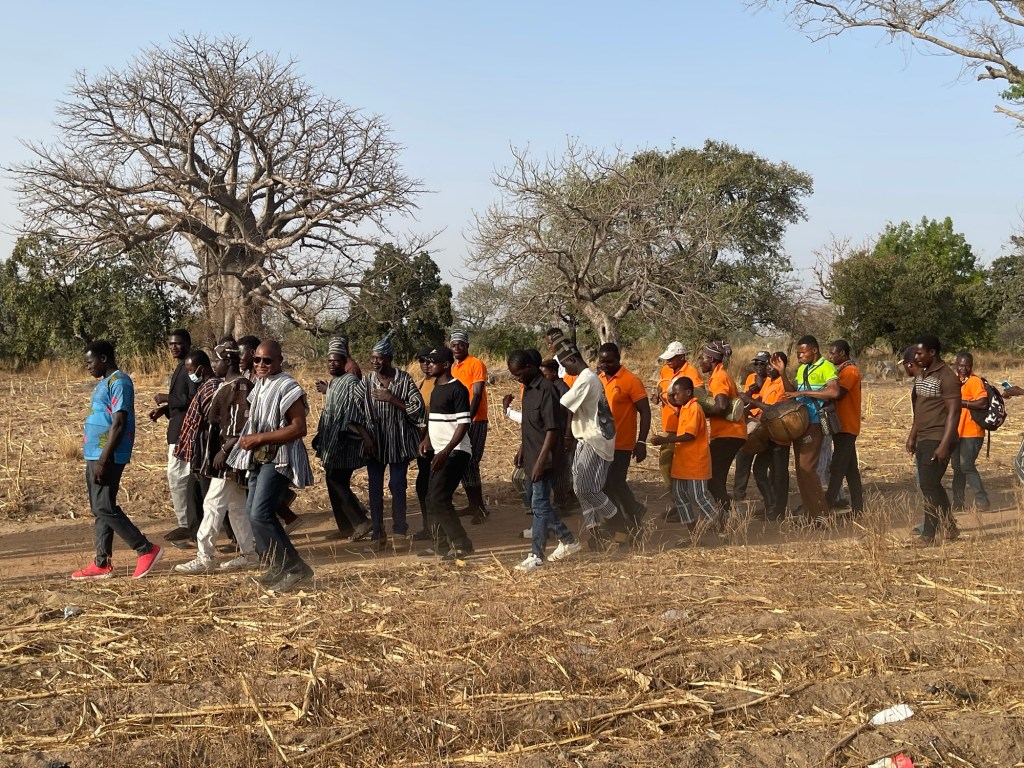
Wechiga is taking me to another funeral. There are so many! Our ‘team’ gathers with drummers a mile away, drums and dances at the first house and then we all drive three miles south into a rural area off the road. Too hot to walk, Wechiga has borrowed a derelict motorbike. I’m taking him. The bike has no brakes, no mirrors, no lights and none of the instruments work. The front brake has been removed; looking around, I find this is a very common adaptation on Navrongo motorbikes. (and on return to Kenya, I begin to spot many boda-bodas without even front brake cables) “Oh, we don’t use it! It makes us fall off; we use the downer one!” they tell me. The ‘downer one’ is the inefficient rear brake. (For non-bikers: good practice is 75% front brake, which is more efficient, and 25% rear brake to control any skidding). Few bikes have mirrors; they are commonly removed by the dealer on request. I’m not surprised the hospitals and graveyards are so full…
The ceremony is diverting. Full of rituals and comings and goings between the ‘teams’. The dancing is great but raises dust in our eyes. The drumming and whistling contains elements that for a while say, ‘Africa’, although it’s captioned tee shirts rather than goat skins on the entertainment troupe. The boys dancing are young and muscular, black skin shining. They wear baggy smock trousers, and fling their arms about as they jump in the frenetic spasms of the local dance. Bystanders – all smocked for the occasion – stick dirty banknotes to the sweat of their brows. It’s fun to watch, and it IS a shred of old culture, even if half the audience clutch and scroll their phones.
We’re beneath a twisted baobab and the African sun is sliding down the sky. As it gets a few inches from the horizon I tell Wechiga that not only can I not see in the dark, but we have no headlight anyway! We beg to leave; I can see things will go on another hour, although everyone assures me it’ll be over in fifteen minutes. We ride home unsafely.
****
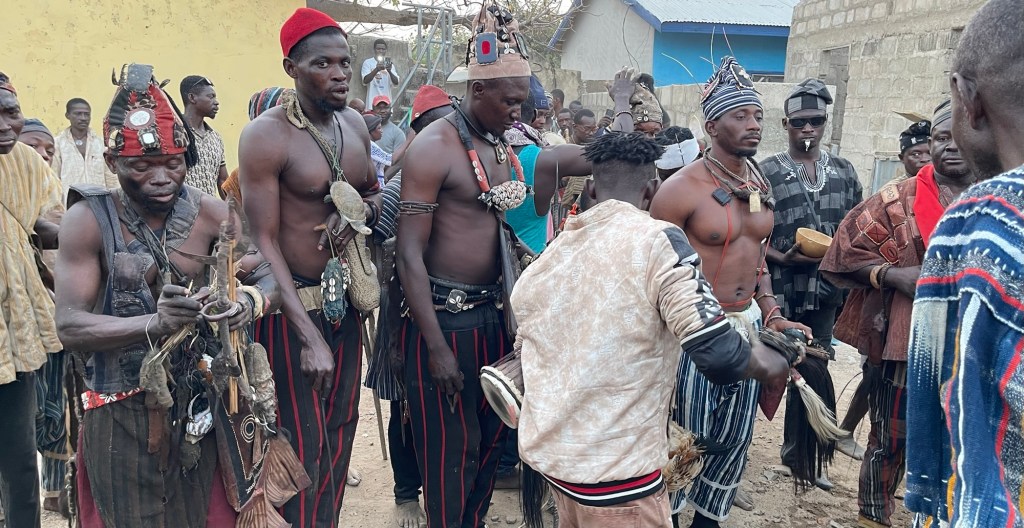
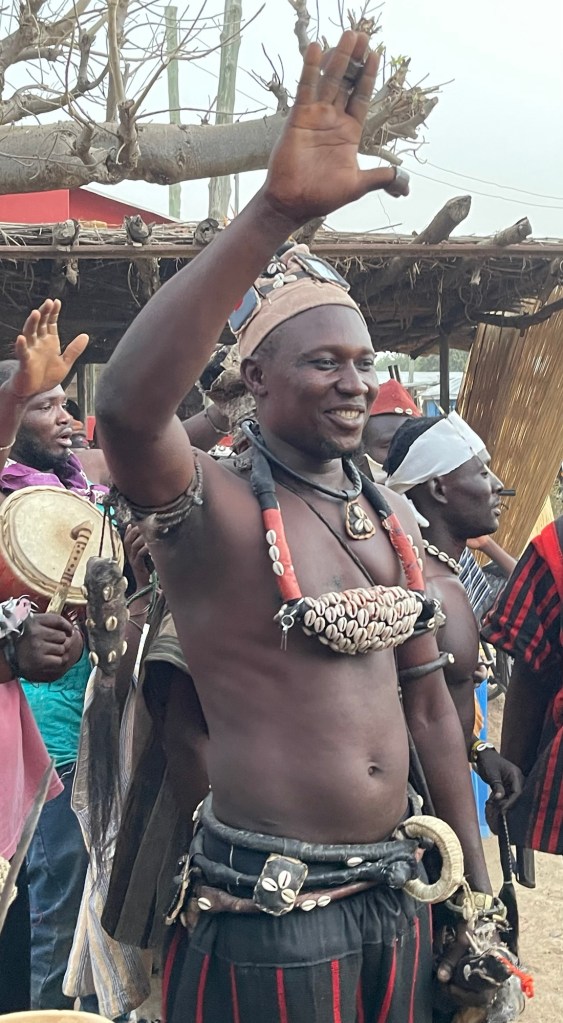
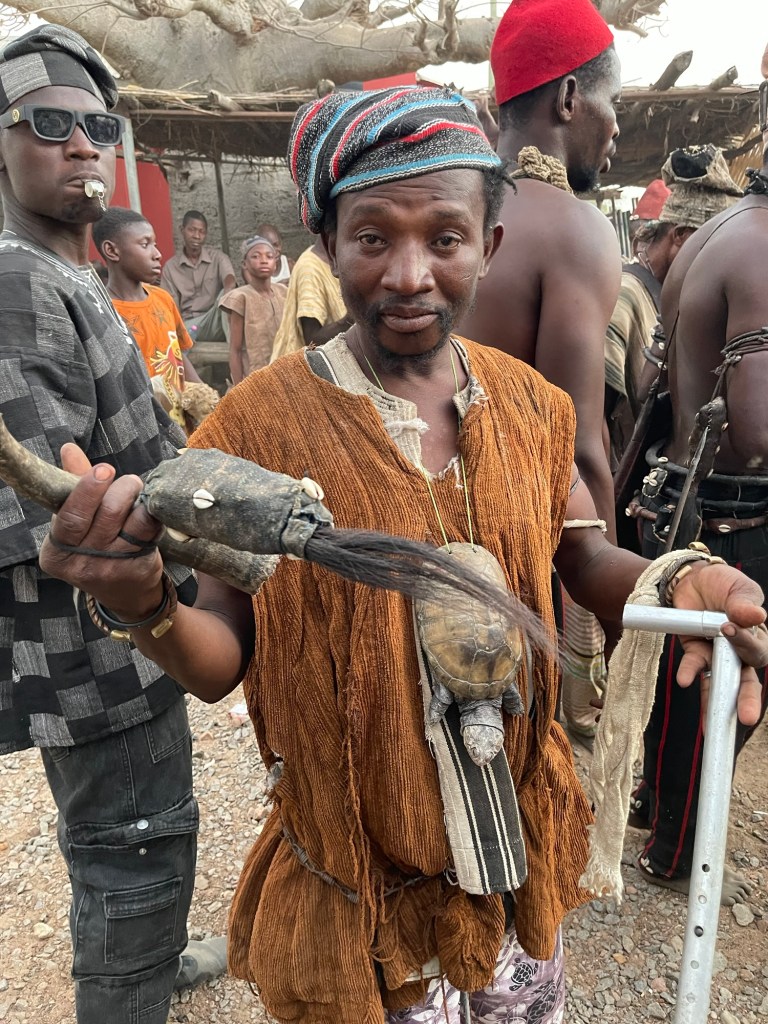
Another day, another funeral… The ‘tradition’ of this second one is a rather watered down version of war dancing. Based on the old dances, with customary mad costumes, it all feels a bit tongue in cheek, without the serious import it would’ve had a few decades ago. These men have inherited the old bangles, slave bracelets, dead tortoises, oddly shaped branches, even perhaps the woven costumes – but what they haven’t inherited is the depth of meaning all theses things once had. They are going through the motions, laughter barely suppressed, their smiles spoiling the gravity of the occasion. These young men are carpenters, clerks, junior government workers, teachers; they have phones in their pockets as they dance and go to church on Sundays. And put commercial plastic wreaths on the Catholic burial mound…
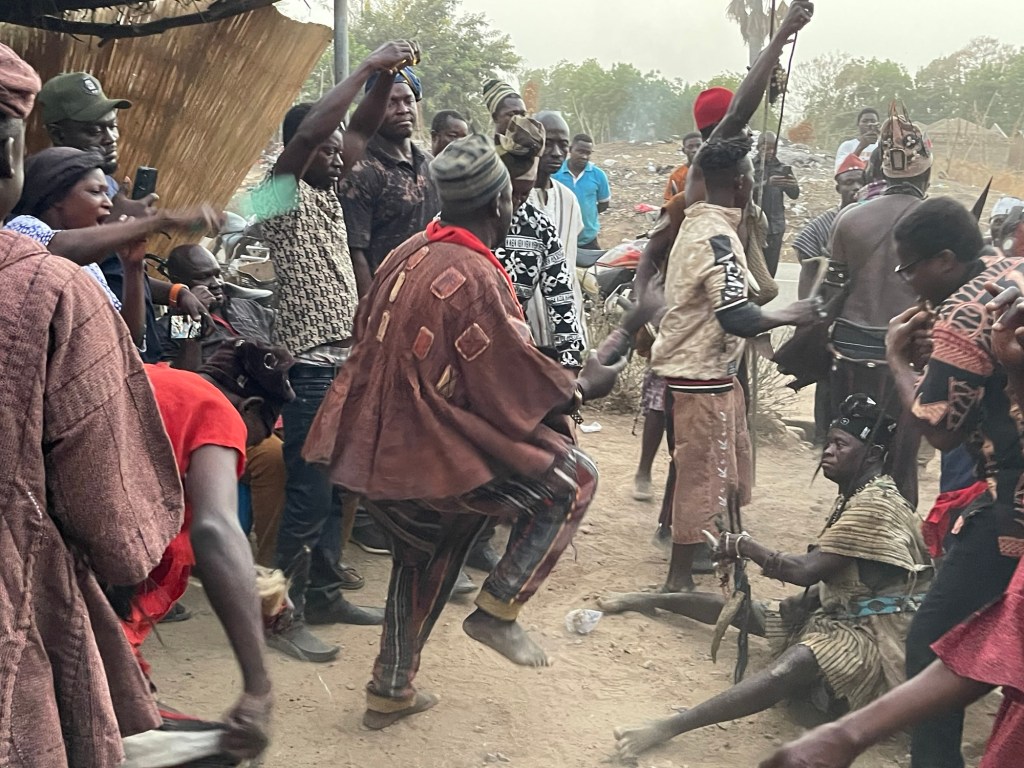
And it’s not even a real burial, as the body was buried earlier in the Catholic cemetery. “The Catholics have won! The white man brought his tradition and killed ours!” exclaims Wechiga. Goats are ‘sacrificed’, blood flows into calabashes, a clay pot is broken and a fake body in a reed mat carried about. Here, in the family compound are buried only some clothes. I’m glad that Akay, Adamba and Grace are buried at home. Go and bury some clothes for them in the Catholic graveyard if you want!
****
I never imagined I’d be glad to leave Navrongo. The compromises I must make are just too uncomfortable. I used to make these adaptations easily, but not so much now. The squalor of life upsets me; perhaps I just don’t rise to the challenge any more? I mean, I know I CAN adapt, but I don’t want to now! Perhaps I’d forgotten how much adaptation I need to make?
At home life is basic, a bit above subsistence, but only just. There’s no time – or imagination – for beautifying and personalising the home. It’s all bare concrete and twisted tin, mess and scurrying scraggy chickens. It’s simple and crude, this life. And HOT!
****
Wechiga agrees to travel south with me. We’re going by ‘public transport’, taking five days. It’s about 16 hours of extreme discomfort in old minibuses. We stop to see Gladys again: his sister still her effusive, laughing, generous self and I’m happy at least that these two old comrades come through my disappointments unscathed.
****
But finally, I’ve decided there IS something for which I’m too old: travelling by African people’s transport. Time WAS, the cattle truck travel was part of the story; proving I could do it – was as tough and accepting as an African. Maybe that was a fable for myself. 2026 Navrongo has challenged me. My fastidious nature objects to the number of compromises I must make to survive here: the basic squalor of this life, and the effort it takes, the HEAT. Time IS, I can’t stand it, get irritable and grumpy and most likely embarrass poor Wechiga.
****
The final straw is that even keli-weli is a poor imitation now: the wonderful Ghana-defining smell that I remember so vividly, as plantain chips fried with pepper and spices in aromatic coconut oil in big pans by the roadside, is now fried in ‘Frytol’, processed vegetable oil. It used to be served in a screw of cement bag paper with a cocktail stick. Now it comes in three plastic bags and a styrofoam box, with a plastic fork.
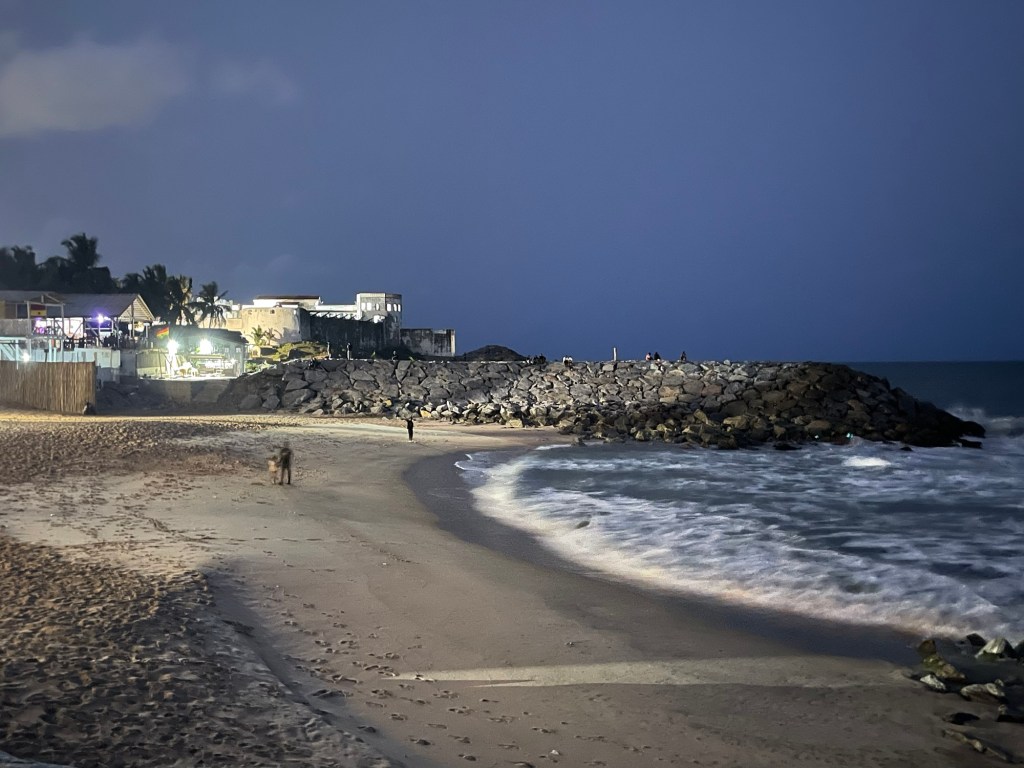
We stop the penultimate night 100 yards from the Atlantic beaches. Winneba is a bit down and scruffy; the traffic is a minor irritation and the breeze a delight. The town is not touristic; a low rise place with some old decaying colonial buildings and no attractions except a rather nice (cleaned) beach to the west backed by palms. It’s still 34° and horribly sticky, but the ocean breeze tempers it. I can walk the small town with a smile on my face. Popular on Saturday, it’s fun to drink beer and watch the enjoyment of so many young folks frolicking in rollers of the bath water warm ocean.
And what’s at the very centre of town? The prison! Backing onto Ghana’s huge free range toilet and refuse dump (ie. the beach). The sea is lined by ruins. Where in any other towns in the world would be the most expensive real estate, Ghana puts its slums and rubbish. Accra was always thus, a capital city on the coast, facing inland – pointing its backside at the ocean like so many of its inhabitants. So odd, that (many) white men look upon nature as an inspiring asset while so much of Africa looks upon nature as a nuisance and dumping place. You’ll never see flowers planted for beauty in Africa. If they have no edible value, they’ll certainly not be food for the soul.
****
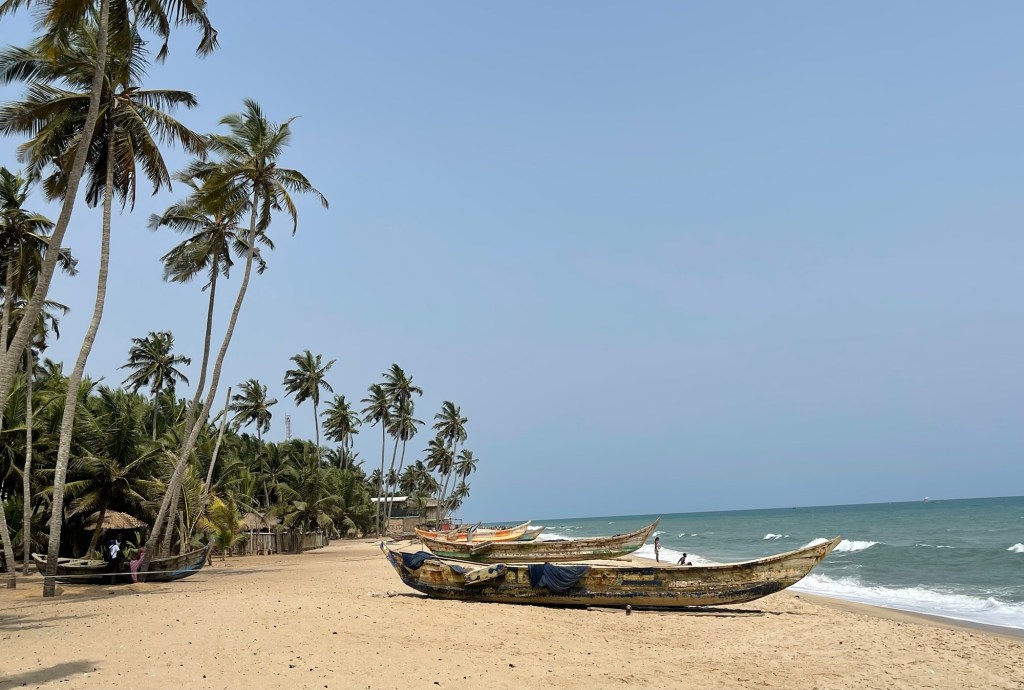
We wander on Winneba beach in the morning. It’s still hot, but there’s a trifle of breeze as we watch local fishermen straining to haul in nets filled with plastic bottles and a few meek fish.
Then we are at the lorry park; a minibus is just loading the last passengers. We’ve timed it well. We crawl into the back seats.
What follows, the last journey in Ghana, is the worst – in a derelict van which should be scrap. It’s so hugely overloaded that soon we have a puncture as we bounce cross-country.
We wait half an hour. There’s not a tree left to give us shade. Another van is sent. It’s even older. The sliding door wobbles without catches and I must now hang onto a stanchion for my life. The front door only has one hinge and must be heaved into position and slammed energetically in the hope of finding purchase. Later, it won’t open. The screen’s crazed like a map of some mad city (it could be Accra, where we are going). There are no instruments left – they’ve just been ripped out leaving their arteries hanging. The steering wheel is a skeleton without a centre. I can hear the crankshaft crashing around and something clangs loudly underneath. And it’s three seats smaller. We are 26 people. This is an 18-seater. It takes ten shouting minutes to decide that we’ll now be squeezed five across on some rows and three people must crush in alongside the driver. I get a fairly short straw: the conductor’s seat by the flapping side door. Oddly, today, I’m quite amused by all this. Maybe the seaside relaxed me?
It’s a couple of excruciating hours to the outskirts of Accra. There’s a new highway being built, but there’s no planning as to how all the traffic will find its way through the large and extensive roadworks, so it’s just a free for all. Red dust billows.
Sometimes, I imagine what it’d be like to be condemned to live here. Then I count my blessings and appreciate Harberton with its petty concerns even more!
****
 jonathansjourney.net