
THIS IS EPISODE FOUR – March 5th
I’m putting up TWO episodes today, as I’ve had no internet for month. They’ll appear with the fifth episode first, so SCROLL DOWN to episode FOUR first.
I’ve just returned to Kenya from a 23 day visit to Ghana, at the hottest possible time of year, leaving me exhausted.
****
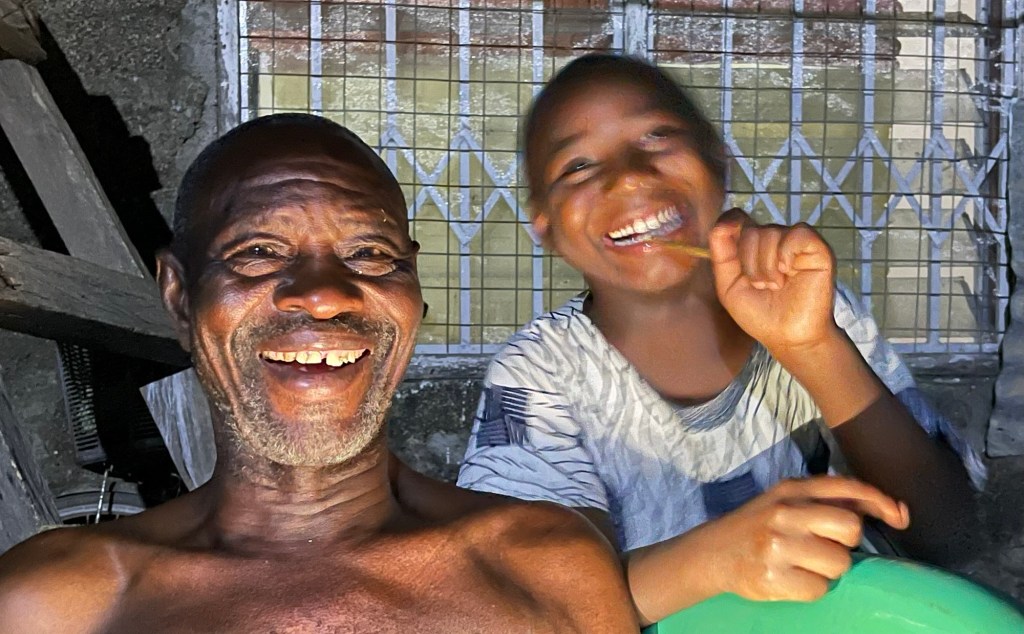
My timing, arriving from East Africa was ill-judged. Firstly, this is the hottest time to visit this Ghana; up north the temperatures hover consistently around 37° to 39°, five degrees north of the Equator as the sun climbs to the equinox. The coolest temperature was 33°, and that was by the ocean, as humid as a sauna… The sun BURNS down 12 hours a day. It’s no joke taking ANY activity at ANY time, yet I walked miles.
But worse was to arrive and find my old friend Perry seriously ill in Accra. I met Perry when he joined my English family as a Christmas guest in 1987, a student alone in London seeking a ‘Typical British Christmas’. Of course, with a guest from a Ghanaian subsistence farming family – from a small town through which I had ridden on my first Sahara crossing on my motorbike in earlier in 1987 – it was anything but typical.
Poor Perry, try as he did to be host, was very unwell. If I’d been told, I probably wouldn’t have come. There seems to be a social taboo to talk of sickness, but arriving into family dramas of sudden hospital admissions is not easy for hosts or guest.
Thus it was that I travelled north quickly to Tamale, an hour’s flight into the brown dust and burning temperatures of the dry season north; and on three hours to Navrongo by racing-driver piloted minibus; his main proficiencies being with the horn, accelerator and texting on his smartphone on the deteriorating road. It’s a dismally dry landscape, grey soil, burned bush and scraggy shea nut trees. All the big Ghanaian trees have gone – to smart furniture in the West, construction and charcoal for cooking.
****
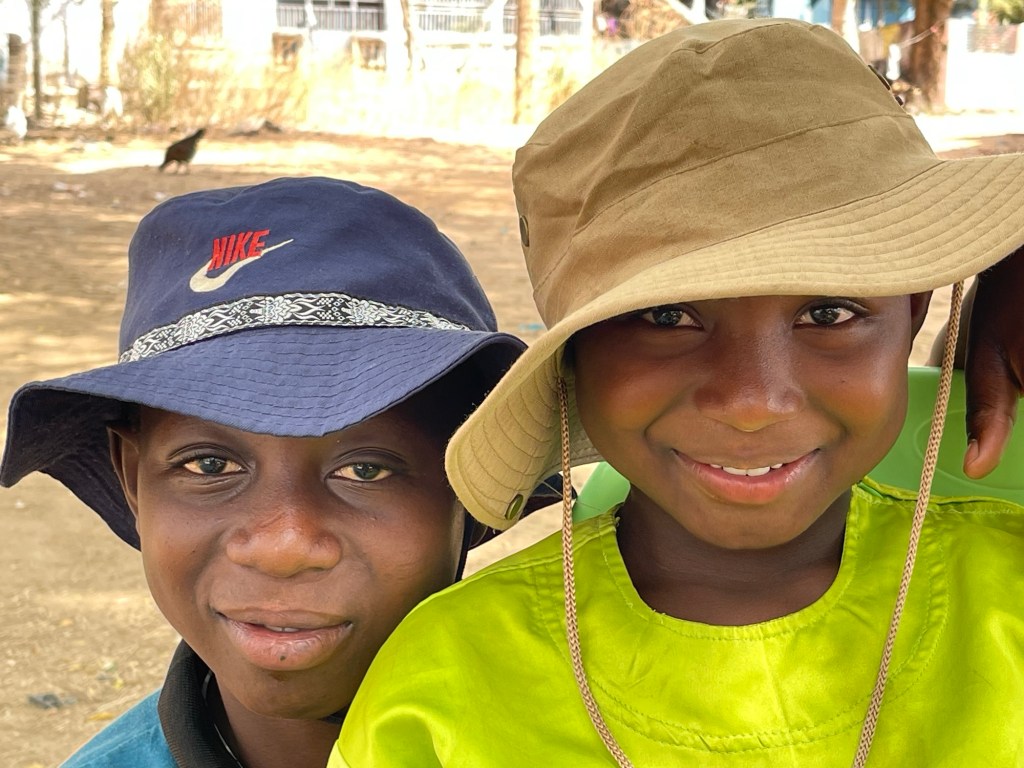
The town of Navrongo in the furnace of northern Ghana has been a major influence in my life, affecting my moral beliefs, ethical standards and how I look at life at home. It’s been in the background of my thoughts for 37 years, since I arrived on my motorbike two days before Christmas 1989, and met my brother Wechiga and became part of the Adamba family. As much as it’s possible for an outsider, I got inside another culture and saw life through their eyes; lived in their earth-built compound and came to know the old generation, last of the old order in Ghana. Although I didn’t know that then…
Now, in 2026, I’m back in this place I came to know so well on 21 previous visits – and I’m totally lost, physically and culturally – and emotionally.
I knew the old compound was gone – razed to the ground, to my unforgettable shock, between two of my visits after Akay died. Now, narrow footpaths are informal even dustier roads, abuzz with a thousand motorbikes and scooters, old cars and 4X4s. A fluorescent rainbow of Chinese-paint walls and ugly security railings surround hideous mouldering bungalows dotted with rusting satellite dishes; all set in a desert of blowing plastic refuse.
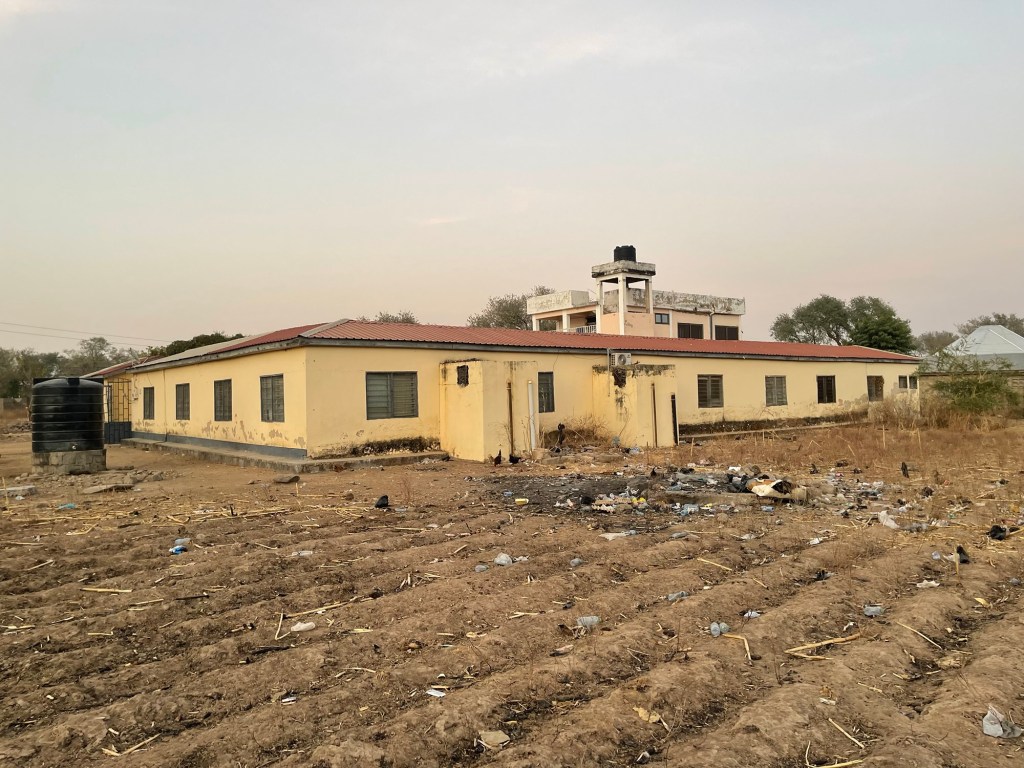
There’s no vernacular architecture, just hubristic designs on display to outdo the neighbours. Where there were fields of groundnuts and millet, grazing cows and earth-built compounds, there’s concrete and zinc, scruffy grey block bungalows and part-finished palaces, all unmaintained. This is considered development.
I’m not sentimental for the old days – when so many died in childbirth or in the first years of life; when hunger was endemic and ancient cruel practices masqueraded as culture. No, now people live longer – to kill themselves of drink, drugs, bad riding, envy, stress and junk food: exploited for the profit of the few.
Mutual support and strict social conventions ruled the the old life; there was a strict moral structure that controlled behaviour. There’s no SHAME any more, like the West. Now the relentless desire to accrue and display material wealth brings murder, jealousy, crime, disillusion, stress and lack of fulfilment. In copying the materialist Western life, the baby’s gone out with the bath water. Akay wouldn’t like this Navrongo. I don’t either.
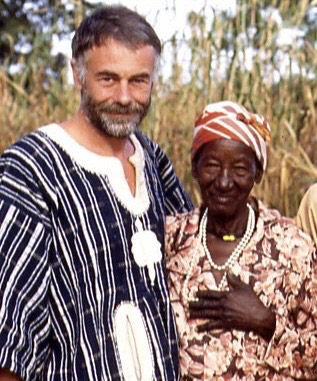
Akay is still the most impressive person I’ve met in all my African travels; my African ‘mother’, mother to my brothers Perry and Wechiga and my ‘mad sister’, the irrepressible Gladys. It is Akay who directed this family into the 21st century, an illiterate woman with no status as wife of a junior brother, but of the finest natural wisdom. I couldn’t speak with her, but that never mattered: we recognised basic integrity and trust instinctively. She was the force of the family, relentlessly making her groundnut oil and kuli-kuli biscuit from the peanut waste to educate her three surviving children in Navrongo. In other circumstances – girls weren’t educated in her day – she’d have been a natural leader. As it was, people young and old listened to Akay’s advice.
Akay wouldn’t like the place Navrongo has become… She was the strongest proponent of the extended family, one of Africa’s greatest institutions. She forever respected hard work, community and mutual support; championed the belief that what she had, she must share. No beggar went empty away despite the hardships and poverty of her life.
The majority of the neighbours are now strangers in rental bungalows, the new income earner for the wealthier men of Navrongo, from lecturers and employees of the university faculties that were set up here 20 years ago and brought money to the town, but also brought a transient population – flitting by on motorbikes – that decimated the old traditions and values. Most of those who make the money from rents don’t live here any more: sons who live and work in the big cities or abroad but capitalised on the family lands in their poor origins. Many houses are empty, junior family members now mere caretakers.
Community, for so long the lifeblood of Africa, its way of overcoming hardships, is a washy version, everyone ‘too busy’ now, despite having more leisure time than any time in history. Time maybe to fritter away in endlessly scrolling screens and ‘liking’ new friends’ activities.
Akay’s Navrongo is gone.
****
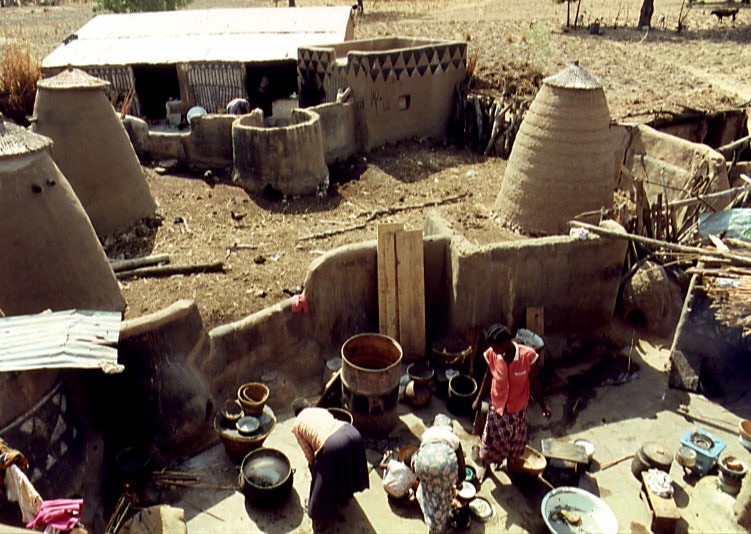
I think back to that first time… It was two days before Christmas 1989, the end of my second Sahara crossing. I was met by Wechiga at the border of Ghana, just ten miles north of Navrongo, having ridden 13,000 miles from Yorkshire on my ‘Big White Moto’, as my BMW motorbike became known as we rode about the area: me suddenly a celebrity. I knew nothing of Wechiga’s culture: how to behave, what habits I must adapt to, what was expected of me. It was in those early days, while I depended on Wechiga’s wisdom inherited from his mother, that I came to respect him so much and built a firm brotherhood – for he knew nothing of my culture and habits either, but guided me instinctively through the minefields of social convention of that old Africa.
In 1989 I remember, many people came in the darkness of that first evening in the original compound in the dusty fields, where my motorbike stood beside the conical mud grain stores with the thatch hats. My big bike was a wonder, its technological presence alien to the earth-built, rounded organic structures around us, decorated in black and white patterns. All the local families came to greet their white guest. By lamplight I could only make out smiling teeth in black faces, but it was warmly sociable and communal and very exciting. Next day, we had to visit all the local houses to pay our respects. It was how life went round in the old Africa.
Now those houses are mostly filled with strangers.
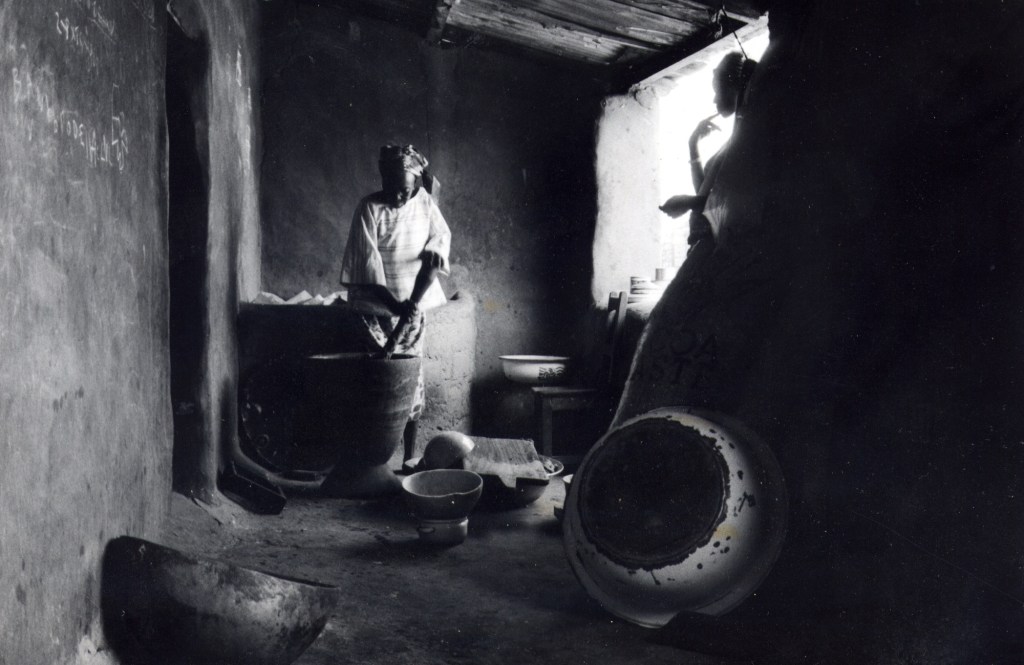
Only a vestige of the old welcomes survives; there’s little of the social formality left. It’s a handshake in passing and “Welcome back. Long time!”, not the formal visitations, ‘sittings’ and extended greetings. It’s a wave from a moped and a shout of, “Eh! Navrossay, you are back!” Navrossay, ‘Navrongo accepts you’, my local name for these 37 years. There’s no time for those old fashioned formalities. We’re all too busy, despite the fact that no one goes laboriously to the well for water – they have big black plastic tanks above their bungalows pumping from boreholes to wash their motorbikes; no one walks to market – they ride; few hoe their compound fields – the only crop is bungalows.
Wechiga and I amble to visit neighbours; some around still know me, but none of them return the visits as formality demanded. There’s little excitement to see the white man; there’s a cheek to the children, a swagger from teenagers who know the worldly wisdom of their smartphones.
Many people I came to know, of all ages, have died anyway. Far more than die in my own circle. It’s a tough life; life expectancy here is lower and fewer people get medical help for ailments. Many die from problems of their own making too.
****
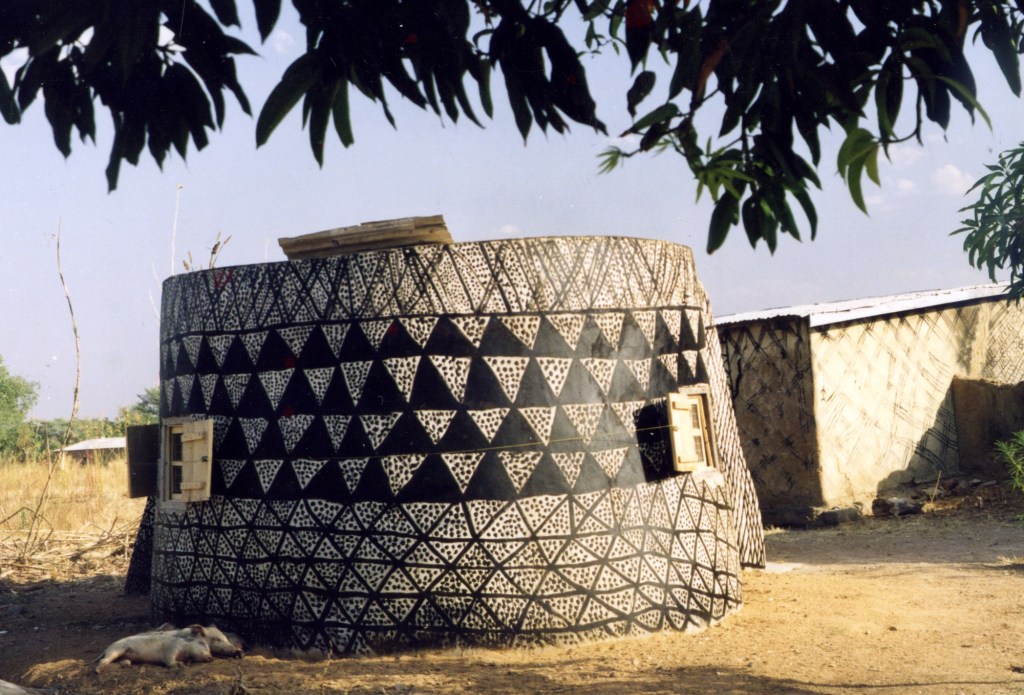
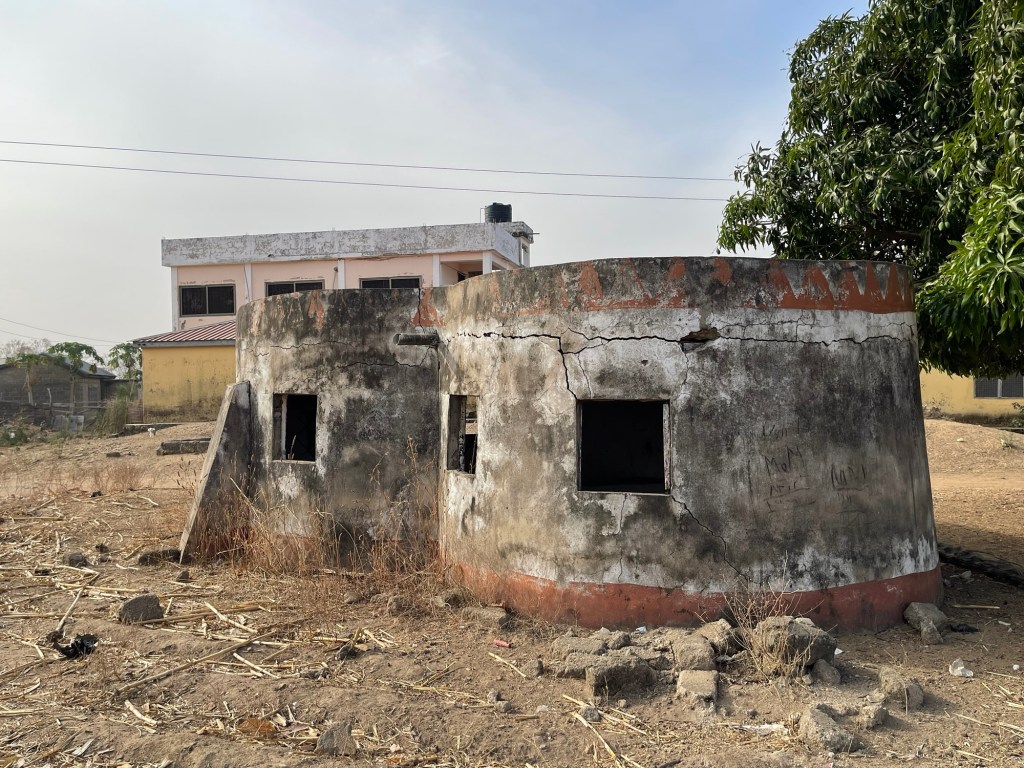
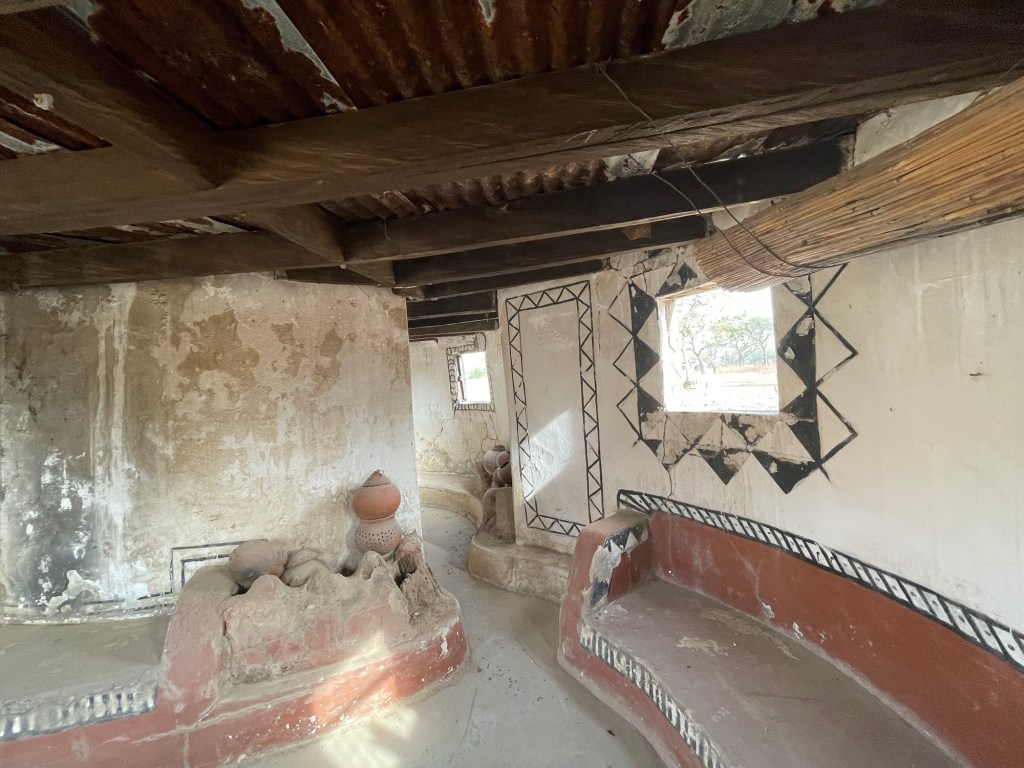
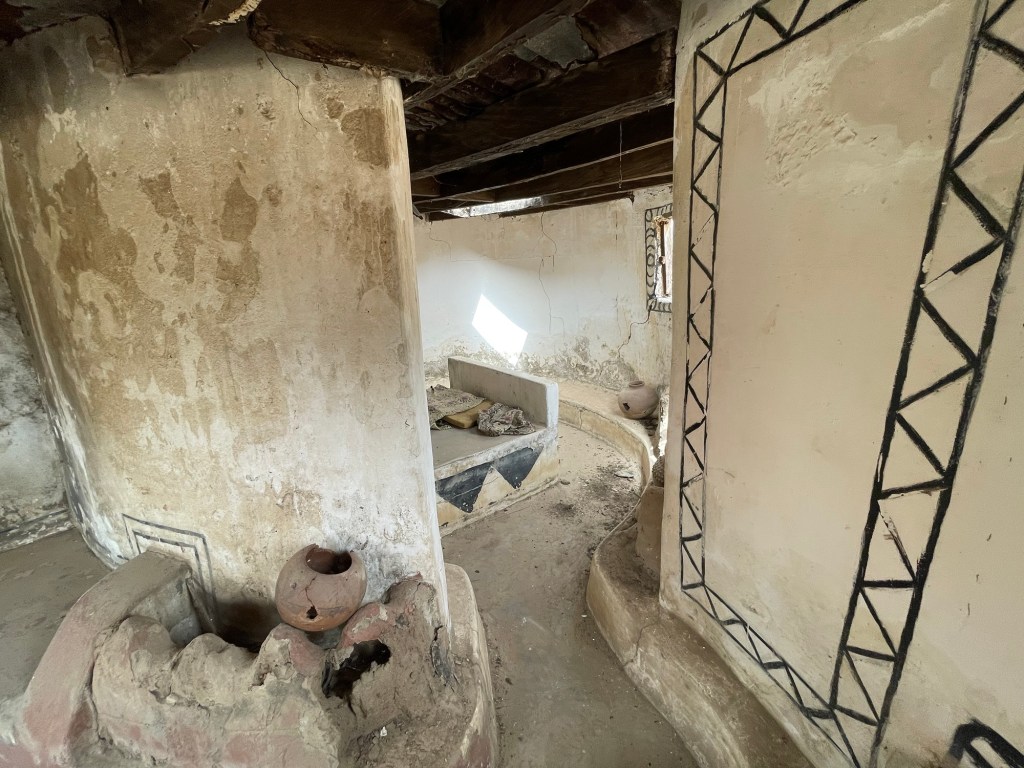
In the 1990s, I built my own block in the then family compound, a design that incorporated traditional with practical modern knowledge. It stood at the edge of the earth-built compound. I imagined it would be absorbed into the compound in time. But in the new nuclear family divisions of Navrongo life, that ‘old fashioned’ compound was razed to the ground in a frenzy of ‘modernisation’; replaced by a two storey block house surrounded by rental rooms, and several ugly rental bungalows. My idiosyncratically quaint round house with its black and white patterns ended up marooned in the remnants of the fields.
Jonathan’s House is now a ruin unworthy of repair; nothing is maintained here and I’ve been away for eight years. It’s stained and gloomy, an eyeless face. The roof is weak, the window frames rotted and eaten by termites. Children have chalked their alphabets where once I had traditional designs.
I made a little museum of traditional items: old pots, one or two unbroken ones rescued from a pit into which all Akay’s carefully safeguarded earthen pots were thrown during the clear out. I collected pots, calabashes, Uncle Gwea’s elephant-headed walking stick, the old men’s tobacco pipes. Very few survive, cracked and ignored in the ruin of Jonathan’s House. I could preserve them, I suppose – but mine’s another culture. Why bother?
No one here wants to remember that their parents and grandparents carried water from distant wells on their heads in fine earthen water pots with incised designs. It’s an embarrassment to preserve memories of their ‘backward ways’. Now, all have plastic containers and vacuum flasks from China, complete with ubiquitous peony decorations. I guess I’ll forget MY tradition and let the pots crumble with the house. No one here looks to the past, that’s a Western tradition… Perhaps my house should be best seen as a metaphor for the lost life of Navrongo. A decaying ruin covered in childish charcoal graffiti disintegrating into an ocean spume of plastic filth. I must ignore nostalgia; perhaps its value always rested in the story not the actuality..?
****
Navrongo has become one of the dirtiest towns I have seen in all Africa (and I’ve seen some FILTHY towns). The plastic problem is disheartening. To one who tuts censoriously at any piece of blowing litter in my home village, it’s distressing. Rotting plastic carpets the ground, flutters from every dead dry season plant and crunches underfoot. The biggest culprit is a piece of total commercial exploitation: half litre plastic bags of water. Sold as ‘pure and hygienic’, it’s almost certainly tap water made pure and hygienic with Ghana’s taxes. It’s the con of the century: tap water as luxury. It tastes of cheap plastic and the bag is discarded in a moment, to blow for evermore about the environment.
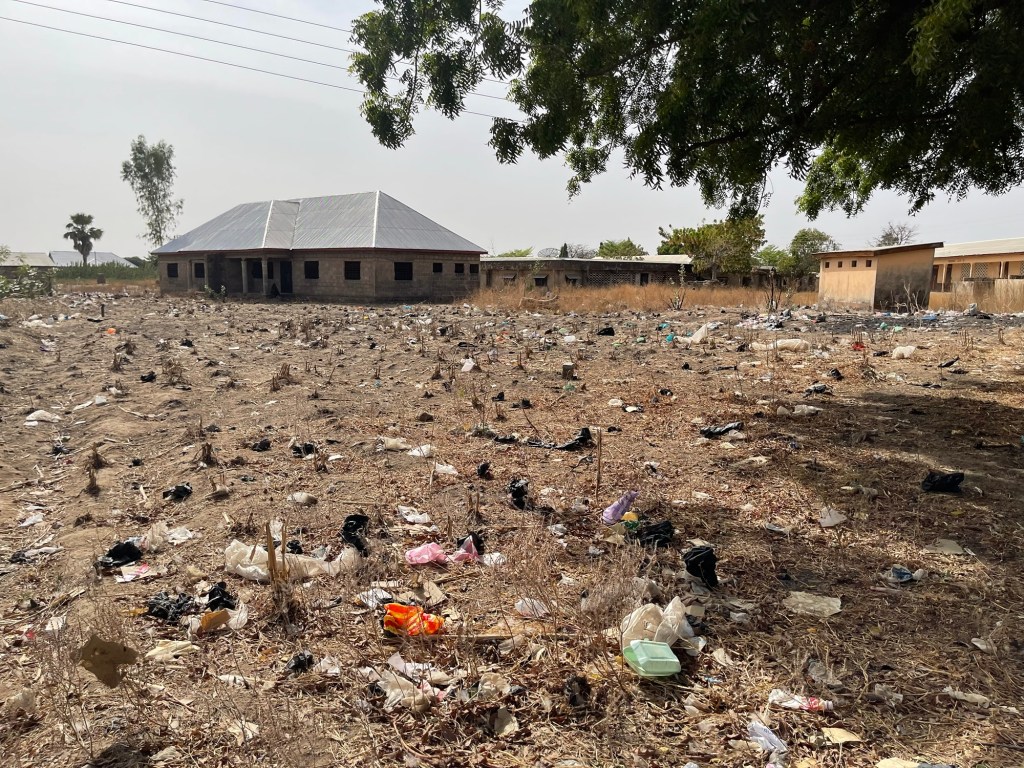
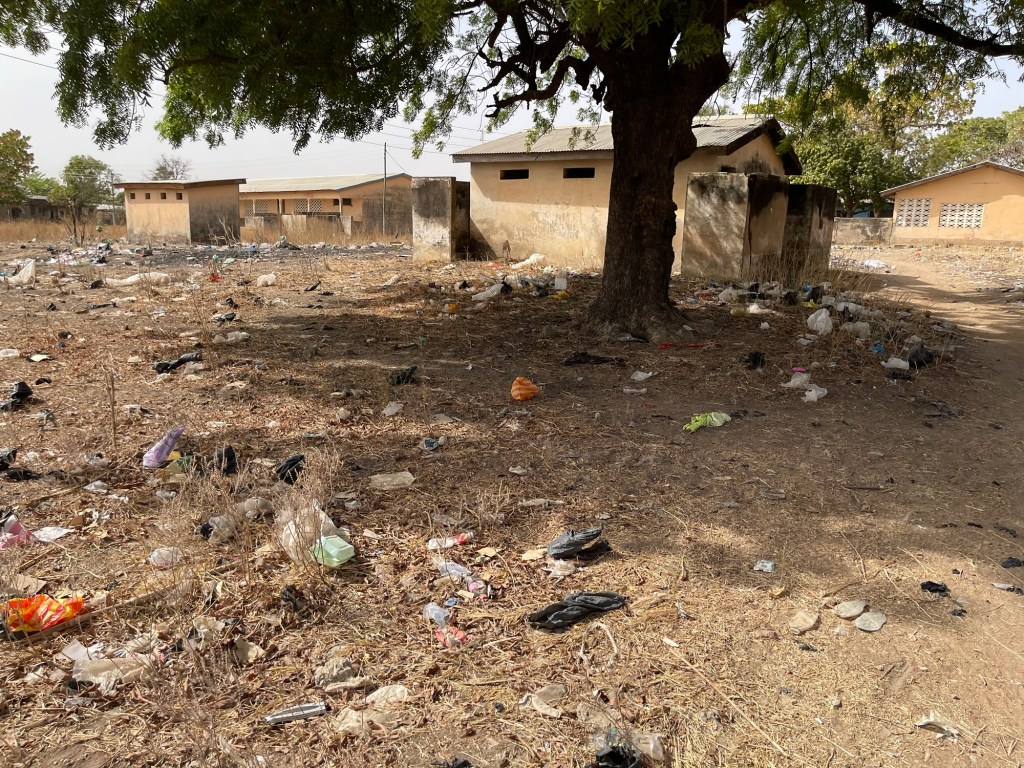
In places it’s ankle deep: single-use bottles; ubiquitous black plastic bags, the reflex reach of every trader; a million water bags; medicine containers, used ‘disposable’ nappies, sanitary towels; sachets from every sort of processed food, Chinese plastic shoes by the thousand – (‘buy Chinese, buy again next year’); sachets from killer alcoholic spirits; soap bags, cooking oil sacks, tattered remains of plastic mosquito nets, fertiliser bags, cement bags, margarine sachets (yuk!), carrier bags, styrofoam junk food containers; household utensils, ‘convenience’ food wrappers, bags, bags, bags, bags, bags, bags, bags. We don’t deserve this fragile planet – and in her wisdom I believe Akay would have sensed that.
****
Maybe I settled a bit once my initial disappointment was past? I tried not to see the filth and pollution, to be more philosophical about the fact that in 37 years almost all the world has gone the same ways. I think I knew, rather than suspected, that this visit would be a disillusioning visit.
Perhaps I just had to finish my Navrongo Story?
*****
I’ll post the conclusion of this Ghana story shortly, a little more upbeat I hope, before I return to Uganda and no internet at the weekend.
 jonathansjourney.net