
MARCH 18th 2025

To reenter Kenya yesterday, I had to buy a new visa. It’s an online application, tedious and arcane, but probably invented by the British, who make such bureaucracy FAR more complex and eye-of-the-needle for my black-skinned friends. I paid with my credit card. Later, I checked the payment.
Guess where the money went – some £25 of my hard currency?
Not the Central Bank of Kenya, but to Neufchatel, Switzerland! – a Swiss bank account.
Intriguing. Under the current president, William Ruto, Kenya has taken many steps backwards to become recognised as one of Africa’s more corrupt governments. But more on endemic East African corruption later…
****
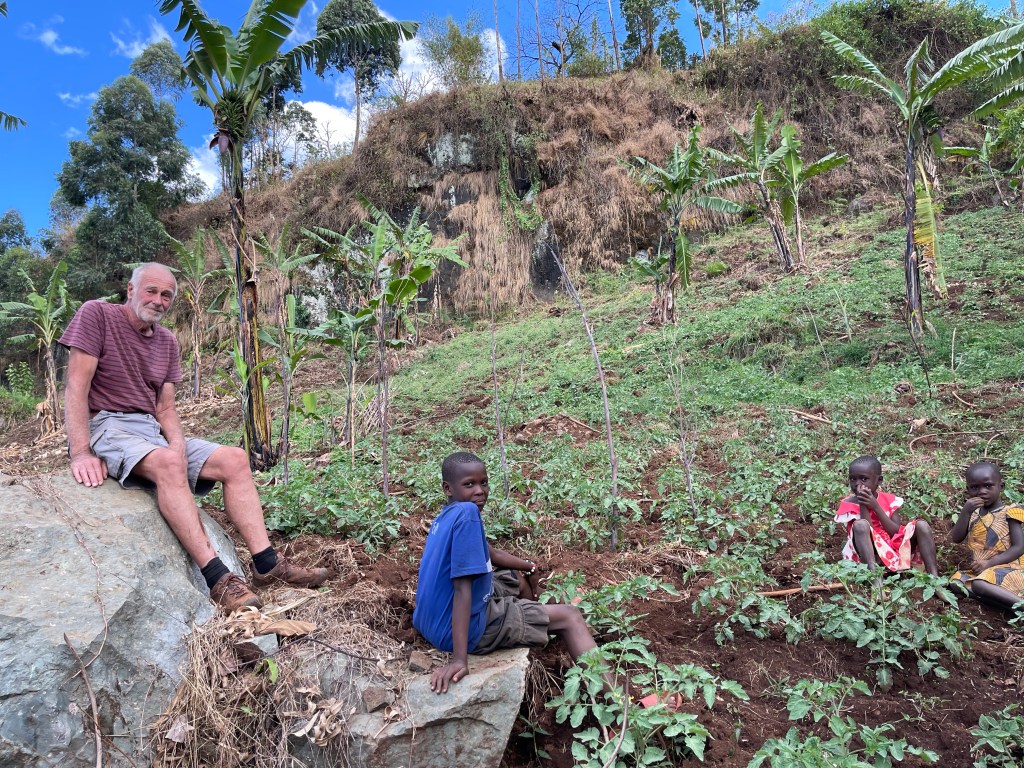
“The rains start on March 10th…” I’ve been told this many times, and it’s the reason I leave East Africa about then. Last year, I got back to Devon on the 12th to find everyone utterly miserable: “It hasn’t stopped raining since you left…” said with despondent misery. Within a week of being trapped in Rock Cottage by dreary drizzle, darkness and chill, I too was miserable and decided right then to stay an extra month in Africa this year! After all, ‘at my age’ I have to make the most of every opportunity, and why be miserable?
But I have a quandary. On a filthy wet day in Uganda, the mud – and the rain, cascading off the corrugated roofs – are wretchedness itself, somehow more difficult to bear. At home I can turn up the heating, turn on Radio Three and eat cake. Here you slosh through cloying red mud and rain waterfalls on your head. There’s not much escape. Happily, the rains are slow to build this year, so my decision is still in my favour – just. On the 9th, we had heavy showers; on the 10th steady rain, on cue. Then several days with no more than light showers here and there. Some of the recent days have been oppressively hot and sunny as the humidity increases.
I’ve just got back to Kitale, where the afternoon thunder roars and frets overhead. Will it rain? Probably a shower. It won’t yet be the concentrated downpours that will come soon. When it rains here on the Equator, it REALLY rains! You don’t want to be on a motorcycle.
****
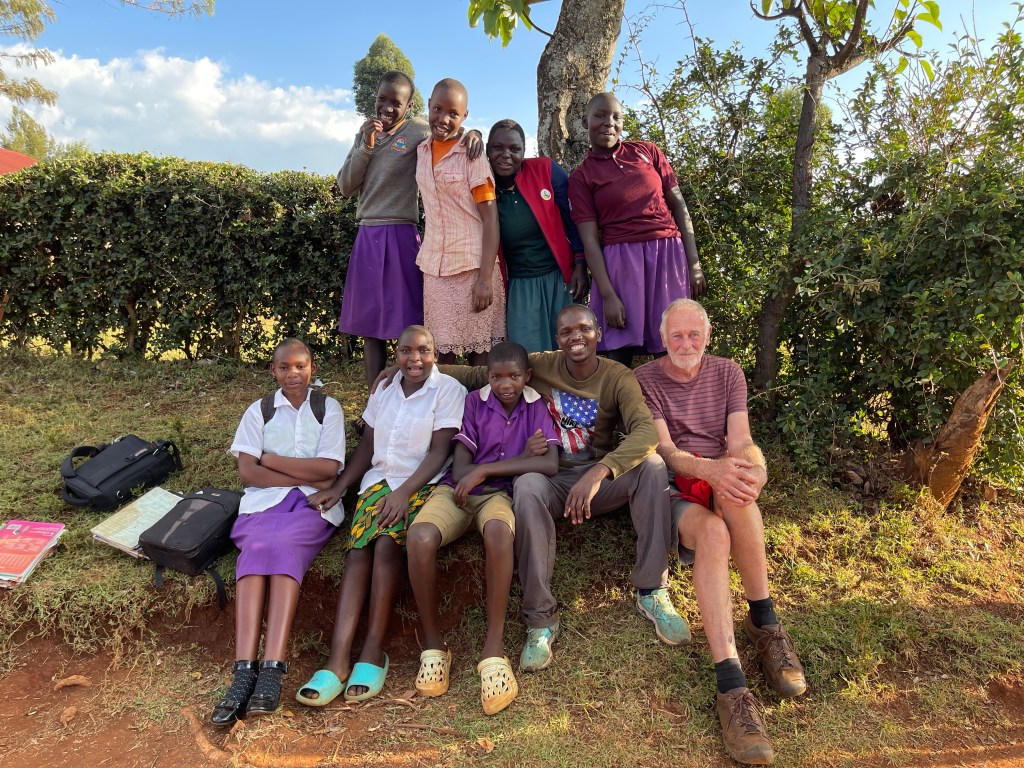
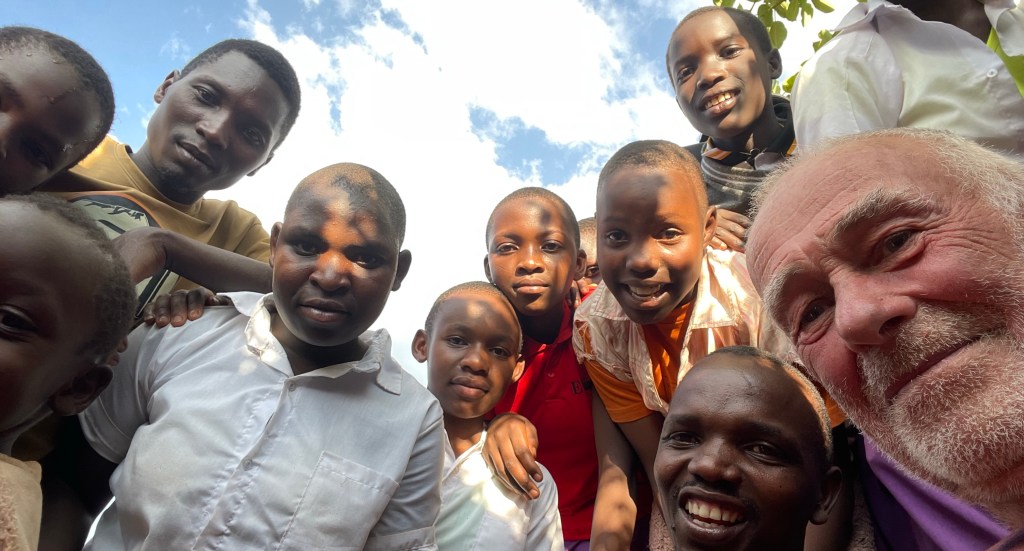
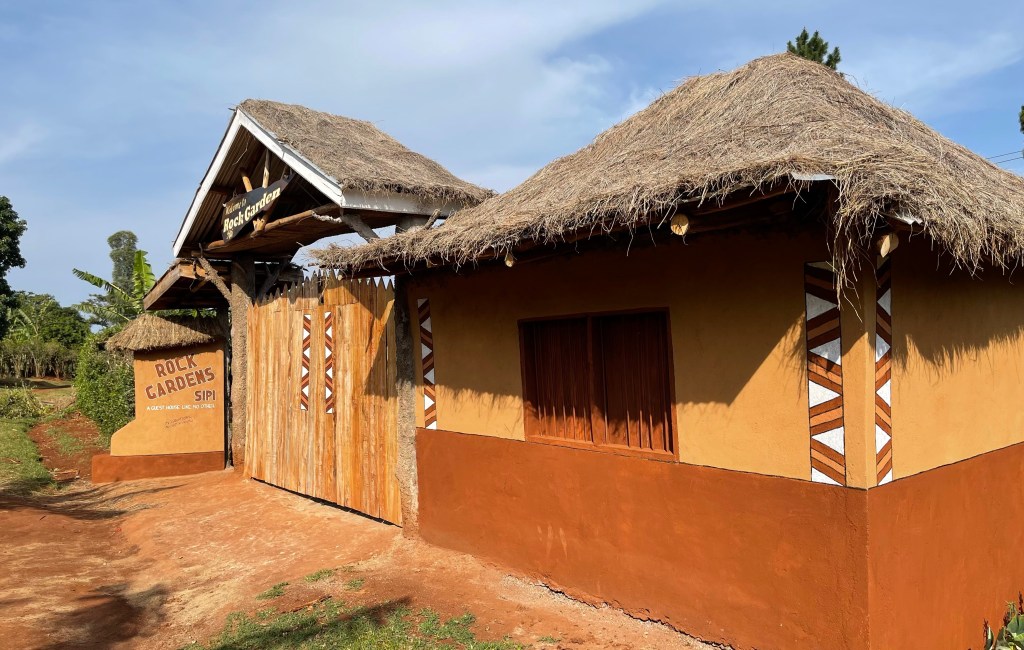
I’ve been in Uganda all the time since I posted my last episode. Of 100 days so far, I’ve been 54 in Sipi. Alex’s building bonanza of 2024 means there’s been plenty to keep me busy.

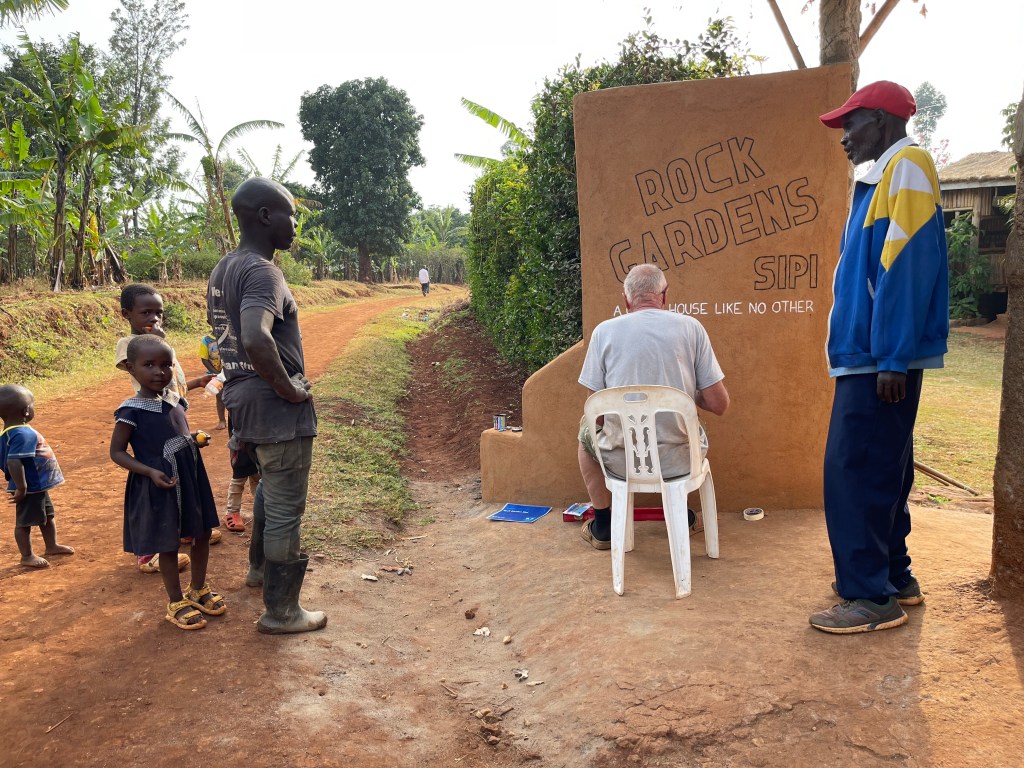

This length of stay has exposed to me some underlying realities of Ugandan life, aspects that tourists coming for the animals (now largely behind protective fences) and the increasingly staged ‘tradition’, don’t witness. Much of this underbelly is not attractive. Such friendly people in a beautiful – but often shitty land and a moral vacuum.
The appalling leadership – Uganda is run as a Family Business by the president and his relations – has made Uganda a dog-eat-dog country. “A very behind country,” as Precious once termed her homeland. All fight and compete for the scant resources left after The Family creams away all the riches to their own – doubtless Swiss – bank accounts. With such leadership as an example, just about everyone – with rare notable exceptions – is corrupted, lawless and grasping for a lifebelt as they drown, often fighting for others’ flotsam to keep their heads above water. Nothing is done in community spirit, only for payment. I’ve heard so many appalling stories of lawless, amoral Ugandan behaviour that I feel prudishly offended and disillusioned: tales of murder, revenge, rape, millions of unwanted pregnancies, attacks, clan rivalry, tribal hatred, fratricide, matricide, patricide, infanticide, jealousy, pride, ignorance and pure evil.
Uganda is an extreme African example of ignorance and immorality, although sadly not alone, with all the medieval horrors of of infanticide: unwanted children discarded into latrines, left to be killed by dogs, abandoned; men like randy animals having casual sex without responsibility for the babies or thought of consequences; of wives killed and disfigured by jealous husbands (with no morals of their own) for sexual misdemeanour in a place where sex is forced, demanded, raped. Of brothers pushed over cliffs for alleged interference with wives; of summary murderous justice meted out clan against clan; assassins hired by the government to seek out and kill; of rampant poisoning and mysterious ‘accidental’ deaths of opposition. It’s like a medieval horror fantasy, but it’s the underbelly of Ugandan conscience.
It makes me wonder – if this is really the sub-surface reality – why do I find Uganda so fascinating and attractive? And ironically this is where fate elected that I’d find a son and grandchildren… Only Alex brings a sense of censure and rationality to it all. Many still believe in witches and ignorant ‘cultural’ beliefs in this poorly educated country. Of course, I am bringing my own judgement and standards to bear, but the stories are gothic, and all around me. Stories of lawless revenge and shocking events apparently accepted and condoned as so-called ‘culture’…
I don’t think that the grandparents’ generations were like this. I believe it’s a relatively modern problem and less pronounced in more developed countries in which I’ve travelled: Ghana and Kenya for instance. Yes, the harsh punishments may still be there, but not the total lack of moral control. That’s modern Uganda, a poverty-stricken country controlled as a criminally despotic Family Business, with no moral example, where everyone fights for money and lives for the day, where no one thinks of the consequences for tomorrow, and is exploited as an emerging ‘market’ by uncaring capitalist corporations and their own leaders.
It’s interesting to note that overwhelmingly, these people profess Christian or Islamic beliefs…. Lip service to moral structures they certainly don’t follow.
Joshua trained as a nurse. He’s been shortlisted for an interview: a job with a salary of £270 a month. He has a small family and needs the work. “But,” he explains, “they will ask me, ‘when are you coming with your brother’?” I look mystified, until I understand that he means the bribe for the people conducting the interview. “This time, I won’t give them money until they offer me the job. The last job I applied for, it cost me one point five million (£335), and I didn’t get the work…” The job for the highest bidder…
Then there’s the phenomenon of ‘ghost employees’ and ‘ghost pensions’ – billions of shillings paid out for teachers, army personnel, nurses, and government workers either struck off the rolls, or dead, whose salaries and pensions go into the pockets of officials on the ladder above them. Marion was widowed by her soldier husband, but can’t get the pension to which she is entitled, because she has no clout. But someone, somewhere, is enjoying her pension… Shameful, shameful Uganda.
****
Debra, nearly a decade younger than me, is from Melbourne, a lawyer and long-time traveller, with a love of Africa. We met last year when she came to Rock Gardens with her charming young protege, Rebecca, an orphan from Jinja, down in steamy central Uganda, where the Nile slides out of Lake Victoria. She quickly and instinctively became part of the Rock Gardens family: ‘Auntie Debra’, and with me, supports Alex in developing the guest house – with financial help and good advice, her legal knowledge coming into use as Alex becomes a land owner.

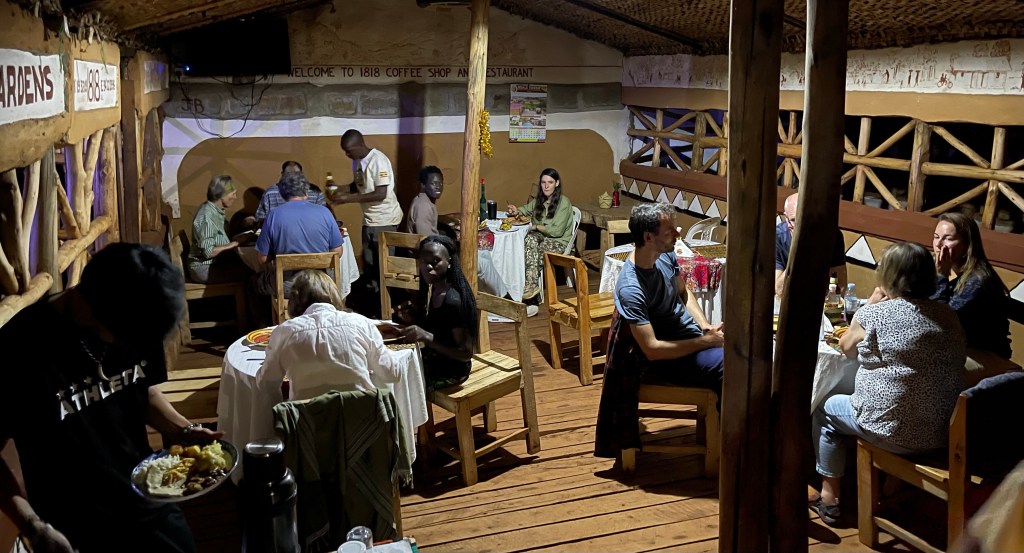
Rock Gardens is a success story way beyond my expectations. But travelling has changed so much since Debra’s and my early days of impecunious wandering to find out how other people experienced the world. The Internet Tourist is now on a merry-go-round (or treadmill) of Tourism, with a capital T. They come to Sipi, do ‘The Waterfall Tour’, ‘The Coffee Tour’, ‘The Sunset Tour’, see it all in the same recycled way, post the pictures on Instagram and have totally unrealistic expectations of life in rural Africa. They demand the comforts and conveniences of home; have an instant NEED to charge phones; use Alex’s pay-as-you-go wifi to work remotely; expect electricity at will; to be able to pay with credit cards (in UGANDA!!! Haha!) or even foreign currency; I hear plaintive bleats of a newly arrived tourist, disappointed by the fact there’s no hot water. What do they expect? Most of the world has to carry their water – cold – from a well or pump far from home. And then only when there’s been rain. The new Tourists do the bungee jumping, rafting, zip lines, abseiling and pay for selfies with ‘natives’ in funny costumes (donned for the tourist dollars). It’s all become very commercial.
But Rock Gardens is on the Tour now. We’re on Google Maps, booking.com; have hundreds of ‘reviews’ (ALL positive except one totally obnoxious Israeli), from visitors, organisations and Tour companies. We’ve Arrived! And chaos is not far below the surface as Alex juggles rooms, sometimes booked for a night, but so much enjoyed that visitors want to stay for several more. One night, he even booked out the generator room, hastily washing it out, installing a bed and a lock on the door. Another happy customer! They love the welcome, the atmosphere, the food. They come, they enjoy, they tell their friends.
Who then book online and tread the mill…
Before the days of ‘social’ media, I don’t think Debra (who once spent several weeks walking across the desert with a camel caravan in West Africa) and I had such expectations or put such demands on the people amongst whom we travelled. On the whole, we left our standards at home, where they belonged, and judged by what we saw around us. Now, Tourists travel WITH their standards and demand the things they have come to know as NEEDS not wants.
I’d last about a day as a hotelier!
****
My ‘son’ Alex and I have come to love walking, especially together. He says it’s my influence that has let him discover the relaxation of hard hiking – an odd oxymoron. He admits that he sometimes just walks away from the pressures of his business and goes for a hike by himself. He says he thinks of me. Best, we enjoy arduous hikes in the spectacular mountain scenery around his home.


Why does anyone want to toil round The Sipi Falls Tour, The Sipi Coffee Tour, The Sipi Sunset Walk, when there’s REAL African life just a few miles in the other direction?
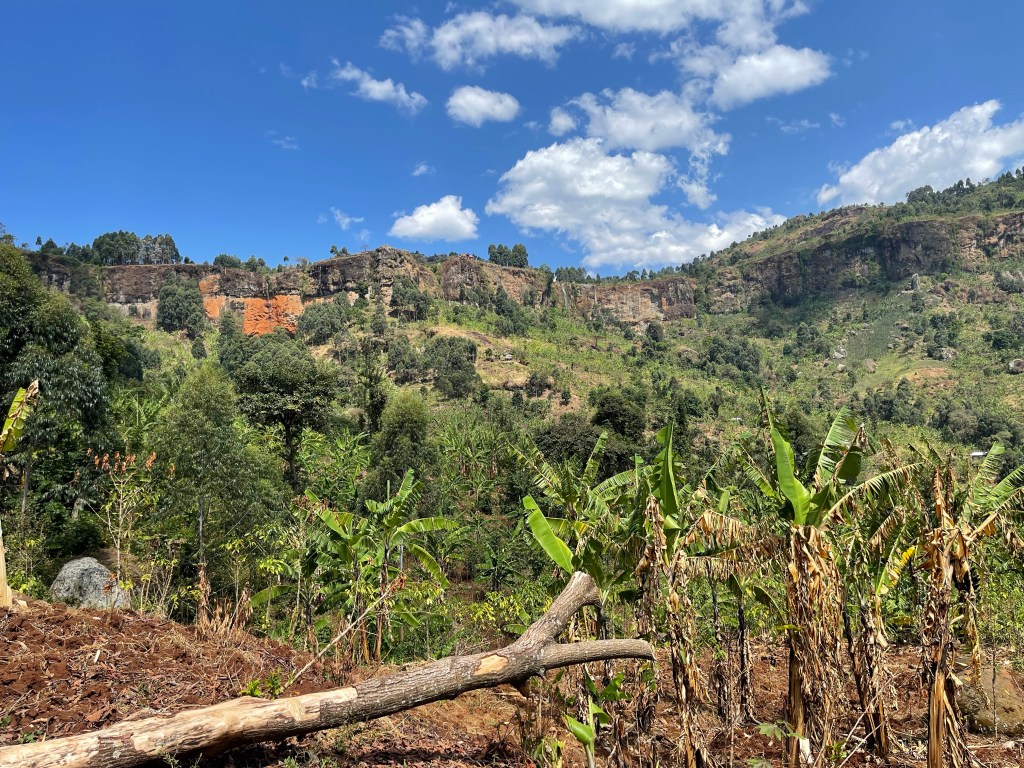
Two days ago, I rode a borrowed motorbike, with Alex as pillion, to his sister, Doreen’s home. She’s one of his closest siblings, married to Leonard, a very charming coffee farmer, about ten miles from Sipi. In past years, we’ve walked BOTH ways to visit Doreen and Leonard! This time, we wanted to walk even further from Sipi, beyond Doreen’s homestead, with cheerful Leonard for guide. Remarkably, just ten miles from Sipi, it’s a different language, and Leonard has been much amused in the past to walk with the mzungu.
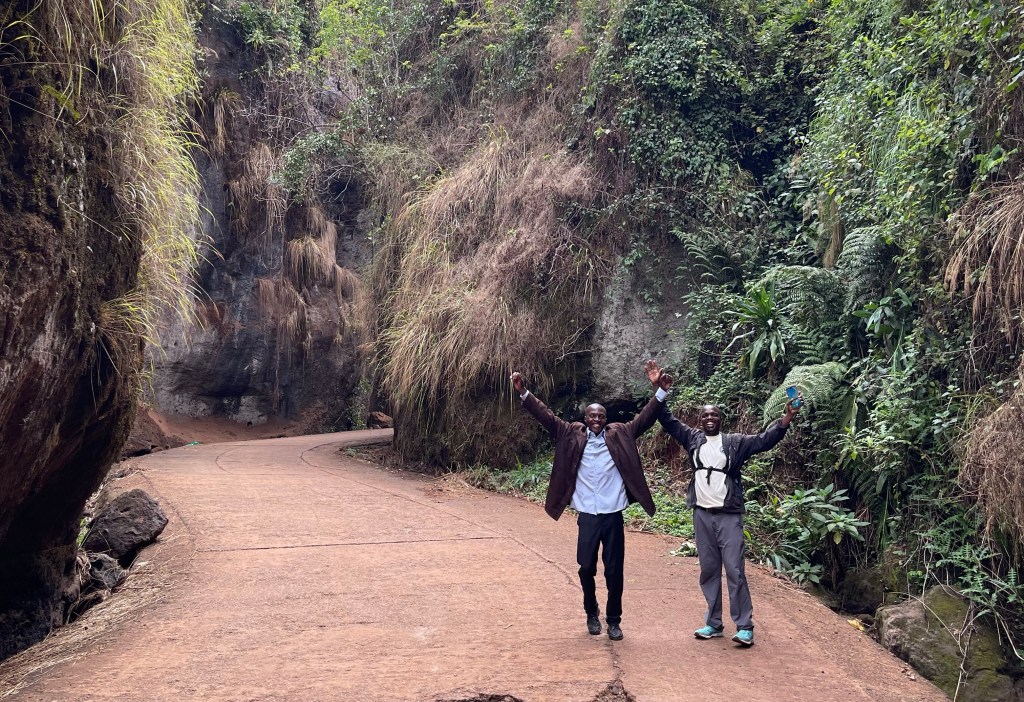
Never before, though, have we caused the sensation of this hike. In so many hamlets, and even one town, people come out to stare. I am, they say, the first white man ever to visit them! It’s SUCH fun to move amongst this goodwill. Children flock or flee; all are concerned that the mzee (old man Huh!) will not survive the clamber up their mountains; Samuel and Robert, late-teen brothers, are so astonished to see the first mzungu to pass their remote rural home, that I have to stop for a selfie; boda-boda riders wobble as they negotiate rough red tracks, staring back at the pink-skinned, rather sweaty phenomenon; madmen gather to talk nonsense; farmers direct our route.
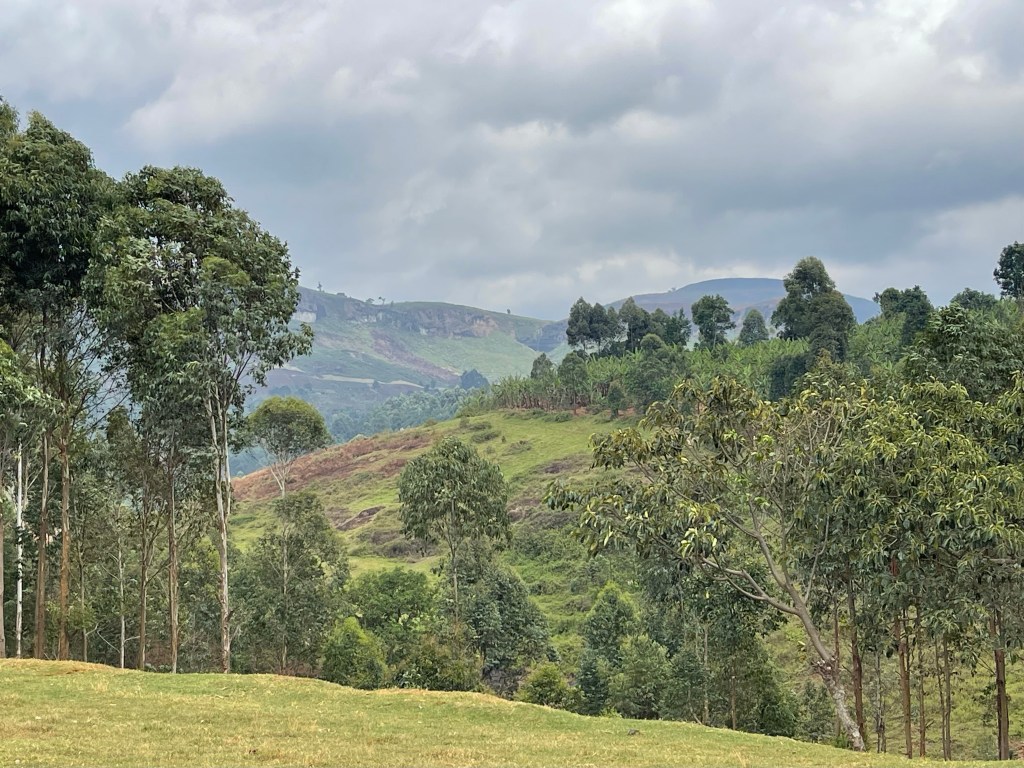
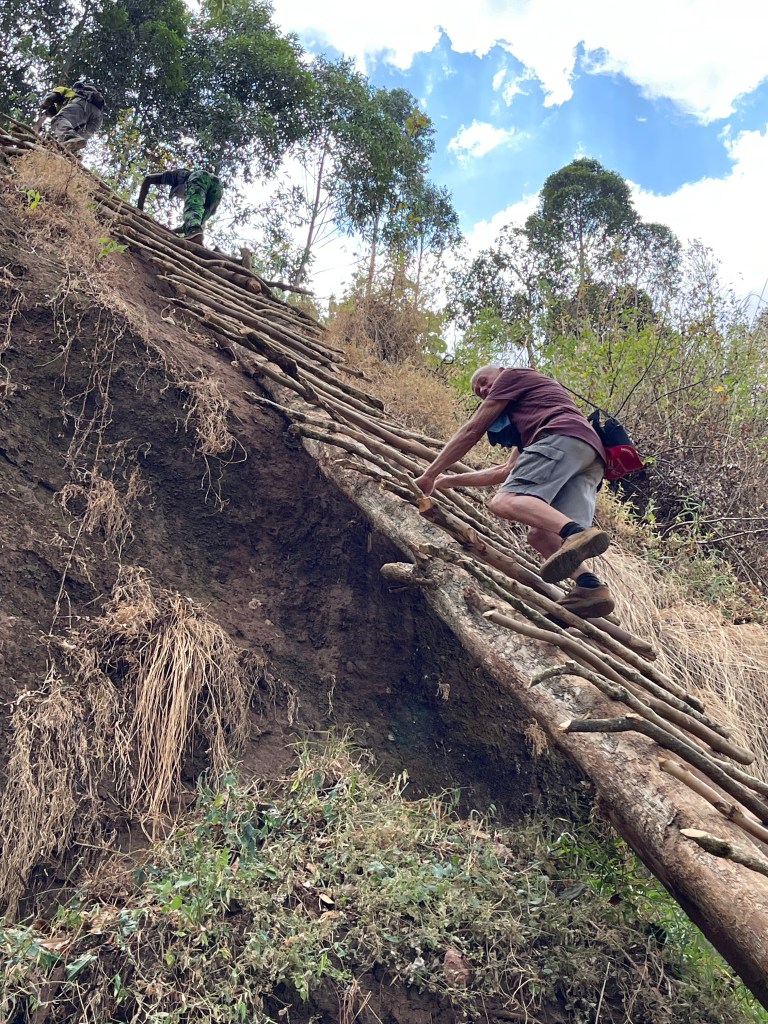
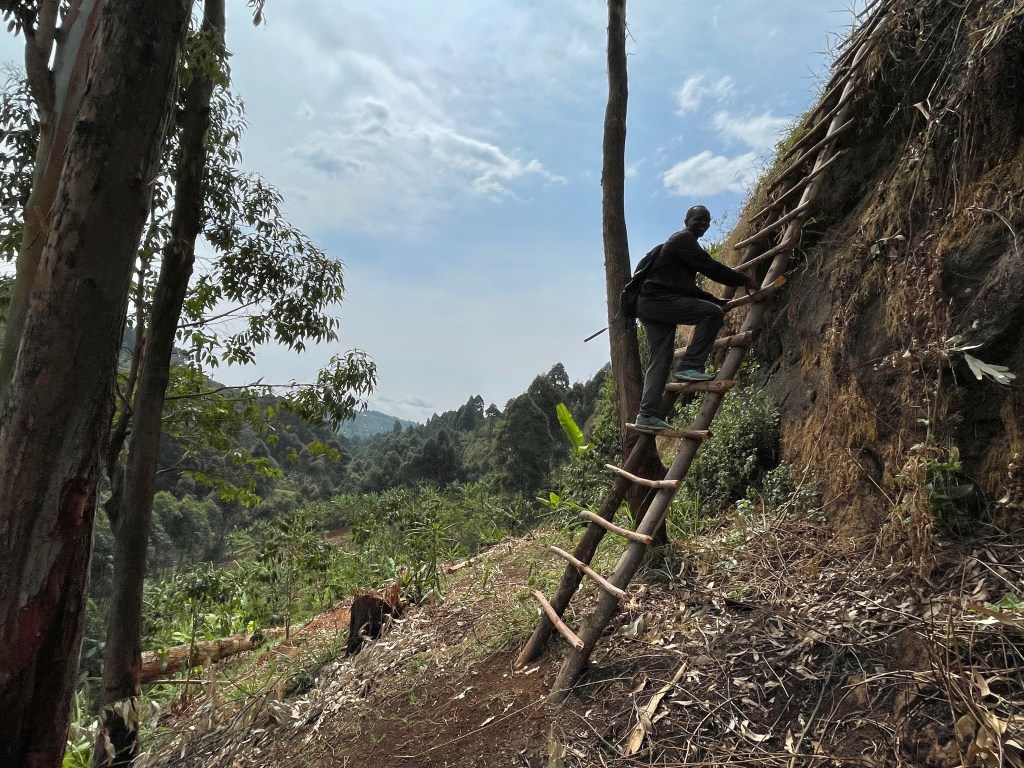
We are high – up around 2000 metres (6500 feet) – in thick green growth, scrambling into steep valleys – one of them 500 feet deep – and up the opposite face, including shinning up a 30 foot rickety wooden ladder. We puff up slopes towards the clouds, always a hill in front. A chapati and disgusting soda bring some energy back on our now hot walk – perhaps about 34 degrees. Dust from hoed cabbage fields fills our dusty shoes; the equatorial sun, just one degree and nineteen minutes south of us, blazes down – and the hills are mysteriously always UP.
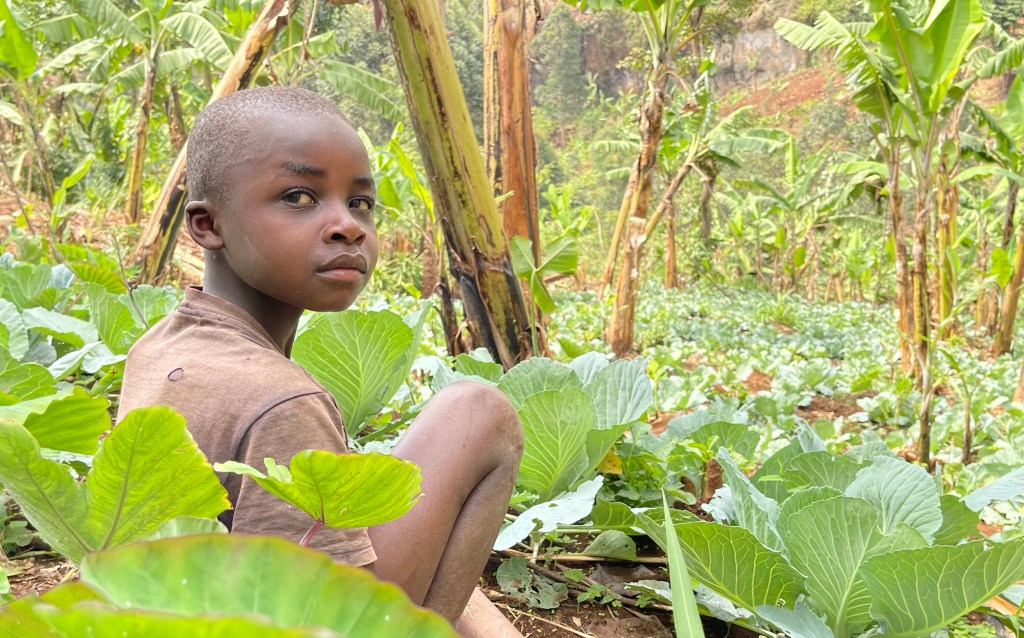
I shake at least 250 small black hands; wave at a thousand more lively children in this land with half the population under 14 years, so about 25 million children. They’re so HAPPY to see me. I love it. I’m constantly charmed by all these excited small people. Teenagers giggle, old men salute in a gesture of equality. Leonard introduces his sisters – but then I remember that Leonard is one of 64 siblings. Yes, sixty four… Ten ‘wives’ for his father. “My father was circumcised from this village,” he tells me as we walk. ‘Pity they didn’t cut it right off’, I think. We meet elderly women, probably Leonard’s relations, who must be so legion that my mind boggles, coming from interminable church services of the business pastors. They greet and welcome me.
Eighteen – EIGHTEEN – children at one – ONE – home scramble down an embankment to shake my hand, dragging reluctant tiny siblings to greet their first mzungu. “They’ll be proud at school tomorrow!” laughs Leonard. “They’ll be boasting that they touched a mzungu!”
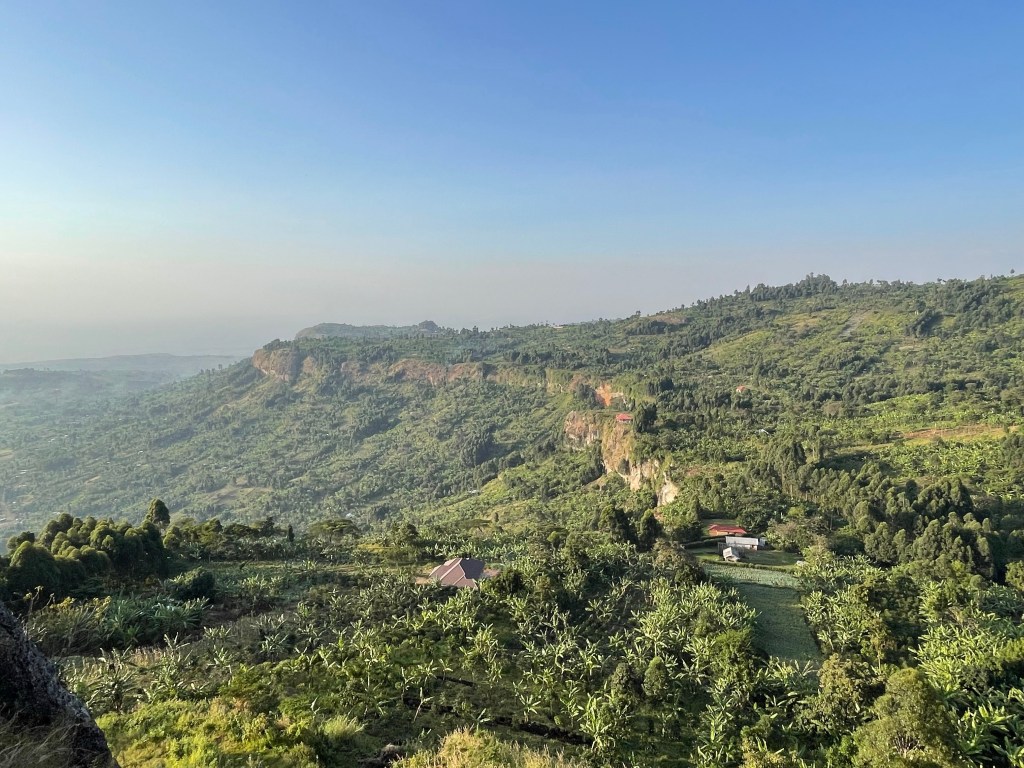
We turn downhill – it seems unusual on this hike – between matoke trees and extensive coffee bushes: this is coffee country. There are small earth, stick and corrugated tin homes everywhere, hidden amongst the shambas. Children everywhere. Goats, chickens, cows. Eucalyptus trees touching the sky. We’ve walked this way before – two years ago. I am recognised. “Eh, your mzungu is old! Get him a boda!” Huh.
Then, a light amongst the thick growth. By now we’ve walked not less than twenty miles. I feel almost superhumanly fit and healthy. It’s kind of worrying! Maybe I’m like the opera consumptive, fooled by the ecstasy of health based on an underlying frailty of old age? It doesn’t FEEL fake though! I really AM able to clamber up these 2000 metre high mountain slopes and keep going at a good lick with a couple of men less than half my age. I’m taking no medication, often out-walking young men a third of my age (Joshua admits he had to lie down and rest after our walk the other day, and Eric says he’ll never walk with Alex and I again!). I reckon sunshine, altitude, exercise and unprocessed food are a pretty good medicine, without the pharmaceutical con job.
The light between the trees becomes the lip of the astonishing cliffs that surround these great shoulders of Mount Elgon. Then there’s that endless vast void, the limitless view across central Uganda. It’s hundreds of feet below and stretches as far as the eye can see – and the haze can reveal. The sun’s lowering, shadows revealing details that the overhead equatorial brilliance flattened all the hot day.
The lip is dramatic: one false step on this dry grass and you’d be jettisoned into the two hundred feet of empty void, then the thousand feet of unstable, matoke and scrub-filled steepness – down to where, they tell us fifteen minutes later, Doreen and her rather many children have been watching us descending the giant steel ladder.

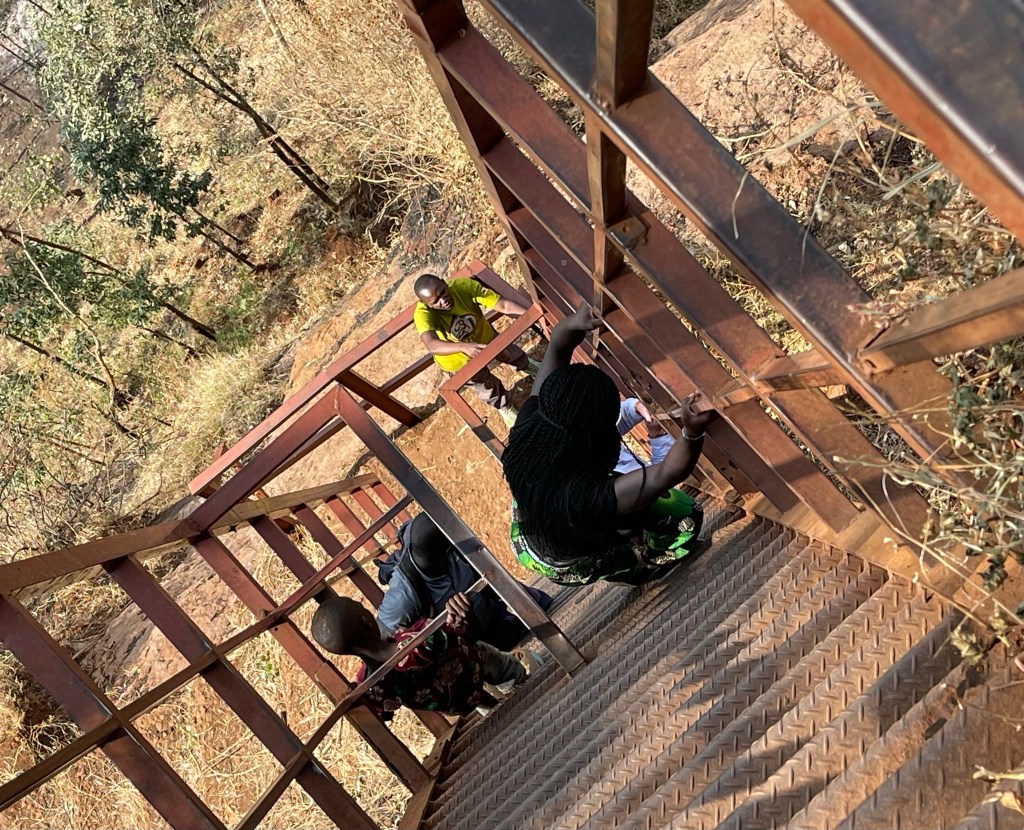
We’re old hands at this ladder, Alex and I, and Leonard lives at the bottom of it. We sprint down its 143 steep, steel steps, and slither down the dry mountainside to the red dirt road winding in the vast landscape below. I feel SO healthy! I’m hiking with two men half my age, and leading down these slopes. I DO go a bit more warily than I used to, but I’m having such a great day, with good companions. Waiting at the bottom, hundreds of feet below, Doreen has produced – this being Africa, where hospitality is paramount – (even given the reservations of former paragraphs) – a meal of rice and goat meat and homegrown coffee. I can only make a gesture. I still have to ride us on the hilly dirt roads home.
We’re caught by rain on the way home. This is not a time for motorbiking in the East African highlands.
As I write, Alex WhatsApps me to say: ‘Good morning, JB. All is well, but still so fatigued and looking sick! Haha. That was challenging walk. Thank you for spending most of your time with us during this visit. Thank you for the children! Thank you for the money. Thank you for being part of our day to day living. Take good care of yourself. I was just thinking about you being a good father!! I miss you already…’
I respond: ‘Now buck up about being fatigued! No point giving in, my mother always said. Half my age, and I’d do it again today!!’
I would too.
****
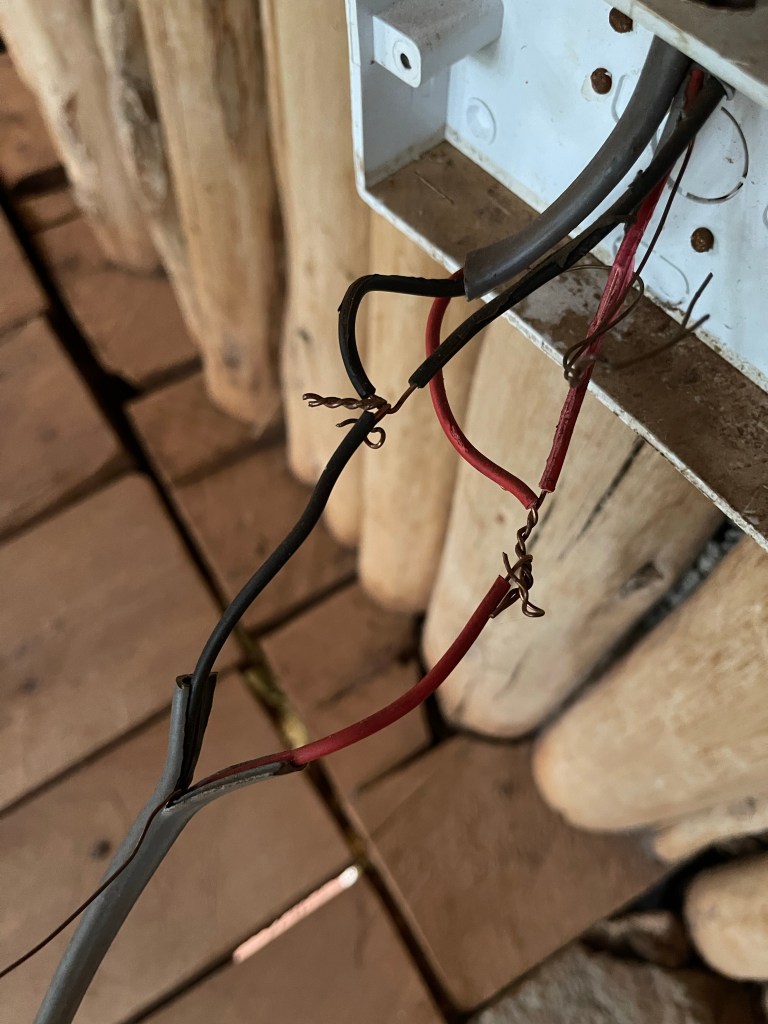
No one has any concept of the dangers of 240 volt electricity, unguarded motors, chain saws, gas bottles, petrol – or any of the things we stress about with our attention to H&S. The other day, I found the new 45 kilo gas bottle, for use with the new cheap gas cooker from China (itself a danger to life), in the kitchen beside the open wood range. Shocked, I had a rant and told Alex to buy 7.5 metres of gas pipe so I could connect the bottle to a point well beyond open fires.
Of course, I should’ve known… At the shop in Kapchorwa, no one had a tape measure.
Instead, they spanned the length, stretching their arms wide and saying to Alex, “That’s two metres – four metres – six, and nose to fingers one metre, plus a half! Two metres per span…”
Alex is not at all practical. The average Ugandan is about 175cm tall. If that.
The ‘seven and a half metre’ pipe that Alex brought home was 5.7m long! God, working here is frustrating. I had to get Moses to build a brick platform to raise the gas bottle to reach the end of the bloody pipe! Just as well a scenery designer is adept at making compromises with what he has.
****

On the 2nd, we went to visit the children at their smart new school. We miss them so much about the compound at home, but local schools are pitiful and this boarding school, 30 miles away is the best in the region.
Last January, my old neighbour Betty, died in Devon. The ‘mascot’ of Harberton and friend to all; a woman always positive about life, even as her disabilities increased in her 97th year, she was a popular villager and became a fond friend. She took delight in stories of Keilah and Jonathan, sending them Christmas cakes and listening to their shrill songs of thanks on my phone. She couldn’t see well enough to watch their antics, but loved the glee in their high-pitched childish voices.
On my return from Africa last year, after Betty died, her son presented me with a plastic cake box wrapped in a doily, on which was written in a shaky hand, ‘For Jonathan with love from Betty’.
‘Crikey,’ I thought, ‘this’ll be stale!’
Inside, the box contained, not stale cake, but one hundred ten pound notes, carefully secured by a rubber band. Saved from her pension. I was very touched and understood her tacit hope was that her gift would help my ‘grandchildren’ in Uganda.
I used Betty’s money to pay the registration, uniforms and first term’s fees for the two children she’d loved to hear singing, at one of the best schools in eastern Uganda. Of course, I get to pay the rest..!
They love their school; are thrilled that it has a small swimming pool (“I don’t even know where to buy Keilah the swimming costume she wants!” laughs Alex), and have already made many friends. Seeing Uncle Jonathan arrive, Keilah came racing like a cannonball across the school yard.
We got them exeats from the administrator and took them out for ice creams and chips, for our enjoyment at least as much as theirs. I DO miss those two, and won’t see them for eight or nine months.

Some days later, Alex had cause to ring the matron at school. She asked Keilah if she wanted to talk to her father. “No, Daddy will be busy with his guests. I don’t want to disturb him. I’m reading my book.” A confident little girl.
****
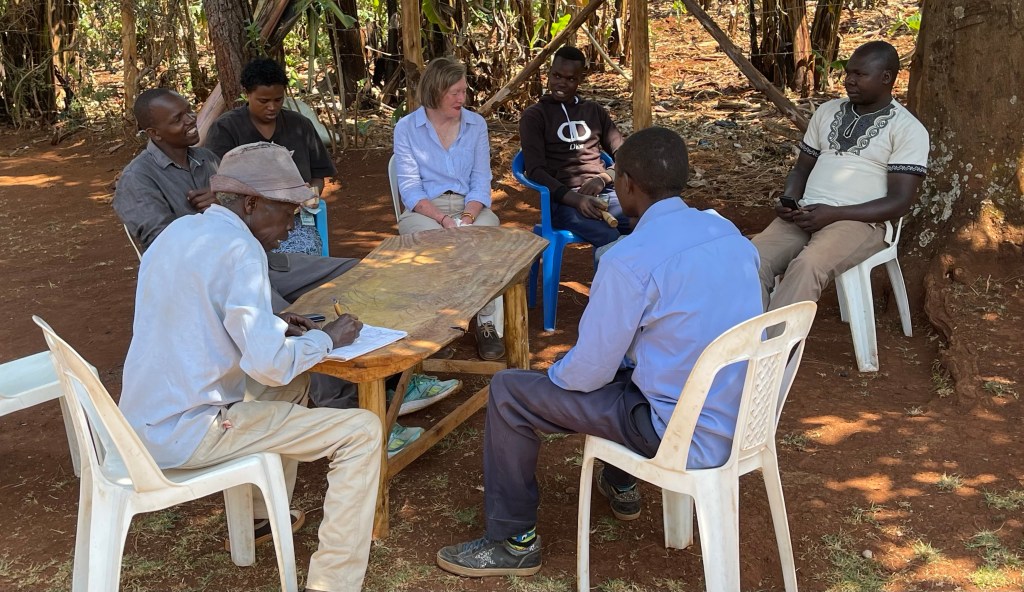
We suffered two more disco funerals this past couple of weeks, and sealed the land deal for the coffee plantation at Chelel. Representatives from the clan, the district council and the sellers gathered to formally exchange the final payment under the avocado tree at Rock Gardens. One elderly man, an ex school teacher, drew up a document in the dusty exercise book in which Alex records his land purchases (six plots now). Everyone witnessed the somewhat scrappy document, including a number of biro-inked fingerprints in this poorly educated neighbourhood. Debra, the lawyer, got photocopies and insists on Alex getting the titles to his plots – another large expense, but a wise one. Copies of the papers will be lodged in a lawyer’s office in far away Melbourne!
****
You’ll want to hear the outcome of my Mosquito trials and tribulations… While I as in Uganda, the Sikh Suzuki dealer in Nairobi did me a very fair and kindly deal: they serviced the bike to running condition, but without the new CDI control unit that it really needs to be trouble-free. Then it was sent back to Kitale. It’s now in Rico’s big garage.
I’ve decided to sell it. After all, I have had seven fun years, but my use of it dwindled as I began to distrust it. And my expenses rose: almost £900 this winter alone. We’ll either sell it through contacts of Adelight’s here in Kenya or somewhat illegally but at a better price, in Uganda, across the leaky border. It will be a popular bike; many riders admire my ‘big’ bike (smallest of the 17 or so bike’s I’ve owned).
Once sold, I will decide on a replacement. I favour a Yamaha 200AG, made as a farm bike and popular in out of the way places like the Australian bush. They appear to retail at about £2600, so if I can raise over half from the Mosquito, I will be happy. All to be decided…
****
Adelight is busy with her construction project. She smartly registered to be a contractor for government building projects. Her first is to complete a two-classroom school building. She’s in the final stages, with not much over a week to go. She’s formed a team of eight men and has already been approved for another contract at the same school. The walls and gate for the four acre plot should be lucrative. Bizarrely though, she has to invest her own money in the materials before she can get payment. This is Africa. It’s the way business is done. For this initial contract, that presents a problem, so I’ve stepped in to lend her a hefty chunk of cash, in the expectation that her – quite big – profit, will provide the capital for the next work. I’ve told her, it’s repayment in May – or my teeth! I’m looking forward to getting shot of the temporary denture forced upon me shortly before travel this winter! No repayment: no new teeth…
Still, if that’s the worst that old age is thrusting upon me, I can’t complain.
Tomorrow, I’m off back to Kessup. I hope the rain holds off for another big hike into the deep Rift Valley. Rain, says the forecast: 2mm tomorrow, 10mm on Thursday, and 0mm for Friday and Saturday. I should get some hiking. Have to keep moving, even as I leave a trail of young men who swear they’ll never walk with me again! Haha!
****
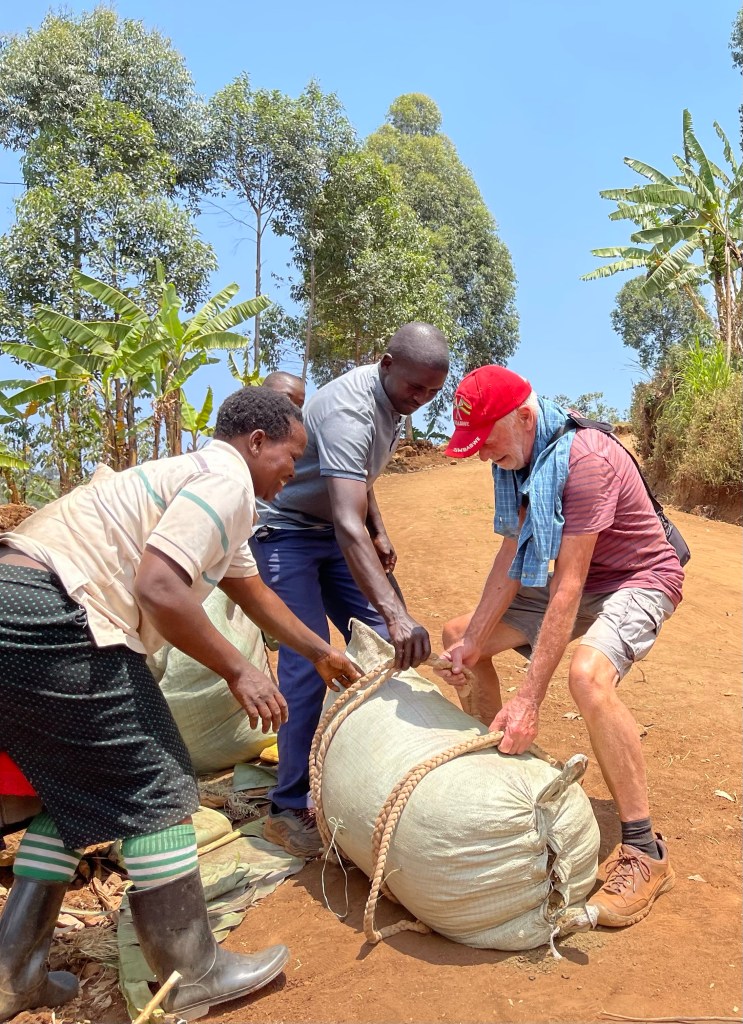
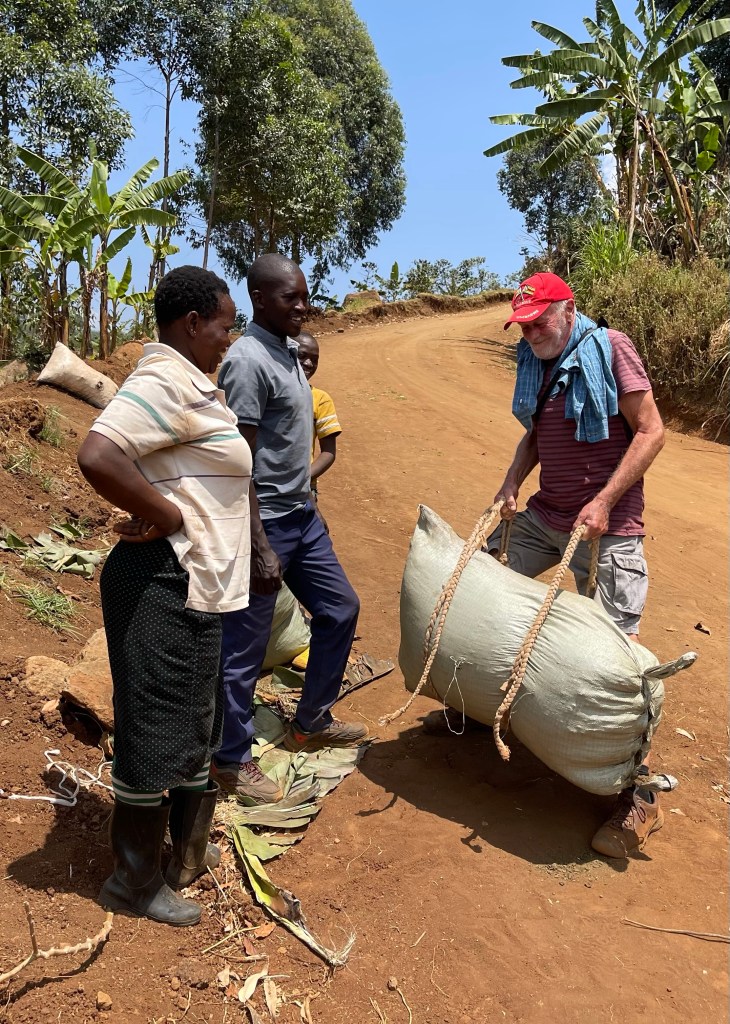
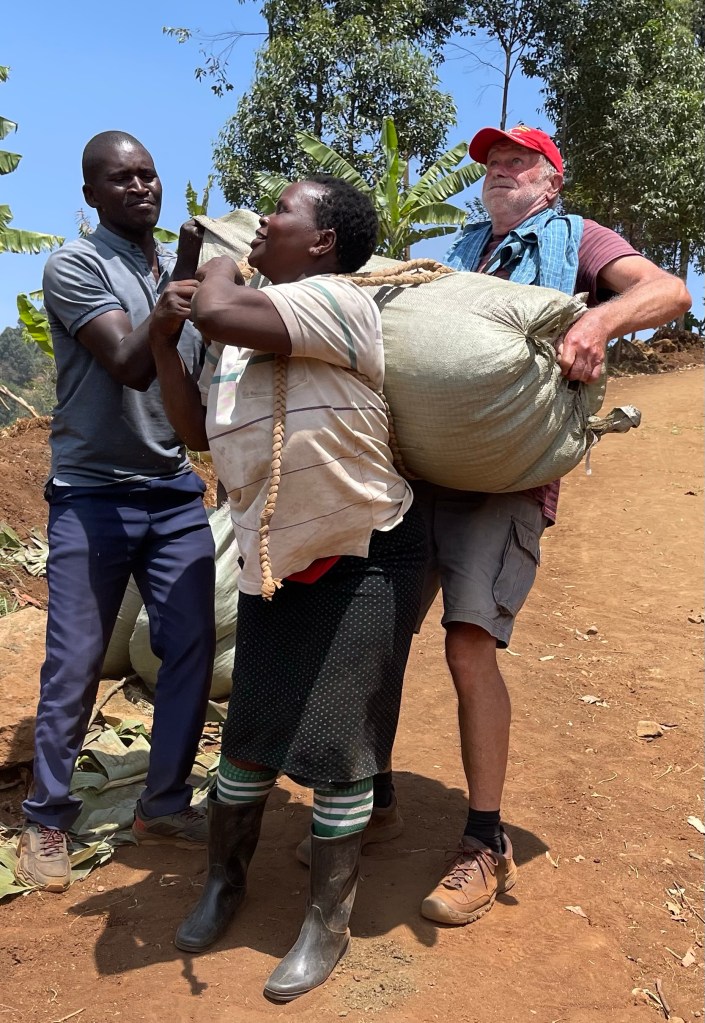
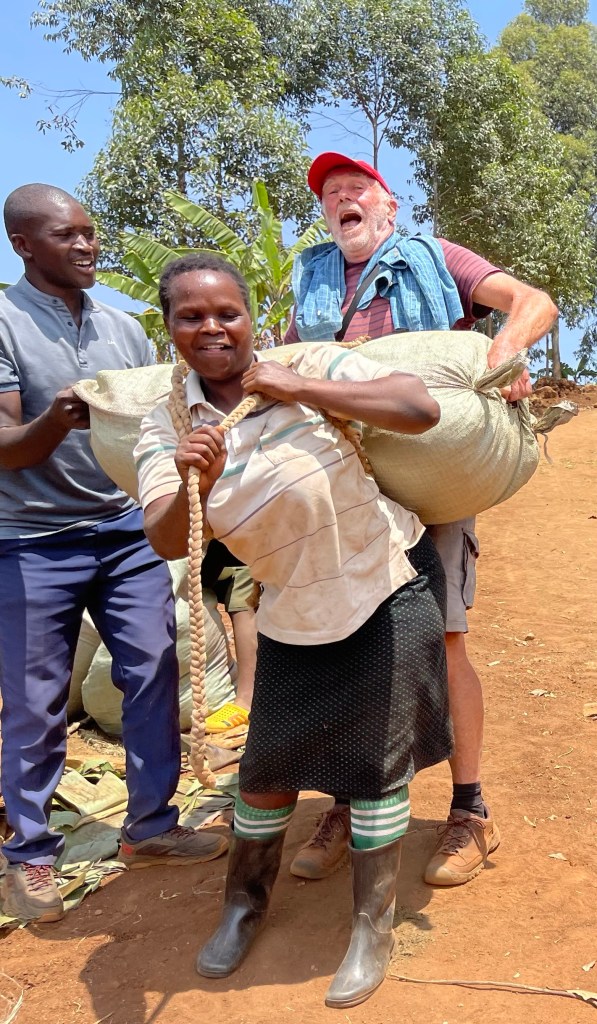
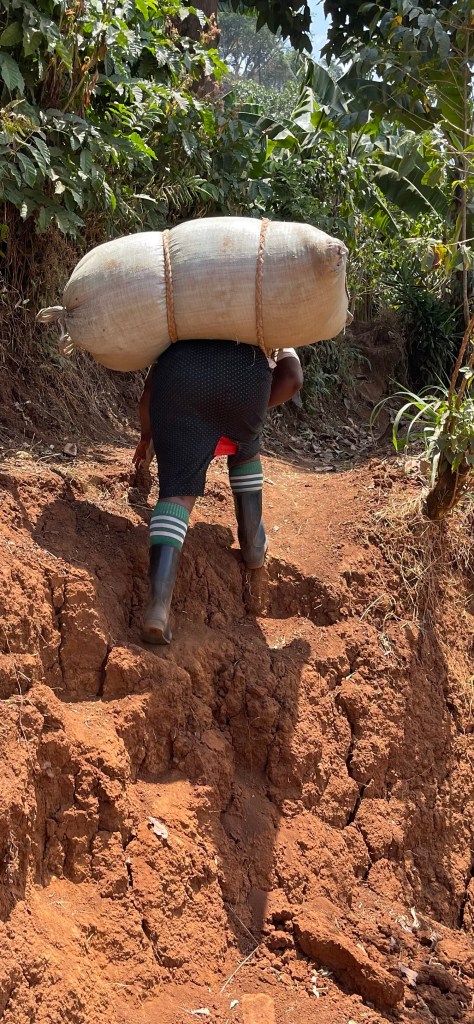
At least I don’t have to work like African women…

 jonathansjourney.net
Jonathan that story about Betty and Keilah and JB is absolutely lovely and a testament to the way you have bridged worlds so beautifully.
Much love
Alice