
IIN WHICH I – WILLINGLY – CHALLENGE MYSELF TO THE HARDEST TRAIL RIDING OF MY AFRICAN TRAVELS, UP AND DOWN THE SIDE OF THE RIFT VALLEY LIKE A HARDWORKING YO-YO
It’s been only a week since I last updated the story of my 2024 East African travels, but I’ve been in such spectacular places – and I’m off back to Sipi, Uganda tomorrow, where I’ll have no internet for a couple of weeks – so I’m going to write about my terrific rides of the past few days.
I’m a biker… There are aspects of that fact that tell so much of my character and tastes: independence; joy of the serendipity of life; absolute reluctance to be confined; love of the tactile nature of being out in nature on two wheels, not ‘trapped’ in a tin-can-car. I relish the ability to go anywhere without restrictions. If my little motorbike can go, I’ll try it!
Thus it was that I found myself on some of the best rides I’ve enjoyed in East Africa this week, and they are all within forty or fifty miles of my base at Kitale, home of my blue ‘Mosquito’.
***
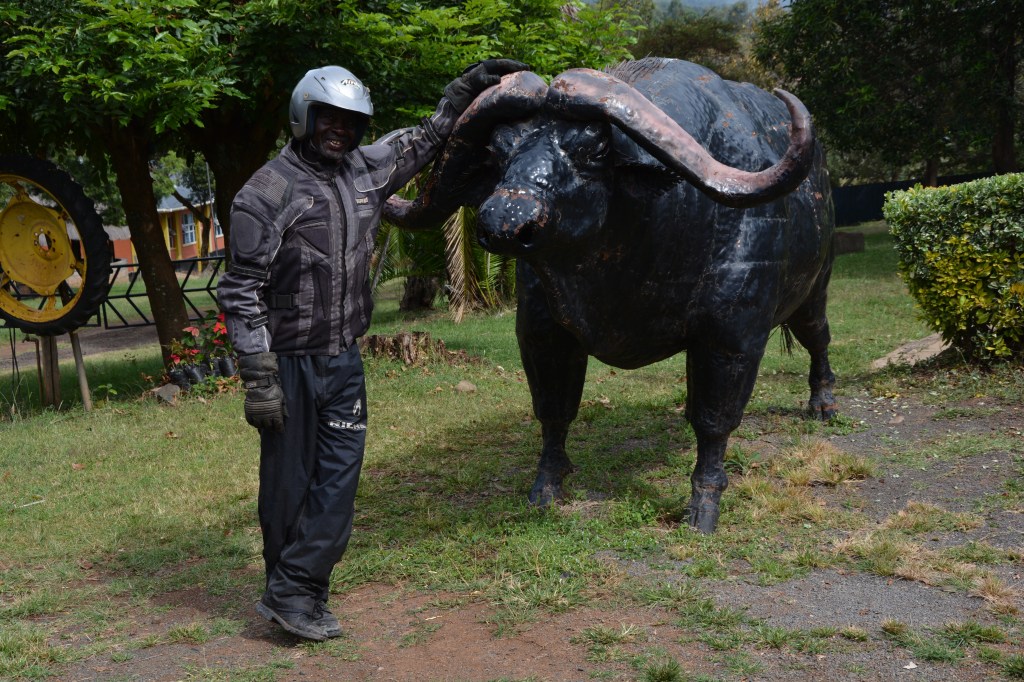
Wechiga left last Sunday, the 28th, from Nairobi. I put him in a taxi at 02.00 to the airport; no point accompanying him there to say goodbye at Departures, I might as well go back to sleep at that time of the morning. He is now a proficient enough international traveller that he can look after himself. He’s practical and easy going and can ask his way when he needs. He had a long journey ahead of him, 05.00 to Addis Ababa, and on later in the morning on the flight across Africa, home to Ghana. He texted at 16.00, that he was in Accra and all well.
It was perhaps a crazy idea to consider that we could meet in East Africa. It could so easily have foundered on bureaucracy or money. The latter, of course, was mine, and I can now despatch money across the world and it arrives in ONE minute! So fast and efficient has the technology become, that World Remit, an alarmingly clever app on my phone, can transmit money from my credit card to a phone of any of my families in Africa in as little time as one minute. Even from a remote village at the bottom of the Rift Valley. I say alarming, as – of course – you still need to cover the funds! It’s so simple to transmit that it’s also easy to forget that it is actual money transferring, not just technical wizardry and a concept…
As for the bureaucracy, well, we managed that too. Even though he was last off the aeroplane that evening he arrived. He’s resourceful enough to cope. I wish Akay had lived to know that her three children all flew out to what she called ‘white man’s land’ over the years. Perry of course studied in London and has been back often as he became a ‘big man’; Wechiga has earned his three trips to Britain and now one to East Africa, through his great integrity and our firm brotherhood; and Gladys, their younger sister, was voted by all her peers to visit Germany some years ago, as representative to a sister church. It’s no small thing that these three siblings have travelled so well – and in no small part the responsibility of their wise, amazing mother, with whom I couldn’t speak – not in words at least, but we ‘conversed’ on other levels in Navrongo; levels that needed no words.
***
So Wechiga departed. I stayed a day to rest up in Nairobi and then travelled back up country by plane to Eldoret and matatu the final 50 miles to Kitale. I just couldn’t face that ten hour bus ride again.
Back in Kitale, Rico helped put a new chain on the Mosquito and a few maintenance jobs necessary after having ridden in some rough places two-up, and on Wednesday, I was off on my own for a couple of days – first time this trip. It’s odd that: for an obsessively independent traveller, I seldom get time to myself to go at will.
But that day I certainly did! I rode back to the Cheringani Hills northwest of Kitale, just a 25 mile ride to Kapcherop, a small straggly town of little appeal, except that it’s my starting off point for rides into the heights of the hills, sitting amidst the highlands of western Kenya at above 7000 feet.

I used one of the new connecting roads that join the deliciously bendy and winding road through the foothills up to the wonderful heights of the Cheringani Highway, the high road that winds and curls above deep fertile valleys, backed by the heights of the mountain chain. Twisting and turning, a big smile on my face – for these are the roads bikers love – I wound and flipped my way upwards. There are four connecting roads, so I chose the new tar one; the others are of varying degrees of dirt and rock (as I discovered upon trying the fourth one on the way home! More on that later). At the top, I turned left on the Highway to approach Murkokoi, a small village of a couple of hundred hardy souls up here at well over 8000 feet, where, despite the equatorial sun, everyone wears old woolly hats and ancient mtumba padded anoraks. I usually have to stop to add a jersey to my riding apparel.
Sweeping round the junction at Murkokoi, an arm waved in excitement, and I saw I was recognised from the tea stop I made here a year ago! There aren’t many white bearded mzungus up here on motorbikes, it has to be said. Daniel is a butcher, with a small wooden booth – surprisingly clean actually – on the corner. A goat carcass hangs in his red and white shack. He must do slow business, here where few can afford the luxury of more than a few pennyworth of mbuzi (goat). So I turned quickly and went back for sweet milky chai and a chat to the gathered men on a plank bench. They moved up to make space and the questions began, as always. Where from? Where to? How old? The motorbike? Which football team? I have the same conversation many times over – but for most it’s their rare opportunity to ask questions and dispel the myths of mzungu life and riches.
“You told me the secret of not getting old is to think young!” said Daniel with a laugh. “You see, I remember!” As I say, not many white bearded old mzungu bikers up here…
From Daniel and his friends, I discover that the road that starts here at Murkokoi is tarred way up into the heights of the ‘hills’. “The tar stops before Tapach,” he says. “Then it’s a rough road, down to Ptop and Parua. From there you can go to Sebit.” I know Sebit is on the main road to the far north of Kenya, up across the vast Turkana Desert to Sudan, the A1 road, now tarred all the way. I went that way over twenty years ago, on my old African Elephant (the BMW 800 at home). It was, I wrote then, the worst road in ALL Africa!
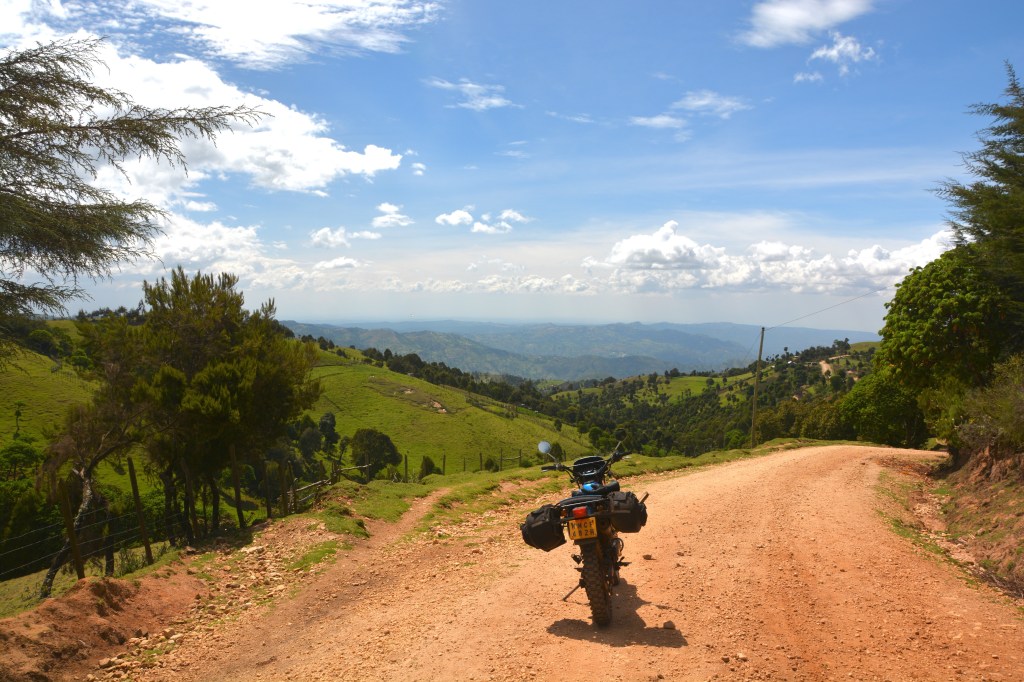
Finishing my sweet tea, a drink I’d normally eschew vehemently, but which here provides energy for the forthcoming ordeal, I throw my leg over the bike – with, it must be admitted, a bit more chutzpah than usual. After all, they’ve all been SO impressed by this antique mzungu who wants to ride their most difficult trails! Off I ride, with a bravado revving of the little engine of my (to my audience) ‘big’ bike.
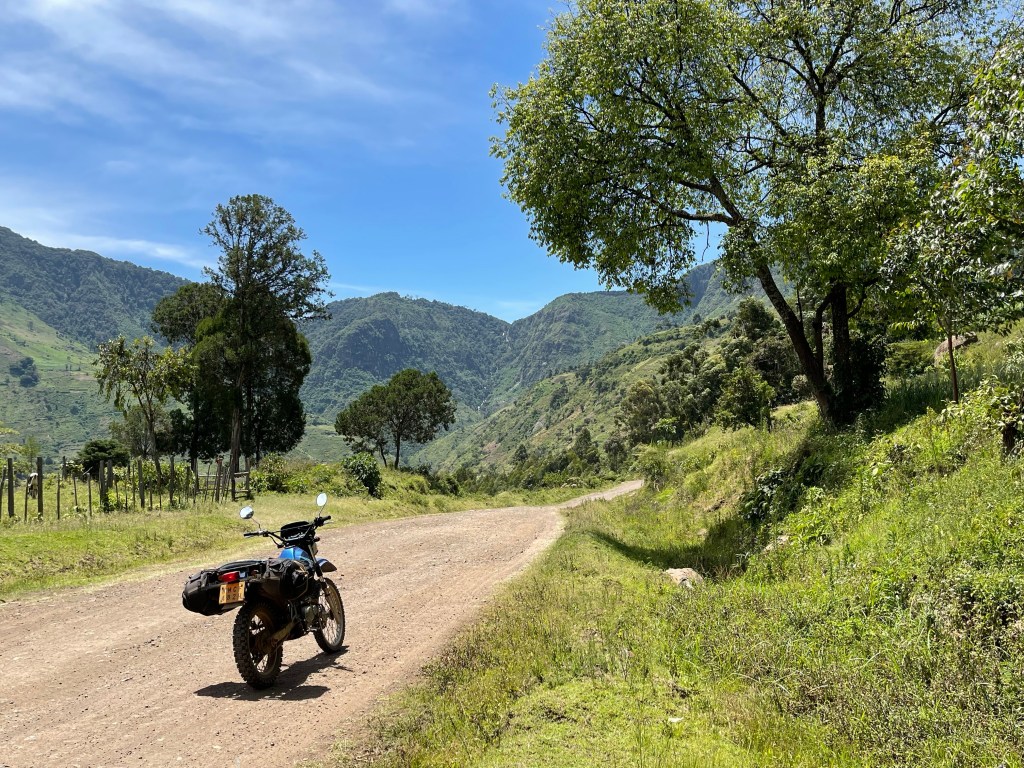
I’m soon climbing at ever-increasing inclines. Way up high, half an hour later, I get out my phone to check the altitude. Way over 9000 feet and still climbing. The tar ends and the red murram track begins. It’s rutted and bumpy, takes concentration. Not easy, when the views that are expanding so widely, are so impressive. I’m in very high country. The road is broken and rocky, patches of dust, protruding rocks, always those pesky sheep and goats to avoid. Not so many cows right up here. I bet it’s cold at night. It’s already chilly. In front is a scrappy sort of place with a big secondary school and smallholdings ranged across the mountain slopes. The air is crystal and fresh. You gulp it in and just KNOW it’s the best you’ll ever breathe. A small junction. Dust and dirt roads in both directions. Everyone wrapped in warm clothes. The sun just burning from the intensely clean sky. A boda-boda rider tells me my way is to the left and down. I check the altitude. My little bike and I have made it up to 10,920 feet! Not absolutely the highest we’ve ridden – that was in northern Ethiopia four years back, over 11,000 feet, but I didn’t have the app then to know. Sadly, looking about, I can’t see any track that’d take me the other 80 feet for a photo! From here, the roads and tracks all head down. The highest of the Cheringani ‘hills’, Chebon, is just 150 feet higher, at 3375 metres, a stones-throw away from Tapach.

We turn and start the descent. It’s going to be a huge drop. In the next few miles, at considerable angles and on broken, dusty, sometimes rocky and sometimes grassy hills, we’ll drop just short of six thousand feet to Sebit and the main road – and then another 2000 feet to my sleeping place tonight. The views are stupendous, contorted and tumbling valleys disappearing into a hazed distance. From up here I can see all Africa, it feels. Rolling away to infinity, small rather decorative clouds tumbling across the incredible blue of the equatorial sky. My smile is broad, people wave back at my cheery greetings. This is as good as biking gets! It’s a challenging trail but SO exhilarating, to be this high, this free and with half the world at my feet.
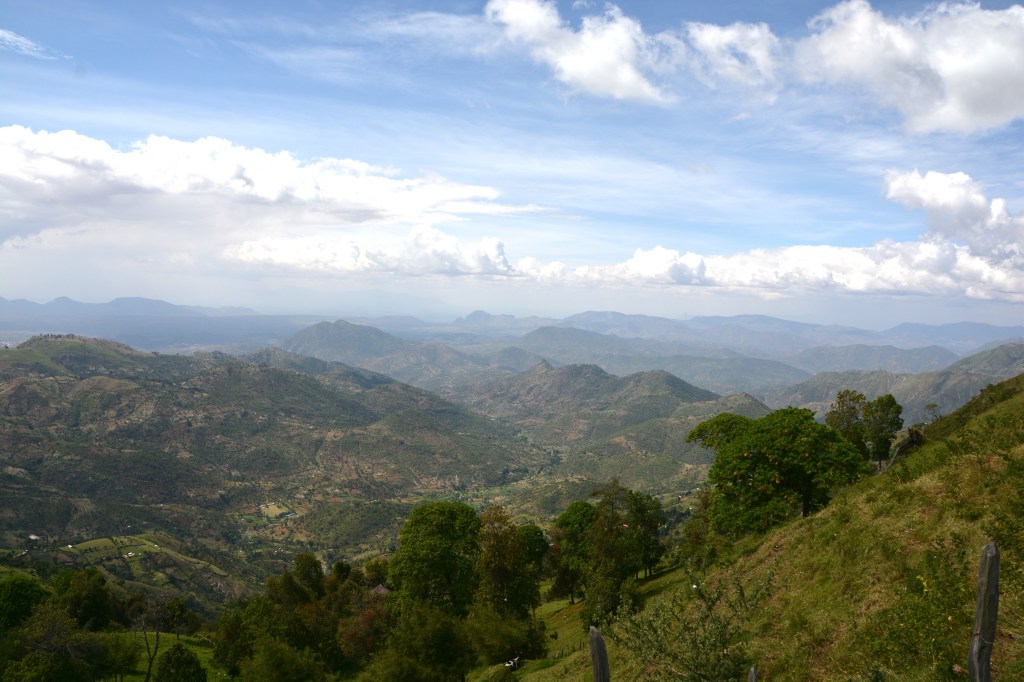
Far far below, I can see the ugly cement factory at Sebit. For now that’s my marker, a horrible wen in the rolling hills and steep valleys, its steel and metal winking up from the glorious scenery. An intrusion. But at least it gives me confidence that I am on the right tracks and paths. In some places they feel dangerously steep. My rear brake’s not doing very well, and a bit of adjustment doesn’t help much, but I need good braking and do much of the descent in low gear, dancing and pirouetting on my footpegs. Great exercise. “Think young,” I told Daniel last year. Well, still doing that!
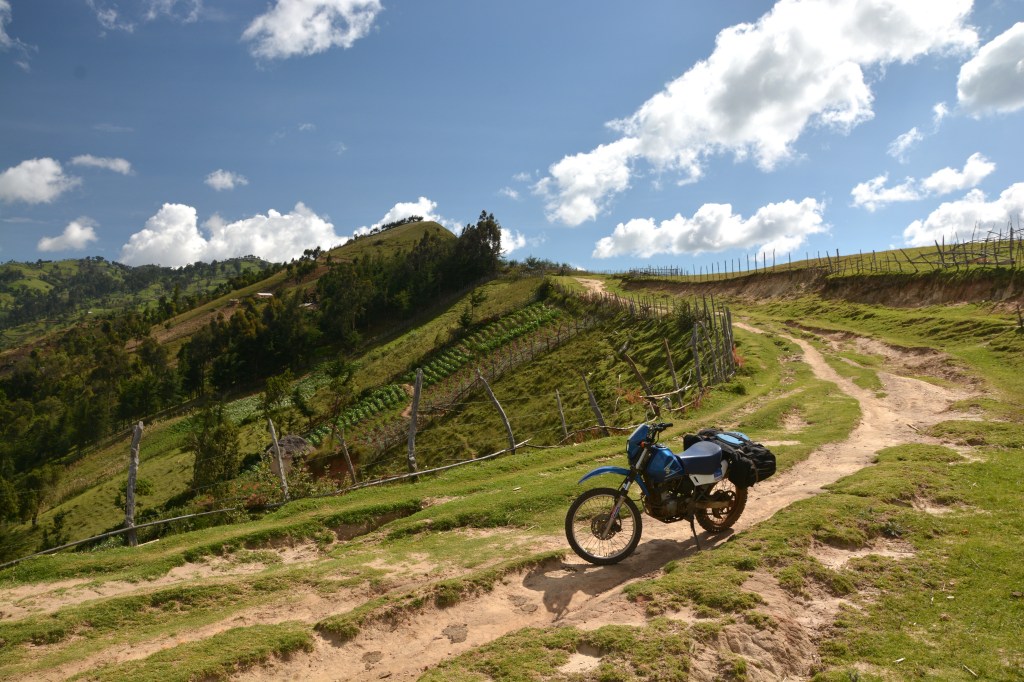
Stopping to take photos, people come to greet me. They are friendly here. One young man wanders from his house near where I am snapping the enormous, apparently endless vista. His house clings to the edge of this hillside. What a view it must have! But he probably thinks more about the inconvenience of getting his crops to market, for these hills are fertile as well as high and beautiful.

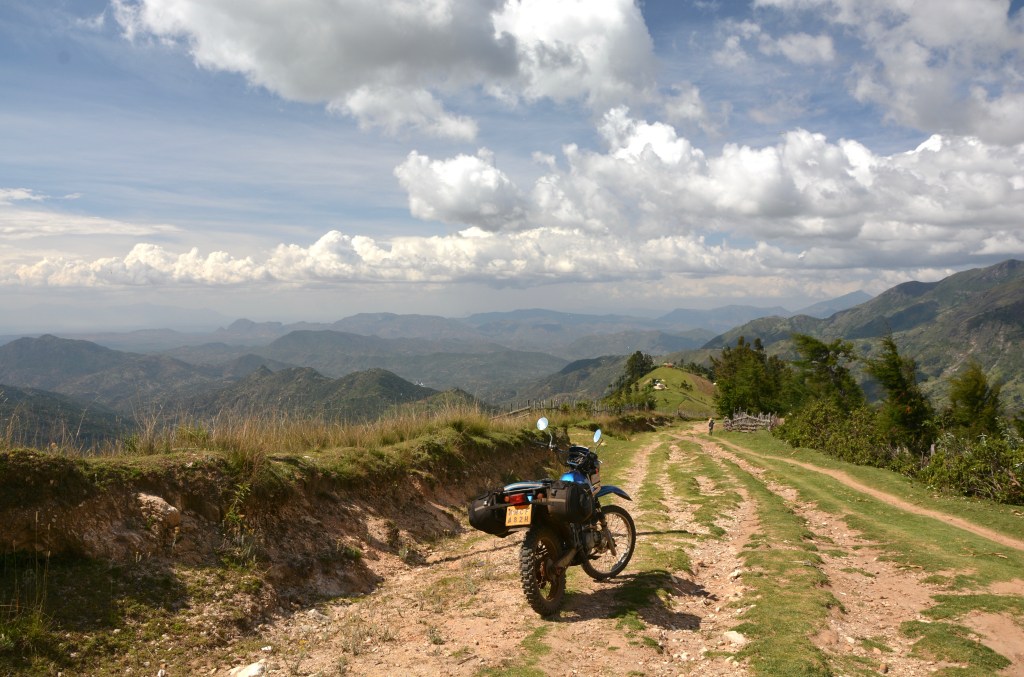
Bumping on down, balancing and weaving, all muscles in use, I feel briefly lost on a REALLY bad path, but it’s still heading down. Steeply. It crashes and bounces over a rocky stream bed and levels out between small farms and countless wandering sheep. Then, at last, with the biggest smile, I am at Sebit. The factory is hideous and here the road’s wet from a recent shower. Sebitians gawp in amazement at the mzee mzungu with the foolish grin. They’ll never really understand what makes us do these apparently pointless things.
From Sebit, I ride the bottom of the gorge that will eventually, in fifteen miles or so, issue me from what feel like great gateposts of the mountains, into the burning northern deserts. Now I’m little more than 3000 feet above sea level (the sea being the best part of 1000 miles away) and the heat has steadily built into the high 30s. Sweaty in my riding clothes, when an hour or two ago, I was pulling on my jumper.
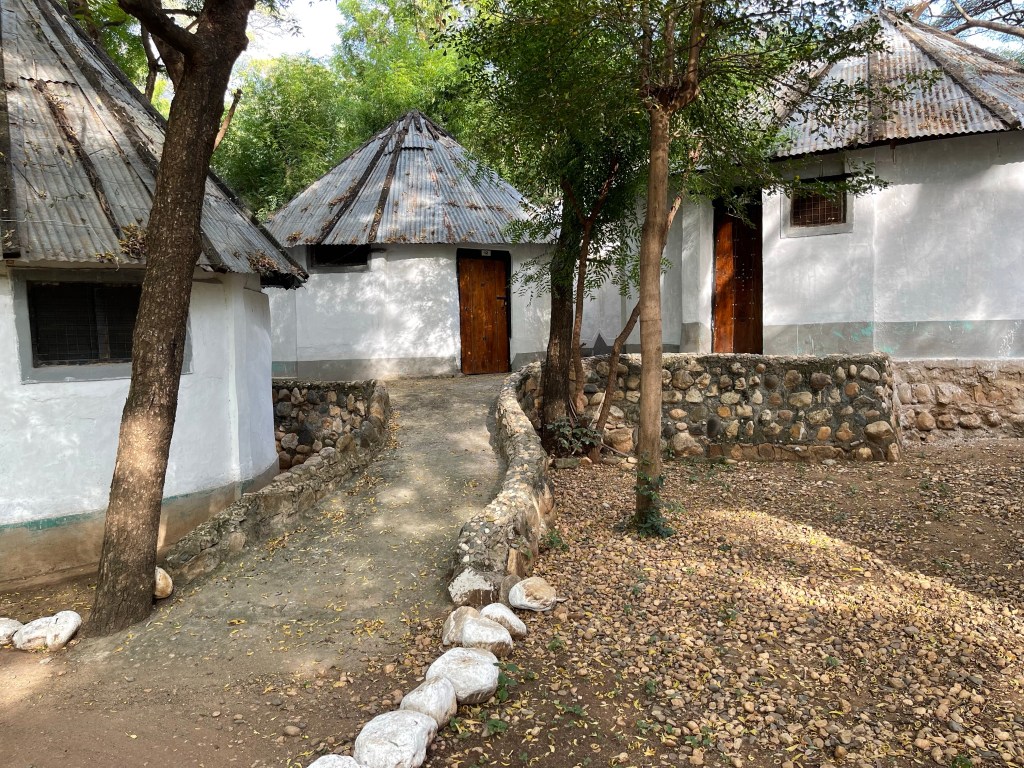
The road disgorges me – literally – onto the flatness of the roasting desert that stretches north to Sudan. Happily, I’m going only a few miles to my sleeping place at Marich Pass, an old campsite with bandas (round huts) started by an English professor, and his Eritrean wife many years ago. I stayed last year and her stepson, Wahid, was restoring some of the buildings. When he heard that I design museum exhibits, he became excited. “Oh, I want to develop some ideas in Khartoum! Are you expensive?”
“Yes, in America I’m expensive, but for a trip to Khartoum, I’d do it for expenses!”
“I can provide you with a motorbike. You could go and visit the ancient pyramids in Sudan. We’ll keep in touch!”
A few weeks after I got home to Devon, all Sudan’s shit hit the fan… There won’t be much interest in heritage designs now – if there’s any heritage left after the battles… You win some and lose some. The Sudanese lost rather more than me.
***
Next morning, after colourful dreams caused as always by sleeping in extreme heat, I was away along the dusty rocky road that circles the base of the great escarpment of the Rift Valley. Just here, the Kerio Valley, that branch of the Great Rift that I’ve come to know and love so much, broadens out into the huge valley. It’s the Rift Valley that contains so much of the desert, going north. Down here, I keep the steep clifflike escarpment on my right for the next few hours, as I bounce and batter my way over the long rock road that would eventually be the one on which William and Wechiga and I walked a couple of weeks ago, that white dusty road that is so boring – and hot – at walking speed. It’s not very interesting now, really. The Chinese have been rebuilding it, but have moved on to a more lucrative project somewhere else, leaving the abandoned bridges and culverts – and rough detours around them.

I’ve ridden this way four or five time, perspiring like a fountain inside my waterproof jacket, motocross trousers, helmet and boots. No shade. In places I have to cross small rivers, and a good run up can provide momentary welcome cooling, but it’s really just a hot punishment, much of the ride today. A certain achievement, but not a lot of pleasure. In the past, I’ve always turned off at the first road that screws itself up to the plateau, 500 feet or so below the rim of the Rift, more than three thousand feet above. I was always instructed to avoid the town and people of Tot, argumentative, aggressive people of the Pokot tribe, known for cattle rustling and gunfights. I suspect, as much as anything, a result of youth with no purpose down here where life is so uncomfortable and unproductive. But now, there seems to be at least an uneasy peace and I have no such warning. Tot, in fact, is so insignificant, I’ve passed it before I realise it was the forbidden township.
A mile or two further along, I turn at a dirt junction and begin what I fondly thought was the tar road up to Kapsowar on the heights. Well, looking DOWN from Chesoi and Kapsowar, there’s a tar ribbon visible twisting downwards. I wasn’t to know that it goes only part-way down and that the rest is as near impassible as anything I’ve yet ridden in Africa! It’s little more than a staircase of rock hacked from the cliffs. Fine for goats maybe, but a big challenge for an old bloke on a motorbike… I reckon it’s the most tiring six or seven miles of trail riding of my life – in the afternoon of a day in which I have slowly oven roasted and broiled, basted by waterfalling sweat! The views down into the increasingly deep valley are stupendous as always, but I have little time to look and little energy to appreciate.

Somehow, I make it to my next tea stop, a small shack at the top of the steepest road of all. Boda riders freewheel down towards the depths, relying on cheap crap Chinese brakes to save their plunge into the valley off the unguarded sides. It beggars belief how these boys ride – young enough to be my grandchildren, but many of them unlikely to survive to have their own if they ride thus. It’s no good telling them. “It’s the way we do it here…” No one EVER learned to ride down even the slightest slope in gear. “We save petrol!” Multitudes of them and their innocent passengers end up in hospitals and graveyards too.

***
There’s a lovely trail that runs along the very rim of the valley for fifteen miles or so. I’ve been planning to take it, but it’s already early afternoon – and I’m absolutely bushed! So I take to the tar roads instead, a longer ride, but almost possible on autopilot, if I watch for the farm life on the roads. Dodging muddy sheep, clipping goats, wayward wandering cows, I pass along new roads back to the old Kaptagat Hotel, that I visit once every trip. I love it for its old colonial gardens, decrepit bungalows from another era – and the fact that Ellen, the woman who runs the dowdy rooms, makes a roaring log fire in my room in the evening. Last night, I sweated at 3000 feet on a hot night beneath a sheet. Tonight, I sleep at almost 9000 feet again, under a heavy Chinese blanket, falling asleep beside a jolly red fire.
***
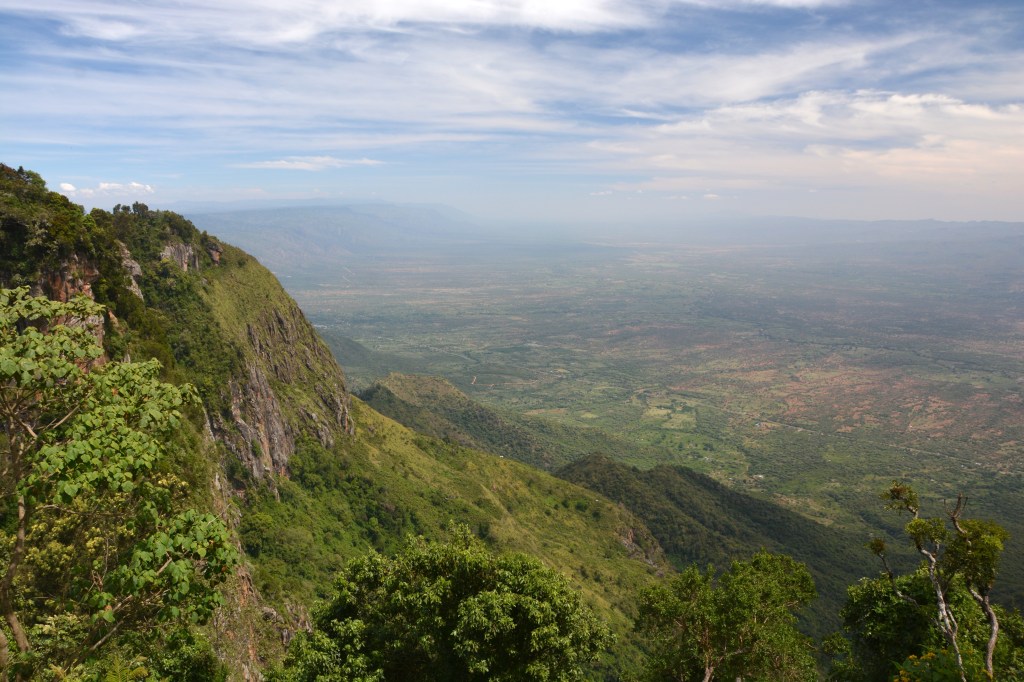
Here too there’s a fine murram road that takes me through the forests of eucalyptus and conifers to yet another newly minted tar road, another one on the rim of the Kerio Valley. I know – and love – all these routes now. The red gravel road’s been graded this year and it’s a fine ride between shady trees this morning, wearing my jumper again, and not starting out from the old hotel until 10.30 when it’s warm enough to ride. Today, I shall ride to Nyaru at over 9000 feet, with pretty bright green carpeted tea estates, and down the winding rock road to Fluorspar, site of sinister old mine ponds, and on down to 3500 feet of burning heat, scrubland and drought, just ten miles down the hairpinning sides of the great valley.

Tea with more unemployed men and youths in a roadside shack under tin sheets like a hotplate. Their womenfolk are busy keeping Africa moving. Next day, walking with William, we come upon a group of young girls, aged about eight to sixteen, combing the hillside for scrap firewood where trees have been felled, and other girls and women bent beneath heavy loads on their backs. I ask a group of girls, “So where are all the boys? The useless boys!” It takes a moment for the girls to register what I’m implying. “Playing… Playing football!” they laugh, but not with much conviction. Nothing changes in Africa, where all the work is done by women. The men sit and chatter uselessly, while their womenfolk strain under loads, do vast family washes by hand, feed the family, harvest the fields, collect the fuel, tend the numerous babies – and often hold down a job as well. My friends who rightly complain of the inequality of the sexes in Europe, wouldn’t want to be born in Africa, where any progress is creepingly, scandalously slow… Kept that way by men and the all pervasive excuse: ‘Tradition and Culture’…’
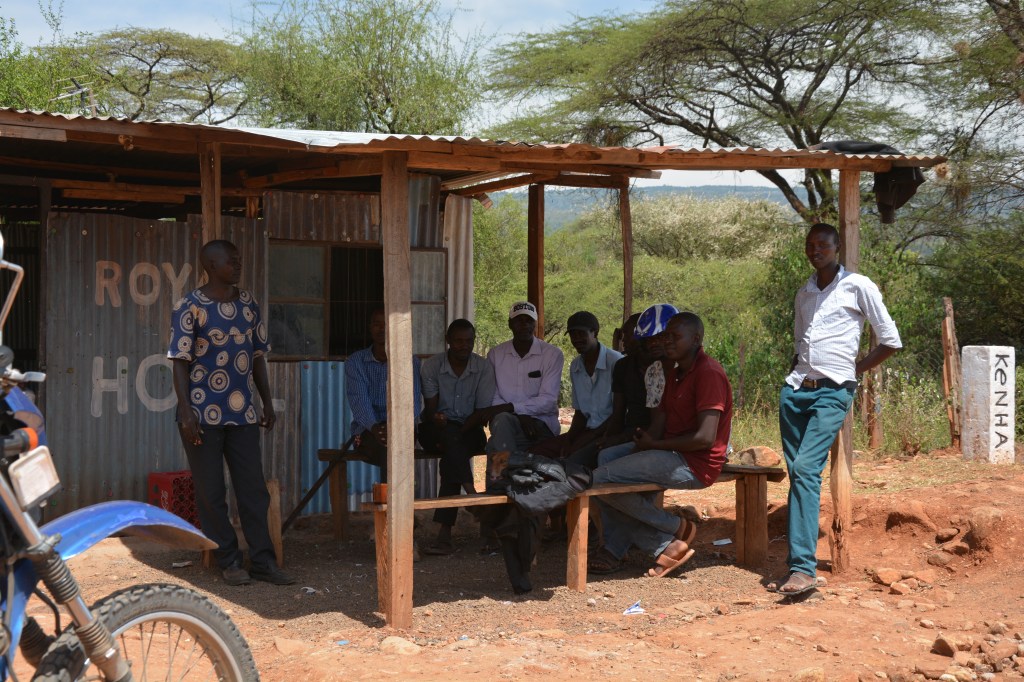
Still, my presence here, drinking sweet tea cooked by the only person actually DOING anything: a woman, doesn’t change much. At least it pays her a paltry 10 pence. All the same questions of course. I have to develop a patience, but once again, how often do these people get to quiz a mzungu? Hardly ever, as most mzungus only mix with their guides and drivers. At least these lazy fellows are interacting with a real white man, not a chimera on their phones. It’s incredibly hot. I’m sweating and uncomfortable, but it’s this interaction I relish most on my journeys.
At last, I excuse myself and set off towards Kessup, which, being 3000 feet higher will at least be more clement for my poor northern body. I buy mangoes from some ladies by the roadside, cheerful and laughing as we shop. For 100 bob – 50 pence – I get ten of the best mangoes in the world – not a shred of that tedious tooth-gap fibre that we associate with the fruits from the East.
***
It’s a welcome cooling ride back up to Kessup, where I’ve stayed so often on its plateau three quarters of the way back up the escarpment that I’ve ridden up and down three times these past three days. I’m ready for an early night in my £7.50 room overlooking the thousand dollar view.
When I reach Kessup, William wants me to greet Dutch, the cow I bought for him two years ago, now pregnant and possibly the beginning of financial independence for William. He’s so grateful that I rescued her from possible disaster this week when he had to call the vet for £12.50 he didn’t have to his name. She had ‘cow malaria’ apparently (!!), and had to have a couple of injections. Too much heat, the diagnosis. She thinks I’m the vet, I guess, as she head butts me, ungrateful animal.
I’ve had three days of extreme trail riding – and it feels like it. One of the things I appreciate most about William is that once he’s had his supper, he gets up and goes! Later, after I’ve filled him with meat and four beers, he excuses himself. I eat the spinach and a bit of meat juice: he gets all the meat. The arrangement seems to work. Once in a while, he gets a proper meal, and I get to meet so many of his neighbours and tribespeople, and understand something of his life and culture.
I need to sleep.
***
Next day William and I walk again, this time starting at the top of the escarpment and mainly walking downhill gently. An eleven mile hike that takes us through pleasant forest, exposes the valley basking below and introduces us inadvertently to relatives he didn’t even know he had. He was born here, it’s home. We stop for water at a remote homestead and it turns out handsome Tina is a friend to his mother and attended his brothers’ weddings, and even remembers William as a boy! It makes for congenial walking, one of the reasons I’ve become so fond of this very impressive area. Scenery’s OK, but it needs people to make it so attractive.

As we walk, I get a call on my phone – no one’s out of reach any more. Adelight. She gives me what I feel is a three line whip about her birthday tomorrow. William says as I ring off, “Heh, I think you’d better go back to Kitale tomorrow!” We’d been going to climb the mountainside again and drink moratina, the honey alcohol, with Leonard again. My sister’s birthday has to take precedence.

***
As if I hadn’t ridden enough tough trails in the past four days, I mistakenly turn off the high Highway to ride back down to Kapcherop. The rain is following me – always present this year, it rained steadily last night in Kessup for some hours. So, thinking to escape quickly to lower, warmer and probably dry regions, I turn at a tar junction I haven’t tried before.
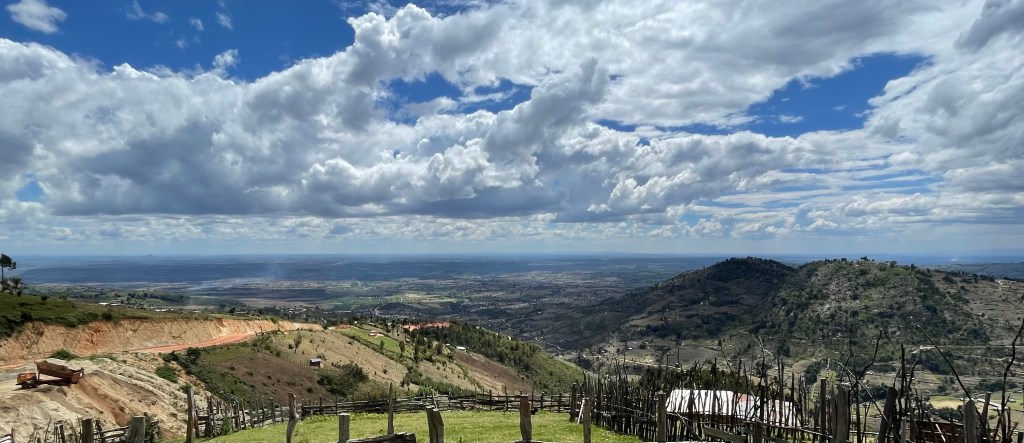
It’s fine for the first three miles or so, just fine… But I should know. The tar ends, I bash and bump and wriggle and dance and pirouette for several more miles, muscles complaining after the rides I’ve had. A VAST view suddenly appears round a corner, the extent of the giant plateau on which Kitale and all these western parts of Kenya sit, dominated by Mount Elgon, just visible in slate rain clouds twenty miles away.
And just to cock a final snook at me, I round a loose earthy corner and find the road builders carving their way upwards. It’s ghastly, the next four miles or more: wet mud, newly spread earth, contractors’ vehicles grinding about in the mess, and THE steepest road I’ve witnessed! It’s surely beyond safety limits, this at present packed earth road – with obstacles? How will clapped out vehicles ever make it up these inclines? How, for that matter, will I make it DOWN them now? It’s tentative stuff. Alarming.
But – of course – it’s fun too. I’m a biker. For 45 years I’ve sought out these tough roads willingly and enthusiastically! Never too old to enjoy a challenge!
***

I’m back for Adelight’s birthday. She roasts chicken in the barbecue, has a few friends and their children for the evening. Marion joins us from Eldoret, and her friend Sharon. It’s a jolly evening with some wine to celebrate. She’s glad to see me home. “You were one person I had to have here!”
***
Tomorrow, I return to Sipi to decorate the new round house and direct some building operations amongst perhaps the world’s most inept, uncaring building workers. Each man will only come for a day, oddly not returning the next day to work with the mzungu who expects them to work tidily, clean their tools, clean the site at the end of the day – and not to steal what few tools we have. No, they don’t often come for a second day. Alex laughs. Even Tom, his carpenter/ wood butcher (who should stick to making his well designed tree trunk furniture, that he does well), with whom I’ve developed a sort of prickly friendship, asked Alex last time I was there, “Will JB be here on Monday?” When told yes, he responded, “I’ll come on Tuesday!” Haha.
Anyway, Sipi, Uganda tomorrow. I hope I get a bed, not that bloody tent once again…
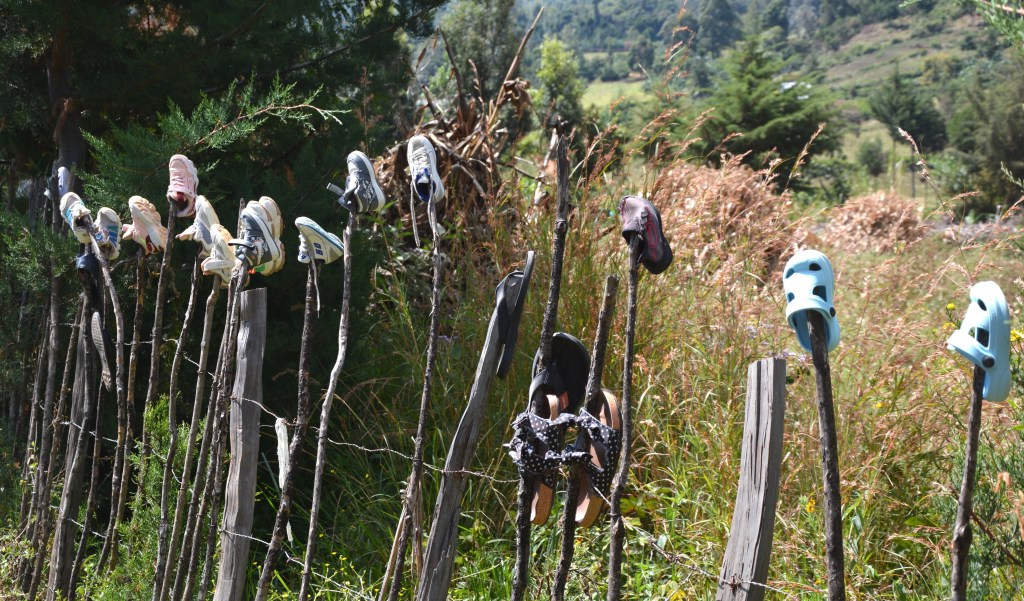
Family shoes
 jonathansjourney.net